


Introduction: What to Decide First When Implementing a VMI and Consignment Inventory System
Factories considering a VMI and consignment inventory system tend to face the same set of problems at once. At month-end, supplier invoices do not match the plant’s own issue records, and reconciliation and variance adjustments take days. Replenishment is left to the suppliers, and both shortages and excess stock occur. Consigned items sit on the shelves unused for months, and nobody has decided who will take them over. On top of that, the accounting team keeps asking: “When is the tax invoice issued, and by whom?”
In this article, we take the view that what you should decide first when implementing a VMI and consignment inventory system is not the screens or reports, but the following three rules.
- Ownership transfer point and risk allocation: Does ownership pass at receipt, at issue or consumption, or after a set period? Who bears loss, damage and obsolescence?
- Consumption recording and settlement flow: What counts as consumption, and when, at what unit price and with which document is it paid? Treat the ERP settlement statement and the Thai tax documents separately.
- Replenishment and aging rules: Who sets the min/max, and who replenishes? What do you show the supplier? What is the maximum consignment period, and what happens at expiry, including buyout?
Alongside these, you decide the price master, the stock categories and the division of responsibility for stocktaking at the same time, because these three are prerequisites for rules 1 to 3.
Major ERPs offer many of these as configuration settings. However, the depth of support differs from product to product, and anything not agreed in the contract cannot be configured. That is why this article follows the order “decide it in the contract, then either hold it in a system function or cover it with reports and operations.”
A note before we begin. This article is not a product recommendation or ranking. Product functions are presented as described in each vendor’s public documentation. The cost and benefit model uses hypothetical figures prepared for this article. We do not draw conclusions on Thai VAT, tax invoices or the relationship with BOI privileges. We recommend confirming these with your tax advisor and the BOI before signing any contract.
Why Thai Factories Are Revisiting Consignment Inventory and VMI Now
Thailand’s vehicle production and Manufacturing Production Index both exceeded their year-earlier levels in August 2026. Each figure, however, has a limited scope. To avoid applying them directly to your own situation, we review them with their sources and scope.
According to Trading Economics, August vehicle production announced by the Federation of Thai Industries (FTI) on September 28, 2026 was 124,646 units, up 10.93% year on year. According to MarkLines, the FTI explained that higher production of passenger BEVs and of pickups for export contributed. These are figures for finished vehicle production and do not directly indicate order volumes at parts plants.
On the Manufacturing Production Index (MPI), according to a Reuters article, the August 2026 figure announced by the Office of Industrial Economics of the Ministry of Industry on September 30 was up 4.44% year on year. The head of the office explained that the ministry revised the MPI calculation method, adding new electronic products and changing the weights. According to Trading Economics, this revision also changed the July figure from its pre-revision published value. When comparing with past months, you need to compare revised figures from the same source.
It is also worth looking at Japanese companies in Thailand. In the Japanese Chamber of Commerce, Bangkok (JCC) business sentiment survey for the first half of 2026 (released June 30, 2026, 504 responding companies), 36% of companies cited “review of inventory management and logistics arrangements” as a response to uncertainty over the Middle East situation (multiple answers allowed). This answer refers to reviews of inventory and logistics in general. It is not the share of companies planning to introduce VMI or consignment inventory.
In this article, we consider that when production figures are moving and logistics uncertainty is on people’s minds, how to prevent shortages of key parts and how to organize inventory holding tend to become issues. Consignment inventory and VMI are among the options.
What Is Consignment Inventory, What Is VMI: Differences and Combinations
Consignment inventory: a question of ownership
Consignment inventory is about who owns the stock. SAP’s learning content explains that consignment is a state in which items provided by the supplier are stored in your own warehouse while ownership remains with the supplier, and that a liability to the supplier arises only when items are withdrawn from consignment stock. Microsoft’s documentation likewise describes consignment inventory as inventory owned by the supplier and stored at your site, with ownership taken over when you are ready to consume or use it. Oracle’s documentation explains that ownership transfers at the point the production organization uses the material, and calls this consumption.
On Japanese shop floors, this is sometimes called “deposited inventory” (yotaku zaiko). In this article, we use consignment inventory to mean stock that remains supplier-owned while held at the buyer’s factory or a nearby warehouse.
VMI: a question of replenishment responsibility
VMI is about who manages replenishment. According to the APICS dictionary definition quoted in a MONOist article (October 23, 2015), VMI is an arrangement in which the supplier views the customer’s inventory data and is responsible for maintaining the inventory level the customer requires. Infor’s documentation describes VMI as an arrangement in which the supplier manages the customer’s inventory, and notes that in some forms the supplier also handles supply planning, while in others the customer manages the inventory and the supplier handles supply planning only.
Combinations and supplier hubs
These are two separate axes. Replenishment can be managed by the supplier while the stock is owned by the buyer. Conversely, the stock can be supplier-owned while the buyer directs replenishment.
The same MONOist article explains that what is generally called VMI in Japan is an arrangement in which the supplier replenishes stock into a warehouse designated by the customer and holds it as the supplier’s asset until it is shipped out. It contrasts this with the APICS definition, in which the stock is the customer’s and the supplier can invoice at the time of replenishment. In other words, a “VMI warehouse” as the term is used on Japanese shop floors can be understood as often combining replenishment management with supplier ownership of consignment stock.
Infor’s documentation gives, as an example of “full VMI,” an arrangement in which the supplier handles both supply planning and warehouse management and owns the goods until the customer consumes them. In the example, the supplier delivers once a week to a warehouse on the customer’s premises, and the customer becomes the owner when the supplier issues the goods and moves them to the production plant.
The boundary with customer-supplied material
A similar term is customer-supplied material, which runs in the opposite direction. Here, material owned by your customer is held and processed by your company. The owner is the customer and the holder is your company. This article covers the design for the side that holds supplier-owned stock. Design for customer-supplied material is covered in our article on implementing a customer-owned material control system.
Who Does What: Three Questions on Warehouse Management, Replenishment Planning and Ownership
Infor’s documentation organizes VMI scenarios around three questions. Who performs warehouse management? Who performs supply planning? Who is the financial owner of the items? It explains that in LN you must define the responsibilities of your company, the supplier and other parties.
| Question | If your company handles it | If the supplier handles it | What to agree in advance |
|---|---|---|---|
| Who performs warehouse management? | Your warehouse staff handle receipt, storage and issue | The supplier or its contractor manages stock on your premises or at a hub | Who records receipts, who records issues, who manages locations |
| Who performs supply planning? | Your company sets min/max and replenishment quantities and instructs replenishment | The supplier looks at stock and requirements and raises replenishment | How min/max is set, review frequency, data to be shared |
| Who is the financial owner? | Ownership passes to your company at receipt | The supplier owns the stock until consumption or until a set period elapses | Transfer trigger, settlement cycle, handling at expiry |
The combination of answers to these three questions defines the pattern. For example: warehouse management by your company, replenishment planning by the supplier, ownership with the supplier until consumption. In this article, we consider that in the arrangement “place supplier-owned parts in a corner of the plant and settle what was used at month-end,” there are cases where only the ownership question has been answered and the other two are run without clear agreement.
Infor explains that ownership in many cases passes when the customer consumes the stock, but that there are other transfer points defined by contract. The third column of the table lists items to agree in the contract before configuring the system.
Overall Functions Required in a VMI and Consignment Inventory System
Based on the discussion so far, here are the functions the system needs. A single ERP will not necessarily cover all of them. We assume they will be met by combining the ERP, a supplier portal, EDI and reports.
| Functional area | Main content | Related rule |
|---|---|---|
| Receipt and stock categories | Receive consigned items separated by supplier. Hold quality inspection and blocked statuses | Prerequisite (stock categories) |
| Consumption and ownership transfer | Configure what counts as consumption and transfer ownership on consumption. Handling of reversals | Rule 1 |
| Settlement | Aggregate consumption and create settlement statements or consumption advices. Pull unit prices from the price master | Rule 2, prerequisite (price master) |
| Replenishment and visibility | Hold min/max, show stock and requirements to suppliers, send alerts at thresholds | Rule 3 |
| Aging management | Track days since last movement and the consignment period, and extract items reaching expiry | Rule 3 |
| Stocktaking | Define who counts consigned items and how variances are processed | Prerequisite (division of stocktaking responsibility) |
| EDI and portal | Exchange stock, consumption and invoicing information with suppliers | Rules 2 and 3 |
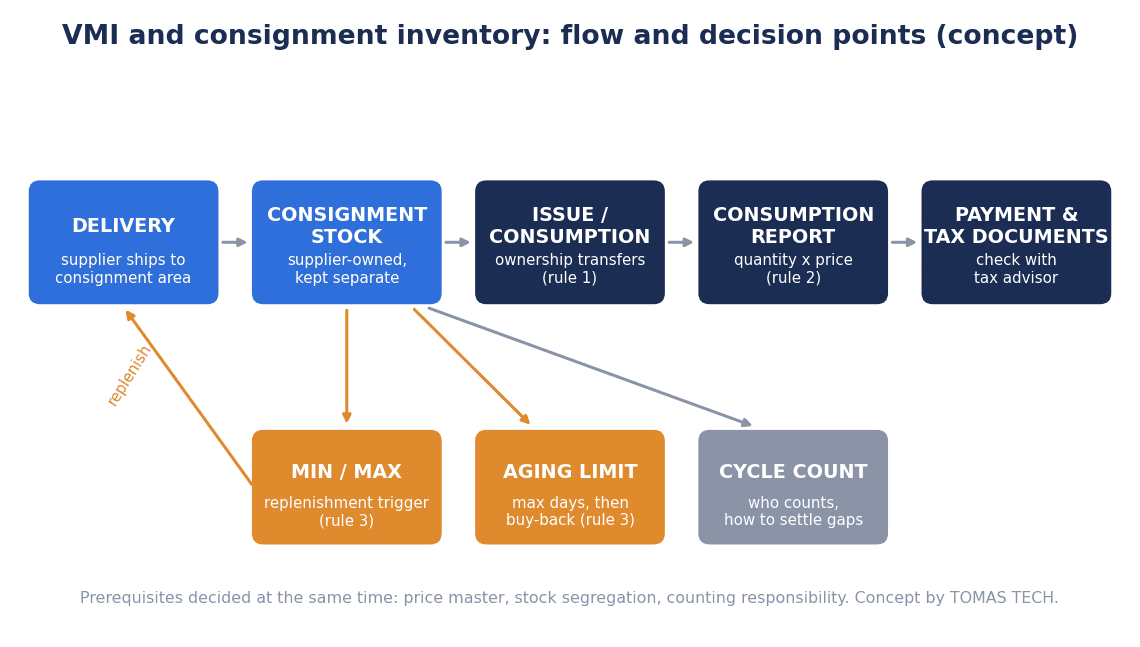
Viewed as a flow, delivered items are received as supplier-owned consignment stock. Ownership passes to your company at the point of issue or consumption. Consumption is aggregated into consumption advices or settlement statements, which lead to payment. How to handle Thai tax documents at this stage requires confirmation by your tax advisor. In parallel, consumption information feeds back into min/max-based replenishment, and aged items enter the expiry management loop.
Rule 1: Decide the Ownership Transfer Point
What counts as “consumption”
The first thing to decide is which transaction transfers ownership. Infor’s documentation explains that “whether a warehouse issue counts as consumption is normally determined by the contract between the supplier and the customer.” Where the contract does not settle it, the setting is made at the level of the item and warehouse combination, the warehouse, or the outbound order line. In this article, we also consider this order to be the practical starting point.
There are four main candidate triggers.
- Consumption issue to production
- Transfer into own stock (taking it into your own inventory for planned use)
- Elapsed time (a set number of days has passed since receipt or since the last transaction)
- Transfer between warehouses (moved from an on-site hub to a production line warehouse)
How each product handles it
Each ERP handles these triggers differently.
According to SAP’s learning content, in S/4HANA consignment stock is managed as supplier-specific special stock K. It explains that a liability to the supplier arises both on an issue for consumption (movement type 201K according to the KBA description) and on a transfer into own stock using movement type 411 with special stock indicator K.
Oracle E-Business Suite 12.2 documentation explains that sales order shipments, WIP issues, inter-organization transfers and miscellaneous issues always result in consumption. For subinventory transfers, move orders, backflush transfers and similar transactions, the consumption transaction rules determine whether they are treated as consumption.
Infor LN documentation describes consumption-based transfer and time-based transfer. Whether a transfer between warehouses counts as consumption is set with “Usage at Warehouse Transfer.” For example, with “Only between Clusters,” ownership remains with the supplier for transfers within the same cluster, and consumption occurs when goods are moved to a site warehouse in a different cluster.
Microsoft Dynamics 365 Supply Chain Management documentation explains that ownership changes are made by posting an “inventory ownership change journal.” Journal lines are entered manually or created from the raw material demand of production orders, typically by a shop floor supervisor. The same documentation states explicitly that automatic processing of ownership journals is not supported. Configuration alone does not necessarily mean ownership transfers automatically, and an operational design for who raises the journal and when is required.
When issue is treated as consumption
In this article, we consider that for many factories, treating issue to a production order as consumption is the easiest arrangement to understand. In that case, the accuracy of issue records directly becomes the accuracy of settlement. If issues per order, returns and the handling of leftovers are unclear, the consumption figures will be unclear too. Issue design is covered in our article on implementing a production material issue control system.
Handling reversals
Also decide how to handle reversing consumption. Oracle’s documentation explains that once consumption has occurred it cannot be reversed automatically, and that returning material after a WIP issue does not restore its consigned attribute. You need to decide, in both the contract and operations, how to correct a mistaken issue and how to reflect it in settlement with the supplier.
Rule 1 Continued: Risk Allocation and Quality Status
Items to agree in the contract
Alongside the ownership transfer point, decide the risk allocation. A supplier-owned item is lost on your premises, damaged, or made unusable by a design change. The question is who bears the cost. This article does not address legal principles. We treat these as items to be set out explicitly in the contract.
| Event | What to agree in advance |
|---|---|
| Loss on your premises | Who bears it as a stocktaking variance, and the variance tolerance |
| Damage on your premises | How to judge whether it stems from handling or from packaging or quality, and who bears it |
| Obsolescence, design changes | Conditions for buyout or return of items that can no longer be used |
| Quality defects | Whether defects found after receipt are returned or treated as consumption |
The paper by Valentini & Zavanella (2003) states that the final consignment stock agreement includes parameters closely tied to tax and regulatory matters, which may differ in an international context. With contracts involving suppliers across borders, prior confirmation is all the more necessary.
Quality status categories
Include quality status in the stock categories as well. According to SAP’s learning content, consignment stock has three stock types, unrestricted, quality inspection and blocked, and issues for consumption can be made only from unrestricted stock. Stock in quality inspection or blocked must first be transferred to unrestricted.
This mechanism links receiving inspection results with consumption of consignment stock. Items whose inspection is not complete are not eligible for issue for consumption. The same learning content, however, explains that issues for samples or scrapping can be made from any of the three stock types. Because a liability to the supplier may arise in these cases too, agree their treatment in the contract. Receipt of consigned items and quality status categories can be designed with the same approach as for ordinary purchased items. Receiving inspection design is covered in our article on implementing a receiving inspection system.
Stock Categories and Physical Layout: How to Hold Consignment Stock Separately
How each product categorizes it
How consignment stock is separated from your own stock depends on the product.
| Product | How stock is categorized (as described in vendor documentation) |
|---|---|
| SAP S/4HANA | Supplier-specific special stock K, updated at storage location level and held as non-valuated |
| Microsoft Dynamics 365 | The Owner dimension distinguishes the owner |
| Oracle E-Business Suite | Distinguished by owning party |
| Infor LN | Defined as a VMI warehouse, and held as an administrative warehouse by the party not responsible for warehouse management |
Infor’s documentation explains that a VMI warehouse is defined in both the customer’s and the supplier’s ERP, with the party responsible for warehouse management defining it as a normal warehouse and the other party as an administrative warehouse. Microsoft’s documentation notes that the Owner field is visible to suppliers, so you may rename it to something easy to understand.
Whether to separate physically
Some products allow mixing in the same location. SAP’s learning content explains that consignment stock can be managed under the same material number as own stock, can share the same storage location, and does not require a dedicated storage location. It also says the same material can be consigned from multiple suppliers and managed independently at each supplier’s price.
There are caveats. Oracle’s documentation explains that consignment and regular stock can be mixed in the same subinventory or locator, but that neither is given priority at issue, and stock is picked by FIFO. If your operation needs to use own stock first, or consignment stock first, you need to decide whether to mix them or separate them physically.
In this article, we recommend deciding, together with your issue operations, whether to set up a separate consignment area for shop floor identification even if the system allows mixing. If labels or shelf colors do not make the owner clear, stocktaking variances tend to increase.
Rule 2: Consumption Recording and Settlement Flow
Deciding the settlement cycle
Once consumption is recorded, it is aggregated and settled. The cycle ranges from daily to monthly. The paper by Valentini & Zavanella states, as a basic rule of consignment stock, that the buyer withdraws material day by day as needed, that payment follows the agreement and can in theory be as frequent as daily, and that consumption information is passed to the supplier immediately. Infor’s documentation explains that typically the customer pays in aggregate by self-billing, for example once a month. Oracle’s documentation explains that consumption transactions are aggregated according to the billing cycle (in days) on the Approved Supplier List (ASL).
Three forms of settlement document
Settlement documents broadly take three forms.
| Form | Content | Examples in the documentation |
|---|---|---|
| Consumption advice | The buyer informs the supplier of consumed quantity and amount, which serves as the basis for invoicing | Oracle Consumption Advice |
| Self-billing | The buyer creates the payment document based on consumption | SAP MRKO, Oracle Pay On Use, ERS in SAP Business Network SCC |
| Supplier invoice | The supplier sees consumption and issues an invoice, which the buyer matches | Microsoft Dynamics 365 flow |
According to SAP’s learning content, consigned items are settled without receiving an invoice, the reason given being that the supplier cannot directly track the withdrawals. It explains that unsettled withdrawals are settled with MRKO, and that message type KONS notifies the supplier of the settled withdrawals and the credit memo amount.
Oracle’s documentation describes a consumption advice as the formal document that informs the supplier of the quantity and value of consigned items consumed in the warehouse. A new consumption advice is created when “the system date is later than the last billing date plus the number of days in the billing cycle.” It describes Pay On Use as a self-billing method that automatically creates invoices on behalf of the supplier and shortens the time from consumption to payment.
Microsoft’s documentation describes a flow in which the supplier sees consumption and invoices, and the buyer matches that invoice to an automatically created purchase order and pays.
Odette explains that some customers in the automotive industry have adopted self-billing, in which they create the invoice themselves based on what was received or consumed.
The price source (price master)
Decide at the same time where the settlement unit price comes from. According to SAP’s learning content, a consignment purchasing info record is created for each combination of consignment supplier and material, and withdrawals are valued at the info record price valid on the withdrawal (transfer) date. Prices in foreign currency and prices by period can also be set. Oracle’s documentation explains that the price on the blanket purchase agreement valid at the time of consumption is referenced, and that currency or unit of measure is converted at consumption if they differ. It also states that consumption cannot occur when setup is incomplete, for example when there is no valid blanket agreement.
In other words, the relationship between the price revision date and the consumption date determines the settlement amount. If a revision takes effect mid-month, the unit price differs between the first and second halves of the month. An approach to managing purchase price revisions is covered in our article on implementing a system to manage purchase price revisions.
Thai Tax and the BOI: Treat the ERP Transfer Point and Tax Documents Separately
ERP settlement statements and Thai tax invoices
Here we outline the issues only, without drawing conclusions. Even if you set the ownership transfer point in your ERP to “at consumption,” the tax point for Thai VAT purposes and the timing of tax invoice issuance will not necessarily be the same.
Section 78(1) of the Thai Revenue Code sets the VAT liability for the sale of goods, in principle, at the time the goods are delivered, or at an earlier time if ownership is transferred, payment is received or a tax invoice is issued before delivery. Section 77/1(8) includes in “sale” the delivery of goods to an agent for sale, among other things.
A Revenue Department ruling (กค 0702/7981, October 27, 2014) responded that a manufacturer’s delivery of goods to department stores or convenience stores for consignment sale constitutes a sale, gives rise to a tax liability, and creates an obligation to issue a tax invoice under Section 86. However, this ruling concerns consignment sales in retail. In our research for this article, we did not find any official ruling that directly addresses the arrangement in which supplier-owned parts are held at the buyer’s factory and consumed in the buyer’s own production.
Section 86 obliges VAT-registered operators to issue a tax invoice when the tax liability arises and to deliver it to the buyer. On the other hand, MRKO, Pay On Use and ERS, discussed in the previous section, are settlement mechanisms created on the buyer’s side.
In this article, we recommend designing the ERP settlement statement (the basis for payment) and the Thai tax invoice (the tax document) separately. Please confirm with your tax advisor who issues which document and when, before finalizing the contract and the ERP settings.
Relationship with BOI privileges
For factories receiving BOI privileges, the relationship with raw material inventory control is also an issue. BOI presentation material explains that applications such as raw material stock adjustment, production formulas and Max Stock are made through RMTS Online. In our research for this article, we could not confirm how supplier-owned consignment stock relates to this control. Please confirm with the BOI. The relationship between RMTS and in-house systems is covered in our article on BOI raw material inventory.
Rule 3: Replenishment Rules and Min/Max
Who sets the min/max in VMI replenishment
The basis of replenishment is min/max. The paper by Valentini & Zavanella gives, as a simple consignment stock rule, that the supplier guarantees stock between a minimum s and a maximum S in the raw material store near the buyer’s production line. It states that the items covered should have steady consumption, and that non-standard items and prototypes are excluded. It says s is roughly estimated as safety stock covering production during the supply lead time.
SAP material explains that in SAP Business Network Supply Chain Collaboration the buyer shares demand, forecasts, current stock and min/max requirements, and the supplier can plan and execute replenishment against min/max inventory targets. It also says the supplier can dynamically calculate min/max from the buyer’s total demand over the planning horizon and create replenishment orders without waiting for purchase orders. SupplyOn explains that in VMI the supplier is shown stock levels in the buyer’s warehouse and keeps them within the agreed minimum and maximum.
There are three ways of deciding who sets the min/max. The buyer sets it and passes it to the supplier. The supplier sets it and the buyer approves. Both parties set it jointly. Whichever you choose, agree the review frequency and how to handle large changes in demand.
Handling overstock above the maximum and shortages
The paper by Valentini & Zavanella gives, as examples of items that may be included in the contract, that goods delivered above S can be returned without bearing transport costs, and that damages from shortages below s can be included in the contract as a penalty. These are examples given in the paper. Rather than adopting them as they are, we recommend setting conditions that suit the relationship between your company and the supplier.
How it differs from your own reorder point
VMI min/max looks similar to your own reorder point control, but the party that triggers replenishment is different. With your own reorder point, your company places an order when stock falls below the reorder point. With VMI, the supplier looks at stock and triggers replenishment. Design of your own reorder point is covered in our article on implementing a reorder point system. When moving items to VMI, check the settings that remove them from MRP or reorder point control, so that a remaining reorder point on the same item does not cause double replenishment.
What to Show Suppliers: Visibility and Portals
Current stock only, or projected stock as well?
If you leave replenishment to the supplier, you need to show the supplier the information it needs to make decisions. SAP material points out that many suppliers can see only current stock, not projected stock, and collaborate by email or spreadsheet. The same material explains that suppliers can view demand plans, current stock and projected stock alerts on a dashboard.
Candidate information to share is as follows.
| Information shared | Purpose | What to agree in advance |
|---|---|---|
| Current stock | Judge whether replenishment is needed | Update frequency (daily or real time) |
| Projected stock, requirements | Anticipate future shortages or excess | Over what horizon, and which version of the plan to show |
| Actual consumption | Basis for settlement and replenishment | Definition of consumption and cut-off |
| Threshold alerts | Act before stock falls below min | Alert conditions and recipients |
SupplyOn explains that data is integrated from the ERP and updated daily, and that both parties are notified automatically if stock is at risk of falling below the minimum. When you show projected stock or requirements, a prerequisite is how you translate customer forecasts into your own requirements. Handling of customer forecasts is covered in our article on implementing a customer forecast management system.
Portal examples
Microsoft’s documentation explains that in Dynamics 365 vendor collaboration, suppliers can check consumption and stock on three pages: purchase orders consuming consignment inventory, products received from consignment inventory, and on-hand consignment inventory. Oracle’s documentation explains that in iSupplier Portal, suppliers can view consignment inventory, consumption advices, consignment receipts, returns and so on, and can initiate invoicing. Oracle Cloud material explains that the Redwood version of Supplier Portal has three tabs: consigned inventory, transactions and consumption advices.
General design of supplier portals is covered in our article on implementing a supplier portal.
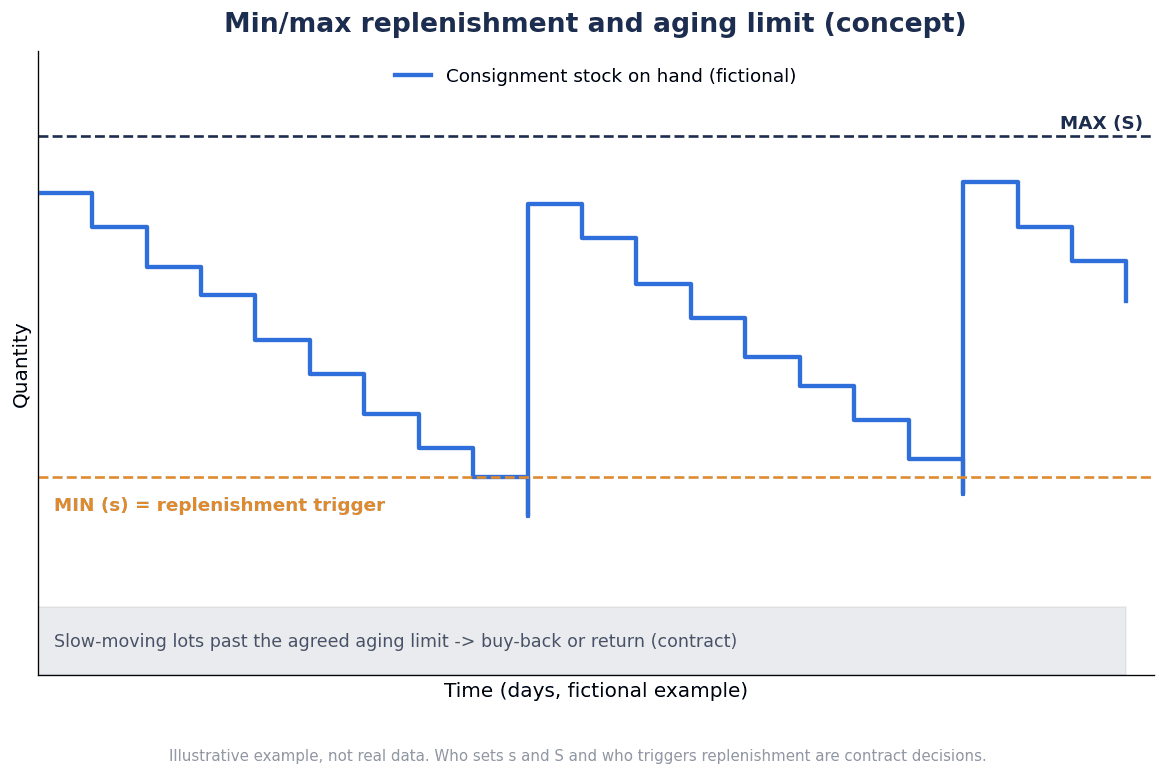
The figure below is a fictitious example that conceptually depicts how consignment stock moves. Between the maximum S and the minimum s, stock decreases with consumption and recovers with replenishment. Stock that does not move for a long time approaches expiry.
Rule 3 Continued: Aging, Maximum Consignment Period and Buyout at Expiry
Agreeing the maximum consignment period in the contract
With consignment stock, the items most likely to cause disputes are those that go unused. The paper by Valentini & Zavanella states that the parties may agree that after a certain period the buyer pays even for unconsumed stock. The help for SAP AFS (a former product for the apparel industry) also describes the idea that you can agree with the supplier on a period after which unused consigned items are transferred to own stock.
In this article, we recommend agreeing in the contract the maximum consignment period and the handling at expiry (buyout, return or extension). Without such an agreement, nobody is designated to take over consigned items that remain for months.
How each product handles it
Oracle E-Business Suite documentation explains that some contractual relationships require the purchase of consignment stock not consumed within a certain period, and that an aging period is defined on the ASL, with an inquiry that displays expiring stock so that ownership can be transferred. The inquiry can search for “already expired,” “within 1 week,” “within 15 days” and “within 1 month.” Oracle Cloud material explains that on the consigned inventory tab of Supplier Portal, stock can be sorted by aging period into “Expired,” “Today and Next 7 Days,” “Today and Next 30 Days” and “All.”
Infor LN documentation explains that time-based ownership change can be set for both after receipt and when there has been no receipt or issue for a set number of days after the last transaction, and that generation of change orders can be run automatically on a periodic basis.
On the other hand, in the S/4HANA learning content and the Dynamics 365 consignment documentation referenced for this article, we could not confirm an aging (maximum consignment period) function. In such cases, the gap is covered operationally by building a report that shows days since last movement and reviewing expiring items in a monthly meeting.
Disposal of expired items
Items bought out at expiry may simply become slow-moving stock of your own. Before buying them out, set a procedure for considering use in other items or negotiating a return. X12 847 (Material Claim) is described as a standard for notifying the cost of material deemed damaged, unusable or obsolete. How to use it must be agreed with the trading partner, but it is worth knowing that such a standard exists. How to proceed with disposing of slow-moving stock is covered in our article on excess inventory reduction.
Stocktaking and Variances: Who Counts, and How Differences Are Handled
Stocktaking of consignment stock takes place in a mismatched situation: the owner is the supplier, but the stock sits on your premises. Unless you decide who counts and who bears variances, the month-end reconciliation will lead to disputes.
Microsoft’s documentation explains that consignment stock is counted with an Item counting journal, and that suppliers with the appropriate permissions can also update on-hand stock through counting. Volvo Group’s INVRPT specification distinguishes reason codes for stock movements such as receipt, issue, scrap, stocktaking variance, transfer of ownership within the warehouse and consumption.
The items to agree are as follows.
- Who performs stocktaking (your company, the supplier, or a joint count with both present)
- Frequency (monthly, quarterly, cycle counting)
- Variance tolerance, and the procedure for investigating causes when it is exceeded
- Who bears variances (who takes responsibility for losses) and how they are reflected in settlement
When a variance occurs, separate whether it stems from missing issue records, wrong receipt quantities or confusion over the owner. How to isolate the causes of inventory variances is covered in our article on inventory discrepancy causes and countermeasures.
Stock and Consumption Information Sent by EDI
Standard EDI messages are sometimes used to exchange information with suppliers.
| Standard | Message | Description (based on material from each organization or company) |
|---|---|---|
| ANSI X12 | 852 Product Activity Data | Notifies trading partners of product activity such as stock and sales, and can be used to suggest replenishment quantities |
| ANSI X12 | 846 Inventory Inquiry/Advice | Can be used to provide inventory information or inquire about inventory availability |
| ANSI X12 | 847 Material Claim | Notifies the cost of material deemed damaged, unusable or obsolete |
| UN/EDIFACT | INVRPT | Conveys information about inventory held, and can be used in either direction between trading partners |
| UN/EDIFACT | INVOIC | Invoice. Odette publishes invoice message guidelines for the automotive industry |
The official X12 site explains that product activity data received via 852 enables trading partners to suggest replenishment quantities.
As an implementation example from the automotive industry, Volvo Group’s INVRPT specification (June 7, 2021) separates own stock and consignment stock by storage location ID, and further distinguishes each as available, under quality inspection or bonded. Movement reason codes include consumption, transfer of ownership within the warehouse and stocktaking variance. In other words, there are implementations that distinguish consigned versus own stock, quality status, consumption and ownership transfer at the message level.
In this article, we consider that whether to use EDI or a portal is often determined by the supplier’s IT environment. Using both, with EDI for large suppliers and a portal for small and medium suppliers, is also realistic. How to proceed with EDI connections is covered in our manufacturing EDI implementation guide.
Functions Confirmed by Product and ERP
Here we list what could be confirmed in each vendor’s public documentation. This does not indicate that any product is better or worse. “Not confirmed in the material referenced” does not mean the function does not exist; it means the material referenced for this article did not describe it.
| Product | Ownership transfer | Settlement | Replenishment and visibility | Aging |
|---|---|---|---|---|
| SAP S/4HANA | Described as creating a liability on consumption issue from special stock K, or on transfer into own stock with 411 and special stock indicator K | Described as settling with MRKO without receiving an invoice and notifying the supplier with KONS | Described as MRP creating consignment purchase requisitions for items always procured on consignment. Supplier visibility not confirmed in the material referenced | Not confirmed in the material referenced (the former AFS help describes the idea of an agreed period) |
| SAP Business Network SCC | Described as sending consumption signals at goods issue and ownership transfer in consignment | Described as the buyer self-billing with ERS and sending via the network | Describes min/max inventory targets, current and projected stock, and alerts | Not confirmed in the material referenced |
| Oracle EBS 12.2 and Cloud | Described as having transactions that always result in consumption and transactions configured by rules | Describes consumption advices and Pay On Use | Described as allowing consignment stock and consumption advices to be viewed in iSupplier Portal or Supplier Portal | Describes the ASL aging period and inquiry, and the Cloud display of Expired, 7 days and 30 days |
| Microsoft Dynamics 365 | Transfer via ownership change journal. States that automatic processing is not supported | Described as the supplier seeing consumption and invoicing, with the buyer matching to the purchase order | Describes consignment replenishment orders and the three vendor collaboration pages | Not confirmed in the material referenced |
| Infor LN | Described as allowing consumption-based and time-based transfer, and the handling of inter-warehouse transfers, to be configured | Described as consumption records starting the payment process, typically with self-billing, for example once a month | Describes the division of VMI roles, including arrangements where the supplier handles supply planning | Describes time-based transfer after the last transaction |
| Odoo 17 | Describes a flow of specifying the Owner at receipt and storing the goods (described as a sales flow) | Not confirmed on the page referenced | Not confirmed on the page referenced | Not confirmed on the page referenced |
The consignment explanation in the Odoo 17 documentation describes a flow in which consigned goods are received by a manual receipt without a purchase order and can be sold in the same way as regular stock. A flow of consuming goods in manufacturing and settling with the supplier was not described on that page.
What this table shows is that which of rules 1 to 3 are held in system functions and which are covered by reports and operations varies by product. That is precisely why, in this article, we consider it important to decide the rules in the contract first and then verify them through the RFP.
RFP Requirements, PoC and Acceptance Test Criteria, Costs and a Model Calculation
Requirements to include in the RFP
The points so far are summarized in an RFP requirements table.
| Category | Requirement | What to verify |
|---|---|---|
| Ownership | Transfer trigger | Which of consumption issue, transfer into own stock, elapsed time and inter-warehouse transfer can be treated as consumption |
| Ownership | Raising and automating transfer | Whether transfer is automatic, or who raises the journal |
| Ownership | Handling of reversals | How reversing a mistaken issue is reflected in settlement |
| Stock categories | How consignment stock is categorized | Whether it can be separated by supplier. Mixing in the same location and issue sequence |
| Stock categories | Quality status | Whether unrestricted, quality inspection and blocked can be distinguished and consumption limited to unrestricted |
| Price | Source of the settlement unit price | Validity periods, currency conversion, handling of consumption spanning a revision date |
| Settlement | Settlement cycle and cut-off | Whether daily, weekly or monthly can be selected |
| Settlement | Form of settlement document | Which of consumption advice, self-billing and supplier invoice can be produced |
| Settlement | Thai tax documents | Whether the issuer and timing of tax invoices can be operated in line with the results of your tax advisor’s confirmation |
| Replenishment | Min/max and who raises replenishment | Setting level, review frequency, who raises replenishment |
| Replenishment | Visibility and alerts | Current stock only, or projected stock as well. Update frequency. Alerts when stock falls below min |
| Aging | Maximum consignment period | Whether expiring items can be extracted, and if there is no function, whether a report can produce them |
| Stocktaking | Who counts and variances | Supplier stocktaking permissions, recording of variance reasons |
| Sharing | EDI and portal | Support for 852, 846, INVRPT, INVOIC and so on. Portal screens |
| Diagnostics | Consumption and settlement errors | Whether stoppages of consumption or settlement, for example due to missing prices, can be detected and notified |
Oracle’s documentation explains that Consigned Inventory Diagnostics can detect consumption errors and consumption advice errors and notify buyers. Diagnostic requirements are easily overlooked, so include them in the table.
PoC and acceptance test criteria
For acceptance testing, we recommend concrete tests such as the following.
- Replay one month of past issue records and check that consumption advices and settlement amounts match a manual calculation
- When the unit price is revised mid-month, check that consumption before and after the revision date is settled at the correct unit price
- Check that consigned items in quality inspection or blocked status are not eligible for consumption
- Check that items exceeding the maximum consignment period are extracted by a report or inquiry
- Check that alerts reach both the supplier and your company before stock falls below min
- Check how ownership and settlement are handled when a mistaken issue is reversed
- Check that stocktaking variances are recorded with reasons and reflected in settlement
A realistic PoC starts with one key supplier and a few items with steady consumption. This also fits the idea, cited in the paper by Valentini & Zavanella, of covering items with steady consumption.
Thinking about costs
We could not confirm any public prices. The SupplyOn VMI product page requires a login to display prices, and the documentation for the consignment inventory functions of SAP, Oracle, Microsoft and Infor did not state prices either. Costs vary with the licensing structure, number of users, number of supplier connections and EDI connections, so comparison has to be made through quotations.
Model calculation (hypothetical figures for this article)
From here, we run a calculation using hypothetical figures prepared for this article. These are not figures from a real factory.
The assumed factory is a Japanese electronic components plant in Thailand. About 40 items from 5 key suppliers are held as consignment stock in a consignment area inside the plant. Consumption is compiled in Excel and settled at month-end, and replenishment is left to the suppliers’ rounds.
The current losses (baseline, annual) are the following three. They are separate losses, and none is counted twice.
| Loss item | Calculation | Amount (THB/year) |
|---|---|---|
| Labor for month-end consumption reconciliation and variance adjustment | 1,200 hours/year × 250 THB | 300,000 |
| Emergency response to shortages of consigned items (expedited freight, changeovers) | 12 times/year × 25,000 THB | 300,000 |
| Loss from buying out and disposing of consigned items with no prospect of use after expiry | Assumed value | 180,000 |
| Total | 780,000 |
The countermeasures are: contractual clarification of the ownership transfer point and settlement cycle; consignment stock categories in the ERP with automatic transfer at consumption or journal-based operation; stock visibility and below-min alerts for suppliers; and an expiry management report.
| Initial cost breakdown | Amount (THB) |
|---|---|
| ERP consignment stock setup and categories | 300,000 |
| Visibility for suppliers (portal or EDI) | 350,000 |
| Clarifying the contract, settlement and tax document flow (including confirmation by your tax advisor) | 110,000 |
| Training, stocktaking, acceptance testing | 200,000 |
| Total | 960,000 |
Annual operating cost is set at 120,000 THB.
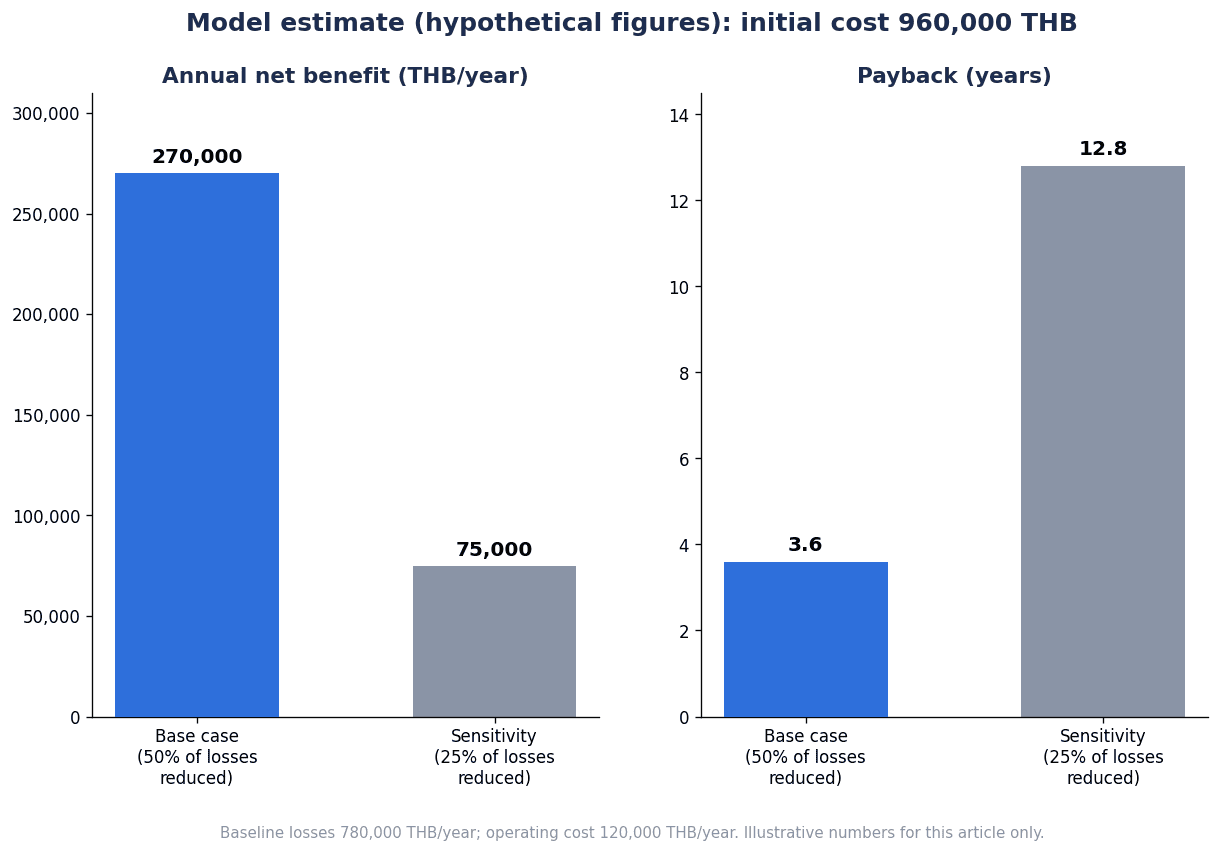
Assuming half (50%) of the above losses can be reduced, the benefit is 780,000 × 50% = 390,000 THB/year. The net benefit is 390,000 − 120,000 = 270,000 THB/year, and the payback period is 960,000 ÷ 270,000 = approximately 3.6 years.
We also look at the case where the benefit is limited to one quarter (25%). The benefit is 780,000 × 25% = 195,000 THB/year, and the net benefit is 195,000 − 120,000 = 75,000 THB/year. The payback period becomes 960,000 ÷ 75,000 = 12.8 years.
| Case | Benefit (THB/year) | Net benefit (THB/year) | Payback period |
|---|---|---|---|
| Base case (50%) | 390,000 | 270,000 | Approx. 3.6 years |
| Sensitivity (25%) | 195,000 | 75,000 | 12.8 years |
How to read the calculation
The benefit percentages are assumptions. In this article, we consider that the most effective lever is the contractual clarification of rules 1 and 2. If what counts as consumption and when it is settled remain unclear, reconciliation labor will not fall even after a system is introduced.
Care is also needed about what the benefit consists of. The study by Claassen et al. (2008) reports that VMI outcomes from the buyer’s perspective were mainly higher service levels and improved supply chain control, with cost reduction “to a lesser extent.” It concludes that many managers expect substantial cost reductions, but that the benefits come mainly from improved service levels. In this article, we likewise consider that the benefits come mainly from fewer shortages, and recommend not making a reduction in inventory value the main objective.
Before implementation, we recommend lining up the past 6 to 12 months of issue records against supplier invoices and counting the number of variances and the labor involved, the number of shortages and the value of slow-moving items. It is safer not to count any benefit until acceptance testing and three months of operation have confirmed that settlement variances and alerts are working.
FAQ and Summary
What is the difference between consignment inventory and VMI?
Consignment inventory is about who owns the stock; VMI is about who manages replenishment. In the APICS definition quoted in the MONOist article, VMI is an arrangement in which the supplier views the customer’s inventory data and maintains the inventory level. A “VMI warehouse” as the term is used on Japanese shop floors can be understood as often being used together with supplier-owned consignment stock.
When does ownership of consignment stock transfer?
It is decided in the contract. Infor’s documentation explains that ownership in many cases passes at consumption, but that there are other transfer points defined by contract. The candidates are consumption issue, transfer into own stock, elapsed time and transfer between warehouses. Each ERP handles this differently, and some products, such as Dynamics 365, state explicitly that automatic processing of ownership journals is not supported.
Who issues the tax invoice for consignment stock, and when?
This article does not draw a conclusion. Section 78(1) of the Thai Revenue Code takes delivery as the principle, and the Revenue Department has a ruling that treated consignment sales in retail as a sale. We did not find, in this research, any official ruling that directly addresses consignment stock consumed at a factory. Design the ERP settlement statement and the tax invoice separately, and confirm with your tax advisor before signing the contract.
Who sets the min/max in VMI?
There are three forms: the buyer sets it, the supplier sets it and the buyer approves, or both set it jointly. The paper by Valentini & Zavanella states that s is roughly estimated as safety stock covering production during the supply lead time. Whichever form you choose, agree the review frequency and how to handle large changes in demand.
What happens to consigned items that are not used?
Agree in the contract the maximum consignment period and the handling at expiry (buyout, return or extension). Oracle’s documentation describes the aging period and the inquiry of expiring stock, and Infor’s documentation describes time-based transfer after the last transaction. For products where this function could not be confirmed in the material referenced, the gap is covered with reports and monthly reviews.
Does VMI lower inventory costs?
It is safer not to assume a large reduction. The study by Claassen et al. (2008) reports that VMI outcomes were mainly improvements in service levels and control, with cost reduction to a lesser extent. It found that success was influenced by the quality of the relationship, the quality of the IT systems and the frequency of information sharing.
How much does a VMI and consignment inventory system cost?
We could not confirm any public prices. Costs vary with the licensing structure, number of users, number of supplier connections and EDI connections, so compare them through quotations. The calculation in this article uses hypothetical figures prepared for this article.
Summary
- VMI is about managing replenishment; consignment inventory is about ownership. They are separate axes and are often used in combination.
- Three rules come first: (1) ownership transfer point and risk allocation, (2) consumption recording and settlement flow, (3) replenishment and aging rules. Alongside them, decide the price master, the stock categories and the division of stocktaking responsibility.
- The depth of support differs by ERP. Decide in the contract, then either hold it in a system function or cover it with reports and operations.
- Design the ERP settlement statement and the Thai tax invoice separately, and before signing the contract confirm with your tax advisor, and with the BOI on the relationship with BOI privileges.
- In the calculation (hypothetical figures), a 50% reduction in losses gives a payback of approximately 3.6 years, and if it is limited to 25%, 12.8 years. What tends to drive the benefit is the contractual clarification of what counts as consumption and when it is settled.
- Starting before implementation by lining up the past 6 to 12 months of issue records against supplier invoices and counting them makes the requirements and expected benefits clearer.
Even at an early stage of your review, such as deciding which items from which suppliers to move to consignment, or how to organize the ownership transfer point and settlement flow against your contracts, TOMAS TECH is available to help. Please contact us here.
References
- Microsoft Learn “Set up consignment (Dynamics 365 Supply Chain Management)” updated May 6, 2026 https://learn.microsoft.com/en-us/dynamics365/supply-chain/inventory/set-up-consignment
- Microsoft Learn “Change the ownership of consignment inventory based on production demand” updated April 10, 2025 https://learn.microsoft.com/en-us/dynamics365/supply-chain/inventory/tasks/change-ownership-consignment
- Oracle “Oracle Inventory Consigned Inventory From Supplier Process Guide (E-Business Suite 12.2) Consuming Material” https://docs.oracle.com/cd/E26401_01/doc.122/e48822/T260819T260824.htm
- Oracle, same guide, “Costing and Accounting” https://docs.oracle.com/cd/E26401_01/doc.122/e48822/T260819T260825.htm
- Oracle Cloud 25B Readiness “Redwood: Review Consigned Inventory in Supplier Portal Using a Redwood Page” https://docs.oracle.com/en/cloud/saas/readiness/scm/25b/inv25b/25B-inventory-wn-f36673.htm
- SAP Learning “Performing the Process of Vendor Consignment” https://learning.sap.com/courses/inventory-management-and-physical-inventory-in-sap-s-4hana/performing-the-process-of-vendor-consignment
- SAP Learning “Supplier Consignment (2LG)” https://learning.sap.com/courses/implementing-sap-s-4hana-cloud-public-edition-sourcing-and-procurement/outlining-supplier-consignment_be5a11cc-76d2-4d91-be31-685dea6faa6a
- SAP KBA 3762417 (preview) https://userapps.support.sap.com/sap/support/knowledge/en/3762417
- SAP Library (AFS 6.5) “Consignment” https://help.sap.com/saphelp_afs65/helpdata/en/7d/e3c765d4d011d3bc0d00a0c92f0691/content.htm
- SAP “Share inventory requirements and visibility with trading partners” (PDF) https://www.sap.com/hungary/docs/download/2022/12/aa19f463-5b7e-0010-bca6-c68f7e60039b.pdf
- Infor LN 2026.x “Vendor managed inventory” https://docs.infor.com/ln/2026.x/en-us/lnolh/wholh/whom000458.html
- Infor LN 2026.x “Consumption-based ownership change” https://docs.infor.com/ln/2026.x/en-us/lnolh/wholh/whom000474.html
- Infor LN 2026.x “Time-based ownership change” https://docs.infor.com/ln/2026.x/en-us/lnolh/wholh/whom000473.html
- Odoo 17.0 “Consignment: buy and sell stock without owning it” https://www.odoo.com/documentation/17.0/applications/inventory_and_mrp/inventory/shipping_receiving/daily_operations/owned_stock.html
- X12 “X12 Transaction Sets” https://x12.org/products/transaction-sets
- EDIFACTORY “D921 INVRPT Inventory Report Message” https://www.edifactory.de/edifact/directory/D921/message/INVRPT
- Volvo Group “VOLVO GLOBAL INVRPT D13A” (PDF) June 7, 2021 https://www.edi.volvogroup.com/content/dam/volvo-group/markets/edi/specifications-and-guidelines/inventory-report/VOLVO-GLOBAL-INVRPT-D13A-1-1.pdf
- Odette “Invoicing & Payment” https://odette.org/process/invoicing-and-payment
- SupplyOn Store “Vendor Management Inventory (VMI)” https://enable.supplyon.com/en/product/130
- SupplyOn “VMI, Kanban & JIT/JIS Supply Chain Collaboration” https://www.supplyon.com/en/solutions/supply-chain-collaboration/vmi/
- MONOist “What Is APICS, the Common Global Language of Production Management? (2)” (Japanese) October 23, 2015 https://monoist.itmedia.co.jp/mn/articles/1510/23/news003_3.html
- Valentini, Zavanella “The consignment stock of inventories: industrial case and performance analysis” International Journal of Production Economics 81–82, 2003 (PDF) https://impianti.unibs.it/Pubblicazioni/Zavanella/Consignment%20Stock%20%28IJPE%29.pdf
- Claassen, van Weele, van Raaij “Performance outcomes and success factors of vendor managed inventory (VMI)” 2008 (TU/e Research Portal) https://research.tue.nl/en/publications/performance-outcomes-and-success-factors-of-vendor-managed-invent/
- Revenue Department “Section 77_79” https://www.rd.go.th/english/37719.html
- Revenue Department “Section 85_86” https://www.rd.go.th/english/37741.html
- Thai Revenue Department (กรมสรรพากร) ruling กค 0702/7981 (October 27, 2014) https://www.rd.go.th/54151.html
- BOI “BOI Incentive on Importing Machinery & Raw Materials” (PDF) https://www.boi.go.th/upload/content/2_BOI%20Incentives%20on%20Importing%20Machinery%20&%20Raw%20Materials.pdf
- Trading Economics “Thailand Car Sales Soar 25.59% in August” https://tradingeconomics.com/thailand/total-vehicle-sales/news/587114
- MarkLines “August vehicle production in Thailand up 10.9%; sales up 25.6%” https://www.marklines.com/en/news/351560
- Trading Economics “Thailand Industrial Output Growth Beats Forecasts” https://tradingeconomics.com/thailand/industrial-production/news/587981
- The Star (Reuters) “Thai August factory output rises 4.44% y/y, beats forecast” September 30, 2026 https://www.thestar.com.my/business/business-news/2026/09/30/thai-august-factory-output-rises-444-yy-beats-forecast
- JCC, JETRO “Survey on Business Sentiment of Japanese Corporations in Thailand for the 1st Half of 2026” (PDF) June 30, 2026 https://www.jetro.go.jp/ext_images/thailand/pdf/JCCSurvey1H2026Eng.pdf


