


When a manufacturer introduces a system for customer-supplied materials, the first decision is not which barcode to print. It is how the customer and the factory will reach the same answer to five questions: who owns the material, which lot arrived, where it is now, how much was consumed on each work order, and what happened to the remainder. This guide is for contract manufacturers in Thailand. It follows the material from inbound receipt and quality hold through issue, actual consumption, scrap, return, monthly reconciliation, and the boundary with invoicing. It also turns those operations into ERP, MES, WMS, RFP, FAT, and SAT requirements.
Fix three boundaries before configuring the system
“Customer-owned material” here means components that a customer sends into the manufacturer’s own plant for processing or assembly of that customer’s order. The plant may hold the boxes while the customer retains title under the agreement. The direction of flow matters. When the manufacturer sends its own materials out to a subcontractor, the screens may look similar, but the party that owns the asset, issues the instruction, and receives the report is reversed. Our subcontracted processing control guide addresses that outbound flow. This article is about material entering your plant from your customer.
First, define ownership. Does the plant purchase the material on receipt? Does the customer retain ownership through processing? Which party bears normal loss or abnormal damage? Align the contract, item master, transaction type, and accounting design. Second, distinguish quantities. The dispatch note, physical count, quality-accepted quantity, issued quantity, and actual consumed quantity are not interchangeable. Third, define money. Is material value included in the manufacturer’s purchase and sale, or does the company invoice only a processing fee? How are extra use, scrap, storage, and returns settled? Tax and accounting decisions depend on the contract and local professional advice; a “customer material” checkbox cannot determine them.
Oracle describes a contract-manufacturing arrangement in which an OEM tracks components it supplied and finished stock at a contract manufacturer’s facility. Microsoft’s consignment example describes a different arrangement: supplier-owned stock is received, then ownership changes before production consumption. Both examples help a team ask the right questions, but neither proves how a particular contract must be booked. Do not treat a material physically stored at your plant as automatically purchased, or assume that “consumption” necessarily means an ownership transfer. Assess material and finished goods separately. See Oracle’s contract-manufacturing flow and Microsoft’s consignment process.
Design an event ledger, not only an inventory balance
A balance answers “how many”; it cannot explain “why.” Record expected delivery, gate receipt, counted receipt, quality hold, acceptance, location move, work-order reservation, warehouse issue, line input, actual consumption, unused return, scrap, return to customer, and stocktake adjustment as distinct events. Each event needs the source document, customer, customer and internal item numbers, revision, lot, unit, quantity, location, timestamp, operator, approver, reason, and state before and after. Make corrections traceable by reversal and replacement rather than silently overwriting the original event.
GS1 EPCIS 2.0.1 describes visibility events through the dimensions of object, time, place, business context, and condition. A plant does not have to implement EPCIS to learn from that structure. Ask what moved, when, where, why, and in what condition; then relate the answer to the customer ASN, physical label, receiving result, and production record. GS1 EPCIS 2.0.1 is a useful primary reference for event design.
If one customer lot arrives in two shipments, immediately merging them into one balance erases which shipment was short or damaged. Preserve a receipt ID and container ID, then aggregate when reporting requires it. When a carton is split, retain the parent-child container link. When several work orders draw from one lot, retain both issue destination and return origin. A lot number alone is not an audit trail.
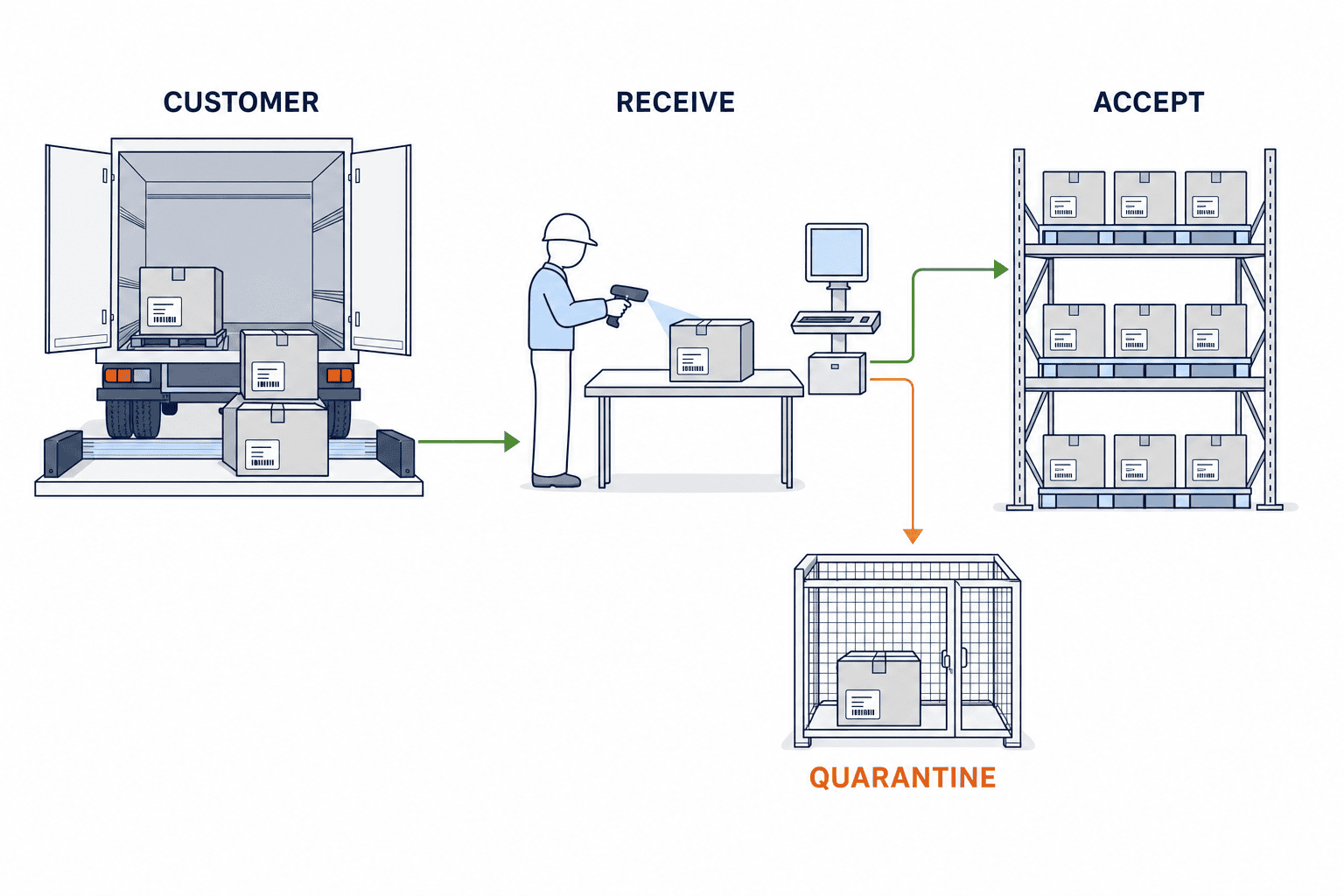
Receiving, counting, quarantine, and release
If the customer sends an advance shipping notice, register expected receipts before the truck arrives. Expected stock must never be available stock. At arrival, compare the customer, supply instruction, item, drawing revision, pack type, number of containers, seal, customer lot, and applicable production or expiry dates. Specify conversions between pieces, cartons, reels, and weight, including rounding. A recorded delivery-note quantity without an actual count leaves the origin of a later discrepancy unknown.
Use separate states for arrived, counted, quality hold, accepted, and rejected. A counted quantity is not automatically available for production. Visible damage, label mismatch, unknown lot, wrong revision, missing certificate, or storage-condition deviation should send the material to a controlled quarantine location. Block reservation and issue until the quality team or customer releases it. In SAT, compare the system block with the physical label and cage. If the ERP still reports quarantined material as available, MRP may plan to use it even though the warehouse has stopped it.
A proprietary barcode can work, but if a customer label carries GS1 identifiers, read their meanings correctly. GS1 AI (10) denotes batch or lot, (21) serial number, and (241) customer part number. None of these guarantees the label contains every field your process needs. Do not force a one-to-one relationship between customer and internal part numbers: include revision, substitution, and effective dates in the mapping. Check the live labels against GS1 Application Identifiers.
For shortages or overages, keep the notified quantity, counted quantity, held quantity, and customer-approved quantity separately. Open a discrepancy case with notice, evidence, photos where useful, approval, replacement or make-up delivery, and closure. Damage in transport and damage after handover can carry different responsibility; record when and where it was detected. A month-end adjustment against the customer’s spreadsheet is too late to explain the event.
Separate reservation, issue, and actual consumption
Reservation means “planned for this work order.” Issue means “physically moved from stores to the production area.” Actual consumption means “used in the product or lost in a documented process outcome.” Combining all three under one button is a common cause of balance differences. Cancelling an order may release a reservation, but material physically sitting at a line will not walk back into the warehouse. Count it, return it, record whether it has been opened, and judge whether it is reusable. At issue, scan both container and work order, and validate lot, revision, and acceptance state.
The BOM standard requirement differs from actual usage when set-up loss, trials, rework, or yield variation occur. Backflushing only the standard quantity can hide a discrepancy in expensive customer-owned components. Microsoft’s raw-material consumption guidance explains that posting can occur at different points, such as production or operation start. Choose automatic posting or scanned actuals by material and contract requirement. Define who approves a variance.
An illustrative calculation: receive 100 units of customer lot A; hold 2 at inspection; accept 98. Issue 60 to a work order. If 56 go into good units, 2 become documented process scrap, and 2 return unused, accepted stock returns to 40 and the two held units remain a separate balance. These numbers are assumptions for explaining the ledger, not standard yield or acceptable loss. A report showing only “issue 60, good output 56” cannot account for the four missing units. The customer needs the breakdown.

Control scrap, rework, unused returns, and customer returns
Scrap is not simply a negative inventory transaction. Link the process step, defect or damage reason, lot, quantity, inspection evidence, responsibility, customer notice, physical disposition, and financial treatment in one case. Distinguish samples held for investigation, material awaiting customer collection, and material approved for destruction. The physical location and system balance must agree. Destroying material before the customer’s required approval can remove the evidence even if the count eventually balances.
For rework, distinguish original material consumption from additional input, and record the work order and revision on which each was used. Otherwise, the normal BOM backflush and a manual withdrawal from another box may be counted together or not at all. For unused returns from the line, check whether the package was opened, storage conditions held, and lot identity preserved. A line-to-store movement does not automatically make the material “new” and freely reservable.
A return to the customer is a chain: request, selection, packing, lot statement, dispatch, carrier handover, and customer receipt. In transit, the customer’s and plant’s balances may legitimately differ. Put “in return transit” in its own reconciliation column and agree when each party removes it from stock. Leftovers at expiry or contract end need the same controls plus agreed transport, disposal, and cost responsibility.
Monthly reconciliation and the invoice boundary
Start the customer statement with an agreed opening balance, add receipts, subtract approved consumption, scrap, and returns, and show held stock, line-side stock, and transit explicitly. Agree what counts as “consumption,” the cutoff time, time zone, treatment of cross-month receipts and returns, and how a later correction is represented. If a Thailand plant and a Japanese head office close on different calendar dates, store event timestamps with offsets and name the report’s aggregation basis.
Classify differences before correcting them: an unposted customer event, unposted plant event, wrong lot, unit conversion, hold status, return in transit, or cutoff mismatch. Do not erase the difference with one anonymous “adjustment” next month. Link the original event, finder, cause, approver, other party’s confirmation, and correcting document. At stocktake, separate customer-owned from company-owned stock even if boxes share a shelf. Include quality cages and line-side containers. Our material management design guide discusses item, location, and transaction master data in more detail.
Invoicing follows the contract. Under a processing-fee-only arrangement, do not generate material purchase and sale postings merely because stock arrived and was consumed. If abnormal loss, overuse, storage, sorting, or disposal is chargeable, retain the approved quantity and rate behind each line. A consignment agreement that transfers ownership at consumption has a different purchase, accounting, and settlement line. Have the commercial and accounting teams review contractual terms, customs, and tax with appropriate specialists, then map the approved design to ERP transaction types. A generic software workflow cannot determine tax treatment.
Allocate responsibilities across ERP, MES, and WMS
ERP commonly holds customer and contract data, sales orders, manufacturing orders, financial postings, invoices, and confirmed balances. WMS handles receiving, locations, containers, counts, and physical moves. MES handles line input, production actuals, good or defective output, and process scrap. Product names do not establish the true boundary. For every event, name the system of entry, authoritative record, readers, correction authority, and failed-message replay path. Even if ERP owns inventory, an unsynced handheld entry is not a confirmed available balance.
Required master data may include customer, customer item, internal item, revision, unit and conversion, BOM, work order, lot, container, storage condition, owner, quality state, location, disposition, and billing category. If one customer number arrives in two revisions, losing the revision at receiving prevents the MES from rejecting a wrong issue. Move mappings out of personal spreadsheets and control their effective dates and approval. Specify whether “one carton equals 100 pieces” is always valid, how weight converts to count, and where rounding happens.
Give each integration event an immutable ID and source-document ID so retries do not post twice. Test reordering, delay, and partial failure. If an issue permission arrives before the quarantine notification, the system needs a safe conflict rule. For offline scanners, retain both device-capture and server-receipt time, and keep unconfirmed entries separate from official balances. Monitor business posting failure as well as transport failure; an API success response is not proof that a work order was validly consumed.
Investigate the current flow before setting the implementation scope
Trace actual documents and physical containers for two customers and several representative materials from receiving to return. Ask at what point each department believes quantity and title changed. Collect customer shipping formats, labels, item mappings, storage requirements, contractual loss rules, reconciliation spreadsheets, invoice lines, and open differences. Walk the warehouse, line-side racks, quality cage, rework zone, and outbound return area. A screen inventory alone will miss the physical exceptions.
Limit a pilot along three axes: customers and materials, physical locations, and events. A possible first wave is customer A’s boards and resin parts in warehouse 1 and assembly line 2, from receipt through hold, issue, actual consumption, unused return, and reconciliation. Those counts and names are illustrative, not a prescribed scope. Select cases by discrepancy frequency, material value, traceability requirement, customer cooperation, and operational readiness. Raising internal scan compliance while the customer balance remains unreconciled is not success.
Use a prior month’s real transactions to establish opening stock and replay the period. Include cartons and pieces, mixed lots, emergency issue, release from hold, cancelled work order, rework, scrap, and goods in return transit. Investigate differences against legacy records, obtain approvals, and jointly sign off the cutover balance. A system can post every new transaction correctly and still never match the customer if the opening balance was never agreed.
Put real exception cases into the RFP and vendor comparison
Do not ask only whether a product “supports customer material.” Describe title patterns, materials excluded from asset valuation, customer-separated balances, lot and container traceability, quality hold, order-specific use, unused return, scrap, shipment back, monthly reconciliation, discrepancy approval, and invoicing integration. For each event, give the entry role, confirmation point, correction method, audit record, and ERP/MES/WMS destination. If a customer portal is needed, define which confirmed and unconfirmed balances are visible, update latency, and tenant access rules.
Compare bids on master-data clean-up, reading existing labels, scanners and printers, interfaces, opening-balance migration, exception development, FAT/SAT, training, parallel operation, support, and customer report changes, as well as licenses. Give every vendor the same sample transaction set. Ask them to identify standard features, configuration, custom code, manual work, and exclusions separately. A polished demo showing a stock dashboard does not prove it can explain consumption and settlement.
Weight discrepancy handling and auditability heavily. Can the system receive a shipment with a count difference? Can a held lot be reserved? Where does material physically issued against a cancelled order go? Can a duplicate scan or retry change stock twice? How is a closed month’s transaction corrected? Request an operated demonstration rather than a yes/no response. Document tasks that remain with the customer, including master data and approvals.
FAT and SAT acceptance conditions
In FAT, test configuration and interfaces with defined expected outcomes. For example, against an expected 100, count 98 and place 2 on hold, leaving 96 available. Scan the same container twice and expect one receipt. Reject issue if customer item or revision is wrong. Cancel a work order after issue and verify that warehouse stock does not rise without a physical return. Record unused return, process scrap, return transit, and post-close correction as separate events. These quantities are assumed test data, not target yield or a universal tolerance.
In SAT, use real labels, illumination, box sizes, weak Wi-Fi areas, gloves, printers, quarantine cages, and stocktake procedures. Test network loss and recovery, damaged labels, mixed units, night shifts, and midnight cutoffs. “The scanner worked” is not a sufficient pass criterion. After each event, the physical container, system state, customer statement, and agreed ERP posting or non-posting should match. Compare financial results only against the accounting design approved for that contract.
Before cutover, have the customer-facing owner, warehouse, quality, and finance confirm opening balances by lot and container, with holds and goods in return transit separate. Do not close unresolved differences by hiding them. Reconcile events daily in the first live week, then make the first customer month-end close an acceptance milestone. Training should include who stops a transaction, informs the customer, and approves a correction when something goes wrong.

Authority, audit, and continuity after go-live
Avoid giving everyone the right to alter stock to “make the numbers match.” Receiving staff record physical arrivals, quality staff decide holds and releases, production staff record issues and consumption, and authorized managers approve count adjustments. In a small plant, duties may overlap; then require a deputy approval, a later review, reason codes, and original evidence. Do not run daily operations with unrestricted administrator privileges.
Enforce customer-level access on screens, downloads, and APIs. Customer A must not see customer B’s material, output, or your costs. Audit records should show who changed which original transaction, from what value to what value, when, and on which device. A last-updated-by field cannot explain a balance difference discovered a month later. Offline or paper fallback needs a document number, duplicate-entry prevention, recovery order, physical marking, and approval. On restoration, compare container and source IDs so one receipt cannot be loaded twice. During a failed close, show which reports are final and which messages remain unsent.
Measure unresolved reconciliation cases, quantity or value at risk, time to root cause, days to customer approval, hold age, work-order consumption capture, and returns in transit by customer and material. Establish targets from the plant’s baseline, not an invented industry benchmark. For a business case, use actual time spent reconciling, investigating, repairing invoices, and answering customer enquiries; separate cash savings from faster decisions. Include device replacement, labels, cloud fees, interface monitoring, customer changes, and master-data maintenance in total cost. Verify benefits after the first full customer close.
When differences cluster around unit conversion, change the conversion table and label. When line returns are missed, change the return rack and scan step. More alerts without a change to physical flow can merely generate more approvals. Measure the same indicators the following month to see whether the cause moved elsewhere.
Manage changes to customer specifications
Customer part numbers, drawing revisions, labels, allowed loss, and billing terms will change after go-live. Do not implement a customer email only in one application. Record the effective date, affected lots, treatment of unused stock and work in process, existing order recalculation, and evidence of approval. During an overlap between old and new revisions, show both on labels and screens and test which lot may be used on which work order.
Changing a report column or API field may break the customer’s importer. Agree the interface version and test the receiving side. If an event from a closed month must be corrected, retain both the correction date and the affected period, and follow the agreed customer process rather than silently rewriting the old statement. Change control is part of the RFP and operating procedure if the same system is to support more customers over time.
Frequently asked questions
Can customer-owned stock share an item master with purchased stock?
Sometimes, if the system reliably separates owner, valuation, posting, reservability, and billing category. Separate codes alone are insufficient without physical lot traceability. The contract and professional accounting review determine the financial treatment.
How granular should lot tracking be?
Use the customer’s requirement, quality risk, and recall scope. At minimum, consider the relationship between received customer lot, item revision, and consuming work order. Add container IDs when carton-level discrepancies or partial returns matter. A customer lot and your receipt ID are different keys.
Is backflushing enough for customer-supplied material?
It can be if standard and actual usage are stable and the customer accepts that reporting granularity. It can hide trials, rework, scrap, manual withdrawals, and partial returns. Choose automatic or scanned actuals by material and define variance approval.
What determines implementation cost?
The customers, items, sites, physical labels, existing systems, opening balance, customer reports, exceptions, devices, testing, and training. Ask vendors for the same scenario-based demonstration and broken-down bid. A single generic price range would conceal the contract-specific work.
How is this different from sending components to a subcontractor?
In outsourced processing, your company sends its own materials out and monitors them at the supplier. Here, the customer sends material into your plant. Physical movements look similar, but ownership, customer reporting, billing, and responsibility face the opposite direction. Companies handling both should explicitly identify owner and counterparty roles in every transaction.
Conclusion
A customer-owned material control system succeeds when both parties can start with the same delivered lot and trace accepted, held, issued, consumed, scrapped, returned, and corrected quantities to the same closing balance and settlement evidence. Define ownership and billing first, record distinct events, assign authoritative systems, and test exceptions in FAT and SAT.
TOMAS TECH can help Thailand factories review existing documents and customer reconciliation sheets, define the event model and scanning flow, and scope ERP, MES, and WMS integration. If you are still preparing an RFP, describe where differences arise and what your customer requires through our contact page.
Primary references
- Oracle: Overview of the Contract Manufacturing Business Flow
- Microsoft Learn: Set up consignment
- Microsoft Learn: Control raw material consumption by using flushing principles
- GS1 EPCIS 2.0.1 Standard
- GS1 Application Identifiers
- ISO: Guidance on documented information under ISO 9001:2015
- SAP Help: Subcontracting


