


Introduction: Moving Measurement Points You Cannot Wire from Paper Rounds to Battery-Powered Wireless
This article is written for readers in Thailand who are considering LoRaWAN factory deployment: plant managers, maintenance staff, utility engineers, production engineers and IT staff at food, chemical, automotive parts and electronic component plants. Your site is large, and you want to put sensors in the boiler room, wastewater treatment, the tank yard, warehouses and outdoor pipe racks. But the cost of running cables out there, and the shutdowns needed for the work, are heavy. Wi-Fi reaches only the office and some of the lines. In the end, someone walks a round every day, reads the gauges, writes the values on paper and transcribes them into Excel back at the office. Plants like this are not unusual.
You may have heard from headquarters in Japan that “with LPWA, you can retrofit sensors cheaply,” yet you do not know which frequencies and equipment conditions apply in Thailand, or how much you can leave to a contractor. This article is meant to organize the picture for readers at that stage.
Here is the conclusion up front. LoRaWAN is a sensor network for sending “small amounts of data, over long distances, slowly.” In a factory, it shows its strengths when you limit it to “measuring points you cannot wire, on battery power, every few minutes to every few hours.” Conversely, it is not suited to equipment control, safety interlocks or high-frequency data such as vibration waveforms. There are four things to decide first in a deployment:
- Which measurement points to put on it. Sort them by interval, data volume and tolerance for delay
- Whether the equipment fits Thai rules. Check the AS923-1 frequency plan, Thai type approval and LoRaWAN Certified status
- Decide gateway placement through a site survey, and decide whether to own the network server and the data destination in-house
- Treat battery life as a “conditional value” and include a battery replacement plan in the budget
Acceptance is judged by communication KPIs (reception rate, RSSI and SNR, number of gateways that received the packet) and by how the system behaves when data goes missing. The approach to sensor types and measurement intervals themselves is covered in our article on factory IoT sensor types.
This article does not recommend or rank specific products. Product functions are presented as described in the manufacturers’ documents, and prices are not covered. The cost-benefit estimate in the second half uses hypothetical numbers for this article.
Why Thai Factories Are Looking at Retrofit Sensor Networks Now
First, let us look at the current figures surrounding manufacturing in Thailand and LoRaWAN. The figures are stated with their source and scope as published, and we do not add them together or compare them with each other.
- According to a Thailand Board of Investment (BOI) announcement dated October 7, 2026, from 2021 to mid-2026 there were 1,380 investment applications from Japanese companies, worth more than USD 11.72 billion (about THB 396.5 billion). This is a cumulative figure on an application basis for Japanese companies, not the approved amount or the actual amount invested. According to the same announcement, on the occasion of the Thailand-Japan Investment Forum 2026 (Bangkok, more than 700 participants), BOI Secretary General Narit said the BOI is supporting existing factories in upgrading to “Smart & Sustainable Industry” standards through automation, emissions reduction and greater use of clean energy. Ichiro Abe, head of the JETRO Bangkok office, said that sustaining cross-border capital flows amid the transformation of digitalization and automation requires a predictable business environment, fair competition and continuous improvement in productivity.
- According to a BOI announcement dated August 27, 2026, in the first half of 2026 alone, the BOI approved 132 smart and sustainable manufacturing projects worth USD 516.8 million (THB 17 billion). Their stated aims are equipment modernization, adoption of clean energy and integration of advanced automation. This figure is on an approval basis for the first half of 2026.
- According to The Star (September 30, 2026), which carried a Reuters article, the Manufacturing Production Index (MPI) for August 2026 announced by Thailand’s Ministry of Industry rose 4.44% year on year, above the Reuters forecast (a 1.0% rise). The director of the Office of Industrial Economics cited higher electronics output, government stimulus measures and a weaker baht as factors. Note that the MPI calculation method has been revised with the addition of new electronic products and changes in weights, so caution is needed when simply comparing it with past values.
- According to the LoRa Alliance’s end-of-2025 report (published February 2026), the number of LoRaWAN end devices deployed worldwide reached 125 million, with a compound annual growth rate of 25%. The report says certified devices exceed 625, the largest deployment sector continues to be utilities (led by smart water), and LoRaWAN has become the leading wireless technology in smart buildings and facility management. These are figures published by the industry association itself.
- According to an IoT Analytics announcement dated March 21, 2024, the number of LPWAN IoT connections worldwide at the end of 2023 was about 1.3 billion. This is the number of connections for LPWAN as a whole, not LoRaWAN alone. It says that when China’s data is excluded, LoRa accounts for 41% of global LPWAN connections and ranks first.
Seen from the plant floor, these movements show up as a demand to “digitize existing factories gradually, without stopping them.” New lines can be designed with wiring and networks from the start, but for utilities and outdoor equipment in existing factories, the only option is to add measurement points afterward. A wireless sensor network that lets you add measurement points with minimal wiring work is one of the options.
What Is LoRaWAN: The Division of Roles Between LoRa Modulation and LoRaWAN, and the Star Topology
To understand LoRaWAN, it helps to separate “LoRa” from “LoRaWAN.” LoRa is a radio modulation method that reaches far at the cost of low speed. LoRaWAN is the communication rule set (protocol) that runs on top of it, defining how end devices join, encryption, data rate management and network structure.
The LoRaWAN link layer specification published by the LoRa Alliance (TS001-1.0.4, posted on the Resource Hub on September 28, 2023, and mandatory for certification) describes LoRaWAN at the outset as “a network protocol optimized for battery-powered end devices.” End devices may be mobile or installed at a fixed location. Internationally, LoRaWAN has also been approved as ITU-T Recommendation Y.4480, “Low power protocol for wide area wireless networks” (LoRa Alliance announcement of December 7, 2021).
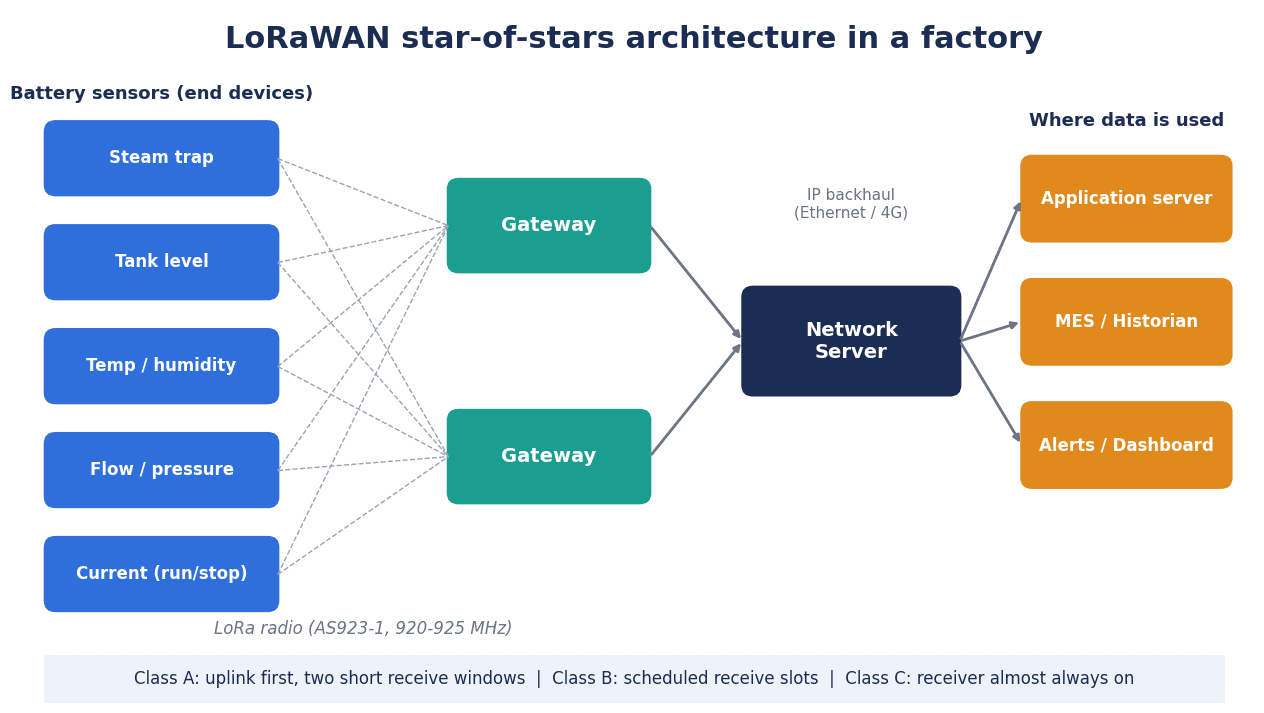
The network takes a star shape called “star-of-stars.” According to the specification, gateways relay communication between end devices and the network server, and gateways connect to the network server over standard IP connections. End devices send to one or more gateways over single-hop wireless. This is where it differs from mesh wireless: in the basic configuration, end devices do not relay for one another (the relay specification mentioned in a later chapter is an additional mechanism for places radio cannot reach). Translated into a factory setup, the flow looks like this.
| Layer | Role | Factory example |
|---|---|---|
| End device (sensor) | Sends measured values over the air. Mostly battery-powered | Steam trap, temperature and humidity, flow, pressure and tank level sensors |
| Gateway | Receives radio and passes it to the IP network. Several gateways may receive the same transmission | Boiler room, warehouse ceiling, outdoor pole |
| Network server | De-duplication, end device authentication, data rate management, scheduling of downlinks | On-site server or cloud |
| Application | The side that uses the data | Monitoring screens, MES, historian, maintenance system |
There are three classes of end devices. The specification requires all end devices to implement at least Class A.
| Class | How it works | Suitability in a factory |
|---|---|---|
| Class A | Opens two short receive windows right after the end device transmits. Data the server wants to send at other times waits until the end device’s next transmission | Lowest power consumption. The basis for battery-powered sensors |
| Class B | Synchronizes time using gateway beacons and opens receive windows (ping slots) at scheduled times | When you want somewhat consistent downlink response times |
| Class C | Always receiving, except while transmitting and during the two receive windows | For equipment with ample power. Not suited to battery power |
The specification also states that an end device supporting Class B must not enable Class B and Class C at the same time. In a factory sensor network, Class A is sufficient for almost all measurement points.
Another important concept is the spreading factor (SF). Raising the SF extends range and improves receiver sensitivity, but sending the same amount of data takes longer. According to The Things Network (TTN) documentation, LoRa modulation has six levels from SF7 to SF12, and the higher the SF, the longer the radio is active and the shorter the battery life. Example receiver sensitivities are −123 dBm at SF7 and −137 dBm at SF12. According to Semtech’s explanation, each step up in SF improves sensitivity by about 2.5 dB at the cost of doubling the symbol period. The link layer specification also describes the choice of data rate as “a trade-off between communication range and message duration.”
The mechanism that adjusts this SF and data rate automatically for each end device is ADR (Adaptive Data Rate). The specification says the network side can manage the data rate and transmit power of each end device to maximize both end device battery life and overall network capacity.
Use Cases That Suit Factories and Those That Do Not
The first thing to do in a LoRaWAN factory deployment is to sort the measurement points. Decide which points go on wireless and which stay wired, based on interval, data volume and tolerance for delay.
The unsuitable uses are clear. The paper “Understanding the Limits of LoRaWAN,” accepted by IEEE Communications Magazine in 2017, points out that industrial control loops can require response times of around 1 ms to 100 ms, whereas even a small 10-byte packet takes about 40 ms to transmit at SF7, so LoRaWAN cannot be a candidate for industrial automation. Because the access method is ALOHA and transmissions can collide, deterministic behavior cannot be guaranteed either. The paper’s analysis mainly assumes the European 868 MHz band and its duty cycle constraints, but its conclusion that LoRaWAN is not suited to control applications serves as a guide when sorting use cases in a factory.
On the other hand, the same paper says that for a small network, under conditions such as using the minimum SF, it may be able to serve uses such as sampling every second. In addition, research from an Italian university (a preprint of a paper accepted by the journal Sensors in 2022) evaluated the latency and reliability limits of LoRaWAN for gas-detection wearables in plants with major accident risk, proposed a method that coordinates end device transmissions using downlink control packets, and ran experiments in an environment close to a factory. However, this is research that found plain LoRaWAN insufficient and added its own coordination control. It does not mean LoRaWAN can be used for safety applications as is.
Based on the above, the table below gives a guide to sorting. The interval and delay columns are examples of how to think about sorting measurement points.
| Example measurement point | Typical interval | Data volume | Delay tolerance | Fit with LoRaWAN |
|---|---|---|---|---|
| Steam trap status | Every few tens of minutes to 1 hour | Status and temperature | Can wait tens of minutes | Suitable |
| Tank level | Every few minutes to few tens of minutes | One level value | Can wait a few minutes | Suitable |
| Temperature and humidity in warehouses and raw material stores | Every few minutes to few tens of minutes | Two values | Can wait a few minutes | Suitable |
| Flow and pressure (for totals and trends) | Every few minutes | A few values | Can wait a few minutes | Suitable |
| Running status via current sensor | Every few minutes, or on change of state | Status and current value | Can wait a few minutes | Suitable |
| Instruments on outdoor piping and wastewater treatment | Every few minutes to 1 hour | A few values | Can wait a few minutes | Suitable |
| Vibration waveforms, sound waveforms | Continuous | Large | Can hardly wait | Not suitable |
| Equipment control, interlocks | Milliseconds | Small | Cannot wait | Do not use |
| Safety-related stop signals | Milliseconds | Small | Cannot wait | Do not use |
One use case example is Yokogawa Electric’s XS822 steam trap monitor (Sushi Sensor). According to the manufacturer’s documents, it judges trap status as one of three states, “Good,” “Cold” and “Blow through,” using temperature and acoustic sensors, and can monitor equipment across a wide area of up to 1 km within a plant. Battery life is stated as 10 years under the conditions of a 1-hour update interval and an ambient temperature of 23±2°C. The documents also state that it supports intrinsic safety explosion protection (Ex ib IIC T4 Gb) and that either a cloud or an on-premises configuration can be chosen. All of these figures are values under the stated conditions.
Sensor selection and acceptance for each use case are covered in detail in the following articles.
- Steam traps: article on wireless steam trap monitoring
- Tank level: article on tank level monitoring
- Temperature and humidity: article on temperature and humidity monitoring systems
- Flow: article on flow meter monitoring
- Running status via current: article on machine monitoring with current sensors
For thinking about interval and data volume, the principle “choose by interval, not by accuracy” from our article on sensor types applies directly.
Where LPWAN Fits as a Factory Sensor Network: Differences from Other Wireless Methods
LoRaWAN is not the only wireless option in a factory. Wireless LAN, private 5G, Thread, DECT NR+, IO-Link Wireless and others each have different strengths. Here we compare only the concepts. Specific figures for range, battery life and latency are not listed side by side in this article, because the assumptions differ greatly from method to method.
| Method | Key concept | Main factory use examples | Details |
|---|---|---|---|
| LoRaWAN | Star topology. End devices send to gateways in a single hop. Designed for battery-powered end devices sending small data at intervals. In Thailand, follows the 920-925 MHz rules | Monitoring utilities and outdoor equipment scattered across the site | This article |
| Wireless LAN | Centered on access points, handles relatively large data. End devices often have power | Lines, offices, handheld terminals | Wireless LAN article |
| Private 5G | A private cellular network centered on base stations. Follows the spectrum licensing regime | Moving equipment, large data volumes | Private 5G article |
| Thread | An open IPv6-based protocol, built on low-power IEEE 802.15.4 | Connecting and controlling building equipment | Thread Sub-GHz article |
| DECT NR+ | An ETSI standard (DECT-2020 NR). Said to use internationally license-exempt bands such as 1.9 GHz | From connecting many end devices to low-latency uses | DECT NR+ article |
| IO-Link Wireless | Wirelessly connects sensors and actuators inside machines | Rotating and moving parts | IO-Link Wireless article |
As key points for each method, the Thread Group describes Thread as an open IPv6-based protocol, based on the low-power IEEE 802.15.4 MAC/PHY, for connecting and controlling devices in homes and buildings. According to the IEEE ComSoc Techblog (October 2021), DECT NR+ (ETSI DECT-2020 NR) was, at an ITU-R WP 5D meeting, set to be included in the next revision of ITU-R M.2150. Its proponents describe it as “the world’s first non-cellular 5G technology standard.”
As seen in the specification, LoRaWAN’s distinguishing feature is the star-of-stars structure in which end devices reach gateways in a single hop. Because end devices do not relay for one another, an end device only needs to wake up for its own transmissions, which suits battery operation. In exchange, an end device that cannot reach a gateway cannot connect. This is why gateway placement and the site survey matter.
For detailed selection of the other methods, see the following articles.
- Article on Thread Sub-GHz selection for factory IoT
- Article on DECT NR+ deployment for factory IoT
- Article on private 5G factory deployment
- Article on factory wireless LAN design
- Article on IO-Link Wireless implementation
In a real factory, there is no need to cover everything with one method. A natural combination is wireless LAN for lines and offices, LoRaWAN for utilities scattered across the site, and wired or IO-Link inside machines.
LoRaWAN Thailand AS923: Frequencies and Radio Rules
When using LoRaWAN in Thailand, the first things to check are the frequencies and the rules. These need to be understood accurately, together with their conditions.
The Frequency Plan Is AS923-1
In the country table of the LoRa Alliance regional parameters specification (RP002-1.0.4, posted on the Resource Hub on September 17, 2023), Thailand is mapped to AS923-1 for 920-925 MHz and to EU433 for 433.05-434.79 MHz. The 920-925 MHz entry carries an “X” mark. This “X” indicates that end devices with LoRaWAN certification that have also obtained Thai type approval exist. It does not mean there are many of them. Note also that this table is a quick reference summarizing each country’s license-exempt bands and recommended channel plans, and it does not indicate whether a permit is required in Thailand.
AS923 has several groups. According to the specification, AS923-1 is the group with a frequency offset of 0 MHz, covering the countries of the “original” AS923, so to speak, with common channels at 923.0-923.5 MHz. Meanwhile, Indonesia, for example, is listed in the same table as AS923-2 at 920-923 MHz. If you plan to use the same equipment in several ASEAN countries, note that different countries can fall into different groups.
The default channels that every AS923 end device has are 923.2 MHz and 923.4 MHz, both within Thailand’s 920-925 MHz range. Data rates are determined by SF and bandwidth, and the specification’s table defines them as follows.
| Data rate | Modulation | Bit rate |
|---|---|---|
| DR0 | SF12, 125 kHz | 250 bit/s |
| DR1 | SF11, 125 kHz | 440 bit/s |
| DR2 | SF10, 125 kHz | 980 bit/s |
| DR3 | SF9, 125 kHz | 1,760 bit/s |
| DR4 | SF8, 125 kHz | 3,125 bit/s |
| DR5 | SF7, 125 kHz | 5,470 bit/s |
| DR6 | SF7, 250 kHz | 11,000 bit/s |
| DR7 | FSK | 50 kbps |
The application data that can be sent at one time is also limited. In the specification’s table (repeater compatible, no dwell time limit), it is 51 bytes for DR0-DR1, 115 bytes for DR2-DR3 and 222 bytes for DR4-DR7. When the 400 ms dwell time limit is enabled, DR0-DR1 cannot be used and DR2 allows 11 bytes. Factory sensors often send only a few values, so this is usually sufficient, but if you want to put a measurement point with a larger data volume on the network, check this limit first.
NBTC Rules for 920-925 MHz
Thailand’s National Broadcasting and Telecommunications Commission (NBTC) published, in the Royal Gazette of November 24, 2017, criteria permitting the use of the 920-925 MHz frequencies (signed November 17, 2017). According to a copy of the gazette posted by the Telecommunications Association of Thailand, the key points are as follows.
- 920-925 MHz may be used only for non-voice communication
- Radio equipment other than RFID must have an e.i.r.p. (equivalent isotropically radiated power) of 4 W or less
- Equipment with an e.i.r.p. of 50 mW or less is exempt from licenses for manufacture, possession, use, import and export, and from the radio station license. However, it is not exempt from the license for sale
- Equipment with an e.i.r.p. of 500 mW or less is exempt from licenses for possession, use and export, and from the radio station license. However, it is not exempt from licenses for manufacture, import and sale
- Equipment must conform to NBTC technical standards and undergo equipment inspection and certification (type approval)
- No protection from interference is provided. If the equipment causes significant interference to other licensed frequencies, its use must stop immediately
In other words, you cannot say that “no license whatsoever is needed for LoRaWAN in Thailand.” Even equipment of 50 mW or less needs a license for sale, and equipment above 500 mW up to 4 W is not covered by the exemptions above. For equipment such as gateways whose transmit power can be higher, check which category it will be used in, together with the equipment’s settings. From the factory’s side, the basic rule is to buy type-approved equipment from a dealer that holds the required license. Also, because there is no protection from interference, you cannot count on legal remedies if other equipment in the same band interferes with you. The more important the measurement point, the more you need a mechanism to detect missing data.
Key Points of Technical Standard 1033–2560
The gazette of the same day also contains the technical standard for non-RFID radio equipment for data communication in 920-925 MHz (กสทช. มท. 1033–2560). The key points are as follows.
- e.i.r.p. must not exceed 4 W
- For spectrum access, equipment must satisfy either a duty cycle limit or frequency hopping (FHSS) conditions
- This standard has no provision for LBT (listen before talk, which checks the channel is free before transmitting)
- Unwanted emissions must comply with either the relevant clause of ETSI EN 300 220-1 or US FCC §15.209
Check the specific duty cycle values in the table of this standard. Many LoRaWAN explanations on the internet show duty cycle values from European rules, but those are not Thai rules. The TTN documentation also states that duty cycle limits apply not only to end devices but also to gateways, and recommends calculating time on air to decide transmission intervals.
Regarding type approval, a third-party regulatory update issued on December 4, 2017 (Kiwa/Product Compliance Specialists) summarizes that all non-RFID radio equipment operating in 920-925 MHz will require NBTC type approval. This is a third-party summary as of the 2017 enactment, and the current certification categories could not be confirmed in NBTC primary sources.
Do Not Bring Settings for Japan Over as They Are
RP002 sets the default EIRP for AS923 end devices at 16 dBm. This is a default value (recommendation) in the specification and is separate from Thailand’s legal upper limit (e.i.r.p. 4 W). Also, as RP002 requires AS923 end devices operated in Japan to perform LBT based on ARIB STD-T108, equipment for Japan is configured to fit Japanese rules. Avoid bringing equipment or settings used in Japan to Thailand as they are. Check with the dealer whether the model is a Thai version with Thai type approval.
Check the Regulations at the Time of Procurement
The notification and technical standard introduced in this article date from 2017. Whether they have been revised since could not be confirmed in this article. When procuring, be sure to check with the dealer and the certification body on the current rules, the type approval status of the equipment and its transmit power category.
Choosing End Devices (Sensors): LoRaWAN Certified, AS923-1, OTAA and Batteries
When selecting end devices, check the following four points.
1. Is it LoRaWAN Certified?
According to the LoRa Alliance certification page, there are two routes to certification: using a third-party authorized test house, or Self Test in-house. The same page says the LoRa Alliance certifies end devices that conform to the LoRaWAN standard. The page contains no description of certification for gateways or network servers. In the end-of-2025 report, certified devices exceed 625.
2. Is it the AS923-1 version for Thailand, and does it have Thai type approval?
LoRaWAN Certified and NBTC type approval are different things. The former is conformance to the protocol, the latter conformance to Thai radio rules. We recommend requiring evidence for these two as separate items in the RFP (this is not a requirement of the standard but a suggestion from this article).
3. Does it support OTAA?
The specification requires end devices to implement either OTAA (over-the-air activation, a join procedure over the air) or ABP (activation by personalization, in which keys are written in advance), or both. As we will see in a later chapter, OTAA is recommended from a security standpoint.
4. The battery, and the conditions behind its battery life
For battery-powered end devices, check the battery type and capacity, and under what conditions the battery life value is given. For example, according to an older version of the manufacturer’s document posted by a dealer, Milesight’s EM300-TH temperature and humidity sensor uses a 4,000 mAh lithium thionyl chloride battery (ER18505), with battery life of more than 5 years under the conditions of “10-minute interval, SF10.” This value carries a note that it is “an estimate tested under laboratory conditions.” The protection rating is stated as IP67 and the operating temperature as −30 to +70°C.
The way conditions are written varies from product to product. The Yokogawa Electric XS822 introduced in the previous chapter states 10 years under “1-hour update interval, ambient temperature 23±2°C.” Because what they measure and their transmission intervals differ, you cannot compare these two values side by side to judge which is better. You need to reread the values under conditions close to your own measurement points’ intervals and installation environment.
Also check the protection rating, operating temperature, whether explosion protection is needed (whether the area has flammable gases or dust), mounting method (band clamping to pipes, magnets, screws) and whether the battery can be replaced in the field.
How to Estimate LoRaWAN Battery Life
Battery life drives the cost of a LoRaWAN factory deployment. Yet every battery life figure a manufacturer gives is a value under specific conditions. When translating it to your own conditions, consider that it changes with the following factors.
| Factor | Effect on battery life | How to check |
|---|---|---|
| SF (data rate) | The higher the SF, the longer the transmission time and the shorter the battery life | Distance from the gateway and obstacles. Look at the actual SF in the survey |
| Transmission interval | The shorter the interval, the more transmissions and the shorter the battery life | Decide the required interval for each measurement point |
| Temperature | Manufacturer values may be given under specific temperature conditions (e.g., 23±2°C) | Temperature at the installation site, such as a hot boiler room or direct sunlight outdoors |
| Test conditions | Values under laboratory conditions are estimates | Read the notes in the datasheet |
| Data volume | The more data sent at one time, the longer the transmission time | Narrow down the items sent |
The TTN documentation is clear about the effect of SF. With a higher SF, even the same amount of data takes longer to transmit, the radio is active longer and battery life becomes shorter. According to Semtech’s explanation, each step up in SF doubles the symbol period. In other words, end devices far from a gateway, or in places with many obstacles, end up transmitting at a higher SF and drain their batteries faster. Even the same model can have very different battery life depending on where it is placed.
When deciding transmission intervals, as the TTN documentation recommends, use a time-on-air calculator to find how long one transmission takes, and choose an appropriate transmission interval based on that.
ADR is a means of extending battery life. The TTN documentation says ADR should be enabled on end devices whose radio conditions are sufficiently stable, and that it can generally be enabled on fixed end devices. The Things Stack calculates the margin between the required SNR and the best gateway SNR over the most recent 20 uplinks, and raises the data rate based on that. In the documentation’s example, if the SNR received at SF12 is 5.0 dB, there is a margin of 25 dB, and 12.5 dB remains even after moving up to SF7. Factory sensors are installed at fixed locations, so there should be many situations where ADR can be used.
As a new development, on November 4, 2025, the LoRa Alliance announced RP2-1.0.5, a new version of the regional parameters, adding SF5 (15.6 kbps) and SF6 (9.4 kbps) as new data rates. According to the announcement, SF5 transmits 3 times faster and SF6 1.5 times faster than before, and higher data rates increase network capacity, allowing more end devices to run with the same number of gateways. However, data rate assignments in AS923 and supporting hardware could not be confirmed. Existing AS923 end devices and gateways cannot necessarily use SF5/SF6, so estimate battery life on the current assumption of SF7 to SF12.
In the end, a battery life estimate comes down to a plan for “how many batteries, in how many years, replaced by whom.” In a plant with many points, battery replacement happens somewhere every year. In the estimate later in this article, we also show the sensitivity for the case where battery life is half of what was assumed.
LoRaWAN Gateway Selection
When selecting gateways, look at the installation location (indoor or outdoor), protection rating and operating temperature, backhaul (how the gateway connects to the upstream network), packet forwarder method, number of channels and whether a network server is built in. Below are product examples, based on the manufacturers’ documents.
| Product (per manufacturer documents) | Installation | Protection rating, temperature | Backhaul | Main features |
|---|---|---|---|---|
| Milesight UG65 (North America datasheet) | Indoor (also some outdoor locations such as under eaves) | IP65, −40 to +70°C | Ethernet, Wi-Fi, 4G | 8 channels, SX1302. Built-in network server. Noise analysis. Integration with BMS and PLCs via BACnet/IP and Modbus |
| RAKwireless RAK7289V2/RAK7289CV2 | Outdoor | IP67, −30 to +55°C | Ethernet (PoE), Wi-Fi, LTE Cat-4 (CV2) | SX1303, 8 channels (16 channels optional). AS923-1/2/3/4. Built-in NS (LoRaWAN 1.0.3). LBT optional |
| Kerlink Wirnet iStation 923 MHz (dealer’s product page) | Outdoor | IP67 | 4G, Ethernet | SecureBoot, SecureStorage, OpenVPN/IPsec. Built-in GPS, 4G and LoRa antennas |
A few supplementary notes. According to the manufacturer’s documents, the Milesight UG65 covers up to 15 km line of sight and about 2 km in urban areas, and supports about 2,000 Class A/B/C end devices with uplinks at 10-minute intervals. This is a vendor claim under specific conditions, and it does not mean that one gateway can accommodate the same number in any factory. Power consumption is stated as 2.9 W typical and 4.2 W maximum. Note that the datasheet we could obtain is the North America version, and its certification section is also for North America. The specifications for Thailand and NBTC certification need to be confirmed with the dealer.
According to the manufacturer’s documents, the RAKwireless RAK7289V2 has a receiver sensitivity of −141 dBm at SF12 and supports both packet forwarder and Basics Station configurations. According to the manufacturer’s documents, Semtech’s SX1303 is a new-generation baseband processor for gateways, size and pin compatible with the SX1302, with a fine timestamp function that can be used for location estimation by time difference of arrival (TDOA).
Packet forwarder and Basics Station are methods by which a gateway communicates with the network server. Which one to use depends on what the network server side supports. ChirpStack, introduced in a later chapter, states that it supports both.
Single-channel gateways were explicitly permitted in the RP002-1.0.4 revision. However, being permitted by the specification is a different matter from being able to accommodate as many end devices as a multi-channel gateway. When using one for a permanent factory network, judge carefully from the standpoints of capacity and redundancy.
As a countermeasure for places radio cannot reach, besides adding gateways, there is the relay specification (TS011-1.0.0, announced October 2022). According to an eeNews Europe article, this specification carries LoRaWAN frames in both directions between end devices and gateways and network servers via battery-powered relay nodes, with uses such as meters underground, deep inside buildings or inside metal cabinets. RP002-1.0.4 defines 923.6 MHz as the default relay channel for AS923, and 923.8 MHz for responses. If you use it, confirm in the RFP that the end devices, gateways and network server support relay.
If one gateway stops, all measurement points around it may lose data. If important measurement points are placed so that two or more gateways can receive them, they can withstand the failure of one gateway. In LoRaWAN, multiple gateways receive the same end device’s transmission and the network server de-duplicates it, so this kind of redundancy comes naturally.
LoRaWAN Network Server and the Destination of the Data
Beyond the gateways, you need a network server (NS). Where the NS is placed and who manages it greatly changes operations and how the data is held. There are three broad options.
| Method | Description | Suitable situations | What to check |
|---|---|---|---|
| Self-operated (on site) | Run the NS on an on-site server or the gateway’s built-in NS | You want to keep data on site. You want to integrate with upstream systems on site | Who takes care of server maintenance, backup and updates |
| Cloud (hosted) | Use the NS provider’s cloud | You do not want to operate servers | Where data is stored, contract terms, impact of internet outages |
| Public network | Use a carrier’s LoRaWAN network | Measurement points extend beyond the site | Availability in Thailand, coverage, contract terms |
An example of software used in self-operated setups is ChirpStack. According to the developer’s documents, ChirpStack is an open-source LoRaWAN network server that can handle multiple regional configurations at the same time. For gateway connections, it supports both Semtech’s UDP packet forwarder and Basics Station over WebSocket, and it has built-in support for the FUOTA (firmware updates over the air) specifications (both v1 and v2). It also has an MQTT forwarding function. The license is MIT, and commercial support is by inquiry to the author.
Another example is The Things Stack, developed by The Things Industries. According to its public README, it is an open-source LoRaWAN network server that can be used for both large public networks and small private networks, under the Apache-2.0 license. Hosting and commercial support are stated to be provided by The Things Industries. Note that the shared environment available free of charge (The Things Stack Sandbox) has fair use limits of 30 seconds of uplink time on air per end device per day and 10 downlinks per day. According to the TTN documentation, these limits do not apply when using a private network. Be careful not to apply the behavior you saw when testing on a free shared network directly to your production design.
You can also use a gateway’s built-in NS. The Milesight UG65 and RAK7289V2 from the previous chapter are stated in the manufacturers’ documents to have a built-in NS. This is convenient for small-scale tests, but when you have several gateways, you need to decide which gateway’s NS will aggregate the whole network, and how to restore the NS settings and data if a gateway fails.
As for public networks in Thailand, it was announced in July 2018 that CAT Telecom had begun rolling out a nationwide LoRaWAN network using Actility’s ThingPark (initially in Phuket, then Bangkok). Later, a November 2020 report said the merger of TOT and CAT Telecom would be completed by January 2021, and that the merged entity was expected to become National Telecom (NT). The current availability could not be confirmed in this article. If you are considering a public network, check coverage and contract terms directly with the carrier.
Beyond the NS comes the design of where to send the data. In factories, data is often sent not only to monitoring screens but also to MES, historians and maintenance systems. The following articles are useful references for designing the handoff from the NS to upstream systems via MQTT or APIs.
- Consolidating factory data with MQTT: article on MQTT Sparkplug B implementation
- Choosing devices that connect field equipment to upstream systems: article on IoT gateway selection
- Storing time-series data: article on industrial historian selection
To make clear that the company owns its data, this article bases its estimate on a configuration in which the company owns the NS and the data destination (self-operated). Whichever method you choose, decide before signing the contract who holds administrator rights to the NS and who holds the end device keys.
Security: Keys, OTAA, Frame Counters, 1.0.x and 1.1
According to the LoRa Alliance security FAQ (2nd edition, February 2020, based on specification 1.0.3), LoRaWAN supports mutual authentication, data origin authentication, integrity and protection against replay attacks, all based on AES with 128-bit keys. The points a factory should keep in mind are as follows.
Use OTAA as the basis
An OTAA end device holds a per-device AES-128 root key (AppKey) and creates session keys each time it joins. According to the specification, an ABP end device uses the same session keys for its entire lifetime and cannot update its keys. The specification recommends using OTAA end devices for applications requiring higher security, and the security FAQ also says OTAA should be preferred over ABP for end devices that need high security.
If you use ABP, watch the frame counter
Under the specification, an ABP end device must start its frame counter at 0 at manufacture and must not reset it over the life of the end device. The counter must be retained even if power is cut, for example during battery replacement, and it is required to be stored in non-volatile memory or similar. The frame counter is 32 bits. An end device whose counter returns to 0 at every battery replacement not only fails the specification’s requirement but may also have its data rejected by the network server, which can cause missing data. If you use ABP end devices, include a power interruption test in acceptance.
Keys are unique to each end device
The security FAQ says LoRaWAN has no concept of “default keys” or “default passwords,” and every end device must have unique keys. The end device identifier (DevEUI) is 64 bits, and assigning it requires an organizationally unique identifier (OUI) obtained from the IEEE Registration Authority. Decide how you will receive the key list from the supplier and where you will store it.
Backend communication
Application data is encrypted end to end from the end device to the application server. On the other hand, the backend, such as between the network server and the application server, is protected hop by hop, and the security FAQ recommends HTTPS or VPN technologies. On the gateway side, some products are stated in the manufacturers’ documents to support VPNs (IPsec, OpenVPN, WireGuard, etc.) and SecureBoot.
Differences between 1.0.x and 1.1
According to a 2021 literature review (de Moraes and da Conceição, arXiv 2105.00384), in specification 1.1 two root keys, AppKey and NwkKey, are stored on the end device, and the Join Server was introduced as a new element responsible for end device authentication. Based on 31 studies, the same review organizes areas of vulnerability such as join request messages not being encrypted, frame counter management not being defined in detail in the specification, and key provisioning, storage and use not being defined. This is a review as of 2021. The security FAQ also says threats can arise from the specification, implementation or deployment, and that implementation issues should be addressed by each manufacturer. Check which specification version the equipment supports, consistently across end devices, gateways and NS.
A LoRaWAN network is also part of the factory’s OT network. For the procurement requirements of gateways and servers, the approach in the following articles applies.
Site Survey and Gateway Placement
The number and placement of gateways cannot be decided from drawings alone. Factories have metal structures, tanks, pipe racks, concrete walls, and moving forklifts and materials, and how radio propagates changes from place to place. That is exactly why the basic rule is to decide through a site survey.
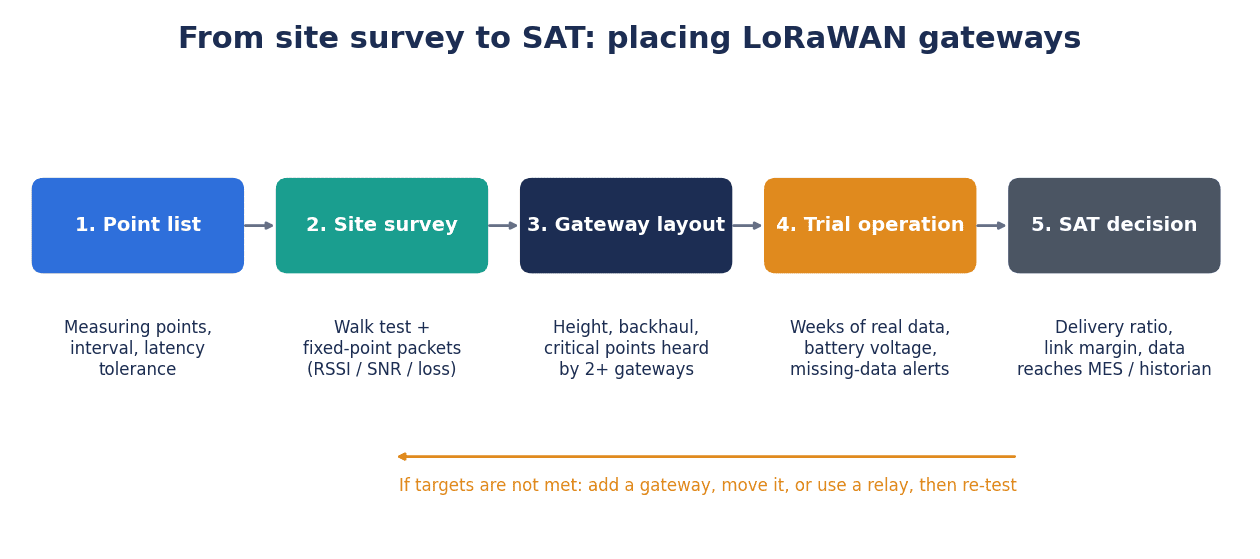
Example Survey Procedure
According to the manufacturer’s documents, RAKwireless’s RAK10701-Plus field tester is a portable device for testing indoor and outdoor LoRaWAN coverage, evaluating gateway placement and optimizing networks. It displays uplink RSSI, SNR, packet loss and information on the gateways that received the packet, and can export to CSV. It is stated to support AS923-1/2/3/4.
The company’s field test procedure uses both walking tests and fixed-point tests. At a fixed point, the device is fixed and kept still while it automatically sends 50 packets, for accurate and repeatable comparison. The procedure notes not to walk, not to rotate the device, not to cover the antenna and not to stand between the device and the gateway.
As a guide to results, the company presents categories such as “Good” when RSSI is stronger than −80 dBm, SNR is higher than 0 dB and packet loss is below 5%. However, this is the company’s guideline, not a value from a standard. There are also gaps between some of the categories, so it is incomplete for use as acceptance criteria as is. Set your own judgment criteria yourself, as in a later chapter.
How to Read RSSI and SNR
According to the TTN documentation, LoRa can demodulate signals weaker than the noise level. So look not only at RSSI (received power; the closer to 0, the stronger) but also at SNR (signal-to-noise ratio). Reception is possible even with a negative SNR, but the lower limit of SNR for reception at SF12 is given as about −20 dB. Factors affecting RSSI include path loss, antenna gain and losses in cables and connectors. Placing a gateway’s antenna inside a cabinet or routing it through a long cable is a disadvantage in itself.
Some gateways, such as the Milesight UG65, are stated in the manufacturer’s documents to have a function (Noise Analyzer) that measures frequency noise for use in channel selection. A factory may contain other equipment using the same band. Since the band offers no protection from interference, it is worth checking the noise situation at the survey stage.
Variation over Time
How radio propagates changes over time. A study published in 2025 (arXiv 2510.04346) measured LoRaWAN reception on one office floor over 12 months and showed that adding environmental variables such as humidity and temperature predicts variation in reception better and also changes the estimate of the required margin (fade margin). This is research in an office, and its figures cannot be applied directly to factories. Still, it shows that “it measured well once, so it will always be good” does not necessarily hold. Build margin into the survey results, and allow a trial operation period to confirm them.
Approach to Placement
As general points, keep the following in mind.
- Place gateways high, without blocking the area around the antenna with metal
- In tank yards and areas with many pipe racks, radio shadows tend to occur, so make it possible to receive from multiple directions
- Confirm that important measurement points can be received by two or more gateways
- For outdoor gateways, check the protection rating, temperature, lightning, and the power and backhaul routes
- Also survey during hours when the equipment is running
Requirements to Include in a LoRaWAN RFP
The table below summarizes requirements you should include in an RFP (request for proposal) when outsourcing a LoRaWAN network. The key point is to state that the number and placement of gateways will be finalized after the survey.
| Item | What to write in the RFP | Points to check |
|---|---|---|
| List of measurement points | Location, measured quantity, interval, delay tolerance and importance of each measurement point | Whether control or safety signals are included |
| Frequency plan | AS923-1 (920-925 MHz). Consistent across end devices, gateways and NS | Whether groups for other countries or settings for Japan are mixed in |
| End device certification | Submit evidence of LoRaWAN Certified and evidence of NBTC type approval separately | Whether model name, part number and regional version match |
| Transmit power and regulatory category | Transmit power settings of end devices and gateways, and their regulatory category | Which of 50 mW or less, 500 mW or less, or 4 W or less applies. Whether the dealer holds a license for sale |
| Gateways | Number and placement to be finalized after the survey. Indoor or outdoor, protection rating, power | Whether important measurement points can be received by two or more gateways |
| Backhaul | Method and route, such as Ethernet, PoE or cellular | Where it connects to the factory network. Handling of failures |
| NS location and rights | On site, cloud or built-in. Holder of administrator rights | Whether settings and data can be taken back when the contract ends |
| Key management and OTAA | OTAA as the basis. Method of handing over and storing keys | Frame counter retention when ABP is used |
| FUOTA | Whether end devices and NS support FUOTA | Update procedure, and how to roll back on failure |
| Data integration | Integration with upstream systems via MQTT, APIs, etc. | Format, frequency, retransmission on failure |
| Handling of missing data | How missing data is detected, notified and recorded | After how many minutes without data a point counts as missing. Detection of gateway outages |
| Battery replacement plan | Assumed battery life and its assumptions, replacement procedure and responsible party | Whether battery level or voltage can be seen upstream |
| Maintenance | Gateway and NS updates, fault response, spare parts | Support structure in Thailand, documentation in Thai |
For FUOTA, the LoRa Alliance publishes a related set of specifications (TS003 for clock synchronization, TS004 for fragmented data block transport, TS005 for multicast setup, TS006 for firmware management and TS007 for multi-package access). End device support differs by model, so we recommend making “whether the end device supports FUOTA” a check item in the RFP (this is a suggestion from this article).
For how to think about interoperability when connecting equipment from different manufacturers, our article on TIS 30162 and industrial IoT interoperability is a useful reference.
If the RFP states not only whether a function exists but also “how that function will be verified in acceptance testing,” it connects directly to the FAT/SAT in the next chapter.
LoRaWAN FAT/SAT and Acceptance Criteria
In FAT (factory acceptance testing, or testing in a simulated environment before deployment) and SAT (site acceptance testing), verify the communication KPIs and how the system behaves when data goes missing. Numerical targets are something you set yourself. Below we show examples of how to set targets, but they are not industry standards.
FAT (testing in a simulated environment)
- Regional settings: Confirm that end devices, gateways and NS are set to AS923-1. Also check that the default downlink receive window (RX2) matches the specification’s default (923.2 MHz, DR2) or the value set in the NS
- Join procedure: Confirm that all end devices can join the network via OTAA
- ADR: Confirm that the data rate changes on end devices with ADR enabled
- Keys: Confirm from the key list that each end device has unique keys
- Power interruption: If ABP end devices are used, remove and reinsert the battery and confirm that the frame counter does not return to 0 and that the NS continues to accept data
- Missing data alarm: Stop an end device’s transmissions and confirm that a missing data notification arrives within the set time. Also confirm the notification when a gateway’s power is cut
- Upstream integration: Confirm that data reaches upstream systems from the NS via MQTT or APIs, and how things are handled when the upstream system is down
SAT (testing in the real environment)
- Operate for a set period in the real environment (for example, several weeks) and check the reception rate of each measurement point. For example, set a higher reception rate target for important measurement points and evaluate them separately from the others
- Record the distribution of RSSI and SNR and the number of gateways that received each measurement point. Check that important measurement points are received by two or more gateways
- Stop gateways one at a time and confirm that important measurement points can still be received by the remaining gateways
- Look at the distribution of data rates (SF) after ADR has settled. End devices skewed toward high SFs may have shorter battery life, so review their placement
- Record battery voltage trends and check for end devices whose voltage drops faster than expected
- Confirm that data reaches upstream systems (monitoring screens, MES, historian) and that timestamps are aligned
- During the transition period, keep paper round records in parallel and reconcile them with the wireless data. If there are discrepancies, investigate the cause before reducing rounds
Missing data can always occur in wireless sensor networks, not only LoRaWAN. Given also that the band has no protection from interference, you need a design that detects and notifies missing data and records the missing periods. How to approach missing data countermeasures and set acceptance criteria is covered in detail in our article on factory sensor data loss countermeasures.
Cost and Benefit Model Estimate (Hypothetical Numbers)
All the numbers from here on are hypothetical numbers for this article. We could not confirm official prices for LoRaWAN equipment, network servers or cloud services, so costs are also placeholders. Primary data for the benefit percentages could not be confirmed either, and they are all assumptions. Use this as a framework for your own estimate.
Assumed plant: A Japanese-affiliated food and chemical plant in Thailand. The site is about 8 hectares. There are 120 utility and equipment measurement points (40 steam traps, 40 temperature and humidity, 30 flow and pressure, 10 tank level). Currently, rounds are made twice a day and recorded on paper.
Current costs (baseline, annual)
| Cost bucket | Baseline (per year) |
|---|---|
| Labor for inspection rounds, manual recording and transcription | 540,000 THB (1,800 hours × 300 THB) |
| Energy and quality losses from late detection of utility abnormalities such as steam, compressed air and cooling | 1,200,000 THB |
| Losses from late detection of tank stockouts and equipment stoppages | 400,000 THB |
Configuration A: Self-Operated LoRaWAN Network (3 Gateways, On-Site NS, 120 Sensors)
Install 3 gateways (2 indoor, 1 outdoor), run the network server on an on-site server and connect 120 sensors.
| Initial cost item | Calculation | Amount |
|---|---|---|
| Gateways | 3 × 60,000 | 180,000 THB |
| Sensors | 120 × 12,000 | 1,440,000 THB |
| Server, upstream integration | — | 400,000 THB |
| Site survey, design, testing | — | 300,000 THB |
| Total initial cost | 180,000 + 1,440,000 + 400,000 + 300,000 | 2,320,000 THB |
Annual operating cost is set at 80,000 THB for battery replacement, 40,000 THB for maintenance and 80,000 THB for server operation, for a total of 200,000 THB/year.
| Benefit (assumed) | Calculation | Annual benefit |
|---|---|---|
| 50% reduction in round labor | 540,000 × 50% | 270,000 THB |
| 30% reduction in utility losses | 1,200,000 × 30% | 360,000 THB |
| 25% reduction in stoppage losses | 400,000 × 25% | 100,000 THB |
| Total benefit | 270,000 + 360,000 + 100,000 | 730,000 THB |
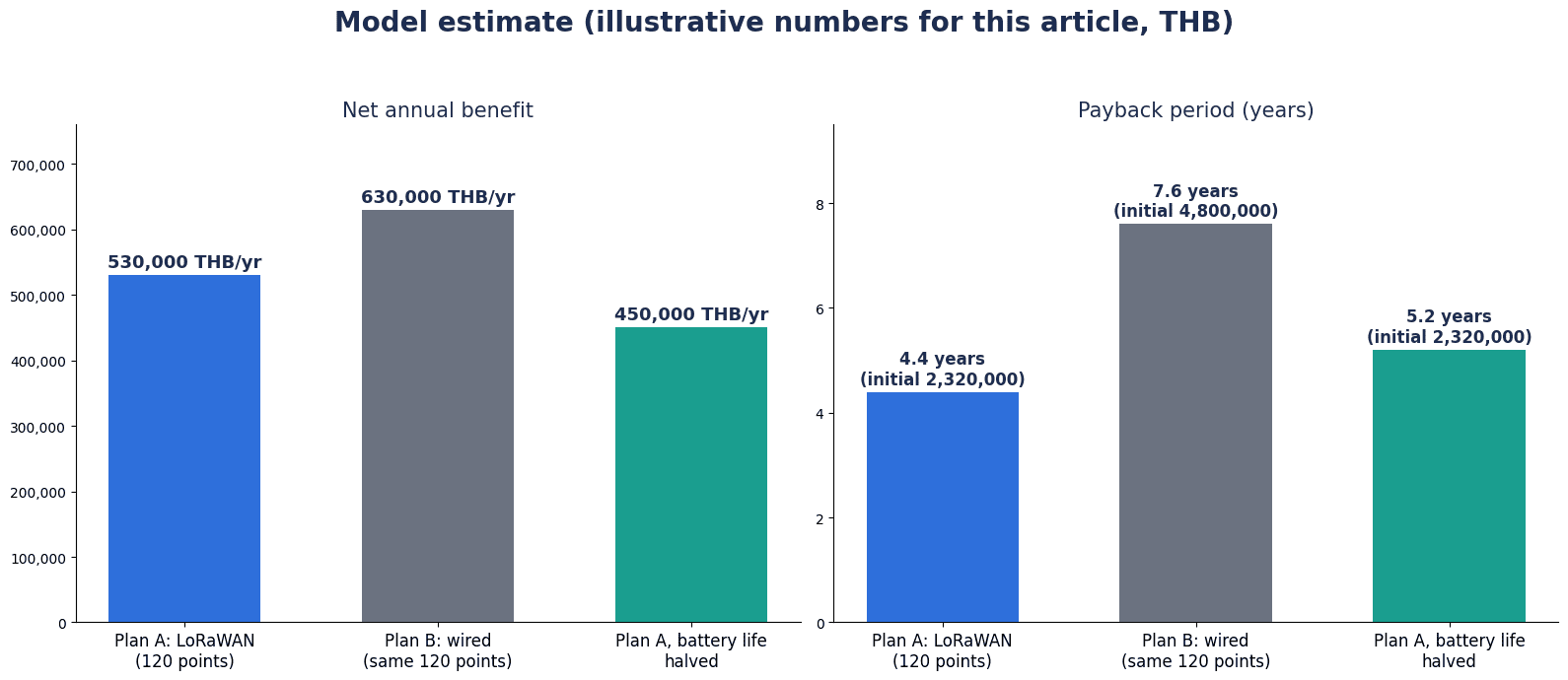
The net benefit is 730,000 − 200,000 = 530,000 THB/year, and the payback period is 2,320,000 ÷ 530,000 ≈ about 4.4 years.
Comparison B: Capturing the Same 120 Points by Wire (Cabling, Remote I/O, PLC)
Compare this with capturing the same 120 points using cabling, remote I/O and a PLC. Cabling work is 120 × 30,000 = 3,600,000 THB, and control panels, design and testing are 1,200,000 THB, for a total initial cost of 4,800,000 THB. With no battery replacement, annual operating cost is set at 100,000 THB/year. The benefit is assumed to be the same as Configuration A, 730,000 THB/year.
The net benefit is 730,000 − 100,000 = 630,000 THB/year, and the payback period is 4,800,000 ÷ 630,000 ≈ about 7.6 years.
Sensitivity: When Battery Life Is Half of What Was Assumed (Configuration A)
If battery life is half of what was assumed and battery replacement costs double to 160,000 THB, annual operating cost becomes 160,000 + 40,000 + 80,000 = 280,000 THB/year. The net benefit is 730,000 − 280,000 = 450,000 THB/year, and the payback period becomes 2,320,000 ÷ 450,000 ≈ about 5.2 years.
| Case | Initial cost | Annual operating cost | Annual benefit | Annual net benefit | Payback period |
|---|---|---|---|---|---|
| Configuration A (self-operated LoRaWAN network) | 2,320,000 THB | 200,000 THB | 730,000 THB | 530,000 THB | About 4.4 years |
| Comparison B (wired) | 4,800,000 THB | 100,000 THB | 730,000 THB | 630,000 THB | About 7.6 years |
| Sensitivity (Configuration A, battery life halved) | 2,320,000 THB | 280,000 THB | 730,000 THB | 450,000 THB | About 5.2 years |
How to Read the Estimate
- The annual net benefit is larger for the wired option with no battery replacement (Comparison B, 630,000 THB/year) than for Configuration A (530,000 THB/year). Even so, because the difference in initial cost (2,320,000 THB versus 4,800,000 THB) is large, payback is faster for wireless, at about 4.4 years versus about 7.6 years
- Of Configuration A’s initial cost of 2,320,000 THB, 1,440,000 THB is sensors. In this estimate, what drives cost is not the gateways but the number of measurement points. Narrowing down to the points you really need when sorting measurement points also pays off in terms of cost
- If battery life is half of what was assumed, the payback period extends from about 4.4 years to about 5.2 years. Battery life is a conditional value, so checking the actual SF in the survey and reviewing transmission intervals also serves as cost management
- When the number of points is small, or for points that already have I/O or a control panel nearby, wired may be more reasonable. You may choose between wireless and wired for each measurement point
- This estimate does not include the impact of equipment shutdowns for cabling work. In plants where shutdowns have a large impact, the advantage of wireless becomes even greater. Conversely, it also does not include the effort of responding to missing data or of checking regulations
How to build up factory IoT costs and how to approach retrofitting existing equipment are covered in detail in our article on factory IoT costs and our article on IoT for existing equipment.
Frequently Asked Questions
What is LoRaWAN?
LoRaWAN is a network protocol optimized for battery-powered end devices, running on top of LoRa, a modulation method that reaches long distances. It takes a star configuration in which end devices send to gateways in a single hop and gateways pass the data to the network server over IP connections. The LoRa Alliance defines the specification, and it has also become ITU-T Recommendation Y.4480. In factories, it suits measuring points scattered across the site with battery-powered sensors every few minutes to every few hours.
Is a license needed to use LoRaWAN in Thailand?
It depends on the conditions. Under the NBTC’s 2017 notification, 920-925 MHz can be used only for non-voice communication, at an e.i.r.p. of 4 W or less. Equipment of 50 mW or less is exempt from licenses for manufacture, possession, use, import and export and from the radio station license, but not from the license for sale. Equipment of 500 mW or less is exempt from licenses for possession, use and export and from the radio station license, but not from licenses for manufacture, import and sale. In every category, conformance to technical standards and type approval are required, and there is no protection from interference. Since later revisions could not be confirmed, check with the dealer and the certification body at the time of procurement.
How long does LoRaWAN battery life last?
It cannot be stated as a single value. Battery life changes greatly with SF, transmission interval, temperature and test conditions. In the manufacturers’ documents, for example, the Milesight EM300-TH is stated at more than 5 years under “10-minute interval, SF10” (an estimate under laboratory conditions), and the Yokogawa Electric XS822 at 10 years under “1-hour update interval, ambient temperature 23±2°C,” but because the conditions differ, they cannot be compared side by side. End devices farther from a gateway transmit at a higher SF, so their batteries drain faster. Check the actual SF in a site survey, and include a battery replacement plan in the budget.
How many gateways are needed?
It depends on the size of the site, buildings and obstacles, the layout of measurement points and their importance, so it cannot be decided from drawings alone. Manufacturers’ documents include figures such as one gateway accommodating many end devices, but all of them are conditional. We recommend measuring radio propagation in a site survey and placing gateways so that important measurement points can be received by two or more gateways. In the RFP, state that the number and placement will be finalized after the survey.
Should we own the network server ourselves?
For plants that want to keep data on site or integrate with upstream systems on site, a self-operated configuration fits. In exchange, your company or a contractor needs to take care of server maintenance, backup and updates. When using a cloud or public network, check where data is stored, the contract terms and the impact of internet outages. Whichever method you choose, it is important to decide before signing the contract who holds administrator rights and end device keys, and whether settings and data can be taken back when the contract ends.
Can LoRaWAN be used to control equipment?
Do not use it for control or safety interlocks. A 2017 paper points out that industrial control loops can require responses of around 1 ms to 100 ms, whereas even a small 10-byte packet takes about 40 ms to transmit at SF7, and that by the nature of its access method, deterministic behavior cannot be guaranteed either. With Class A end devices, instructions from the server wait until the end device’s next transmission. Use LoRaWAN for monitoring status and trends, and leave control to wired or control networks.
How should we choose between it and Wi-Fi or private 5G?
Dividing by data volume and power makes it easier to understand. Video and large data, handheld terminals and moving equipment are the domain of wireless LAN or private 5G. Measurement points scattered across the site, in places without power, sending small data at intervals, are the domain of LoRaWAN. There is no need to cover everything with one method; choose for each measurement point. For how to choose each method, see the wireless LAN and private 5G articles introduced in the main text.
Summary
- LoRaWAN is a sensor network that sends “small amounts of data, over long distances, slowly.” In a factory, it is strong when limited to measuring points you cannot wire, on battery power, every few minutes to every few hours
- It is not suited to control, safety interlocks or high-frequency waveforms. Sort measurement points by interval, data volume and delay tolerance before deciding which points go on wireless
- Thailand’s frequency plan is AS923-1 (920-925 MHz). Under NBTC rules, the scope of exemptions differs across the categories of 50 mW or less, 500 mW or less and 4 W or less, the license for sale is not exempted, and there is no protection from interference. Check for revisions with the dealer and the certification body at the time of procurement
- The AS923 default EIRP of 16 dBm is not Thailand’s legal upper limit. Do not bring equipment or settings for Japan over as they are
- For end devices, check LoRaWAN Certified status and NBTC type approval separately. Use OTAA as the basis, and receive and manage keys that are unique to each end device
- Battery life is a conditional value. It changes with SF, transmission interval, temperature and test conditions. Include a replacement plan in the budget
- Decide the number and placement of gateways through a site survey, and make sure important measurement points can be received by two or more gateways. The judgment guidelines of survey equipment are not values from a standard
- Decide the network server and data destination before signing the contract, including who holds administrator rights and keys
- In the estimate with hypothetical numbers, the self-operated LoRaWAN network (Configuration A) has a net benefit of 530,000 THB/year and a payback of about 4.4 years. The wired option (Comparison B) has a larger net benefit of 630,000 THB/year, but a payback of about 7.6 years. If battery life is halved, Configuration A’s payback extends to about 5.2 years
TOMAS TECH can help even at an early stage, such as sorting which measurement points to put on wireless or planning a site survey. Please contact us through this form.
References
- https://resources.lora-alliance.org/home/ts001-1-0-4-lorawan-l2-1-0-4-specification
- https://resources.lora-alliance.org/home/rp002-1-0-4-regional-parameters
- https://resources.lora-alliance.org/home/lora-alliance-updates-lorawan-regional-parameters-to-improve-smart-city-building-homes-industrial-and-logistics-iot-performance
- https://lora-alliance.org/?p=219640
- https://www.eenewseurope.com/en/new-lorawan-spec-lets-signals-go-where-they-couldnt-go-before/
- https://lora-alliance.org/wp-content/uploads/2020/11/la_faq_security_0220_v1.2_0.pdf
- https://lora-alliance.org/lorawan-certification/
- https://resources.lora-alliance.org/home/lora-alliance-building-block-specifications-of-firmware-updates-over-the-air-fuota
- https://resources.lora-alliance.org/home/lorawan-enters-its-next-growth-phase-as-massive-iot-scales-globally
- https://www.tct.or.th/images/article/member/25601204/920-925MHz.PDF
- https://www.tct.or.th/images/article/member/25601204/no–RFID–920-925.PDF
- https://careers.kiwa.com/globalassets/uk/pcs/regulatory-updates-2017/regulatory_update_thailand_non-rfid_04-dec-17.pdf
- https://www.semtech.com/design-support/faq/faq-lora
- https://www.semtech.com/products/wireless-rf/lora-core/sx1303
- https://www.thethingsnetwork.org/docs/lorawan/spreading-factors/
- https://www.thethingsnetwork.org/docs/lorawan/rssi-and-snr/
- https://www.thethingsnetwork.org/docs/lorawan/duty-cycle/
- https://www.thethingsnetwork.org/docs/lorawan/adaptive-data-rate/
- https://www.chirpstack.io/
- https://github.com/chirpstack/chirpstack
- https://pkg.go.dev/go.thethings.network/lorawan-stack
- https://resource.milesight.com/milesight/iot/document/ug65-datasheet-north-america-en.pdf
- https://docs.rakwireless.com/product-categories/wisgate/rak7289v2/datasheet/
- https://embeddedworks.net/product/sens1354/
- https://spectra.de/media/1f/ee/d8/1639734738/Datasheet-EM300-TH.pdf
- https://web-material3.yokogawa.com/2/38222/details/BU01W06A14-01EN.pdf
- https://yokogawa.com/ca/solutions/products-and-services/measurement/field-instruments-products/sushi-sensor-e/wireless-steamtrap-monitoring-sushisensor
- https://docs.rakwireless.com/product-categories/wisgate/rak10701-plus/datasheet/
- https://docs.rakwireless.com/product-categories/wisgate/rak10701-plus/field-test
- https://arxiv.org/pdf/1607.08011
- https://arxiv.org/pdf/2202.08742
- https://arxiv.org/abs/2510.04346
- https://arxiv.org/pdf/2105.00384
- https://iot-analytics.com/wp-content/uploads/2024/03/INSIGHTS-RELEASE-LPWAN-Market-2024.pdf
- https://www.boi.go.th/upload/content/PR178_2569EN.pdf
- https://www.boi.go.th/upload/content/PR144_2569EN.pdf
- https://www.thestar.com.my/business/business-news/2026/09/30/thai-august-factory-output-rises-444-yy-beats-forecast
- https://www.actility.com/cat-telecom-selects-actility-to-power-rollout-of-thai-national-iot-communication-network/
- https://developingtelecoms.com/telecom-business/operator-news/10311-cat-and-tot-merger-on-track-for-january-deadline.html
- https://techblog.comsoc.org/2021/10/19/etsi-dect-2020-approved-by-itu-r-wp5d-for-next-revision-of-itu-r-m-2150-imt-2020/
- https://www.threadgroup.org/What-is-Thread/Overview


