


At factories in Thailand that start looking at tank level remote monitoring, a familiar scene goes like this. Every morning, a staff member walks around the outside of the factory, reads the level gauges on the caustic soda tank, the acid tank, the diesel tank for the boiler and the adhesive IBC one by one, writes the readings on paper and copies them into Excel back in the office. When something is running low, they phone the chemical maker or the fuel supplier.
The trouble comes not on ordinary days but in the exceptions. After a long holiday weekend, someone finds a tank almost empty and has to request express delivery. A phone call comes in at night asking, “Will it last until tomorrow morning?” Or the opposite happens: an order placed early means that when the tanker truck arrives, the tank still holds a lot of liquid, the full load will not fit and the driver has to take part of it back. This is not unusual at Japanese-affiliated chemical, resin, food, automotive parts, electronic components and metal processing plants in Rayong, Chonburi, Ayutthaya and the Bangkok area.
This article is a practical guide for facilities and utilities staff, purchasing, production control, safety and environment (EHS) and IT staff at such factories. It sets out, for building a system to see tank contents remotely, “what to measure, which level sensor to use, how to communicate, where to make the ordering decision, how to compare options and how to implement.”
First, here is the main argument of this article.
The purpose of tank level remote monitoring is not “making the liquid level visible.” It is to hold, for each tank, numbers that let you decide “when to order, and how many litres.”
There are three typical reasons why stock-outs, express deliveries and near-miss overfills do not decrease even after remote monitoring is introduced.
- (1) The difference between level (mm) and inventory quantity (L, t) has not been worked out, so the inventory figure drifts because of the capacity table, temperature correction and installation conditions
- (2) The reorder point (daily consumption × lead time + safety stock) and the receivable volume (full capacity × upper limit rate − current quantity) have not both been defined
- (3) High-high (HH) overfill prevention is left to the single level sensor used for inventory monitoring
That is why you decide the tank register, the quantity to measure, the ordering rules and the alarm levels before choosing the level sensor technology (radar or hydrostatic). The illustrative calculation later in this article also shows that what decides the payback is not the sensor technology but two things: the actual number of your own emergency orders and express deliveries, and whether you can make use of existing instruments (4-20mA, HART).
Note that this article does not recommend or rank any specific product. It is also not legal, permitting or radio-regulation advice. Thai laws and regulations are presented as “points to check,” and you should confirm the latest requirements with the competent authorities (the Department of Energy Business DOEB, the Department of Industrial Works DIW of the Ministry of Industry, and NBTC) or with experts. All quantities, amounts, hours and costs in the calculation and in the reorder point example are hypothetical figures made up for this article.
Why hold tank contents as numbers now
When production is growing, consumption estimates easily go wrong
Recent figures for Thai manufacturing show that output and orders are growing. According to a Reuters report, the Manufacturing Production Index (MPI) of Thailand’s Ministry of Industry rose 4.44% year on year in August 2026, beating the +1.0% forecast in a Reuters poll. However, the ministry revised the MPI calculation method at this time, for example by adding new electronic products and changing the weights. Figures from August 2026 onward cannot be compared simply with the old series.
The S&P Global Thailand Manufacturing PMI was 54.3 in September 2026 (53.8 in August), its highest level since December 2025. According to a Trading Economics report, output grew at the fastest pace in nine months and new orders were the strongest in six months.
These figures do not go so far as to show that individual factories are changing how they use chemicals and fuel. Still, when production increases, the amount used per day increases, and the old feeling that “ordering roughly once a week is enough” easily goes wrong.
Fuel prices and the handling of subsidies are moving
Fuel prices are also moving. According to a Nation Thailand report, PTT Oil and Retail Business (OR) and Bangchak raised retail prices of gasoline, gasohol and diesel by 0.75 baht per litre on October 2, 2026, bringing diesel (standard) in Bangkok to 42.19 baht/L. This is a retail price and differs from the delivered price a factory pays for tanker deliveries.
A Nation Thailand report on October 7, 2026 said that the Ministry of Energy is considering an exit strategy for fuel subsidies. According to the report, the Oil Fuel Fund Office’s financial report as of October 4 put the net deficit at 98.942 billion baht, and the diesel subsidy has fallen from a peak of 5 to 6 baht per litre to 2 to 3 baht now. Three options, a larger discount on the ex-refinery price, a cut in the diesel excise tax and new government-guaranteed borrowing, have not been approved and are said to be awaiting the energy minister’s policy decision. How prices will move from here has not been decided.
In a period when the unit prices of fuel and chemicals are moving and production is increasing, measured data on how many litres remain in each tank and how many litres are used per day becomes the basis for cost control and ordering decisions.
No direct regulatory change in Thailand could be confirmed
On the other hand, in this research we could not confirm from primary sources any official announcement or regulatory change in Thailand between August and October 2026 directly related to tank level monitoring, level sensors or VMI (vendor managed inventory). This article is not about “installing it because the rules changed.” It is about “what to decide in order to reduce stock-outs, express deliveries and near-miss overfills.”
What is tank level remote monitoring: the flow from tank to order
A flow of five stages
Tank level remote monitoring consists of the following flow.
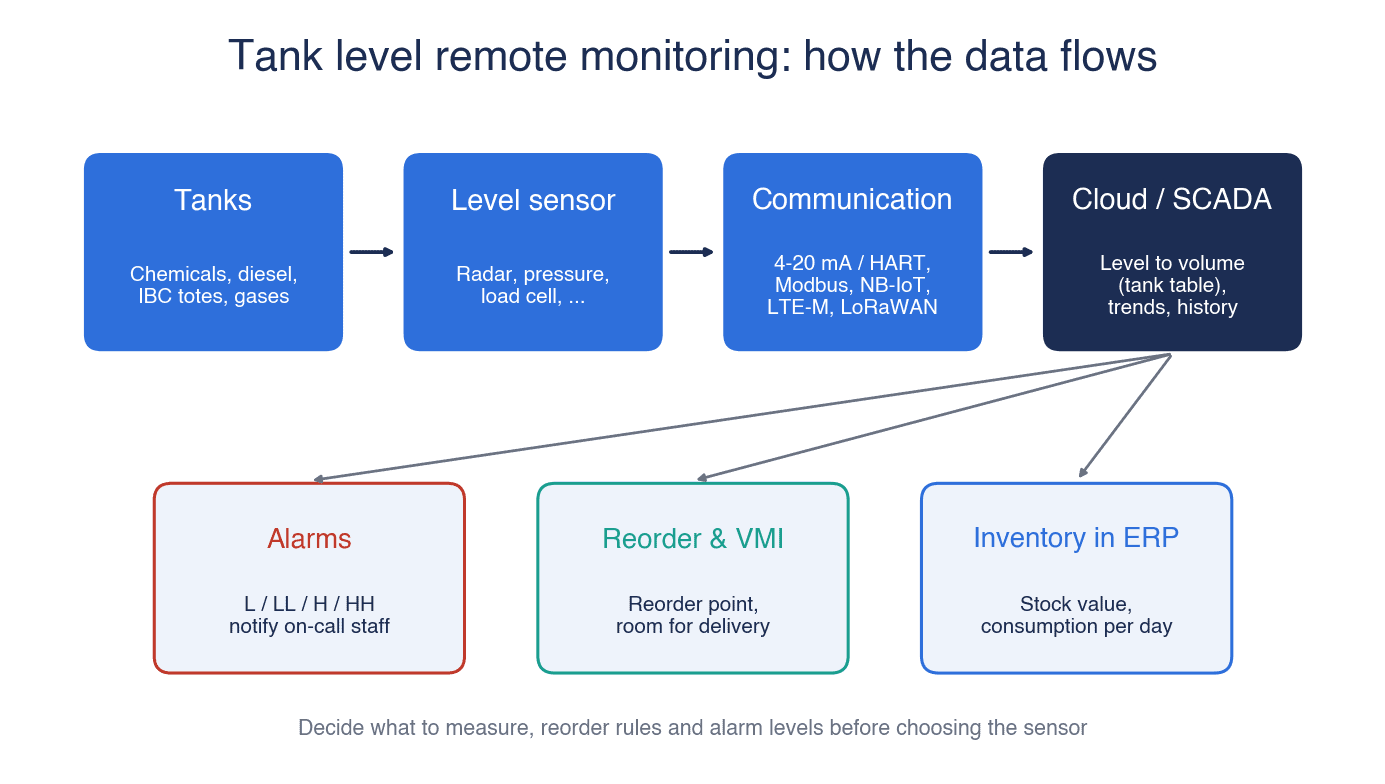
- Tank: chemical tanks, fuel tanks, IBCs and liquefied gas storage tanks
- Level sensor: measures level, pressure or weight
- Communication: wiring to existing PLCs and DCSs, or a gateway, cellular (NB-IoT, LTE-M) or LoRaWAN
- Cloud or SCADA: converts level into volume (L) or mass (t) and keeps the history
- Use: alarms (low level, high level), ordering or replenishment via VMI, and inventory posting in the ERP
Some products provide all five stages together. For example, according to Endress+Hauser’s official documentation, its SupplyCare Hosting is configured as “measuring sensors + data transmission gateway + SupplyCare,” automatically notifies defined stakeholders when an inventory upper limit or safety stock is reached, and recognizes the optimal time to reorder raw materials (vendor claim).
The key is to decide the earlier stages by working backward from the last stage, “use.” The required accuracy and communication frequency change depending on whether you only want alarms, want to automate the ordering decision as well, or want to post ERP inventory from the level.
Relationship with gas suppliers’ telemetry
In Thailand, gas suppliers already have systems to watch customers’ tanks. According to the official page of Bangkok Industrial Gas (BIG, part of the Air Products group), its “BIG Telemetry” automatically monitors the liquefied gas level in customers’ storage tanks and the usage over set periods, and can be used to assess and manage the remaining quantity and to plan the next delivery. The page also states that many customers use this telemetry (vendor claim; no number of customers or effect figures are given).
Some factories will already see their liquid nitrogen and liquid oxygen storage tanks through such services. If so, the tanks you newly want to monitor yourself are the “tanks the supplier is not watching,” such as chemicals, fuel and IBCs. When you first build the tank register, adding a column for “who is watching it” helps avoid duplicate investment.
The moment a lot goes into a tank, lots mix
One more point: tank level monitoring and lot management are separate topics. When a new lot is topped up into a tank, it mixes with what remains of the previous lot. Tank level monitoring tells you “how many litres there are,” but not “how many litres of which lot.” For chemicals that require traceability, you need to design receiving records and the way you think about issuing separately. This is covered in detail, as the problem of tracking breaking where batches merge, in our article on chemical lot management.
Three reasons stock-outs do not decrease even with remote tank monitoring
Reason (1): the difference between level and inventory quantity has not been worked out
What a level sensor outputs is basically “level (mm),” “pressure” or “weight.” What ordering needs is “how many litres (or how many tonnes) there are.” The capacity table and temperature correction connect the two, but if you run on “level X%” while leaving this vague, you will misjudge the remaining quantity, especially in horizontal tanks (a table follows in a later section).
Reason (2): only one of the reorder point and the receivable volume is defined
Many factories have a lower-limit rule: “order when it gets low.” However, an upper-limit rule, “if you order while more than this amount remains, one tanker load will not fit,” is rarely defined. A lower limit alone cannot prevent the failure of ordering too early, and an upper limit alone cannot prevent stock-outs. You need to define, for each tank, the “window” of quantities at which ordering is allowed.
Reason (3): overfill prevention is left to the inventory level sensor
There are cases where a “high level alarm” is set on the inventory level sensor and people assume that overfill prevention is also taken care of. But if the level sensor sticks or communication is lost, both the inventory reading and the high level alarm are lost at the same time. As a principle, the last stage that prevents overfill (HH) should be a system independent of the inventory level sensor. This, too, is explained in a later section together with an example of an accident in the UK.
No official statistics on the effects could be found
In this research we could not confirm any official statistics or academic surveys, with a clearly stated survey body, country, industry, year and sample size, on the effects of remote tank monitoring or VMI (reduction rates for deliveries, inventory, stock-outs and so on). Reduction rates sometimes appear in vendor materials, but using figures whose conditions are unknown for your own investment decision is risky.
That is why this article recommends not borrowing effect figures from outside, and instead starting by measuring the consumption, lead time and number of emergency orders for each of your own tanks.
What to measure: the three layers of level, volume and mass
Three layers
The “remaining quantity” in a tank has the following three layers.
| Layer | Unit | How it is obtained | Points to note |
|---|---|---|---|
| (1) Level | mm | Radar, ultrasonic, guided wave radar, float and so on | Without knowing the tank shape, it cannot be turned into a quantity |
| (2) Volume | L (for fuel, also L converted to a reference temperature) | Level × capacity table, temperature correction | Accuracy of the capacity table, and volume change with temperature |
| (3) Mass | t, kg | Load cells, hydrostatic pressure and density | If density changes, the conversion from hydrostatic pressure drifts |
Level sensors measure (1) directly, and load cells measure (3) directly. To convert to (2), which is used for ordering and inventory posting, you need a capacity table (tank calibration) and, for fuel, temperature correction.
Chemical tank inventory management sometimes uses mass
For chemicals such as caustic soda and acids, the purchasing unit is often tonnes or kilograms, and holding inventory as mass can match purchasing better. A 2021 METTLER TOLEDO document describes weighing with load cells as one of the most accurate methods of tank inventory management, and claims that non-contact level measurement and most flow meters can only obtain volume. However, this is a comparison claim by a weighing equipment maker itself, and retrofitting an existing tank requires modifying the support structure to turn the tank into a weighing device. Neither can be said to be better across the board; decide based on the purchasing unit and the existing conditions.
Capacity tables are built from tank calibration
The “capacity table (strapping table)” used to convert level into volume is built on the basis of tank calibration. The American Petroleum Institute (API) Manual of Petroleum Measurement Standards (MPMS) includes Chapter 2.2A (2nd edition, November 2019), which gives the calibration procedure for vertical cylindrical tanks, and Chapter 2.2E / ISO 12917-1:2002, which gives the manual calibration method for horizontal cylindrical tanks. According to the API catalog, the latter covers stationary horizontal cylindrical tanks up to 4 m in diameter and 30 m in length, applies to dished, flat, elliptical and hemispherical heads, and can be applied to tanks tilted up to 10% from horizontal if a correction for the measured tilt is made.
In other words, for horizontal tanks the relationship between level and volume changes with the shape of the heads and the tilt. Values calculated only from the full capacity and diameter on the maker’s nameplate will not give correct inventory figures.
In horizontal cylinders, volume is not proportional to level
Calculating the relationship between level and volume for a horizontal cylindrical tank as an ideal cylinder (excluding heads and tilt) gives the following. This is a geometric calculation made for this article, not figures published in a source.
| Level (% of diameter) | Volume (% of full capacity) |
|---|---|
| 5% | 1.9% |
| 10% | 5.2% |
| 20% | 14.2% |
| 30% | 25.2% |
| 50% | 50.0% |
| 80% | 85.8% |
| 90% | 94.8% |
| 95% | 98.1% |
If you treat the level % directly as the remaining quantity % when deciding to order, you overestimate the remaining quantity on the low-level side. Even if the display shows a level of 10%, the volume is only about 5%. It is exactly on this low-level side that stock-outs tend to happen. Conversely, on the high-level side, at a level of 90% the volume has already reached about 95%. For actual volumes, use a calibrated capacity table.
Fuel changes volume with temperature
The volume of fuel changes with temperature. API MPMS Chapter 11.1 gives algorithms for correcting the effects of temperature and pressure on the density and volume of liquid hydrocarbons: crude oil, refined products and lubricating oils. Natural gas liquids (NGL) and liquefied petroleum gas (LPG) are outside the scope of this standard. Chapter 9.1 gives the procedure for correcting density measured with a hydrometer to the value at 15 °C or 60 °F.
Fuel is sometimes traded and managed by volume at a reference temperature, but we have not been able to confirm whether fuel deliveries to factories in Thailand are made on a reference-temperature basis. Check at what temperature the volume on your fuel supplier’s delivery note is stated, and align your inventory calculation with it.
How to think about accuracy: instrument accuracy and inventory accuracy are different things
The “±1mm” or “±2mm” in a level sensor catalog is the accuracy of the instrument alone. The accuracy of the inventory quantity (L) is a different thing, and it is the combination of the following four.
- Instrument accuracy (mm)
- Accuracy of the capacity table (whether it is calibrated; heads and tilt of horizontal cylinders)
- Temperature and density correction
- Installation and the state of the liquid surface (foam, agitation, nozzle position)
In a horizontal cylinder, the same 1mm level error gives the largest volume error near the middle (where the liquid surface is widest), and a smaller one at the top and bottom ends. This property follows from the geometry of chords of a circle and is an explanation made for this article.
In practice, first decide “how many litres of inventory error would not get in the way of ordering decisions.” For example, for a tank ordered in units of one tanker load of several thousand litres, competing on instrument accuracy in mm will not change the ordering decision. Conversely, if there is no capacity table and you are calculating from the nameplate, no matter how accurate a level sensor you install, the inventory figures will not be right. It is often the capacity table, rather than the instrument, that deserves the money.
Level sensor selection: strengths and weaknesses of each technology
Main technologies
Endress+Hauser’s selection guide (CP00023F) lists radar, guided wave radar, hydrostatic and differential pressure, ultrasonic, servo, capacitance and radiometric as technologies for continuous level measurement in liquids. Organizing the ones often used for factory tanks gives the following.
| Technology | Measuring principle | Instrument accuracy stated in the company’s documents | Conditions that can affect function and accuracy (company’s documents) |
|---|---|---|---|
| Radar (non-contact) | Reflection of radio waves | 80 GHz ±1mm, 26 GHz ±2mm, 6 GHz ±6mm | Foam, extremely turbulent surfaces, obstacles and interference reflections in the beam. Relative permittivity below 1.2 is an application limit |
| Guided wave radar (contact) | Reflection time of high-frequency pulses along a probe | Under 15m ±2mm, over 15m ±10mm | Extreme buildup. Applications with agitators, extreme foam and relative permittivity below 1.4 are application limits |
| Ultrasonic (non-contact) | Round-trip time of sound pulses | ±2mm, ±0.2% of measuring distance | Foam, boiling surfaces, condensation, high vapor pressure, temperature layers in the gas phase, sudden temperature changes |
| Hydrostatic and differential pressure (contact) | Pressure of the liquid column | Up to ±0.025% of the set span | Turbulent surfaces, density changes, dynamic pressure from agitators (differential pressure) |
| Capacitance (contact) | Capacitance between the probe and the tank wall | ±1% of measuring distance | Plastic tanks, extreme conductive buildup, agitator blades, relative permittivity below 2.0 |
All sources are Endress+Hauser technical documents, and the values are the maker’s figures for the instrument alone (vendor claim). As written in the previous section, this is not the accuracy of the tank’s inventory quantity.
Floats are classed as point level detection (switches) in the company’s documents. If you have existing float-type level gauges, check the type of signal (contact or continuous output).
Quick reference by condition
Combining the selection guide table in the same document with technical documents from other makers, the options can be organized by condition as follows.
| Tank condition | Technologies that tend to suit | Technologies that are unfavorable or need checking |
|---|---|---|
| Much foam or vapor | Hydrostatic and differential pressure, guided wave radar (dense foam needs checking) | Ultrasonic |
| Agitators or internal structures | High-frequency radar with a narrow beam (80 GHz) | Guided wave radar (unsuitable for applications with agitators) |
| Liquid density changes | Radar, guided wave radar, ultrasonic | Hydrostatic |
| Pressurized, high vapor pressure | Radar, guided wave radar, hydrostatic and differential pressure | Ultrasonic |
| Plastic tanks | Technologies other than capacitance (there are also battery-powered radars marketed for IBCs and plastic containers) | Capacitance |
| IBCs, mobile containers | Battery-powered wireless radar | Technologies that assume wiring |
| Want to hold by weight, complex shape | Load cells | Level sensors (a capacity table is required) |
On beam width, a VEGA blog post (2020) says that the beam angle is determined by the transmission frequency and the effective antenna diameter, and that with 80 GHz and an 80mm antenna the beam angle is 3°, while typical ultrasonic sensors and 26 GHz radars with the same antenna diameter are about 10°. The explanation is that a narrow beam is less affected by pipes, pumps and buildup on the walls (vendor claim).
Foam needs care. Emerson’s explanation of guided wave radar says it is less affected by foam, vapor, buildup and density changes, while on the same page it also writes that “high-density foam can be a source of error” (vendor material). The effect of foam depends on the nature of the foam, and the reliable way is to check with actual equipment using your own liquid and operating conditions.
Selection example for horizontal cylindrical tanks
Endress+Hauser’s documents also include a selection example for horizontal cylindrical storage tanks. Under the conditions of a calm surface, accuracy of 3 to 10mm, top mounting without a stilling well and a tank diameter of 3m or less, the first recommendation is radar among non-contact technologies and guided wave radar among contact technologies. As application limits of radar, it lists “heavy foam,” “many obstacles” and “low relative permittivity (below 1.2),” and shows guided wave radar, hydrostatic and others as alternatives in those cases (vendor claim).
Point level detection is covered in another article
This article deals with the continuous level of storage tanks and its use for inventory and ordering. Choosing point level sensors that detect “liquid present or absent” inside equipment is covered in detail in our article on capacitive level sensor selection. It is also useful when you install independent point detection for low or high level separately from the inventory level sensor.
The option of reading existing analog gauges with a camera for now
If existing tanks already have sight glass level gauges or dial-type level gauges, you may not be able to replace the level gauges right away. In that case, one option is to read the existing gauges with a camera for the time being. This lets you build up measured consumption data first while reducing the patrol workload. The approach and its acceptance testing are summarized in our article on analog gauge reading AI.
Explosion protection and ingress protection
How Zone classification works
The area around solvent and fuel tanks may be a hazardous area where an explosive atmosphere can occur. The classification of areas (Zones) is organized by IEC/ATEX-type definitions. Schedule 2 of the UK’s DSEAR 2002 (definitions of area classification based on the ATEX directive) defines them as follows.
- Zone 0: a place in which an explosive atmosphere of air with gas, vapor or mist is present continuously, or for long periods or frequently
- Zone 1: a place in which it is likely to occur occasionally in normal operation
- Zone 2: a place in which it is not likely to occur in normal operation and, if it does occur, will persist for a short period only
For dusts, Zones 20/21/22 are defined in the same way. The international standard for the classification of gas and vapor areas is IEC 60079-10-1:2020 (Edition 3.0). However, these are definitions in UK law and an international standard. We have not confirmed the legal basis for area classification in Thailand.
Examples of product certification statements
On the level sensor side, check the certifications for explosion protection and ingress protection. For example, according to VEGA’s official documentation, VEGAPULS Air 23 has ingress protection IP69 and ATEX/IEC certifications for intrinsic safety “i” and dust ignition protection “t.” Endress+Hauser’s selection checklist lists Ex (Ex ia, Ex d), WHG, marine approvals, EHEDG, 3-A, SIL and others as approval items (both are vendor materials).
The area classification cannot be decided from the level sensor side. Based on your own hazardous area drawing, confirm with the competent authority and experts, and then choose equipment with certifications suited to that area. When placing battery-powered wireless equipment in a hazardous area, you also need to check the procedure for replacing batteries.
Communication and power: existing signals or battery-powered wireless
If you have an existing DCS or PLC, start with the existing signals
If level sensors are already installed and their signals go into a PLC or DCS, first consider making use of those signals. Endress+Hauser’s selection checklist lists 2-wire and 4-wire as electrical connections, and HART, PROFIBUS, Ethernet-APL, FOUNDATION fieldbus and others as digital communication. The company’s configuration example for chemical distributors shows a gateway with four 4 to 20mA analog inputs, Modbus TCP and a Modbus-to-HART (multidrop) converter sending data to the cloud over Ethernet, WiFi or cellular. A vendor article in a trade magazine about VEGA’s inventory management system says that with HART multidrop, up to 15 sensors can be connected to one controller (all vendor claims).
As the calculation later shows, whether you can make use of existing signals has a large effect on the payback.
Battery-powered wireless for outdoor tanks without wiring and for IBCs
For outdoor tanks without wiring and for mobile IBCs, battery-powered wireless level sensors are used. According to official documentation, there are products such as the following (all vendor claims).
- Endress+Hauser Micropilot FWR30: 80 GHz, maximum measuring distance 30m, accuracy ±2mm in liquids, NB-IoT / LTE-M / 2G (fallback), battery powered, GPS position tracking for mobile tanks, operating temperature −20 to +60 °C
- VEGA VEGAPULS Air 23: 80 GHz, measuring range 3m, accuracy ±5mm, NB-IoT / LTE-M / LoRaWAN, no external power required, for level measurement in IBCs and plastic containers, mounted with adhesive or tension straps
The 920–925 MHz band in Thailand
In Thailand, equipment that uses the 920–925 MHz band, such as LoRaWAN, is subject to NBTC standards. The NBTC notification and technical standard published in the Royal Gazette on November 24, 2017 (original in Thai) provide as follows.
- The 920–925 MHz band is limited to non-voice communication
- Equivalent isotropically radiated power (e.i.r.p.) is 4 W or less
- Equipment of 50 mW or less is exempt from licenses for manufacturing, possession, use and so on, and from the license to establish a radio station (the license for sale is not exempt)
- Spectrum access is either by duty cycle (per hour, bandwidth of 500 kHz or less; 1% for under 50 mW, 10% for over 50 mW up to 4 W) or by frequency hopping
- There is no protection from interference, and if the equipment causes serious interference to other licensed communications, its use must be stopped immediately
A 1% duty cycle becomes a constraint on the design of transmission frequency and data volume. We have not been able to check primary sources for the name of the LoRaWAN channel plan in Thailand, so this article does not state it definitively. These are the standards we could confirm as of October 2026, and we have not checked whether they have been amended since. Check the compliance of each device with the vendor.
Cellular (NB-IoT, LTE-M)
On cellular, AIS announced in an advertorial in May 2018 that it had covered 77 provinces with NB-IoT in February 2018. This is a 2018 advertorial and does not describe coverage or service conditions as of 2026. Also, a technical note from one IoT device maker (Digital Matter, updated September 29, 2026) states, as the company’s own observation, that AIS’s NB-IoT operates on band 8 and LTE-M on band 3.
Tanks are often in places where radio signals do not reach easily, such as in the shadow of buildings, near metal structures or in underground pits. Be sure to check the radio signal at the installation location before implementation.
Battery life varies greatly with measurement frequency
The life of battery-powered equipment varies greatly with measurement frequency, communication method and radio conditions. For example, FoxInsights’ official page says its FoxRadar Gen 4 lasts “more than 10 years with one measurement per day,” and lists, by method, 7 to 12 years for Cat-M, 5 to 10 years for NB-IoT and 2 to 5 years for 2G (manufacturer’s stated values). Even for the same product, the range in years differs this much depending on conditions.
Some tanks need only one value per day for ordering decisions, while for receiving or for fast-consuming tanks you may want to increase the frequency. Check under what frequency and method conditions the battery life in the specification applies, and ask for an estimate at your own operating frequency.
Comparison of communication methods
| Aspect | Existing 4-20mA, HART, Modbus | Battery-powered cellular (NB-IoT, LTE-M) | LoRaWAN (920–925 MHz) |
|---|---|---|---|
| Suitable tanks | Tanks with existing level sensors and PLCs | Outdoor tanks without wiring, IBCs | Sites with many sensors on the premises |
| Power | Existing instrument power | Battery | Battery (the gateway needs power) |
| Main points to check | Free PLC inputs, how to take off the signal | Radio signal at the installation location, conditions for battery life | NBTC standards, duty cycle, gateway installation |
| When communication is lost | Depends on monitoring on the PLC or DCS side | Behavior on transmission failure and retransmission | Health monitoring of the gateway |
Design on the assumption of data loss
Whatever the method, periods when communication is lost and values do not arrive will certainly occur. The danger is that the screen looks “normal” with the last value received. You need a design that shows the time of the last reception and raises a “data loss” alarm if nothing arrives within a set time. How to monitor data loss and set acceptance criteria is summarized in our article on factory sensor data loss prevention.
How to set the reorder point and the receivable volume
Define two quantities for each tank
Ordering rules need two quantities.
- Reorder point: the quantity below which you place an order. Reorder point (L) = average daily consumption × lead time (days) + safety stock
- Receivable volume: the quantity that can be received from a tanker right now. Receivable volume = (full capacity × allowable upper limit rate) − current quantity
The thinking behind the reorder point is based on the standard textbook treatment of inventory management. Lecture material from the University of Iowa in the US defines safety stock as “the reorder point minus the expected demand during the lead time,” and explains that variation in demand during the lead time arises from both variation in daily demand and variation in the lead time. It also says that a long lead time without variation can require less safety stock than a short lead time with large variation.
In other words, whether the “how many days from order to delivery” of your fuel supplier or chemical maker is stable is as important a piece of information as the tank capacity. In the tank register, record not only the average lead time but also the record of delays.
Example of fuel tank level management (hypothetical figures)
Let us apply numbers using a diesel aboveground tank used for a boiler and an emergency generator as an example. All of the following are hypothetical figures made up for this article. The 90% upper limit is an example applying “fuel shall not be filled beyond 90% of the capacity” from Thailand’s 2008 ministerial regulation on fuel oil storage premises (as far as we could read it in the unofficial English translation). Please check with the competent authority which category your own tank falls into and what the requirements are.
- Tank capacity: 10,000 L (maximum 9,000 L with the 90% upper limit)
- Daily consumption: 400 L/day
- Replenishment lead time: 3 days
- Safety stock: 2 days’ worth (800 L)
- Delivery quantity of one tanker: 6,000 L
Reorder point = 400 × (3 + 2) = 2,000 L
Receiving condition: for 6,000 L to fit at the time of delivery, the quantity remaining at delivery must be 9,000 − 6,000 = 3,000 L or less. Since 400 × 3 = 1,200 L is used in the 3 days from order to delivery, the quantity remaining at the time of ordering must be 3,000 + 1,200 = 4,200 L or less.
Therefore, the window in which ordering is allowed is a remaining quantity of 2,000 to 4,200 L.

- If you order at 2,000 L: the quantity at delivery is 2,000 − 1,200 = 800 L (the 2 days of safety stock), and after delivery it is 800 + 6,000 = 6,800 L
- If you order at 4,500 L: the quantity at delivery is 4,500 − 1,200 = 3,300 L, and adding 6,000 L gives 9,300 L, which exceeds the 9,000 L upper limit. The full load will not fit
This is what is really behind “ordering too early so the full tanker load does not fit.” If only the lower-limit reorder point is set as an alarm, this failure happens when a staff member thoughtfully orders early. If the monitoring screen shows both the reorder point and the “upper limit for ordering” calculated back from the receiving limit, decisions will be consistent no matter who places the order.
Monitoring of combustion, efficiency and statutory inspections of the boiler itself is a separate topic from this tank. The measurement points on the boiler side are covered in our article on boiler remote monitoring.
Looking at days of coverage
Many products calculate daily consumption from the level time series and display “days of coverage” (inventory ÷ daily consumption). For example, a vendor article in a trade magazine about VEGA’s inventory management system says it displays daily consumption and days of coverage for liquid inventory. Endress+Hauser’s SupplyCare lists trends and history, and PowTechnology’s brochure lists forecasts based on recent history, as functions (all vendor claims).
In the example above, the reorder point of 2,000 L is 5 days’ worth at 400 L/day. Rephrasing it in days, “order when less than 5 days remain,” makes it easier to communicate to both the shop floor and purchasing. However, when production increases and daily consumption changes, the reorder point also needs to be reviewed. At first, a rule of reviewing it once a month using measured consumption is the safe approach.
Alarm level design and overfill prevention
Four alarm levels
Alarms for tank level monitoring are easier to organize if you think of them in the following four levels.
| Level | Meaning | What to do | System |
|---|---|---|---|
| L (low) | Reorder point | Place an order (or the VMI supplier plans replenishment) | Inventory level sensor |
| LL (low-low) | About to run out | Emergency replenishment, adjusting consumption, notifying production | Inventory level sensor (separate point detection also for pump protection) |
| H (high) | Guide for stopping receiving | Have the receiving operator get ready to stop | Inventory level sensor |
| HH (high-high) | Just before overfill | Stop, for example by automatically closing the receiving valve | Detection and shutoff independent of inventory monitoring |
L and H are “business alarms,” and LL and HH are “alarms that protect safety and production.” HH in particular should be on a system separate from the inventory level sensor.
What the Buncefield accident in the UK showed
An accident in the UK illustrates well why HH should be independent. According to the 2011 report “Buncefield: Why did it happen?” by the UK Health and Safety Executive (HSE), on December 10 to 11, 2005, while gasoline was being received into Tank 912 at the Buncefield oil storage depot in the UK, the level gauge (a servo-type automatic tank gauge) had stuck and the independent high level switch was also in an inoperable state. There was no means of warning the control room of the dangerous level, gasoline overflowed from the roof vents, and the vapor cloud ignited, leading to a massive explosion and a fire that lasted five days.
The report also points out the following.
- After the level gauge returned from maintenance on August 31, 2005, it had stuck 14 times by December 11, but the root cause was not identified and the fault records were not consistent
- The independent high level switch needed a padlock to keep its test lever in the operating position, but this was not communicated to the installer, the maintenance contractor or the operator, and the padlock was not fitted
- The level gauge had three high level alarms, “user high,” “high” and “high-high,” but each supervisor used them differently, and sometimes receiving continued beyond high-high
This was an accident at a large fuel depot in the UK and differs in scale from small tanks at a factory. Even so, three lessons apply directly to factory tanks as well: “high-high level detection independent of the level gauge,” “recording instrument faults and finding their causes” and “aligning the operating rules for alarm set points.”
Example of the US underground tank rules (for reference)
As a reference example of staged alarms and shutoff, there are the US rules for underground storage tanks (UST) (40 CFR 280.20). They require overfill prevention equipment to do one of several things, such as automatically shutting off at no more than 95% of full capacity, or restricting flow or alerting the receiving operator with a high level alarm at no more than 90% of full capacity. In addition, 40 CFR 280.35 requires overfill prevention equipment to be inspected at least once every 3 years to confirm that it operates at the specified level.
These are US rules for underground tanks and do not apply to factories in Thailand. They are introduced as a reference for the idea of “dividing alarms and shutoff into stages and regularly confirming that the shutoff works.”
Leak and theft detection
Noticing from sudden changes in the remaining quantity
Tank level monitoring data can also be a clue for noticing leaks or theft. According to official documentation, Endress+Hauser’s SupplyCare advertises notification when “unauthorized movement” is detected, and PowTechnology’s monitoring system advertises theft and leak alerts, as functions (vendor claims). The idea is to detect sudden changes, such as the remaining quantity falling at night or on holidays when production is stopped, or rising when there has been no receiving. No figures on detection accuracy are given in the published materials.
If you set it up yourself, decide thresholds from your own consumption record, such as “a decrease of X L or more at night or on holidays” or “a decrease per hour of X times the usual or more.” At first there will be many false alarms, so adjust them with real data during the PoC.
Bunds and gas leak detection are separate systems
Detecting sudden changes in level is a way of learning about a leak afterwards, as a change in “quantity.” What catches the leaked liquid is the bund. Thailand’s 2008 ministerial regulation on fuel oil storage premises (unofficial English translation) provides that a bund or wall large enough to hold fuel equal to the largest tank capacity is to be provided around Class 2 aboveground tanks.
For leaks from liquefied gas storage tanks, the basic approach is to detect them directly with gas detectors rather than waiting for a change in level. Detecting sudden changes in level and detecting gas leaks are different in both purpose and mechanism. The design of gas leak detection is covered in our article on gas leak detection systems.
VMI (automatic replenishment) or ordering yourself
What is VMI
VMI (vendor managed inventory) is a model in which the supplier watches the level in the customer’s tank and takes responsibility for replenishment. A vendor article in a trade magazine about VEGA’s inventory management system lists two operating models: “in-house inventory monitoring” and “VMI (the supplier watches the level at the customer’s site and replenishes).” Endress+Hauser’s documentation for chemical distributors also lists collaborative planning for VMI, and automatic planning and reminders to prevent missed deliveries, as requirements (vendor claims).
Even at major companies, telemetry customers and order-based customers coexist
According to an explanatory document prepared in April 2015 by the R&D division of the French industrial gas major Air Liquide (a problem description for an optimization challenge; the company’s own document), its bulk delivery operations worldwide involve more than 2,500 trucks, 40,000 tanks and 350 dispatchers. While it practices VMI, monitoring customer inventory with telemetry and forecasts to manage deliveries, “call-in (order-based) customers” without telemetry or forecasts remain, “fewer than before but still a significant number.” This is a single company’s document as of 2015 and contains no figures on financial effects.
From the factory side as well, not every tank needs to be on VMI. A mix is realistic: liquefied gas through the gas supplier’s telemetry, some chemicals through the chemical maker’s VMI, and fuel and the remaining chemicals ordered by yourself.
Decide not only “sharing data” but also “who decides”
One empirical study on VMI is the 2014 paper by Dong, Dresner and Yao (Production and Operations Management). According to its abstract, it analyzed the effects of VMI for downstream firms using item-level data, and found that moving the ordering decision to the vendor had effects beyond those of information sharing alone. However, the abstract does not state the industry, country or number of companies, and the study is not limited to liquids in tanks. Here it is introduced only as a qualitative point: “what works is not just showing the data, but deciding who decides replenishment.”
If you adopt VMI, you need to settle the following points in the contract.
- Who decides replenishment, at what threshold and with what lead time
- Whether the upper limit of the receivable volume (full capacity × upper limit rate) becomes a rule the supplier also follows
- Ownership of and access rights to the level data (which tanks, who, and to what extent can see them)
- Who checks when communication is lost
- Division of responsibility when a stock-out occurs or an overfill is about to happen
Examples of products and services, and aspects for comparison
Here are examples of products and services, within the range we could confirm in official documentation. All are vendor claims, not recommendations or rankings. Prices are not given.
- Endress+Hauser SupplyCare Hosting: cloud software for inventory management of tanks and silos. Inventory display as tables, graphs and maps, notifications of limit values and unauthorized movement, data export, master data for tanks, sites, customers and products, user roles, RESTful API. Said to enable VMI and SMI (supplier managed inventory) business models
- VEGA Inventory System: integrates level sensors with cloud inventory management software. Four types of display: numeric tables, color-coded graphics (from “Reorder” to “Safety stock”), maps and trends; a dispatch module; and integration of other makers’ instruments if they can be connected to a signal converter (vendor article in a trade magazine). It also states explicitly that moving from manual work requires training, changes to work processes and agreement among stakeholders
- PowTechnology (UK): supports sensors such as hydrostatic, ultrasonic, radar, load cell and capacitance, and lists multiple high and low level alarms, theft and leak detection, and an audit trail for invoice verification as functions
- FoxInsights FoxRadar: a battery-powered radar for distributors managing many tanks in the field
- BIG Telemetry: a gas supplier’s service in Thailand that monitors the level and usage of liquefied gas storage tanks
When comparing, line them up by the following aspects rather than by product name.
| Aspect | What to check |
|---|---|
| Volume conversion | Whether your own capacity table can be registered for conversion from level to volume (L, t). Whether free capacity can be displayed |
| Alarms | Whether multi-level alarms can be set. Whether notification recipients can be changed per tank |
| Consumption and forecasting | Whether the calculation methods for daily consumption, days of coverage and forecasts are disclosed |
| Master data and permissions | Master data for tanks, sites and products. Whether the scope shown to suppliers can be limited |
| Integration | Data export, API, track record of integration with ERP and purchasing systems |
| Other makers’ instruments | Whether signals from existing level sensors of other makers can be taken in |
| Delivery planning | Whether a delivery planning function on the supplier side is needed (often unnecessary if you order yourself) |
What to check in Thai laws and regulations
Four areas
The laws and regulations you will want to check when designing tank level monitoring in Thailand fall into the following four areas. This section is not legal advice. The provisions are those we could confirm from public materials as of October 2026, and we have not been able to check whether there have been later amendments. Confirm the latest requirements with the competent authorities (the Department of Energy Business DOEB, the Department of Industrial Works DIW of the Ministry of Industry, and NBTC) or with experts.
| Area | Scope confirmed | Relationship to tank level monitoring |
|---|---|---|
| Fuel oil (diesel, heavy oil and so on) | The Fuel Oil Control Act and the ministerial regulation on fuel oil storage premises B.E. 2551 (2008, unofficial English translation). Chapters are divided by Classes 1 to 3 | 90% filling limit, leak testing, record keeping |
| Chemicals (hazardous substances) | The four categories of the Hazardous Substance Act B.E. 2535 (1992, unofficial English translation). The Ministry of Industry’s hazardous substance “storage” notification B.E. 2551 excludes storage in tanks and silos from its scope | Hazardous substance rules that apply to tanks could not be confirmed in this research |
| LPG, LNG, liquid nitrogen and so on | For storage tanks in factories, there is a separate group of ministerial regulations that we did not check this time | Liquefied gas needs to be checked separately |
| Radio | NBTC standards for the 920–925 MHz band (2017 Royal Gazette) | Compliance of LoRaWAN and other equipment |
Fuel oil: what can be read in the 2008 ministerial regulation (unofficial English translation)
In the English translation of the Fuel Oil Control Act (2nd amendment, B.E. 2550), “fuel oil” includes LPG, crude oil, diesel oil, heavy oil, lubricating oil and others. On the other hand, in the 2008 ministerial regulation on fuel oil storage premises (as far as we could confirm in the unofficial English translation posted on the Department of Energy Business website), natural gas and LPG are excluded from fuel oil as used in that regulation. Storage premises are divided into chapters for Class 1, Class 2 and Class 3 based on the notification and permit categories, and the requirements for notification and permits, tank construction and testing change by category.
The main points we could confirm in this unofficial English translation are as follows.
- Clause 4: fuel shall not be filled into a fuel container beyond 90% of its capacity
- Class 2 aboveground tanks: a bund or wall large enough to hold fuel equal to the largest tank capacity is to be provided around them. A leak test is to be conducted after installation, and tanks are to be tested by the same method every 10 years. The operator is to keep records of test results for 1 year and make them available for inspection by the Department of Energy Business
- Class 3 large tanks: specifications for open/close valves, safety devices and so on are to be submitted to the Department of Energy Business for approval before installation, and after installation a qualified engineer is to inspect them at least once a year, with reports kept for 1 year
The 90% in Clause 4 serves as the basis for setting the H alarm in tank level monitoring and the upper limit of the receivable volume in the previous section. The quantity thresholds for which category applies are set in a separate ministerial regulation and are not given in this article. Since we have also not been able to confirm whether there have been amendments after 2008, do not treat this as definitively “the current rules”; treat it as what can be read in the unofficial English translation of the 2008 ministerial regulation.
Chemicals: the hazardous substance “storage” notification excludes tanks
In the unofficial English translation of the Hazardous Substance Act B.E. 2535 (commissioned by the Office of the Council of State), hazardous substances are divided into four categories: Category 1 must follow prescribed criteria and procedures, Category 2 must be notified in advance, Category 3 requires a permit, and Category 4 is prohibited. Which substance falls into which category is announced by the Minister of Industry in the Royal Gazette. This English translation carries a disclaimer that it has no legal effect and that only the original Thai text is authoritative.
A point to note is the Ministry of Industry notification “on the storage of hazardous substances under the responsibility of the Department of Industrial Works” B.E. 2551 (Royal Gazette of April 18, 2008, original in Thai). This notification explicitly excludes storage in tanks, silos and cryogenic liquefied gas containers from its definition of “storage.” The storage premises it covers are warehouse buildings that store hazardous substances. Therefore, it cannot be said that “chemical tanks are regulated by this notification.” Nor, however, can it be said that “Thailand has no regulations on chemical tanks.” This is because in this research we could not confirm the content of the hazardous substance or factory law rules that apply to tanks. For chemical tanks, please check with the Department of Industrial Works and experts.
Check LPG and liquefied gases separately
For storage tanks of LPG, LNG, liquid nitrogen and so on in factories, there is a separate group of ministerial regulations that we did not check this time. When designing tank level monitoring for liquefied gas storage tanks, please confirm the requirements with the supplier and the competent authority.
Model calculation of costs and benefits (hypothetical figures)
Assumed factory
All figures from here on are hypothetical figures made up for this article. For the actual effects, replace these figures with your own measurements.
- A Japanese-affiliated chemical and resin plant in Rayong Province
- 10 tanks to be monitored: 6 chemical tanks, 2 diesel and heavy oil tanks, and 2 IBCs for adhesives, paints and the like
- Currently, staff patrol and read visually, record in Excel, and order by phone and email
Benefit (1): reducing patrol inspections
- Current: 2 times a day × 10 tanks × 5 minutes = 100 minutes/day. 100 minutes × 30 days = 3,000 minutes = 50 hours/month
- 50 hours × 200 THB × 12 months = 120,000 THB/year
- After implementation, only checks in exceptional cases, 10 hours a month: 10 hours × 200 THB × 12 months = 24,000 THB/year
- Benefit (1) = 120,000 − 24,000 = 96,000 THB/year
Benefit (2): reducing emergency orders and express deliveries
- Current: 12 times a year × surcharge of 8,000 THB = 96,000 THB/year
- After implementation: 2 times a year × 8,000 THB = 16,000 THB/year
- Benefit (2) = 96,000 − 16,000 = 80,000 THB/year
Benefit (3): reducing safety stock
- Average inventory value of chemicals and fuel: 1,200,000 THB → 900,000 THB (a reduction of 300,000 THB)
- Storage and capital cost rate of 20%/year: 300,000 × 20% = 60,000 THB/year
The point to note here is that the 300,000 THB of cash freed up by the lower inventory is a one-time effect. It is not included in the annual benefit. What counts as an annual benefit is only the 60,000 THB cost of continuing to hold the inventory that has been reduced (storage and capital cost). Including both 300,000 THB and 60,000 THB in the annual benefit would count the same inventory reduction twice.
Total benefit
96,000 + 80,000 + 60,000 = 236,000 THB/year
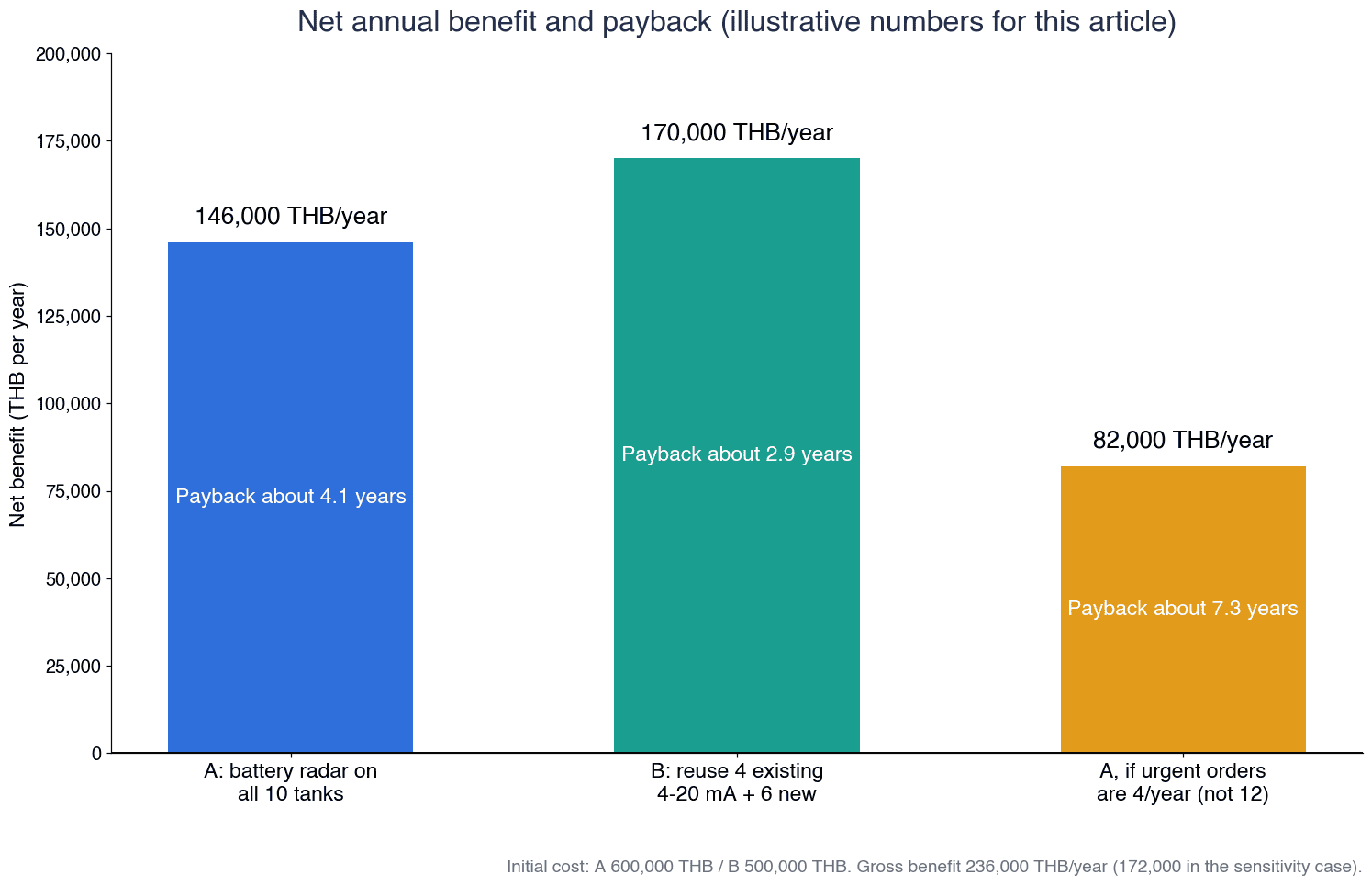
Configuration A: battery-powered 80 GHz radar on all 10 tanks
- Initial cost: sensors 10 × 45,000 = 450,000 THB, setup, installation, threshold design and training 150,000 THB, total 600,000 THB
- Annual cost: communication and cloud 10 × 6,000 = 60,000 THB, maintenance 30,000 THB, total 90,000 THB
- Net benefit: 236,000 − 90,000 = 146,000 THB/year
- Payback: 600,000 ÷ 146,000 ≈ about 4.1 years
Configuration B: take signals for the 4 existing tanks from the existing PLC
For the 4 tanks that already have level sensors, the 4-20mA signals are taken from the existing PLC, and battery-powered radars are installed only on the remaining 6 tanks.
- Initial cost: taking off signals from the 4 existing tanks 4 × 20,000 = 80,000 THB, new installation 6 × 45,000 = 270,000 THB, setup and so on 150,000 THB, total 500,000 THB
- Annual cost: communication and cloud 6 × 6,000 = 36,000 THB, maintenance 30,000 THB, total 66,000 THB
- Net benefit: 236,000 − 66,000 = 170,000 THB/year
- Payback: 500,000 ÷ 170,000 ≈ about 2.9 years
Sensitivity: if emergency orders were 4 a year instead of 12 (Configuration A)
Consider the case where measurement shows that emergency orders were 4 a year, not 12.
- Benefit (2): 4 × 8,000 = 32,000 THB → 2 × 8,000 = 16,000 THB, so the benefit is 16,000 THB/year
- Total benefit: 96,000 + 16,000 + 60,000 = 172,000 THB/year
- Net benefit: 172,000 − 90,000 = 82,000 THB/year
- Payback: 600,000 ÷ 82,000 ≈ about 7.3 years
How to read the calculation
Putting the three side by side, the payback ranges from about 2.9 years to about 7.3 years. What creates this difference is not the sensor technology.
- (1) Whether your own emergency orders and express deliveries are on the order of 12 a year or 4 a year
- (2) Whether you can make use of the signals from existing instruments
It is these two. That is why the first job, before comparing level sensor catalogs, is to count the number of emergency orders and express deliveries over the past year from purchasing records, and to take stock of the existing level sensors and free PLC inputs. How to estimate costs and think about TCO for factory IoT in general is summarized in our article on factory IoT costs.
What is not included in this calculation
- Losses from line stoppages and stock-outs
- Damage from overfill and leak accidents
- Changes in ordering administration from moving to VMI
- CO2
In particular, prevention of overfill and leak accidents is not included in this calculation, but in design it is treated as the top priority. Think of independent HH detection and shutoff as necessary regardless of the payback period.
Items to check in the RFP and demos
Conditions to collect for instrument selection
Before choosing level sensors, collect the following conditions for each tank. The items are based on Endress+Hauser’s selection checklist.
| Category | Conditions to collect |
|---|---|
| Medium | Name of the liquid, density (g/cm³), conductivity (μS/cm), relative permittivity, tendency to build up, how foam forms |
| Process | Temperature, pressure, vapor pressure (minimum and maximum), presence of agitators |
| Tank | Height, diameter, shape (vertical, horizontal, IBC), material (metal, plastic), nozzle dimensions, mounting position, presence of a stilling well |
| Electrical and communication | 2-wire or 4-wire, existing signals (4-20mA, HART, Modbus), free PLC inputs |
| Approvals and certificates | Explosion protection certification, ingress protection, material certificates, calibration certificates |
Items to check in the RFP
| Item | What to check |
|---|---|
| Volume conversion | Whether your own capacity table can be registered. How temperature correction for fuel is handled |
| Ordering rules | Whether both the reorder point and the “upper limit for ordering” can be displayed and alarmed |
| Alarms | Settings for L / LL / H / HH. On the assumption that HH is an independent system, what the inventory monitoring side is responsible for |
| Notifications | Notification recipients per tank, recipients at night and on holidays, escalation when not acknowledged |
| Data loss | Display of the time of last reception, data loss alarms, handling of data after communication recovers |
| Integration | Integration with purchasing and ERP (automatic creation of order requests, or notification only) |
| Inspection and calibration | How level sensors are inspected and calibrated, calibration certificates, how fault records are kept |
| Permissions | Scope shown to suppliers, user roles |
On inspection and calibration, include the following in the operating requirements: operating overfill prevention equipment regularly to confirm it works (in the US UST rules example, at least once every 3 years), the leak testing and record keeping in Thailand’s fuel oil ministerial regulation (2008, unofficial English translation), and the Buncefield lesson of “consistently recording instrument faults and finding their causes.” Refer as needed to tank calibration for capacity tables and to standard practice for calibrating and verifying automatic tank gauges (API MPMS Chapter 3.1B).
Integration with order approval and purchasing procedures is covered in our article on purchasing management systems. If tank level monitoring automatically creates “order requests,” who approves them needs to be aligned with the rules on the purchasing side.
What to confirm in the PoC, FAT and SAT
- Readings with the actual liquid: whether readings with your own liquid are stable when foam forms, during agitation and when the surface is disturbed during receiving
- Volume conversion: whether the volume converted from level matches the quantity on the delivery note (check using the difference before and after receiving)
- Alarm triggering and notification: whether L, H and data loss alarms reach the designated people within the designated time. Test at night and on holidays too
- Behavior on communication loss: whether the screen shows “data loss” when communication is cut, and whether the data is filled in when it recovers
- Order integration: whether an order request is created at the reorder point and flows into purchasing approval
How to proceed: 90 days from tank register to rollout decision
Days 1 to 30: tank register, and measuring consumption and lead time
- Build a register of all tanks: contents, capacity, shape, material, location, explosion protection zone, existing instruments and signals, and who is watching it (yourself, the gas supplier, the chemical maker)
- Count the number of emergency orders and express deliveries over the past year from purchasing records
- Work out daily consumption for the main tanks from patrol records and delivery notes
- Collect the average lead time and the record of delays for each supplier
- Check whether capacity tables exist (for horizontal tanks without one, consider whether calibration is needed)
Days 31 to 60: PoC on 2 to 3 tanks
- Choose tanks with different conditions: for example, a chemical tank that foams, an outdoor diesel tank and an IBC
- Check the radio signal at the installation locations
- With the actual liquid, confirm reading stability, agreement between volume conversion and delivery notes, alarms and notifications, and behavior on communication loss
Days 61 to 90: finalize ordering rules and alarms, and decide on rollout
- Decide the reorder point and the “upper limit for ordering” for each tank
- Decide the alarm levels (L / LL / H / HH) and notification recipients, and check whether an independent HH system is needed
- Separate tanks to be put on VMI from tanks you will order yourself, and if VMI, organize the contract points
- Redo the calculation with the PoC measurements (number of emergency orders, use of existing signals) and decide the scope of rollout
What to check especially at factories in Thailand
Language of screens and notifications
Often, shop floor staff use Thai, Japanese managers use Japanese, and communication with headquarters and vendors is in English. Check whether screens, alarm notifications and reports can be produced in Thai, English and Japanese. Prepare alarm messages in Thai so that “what happened” and “who does what” are clear at a glance.
Notification recipients at night and on holidays
Stock-outs and near-miss overfills tend to happen at night and on holidays, when few people are around, and before and after long holidays. Decide the notification recipients at night and on holidays, the next contact if a notification is missed, and a rule for the quantity to fill up before long breaks.
Tanker receiving procedure
For receiving tankers from chemical makers and fuel suppliers, it is sometimes not decided who attends and which value they watch to stop receiving. Write into the receiving procedure that the receivable volume is checked on the monitoring screen before receiving, that preparations to stop are made at the H alarm, and that the operation does not rely on the HH shutoff. Prepare the procedure in Thai so that the procedure stays the same even when drivers change.
Hazardous area drawing
Before placing new equipment around solvent and fuel tanks, check whether you have a hazardous area drawing and whether it is up to date. If there is no drawing, confirm the areas with experts before selecting level sensors.
Radio signals
Even within an industrial estate, tank yards may be surrounded by the shadows of buildings and by metal structures. For cellular, measure the radio signal at the installation location; for LoRaWAN, check the gateway location and whether the equipment complies with NBTC standards.
Signals from existing instruments
Check what signal the existing level sensors output (4-20mA, HART, contact, display only), whether that signal goes into the PLC, and whether the PLC has free inputs. Drawings often differ from what is actually installed, so check on site. As the calculation shows, this greatly affects the payback on the investment.
Frequently asked questions
What is tank level remote monitoring?
It is a system that measures the level of chemical tanks, fuel tanks, IBCs and liquefied gas storage tanks with level sensors, sends it via communication to the cloud or SCADA, converts it into volume (L) or mass (t), and uses it for alarms, ordering and inventory posting. Its purpose is not making the liquid level visible, but holding, for each tank, numbers that let you decide “when to order, and how many litres.”
How should level sensor selection be done?
Before comparing technology catalogs, collect for each tank the properties of the liquid (density, relative permittivity, foam, buildup), temperature and pressure, presence of agitators, tank shape and material, mounting position, existing signals and explosion protection zone. Then narrow down by condition, for example hydrostatic or guided wave radar if there is much foam, a high-frequency radar with a narrow beam if there is an agitator, something other than hydrostatic if the density changes, and something other than capacitance for plastic tanks, and confirm with actual equipment using your own liquid.
Can a tank level monitoring system be retrofitted to existing tanks?
In many cases, yes. If there are existing level sensors and PLCs, there is the option of taking off their 4-20mA or HART signals (in this article’s hypothetical calculation, this also had a large effect in keeping initial and annual costs down), and for outdoor tanks without wiring and IBCs, battery-powered wireless radars can be used. If there are only sight glass or dial-type level gauges, there is also the option of reading them with a camera for the time being. Load cells require modifying the support structure, so retrofitting them involves larger construction work.
How should the reorder point be set for fuel tank level management?
Set the reorder point as “average daily consumption × lead time (days) + safety stock.” In addition, set “(full capacity × allowable upper limit rate) − delivery quantity of one tanker + consumption during the lead time” as the upper limit for ordering. In this article’s example with hypothetical figures, for a 10,000 L diesel tank, the window in which ordering is allowed was a remaining quantity of 2,000 to 4,200 L.
What is VMI (vendor managed inventory) with telemetry?
VMI (vendor managed inventory) is a model in which the supplier watches the level in the customer’s tank and takes responsibility for replenishment. In reality, even at major gas suppliers, VMI customers with telemetry and order-based customers coexist. If you adopt VMI, settle in the contract who decides replenishment at what threshold, the receiving upper limit, access rights to the data, and the division of responsibility in case of stock-outs or overfills.
How many years do battery-powered sensors last?
It cannot be stated in general, because it varies greatly with the frequency of measurement and transmission, the communication method (NB-IoT, LTE-M and so on) and the radio conditions at the installation location. Even for the same product, the manufacturer’s stated values can vary by several years. Check under what conditions the battery life in the specification applies, and ask for an estimate at your own operating frequency.
How long does implementation take?
This article introduced a 90-day approach. In the first 30 days, build the tank register and measure consumption, lead time and the number of emergency orders; in the next 30 days, run a PoC on 2 to 3 tanks; and in the last 30 days, finalize the ordering rules and alarms and decide on rollout. Rollout to all tanks and integration with purchasing and ERP are later steps.
Summary
- The purpose of tank level remote monitoring is not making the liquid level visible, but holding, for each tank, numbers that let you decide “when to order, and how many litres”
- The typical reasons stock-outs do not decrease are three: (1) the difference between level and inventory quantity (capacity table, temperature correction, installation) has not been worked out, (2) the reorder point and the receivable volume have not both been defined, and (3) HH overfill prevention is left to the inventory level sensor
- In horizontal cylinders, volume is not proportional to level. Even at a level of 10%, the volume is about 5%. Use a calibrated capacity table for actual volumes
- Narrow down level sensor technologies by conditions such as foam, agitators, density changes, pressurization, plastic and IBCs, and confirm with actual equipment using your own liquid
- Decide ordering by a “window.” In the example with hypothetical figures, the reorder point was 2,000 L and the upper limit for ordering 4,200 L
- Put HH on a system independent of inventory monitoring. Buncefield in the UK (2005) was an accident in which a stuck level gauge and an inoperable independent high level switch coincided
- For fuel oil in Thailand, the 90% filling limit and the testing and record requirements can be read in the 2008 ministerial regulation (unofficial English translation). The Ministry of Industry’s hazardous substance “storage” notification excludes tanks from its scope. In both cases, confirm the latest requirements with the competent authority
- In the hypothetical calculation, the payback ranged from about 2.9 years to about 7.3 years. What decides the payback is not the sensor technology but the actual number of emergency orders and whether you can make use of the signals from existing instruments
At TOMAS TECH, we help factories in Thailand design sensor and equipment monitoring systems, select equipment and run on-site tests, and integrate with existing PLCs and business systems. You can also consult us before choosing a product, for example at the stage of building a tank register, selecting level sensor technologies, designing reorder points and alarms, or drafting RFP requirements. Please contact us via this form.
References
- The Star (Reuters), Thai August factory output rises 4.44% y/y, beats forecast (September 30, 2026)
- Trading Economics, Thailand Manufacturing PMI (October 1, 2026)
- Nation Thailand, OR, Bangchak raise fuel prices by 0.75 baht on October 2 (October 2, 2026)
- Nation Thailand, Energy Ministry weighs exit strategy to cut fuel subsidies as oil fund deficit exceeds 100bn baht (October 7, 2026)
- Endress+Hauser, Continuous level measurement in liquids and bulk solids — Selection and engineering guide (CP00023F)
- VEGA, Radar sensors with strong focusing ensure more precise values in continuous level measurement (June 18, 2020)
- Emerson, Guided Wave Radar Transmitters
- American Petroleum Institute, 2024 Publications Catalog — Petroleum Measurement
- legislation.gov.uk, The Dangerous Substances and Explosive Atmospheres Regulations 2002, Schedule 2
- IEC Webstore, IEC 60079-10-1:2020
- Air Liquide R&D, EURO/ROADEF 2016 Challenge — Inventory routing for gas distribution (April 2015)
- Bangkok Industrial Gas, BIG Telemetry
- Endress+Hauser, Inventory and supply chain solution across depots for a chemical distributor (AI01125S)
- Health and Safety Executive, Buncefield: Why did it happen? (2011)
- Endress+Hauser, SupplyCare Hosting (IN01354S)
- Endress+Hauser, Micropilot FWR30
- VEGA, VEGAPULS Air 23
- Thai FDA data catalog, Hazardous Substance Act B.E. 2535 (1992), Unofficial Translation
- Chulalongkorn University SHECU, ประกาศกระทรวงอุตสาหกรรม เรื่อง การเก็บรักษาวัตถุอันตรายที่กรมโรงงานอุตสาหกรรมรับผิดชอบ พ.ศ. ๒๕๕๑ (Royal Gazette of April 18, 2008, in Thai)
- Department of Energy Business, Ministerial Regulations — Fuel Oil Storage Premises B.E. 2551 (2008), Unofficial Translation
- NBTC, ประกาศ กสทช. เรื่อง หลักเกณฑ์การอนุญาตให้ใช้คลื่นความถี่ย่าน ๙๒๐ – ๙๒๕ เมกะเฮิรตซ์ (Royal Gazette of November 24, 2017, in Thai)
- NBTC, ประกาศ กสทช. เรื่อง มาตรฐานทางเทคนิคของเครื่องโทรคมนาคมและอุปกรณ์ สำหรับเครื่องวิทยุคมนาคมที่ไม่ใช่ประเภท RFID ซึ่งใช้คลื่นความถี่ย่าน ๙๒๐ – ๙๒๕ เมกะเฮิรตซ์ (กสทช. มท. 1033–2560, Royal Gazette of November 24, 2017, in Thai)
- eCFR, Code of Federal Regulations 40 CFR §280.20
- The University of Iowa (Dennis Bricker), Reorder Point (lecture slides)


