


A purchasing management system for a Thai factory should not be selected by counting requisition and purchase-order screens. The real test is whether it links purchase requisition (PR), approval, purchase order (PO), receipt and acceptance, three-way invoice matching and payment handoff in one auditable transaction—and whether it handles MRP exceptions and supplier changes safely. This guide turns those needs into an RFP, segregation-of-duties model, e-invoice design, KPIs, a 30/60/90-day proof of concept and acceptance tests.
Purchasing management system: connect the transaction through approved facts
If the objective is merely to eliminate paper or generate POs faster, a factory can speed up one desk while leaving month-end reconciliation in spreadsheets and email. The target operating model should let authorized users trace one transaction through this chain:
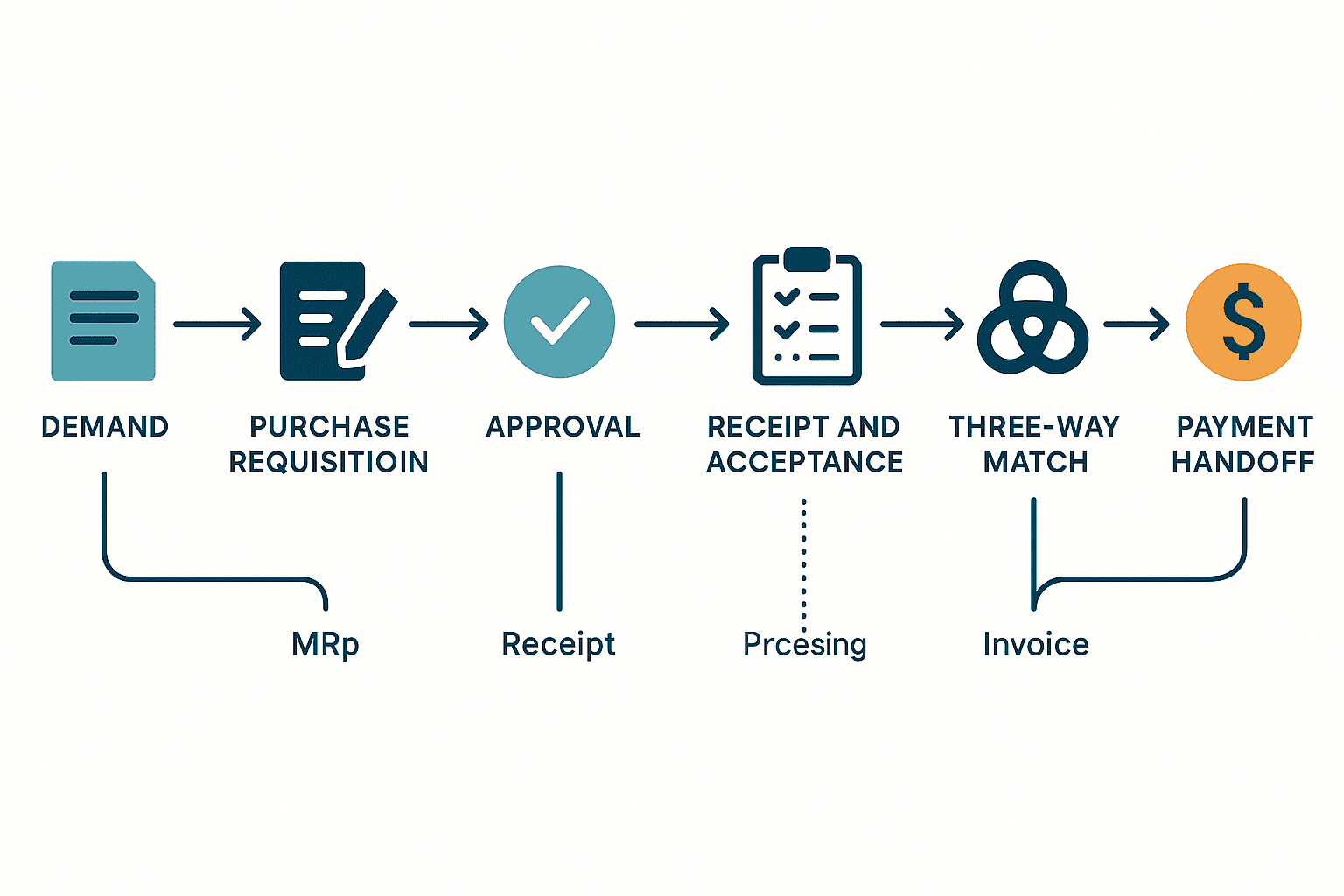
demand or replenishment basis → PR → budget/authority approval → RFQ and award → PO → receipt → quality/quantity acceptance → invoice → three-way match → payment handoff
The goal is not to automate every step on day one. It is to preserve who changed a state, when, on what authority and against which approved data. If the PO is an email attachment, the warehouse receipt is a local worksheet and Accounts Payable keeps a separate invoice register, people repeatedly reinterpret the same purchase. A purchasing management system should manage that interpretation at transaction level.
The 30/60/90-day plan below is a proposed PoC roadmap, not a statutory deadline or a universal implementation standard. Thai e-tax, retention and accounting obligations depend on the entity, registration and transaction. Confirm the final design against current authority guidance and qualified Thai tax or legal advice.
Ten items to freeze before issuing a purchasing RFP in Thailand
Starting an order management system RFP with a feature checklist produces incomparable “supported” answers. Define the business and evidence boundary first.
| RFP item | What to state | Acceptance evidence |
|---|---|---|
| Organization | Legal entities, plants, purchasing units, warehouses, currencies and languages | Organization-specific access tests |
| Spend scope | Direct material, indirect/MRO, services and capex | Scenarios by spend type |
| Start and end | For example, PR submission through approved AP handoff | End-to-end transaction trace |
| Approval authority | Amount, account, department, exception, delegation and expiry | Authority matrix and negative tests |
| Ordering model | Spot PO, blanket order, releases, partial delivery and emergency buy | Order-type scenarios and open balance |
| Acceptance model | Quantity, quality, service completion and tolerances | Receipt, hold, rejection and return evidence |
| Match policy | PO-receipt-invoice three-way match and tolerance rules | Matched, blocked and resolved cases |
| Integration | MRP, inventory, accounting, bank and electronic invoice | API/file payload and replay log |
| Non-functional | Availability, performance, audit, backup, RTO and RPO | Failure and recovery test |
| Migration and exit | Masters, open POs, history, attachments and configuration | Export and restore evidence |
Ask suppliers to demonstrate representative data, not to tick “standard feature.” A useful partial-delivery scenario is a PO for 100 units, receipt of 40, quality hold on 10, an open quantity of 60 and an invoice for only the accepted portion. That single scenario exposes differences in quantity status, matching logic and auditability.
For inventory policies and replenishment foundations, see our guide to an inventory management system for SME manufacturers in Thailand. For common templates, controlled local variation and multi-site ownership, see governance for overseas-site system rollout.
The end-to-end process: PR to payment handoff
1. Purchase requisition: preserve the reason for demand
A PR is not just a shopping form. It transfers the basis of demand to Purchasing. It should carry requester organization, item or service, quantity, required date, delivery point, cost center or project, candidate currency, specification attachment and demand source. Distinguish an MRP proposal from reorder-point replenishment, maintenance work, capex, customer project and manual emergency demand.
For a PR created by an MRP system, keep the planning version, pegged order, need date, net requirement, lot rule, assumed lead time and the inventory/open-supply position used in the calculation. A generic “created by MRP” flag is insufficient when a revised plan makes yesterday’s requisition unnecessary.
2. Approval: evaluate risk and segregation, not amount alone
Approval routing should not be a single value ladder. Add conditional approval for off-contract spend, new suppliers, prepayment, related parties, capital expenditure, sole source, urgency and budget variance. Delegation needs a valid period and scope; permanent shared accounts undermine accountability.
When quantity, price, delivery date, supplier or payment terms change after approval, retain a new version and evaluate reapproval. Never silently overwrite what the approver saw. Acceptance testing must show the approved version, PO-issued version and reason for change.
3. RFQ and bid comparison: structure the award basis
Normalize unit price, currency, tax, freight, minimum order quantity, lead time, terms, validity, quality, warranty and Incoterms before comparison. If negotiation happens outside the platform, attach the final quote and award rationale to the PO.
Do not design an automatic “lowest price wins” rule. Quality, delivery, continuity, technical fit, total ownership cost and approved-supplier status may justify a different award. The system should make the human decision explainable.
4. Purchase order: one controlled point for agreed conditions
A PO needs buyer and seller identifiers, order number and version, line number, item or service, quantity and unit, unit price, currency, tax treatment, required date, ship-to, payment terms, contract reference, contact and specifications. A change order should supersede the old version without deleting it and record which version the supplier acknowledged.
GS1’s EDI solutions organize business messages such as Order, Order Response, Despatch Advice, Receiving Advice, Invoice and Remittance Advice. They do not mandate a particular product, but they offer a useful checklist for references that must survive from order through receipt, invoice and settlement. GS1 EDI solutions
5. Receipt and acceptance: arrival is not approval
Physical arrival and business or quality acceptance are different facts. Record received quantity, damage, overage or shortage, lot/serial, expiry, inspection pending, accepted, rejected, conditionally accepted and returned as separate states.
Services have no warehouse arrival. Their evidence may be a service entry, milestone, hours, deliverable or authorized completion certificate. Equipment and construction may require partial acceptance and retention. A single “received” button cannot support a reliable three-way match across these cases.
6. Three-way invoice matching: do not auto-pay what is unexplained
Three-way matching compares the approved PO, receipt/acceptance and supplier invoice at line level. The system should classify price, quantity, tax, freight, rounding, missing receipt, duplicate and no-PO exceptions rather than treating every mismatch alike.
| Match outcome | Example | Standard treatment |
|---|---|---|
| Within policy | PO, accepted receipt and invoice agree within approved tolerance | Eligible for payment workflow |
| Quantity variance | Invoiced quantity exceeds accepted quantity | Block and confirm receipt/invoice |
| Price variance | Invoice price differs from approved PO | Review contract/change order |
| Tax or charge variance | Tax code, freight or allowance differs | Tax/Purchasing review |
| Possible duplicate | Supplier, invoice number and amount repeat | Automatic block and investigation |
| No PO | Utility or justified emergency case | Controlled exception approval |
Avoid one blanket “2% tolerance.” Tolerance may vary by category, value, contract, tax treatment and unit. Even when a transaction falls within tolerance, recurring variances by supplier should remain visible in KPI reviews.
Peppol BIS Billing 3.0 supports invoice verification through references such as purchase order, contract, buyer reference, confirmed receipt and delivery information. Its validation model separates syntax, EN 16931, general CIUS and country-qualified rules. It is not itself proof of Thai legal compliance, but it is a strong design reference for structured invoice data and layered validation. Peppol BIS Billing 3.0
7. Payment handoff: pass only approved liabilities
The AP or accounting interface should carry supplier, invoice number and date, tax, currency, payment terms, due date, account and cost object, match state and approvals. Payment-file creation and bank approval should be separated from PR and PO approval. Return paid, rejected, reversed and foreign-exchange results so invoices do not remain falsely open.
How an MRP system should hand exceptions to Purchasing
An MRP quantity and date are planning proposals based on current assumptions, not automatically correct orders. Demand, stock accuracy, lead time, lot sizing, yield, open supply, calendars and substitutes can change. An RFP must therefore weight exception handling as heavily as the happy path.
Typical actions include expedite, defer, cancel, increase, decrease, overdue order, below-minimum order, order-multiple violation, supplier disruption, substitute candidate and projected excess. A buyer should assign an owner, due date, business impact, reason and response, then link the outcome to a PO change or planning response.
Do not use “percentage of automated orders” as the only target. Automation can amplify poor master data or abnormal demand into larger commitments. Before touchless PO creation, apply gates for freeze horizons, value limits, approved suppliers, valid contracts, abnormal demand, duplicate proposals and master-data freshness.
Supplier master: separate onboarding, changes and performance
A supplier master is more than legal name and bank account. It needs legal and tax identifiers, addresses and branches, contacts, category, currencies, terms, bank details, certifications, contracts, risk tier, approval state and purchasing organizations permitted to use it.
Bank and remittance changes deserve stronger controls. Separate requester and approver, verify through a known independent channel, preserve before-and-after values and effective date, and add a check on the first payment. Do not accept an email body as the only evidence. Use distinct workflows for onboarding, data changes, qualification and blocking.
NIST SP 1326 became final on July 8, 2026. For ICT suppliers, it organizes due-diligence considerations around Supply Chain Tiers; Foreign Ownership, Control, or Influence; Provenance; Resilience; and Foundational Cyber Practices. It does not impose identical legal requirements on every material supplier. It can, however, improve the evaluation of purchasing software, cloud, EDI and API providers beyond price and features. NIST SP 1326
NIST SP 800-161 Rev. 1 integrates cybersecurity supply-chain risk management across enterprise, mission/business and system levels. In a system RFP, translate that into evidence for vulnerability notice, update policy, dependencies, incident contact, logging, data return and termination support. NIST SP 800-161 Rev. 1
Test segregation of duties as transactions, not role names
Different role labels do not prove segregation. If one person can create a supplier, change its bank account, submit and approve a PR, receive goods, release a mismatch and prepare payment, the process remains exposed.
| Transaction | Initiation | Approval/execution | Representative prohibited combination |
|---|---|---|---|
| Supplier onboarding | Purchasing/business | Master-data and Finance review | Creator finally approves own bank change |
| PR | Requesting unit | Budget/authority holder | Self-approval |
| PO | Buyer | Authorized approver | Buyer approves own competition exception |
| Receipt | Warehouse/user | Quality or accountable owner | Buyer creates fictitious final acceptance alone |
| Invoice | AP | Variance owner | Invoice entry user releases own PO variance |
| Payment | Treasury preparer | Separate payment approver | Bank-data changer approves first payment |
Acceptance tests need negative cases: self-approval, inactive user, expired delegation, conflicting access, emergency access and overprivileged service accounts. The evidence should show periodic access review and time-limited approval for unavoidable conflicts.
Designing Thai e-Tax Invoice/e-Receipt integration
The Thai Revenue Department’s official e-Tax Invoice & e-Receipt portal provides registration checks, data-structure resources and FAQs. Thai Revenue Department e-Tax Invoice & e-Receipt
ETDA identifies relevant electronic transaction standards, including XML data structures and digital signatures for e-invoice and e-tax documents. ETDA e-Tax Invoice standards
Replace a generic “e-Tax supported” requirement with concrete questions:
- Which method, registration state and document types apply to the entity and transaction?
- Can the solution preserve supplier tax ID and branch, document number/date, currency, tax classification, lines and PO/contract references?
- How are XML, signature, timestamp, submission result, error, replay, cancellation and correction tracked?
- Which artifact is the authoritative original, and where are XML, human-readable presentation and validation evidence retained?
- Can tax-document validation and AP three-way matching remain separate checks that both influence payment release?
- Who owns mapping, testing and version change when the official specification changes?
Compliance depends on the company’s facts. Set acceptance criteria using current official specifications, tax-owner approval and end-to-end representative documents. This article is not tax or legal advice.
Purchasing KPIs: separate speed, quality and control
Freeze formula, population, exclusions, time source and owner for each KPI. This prevents a new system from appearing effective only because definitions changed.
| KPI | Example definition | Companion check |
|---|---|---|
| PR approval lead time | Submission to final approval | Returns and delegation rate |
| PO issue lead time | Final PR approval to PO transmission | RFQ duration and emergency-buy rate |
| On-time delivery | Receipt lines within acknowledged due date | Partial delivery, holds and revised dates |
| Touchless three-way match | Invoice lines matched without intervention | Tolerance use and later corrections |
| Variance resolution time | Block creation to resolved cause | Cause mix and recurrence |
| No-PO invoice rate | Invoices without valid PO reference | Separate legitimate exceptions |
| MRP exception aging | Time unresolved planning exceptions remain open | Severity and supply effect |
| Master-data change quality | Changes later corrected or reversed | Change type and approval route |
Touchless match can be inflated by widening tolerance. On-time delivery can be inflated by rewriting dates after the fact. Review change history and companion measures. If the pre-implementation baseline is unreliable, use the first 30 days to establish measurement rather than inventing a guaranteed improvement percentage.
A 30/60/90-day PoC that produces transaction evidence

Days 1–30: prove the boundary, masters and one normal path
Limit scope to one plant, one purchasing unit, representative categories and a small supplier cohort. Run one PR-to-PO-to-receipt-to-invoice-to-accounting flow and verify identifiers, versions, authority and audit. Record gaps in baseline data.
At the Day 30 gate, the PO number and line must survive into receipt and invoice, and every state transition must be attributable. Resolve critical access conflicts or inability to export required data before proceeding.
Days 31–60: operate exceptions with real roles
Test partial/over/short delivery, quality hold, return, price difference, duplicate invoice, PO change, MRP cancellation, emergency buy, delegated approval, network interruption and integration replay. Purchasing, Warehouse, Quality, AP and IT should work in their actual roles without a hidden “super-user” fixing everything.
At Day 60, review open exceptions, resolution time, manual work, inquiries and access overrides. Separate product gaps from unclear master ownership or policy.
Days 61–90: prove payment handoff, recovery and investment choice
Process representative e-invoices, accounting entries, payment candidates and returned settlement results. Restore from backup, resume open transactions, prevent duplicate sends, export data and disable users. Compare KPIs with the measured baseline while avoiding claims about seasonal or enterprise-wide effects from a short pilot.
At Day 90, choose CONTINUE, CORRECT, SCALE or STOP based on the evidence. The period does not guarantee completion; long-lead capex and annual contracts may need a longer observation window.
Essential user-acceptance scenarios

Business acceptance
- Convert an MRP proposal to a PR, approve it and create a controlled PO.
- Revise the PO without deleting the old version; retain supplier acknowledgment.
- Record partial receipt and quality hold separately; match only accepted quantity.
- Classify price, quantity and tax variances; only an authorized owner can release them.
- Link return, cancellation and credit note to the original transaction.
- Receive accounting and payment status and report every open item.
Access and audit acceptance
Verify rejection of self-approval, inactive users, expired delegates, conflict combinations and excessive API access. Create, change, approve, release and handoff events need user, timestamp, before/after value, reason and reference. Test that ordinary administrators cannot silently rewrite the business audit trail.
Integration and recovery acceptance
Replay the same message and confirm that idempotency prevents duplicate PRs, POs and invoices. Simulate timeout, out-of-order messages, partial success, missing master, unit mismatch and currency mismatch. Reconcile transaction counts and amounts after recovery.
Migration and exit acceptance
Migrate suppliers, contracts, open PR/PO, receipt balances, unpaid invoices, attachments and approval history. Reconcile counts, amounts, currency, status and references—not counts alone. Export masters, transactions, attachments, audit, workflow, code lists and API definitions in machine-readable form and prove that another environment can read them.
Define identifiers and states in the data model first
Procurement terms often carry different meanings across departments, so agree the data dictionary and state transitions before designing screens. Supplier, item, contract, PR, PO, receipt, acceptance and invoice records should each have an immutable internal ID separate from the display number used by people. A legal-name or item-description change must not break references to historical transactions.
A PO number alone is also insufficient. Preserve the relationships among PO line, delivery schedule, version, receipt line and invoice line so partial processing remains explainable. If line 10 orders 100 units, 40 arrive in the first delivery and only 30 pass inspection, the system must simultaneously explain 60 open, 10 received but not accepted and 30 accepted.
States are not merely labels; each needs an allowed transition. For a PR, define who can move Draft, Submitted, Approved, Rejected, Cancelled and Converted, under which conditions and which data remains editable. Do the same for PO states such as Draft, Issued, Acknowledged, Partially Received, Closed and Cancelled. Reopening a Closed transaction should require a separate privilege and reason.
Units and currencies require the same discipline. If the purchasing unit is a box, the inventory unit is an each and the invoice unit is a case, maintain conversion factor, rounding, effective date and lot condition. An exchange rate used for bid comparison may differ in purpose and date from the rate used for PO valuation or accounting, so preserve the rate type and basis date, not the value alone.
| Data element | Required design decision | Representative failure |
|---|---|---|
| Supplier ID | Distinguish legal entity, branch and remittance destination | Duplicate registration of the same company |
| Item ID | Relationship among purchased item, stocked item and substitute | Wrong order based on matching descriptions |
| PO/line/version | References across change and partial delivery | Invoice matched to a superseded version |
| Quantity/unit | Purchase, stock and invoice units plus conversion | Box-versus-each quantity error |
| Date/time | Time zone, business date and calendar | Inconsistent on-time KPI |
| Tax/charge | Tax category, freight, discount and rounding | Same total with a different tax breakdown |
| State/reason | Allowed transition, reason code and owner | Hold remains open without an explanation |
API and file messages need a message ID, created timestamp, source, schema version and replay number. A response should distinguish technical success from business rejection and state how to reprocess it. Integration errors should appear as accountable procurement work, not remain hidden only in an IT log.
Score vendors fairly with common evidence
RFP answers should distinguish available standard functionality, configuration, custom development, external product and unsupported requirement. “Possible” does not reveal cost or operating effort. For each requirement, ask for the standard screen or setting, data fields, API, constraints, supported version, incremental charge, reference use and acceptance method.
Score more than features. Separate business fit, data/integration, security/control, operation/support, migration/exit and three-to-five-year TCO. Weighting depends on business risk, but critical conditions should be gates. For example, inability to export audit logs, segregate bank changes, return transaction data in a machine-readable form or define disaster-recovery accountability should not be offset by a high total score elsewhere.
Provide every vendor with one demonstration script, the same initial data, the same exceptions and the same time limit. Do not accept only a polished vendor environment. During the session, change PO terms and make the vendor execute partial receipt, quality hold, invoice variance, access rejection and interface replay. For an unanswered item, record an evidence deadline and re-evaluation condition instead of relying on a verbal promise.
Commercial comparison should include environments, users, transaction volume, API, storage, backup, monitoring, test environment, training, local support, specification change, data extraction and termination assistance—not just setup and monthly subscription. Confirm Thai/English operational support, coverage during ICT business hours, local holidays and approval of remote work.
The final choice is not the product with the largest feature count. Select the proposal that can operate the defined boundary safely and can explain remaining gaps and future cost. If PoC behavior differs from the RFP answer, update the fit/gap record, price, schedule and acceptance criteria rather than closing it through an informal agreement.
Purchase order management system or procure-to-pay system?
Product labels are inconsistent. “Order management system” may mean buyer-side PR/PO control, while an “order-to-cash” or broader order processing platform can include supplier or customer transactions. Select by accountability boundary, not by label.
In SEO and vendor terminology, a purchase order management system often emphasizes PO creation, change and receipt, while a procure-to-pay system normally extends through invoice and payment handoff. MRP system integration describes the planning feedback loop rather than a product category. These labels are useful for discovery, but the RFP must still define the actual boundary.
- For internal procurement control, prioritize PR, approval, PO, acceptance and AP integration.
- For supplier collaboration, add PO acknowledgment, delivery response, despatch notice and structured invoice.
- If customer orders share a platform, evaluate sales pricing, allocation, shipment and receivables as a separate requirement set.
- Where MRP fit is critical, focus on planning versions, exceptions, changes and open-order synchronization.
A broad suite is not automatically better. If identifiers and status definitions differ across its modules, manual reconciliation remains.
Common RFP failures and how to prevent them
Turning the current spreadsheet into screens
Undefined columns, IDs, versions and ownership become permanent digital ambiguity. Create the data dictionary and state model first; distinguish migrated from retired data.
Selecting on happy-path demos
Most products can show PR to PO. Compare partial delivery, hold, variance, cancellation, delegation, replay and recovery with the same scored script.
Treating automation rate as success
Automatically processing a wrong order or invoice weakens control. Pair automation rate with exceptions, corrections, duplicates and later reversals.
Underestimating supplier and bank changes
Weak master controls leave payment risk even when the downstream PO and match are correct. Test independent verification, approval and first-payment review.
Treating a PDF as a structured e-invoice
Human-readable presentation, structured original, signature/validation evidence and authority response have different roles. Define ownership for original, rendering, validation, retention and correction.
Forcing a global template without governed variation
Standardize identifier policy, PO references, audit, access and interface contracts. Treat tax document, branch, language, approval threshold and local practice as governed differences.
FAQ about purchasing management systems
What is a purchasing management system?
It manages requisition, approval, sourcing, PO, receipt/acceptance, invoice match and payment handoff using a common transaction reference and audit trail. It connects demand evidence to payment evidence rather than merely printing POs.
How should MRP system integration work?
MRP system integration should receive item, quantity, need date, planning version, demand basis and exceptions; it returns approved PR/PO and supplier dates. Cancellation, expedite, defer and quantity change need controlled feedback, not a one-way file.
What does a purchase order management system control?
A purchase order management system controls PO creation, changes, acknowledgments, open quantities and receipt references. The RFP should verify versions, partial delivery and audit evidence rather than assuming the product name defines the scope.
What should come first in a procure-to-pay system RFP?
In a procure-to-pay system RFP, prioritize the PR-to-payment accountability boundary, exceptions, identifiers, access, three-way match, replay, exit data and acceptance evidence before feature count.
What is three-way invoice matching?
It compares the PO agreement, actual receipt/acceptance and supplier invoice at line level. Unexplained differences are blocked and assigned to an accountable owner.
Does an “e-Tax ready” product guarantee Thai tax compliance?
No label alone can do so. Confirm the applicable method, document, XML/signature, submission, correction, retention and accounting treatment using current official rules and qualified advice, then test representative documents.
Can a factory go live in 90 days?
The 90-day period here is a limited PoC proposal. Production timing depends on categories, integration, data quality, approval, tax and supplier participation. Day 90 is an investment gate, not a universal go-live promise.
Conclusion: purchasing system differentiation is visible in exceptions and evidence
A purchasing management system for a Thai factory should connect PR, approval, PO, receipt and acceptance, three-way match and payment handoff with common IDs, versions, ownership and audit. It should treat MRP proposals as controlled recommendations, test supplier-master and segregation controls through real transactions, and validate e-invoices against both official specifications and the company’s tax position. KPIs must reveal side effects across speed, quality and control.
TOMAS TECH supports manufacturers in Thailand and ASEAN with current-process assessment, procurement RFPs, supplier master design, MRP/inventory/accounting integration, 30/60/90-day PoCs and user acceptance. You can contact us while products are still being shortlisted or while planning an integration that retains the existing ERP.


