


An overseas site system implementation should not be framed as a choice between copying headquarters exactly and localizing everything. Factories in Thailand, Vietnam, and other Southeast Asian markets have different operating languages, documents, authority structures, connectivity, and support conditions, while item, process, cost, and control data must still connect to group standards. This guide turns six rollout issues into RFP clauses and acceptance evidence: headquarters standards versus local exceptions; data and authority boundaries; master-data migration; bilingual operations and support; cutover and rollback; and exit and handover. It is not another vendor shortlist or a generic multi-site consolidation article. It is a governance specification that can be tested before go-live.
Overseas site system implementation succeeds through boundary design
In an overseas site system implementation, projects fail not only because a function is missing. They fail when no one has agreed who makes a decision, which system owns a record, how far a local exception may go, who restores service, and what must be handed over if the supplier changes.
An RFP that says “same production system as headquarters,” “Thai language,” “data migration,” and “post-launch support” leaves vendors free to make different assumptions. One bidder may call translated menus bilingual; another may include manuals, training, and the service desk. One may define migration as importing a spreadsheet; another may include cleansing, reconciliation, and business-owner sign-off.
Each requirement should therefore include the business purpose, scope, owner, preconditions, expected outcome, exceptions, and evidence. The same statement then supports proposal comparison, detailed design, and objective acceptance.
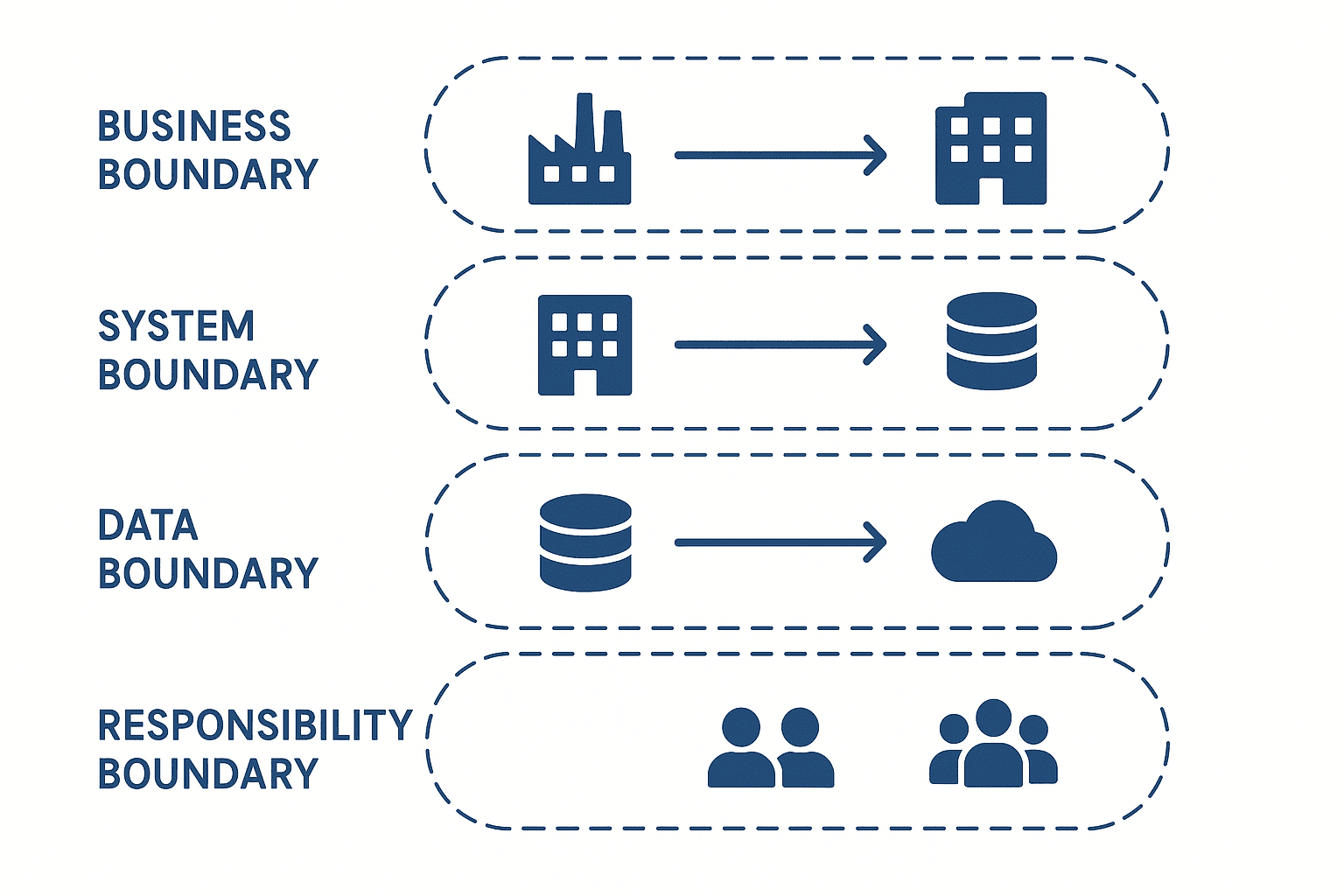
Agree four boundary maps first
Before screen requirements, headquarters, the site, and the implementer should approve:
- Business boundary: where planning, approval, execution, and exception decisions sit among headquarters, sites, customers, and suppliers.
- System boundary: systems of record and interface direction across ERP, MES, production, inventory, accounting, quality, equipment, and BI.
- Data boundary: global data, locally owned data, headquarters-readable data, and information restricted by contract or regulation.
- Responsibility boundary: the RACI for headquarters IT, local management, process owners, implementer, cloud provider, and support vendors.
Keep versioned RFP, design, and go-live editions. Otherwise “headquarters was going to decide” and “the site was allowed to change it” become late project surprises.
Issue 1: Govern headquarters standards and local exceptions in one register
Manage the reason for deviation, not a headline standardization rate
Local tax documents, customer labels, Thai or Vietnamese work instructions, supplier packing, and offline procedures can be legitimate differences. “We have always used this spreadsheet” is not automatically one. Classify each demand as global standard, configurable local variation, custom local exception, or process to retire.
Every exception needs a basis, affected site, process owner, review date, condition for returning to standard, cost, and impact on other sites. This prevents both blind standardization and uncontrolled customization.
RFP clauses
- Answer each requirement as standard, configuration, customization, or excluded.
- Explain how an extension avoids changing the core and affects future upgrades.
- Define who can change local settings, the approval, audit trail, and cross-site effect.
- Test reports and labels on actual printers, paper, encoding, language, and barcode format.
- Include source, design, tests, maintenance, and exit handover for custom work.
Acceptance evidence
Pair a standard scenario with a local-exception scenario. Run the same item through a normal production order and a customer-label variant. Retain master data, approval history, interface result, printed label, transaction ID, and audit log—not only demonstration screenshots.
Issue 2: Define data and authority boundaries beyond “who can view”
Separate ownership, location, and purpose
Centralizing everything is not a design principle. Headquarters may own the item code while local procurement owns local price data. Equipment raw data may remain on site while headquarters receives an aggregate.
For each key field, state the data owner, system of record, creator and changer, storage location, retention, recipients, purpose, and deletion method. Interfaces must handle duplicates, reversed order, omissions, retries, and partial failure—not merely report a successful send.
Separate business roles from exceptional authority
“Administrator” and “user” are insufficient. Design segregation among purchase request, approval, receipt, and invoice matching. Include delegation, emergency access, and revocation after transfer or departure. Headquarters read access must not automatically include every local personnel or contract record.
NIST Cybersecurity Framework 2.0 provides an organizational risk-management structure across Govern, Identify, Protect, Detect, Respond, and Recover. CISA Secure by Demand guidance is also useful for asking suppliers for verifiable security rather than accepting product claims.
RFP clauses
- Deliver a data classification and flow map.
- Show role design, segregation, delegation, emergency access, and periodic access review.
- Define authentication, encryption, retry, deduplication, monitoring, and log retention for interfaces.
- State the notification, remediation, impact assessment, and workaround process for serious vulnerabilities.
- Disclose critical subcontractors, cloud services, software components, and maintenance-access boundaries.
Acceptance evidence
Assign the matrix to real users and record both allowed success and prohibited rejection. Test delegation start and end, a departed user’s revocation, and emergency-access expiry. Inject a duplicate, network break, reversed sequence, and missing field into an interface, then preserve the alert, recovery, and audit trail.
Issue 3: Treat master migration as business readiness, not file loading
Define usable data before migration
An overseas factory digital transformation often carries old spreadsheet defects into the new platform: duplicate item codes, missing unit conversions, inactive suppliers, obsolete BOMs, invalid bins, and inconsistent names. A successful import does not correct them.
For each master, define mandatory fields, uniqueness, referential integrity, accepted values, language fields, effective dates, and retirement rules. Assign owners for extraction, cleansing, transformation, trial load, reconciliation, business approval, and production load. Count matching is necessary but not sufficient; the data must execute a business scenario.
Divide scope into three layers
- Go-live data: active items, BOMs, routings, partners, stock, and open orders.
- Reference history: production, quality, and price history, either migrated or retained in a controlled read-only archive.
- Excluded data: expired, temporary, duplicate, or unexplained records, with disposal approval and reference policy.
RFP clauses
- Provide templates, validation rules, and example error reports by master.
- State who cleans data and what supplier assistance includes.
- Run repeated trial migrations and track defect, correction, and retest.
- Reconcile business behavior such as BOM explosion and material planning as well as counts and values.
- Define legacy access, retention, decommissioning, deletion, and audit response.
Acceptance evidence
Retain migration logs, error list, correction history, before-and-after counts, quantities and values, sampled field comparison, and business-owner approval. Expand a migrated BOM and execute procure, receive, produce, and ship. Do not silently drop rejected data; record reason, approver, and future access route.

Issue 4: Make bilingual operations and maintenance broader than screen translation
Bilingual means both users can make the same decision
In a factory system implementation in Thailand, a “Japanese and Thai” system may translate menus but not errors, reports, manuals, training, or help desk. The same risk exists in Vietnam. Acceptance should mean that a user in either language can execute the same transaction, understand the same exception, and request recovery through the same process.
Create the glossary during requirements. Standardize material status, operation, inventory status, quality judgement, and role names. Translation must be reviewed in shop-floor context: “issue,” for example, can mean material issue, problem, or document issuance.
Split support into L1, L2, and L3
- L1 local key user: guidance, initial triage, and evidence capture.
- L2 local or regional support: configuration, interface, data, and device investigation.
- L3 product or development team: defects, performance, and security fixes.
Define language, hours, channel, severity, first response, recovery target, and escalation for each tier. “24-hour support” must state the calendar and time zone, and distinguish workaround from permanent correction.
RFP clauses
- Answer supported language separately for UI, messages, reports, manuals, training, and service desk.
- Deliver a glossary with approval and update procedure.
- Name L1/L2/L3 organizations, countries, languages, hours, and subcontracting.
- Keep reproduction, logs, workaround, root cause, and permanent action in the ticket.
- Include retraining and material updates when key users change.
Acceptance evidence
Have different users execute one scenario in Japanese and the local language and compare results. Create an error, let L1 collect evidence from the local-language message, hand it to L2, and simulate recovery. Verify practical performance and recovery from mistakes, not attendance alone.
Issue 5: Convert cutover and rollback from dates into decision conditions
Use waves to reduce dependency risk
Microsoft Cloud Adoption Framework describes migration-wave planning based on dependencies and readiness. Overseas sites may control impact better by separating sites, product families, warehouses, or functions, while inseparable flows such as inventory-production and order-shipment remain in one wave.
A cutover runbook needs entry conditions, checkpoint Go/No-Go criteria, decision owners, maximum outage, rollback triggers, and post-recovery reconciliation. “Return if there is a problem” is too late. Define observable triggers such as an unapproved opening balance, failed critical interface, unavailable legal document, or absent local L1.
Microsoft’s execution guidance calls for close monitoring during the first 24–48 hours after cutover. Treat that as a planning reference, not a universal finish line. The factory must cover relevant shifts, dispatch cycles, and close routines and define who watches which indicator and escalation threshold.
Rollback is more than possessing a backup
Rollback includes restarting the legacy system, handling transactions entered after cutover, restoring devices, reversing interface direction, informing users, and setting conditions for another attempt. A backup whose restoration time and consistency have never been tested is not an executable rollback.
ISO 22301:2019 is a relevant business-continuity reference, while ISO indicates that revision work is underway. Do not invent requirements from an unfinished edition. Apply continuity principles through factory-specific recovery priorities, responsibility, exercises, and improvement.
RFP clauses
- Explain wave rationale, dependencies, and readiness criteria.
- Include owner, planned and actual time, evidence, and Go/No-Go in the cutover runbook.
- Define rollback trigger, decision owner, target time, and data reconciliation.
- Define monitoring organization, measures, thresholds, incident communication, and daily review.
- Rehearse cutover and rollback with production-like data, devices, and network.
Acceptance evidence
Keep rehearsal result, duration, misses, corrective actions, retest, and approval. During production cutover, timestamp every action, operator, log, reconciliation value, and decision. A rollback test must prove representative transactions work in the legacy environment and show how new-system transactions will be recovered.
Issue 6: Specify exit and handover in the RFP, not at contract end
Do not confuse product use with uncontrolled lock-in
Long-term use of a product is not itself a problem. The risk is inability to export complete data, explain configuration, transfer source and build method, recover supplier-held accounts, or let another team operate.
A program for system development in Southeast Asia often spans a local company, regional office, Japan headquarters, and subcontractors. Plan for personnel and contract change. Define ownership, use rights, storage, update responsibility, transition assistance, data extraction, account return, and deletion of confidential data from the beginning. Effective IT support for Japanese companies in Thailand also needs a communication design that combines headquarters approvals with local response speed.
RFP clauses
- Define exit data formats, dictionaries, attachments, audit logs, and extraction procedure.
- State handover conditions for configuration, interfaces, runbooks, incident history, known issues, source, build, and release method.
- Require customer-controlled repositories, shared service accounts, and password vaults.
- Define third-party transition duration, roles, rates, and knowledge-transfer sessions.
- Define data return, deletion certificate, access revocation, and backup residual period.
Acceptance evidence
Run a mock handover before production. Using only delivered documents and accounts, the customer or a third party should start a test environment, change a setting, inspect a log, export data, and resolve a small incident. Reproducibility by another person—not the existence of a document—is the evidence.

Use a structured RFP response table
Free-form proposals are hard to compare. Issue a response table with these fields:
| Field | Required content |
|---|---|
| Requirement ID | Stable unique number |
| Business purpose | Why it is needed and impact of failure |
| Scope | Site, team, language, volume, and interfaces |
| Mandatory/evaluated | Go-live necessity or scored option |
| Supplier response | Standard, configuration, customization, excluded |
| Exception | Constraint, alternative, and future impact |
| Responsibility | Customer, headquarters, site, supplier, third party |
| Deliverables | Design, configuration, code, runbook, training |
| Acceptance | Scenario, expected result, evidence, approver |
| Cost and date | Initial, recurring, assumptions, deadline |
Do not accept “supported” without method, assumptions, constraints, and example evidence. Total cost should include local-exception maintenance, translation updates, off-hours response, regression testing after upgrades, data export, and exit assistance.
Build an acceptance-evidence pack by requirement ID
Do not replace acceptance with a verbal meeting. Each pack should contain:
- Link to approved requirement and design
- Preconditions, test data, operator, time, and environment
- Steps and expected result
- Screens, raw logs, reports, interface IDs, and reconciliation
- Defect ID, workaround, permanent fix, and retest
- Residual issue, risk owner, and due date
- Process-owner and IT-owner approval
Use a customer-controlled location and filenames that identify contents. Do not depend only on videos, screenshots, or a URL inside the supplier environment. Preserve searchable text, raw logs, and exported results.
Go-live gates for an overseas factory
Gate 1: Operating design ready
Standards and exceptions, systems of record, access, language, support, and exit are approved; every open decision has an owner and due date.
Gate 2: Migration ready
Trial migration is repeatable, critical errors are cleared, and balances, open transactions, and BOM behavior are approved.
Gate 3: Operations ready
Local L1, headquarters, and L2/L3 rosters and channels work; bilingual procedures and materials are approved; practical assessment is complete.
Gate 4: Cutover ready
Rehearsal meets target time, rollback has been tested, and Go/No-Go owners are available.
Gate 5: Stabilization complete
Critical transactions, interfaces, performance, errors, and tickets are monitored; residual work has owners and dates; transition to steady support is formally accepted.
A five-phase delivery flow from requirements to operations
Phase 1: Fix boundaries and decision authority
Create the four boundary maps and exception register, then name the decision owner for each requirement. A site study must observe real documents, devices, connectivity, shifts, and exception work rather than collect wishes only. Do not reject a request merely because it differs from headquarters; establish its basis and control purpose.
Phase 2: Compare RFP responses with one measurement system
Use the structured response table, abnormal-case demonstrations, responsibility map, and evidence samples. Assess the people who will actually perform requirements work, development, and local support, not only the sales presenter. Control any difference between the proposed team and the delivery team in the contract.
Phase 3: Trace requirement IDs through design and migration
Carry the same IDs into design, configuration, development, tests, migration, and training. Evaluate every change request for cost, schedule, impact on the group standard, and impact on other sites. Record important decisions and communicate them bilingually instead of relying on verbal agreement.
Phase 4: Accept exceptions and recovery, not only happy paths
Test network loss, duplicate transfer, insufficient access, bad master data, cancellation, night incidents, and key-user absence alongside normal transactions. Deliberately creating these events in a test environment exposes unclear responsibilities and communication routes before production.
Phase 5: Decide Go-Live from evidence and hand over operations
Do not force every open issue to zero merely to make a report look complete. Each residual issue must have a severity, workaround, owner, due date, and explicit business-risk owner. After launch, formally transfer tickets, monitoring, known issues, and the contact roster from the project team to steady-state support.
Common failure patterns
Stopping at Fit & Gap against a headquarters template
Screen and function gaps appear, while data ownership, access, support, and exit remain invisible. Treat the six governance issues as explicit workstreams.
Customizing every local request
Assess rationale, frequency, control objective, alternative process, and upgrade effect. Put every approved exception in the register with review date and return-to-standard condition.
Accepting the supplier’s migration success statement
Import counts do not prove readiness. Business owners must execute representative flows and approve exclusions and corrections.
Translating just before go-live
Terminology diverges across design and training. Maintain the glossary from requirements through screens, documents, runbooks, and tickets.
Planning rollback without testing it
Restoration time, reversed interfaces, and old/new transaction reconciliation become known only through a production-like exercise.
Asking for handover documents in the final month
Knowledge has already dispersed. Update customer-controlled materials during the project and inspect completeness at every gate.
FAQ on overseas-site system rollout
Must every site use the headquarters product?
Separate the data and controls that must be common from decisions that remain local before selecting a product. One product can still have site configurations; different products can share a governed data model and interface controls.
What should a factory digitalization RFP fix first?
The business, system, data, and responsibility boundaries. They align assumptions for functions, migration, access, and support.
What matters besides price in Southeast Asia system development?
Compare maintainability of local exceptions, bilingual support, security evidence, migration responsibility, cutover/rollback capability, and exit transfer of data, source, and knowledge. Ask for abnormal-case demonstrations.
Who accepts a Thailand factory implementation?
Local process owners and headquarters data/control owners should approve by requirement ID with IT. Add security, finance, and legal owners where relevant.
What should a Japanese company verify in Thailand IT support?
Look beyond a Japanese-language contact. Confirm who responds during Thai operating hours, what evidence L1 collects, how escalation reaches L2/L3, and how emergency authority avoids waiting for headquarters.
How long should post-cutover monitoring run?
Microsoft highlights the first 24–48 hours, but a factory should cover relevant shifts, major dispatches, and daily close. End stabilization on passed transactions and indicators, not elapsed time alone.
Conclusion: Make the RFP an acceptance design
An overseas system rollout cannot be governed by feature lists and vendor reputation alone. Convert headquarters standards and local exceptions, data and authority boundaries, master migration, bilingual operations and support, cutover and rollback, and exit and handover into responsibility assignments and testable acceptance conditions. Trace every requirement ID to design, test, evidence, and residual risk. The result supports an objective Go-Live decision and becomes a reusable asset for the next site and future support transition.
TOMAS TECH supports manufacturing sites in Thailand, Vietnam, and Southeast Asia from site assessment and RFP design through implementation, migration, and local adoption. You can contact us before selecting a product or vendor, while defining the six boundaries and acceptance evidence. Related guidance is available on production-management RFPs in Vietnam, vendor selection for Thailand factory systems, and multi-site production-management integration.
References and source information (last checked 2 September 2026)
- Microsoft Learn, Execute migration and cutover: https://learn.microsoft.com/en-us/azure/cloud-adoption-framework/migrate/execute-migration
- Microsoft Learn, Migration wave planning: https://learn.microsoft.com/en-us/azure/cloud-adoption-framework/migrate/migration-wave-planning
- Microsoft Learn, Prepare workloads for cloud migration: https://learn.microsoft.com/en-us/azure/cloud-adoption-framework/migrate/prepare-workloads-cloud
- NIST, Cybersecurity Framework (CSF) 2.0: https://www.nist.gov/publications/nist-cybersecurity-framework-csf-20
- NIST, Cybersecurity Framework Quick Start Guides: https://www.nist.gov/cyberframework/quick-start-guides
- CISA, Choosing Secure and Verifiable Technologies: https://www.cisa.gov/resources-tools/resources/choosing-secure-and-verifiable-technologies
- CISA, Secure by Demand Guide: https://www.cisa.gov/sites/default/files/2024-08/SecureByDemandGuide_080624_508c.pdf
- ISO, ISO 22301:2019 Security and resilience — Business continuity management systems: https://www.iso.org/standard/75106.html


