


In April 2024, an explosion at an ice plant in Chonburi province spread harm beyond the factory fence. In July 2025, another ammonia leak occurred in the same area, and the Minister of Industry instructed Thailand’s Department of Industrial Works that repeated leaks would no longer be tolerated. The precautions published by the Department call for at least one detector each in the machine room and the work room. Between that minimum line and the level actually needed to prevent an incident and account for it afterwards, there is a gap. This article looks at gas leak detection systems for factories through one lens in particular — the difference between a stand-alone alarm and IoT-based continuous monitoring.
Why factory gas leak safety is under scrutiny now — the incidents of 2024 and 2025
Ice plants and cold storage warehouses in Thailand are among the heaviest users of ammonia as a refrigerant. Ammonia offers high refrigeration capacity and, in environmental terms, compares favourably with fluorocarbon refrigerants. It is also a hazardous substance that is both toxic and flammable. That dual character is what makes the situation around refrigeration equipment in Thailand difficult.
April 2024, an ice plant in Chonburi
According to a report published by Naewna on 18 April 2024 (B.E. 2567), an explosion occurred late on the previous night, 17 April 2024, at an ice plant in the Nong Prue subdistrict of Bang Lamung district, Chonburi province. Factory workers were injured, and the damage did not stop at the property line. Gas poisoning from the escaping ammonia spread to residents in the surrounding area.
What the incident demonstrated is that a refrigeration leak is not confined to the question of occupational safety inside the plant, and that the effects of escaping gas can cross the site boundary and reach the neighbourhood. Ice plants and cold storage warehouses are often located on the edge of urban areas or next to housing. When something goes wrong, the people affected are not only your own employees.
July 2025, a repeat leak in the same area
More serious still is the fact that the same area has seen the event repeat. According to an article published by Thai Examiner on 14 July 2025, another ammonia leak occurred on the night of 13 July 2025 at an ice and cold storage plant on Soi Nern Plub Wan in Pattaya, which administratively also falls within Nong Prue subdistrict, Bang Lamung district, Chonburi province. Local residents had to be evacuated.
The reported cause was a valve on an ammonia tank that had been left open. Plant staff closed the valve as soon as they found it. In other words, this was not a complex equipment failure or an unforeseeable event. A basic operational matter — control of valve status — escalated into an incident that forced an evacuation.
This is precisely where the difference between a stand-alone detector and a continuous monitoring system shows itself. An open valve is not a condition that springs into existence at the moment of the leak. Concentration begins to climb from the moment the valve opens. Had someone been watching that rise, there was a chance to stop it well before an evacuation became necessary.
The Minister of Industry declares zero tolerance for repeated leaks
Against that background, the Department of Industrial Works set out a clear position. According to the Department’s press release and reporting by Matichon, Minister of Industry Akanat Promphan instructed the Department to tighten safety supervision of factories using ammonia as a refrigerant, ice plants and cold storage warehouses in particular. For factories that leak repeatedly, the stated policy is immediate suspension of operations as a violation of the law.
Behind that policy sit two ministerial regulations, one effective on 8 December 2024 (B.E. 2567) and one effective on 19 February 2025 (B.E. 2568). Together they strengthen the safety standards for ammonia refrigeration systems, and the number of factories in scope is given as 2,341.
For a manufacturer, the meaning of that figure is not “we are not an ice plant, so this does not concern us.” Freezing equipment in a food plant, cold storage for seafood processing, low-temperature warehouses at a logistics hub, process cooling equipment on the production line — equipment that may run on ammonia refrigerant exists across many industries. The first things to establish are whether your own refrigeration equipment uses ammonia, and whether your site falls within those 2,341 factories.
The minimum line set by the Department — ammonia detectors and eight precautions
The Naewna article cited above quotes eight items published by the Department of Industrial Works as precautions for factories operating refrigeration systems that use ammonia as a refrigerant. These eight items are the practical baseline expected of any factory running ammonia refrigeration in Thailand.
Summarised, they are as follows.
- Appoint a supervisor with specialist knowledge of refrigeration systems
- Ensure access to the main valves and label them clearly
- Keep ammonia piping out of the sole escape route leading from the machine room to other areas
- Fit oil drain valves as normally closed loaded valves
- Install at least one ammonia detector each in the machine room and in work rooms where staff are present
- Keep personal protective equipment on hand, including gloves, masks, protective clothing and respirators
- Provide water spray equipment, commonly known as a water curtain, to suppress the dispersion of ammonia gas
- Prepare an emergency plan that includes emergency response drills at least once a year
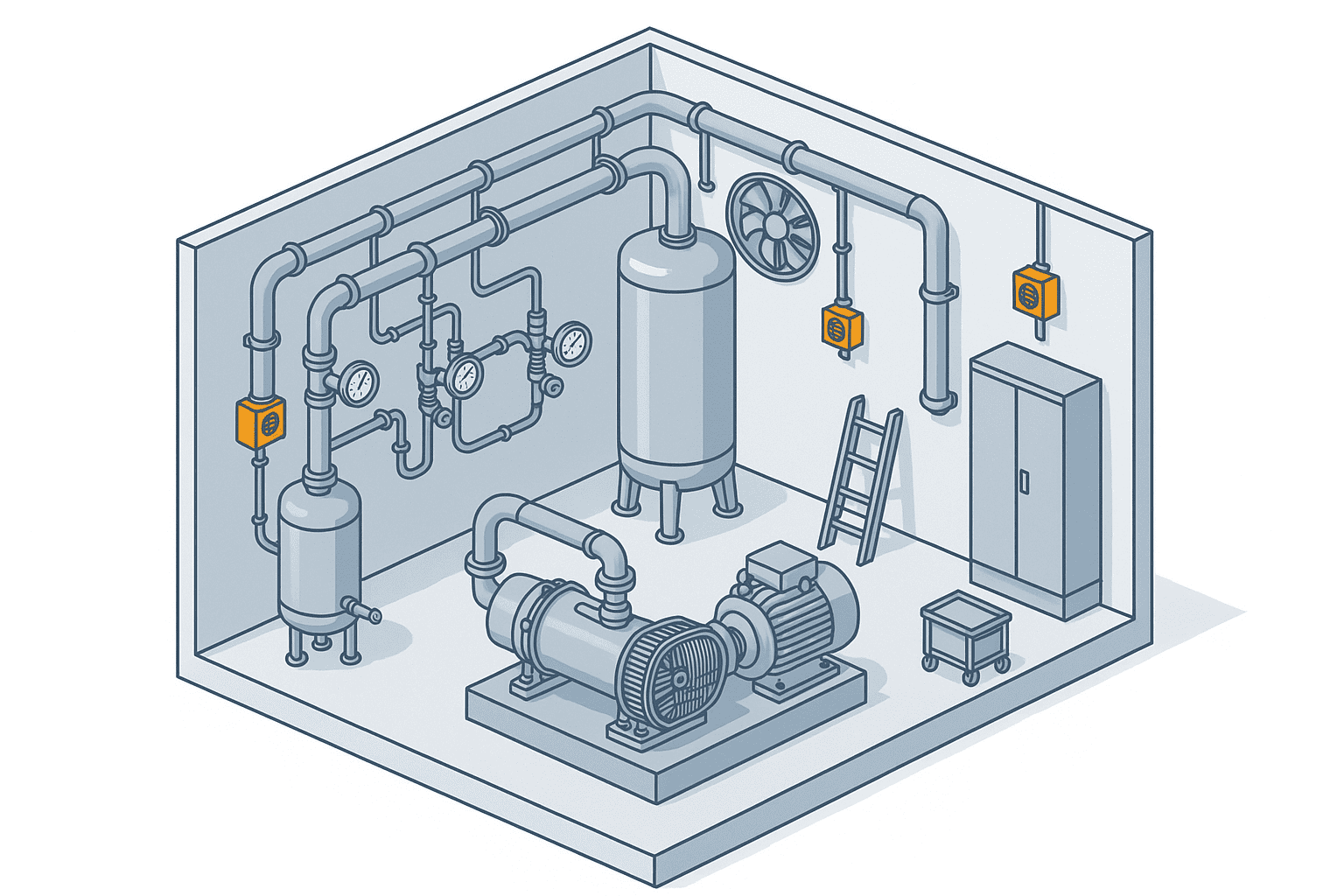
Look at the eight items together and a structure emerges. Of the eight, only one relates directly to detecting a leak. The rest cover organisational readiness in the form of a qualified supervisor, design that makes leaks less likely, an escape route people can use when a leak happens, protective equipment that shields people after a leak, equipment that limits dispersion, and operational readiness in the form of drills.
The set as a whole, in other words, is built on the premise that leaks can happen. It is layered defence aimed at minimising harm once one does. And every part of that layered defence that actually goes into action on site — the water curtain, donning protective equipment, evacuation, activating the emergency plan — can only be triggered once it is known that a leak is under way. Late detection means everything downstream is equally late.
How to read “at least one each”
Read the detector item again, precisely. What is required is at least one ammonia detector each in the machine room and in work rooms where staff are present. From here on this article refers to those rooms as work areas.
The important point is that “at least one” is an administrative minimum, not a sufficient condition for safety. Requirements of this kind are normally written as the lowest common line that can be applied to every factory. Machine room size, pipe run length, refrigeration capacity and work area layout all differ from plant to plant, so no rule can state how many units your particular factory needs. That is exactly why a minimum is given, and it is not a guarantee that the stated count will reliably catch a leak.
Note as well what the item does not cover. What is required is the installation of detectors. Recording the values measured, retaining those records, and notifying anyone are all outside the scope of the item itself. Mount one detector on the wall of each room so that a buzzer sounds, and what the precautions ask for is satisfied.
That is where the gap between the stated minimum and actual safety really lies. The gap is not only about the number of units. It opens up in the more fundamental areas of recording and notification.
For how far the two ministerial regulations effective on 8 December 2024 and 19 February 2025 go in the requirements they impose, including how they apply to your own equipment, please confirm with the competent authority or a local specialist. What is discussed here is the level set out in the precautions published by the Department.
Two regulations and a scope of 2,341 factories
The fact that two regulations have raised the standard and brought 2,341 factories into scope carries two practical implications.
The first is that the 2,341 factories in scope have been identified and are clearly marked out as subjects of guidance and site inspections. It is against that backdrop that the Minister of Industry has ordered tighter enforcement. The assumption that “nobody knows about our plant” does not hold.
The second is that a factory with repeated leaks becomes a candidate for immediate suspension. “Repeated” can only be determined where there is a record of past events. Turn that around, and it means the factory needs records of its own in order to show that this is a first occurrence and that precursors have been monitored and acted on all along. Being able to answer the regulator’s records with your own is the starting point of what compliance evidence really means.
The limits of “one detector” — what toxic gas monitoring in a factory actually needs
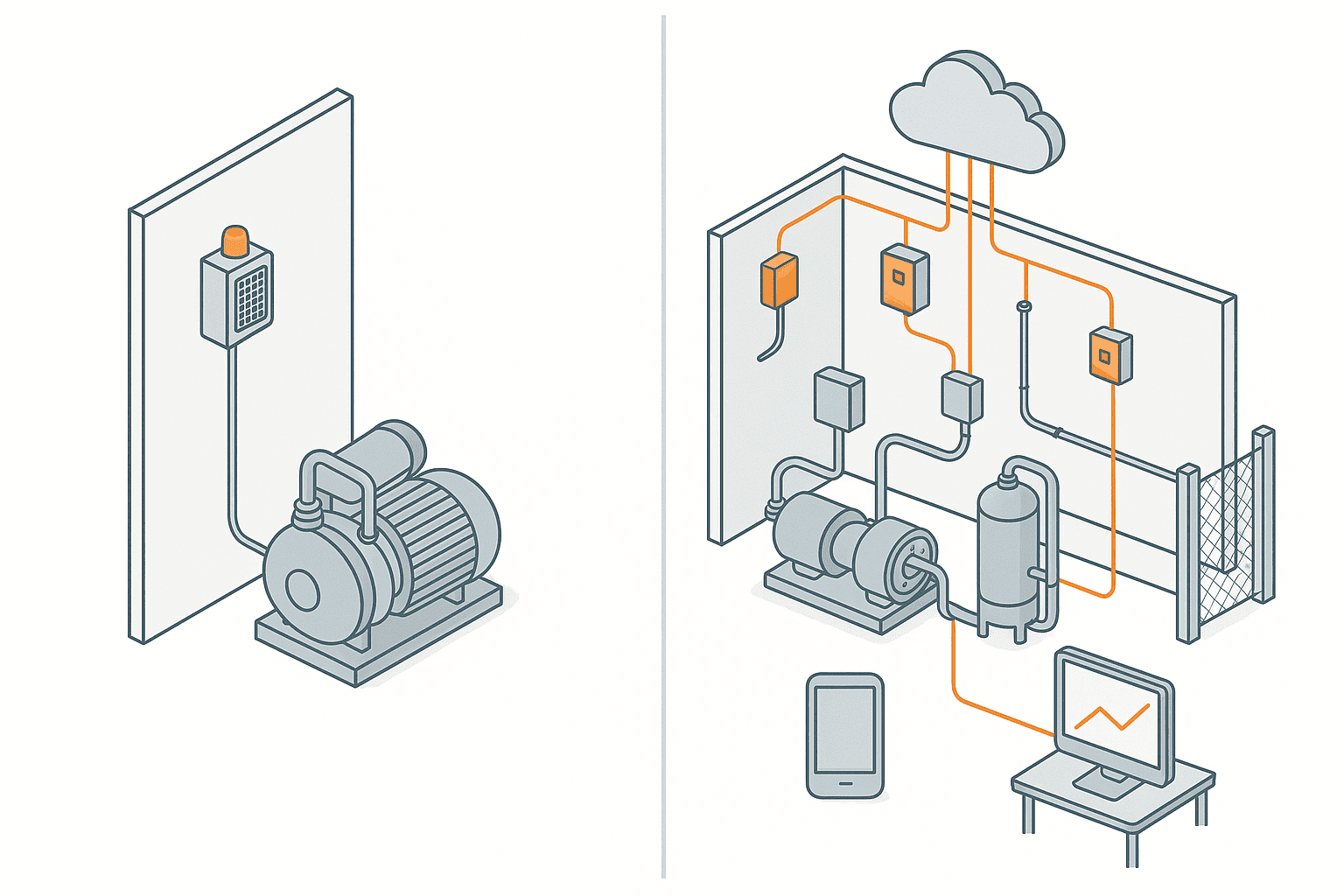
Here is the core of the matter. What is the difference between a single gas detector mounted on a wall and a networked IoT monitoring system installed at multiple points? It is usually understood as a difference in quantity, more units against fewer. In practice the difference is qualitative.
No record survives, and that is the biggest problem
A stand-alone detector raises an alarm through a buzzer or a lamp when a set threshold is exceeded. Put the other way round, it does nothing else. The concentration curve leading up to that threshold is preserved nowhere.
Consider concretely what that means in practice. A detector in the machine room sounds during the night, the worker on duty arrives, ventilates the space, and the alarm stops. The next morning, writing the event up in a report, all that can be written is that an alarm sounded at night and normal conditions were restored by ventilation.
When did the concentration begin to rise? How high did the peak go? How fast was the rise? Was the concentration also rising elsewhere in the same machine room, or only at one spot? How many minutes passed between the start of ventilation and the return to normal? None of it is known.
And the absence of that information means the cause cannot be identified. Without a clue that narrows the search to a particular fitting on a particular pipe, the inspection turns into a search of the whole machine room. It takes time, and anything missed leaves the same event free to recur. The pattern where the same kind of leak keeps returning on the same equipment also grows out of this process of restoring service without ever identifying the cause.
Missing the gradual concentration rise that signals a problem
The second limitation concerns precursors.
Leaks at pipe fittings and valve glands do not necessarily arrive all at once in large volume. As seal materials degrade and vibration loosens connections, a small leak can grow gradually larger. At that stage the concentration sits far below the threshold. A stand-alone detector, naturally, stays silent.
Continuous logging changes the picture. Compared at the same time of day under the same operating conditions, the baseline concentration in the machine room is higher than it was last month. That change can be found before the threshold is crossed. A design that waits for a threshold and a design that watches the baseline shift are fundamentally different in when they let you act.
Ammonia has a pungent odour, and people are generally held to notice it even at low concentrations. Some sites therefore operate on the assumption that anyone would smell it. Detection by smell, however, comes with the problem of olfactory adaptation. Workers who spend long periods in the same environment are understood to become less likely to notice a gradual rise in concentration. The more regularly someone works in that machine room, the less they sense the slow change. Human smell is sensitive to sudden change, but it is not a recording instrument for gradual change.
As a reference point for exposure, commonly cited values include a time-weighted average of 25 ppm and a short-term exposure limit of 35 ppm. These figures differ depending on the body or national standard being referenced, so when designing your own alarm thresholds, set them individually in light of the applicable regulations, internal standards and the advice of an occupational physician.
Being unable to explain what happened afterwards
The third limitation is the compliance dimension.
A regulator’s site inspection asks about more than the presence of equipment. It asks how that equipment has been operated. Whether a detector is installed can be confirmed by eye, but whether it was functioning correctly, how the alarm was handled when it went off, and whether corrective action followed cannot be shown without records.
Where the stated policy is immediate suspension for factories that leak repeatedly, that difference is decisive. A factory that can produce, in chronological order, the concentration log, the time the alarm was raised, the person notified, the time of arrival on site, the actions taken and the time to recovery looks nothing like a factory that has only verbal recollection. The former leaves room to be treated as an event that occurred at a managed installation. The latter carries the risk of being judged an unmanaged one.
Stand-alone alarm versus IoT continuous monitoring
Here is the same ground organised by function.
| Dimension | Stand-alone gas detector | IoT continuous monitoring system |
|---|---|---|
| Detection concept | Raises an alarm once a threshold is crossed | Measures and records concentration continuously |
| Number of detection points | Minimum of one in the machine room and one per work area (three in total in this article’s model) | Multiple points inside the machine room, each work area, and the downwind site boundary where warranted |
| Records | None. Events depend on human memory and a handwritten logbook | Concentration at every point saved automatically as a time series |
| Precursor visibility | None. No response until the threshold is reached | Gradual rises detected from the movement of the baseline |
| Notification | Local buzzer and lamp only. Nobody notices during unmanned hours | Immediate notification to responsible staff by smartphone or to the control room, by severity level |
| Locating the leak | Not possible. The whole machine room has to be inspected | Source inferred from concentration and timing differences between points |
| Material for site inspections | Only proof of installation and inspection records | Concentration logs, alarm history and response records in chronological order |
| Link to maintenance | Stands alone, unconnected to other equipment data | Shares a platform with refrigeration plant operating data and equipment fault notifications |
The essential rows in that table are the bottom three. Locating the leak, material for site inspections, and the link to maintenance. None of the three arrives simply by adding detectors. They only become possible once there is a mechanism that collects data, records it, and connects it to other information.
Put differently, going from three stand-alone detectors to six only increases the number of places where something can beep. This is the single most misunderstood point in how the investment gets framed.
Design essentials for IoT gas leak detection — sensor type, placement and alert design
So where does the judgement most often go wrong when an IoT gas leak detection system is actually designed? Three practical issues carry most of the weight.
Choosing the sensor type
Several sensor technologies are used for ammonia detection, and each has its own strengths.
Electrochemical sensors measure the current produced by a chemical reaction with the target gas. They are accurate at low concentrations, which suits the purpose of managing human exposure, in other words monitoring work areas. The sensing element has a limited service life, however, and generally needs replacing every two to three years. If that replacement cycle is not built into the operating plan, a few years later you have a row of detectors that appear to be running but are no longer measuring anything.
Semiconductor sensors detect the change in electrical resistance of a semiconductor as gas adsorbs onto it. They are relatively inexpensive and long-lived, but they respond readily to gases other than the target and are weaker on selectivity. In an environment where lubricating oil mist from chillers or cleaning agent vapours are in the air, they can become a source of false alarms.
Catalytic combustion sensors burn a flammable gas over a catalyst and detect the resulting heat. They suit the flammability side of ammonia, meaning explosion risk, but they detect only in the high-concentration range and are not appropriate for exposure management.
The practical point is not which technology is best, but deciding first what you are trying to protect. Human exposure, explosion prevention, or equipment integrity? A different objective means a different concentration range of interest, and a different range means a different suitable technology. Since ammonia is both toxic and flammable, a realistic design combines technologies chosen for different objectives.
Sensors also come with the premise of calibration. Installation is not the end of it. Periodic calibration is required to keep readings trustworthy. Decide the calibration interval, and how the records issued at each calibration will be retained, at the design stage. Those records are another piece of evidence that carries weight in a site inspection.
Designing detector placement
The minimum line names the machine room and the work areas. Where exactly to mount the units is not written in the precautions.
Start with why one unit is not enough even inside the machine room. Possible leak points are spread across the compressor shaft seal, fittings around the receiver, valve glands, the oil separator drain valve, the relief valve discharge line and more. With a single unit in the centre of the machine room, ventilation airflow can mean that a leak starting in one corner takes time to reach the detector. Place several points near the sources you expect instead, and the difference in which point rises first lets you narrow down the origin.
Next, places outside the minimum line deserve consideration too. The downwind site boundary is the main one. Given that both the 2024 and the 2025 incidents affected people living nearby, whether you can measure the concentration leaving your property makes a large difference to what you can explain afterwards. With boundary concentration data, you can show from your own records at what point levels capable of affecting the outside were reached. Without it, you can neither rebut nor corroborate a complaint from the neighbourhood.
Then there is the question of unmanned hours. At a factory where the machine room is empty at night or at weekends, a local buzzer physically reaches nobody. For any installation with unmanned periods, an alarm with no notification path should be treated as effectively non-functional.
Designing alert escalation
This is where IoT brings the most value.
A stand-alone detector’s alarm is binary. It is either sounding or it is not. Continuous monitoring, by contrast, lets you define several concentration bands and treat each differently.
For example, a three-tier arrangement. The first level above the range of normal variation is treated as an advisory, notifying the responsible person only. The next level is a warning, prompting a site check and ventilation. The highest level is a danger level, triggering evacuation and activating the emergency call tree. Who is notified, and by which route, changes at each level. The advisory goes to a chat channel, the warning becomes a push notification to the responsible person and the maintenance lead, and the danger level triggers simultaneous notification to several people including management along with the on-site alarm devices.
What goes wrong in design here is less often the threshold values themselves than two other things — notification concentrated on a single person, and no next step when a notification fails to land. Send a night-time alert to one maintenance engineer’s smartphone, and if that person does not notice it, the system has achieved nothing. Escalation design is needed, such as automatic forwarding to the next recipient if no acknowledgement is made within a set period. This thinking applies to equipment notifications generally, so it is worth reading alongside Equipment Alert Notification System 2026. Redundant notification paths and acknowledgement design are useful well beyond gas detection.
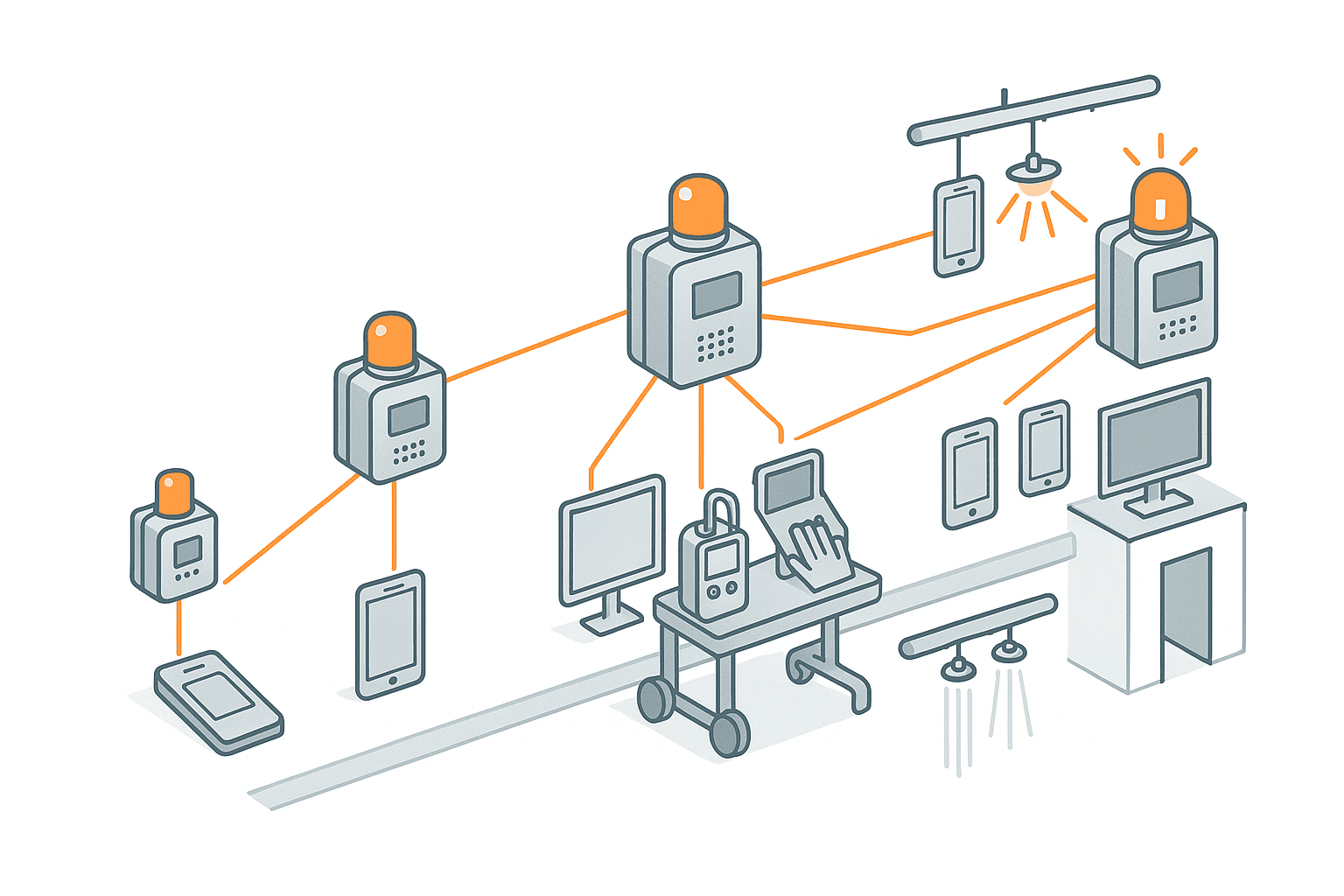
One more issue is alert fatigue. Set thresholds too low and notifications become constant, until the site starts ignoring them. The real intent of tiering is to treat frequent low-level notifications as something to record and trend, and infrequent high-level notifications as something that always demands action. Issue every tier with the same intensity and the tiering has lost its purpose.
Log retention and dashboards
Finally, how to hold the data you collect.
The retention period needs to be at least long enough to span the regulator’s inspection cycle. Being able to produce the entire period since the last inspection is the minimum, and discussions about equipment renewal or incident response can call for comparisons spanning several years.
Dashboard design tends to fall into showing only a large real-time reading of the current value. Current values are already handled by the on-site alarm devices. What a manager needs to see is the trend — how the baseline at each detection point has shifted over time. A screen that shows a month-on-month comparison under the same operating conditions at a glance makes a conversation about precursors possible.
The idea of putting safety-related monitoring on an IoT platform is not specific to gas detection. Other safety monitoring in the plant, for instance Industrial BESS Monitoring, shows the same structure of continuous measurement of temperature and voltage, tiered alerts, and logs kept for later explanation. Rather than building a separate island of monitoring for each installation, standardising the notification paths and the logging platform holds down both the operational load and the cost of future expansion.
Implementation cost and the value of compliance evidence — an in-house model case
This section frames the cost side as input to an investment decision. The amounts below are TOMAS TECH’s own estimates and are not based on published market rates or statistics. Actual quotations vary considerably with the equipment configuration, the size of the machine room, the state of existing wiring and the sensor technologies selected, so please treat them purely as a starting point for discussion.
The model is a medium-sized cold storage warehouse with ammonia refrigeration equipment. It has one machine room and two work areas. For the continuous monitoring case, because the sources of a leak inside the machine room are dispersed, three points go in the machine room, one in each work area, and one at the downwind site boundary, for six detection points in total.
First, a configuration that only meets the stated minimum. One unit in the machine room and one in each of the two work areas, three units in all.
| Item | Detail | Amount |
|---|---|---|
| Detector units | Three units — one machine room, two work areas | THB 75,000 |
| Installation work | Mounting and power wiring | THB 25,000 |
| Total initial cost | – | THB 100,000 |
| Annual running cost | Calibration and reserve for element replacement | THB 30,000 |
Even this configuration satisfies the detector clause among the eight precautions. Next, the configuration for an IoT continuous monitoring system.
| Item | Detail | Amount |
|---|---|---|
| Sensors | Six detection points, technologies mixed by purpose | THB 210,000 |
| Controller and gateway | Signal aggregation and communications | THB 80,000 |
| Wiring and installation | Including runs inside the machine room and out to the site boundary | THB 120,000 |
| Dashboard and notification setup | Tiered thresholds, escalation, screen build | THB 60,000 |
| Total initial cost | – | THB 470,000 |
| Annual running cost | Calibration, reserve for element replacement, cloud usage | THB 90,000 |
The difference in initial cost is THB 370,000, and the difference in annual running cost is THB 60,000. How to evaluate those figures is the real question in the approval process.
For a labour-reduction investment you can calculate a payback period from the hours saved. That formula does not work for a safety monitoring investment. The variable to use here is avoided loss instead. Suppose, for the sake of argument, that lost profit from a suspension of operations is THB 150,000 per day. On that assumption, the THB 370,000 difference in initial cost equates to roughly two and a half days of suspended operations. Given a stated policy of immediate suspension for factories that leak repeatedly, that comparison starts to look real.
There is also value that resists translation into money. When an event occurs, can you produce the concentration log, the alarm history and the response record in chronological order? That matters not only in dealings with the regulator, but in reporting to head office, in insurance claims, and in explaining yourself to the neighbourhood. Records cannot be created after the fact. Only what you already held when the event occurred can serve as evidence.
Organised as material for an investment decision, it comes out like this.
- The THB 100,000 initial cost of the minimum configuration is the cost of meeting the level set out in the precautions
- The THB 370,000 initial difference for the IoT configuration is the cost of acquiring records, notification and precursor detection
- The former is spending to avoid being cited, the latter is spending to avoid an incident and to be able to explain one that does occur
- Because the two serve different purposes, asking which is cheaper is not a meaningful comparison
Whether that distinction can be made explicit in the approval document largely determines whether it gets signed off, because once a safety investment is put on a unit-price comparison, the minimum configuration wins every time.
Practical checklist for refrigeration safety in Thailand
The following are points worth confirming at any factory with ammonia refrigeration equipment. They apply not only to new installations but also to taking stock of existing ones.
- Have you confirmed, from both the equipment register and the equipment itself, whether your refrigeration systems use ammonia as the refrigerant
- Have you confirmed with the competent authority or a specialist whether your site falls within the scope of the regulations effective 8 December 2024 and 19 February 2025
- Have you written out your current status against each of the eight precautions published by the Department of Industrial Works
- Can you confirm from calibration records that the detectors in the machine room and work areas are not merely installed but functioning correctly
- Are the calibration interval and the element replacement timing for electrochemical sensors built into the maintenance plan
- Have you identified the possible leak points inside the machine room, and does the placement of detection points match that distribution
- Is there a defined path for who is notified and how when an alarm sounds during unmanned hours, and has it actually been tested
- Is notification spread across more than a single person, and is there a defined next recipient when there is no acknowledgement
- Are concentration measurements recorded continuously, and can the entire period since the last site inspection be produced
- For alarms that have occurred in the past, do the time raised, the responder, the action taken and the time of recovery remain in chronological order
- Do you have, or have you considered, a means of measuring concentration at the downwind site boundary
- Have you set tiered alarm thresholds and written out the notification recipients and required actions separately for each tier
- Have you measured how many minutes it takes from an alarm before the water curtain and personal protective equipment are actually usable
- Are emergency response drills held at least once a year, and are the records retained
- Does the emergency plan include a communication procedure for cases where surrounding residents are affected
Of these, the two most often skipped in practice are the live test of the notification path during unmanned hours and the retention of past alarm history. The first tends to be waved through on the basis that it is configured so it must work, when in reality it breaks quietly through a change to communication settings or a change of personnel. The second feels unnecessary right after an event, because everyone still remembers, and the gap is only discovered months later when an explanation is required.
Frequently asked questions
Where should ammonia detectors be installed
The precautions published by the Department of Industrial Works call for at least one each in the machine room and in work rooms where staff are present. That is a minimum level applicable to every factory, however, and not a statement of how many units you actually need. In practice we recommend placing several points to match the distribution of leak sources inside the machine room, such as the compressor shaft seal, fittings around the receiver, valve glands and the oil drain valve, so that the timing difference between points lets you narrow down the origin. Installation at the downwind site boundary is also worth considering, for the purpose of understanding the impact on people living nearby.
What does a gas leak detection system typically cost
It varies greatly with the configuration. In our own model case, a medium-sized cold storage warehouse with one machine room and two work areas, a three-detector configuration meeting the minimum came out at around THB 100,000 initially with around THB 30,000 in annual running cost, while an IoT configuration networking six detection points with log retention and notification came out at around THB 470,000 initially with around THB 90,000 in annual running cost. Because the two serve different purposes, a straight price comparison is not meaningful. The first is spending to meet the level set out in the precautions, the second is spending to acquire precursor detection, records and notification. Actual figures move with the size of the machine room, the state of existing wiring and the sensor technologies selected, so please treat a site survey as a prerequisite.
How long should records be kept for toxic gas monitoring in a factory
A fixed retention period is not necessarily prescribed, so this answer takes a practical view. At minimum you need to be able to produce the entire period since the last inspection, long enough to span the regulator’s inspection cycle. Beyond that, decisions on equipment renewal and trend analysis of recurring events can call for comparisons spanning several years. With an IoT system the cost of retention itself is not significant, so there is little reason to cut it short. What matters more is whether you hold the data in a form you can retrieve as a time series when it is needed.
Which sensor technology suits ammonia leak detection
The answer changes with what you are protecting. For managing human exposure, meaning low-concentration monitoring in work areas, the accuracy of electrochemical sensors suits the task. Their sensing elements have a limited life, generally requiring replacement every two to three years, which needs to be built into the operating plan. For the explosion risk side, meaning the high-concentration range, catalytic combustion sensors are appropriate. Semiconductor sensors are inexpensive and long-lived but respond readily to gases other than the target, and can be a source of false alarms where oil mist or cleaning agent vapours are present. Since ammonia is both toxic and flammable, a realistic design combines technologies chosen for different objectives.
We already have stand-alone detectors. Do we need to move to IoT
In terms of the level set out in the Department’s precautions, your existing installation may already satisfy it. The dividing line is what you can show when an event occurs. Stand-alone detectors leave no record of when the concentration began to rise, how high it reached, or how long it took to come down. Identifying the source is difficult, and preventing a recurrence of the same event becomes harder. Where the stated policy is immediate suspension for factories that leak repeatedly, the presence or absence of those records makes a practical difference. Start by checking two things — the notification path when an alarm sounds during unmanned hours, and how past alarm history is retained. If there are holes there, it is worth looking at IoT.
What documents are requested during a site inspection
The content of any individual inspection needs to be confirmed with the competent authority or a local specialist, but the eight precautions indicate the direction of what to have ready. These include documentation showing the appointment of a supervisor with specialist knowledge of refrigeration systems, the labelling status of the main valves, drawings of escape routes in relation to pipe routing, detector placement and calibration records, the provision and inspection records of personal protective equipment, inspection records for the water curtain equipment, and records of emergency response drills held at least once a year. Where continuous monitoring is in place, concentration logs and records of alarm responses can be submitted as well. Note that documents showing equipment exists and documents showing it is being operated are two different things, and the latter is the harder set to assemble.
References
- The Department of Industrial Works press release, titled in Thai and translating as “Cold stores and ice plants take note — Akanat declares he will not tolerate repeated ammonia leaks,” can be found on the relevant page of the Department’s website. The instruction from Minister of Industry Akanat Promphan, the policy of immediate suspension for factories with repeated leaks, the two ministerial regulations effective 8 December 2024 (B.E. 2567) and 19 February 2025 (B.E. 2568), and the figure of 2,341 factories in scope are all based on this press release
- Reporting on the same policy announcement can also be found in the Matichon article
- The explosion late on 17 April 2024 at an ice plant in Nong Prue subdistrict, Bang Lamung district, Chonburi province, the spread of gas poisoning to residents nearby, and the eight precautions published by the Department of Industrial Works for factories using ammonia refrigeration systems are based on an article in Naewna dated 18 April 2024 (B.E. 2567), titled in Thai and translating as “Ammonia — widely useful across industrial sectors, but a hazardous substance that demands care”
- The ammonia leak and resident evacuation on the night of 13 July 2025 on Soi Nern Plub Wan in Pattaya, and the reported cause of an open valve on an ammonia tank, are based on a Thai Examiner article dated 14 July 2025
- Technical matters such as the characteristics of each sensor technology, the typical service life of electrochemical sensors, reference values for exposure concentration and the general properties of ammonia odour are reference information based on widely held knowledge. For legal requirements that apply to you and for specific threshold settings at your own facility, please confirm with the competent authority and with specialists
- All monetary figures are TOMAS TECH’s own estimates and are not based on published market rates or statistics
Summary
Ammonia refrigerant leaks keep recurring at Thailand’s ice plants and cold storage warehouses. The April 2024 explosion in Chonburi province harmed people living nearby, and in July 2025 another leak occurred in the same area. The Department of Industrial Works has strengthened safety standards through two ministerial regulations, with 2,341 factories given as the scope. The Minister of Industry has ordered tighter enforcement, including immediate suspension of operations for factories that leak repeatedly.
What the Department’s precautions require is at least one ammonia detector each in the machine room and the work areas. That wording is clear, and so is what it does not require. Recording and notification appear nowhere in it. Which is exactly why a gap remains between meeting the minimum and being in a state where incidents are actually prevented and can be explained when they occur.
What closes that gap is not the number of detectors. Narrowing down the leak location through continuous measurement at multiple points. Catching precursors from the movement of the baseline. Notifications that arrive during unmanned hours and move on to the next recipient when unanswered. And the full course of an event retained as a time-series record. Those four things are what a stand-alone alarm cannot give you.
Safety investments struggle in the approval process because you cannot calculate a payback period from hours saved. But where the stated policy is immediate suspension for factories that leak repeatedly, the variables to use are not hours saved. They are avoided loss and the value of being able to explain yourself afterwards. Whether those two can be set out side by side in the approval document is what decides the outcome.
TOMAS TECH is based in Bangkok and helps manufacturing, food and logistics sites across Thailand build their equipment monitoring and data collection. We can propose a design suited to the conditions on your site, including configurations that keep your existing detectors and add only the recording and notification layer on top. There is no need to have decided on anything yet, and we are happy to start by taking stock of where you stand today. Please get in touch through our contact page.


