


Selecting Thread Sub-GHz for factory IoT begins with a distinction between a development announcement and a product that can be purchased and operated. On 21 September 2026, Thread Group said its board had approved work to extend Thread to a Sub-GHz physical layer, and that specification development was underway. It did not announce a completed Sub-GHz specification, a certification program for that variant, certified products, Thai operating bands or a commercial delivery date. A Thai factory can still prepare: define its data requirements, evaluate available connectivity, survey the site and write procurement criteria that allow a future technology to be assessed when evidence exists.
What the Thread Group announcement actually means
Thread Group describes the goal as taking Thread’s IP-based, low-power mesh approach into commercial and industrial Sub-GHz applications. Its release says a distinct brand will be introduced later. It does not settle the final channel plan, transmit power, throughput, latency, battery life, gateway design or certification tests. If a supplier says a device is “Thread Sub-GHz ready,” ask for the exact published specification version, the responsible certification body, a test report, a Thai model number and a binding availability date. Treat a roadmap as a roadmap; do not turn it into a line item with a guaranteed installation date.
Today’s Thread is an IPv6 mesh technology built on IEEE 802.15.4. Thread 1.4 includes features such as credential sharing, diagnostics and integration through infrastructure. Those documents explain the current Thread ecosystem. They do not prove that today’s Thread products will communicate by radio with a future Sub-GHz implementation. A new PHY can change the radio, antenna, power budget, gateway and conformity path. Wait for the published specification and interoperability evidence before promising an upgrade route.
There are two sensible planning horizons. For monitoring points that must work during this budget year, select an available device whose Thai conformity and field performance can be checked. For the longer term, keep asset identifiers, application APIs and data models independent of the radio adapter. This leaves a later Thread Sub-GHz option open without making production schedules depend on an unfinished specification.
Define the factory data before choosing a radio
“Connect the factory” is too broad to procure. List each use case: environmental and energy readings, motor condition, alarm notification, moving carts, operator terminals, camera feeds and PLC control. For every point, record the asset ID, measured quantity, payload size, reporting interval, maximum useful delay, response to missing data, retention location and maintenance owner. A temperature value every ten minutes is a different workload from video or a safety stop. None should inherit a performance promise merely because a technology uses the word mesh.
Start with the operational loss: missed readings, late fault discovery, walking time for inspection, downtime or traceability gaps. A fixed machine with a short, safe cable route may still be cheaper over its life with Ethernet or IO-Link. Wireless can be compelling for distant utilities, moving work, crowded cable trays or retrofits where shutdown is expensive. “Percentage of sensors made wireless” is not a useful business target. Ask which existing loss the installation will reduce and how that change will be measured.
Safety-related functions need a separate design and validation process. Do not assume an ordinary monitoring mesh can replace an emergency stop or other machine-safety circuit. For ordinary monitoring, decide whether a missing sample can be backfilled or requires a local alarm. Put that decision in the requirements before vendors quote latency or reliability figures.
Sub-GHz does not equal a guaranteed range
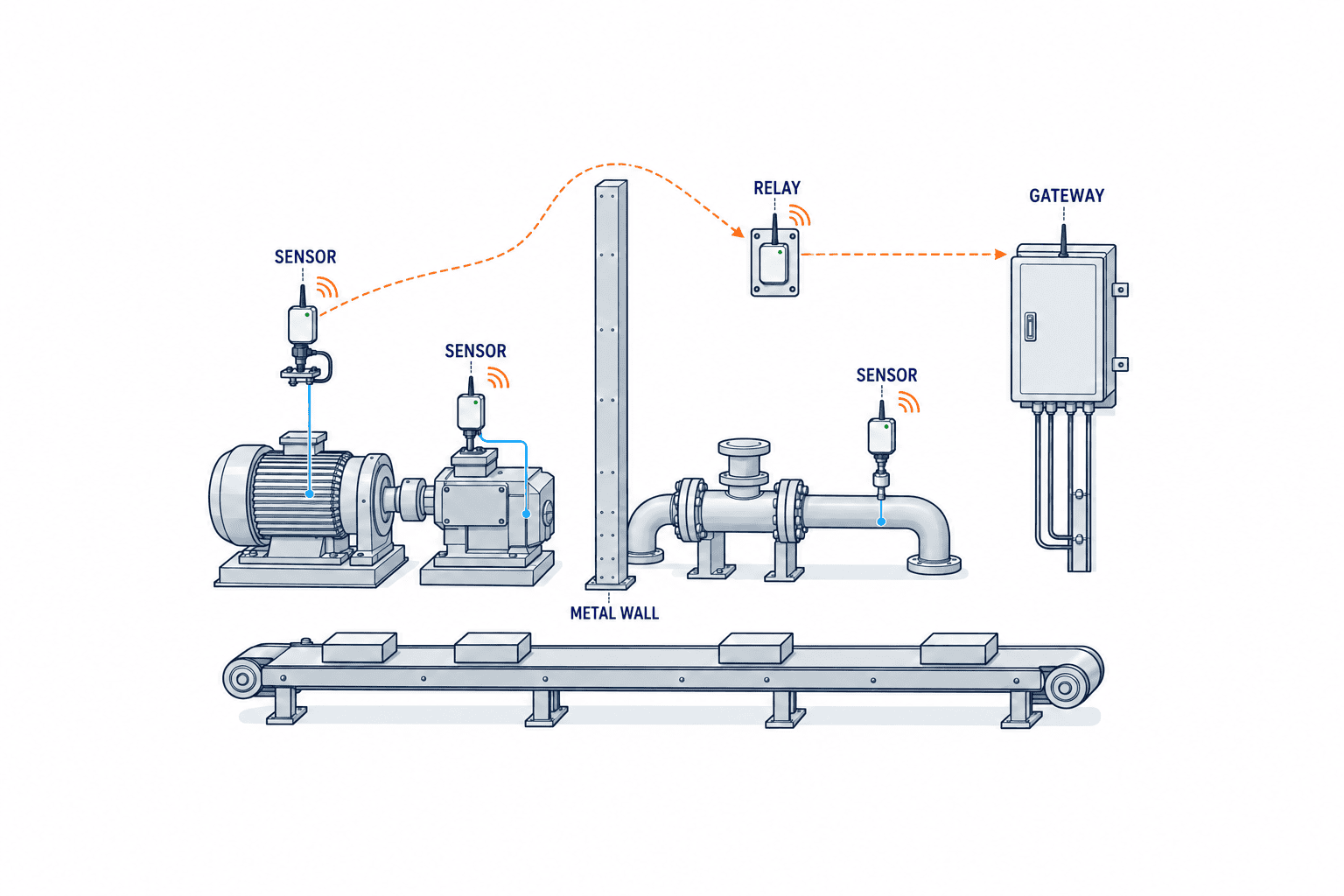
Sub-GHz is a broad frequency category below 1 GHz. Lower frequencies can help in some environments, but actual coverage depends on lawful transmit power, receiver sensitivity, antenna gain and orientation, installation height, cable loss, metal shielding, multipath, channel occupancy and packet size. A warehouse aisle changes when a rack is filled. A manufacturer’s outdoor maximum range is not an indoor factory guarantee. Test the proposed device at the intended mounting positions while the production line is running.
Mesh routing may add alternative paths but also adds powered relay locations, hops, airtime and maintenance points. A battery node may not serve as a permanent router; check the actual product design. The future Thread Sub-GHz node roles and deployment constraints must be read from its final specification and implementations, when available. For a proof of concept, include difficult positions behind equipment, near motors, across doors and along moving-material routes. Do not demonstrate only the easiest point near the gateway.
Measure packet delivery, consecutive outage duration, end-to-end latency, reconnection time and battery trend by use case. Record both idle and peak-production conditions. Signal strength alone cannot show whether an alarm reaches the maintenance team or whether a traceability event reaches the MES with the right asset and timestamp. Keep raw logs and a site plan so another option can be evaluated under comparable conditions.
Comparing Thread Sub-GHz, DECT NR+, Wi-Fi and private 5G
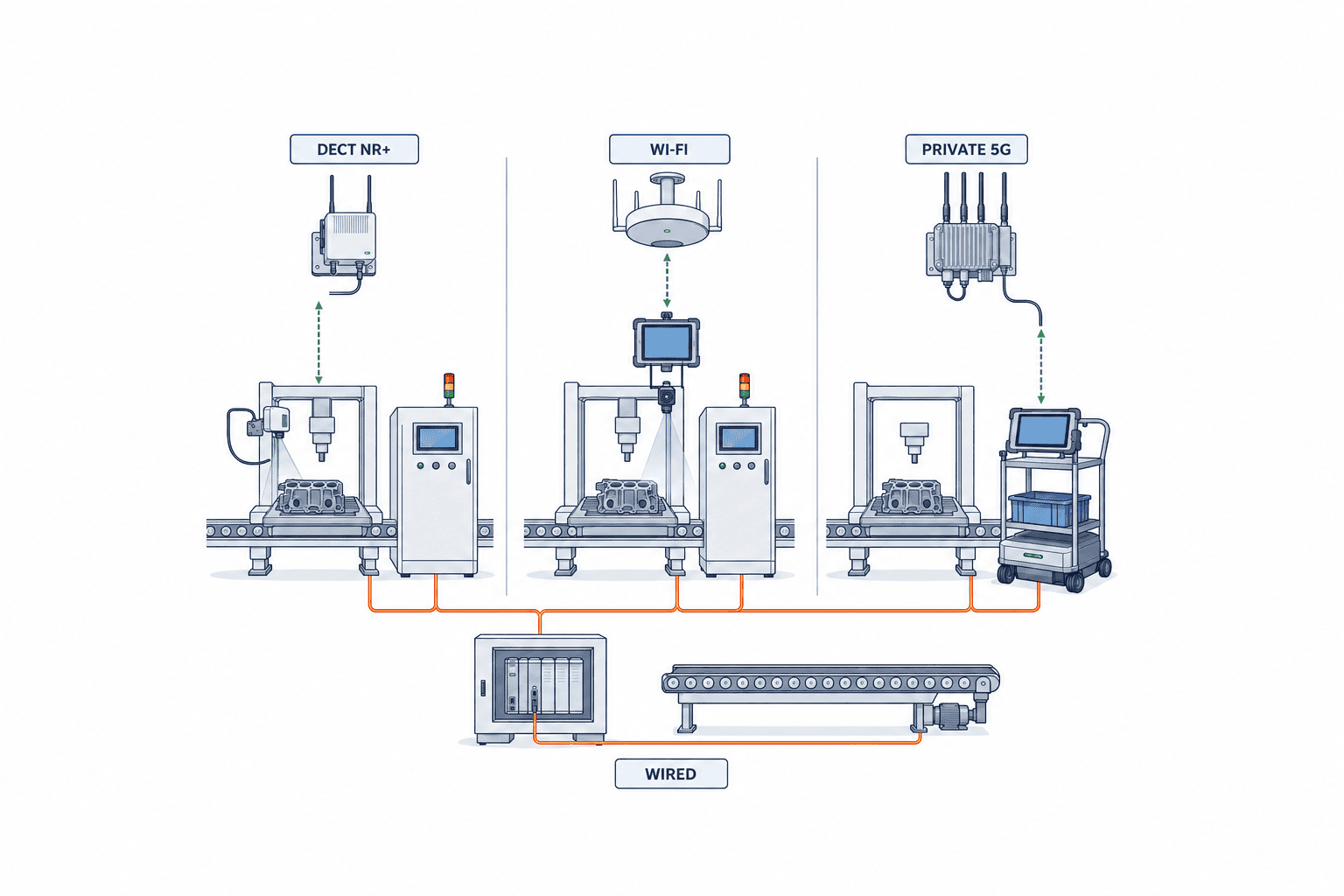
DECT NR+ is a separate technology based on ETSI’s DECT-2020 NR standards. ETSI describes industrial IoT and local mesh applications. Its technical documents should be used to understand that system, not to assert compatibility with future Thread Sub-GHz. Statements about flexible or unlicensed deployment in international ETSI material do not grant a blanket right to use any model in Thailand. Ask about the exact frequency, model, configuration and NBTC requirements.
Wi-Fi is often the practical option for tablets, HMIs, cameras and other endpoints already integrated into an IT/OT network. It needs a site design covering access point locations, roaming, interference, power, segmentation and device management. A battery sensor sending a few bytes periodically may have a different lifetime and maintenance profile from a camera or tablet. Existing access points do not automatically make additional sensor traffic free. See our factory wireless LAN design guide for a site-oriented approach.
Private 5G may merit evaluation for a large site with mobile assets, multiple applications and a team able to operate the network. 5G-ACIA frames industrial 5G value and return on investment by use case. Low latency is not guaranteed by the name: devices, radio layout, core, backhaul and applications must be measured together. Include spectrum and contract conditions, radio units, core, handsets or modules, integration, security and ongoing support in the estimate. A few low-rate sensors could make this overbuilt; a shared network for moving equipment and several production processes is a different case.
| Option | Procurement position in October 2026 | Evidence to request | Shortcut to avoid |
|---|---|---|---|
| Thread Sub-GHz concept | Specification in development | Final specification, certification path, Thai product availability | Treating the proposal as a certified product |
| DECT NR+ | Separate ETSI-standardized technology; verify actual products | Frequency, NBTC status, gateway, local support | Assuming global spectrum language is Thai authorization |
| Wi-Fi | Evaluate against the installed IT/OT network | Coverage, roaming, congestion, power | Assuming existing APs suit every sensor |
| Private 5G | Assess as a site-wide investment | Devices, core, coverage, operations and regulation | Assuming the label guarantees latency |
| Wired Ethernet or IO-Link | A baseline for fixed equipment | Cabling, shutdown, power, serviceability | Excluding wired life-cycle cost |
The table is not a ranking of standards. Fix the use case and site conditions first, then compare products and evidence. Our DECT NR+ industrial IoT article explores that alternative without treating it as the same specification.
Check NBTC applicability by device and configuration
The Thai NBTC publishes procedures and a type-approval database for radio and telecommunications equipment. Its materials have discussed 920–925 MHz for IoT use, but a band description does not establish that a future Thread Sub-GHz device may be imported, installed or used without further checks. The proposed variant has not announced a Thai band. Review current NBTC notices and the requirements that apply to the exact candidate model, module, frequency range, output power, antenna, firmware and use case.
Ask the supplier for the Thai model code, applicable technical standard, NBTC certification or registration record where required, test reports, the approved radio configuration, importer and local service entity. A report for another country is useful background, not automatic Thai approval. Changing antennas, modules or transmit settings can change the approved configuration. Cross-check the type-approval record and resolve discrepancies before purchase or installation. The supplier and relevant local specialists should confirm the current requirements at the time of the decision.
Stage the project accordingly. An RFI can collect candidate approaches. Before importing samples, conducting a field trial or signing a production purchase order, confirm the applicable procedures for that action. The contract should say who supplies compliance evidence, who handles a configuration change and what happens if an approval or delivery slips. Avoid using a historical article as the final legal determination for a new model.
Specify the entire data path, not just the wireless hop
A useful installation delivers the right value under the right asset ID and timestamp to a person or system that can act. Draw the sensor, gateway, network, broker, database, dashboard and MES boundaries. At each boundary define missing samples, buffering, retries, deduplication, clock drift and alarm ownership. Our industrial IoT gateway selection guide provides questions that can be reused in the RFP.
For vibration monitoring, identify the axis, sample or aggregate value, motor, operating condition, threshold and maintenance event. A perfect radio link with the wrong asset mapping still produces bad analysis. For product traceability, distinguish event time from reception time and prevent retransmissions from creating duplicate events. For a temperature alarm, define how staff respond if the network fails. These application tests belong in acceptance criteria, not as an afterthought once a supplier demonstrates radio coverage.
Radio encryption is only one part of security. Specify onboarding, credential storage and rotation, device retirement, theft response, gateway patching, segmentation between OT and the cloud, logs and recovery rights. Thread Group describes network-layer protections for current Thread; a factory must still implement application authorization and secure remote support. Make the operator for each task explicit in the contract.
Design a proof of concept around difficult locations
Choose one representative process, then deliberately include locations behind metal, low to the floor, outside a building edge or along a moving cart route. Survey coexistence with installed Wi-Fi and wireless sensors, and test while motors and material handling are active. Record behavior during gateway restart, power failure, network disruption and route changes. Use photographs and a drawing to fix antenna position and orientation.
Set pass criteria before testing. Examples are receiving each scheduled temperature reading, raising a local alert after a defined outage, or retaining values when the gateway is offline. The numerical thresholds depend on the business task and site; there is no universal pass percentage in this article. Preserve failed tests and raw logs. Changing the threshold after seeing results undermines the procurement comparison.
For battery cost, do not multiply a catalogue “up to” lifetime by the node count. Include reporting frequency, retransmission, ambient temperature, chemistry, replacement access and permitted downtime. A large population of sensors at height may have a material service cost even with multiyear batteries. Powered routing points can stabilize some designs where safe power exists. Recalculate with an actual product’s specifications rather than the proposed future standard.
RFI now, product RFP when evidence exists
For Thread Sub-GHz in October 2026, an RFI is the appropriate procurement instrument. Ask whether a supplier participates in specification work, what technical material can be shared, whether it has a certification roadmap, when samples may exist, what Thai radio plan it proposes and who would support units locally. Label every answer as development, roadmap or verified product fact. Do not write “Thread Sub-GHz required” into an urgent equipment purchase as if a certified ecosystem already exists.
For available technologies, issue an RFP with the sensor count, layout, operating hours, environment, power, loss behavior, data format, local support, spares, NBTC evidence, FAT, SAT and training. Use the same requirement table for DECT NR+, Wi-Fi, other lawful low-power solutions and wired options. To preserve future choice, specify an exchangeable adapter boundary and documented data API, not a promise that an unannounced device will be backward compatible.
Request six groups of evidence: model-specific radio and Thai conformity documents; supply and spare-part commitments; field measurement method; gateway outputs and offline behavior; credential and patch lifecycle; and acceptance tests. A seventh group may describe how a future radio migration would be priced, but this is a scenario estimate, not a guarantee that the future specification is available.
Compare five-year operating cost and plan an exit
Normalize supplier scope before comparing prices. Up-front costs include sensors, antennas, power, mounts, gateways, installation, site survey, application integration, conformity work, FAT/SAT and training. Recurring costs include batteries, subscriptions, spares, firmware, cybersecurity operations, service response and any retesting after a layout change. Show production shutdown work separately. A sensor-only quote cannot be compared with an installed and supported network quote without filling those gaps.
Measure a business baseline: inspection time, fault discovery time, missing events, downtime and quality-investigation effort. A longer radio range alone does not prove lower maintenance or quality cost. Estimate the first process, one building and multiple buildings separately because relay points, power and support staffing change with scale. Include the cost of waiting: if missing data causes losses now, a small current-technology deployment may be rational. If the equipment refresh is years away, monitoring the future specification may be rational. Put both choices on the same time horizon.
An exit architecture maps logical measurement-point IDs to physical device IDs. Applications consume asset, unit, value, event time and quality flags rather than a manufacturer’s address. This limits rework when a device or radio is replaced. During migration, run old and new points in parallel long enough to compare values, prevent duplicate alarms, revoke old credentials and dispose of batteries properly. Include that field work in any later Thread Sub-GHz migration estimate.
A five-column decision record for purchasing, maintenance and IT/OT
Use a decision record with five columns, shared by the plant operator, maintenance, engineering, purchasing and IT/OT. Column one describes the use case and measurement point. “Temperature monitoring” is not enough: state which bearing or cabinet is measured, how often, what limit triggers a check, and who responds. Column two describes the existing method, such as a manual round, PLC signal, logger or installed Wi-Fi, so the comparison has a baseline. Column three contains hard gates: lawful Thai operation, acceptable loss behavior, safe installation, maintainability and connection to the production application. A proposal that misses a hard gate cannot be rescued by a high score elsewhere.
Column four contains preferences that can be scored: size, replacement interval, mounting effort, future scale and ease of operation. Column five names the evidence: certificate, dated supplier document, site test log, FAT/SAT record or contractual commitment. Put an owner and review date beside each unresolved item. Under this scheme, the future Thread Sub-GHz option can remain a technology to revisit but cannot score as an available certified device. Products that can be ordered now compete on testable evidence. Set reassessment triggers such as publication of a final specification, a relevant certification program, Thai-model documentation and a verifiable delivery commitment. The passage of a few months alone is not a new piece of evidence.
Have each discipline sign its part. A supplier may place a node where washdown staff will damage it. IT may define an alarm that the night shift cannot interpret. Purchasing may focus on unit price while excluding spare stock and emergency response. The decision record should expose those gaps before approval. A change in use case, antenna, radio settings, plant layout or applicable regulation should reopen the relevant gate rather than being treated as an informal field adjustment.
Five cost buckets that supplier quotes often omit
First, include field survey time: the number of production states measured, shifts visited, repeat visits and the cost of documenting positions. A line that appears short on a drawing may have metal obstructions or traffic that only exists during peak operation. Second, include physical installation: brackets, guarding, vibration-resistant connectors, antenna mounts, power supply and access equipment. Third, include data integration: mapping asset IDs, units, quality flags and timestamps once values leave the gateway. A vendor saying “MQTT available” has not necessarily implemented the plant’s alarm and historian rules.
Fourth, include maintenance throughout the contract: batteries, replacements, firmware, credentials, stolen-device revocation, logs and the technician able to respond outside office hours. Fifth, include reassessment when the environment changes: a new rack, relocated line, additional Wi-Fi network, replacement module or firmware change may require a new RF survey or conformity check. Put every exclusion on a separate line. “Power by customer,” “NBTC paperwork by importer,” and “MES connection up to API only” can change the real price and owner of the work. Compare the same five-year scope and expected recovery time; a slightly cheaper node can be the more expensive system if local spares are unavailable.
Design the exit when the radio method changes
Define an application-facing schema for the measurement-point ID, asset ID, engineering unit, value, event time and quality status. Keep a controlled table mapping each logical point to the physical node, sensor port and gateway. If dashboards and reports directly reference a vendor’s device address, replacing the radio creates application work at every point. A common schema costs something to build, so use it first on measurements expected to survive beyond the pilot. Do not abstract every temporary sensor merely for architectural neatness.
Exit planning also covers retirement, not just data export. Run old and new systems together for an agreed period, compare values and clocks, prevent duplicate alarms, move buffered events, revoke old network credentials and reconcile the inventory with the devices collected in the field. Record safe battery handling and the rollback conditions if the new path fails. A gateway swap may require special treatment of unsent events. These tasks belong in a later migration estimate even if the final Thread Sub-GHz specification eventually offers attractive device prices.
A 90-day procurement-readiness example
During days 1–30, identify the target assets, operational loss, existing wiring and networks, measurement-point register and Thai-available candidate devices. Agree on hard gates and success criteria before viewing demonstrations. During days 31–60, issue an RFI for currently available options and survey the site while the line runs. Shortlist two or three architectures and document exclusions. For the unfinished Thread Sub-GHz work, collect public developments and establish the evidence triggers; do not invent a product price based on an expected standard. During days 61–90, run a representative PoC, validate the data path and missing-data response, collect NBTC documentation and service quotations, and turn the findings into an RFP aligned to the equipment-refresh window.
This is a buyer’s work plan, not a prediction of a specification or product launch. Import procedures and shutdown windows can extend it. Compressing the schedule by omitting a field survey or conformity check often shifts time into installation rework. For multiple plants, standardize IDs, data-quality definitions and acceptance-record formats, then repeat the radio and maintenance assessment at each plant. Different walls, machinery, RF traffic and spare-part channels can invalidate a copied coverage plan. Keep the decision record in the maintenance register as well as the purchasing file so a future team can see why positions and thresholds were chosen.
FAT, SAT and operating handover
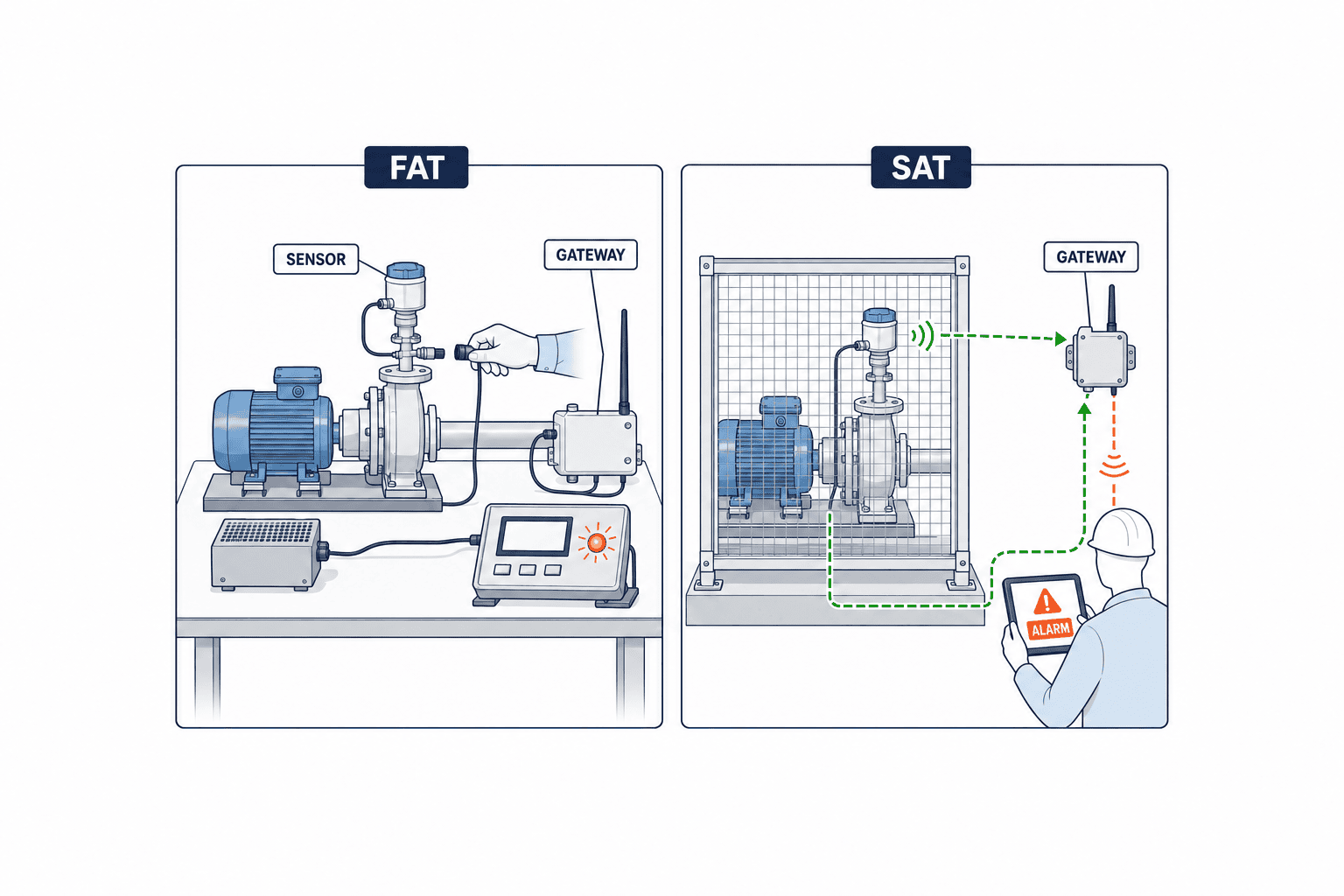
At FAT, test configuration, data format, asset mapping, missing and duplicated readings, time synchronization, recovery from a broken link, rejection of an unauthorized device, credential changes and alarm action. Record model, firmware, network diagram, pass result and exception. These acceptance checks are reusable across radio technologies. At SAT, repeat the tests at installed positions while the actual line operates. Record packet delivery, long outages, latency, power behavior, gateway recovery and the effect of moving metal workpieces. Define when a changed layout requires another survey.
Handover includes the asset-to-device register, NBTC evidence, software versions, key custodian, spares, battery process, service contacts, troubleshooting tree, log retention and a recovery drill. Thai and English operator instructions should use the same equipment names and alarm terms. A network becomes a maintainable factory system only when the local team can identify a failure, replace a device and restore a known-good configuration.
For a 90-day preparation example, use the first month to map losses and assets, the second for an RFI and live site survey, and the third for a representative proof of concept and RFP. This is a buyer’s work plan, not a prediction of when the Thread Sub-GHz specification or products will ship. For multiple plants, standardize data definitions and test records, then repeat radio and maintenance checks at every site. Different walls, equipment and support arrangements can invalidate a copied coverage plan.
Conclusion: buy to today’s evidence and preserve tomorrow’s option
Thread Sub-GHz is a development initiative announced by Thread Group in September 2026. Select today’s network with current product, Thai compliance and factory-test evidence. Keep the data and device replacement boundaries clear so a future option can be evaluated when its specification, certification, products and local approvals are known.
If your Thailand plant is preparing a sensor-network comparison or RFI, contact TOMAS TECH at the scoping stage. We can help define the site test, data handoff and procurement evidence for the options available today.
Frequently asked questions
Can we order certified Thread Sub-GHz equipment now?
The 21 September 2026 announcement says specification development is underway. It does not establish a completed specification or certified-product supply. Request the final specification, relevant certification, exact model, Thai compliance and delivery evidence before ordering.
Is Thread Sub-GHz the same as DECT NR+?
No. DECT NR+ is based on ETSI’s DECT-2020 NR standards. The proposed Thread extension is separate. Shared terms such as mesh or IP do not establish radio interoperability.
Does Thailand’s 920–925 MHz IoT band mean no device approval is needed?
No general conclusion follows. Band information and the requirements for a specific radio, import or installation are different questions. Check the current NBTC rules and the candidate model and configuration.
Will it reach farther than Wi-Fi or private 5G?
The technology name cannot answer this. Lawful power, antenna, obstruction, traffic and mounting position matter. Compare real products at the same site under the same acceptance criteria once the future option exists.
Should we postpone factory IoT until the specification is ready?
Decide from current losses and equipment schedules. A compliant, available technology can address urgent points now while the application data model remains portable. If waiting is viable, assign a date and evidence triggers for reassessment.
Primary sources
- Thread Group announcement, 21 September 2026: development status.
- Thread Group technology overview: existing Thread foundations.
- Thread Group resources: current Thread 1.4 features.
- ETSI DECT committee: separate DECT-2020 NR work.
- ETSI TS 103 636-1 Release 2: radio overview.
- NBTC radio services: Thai regulatory procedures.
- NBTC type-approval database: device records.
- NBTC IoT spectrum document: 920–925 MHz context, not a device approval.
- 5G-ACIA industrial 5G value paper: ROI method.


