


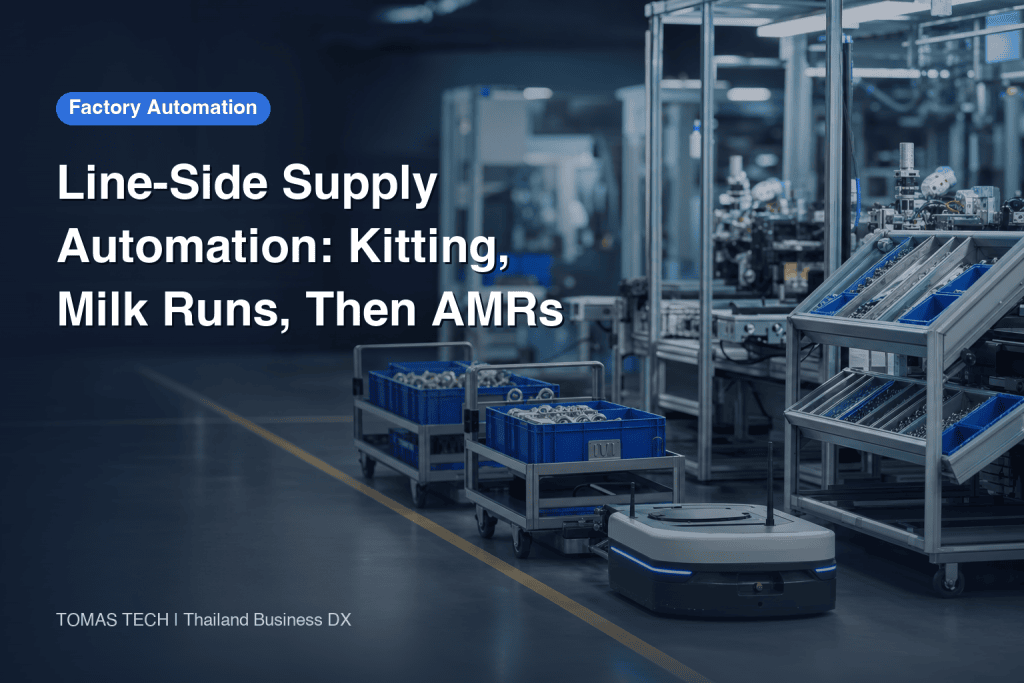
Boxes of parts pile up beside the assembly line, yet a needed part runs out and the line stops. Material handlers shuttle between the warehouse and the line by forklift or hand cart each time they are called. In such a plant, a proposal saying “install AGVs or AMRs and you get line-side supply automation” does not tell you where to start or how much to hand over to machines. This article is a practical guide for people in production control, production engineering and in-plant logistics at Japanese-affiliated automotive parts, electronic components and electrical assembly plants in Thailand (and ASEAN) who need to assemble the facts for an internal decision.
This article makes one argument. Line-side supply automation tends to fail when it starts with “buying vehicles.” First decide (1) the supply method (line-side stock, kitting or sequenced supply), (2) quantity and timing (pitch, container size and the upper limit of line-side stock), (3) the signal (kanban, call buttons or system instructions) and (4) the route and layout (fixed routes, stop points, aisle widths and intersections), and only then (5) choose the means of conveyance (hand carts, tow tractors, AGVs or AMRs). Steps (1) to (4) are mainly design work. Start by running a fixed-time, fixed-route loop (a milk run) by hand to collect numbers, then automate the routes where the benefit has been confirmed.
The sections below follow this order. All product specifications are figures published by the manufacturers, not values verified by third parties. The case studies were published by vendors and are not cases from Thai plants. The cost calculation uses placeholder figures set for this article.
Why line-side supply automation is a live question for Thai plants now
First, let us look at how production in Thailand is moving in 2026.
According to figures from the Federation of Thai Industries (FTI) reported by Reuters, Thailand’s car production in August 2026 was 124,646 units, up 10.93% year on year. In the same month, domestic sales rose 25.59% and exports fell 2.04%. Production in July also rose 6.12%. At the same time, the FTI has revised its full-year 2026 production outlook down from a 3% increase to a 3.33% decrease (a forecast). The reason given is an expected fall in exports due to the situation in the Middle East. With monthly production gains and a full-year decline forecast existing side by side, 2026 can be read as a year of large swings in output.
For manufacturing as a whole, Reuters (published in The Star) reports that the Manufacturing Production Index (MPI) for August 2026 rose 4.44% year on year, above the 1.0% analysts had expected. The director-general of the Office of Industrial Economics at the Ministry of Industry cited higher electronics output, government stimulus measures and a weaker baht as factors. Note that the ministry has revised the MPI calculation method, adding electronic products and changing the weights, and this figure is on the revised basis. According to a BOI announcement (August 3, 2026), investment applications in semiconductors and advanced electronics from 2023 to mid-2026 totaled USD 26.8 billion (about THB 900 billion) across 880 projects, with PCBs the largest segment at 224 projects and USD 9.85 billion (about THB 331 billion).
On the labor side, an August 2025 report (The Nation, carrying Reuters) said that more than 520,000 Cambodians had been working in Thailand before the conflict and that about 400,000 of them had left. Cambodians make up 12% of Thailand’s foreign workforce, and Thailand has approved a first phase of intake of 10,000 Sri Lankan workers (both points are from reports as of 2025). According to the ILO, Thailand has at least 3 million registered foreign workers. In addition, a 2024 announcement article from MiR states that Thailand’s workforce is expected to shrink by 3 million people by 2037. However, this is a quotation inside a vendor press release, and the article does not give the source of the primary statistics.
Globally, according to the IFR’s “World Robotics 2026” (released September 24, 2026), the number of industrial robots operating worldwide in 2025 rose 9% to 5 million units, and annual installations in 2025 rose 11% to more than 600,000 units. These are global figures, not figures for Thailand.
When output swings and staffing is hard to predict, the first thing likely to be affected is parts supply of the “deliver when called” kind. Every change in output changes the number of material handlers needed, and when someone is absent, supply is delayed and the line stops. However, we could not find data that directly links demand for line-side supply automation to these statistics. Please read this part as inference.
What line-side supply is: how it differs from intra-process transport and parts feeding
Let us align the terms first.
In this article, line-side supply means “a system that delivers parts to the side of the assembly line (the line side) in fixed quantities at fixed times.” It is the flow from the warehouse or a supermarket (explained later) to the hands of the operators in the assembly process.
Intra-process transport is the flow that carries the output of one process (work in process) to the next process, and it is a broader term than line-side supply. It includes flows such as press to welding and molding to assembly. Much of the design thinking in this article also applies to intra-process transport automation, but the topic here is the side that delivers parts to the line.
Parts supply is used in two senses depending on context. One is the same meaning as line-side supply; the other is a device that orients and feeds parts inside a machine (a parts feeder). The latter is about “parts feeding and orienting equipment” and is outside the scope of this article. How to choose a parts feeder is covered in Parts Feeding Systems: Four Methods, PoC and FAT/SAT Guide.
The Lean Enterprise Institute (LEI), which publishes a lean production glossary, describes material handling as “not only moving the necessary materials within the plant but also a system that conveys production instructions.” In other words, line-side supply is both the work of moving things and a system that carries information about “what to make next and how much.” Keeping this in mind makes it easier to see why the signaling system should be decided before choosing vehicles.
LEI divides conveyance into two methods.
- Fixed-time, unfixed-quantity conveyance: the material handler travels a set standard route at fixed intervals (for example, every 20 minutes), collects kanban and delivers what is needed. The timing is constant and the quantity varies. Also called “waterspider conveyance,” it is said to suit supplying parts to many points on an assembly line.
- Fixed-quantity, unfixed-time conveyance: conveyance in response to a signal from the downstream process, a “call parts” approach triggered by a set inventory level. The quantity is constant and the timing varies. It is said to suit plants with batch-produced items and storage areas.
LEI also notes that the two can be combined, with a fixed quantity collected on a variable route.
Comparing three supply methods: line stocking, kitting and sequencing
In research, supplying parts to assembly lines is framed as the “Assembly line feeding problem.” The Wikipedia entry divides it into the following five methods.
- Line stocking: parts are taken to the line in the same packaging they were stored in at the warehouse.
- Boxed supply (kanban supply, batch supply): quantities are split into smaller lots before being supplied to the line.
- Sequencing: part variants are arranged in order of demand before being supplied.
- Stationary kitting: quantities are reduced and sorted in order of demand at a fixed location, then taken to the process.
- Traveling kitting: kits sorted in the same way move along with the assembly line.
In practice, discussions go more smoothly if you group line stocking and boxed supply as “line-side stock (fixed-quantity replenishment),” the two kitting methods as “kitting (set supply),” and sequencing as “sequenced supply.” The table below compares these three from a design perspective. The assessments summarize general tendencies and change depending on the items and the production pattern.
| Aspect | Line-side stock (fixed-quantity replenishment) | Kitting (set supply) | Sequenced supply (sequencing) |
|---|---|---|---|
| Suited production pattern | Lines with few variants that use the same parts repeatedly | Lines with many variants and frequent model changeovers | Lines where the specification changes unit by unit and part variants are numerous |
| Line-side stock | Tends to be high (number of items × containers) | Easier to keep low (kit quantities) | Easier to keep low (what is lined up in sequence) |
| Picking load | Operators at the line pick at hand | Concentrated at the kitting area | Concentrated at the sequencing area, and sequence control is required |
| Risk of wrong parts | Mix-ups occur easily when similar parts sit side by side | An error introduced at kit-building flows straight to the line | If the sequence slips, everything after it is affected |
| Fit with automation | Replenishment by container makes it easy to put on fixed-route conveyance | Transport by kit cart makes it easy to put on tow tractors or AMRs | Requires precise timing and sequence, so linkage with production instructions is a prerequisite |
There is research that helps on the relative merits of the methods. The abstract of a master’s thesis (Simon Ersbo) published at LTH, Lund University in Sweden, on June 30, 2020, states that “kitting outperformed line stocking with respect to production downtime, especially with frequent model changeovers,” and that the same held for small kits. Kitting is also reported to have lowered work in process (WIP) on the line. On the other hand, whether in-line storage locations were dedicated or shared reportedly had no significant effect on downtime. However, the abstract does not give the company name, country, sample size or numerical data. It is reasonable to take this as the conclusion of a single study and to confirm it with trials on your own line.
In real plants, it is normal to use different methods for different parts even within a single line. A common split to consider is line-side stock for high-usage, low-cost parts such as screws and small items, kitting for parts that differ by model, and sequenced supply for large parts with many color or specification variants. The first job is to go through the line’s bill of materials item by item and decide which method each item goes into.
How far to take kitting automation
Kitting involves more human judgment than most line-side supply work. “Kitting automation” here has several stages.
Stage 1 is deciding where kits are built and what unit they are carried in. With stationary kitting, the kitting area is placed near the supermarket, and parts are gathered on kit carts before being taken to the line. With traveling kitting, the kit moves with the assembly line, so there is less need for parts shelves at the line side. Which one you choose changes how the line-side floor is used and the shape of the carts that carry the parts.
Stage 2 is making replenishment independent of people’s memory. One example is the flow rack. A flow rack manufacturer (Flexpipe) explains that boxes placed on inclined lanes slide to the front by gravity, replenishers load from the back and operators pick from the front, so first-in, first-out is maintained automatically. It describes two-bin kanban as placing two boxes in each lane, where returning the front box to the replenishment area when it is empty is itself the replenishment signal, with no software or scanning needed (this is the vendor’s explanation). The company says the best place for flow racks is beside or in front of the work cell. The idea can be used for both the shelves in the kitting area and the shelves at the line side.
Stage 3 is handing over the transport of kit carts to machines. Once the kit cart has been set as the unit of transport, it becomes easier to move it onto tow tractors or AMRs. Conversely, if you automate only the transport while cart shapes are not standardized and kit completion times vary, either the vehicle waits or the kit waits.
So where should people remain? Selecting the parts that go into the kit and checking it visually are likely to be kept with people, more so in plants with frequent item changes. Errors in a kit flow straight to the line, so you need to decide in advance “who judges, where, and by looking at what, that the kit is correct.” Automating transport does not reduce the work of building kits itself. It is realistic to separate the question of whether to also automate picking and decide it on its own, looking at the number of items and the frequency of changes.
Designing the milk run (fixed-time, fixed-route loop): trips, cycle time, stop points and load
In moving toward line-side supply automation, the milk run is the most important intermediate step.
LEI describes a milk run as “a routing of a vehicle that picks up and delivers at multiple locations, a way to speed the flow of materials between sites.” By running frequently instead of waiting for the truck to fill up, it can reduce inventory along the value stream and the time needed to respond to requests, and LEI states that “milk runs between sites are conceptually similar to material handling routes within a plant.” In other words, inside a plant, tow tractors or carts travel a fixed route at fixed times, drop parts at each line’s stop points and collect empty containers and kanban.
The starting point of the milk run is the supermarket. In LEI’s description, a supermarket is the place that holds a “predetermined standard inventory” for supplying the downstream process; every item has a fixed location, and the material handler takes only the quantity the downstream process needs. Taking items generates signals such as kanban or empty containers, and the upstream process produces to replenish them. According to LEI, this system was started by Toyota in 1953 at a machining plant in Toyota City, and Taiichi Ohno is said to have drawn the idea from photographs of American supermarkets. Toyota’s official company history traces the origin of just-in-time to Kiichiro Toyoda’s words to the effect that “just-in-time is the best way to gather automobile parts,” and explains that implementation in all plants began in 1960.

As the figure shows, Before is the “deliver when called” pattern from the warehouse by forklift and hand cart, and After is a fixed-route, fixed-time loop starting from the supermarket and the kitting area. Even in After, the assumption is that the tow tractor is driven by a person at first and replaced with an AMR once numbers have been collected.
Four design variables
There are four main variables to decide in designing a milk run. We do not use figures such as industry averages here; we show only the way of thinking as formulas. Fill in the actual numbers from your own measurements.
1. Loop interval (how often the loop runs)
The shorter the loop interval, the smaller the quantity carried per trip and the lower the line-side stock. In exchange, the number of trips increases, and so does the workload of material handlers or vehicles.
- Trips per shift = operating time per shift ÷ loop interval
2. Cycle time (how many minutes one loop takes)
The time for one loop is the sum of travel time and the work time at each stop point (dropping parts, collecting empty containers, collecting kanban).
- Cycle time = route length ÷ travel speed + Σ (work time at each stop point) + loading time at the supermarket
If the cycle time is longer than the loop interval, the route cannot be covered by one vehicle or one person. You need to split the route or add vehicles or people.
- Number of vehicles (or material handlers) needed ≥ cycle time ÷ loop interval
3. Stop points (where to stop)
Stop points are set to match the line-side shelves and the replenishment openings of flow racks. Too many stop points lengthen the cycle time; too few mean operators have to walk to get parts. Decide the positions of stop points on the layout drawing, including their relationship to aisle widths and intersections.
4. Load (what and how many boxes to carry per trip)
The quantity carried on each trip must not fall below what the line uses before the next trip arrives.
- Required quantity per trip at each stop point ≥ usage rate of that line × loop interval + safety margin
- Load per trip ≥ Σ (required quantity per trip at each stop point)
If the upper limit of line-side stock (the maximum quantity allowed at that location) has not been set, operations tend to drift toward lengthening the loop interval to make life easier. The upper limit is a commitment that “no more than this will be placed at the line side,” and it is decided together with the milk run design.
Run it by hand first
These four variables cannot be settled by desk calculation alone. The work time at stop points and the frequency of interruptions (urgent parts, replacing defects) are only known once you actually run the loop. So at first, have people run the fixed-time, fixed-route loop with hand carts or manually driven tow tractors, and record the cycle time, the work time at each stop point, and the number of shortages and interruptions. These records become the numbers for deciding later whether to introduce AMRs.
The signaling system: kanban, call buttons and system instructions
Once quantity and timing are set, the next step is to decide who signals “what to replenish” and how, in other words the signal. There are three broad forms of signal.
Kanban (cards or empty boxes)
This is the form used in the Toyota Production System. The material handler collects kanban on each loop and withdraws parts from the supermarket accordingly. With two-bin kanban flow racks, as mentioned earlier, returning an empty box is itself the replenishment signal. Its strengths are that it needs no electricity or communications and the mechanism is visible. It goes well with fixed-time, unfixed-quantity conveyance (milk runs).
Call buttons
In this form, an operator at the line presses a button to call for delivery when parts fall to a set level. It corresponds to LEI’s “call parts” (fixed-quantity, unfixed-time conveyance triggered by an inventory level). It suits a small number of items whose usage varies widely. However, if you deliver every time the button is pressed, you are back to the original “deliver when called” state. You need to decide in advance the rule for whether a call goes on the next scheduled trip or triggers an extra trip. For thinking about forklift calls and dispatch, see also Forklift Call and Dispatch System: 30-Day PoC & RFP Guide.
System instructions (linkage with production plans and MES/ERP)
In this form, the system calculates the parts and times needed from the production plan and production results and issues instructions to material handlers or vehicles. It is almost a prerequisite for sequenced supply. For example, Hikrobot explains that its upper-level software “RCS 2000” controls the coordination of multiple robots while synchronizing with MES/ERP, supporting just-in-time supply in automotive plants (this is the vendor’s claim).
“Electronic kanban,” which replaces paper kanban with barcode or wireless signals, sits between kanban and system instructions. The details of the signaling system and how to run a PoC at introduction are explained in Electronic Kanban | RFP and 90-Day PoC for Thai Factories. The point this article wants to stress is that the form of the signal is decided before the means of conveyance. Even with paper kanban as the signal, a milk run works. Conversely, if you switch only the vehicles to AMRs while the signal is still “someone calls by phone,” the AMR just becomes a vehicle that delivers when called.
Choosing the means of conveyance: hand carts, tow tractors, AGVs, AMRs and conveyor-top AMRs
Only after deciding all of the above do you choose the means of conveyance. The table below summarizes the main options and where each fits. Product examples are manufacturer-published figures; the list is not exhaustive and does not recommend any particular product.
| Means of conveyance | Where it fits | Points to watch | Product examples and published figures (manufacturer-published) |
|---|---|---|---|
| Hand cart | Short distances, few trips, milk runs at the trial stage | Heavy loads or long distances put a large burden on workers | — |
| Manual tow tractor (driven by a person) | Milk runs that couple carts and loop around several lines | Requires driver training and management of crossings with pedestrians | — |
| Automated tow tractor (tugger-type AGV/AMR) | Long routes that carry several carts together on a fixed route | Who couples and uncouples carts and where, turning width when coupled | Seegrid Tow Tractor S7: max towing 10,000 lbs, max autonomous travel speed 4 mph. Linde P-MATIC: towing load 3,000 to 5,000 kg |
| Cart or pallet transport AMR (under-ride, lift and similar types) | Places that carry carts or pallets one at a time, with frequent route changes | Load per vehicle is limited, so many trips mean more vehicles | Omron MD-650: payload 650 kg, max 2.2 m/s. MD-900: 900 kg, 1.8 m/s. MiR250: max payload 250 kg, max 2 m/s. MiR1200 Pallet Jack: payload 1,200 kg, minimum aisle width 2,350 mm |
| Conveyor-top AMR | Places where boxes are handed over by conveyor to and from shelves or equipment | Requires agreement on handover height, position and timing | OTTO 1500: conveyor and lift attachments available |
A few additional notes.
- Seegrid Tow Tractor S7, according to the manufacturer, is a vehicle that couples and tows a train of carts (not a vehicle that lifts pallets). It navigates using 3D computer vision and sensor fusion and lists “parts-to-line” supply to assembly stations first among its applications. It claims certification to ANSI/ITSDF B56.5-2019, ANSI B11.0 and UL 583.
- Linde P-MATIC, according to the manufacturer, uses “infrastructure-free navigation” that needs no floor guide lines or reflectors, and detects obstacles with lasers and cameras to control its speed. It lists “supply of production materials” and “collection of waste materials” among its applications. Travel speed is given in the technical data as “8/8 (max. 7.2/-) km/h,” and the surest approach is to confirm with the manufacturer under which conditions this value applies.
- Omron MD series: both the MD-650 and MD-900 are given a run time of 10 hours (no load) / 8 hours (full load), with “line-side replenishment” and “line-side delivery” listed among applications. Standards listed for compliance include EN ISO 3691-4 and ANSI/RIA R15.08.
- KUKA, according to a February 2026 industry media article, has expanded its KMP series to cover the KMP 250P (250 kg) through the KMP 3000P (3 t), with switching between SLAM and QR code / line following.
- Hikrobot claims a maximum payload of 1,500 kg for its under-ride LMR.
- Panasonic Connect announced in August 2023 a prototype AMR for PCB mounting lines (max payload 500 kg, compatible with 1,250 mm aisles, transport speed 1 m per second). It is for supplying reel components and feeders, and was described as designed to solve the loss of efficiency caused by vehicles “running into each other,” through fleet control together with other companies’ AMRs. At the time, it was scheduled to be commercialized in fiscal 2024. In electronic component mounting plants, application-specific options like this are also worth considering.
The difference between AGVs and AMRs is generally explained as AGVs following fixed paths such as floor tape or magnetic guides, while AMRs choose their own paths using maps and surrounding sensors. However, as the examples above show, some products can switch navigation methods, so drawing a line by name alone has become difficult. For line-side supply, a practical way to think about it is roughly this: for milk runs on fixed routes, travel on a fixed path is often enough, while places with frequent changes to routes or stop points suit methods that can change paths flexibly.
For detailed comparisons by vehicle type, see Towing AGV (Tugger AGV) Guide – Mixed-Cart Routing, Runs, and Cost for tow types, Conveyor-Top AMR Integration: Interface and 90-Day PoC for conveyor-top types, and AGV System Integration in Thailand: 2026 RFP and Deployment Guide for how to build the whole system.
Making the five decisions in order
Here is the content so far, rearranged as the order of decisions.

- Supply method: decide, item by item, whether it goes into line-side stock, kitting or sequenced supply. This follows from the bill of materials and the product mix.
- Quantity and timing: decide the loop interval, container size (how many pieces per box) and the upper limit of line-side stock. Until the method in step 1 is decided, you cannot decide what to carry and in what unit.
- Signal: decide whether replenishment is signaled by kanban, call buttons or system instructions. If timing has not been set in step 2, you cannot decide whether calls go on scheduled trips or trigger extra trips.
- Route and layout: decide the positions of the supermarket and the kitting area, the fixed routes, stop points, aisle widths and intersections. At this point you can run a manual milk run.
- Means of conveyance: decide, route by route, whether to carry with hand carts, tow tractors, AGVs or AMRs.
As noted in the figure, steps 1 to 4 are mainly design work, and most of the capital investment goes into step 5. If you reverse the order and start from step 5, you end up bending the method and routes afterwards to fit the vehicle specifications, and the investment tends to deliver less than its cost would suggest. Another advantage is that once steps 1 to 4 are decided, you can run a manual milk run and collect numbers. Knowing which routes have long cycle times and where interruptions are frequent gives you grounds for choosing which routes to automate in step 5.
How the benefits show up in case studies
Here are three case studies published by vendors. None are from Thailand; the figures are based on vendor announcements and have not been verified by third parties. Plant sizes and conditions differ, so please do not read them as an estimate of the benefits at your own plant.
DENSO (Athens, Tennessee, USA): According to an article dated February 28, 2023, the 800,000-square-foot plant operates six MiR250 units and purchased five MiR500 units for new business. Before introduction, workers reportedly walked up to 12 miles a day and spent about 60% of their time pushing carts. It was announced that the investment paid back within one year and that six manual material handler positions were eliminated within six months. This is a single plant in the United States.
FAW-Volkswagen Foshan plant (China): According to an article in Indian industry media, 47 Hikrobot LMRs were introduced at a 1.66-million-m² plant producing 2,400 vehicles a day, reportedly achieving a 30% reduction in workload, 100% outbound accuracy and 100% on-time supply. These are vendor-announced figures for a single plant in China, not figures that show a general effect.
Opel Wien (Aspern, Austria): According to a Linde case study, a fully automated tugger train using the Linde P-MATIC was introduced for assembly supply at an engine and transmission plant (plant area 150,000 m²). Transport distances are up to 1.5 km, and the plant produces on average two passenger car transmissions per minute. It is said to have been introduced without changes to existing processes or building infrastructure, with each vehicle holding a “virtual map” of the entire route and warning pedestrians of its approach with blue light arrows projected onto the floor. No figures are given for staffing or cost benefits.
What can be read from the three cases is that the benefits described are mainly in the transport work itself. In the DENSO case, the pre-introduction state cited is time spent walking and pushing carts; in the FAW-Volkswagen case, workload and supply accuracy; and in the Opel Wien case, assembly supply over a long fixed route. Whether your plant would see the same benefits cannot be known without measuring current walking distances and transport time. That is why the earlier section said to “run it by hand first and collect numbers.”
Safety: ISO 3691-4 and other standards, and operating in aisles shared with people
Vehicles for line-side supply often travel in the same aisles as workers and forklifts, so safety design is essential.
ISO 3691-4:2023 is the standard that sets safety requirements and means of verification for driverless industrial trucks and their systems. The summary of the EN version (SS-EN ISO 3691-4:2023) published by the Swedish Institute for Standards gives as examples of covered vehicles “automated guided vehicle,” “autonomous mobile robot,” “bots,” “automated guided cart,” “tunnel tugger” and “under cart.” It also applies to vehicles that have automatic modes started by an operator, manual modes or maintenance modes. On the other hand, vehicles guided only by mechanical means such as rails and remotely operated vehicles are outside its scope, and power supply requirements are also not covered.
ANSI/A3 R15.08 is the US standard for industrial mobile robots (IMRs). According to a Design World article, Part 1 (ANSI/RIA R15.08-1-2020) was issued at the end of 2020 for IMR manufacturers, and Part 2 (R15.08-2-2023) was issued in October 2023 for system integrators, setting requirements for integrating and configuring IMRs and fleets on site (interaction with workstations and charging stations, and the operating environment). Part 3, for users, is planned to be developed by the committee.
ISO 10218-1:2025 is the standard for inherently safe design and risk reduction of industrial robots. The summary of the EN version (April 1, 2025) published by the Estonian Centre for Standardisation states that it does not apply to the “mobility” of robots fixed to or integrated into driverless industrial trucks or mobile platforms. If you are considering mobile robots with arms, you need to confirm with the supplier which standards are applied to which parts to verify safety.
Thai regulations: According to an explanation by Enviliance ASIA, the Ministry of Labour’s “Ministerial Regulation on the Standard for Administration and Management of Occupational Safety, Health and Environment in relation to Machinery, Cranes and Boilers B.E. 2564 (2021)” was published in the Royal Gazette on August 6, 2021, and took effect 90 days later. Chapter 1, “Machinery,” covers presses, welding machines, forklifts, lifts and others, and requires employers to train operators, provide written work procedures and carry out pre-use inspections. The body of that explanation made no mention of automated guided vehicles or AMRs. Please confirm whether it applies with your occupational safety staff or a specialist.
On the operational side, decide the following points at the design stage.
- Passing pedestrians: whether to separate vehicle travel areas from pedestrian walkways or share them. If shared, at what speed vehicles travel and where they stop.
- Intersections and blind spots: speed and warning methods at places with poor visibility, such as shelf corners and line ends.
- Work at stop points: how the vehicle waits where operators move carts in and out.
- Mixing with forklifts: the order of priority when they share the same aisle.
The settings of a vehicle’s safety sensors, especially the detection zones of safety laser scanners, are directly tied to aisle width and speed. How to select and configure them is explained in Safety laser scanner selection for Thai factories: from site survey to acceptance.
Model cost calculation (placeholder figures)
Here we compare, in the same model, an option that only improves the method and an option that adds AMRs on top. All figures below are placeholders set for this article; they are neither figures from a real plant nor product prices. When you actually evaluate this, replace them with measurements of your current trips and walking distances and with quotes from suppliers.
Model assumptions
- An area with six assembly lines. Currently, supply is “deliver when called” from the warehouse by forklift and hand cart.
- Material handlers: 6 per shift × 2 shifts = 12 people.
- Annual labor cost per person (including bonuses, social insurance and the like) is set at 220,000 THB as a placeholder. This figure is not calculated from published figures such as the minimum wage discussed later; it is a placeholder for the calculation.
- Currency: THB.
| Item | Current state | Option 1: method improvement only (supermarket + kitting + milk run with manual tow tractor) | Option 2: Option 1 + automating the two longest routes with 2 tow-type AMRs |
|---|---|---|---|
| Number of material handlers | 12 (6 × 2 shifts) | 8 (4 × 2 shifts) | 4 (2 × 2 shifts) |
| Initial investment (one-time cost) | — | 900,000 (shelves, kit carts, manual tow tractor, signage) | 4,500,000 (Option 1’s 900,000 + 2 AMRs, call system and integration 3,600,000) |
| Annual maintenance cost | — | — | 180,000 |
| Annual net benefit vs. current state | — | 4 × 220,000 = 880,000 | 8 × 220,000 − 180,000 = 1,580,000 |
| Simple payback period | — | 900,000 ÷ 880,000 ≈ 1.0 years | 4,500,000 ÷ 1,580,000 ≈ 2.8 years |
How the numbers are calculated
For reference, the current labor cost of material handlers is 12 × 220,000 = 2,640,000 THB/year.
Option 1: Material handlers go from 12 to 8, a reduction of 4 people. The annual benefit is 4 × 220,000 = 880,000 THB. Dividing the initial investment of 900,000 THB gives a payback of 900,000 ÷ 880,000 ≈ 1.0 years.
Option 2: Material handlers go from 12 to 4, a reduction of 8 people. The labor cost benefit is 8 × 220,000 = 1,760,000 THB; subtracting the annual AMR maintenance cost of 180,000 THB gives an annual net benefit of 1,760,000 − 180,000 = 1,580,000 THB. Dividing the initial investment of 4,500,000 THB gives 4,500,000 ÷ 1,580,000 ≈ 2.8 years.
Looking only at the AMR increment
The Option 2 payback of about 2.8 years includes the benefit of Option 1. To decide whether to introduce AMRs, you need to look only at the “increment” when moving from Option 1 to Option 2.
- Additional investment: 4,500,000 − 900,000 = 3,600,000 THB
- Additional reduction in headcount: 8 − 4 = 4 people (2 × 2 shifts)
- Additional benefit: 4 × 220,000 − 180,000 = 700,000 THB/year
- Payback on the increment: 3,600,000 ÷ 700,000 ≈ 5.1 years (with 2 shifts)
Sensitivity (same model with 3-shift operation, AMR increment only): AMRs run regardless of the number of shifts, so the headcount that can be reduced becomes 2 × 3 shifts = 6 people. The additional benefit is 6 × 220,000 − 180,000 = 1,140,000 THB/year, and payback on the increment is 3,600,000 ÷ 1,140,000 ≈ 3.2 years.

How to read the calculation
- In this model, most of the benefit comes from the method improvement (Option 1). Option 1 pays back in about 1.0 years.
- AMRs become a decision to add on top of routes where Option 1 has been run and numbers have been collected. Payback on the increment is about 5.1 years with 2 shifts and about 3.2 years with 3 shifts. The decision changes with the number of shifts operated, route length and how hard it is to hire people.
- The labor cost benefit is realized only if the reduced staff can be used to fill vacancies or be redeployed to other processes. This calculation does not assume layoffs. If the plan simply cuts headcount without anywhere to redeploy people, the benefit will not match the calculation.
What this calculation leaves out
Fewer stoppages due to shortages, floor space freed up by reducing line-side stock, and fewer wrong parts are not included in this calculation. Each may bring benefits, but the assumptions for converting them into money differ greatly from plant to plant, and there is a risk of double-counting them with the labor cost benefit. To avoid overestimation, the calculation here uses only the change in headcount and maintenance costs. It also does not include renewal costs such as AMR battery replacement, software license renewals or internal training time. How to think about multi-year total cost of ownership (TCO) is explained in AGV and AMR Cost: A Five-Year TCO Guide for Thai Factories.
What to write in the RFP (request for proposal)
When you ask suppliers to quote for line-side supply automation, pass on not only the vehicle specifications but also the design decided in steps 1 to 4 as preconditions. Writing at least the following 12 items into the RFP makes quotes easier to compare.
| No. | Item | Example of what to write |
|---|---|---|
| 1 | Target routes and scope | Routes to be automated, number and positions of stop points, positions of the supermarket and kitting area (attach the layout drawing) |
| 2 | Supply method | Classification of each item into line-side stock, kitting or sequenced supply |
| 3 | Quantity and timing | Loop interval, load per trip, upper limit of line-side stock |
| 4 | What is carried | Dimensions and weights of carts, containers and pallets, coupling method |
| 5 | Linkage with signals | Scope of interaction with kanban, call buttons and upper-level systems (MES/ERP) |
| 6 | Floor and aisles | Aisle widths, floor condition (steps, joints, slopes), intersections, doors and shutters |
| 7 | Mixing with people and forklifts | Whether aisles are shared, order of priority, speed limits |
| 8 | Safety | Standards the supplier must comply with (such as ISO 3691-4), division of risk assessment responsibilities, warning signs |
| 9 | Operating conditions | Number of shifts operated, charging method and location, behavior during power or communication loss |
| 10 | Operation during abnormalities | Procedures for shortages, interruptions, obstacles and vehicle breakdowns, switching to manual |
| 11 | Acceptance testing | FAT/SAT items and pass/fail criteria (next section) |
| 12 | Maintenance and training | Scope and response time of maintenance, spare parts stock, training and signage in Thai |
Of these, items 5 and 10 are the ones most easily missed when comparing quotes. Comparing the price of a quote that lists integration with upper-level systems as “separate” with one that lists it as “included” is meaningless.
Acceptance testing (FAT/SAT) and the first 90 days
For line-side supply vehicles, confirming that they run under normal conditions is not enough. Deliberately create the disruptions that actually happen on the shop floor and check the response.
Tests that deliberately cause problems
- Shortage: when a call comes in while the supermarket has no parts, how is this communicated to the vehicle and the material handler?
- Interruption: when a call for urgent parts comes in partway through a scheduled trip, how is it handled?
- Crossing: when the vehicle meets a pedestrian or forklift at an intersection, where does it stop and how does it resume?
- Communication loss: when the wireless link drops, does the vehicle stop on the spot or proceed to a designated location? After recovery, are instructions duplicated?
- Low battery: when the battery runs low, does the vehicle head for charging even mid-task, and what happens to the cart it was carrying?
- Wrong container: when a container or cart with different dimensions from the specified ones is placed, does the vehicle detect it and stop, or carry it anyway?
The plant’s floor, lighting and wireless environment differ from those at the supplier’s facility, so items checked at FAT (factory acceptance test) are checked again at SAT (site acceptance test).
How to run the first 90 days
For the 90 days after start-up, problems are easier to isolate if you proceed in stages rather than automating all routes from the beginning.
- First phase: even on automated routes, keep manual transport running in parallel so that supply does not stop when a vehicle stops. Record the number of stoppages and their causes.
- Middle phase: take countermeasures for each cause of stoppage (floor repairs, adjusting stop point positions, reviewing call rules). Gradually reduce the parallel manual operation.
- Final phase: compare cycle times and the number of shortages and interruptions with the numbers collected from the manual milk run. Once the benefit has been confirmed, consider automating the next route.
The flow for collecting empty containers is another place that tends to get stuck during start-up. Automating empty-container collection is explained in Empty-Container Return Automation in Thailand | RFP and FAT/SAT.
Issues specific to Thailand and ASEAN
Heat, humidity and floors
Heat and humidity may affect battery performance, sensors and floor condition. Check with suppliers by comparing the operating temperature and humidity ranges in the catalog against the actual plant environment (especially the warehouse side without air conditioning). Cracks, steps and joints in the floor affect vehicle travel and load stability, so survey the floor along the routes in advance and include repair costs in the estimate.
Outdoor walkways in the rainy season
If the warehouse and the assembly building are separate and a route passes along a walkway without a roof, rain and puddles in the rainy season may stop vehicles from running. Whether a product can run outdoors differs by product, so confirm with the manufacturer. Leaving routes that include outdoor sections out of the first round of automation and continuing them as manual milk runs is also a possible decision.
Multilingual signage and training
In plants where operators use different languages such as Thai, Burmese and Khmer, kanban, stop point signage, vehicle warnings and procedures for abnormalities are easier to understand if they do not rely on text alone (using colors, pictures and symbols). The language of the vehicle’s operating screen is also something to check.
Wages and hiring
According to a private explanatory website, Thailand’s daily minimum wage ranges from 337 to 400 baht depending on the province, and this was reportedly reconfirmed by Notification No. 14 dated July 1, 2026. The same explanation states that the ceiling on wages used to calculate Social Security Fund contributions was raised from 15,000 baht to 17,500 baht per month from January 1, 2026, and that an Employee Welfare Fund started on October 1, 2026, covering employers with 10 or more employees, with both employers and employees contributing 0.25% of wages. All of this comes from a private explanation, not from the original Royal Gazette. The 220,000 THB in the calculation above is a placeholder unrelated to these figures. Please check how rising labor costs affect your own calculation using your own payroll data.
Spare parts and support
When a vehicle stops, the time to recovery depends on whether replacement parts are available in Thailand or must be ordered from overseas. Decide at the contract stage where and how many spare parts will be kept and who will provide first-line support locally. Note that MiR announced Sonic Automation as its new partner in Thailand in June 2024, and sales and support arrangements within Thailand differ by manufacturer.
Checking eligibility for BOI incentives
According to an explanation by Tilleke & Gibbins, BOI Announcement No. 4/2569 (published in the Royal Gazette on March 31, 2026) grants a 50% corporate income tax exemption for three years on investment in automation and robotic systems, limited to businesses in general automobile manufacturing (Category 3.6) and PHEV/HEV manufacturing (Category 3.8). If at least 30% of the total value of the automation machinery relates to or supports automation machinery manufacturers in Thailand, the exemption rises to 100%, and there is also an import duty exemption on the machinery. Requirements include an investment of at least 1 million baht (excluding land and working capital), not currently receiving a corporate income tax exemption, and including a product development plan, and the application deadline is stated as the end of 2027. This announcement is not for all industries. It does not say that plants outside Categories 3.6 and 3.8, such as electronic component plants, can use the same conditions, so please confirm with the BOI whether you are eligible.
Frequently asked questions
What is line-side supply, and how does it differ from intra-process transport automation?
Line-side supply is a system that delivers parts to the side of the assembly line in fixed quantities at fixed times. Intra-process transport is the flow that carries work in process from one process to the next, and it is a broader term than line-side supply. In intra-process transport automation, the main issues are handover between upstream and downstream equipment and the buildup of work in process; in line-side supply automation, the main issues are the design of the supply method, quantity and timing, and signals.
Which is better, kitting or line-side stock?
It depends on the items and the production pattern. Line-side stock is a candidate if there are few variants and the same parts are used repeatedly; kitting is a candidate if there are many variants and frequent model changeovers. The abstract of a master’s thesis at LTH, Lund University, reports that kitting outperformed line stocking on production downtime, especially with frequent model changeovers, but it is a single study that does not give the company name or sample size. Even within a single line, it is normal to use different methods for different parts.
How do you decide the number of trips for an in-plant milk run?
Operating time per shift divided by the loop interval gives the number of trips per shift. The loop interval is set from the upper limit of line-side stock and the quantity that can be carried per trip. If one loop takes longer than the loop interval, the route cannot be covered by one vehicle or one person, so split the route or add vehicles or people. The surest way is to run it by hand at first and decide after measuring the cycle time and the work time at each stop point.
How should AGVs and AMRs be used differently for line-side supply?
If you are carrying carts together on a milk run with a fixed route, tow-type vehicles are candidates. Where carts or pallets are carried one at a time and routes or stop points change often, AMRs that can choose paths using maps and sensors are a good fit. However, some products can switch navigation methods, so it is hard to draw a line by name alone. Choose based on what is carried, the number of trips and how often routes change.
How much does parts supply automation cost?
Prices for AMRs and systems vary greatly with scale and the scope of integration, so this article does not give a general market price. In this article’s model calculation (placeholder figures), Option 1 (method improvement only) had an initial investment of 900,000 THB and paid back in about 1.0 years, Option 2 (adding AMRs) had 4,500,000 THB and about 2.8 years, and the AMR increment alone paid back in about 5.1 years with 2 shifts. Please confirm actual costs through measurement of the current state and quotes.
How can a plant start small on material flow efficiency?
A small way to start is to begin a manual milk run on one route before buying any vehicles. Decide the fixed locations in the supermarket, the loop interval, the stop points and whether to use kanban or call buttons, and run it with hand carts or a manual tow tractor. Record the cycle time and the number of shortages and interruptions, and consider automation starting from routes where benefits appeared, especially routes with long distances and many trips.
How much of kitting automation can be handed to machines?
Transporting kit carts is the part that is easy to hand over to tow tractors or AMRs if the unit of transport is standardized. On the other hand, selecting and checking the parts that go into a kit is likely to be kept with people, more so in plants with frequent item changes. Errors in a kit flow straight to the line, so decide first who checks and where, and then proceed with automating transport.
Conclusion
If line-side supply automation starts with choosing vehicles, you end up bending the method and routes afterwards to fit the vehicle specifications, and the investment tends to deliver less than its cost would suggest. First decide the supply method for each item (line-side stock, kitting or sequenced supply); decide the loop interval, container size and upper limit of line-side stock; decide whether replenishment is signaled by kanban, call buttons or system instructions; and decide the supermarket, routes and stop points on the layout drawing. Up to this point, the work is mainly design, and you can run a manual milk run to collect numbers. Then automate with tow tractors or AMRs, starting from the routes where the benefit has been confirmed.
In the model calculation (placeholder figures), most of the benefit came from the method improvement, and payback on the AMR increment differed: about 5.1 years with 2 shifts and about 3.2 years with 3 shifts. The decision changes with the number of shifts operated, route length and how hard it is to hire people. And the labor cost benefit is realized only when the reduced staff can be redeployed. That is exactly why the starting point is to run it by hand first and decide based on your own numbers.
At TOMAS TECH, we help Thai plants design line-side supply and evaluate its automation, matched to their production pattern and layout. You are welcome to consult us even before vehicles or methods have been decided, for example while you are taking an inventory of current supply routes and trip counts or designing a milk run trial. Please reach us through this contact form.
References
- Reuters (via Capital.com): Thailand’s August 2026 car production (September 28, 2026)
- Reuters (via The Star): Thailand’s August 2026 Manufacturing Production Index (September 30, 2026)
- BOI: Investment applications in advanced electronics (August 3, 2026)
- Tilleke & Gibbins: New incentives for automotive and HEV/PHEV manufacturing (April 21, 2026)
- employerrecords.com: Minimum Wage in Thailand (2026) (updated July 15, 2026)
- Asia News Network (The Nation, Reuters): Thailand’s intake of Sri Lankan workers (August 21, 2025)
- CFOtech Asia: MiR partnership with Sonic Automation (June 11, 2024)
- IFR: Five Million Robots now Operate in Factories Globally (September 24, 2026)
- Lean Enterprise Institute: milk run
- Lean Enterprise Institute: supermarket
- Lean Enterprise Institute: material handling
- Toyota: Toyota Production System (75-year history)
- Wikipedia: Assembly line feeding problem
- Lund University LTH: Assembly line feeding methods and production downtime (June 30, 2020)
- Flexpipe: Supermarket Flowracks and their influence on Manufacturing
- Seegrid: Tow Tractor S7
- Linde Material Handling: P-MATIC
- OMRON: MD Series Autonomous Mobile Robot
- IDEC Factory Solutions: MiR1200 Pallet Jack
- OTTO by Rockwell Automation: OTTO 1500
- Automated Warehouse: KUKA expands its KMP series (February 17, 2026)
- Industrial Automation India: Hikrobot India mobile robots for automotive logistics (January 5, 2026)
- Newswitch (Nikkan Kogyo Shimbun, in Japanese): Panasonic Connect AMR for PCB mounting lines (August 2023)
- Linde Material Handling: Case Study Opel Wien GmbH (PDF)
- Automated Warehouse: Tier 1 automotive supplier uses AMRs to boost efficiency (February 28, 2023)
- Swedish Institute for Standards: SS-EN ISO 3691-4:2023
- Design World: A3 releases more safety standards for industrial mobile robots
- Estonian Centre for Standardisation: EVS-EN ISO 10218-1:2025
- Enviliance ASIA: Thailand renews safety standard for machine, crane and boiler


