


Successful AGV system integration in a Thai or ASEAN factory requires more than selecting vehicles. Material-flow requirements, layout, safety, host-system interfaces and operational ownership must work as one design. This guide gives project owners a practical route from RFP and AGV layout design through WMS integration, FAT/SAT and ramp-up.
AGV system integration is a material-flow redesign project
Payload, speed, battery life and navigation attract attention in an AGV or AMR proposal. Yet standalone vehicle performance rarely decides the outcome. The real questions are whether the system can meet peak demand, coexist safely with people and forklifts, receive correct work orders from WMS or MES, and recover predictably when something fails.
Brownfield factories in Thailand and ASEAN often combine uneven aisles, variable floor quality, hot or humid areas, inconsistent wireless coverage and multilingual workforces. A route that looks feasible in CAD may fail because temporary storage narrows an aisle, a forklift cuts across an intersection, or a door handshake is unreliable. A physical survey must therefore become a formal design input.
The International Federation of Robotics reported in its World Robotics 2025 presentation that Asia/Australia accounted for 75% of annual industrial-robot installations in 2024. This is a worldwide regional share, not a Thailand-specific figure. It indicates the importance of automation in the region, but it does not justify an individual investment. The business case must begin with the factory’s own logistics losses and production constraints.
For a broader investment framework, see our guide to robot implementation ROI in Thailand.
Define six outcomes before writing the RFP
Management, production, logistics, engineering, IT and EHS should agree on success criteria before vendors are invited. Useful measures include:
| Metric | Practical definition | Evidence |
|---|---|---|
| Transport fulfilment | Orders completed within the required window | WMS/FMS logs and handover records |
| Cycle time | Call-to-drop completion time | Separate normal and peak periods |
| Production-impact downtime | Time a process waits because of the AGV system | MES/Andon reason codes |
| Safety events | Contacts, near misses and protective stops | EHS records and vehicle logs |
| Recovery time | Time from fault occurrence to normal service | Tickets and maintenance records |
| Manual work reduction | Change in material-handling effort | Standard work and observations |
Avoid defining success as “install five vehicles.” A better statement is: meet the peak two-hour transport profile without increasing line starvation and restore service within the agreed window after a protective stop. Targets must come from current-state measurement and process needs, not generic vendor claims.

Build an AGV deployment RFP that removes ambiguity
Convert material movement into an origin–destination table
Describe each origin and destination pair with material family, load carrier, weight, dimensions, frequency, time-of-day peak, priority, transfer method, empty-carrier return and exception handling. An average daily trip count is not sufficient. Model peaks around shift changes, breaks, changeovers, inbound arrivals and shipping cut-offs. Include scenarios for production-plan changes.
Use at least a representative period of historical records when available, and validate the numbers through floor observation. Clearly distinguish measurements from assumptions.
Freeze the load and transfer interfaces
Plastic totes, racks, pallets and rolls may have the same mass but demand different vehicles and safeguards. Define pallet damage limits, deflection, dimensional tolerance, fork openings and possible centre-of-gravity offsets. For conveyor transfer, specify height, positioning tolerance, handshakes, jam detection and emergency-stop interaction.
Do not leave “compatible with existing pallets” unqualified. Identify representative and worst-case samples for FAT, or define acceptance boundaries on controlled drawings.
Assign ownership down to signals and timeouts
Use a RACI table for the vehicle vendor, fleet management system (FMS), WMS/MES, PLC, conveyor, automatic doors, lifts, Wi-Fi and building work. At every boundary define who sends a signal, who acknowledges it and what happens after a timeout.
| Boundary | Required definition | Common omission |
|---|---|---|
| WMS–FMS | Create, cancel, priority, completion, inventory exception | Duplicate orders and retries |
| FMS–PLC | Arrival, entry permission, load presence, fault | Recovery after timeout |
| Vehicle–door | Approach, open, open-complete, pass, close | Behaviour during manual override |
| Vehicle–charger | Dock, align, charge, release | Power recovery and dirty contacts |
| Operations–maintenance | First response, removal, restart approval | Night-shift escalation |
When internal engineering capacity is limited across several interfaces, our guide to production engineering outsourcing in Thailand explains ways to reinforce the owner’s engineering function.
AGV layout design: verify the floor, not only the drawing
What to capture in the site survey
Before drawing routes, record effective aisle width, visibility at intersections, steps, slopes, cracks, drains, dust, oil, doors, shutters, evacuation paths, fire equipment, pedestrian movement, forklift turns and recurring temporary storage. Treat floor repair, guards, rack relocation, power and network work as separate cost packages rather than hiding them in a vehicle price.
For wireless coverage, test during operating hours. Check roaming, interference, physical blockage and vehicle behaviour after disconnection, not merely access-point locations.
Design intersections and shared sections as zones
Assess whether congestion can propagate through the network. Define zones for narrow aisles, intersections, conveyor fronts, charging points and manual-traffic sections. Set entry capacity, priority, waiting locations and diversion rules. Waiting vehicles must not block transfer points or emergency routes.
In April 2026, VDA described zone concepts and path sharing in VDA 5050 v3.0 as mechanisms intended to improve mixed-fleet control. VDA 5050 is not a law; it is a voluntary communication interface between AGVs/AMRs and a master controller. Adoption does not automatically deliver interoperability. The contract should state version, implemented functions, proprietary extensions and joint test cases.
Compare scenarios in simulation
Simulation should not merely produce one fleet-size number. Compare normal and peak operation, one vehicle unavailable, one charger unavailable, a route closed, a downstream station delayed, communications lost and a high-priority order inserted.
Review fulfilment, waiting-time distribution, congestion locations, charging queues, utilisation and line-starvation events. An acceptable average can hide a long tail. Use distributions such as the 95th percentile, while setting acceptance values from the factory’s process tolerance rather than copying an external benchmark.

AGV WMS integration: align business states before APIs
Define order-state transitions
Before discussing endpoints and protocols, define order states such as created, reserved, sent, accepted, assigned, picked, moving, dropped, completed, cancelled, failed and held. Identify whether WMS, FMS, MES or PLC is authoritative for each state.
Unique IDs and idempotent processing are necessary so a resent message cannot trigger a second physical move. Define reconciliation after a lost completion message, partial completion, missing load, full destination, denied PLC permission and operator intervention.
Align master data and time
Agree location codes, equipment IDs, load-carrier codes, priority rules, production-order and lot references, and vehicle identifiers. Keep a governed mapping between floor labels and system codes. Synchronise clocks across servers, PLCs, FMS and vehicles so that incident logs can be reconstructed.
Include OT security from the start
NIST SP 800-82 Revision 3 is the final published guide that addresses OT security while considering performance, reliability and safety. In 2026, Revision 4 is in the revision process; it should not be represented as the final standard.
The RFP should cover IT/OT segmentation, least-privilege traffic, administrator access, vendor remote access, multi-factor authentication, logging, backups, vulnerability response, removable service media and safe behaviour during a cyber incident. Validate security controls under realistic load because availability and latency matter to the physical process.
Safety engineering goes beyond vehicle certification
ISO 3691-4:2023 addresses safety requirements and verification for driverless industrial trucks and their systems. The operating zone matters as much as the vehicle. The risk assessment should include human intersections, obscured visibility, doors, narrow areas, charging, maintenance, manual mode and reasonably foreseeable misuse.
Applicability and the route to conformity depend on the exact system. Local Thai law, factory rules, fire protection and building requirements also need review. Confirm them with the system integrator and qualified safety specialists; this article does not determine legal compliance.
Scenarios to include in safety validation
- A pedestrian enters an intersection unexpectedly.
- The load blocks part of a sensor field.
- A forklift protrudes into the AGV route.
- The system restarts while retaining a load after an emergency stop.
- An operator changes from manual back to automatic mode.
- A door or conveyor sends permission while not physically ready.
- Communications or localisation is lost.
- A third party approaches during cleaning, service or battery work.
Do not accept the mere presence of a safety scanner as proof. Validate speed, stopping distance, load geometry, floor, curves, visibility and protective-field switching together on the real system. Establish near-miss reporting and mandatory reassessment when routes or speeds change.
Compare vendors by operating conditions and exceptions
Give all bidders the same OD table, layout, interfaces and operating profile. Require each “compliant” answer to state conditions, exclusions, customer prerequisites, standard versus custom functions and the effect of future upgrades.
| Area | Evidence requested | Decision question |
|---|---|---|
| Throughput | Simulation assumptions and results | Does it work at peak and during faults? |
| Safety | Draft risk assessment, standards and tests | Does it include the operating zone? |
| Integration | State model, API/I/O list, retry logic | Can exceptions be reconciled? |
| Service | SLA, spares, local support and training | Is off-shift recovery realistic? |
| Security | Architecture, rights, remote access and updates | Does it fit the OT policy? |
| Scalability | More vehicles, vendors and areas | Are lock-in and change costs visible? |
| Handover | Documents, configurations and backups | Can the owner operate the system? |
For VDA 5050, ask which v3.0.0 messages, states, errors, zones and path-sharing capabilities are implemented. Define who conducts mixed-vendor interoperability tests and how migration costs for later versions will be handled.
Estimate AGV system integration cost with a WBS
A vehicle-unit price does not describe total cost. Site conditions, vehicle count, transfer equipment, software interfaces and local service vary too much for an invented benchmark price to be useful. Align quotations using the same work breakdown:
- Vehicles, top modules, batteries and chargers
- FMS, monitoring, licences and servers
- WMS/MES/PLC/door/conveyor integration
- Floors, racks, barriers, signs, power and network work
- Engineering, simulation and project management
- FAT, freight, installation, SAT and ramp-up support
- Training, manuals, spares and service agreements
- Cybersecurity, backup and update work
- Production cutover, off-hour work and owner labour
- Future route changes, added vehicles and software modifications
Use a transparent ROI model
Build annual benefit from labour capacity released, avoided handling equipment, avoided production loss, and improvements in WIP or damage, without double counting.
Annual net benefit = annual gross benefit − maintenance − energy − licences − added operating cost
Simple payback = initial investment ÷ annual net benefit
Prepare base, downside and upside cases. Vary throughput, availability, the practical success of labour reassignment and downtime. “Labour saving” should specify whether value comes from avoided hiring, reduced overtime, vacancy coverage or reassignment to higher-value work.
Thailand BOI’s Investment Promotion Guide 2025 contains information about automation and robotics investment measures. Conditions and application deadlines apply, and the guide may describe earlier schemes. Do not assume that an incentive is currently available in 2026. Verify the latest BOI information and obtain professional advice. The base business case should remain viable without an unconfirmed incentive.
Design a limited production release, not a showroom PoC
A vehicle running in a demo area does not prove production value. Limit routes, loads or shifts, but use actual WMS orders, operators, exceptions and maintenance arrangements.
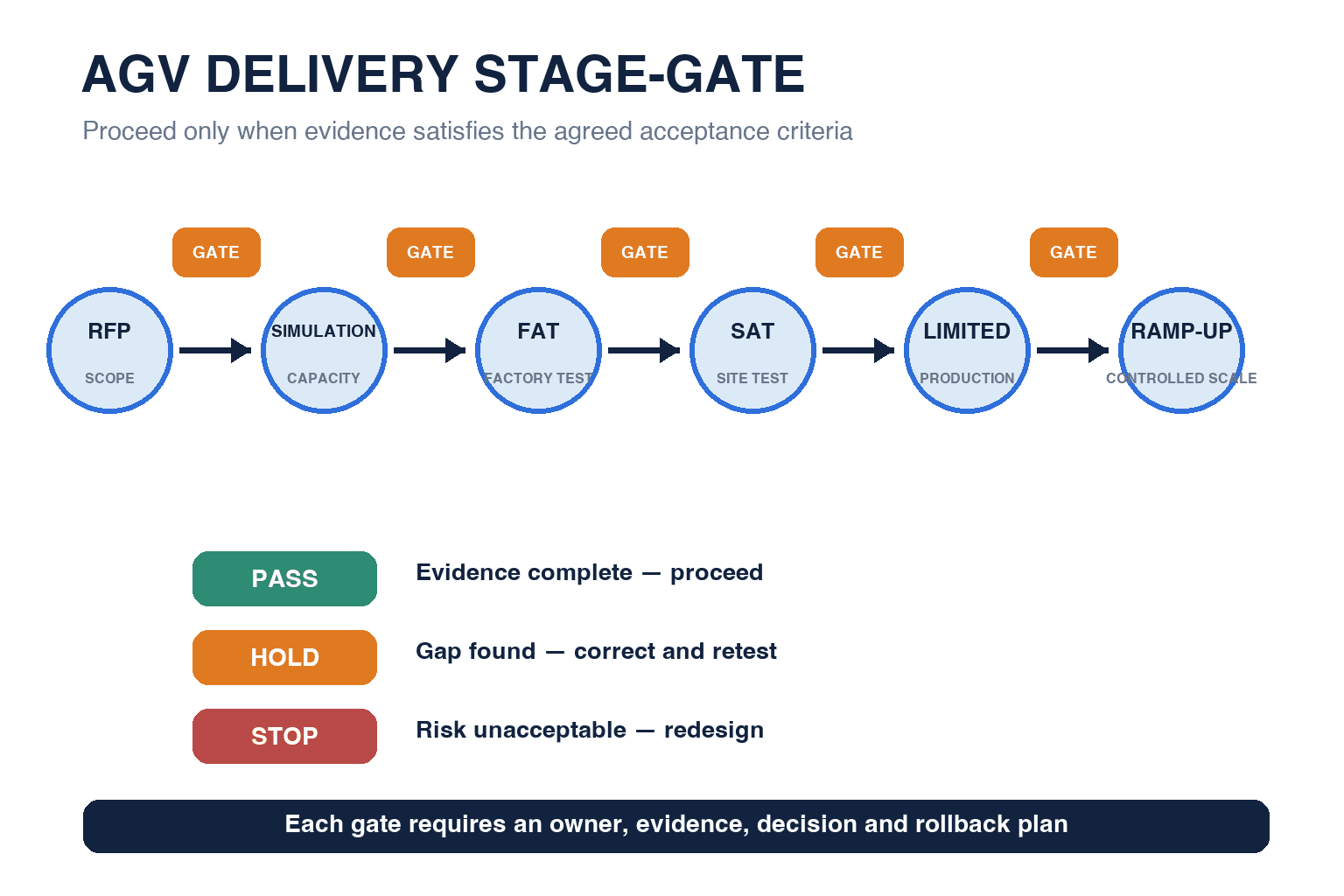
Factory Acceptance Test (FAT)
Test representative and boundary loads, maximum intended weight, charging, sensors, emergency stops, FMS logic, communications loss, cancellations, duplicate messages, logs and backup restoration. Explicitly transfer site-only tests to SAT rather than accepting them as untested.
Site Acceptance Test (SAT)
Use the actual floor, lighting, wireless network, machines and workforce. Test normal, peak, fault and recovery scenarios. Agree pass criteria, evidence, owners and retest rules before execution. During endurance tests, classify every stop by equipment waiting, traffic control, communications, load carrier or operation error.
Controlled ramp-up
Keep a manual contingency at the start. Expand by shift, route and material family only when each gate is met. Review incomplete orders, protective stops, manual interventions, congestion, charging and WMS discrepancies every day, and control every configuration change.
Operating model and KPIs after go-live
Layouts, products, volumes and pedestrian patterns will change. Define shift-specific contacts for the system owner, first responder, maintenance, IT/OT and vendor. Separate authority to move a vehicle, edit routes or speeds, and approve software updates.
Review unfinished moves, manual interventions, protective stops and charging faults daily. Weekly, analyse congestion points, cycle-time distributions, station waiting and stop causes. Monthly, review volume assumptions, SLA performance, spares, software updates and whether the risk assessment must be revised.
If the scope later extends into automated pallet handling, our robotic depalletizing guide for Thailand factories can help define the transfer point between the AGV and robot cell.
Treat handover documents as operational assets
At acceptance, receive the as-built drawings, network architecture, I/O list, state transitions, account inventory, configuration backups, software and firmware versions, risk assessment, test records, spare-parts list, maintenance procedures and troubleshooting guide. Delivery of files alone is not enough: a local operator should be able to restore a configuration from backup and diagnose representative faults before training is accepted.
Manage changes to routes, speeds, protective fields, priorities, equipment handshakes and WMS mappings in one register. Record the pre-change risk review, validation in a test environment or restricted zone, approval, deployment, rollback plan and result confirmation. Remote vendor changes must remain auditable by work time, operator, change details and approver.
Plan disaster recovery for FMS server failure, corrupted configuration, network-equipment replacement and prolonged power loss. A backup that exists is not necessarily a backup that can be restored. Include periodic restore tests and clear criteria for switching to manual transport so production teams can act without improvisation.
Twelve-point decision checklist
- A time-bucketed OD table and peak profile exist.
- Normal and worst-case load carriers are defined.
- The site survey covers floor, aisles, crossings and wireless conditions.
- Risks among pedestrians, forklifts and AGVs have been assessed.
- WMS/FMS/PLC state transitions and ownership are documented.
- Retry, cancellation, destination-full and disconnection handling exist.
- Normal, peak and failure simulations have been compared.
- FAT/SAT pass criteria and evidence are contractual.
- Service SLA, spares and night-shift recovery are practical.
- OT security and remote-support conditions are defined.
- TCO includes civil work, interfaces and owner effort.
- Staged rollout and manual-contingency exit gates are defined.
If several critical items remain incomplete, requirements engineering may deliver more value than immediate vendor selection. Where data is weak, use the limited production phase to test assumptions.
FAQ: AGV deployment, layout design and WMS integration
Should an AGV deployment use AGVs or AMRs?
Choose by load, floor, route volatility, positioning, traffic, safety and support—not the label. Guided navigation can be rational for a stable route; autonomous navigation can add flexibility where diversion is frequent. Mixed fleets are possible but increase FMS and exception complexity.
What aisle width is required for AGV layout design?
There is no universal dimension. It depends on vehicle and load envelopes, turning, speed, stopping distance, protective fields, separation from people or forklifts, obstacles and applicable rules. Have the integrator and safety specialist calculate it for the actual system and verify it on site.
Is AGV WMS integration complete once the API connects?
No. The order model, inventory reservation, equipment permissions, idempotent retries, cancellations, timeouts, logs, clock synchronisation and recovery procedures must also work. End-to-end failure testing is essential.
Does VDA 5050 make mixed-vendor fleets immediately interoperable?
Not necessarily. It is a voluntary communication interface, not a law or a finished fleet-management function. Verify version, implementation scope, extensions, vehicle capabilities, master control and interoperability tests.
How should AGV system integration costs be compared?
Compare TCO, not vehicle price. Include FMS, interfaces, floor/building/network work, tests, training, service, licences, owner labour and future change. Require every bidder to use the same WBS and declare exclusions.
Does ISO 3691-4 compliance satisfy Thai law automatically?
No. ISO 3691-4:2023 is an important safety reference, but applicability, conformity assessment, Thai requirements, factory rules, building and fire requirements need project-specific review by the integrator and qualified professionals.
Conclusion
AGV system integration is a production-system programme linking material flow, layout, safety, WMS/MES, equipment and maintenance. Start with the OD table and peak profile; put exceptions and responsibility boundaries into the RFP; then validate assumptions through simulation, FAT, SAT and staged ramp-up. VDA 5050, ISO 3691-4 and NIST SP 800-82 provide valuable inputs, but they do not replace site-specific engineering or legal review.
TOMAS TECH can support an early-stage review of an AGV concept, RFP, layout and WMS interface for a Thai factory. You are welcome to contact us while options are still being evaluated; the discussion can focus first on requirements and decision evidence.
References
- VDA, “VDA 5050 Version 3.0” press release, 20 April 2026: https://www.vda.de/en/press/press-releases/2026/260421_PM_VDA_5050_EN
- VDA, VDA 5050 Recommendation v3.0.0, 17 March 2026: https://www.vda.de/en/news/publications/publication/vda-5050
- ISO, ISO 3691-4:2023: https://www.iso.org/standard/83545.html
- Thailand Board of Investment, A Guide to the Board of Investment 2025: https://osos.boi.go.th/download/BOI_PDF/BOI_A_Guide2025_EN.pdf
- NIST, SP 800-82 Revision 3: https://csrc.nist.gov/pubs/sp/800/82/r3/final
- International Federation of Robotics, World Robotics 2025 presentation: https://ifr.org/downloads/press_docs/PressConference2025_presentation.pdf
*This article reflects public information available on 24 August 2026. Confirm standards, law, incentives and safety assessment with the responsible authorities, integrator and qualified professionals for the specific project.*


