



Production Engineering Outsourcing in Thailand 2026 — Scope, Cost and Vendor Selection
When a factory considers production engineering outsourcing in Thailand, it should not be buying engineering hours alone. It should be buying a controllable responsibility package: a defined objective, scope, responsibility boundary, deliverables, and acceptance evidence. If these elements remain vague when quotations are requested, an apparently inexpensive proposal may accumulate changes later, while unresolved interfaces surface immediately before a production shutdown.
Keeping every capability in-house is not always realistic either. People who understand the process are often occupied with daily production, while a project still has to connect mechanical, electrical, controls, data, safety, maintenance, and training work. This guide explains how a production engineering team can use outside expertise and execution capacity without giving away its decision rights.
Why production engineering outsourcing matters in Thailand in 2026
The World Bank’s February 2026 Thailand Economic Monitor projects Thailand’s 2026 growth at 1.6%. It reports that manufacturing accounts for 25% of GDP and 16% of employment, supporting more than 6.2 million jobs, and emphasizes skills upgrading and a move toward higher-productivity, higher-value manufacturing. In a slower-growth environment, an equipment investment needs an explanation beyond the purchase of a new machine. Ramp-up speed, quality, downtime exposure, and maintainability also matter.
In the 1H 2026 context reported by BOI, companies submitted 132 applications valued at about THB 17.2 billion under the Smart and Sustainable Industry initiative. These applications concerned machinery upgrades, digital technology, and the integration of automation and robotics. BOI’s eligible-activity catalogue also includes machinery and automation system industries, while Activity 3.1.1 covers the manufacture of automation machinery or automation equipment with engineering design. This does not mean that every factory outsourcing contract automatically qualifies for an incentive. Eligibility remains project-specific and should be checked with BOI.
The practical question is therefore not simply whether to outsource. It is what the factory will retain under its governance, what it will delegate, and what evidence will connect the two sides. If process targets and pass-fail decisions are handed away, a machine may run without delivering the intended business result. If every design detail requires internal approval, the speed benefit of outsourcing disappears.
What production engineering outsourcing includes and excludes
Production engineering outsourcing is not another name for staffing. It is the delivery of a bounded body of work that can include current-state analysis, concept design, mechanical, electrical and controls design, procurement coordination, fabrication coordination, on-site work, equipment commissioning support, testing, documentation, training, and maintenance handover.
Several elements should remain with the buying company. The first is the production objective: what will be made, at what quality, and under which operating conditions. The second is the acceptance criteria. “It operates normally” is not enough; applicable products, assumptions, measurement methods, pass-fail rules, and exception handling need owner approval. The third is safety authority. A factory can obtain specialist analysis and design support, but outsourcing work does not erase the owner’s governance of site operation. The fourth is data ownership and use policy. The fifth is authority over change control.
What can be transferred is a bounded package of analysis, design, implementation, and evidence production. What remains is the owner’s accountability for deciding whether that package satisfies business, operational, safety, and information-management requirements. This distinction allows vendors to be compared by the deliverables they can complete under stated conditions, not merely by the number of engineers they can assign.
Divide the outsourced scope into five work packages

1. Diagnosis and concept design
The first package covers site observation, decomposition of the problem, constraint mapping, improvement hypotheses, and comparison of alternatives. Owner inputs include product mix, the intended takt concept, quality issues, downtime history, layout, existing-equipment specifications, work standards, and future plans. Outputs should include a current-state analysis, scope boundary diagram, requirement specification, concept drawings, assumptions and exclusions, and an indicative execution plan.
The key is not to lock in a solution too early. Define which loss in which task should be reduced under which conditions, rather than starting with “install a robot.” When automation consulting is procured, evaluate whether observations and hypotheses are kept separate, whether alternatives can be compared, and whether unknowns are visible. A polished proposal is not a substitute for traceable reasoning.
2. Mechanical, electrical, and controls design
The second package is detailed engineering. Mechanical structures, tooling, sensors, cabinets, wiring, PLCs, HMIs, robots, networks, and interfaces to higher-level systems have to remain consistent. In FA system integration, completion of one discipline does not complete the system. A sensor substitution, for example, can affect mounting, wiring, I/O, PLC logic, spares, drawings, and maintenance training.
The purchase specification should define drawing formats, source-code handover, comment language, naming conventions, backup methods, approval workflow, and the way design changes are recorded. A design review neither removes vendor responsibility because the owner approved it nor removes owner involvement because the vendor designed it. Its purpose is to reveal incorrect inputs and interface conflicts early.
3. Procurement, fabrication, and subcontractor coordination
The third package covers component selection, quotation collection, purchasing, fabrication, cabinet building, software preparation, and subcontractor coordination. The responsibility boundary should say who places orders, who follows delivery dates, who approves substitutes, and who owns the warranty interface. A procurement approval under the owner’s purchasing rules is different from an engineering approval.
Locally sourced components can improve lead time and maintainability, but compatibility with global-standard equipment still needs verification. Headquarters-specified parts support standardization but may have weak local inventory, repair, or technical support in Thailand. A useful bill of materials therefore includes not only a model number, but also substitution rules, approved alternatives, recommended spares, supplier, and the date on which lead time was checked.
4. Installation, commissioning, and ramp-up support
The fourth package covers installation, wiring, I/O checks, standalone tests, integrated tests, product-variant tests, performance verification, and corrective action. When a factory has a narrow shutdown window, project success depends on how much can be tested before site work. Simulated signals, offline review, cabinet pre-inspection, software version control, and confirmation of tools and spares become pre-site gates.
The deliverable for equipment commissioning support cannot be only a record that engineers attended the site. It should retain each test item, expected result, actual result, judgment, open issue, temporary containment, permanent action, owner, and due date. The quotation should also define whether stabilization after start-up is included, how nights and holidays are handled, and what remote access is permitted. For a deeper treatment, see our equipment commissioning support guide.
5. Documentation, training, and maintenance handover
The final package makes the equipment operable and maintainable after the people who built it leave. It includes as-built drawings, electrical diagrams, I/O lists, bills of materials, source code, backups, operating procedures, abnormal-recovery procedures, inspection standards, training records, and an open-item list. The owner should confirm that documents match the installed equipment, that restoration can be tested, and that the site team can understand the material in the working language.
Training is more than holding a briefing. Acceptance can include the participants’ ability to perform the required operation or recovery task. Maintenance should not see the documents for the first time on the final day; the team can participate during design reviews and commissioning. Treating this handover as a work package reduces the risk of equipment that works at start-up but cannot be restored months later.
A matrix for deciding what to retain and what to outsource

The decision is not based on technical difficulty alone. Business criticality, repeatability, internal capability, speed, the need for independent verification, and long-term operation all matter.
| Decision factor | Direction to retain in-house | Direction to outsource | Boundary-design point |
|---|---|---|---|
| Business and process criticality | Product know-how and competitive advantage | General implementation and documentation | Owner defines objective and confidentiality boundary |
| Repeatability | Repeated work for which capability should be retained | Temporary capacity or specialist work | Make training and knowledge transfer deliverables |
| Internal approval authority | Final quality, safety, and operational judgment | Analysis, design proposals, test execution | Define RACI and signatories |
| Multidiscipline integration | Architecture and standards | Mechanical, electrical, controls integration work | Share an interface register |
| Urgency | Priority and shutdown decision | Additional resources and local execution | Define escalation triggers |
| Long-term maintenance | Standards, spare strategy, data ownership | Documentation, training, initial support | Accept as-builts and source code formally |
For example, the factory can retain process settings and the quality decision while outsourcing controls modification and test records. Conversely, even with an in-house PLC engineer, it can procure a limited independent review of robot-cell integration safety or network architecture. The practical unit of design is responsibility, not an all-in-house or all-outsourced label.
Contract types and cost structure
The cost of production engineering outsourcing cannot be compared by hourly rate alone. The certainty of inputs, specificity of deliverables, site conditions, available shutdown time, review cycles, and expected changes determine the suitable commercial structure.
| Contract type | Suitable situation | Owner benefit | Main caution |
|---|---|---|---|
| Fixed scope and price | Inputs, outputs, and acceptance criteria are clear | Easier budget control | Ambiguity tends to become an exclusion or change |
| Time and materials | Investigation or recovery has high uncertainty | Flexible response to discoveries | Needs a cap, reporting unit, and priority control |
| Milestone hybrid | Detail can be fixed after concept work | Reduces uncertainty in stages | Needs exit and re-quotation conditions at every stage |
Total cost review should include site travel, night and holiday work, interpretation, test material, shutdown preparation, licenses, spares, training, as-built documentation, and post-warranty support, not only design and implementation. The owner’s internal effort is not zero either. Data preparation, site coordination, reviews, decisions, and acceptance require planned capacity.
Normalize scope before putting all prices in one column. As discussed in our automation quotation comparison guide, transferring deliverables, exclusions, assumptions, quantities, tests, warranty, and change rates into one comparison table reveals why totals differ. The decision should consider undefined risk, not only select the lowest price.
Separate the baseline from open items before quotation
To improve cost accuracy, the owner should decide what is treated as confirmed before asking vendors for precise numbers. Put the applicable products, capacity conditions, quality judgment, existing-equipment boundary, available shutdown windows, utilities, higher-level system interfaces, owner-supplied items, and site-work constraints into one baseline with a revision and reference date. A baseline is not a perfect specification. It separates the current agreement from matters that still need confirmation so that every proposer reasons from the same starting point.
Do not hide open items. Classify them into matters to investigate, owner decisions, vendor design proposals, and matters needing independent review. If spare capacity in an existing panel, drawing-to-site consistency, workpiece variation, communication specifications, or temporary operation during construction is unknown, record the confirmation method, owner, decision deadline, and fallback treatment. Pushing every uncertainty onto the vendor tends to produce a large contingency or a later exclusion. Declaring “no issue” without evidence creates a dispute over change responsibility when the premise fails on site.
Treat the site survey as a deliverable that updates quotation conditions, not as proof that someone visited. Agree in advance on where photography is allowed, what will be measured, who attends, which samples are available, and whether equipment can stop. Afterward, put confirmed facts, discrepancies, additional data, and remaining issues into the meeting record. Verify that orally supplied conditions entered the proposal and that answers to questions do not contradict the main specification. Without one designated quotation baseline, vendors may treat different emails and drawings as the governing copy even when the comparison sheet looks aligned.
Make the owner’s effort visible through roles and response deadlines, not only names. The process owner covers production conditions, quality defines judgment methods, maintenance covers maintainability and spares, IT and OT cover interfaces and access, safety covers risk treatment, and procurement covers commercial terms. If a decision maker cannot attend a review, define delegated authority and conditions that must be escalated. Recording the schedule effect of owner decision waits in the change ledger is fairer than treating every stalled hour as only an outsourcing-cost problem.
Also define what must be handed over if the work stops or the supplier changes. Stage-by-stage delivery of survey data, calculation basis, editable drawings, program revisions, configuration backups, bills of materials, open issues, and test results lets the owner decide whether and how to continue. A contract in which deliverables appear only on the final day makes migration to another support party difficult when problems arise. Comparing cost structures therefore means comparing when each option buys the owner a decision-ready state, not only comparing totals.
Required RFP inputs and vendor deliverables
The shortest route to a useful proposal is not to tell a vendor only to inspect the site and make a recommendation. Share what is known, expose what is unknown, and define how decisions will be made.
Inputs the owner should prepare
- Applicable products, process, current flow, layout, and existing-equipment boundary
- Intended business and production objectives, with priorities
- Quality conditions, measurement method, representative samples, and variation factors
- Production calendar, permitted shutdown windows, construction rules, and access requirements
- Available utilities, network conditions, and higher-level system interfaces
- Internal standards, specified parts, prohibited items, languages, and document formats
- Internal safety, information-management, and remote-access requirements
- Known issues, open questions, stakeholders, approvers, and decision deadlines
If inputs are missing, make discovery a defined first-phase deliverable. A short diagnostic followed by an implementation decision is more explainable than demanding a fixed price based on guesses.
Deliverables to require from the vendor
- Compliance matrix against requirements, with assumptions and exclusions
- Current-state analysis, concept comparison, selection rationale, and scope diagram
- Mechanical, electrical, controls, and network engineering documents
- Interface list, signal list, data definition, and responsibility matrix
- Project plan, review plan, risk register, and change-control ledger
- Bill of materials, substitution policy, spare proposal, and procurement status
- Test plan, results, issue list, corrective evidence, and acceptance record
- As-built drawings, source code, backups, operation and maintenance procedures, and training records
Define submission timing and approvers for every deliverable. A single package at the end allows design errors to survive until the final day. Review evidence progressively at concept, detailed design, pre-fabrication, pre-shipment, site commissioning, and final handover gates.
Design acceptance criteria and change control before work begins
Acceptance criteria are not an after-contract topic. At RFP and quotation stage, define at least the test subject, preconditions, measurement method, expected result, decision maker, and action after failure. A capacity test alone can miss unfinished quality, recovery, data, documentation, or safety work.
| Acceptance area | How to express the criterion | Example evidence |
|---|---|---|
| Function | Expected behavior for each applicable mode and action | Signed test sheet, video, log |
| Quality | Product variants, conditions, method, and tolerance | Measurements and sample records |
| Performance | Operating condition and excluded downtime | Time record, equipment log, production result |
| Recovery | Expected faults and safe restoration sequence | Fault-test record and procedure |
| Data | Tags, timestamps, units, and missing-data handling | Communication log, screen, reconciliation table |
| Documents and training | Required documents and demonstrated learner outcome | Revision index, practical check, training record |
The change-control ledger should retain the reason, requester, impact, cost, schedule, risk, approver, decision date, and associated drawing or software revision. A verbal “while you are here” request may look small but affect multiple disciplines. The aim is not to ban urgent changes; it is to preserve a minimum trace even when action must be fast.
Linking acceptance criteria and change control separates completion against the original requirement from completion against an approved addition. Open work can then be managed by owner and due date instead of turning into a dispute about whose responsibility it was.
Responsibility boundaries for machinery safety, robot integration, and IACS cybersecurity
Safety and cybersecurity should not be reduced to one checkbox. Their assets, parties, evidence, and lifecycle differ.
ISO 12100:2010 provides principles and a methodology for machinery risk assessment and risk reduction. Its lifecycle framing covers hazard identification, risk estimation and evaluation, risk reduction, documentation, and verification. It can support a common method for designers and users, but mentioning the standard alone does not establish conformity or fulfillment of a legal requirement. Applicable law and project requirements need case-specific review.
ISO 10218-2:2025 addresses safety requirements for the integration of industrial robot applications and robot cells. It covers design, integration, commissioning, operation, maintenance, decommissioning and disposal, integration of machinery and components, and information for use. This broad lifecycle is a reason to preserve information and responsibility boundaries beyond the integrator’s delivery date, especially for operational changes and maintenance.
IEC 62443-2-4:2023 specifies security-program requirements for IACS service providers during integration and maintenance of an Automation Solution. It distinguishes the roles and relationships of asset owners, service providers, and product suppliers. It can inform contractual and operational controls for remote maintenance, accounts, backups, changes, and incident communications. Again, putting the standard name in a proposal does not by itself demonstrate compliance.
The owner governs safety authority for the asset, access approval, account ownership, data retention, and operational changes. The vendor performs agreed assessment, design, implementation, testing, and recording. Product suppliers provide relevant product and update information. Hiring a vendor does not erase the asset owner’s accountability; the parties’ duties and evidence must connect.
Local execution conditions for Thailand and ASEAN factories
When stakeholders span countries, identical technical requirements can still produce different decision speeds. The site may work in Thai, headquarters in Japanese or English, and the equipment supplier in another language. Define the authoritative meeting-record language, drawing comments, alarm text, training material, and interpretation scope. Translation is not word substitution; confirm who can approve the meaning.
For shutdown work, separate decisions the local team can make immediately from those requiring headquarters approval. If headquarters will be unavailable during the work window, prepare conditional approvals or alternatives. Escalation rules should cover not only technical problems but also safety, quality, production impact, and information security, with contact order and decision makers.
The component strategy should consider local inventory, alternate sourcing, repair locations, and import uncertainty. Approved alternatives and a change procedure can improve local maintainability without abandoning global standards. Remote support should not imply permanent connectivity by default; requests, time limits, logs, and post-session disablement can be included in the operating process.
TOMAS TECH works as a factory IT, OT, and FA integration partner in Thailand and ASEAN. We help translate the interfaces among equipment, controls, data, and operations into responsibility boundaries, deliverables, and acceptance evidence. This is not staffing, and it is not a blanket claim of legal or certification authority. It is preparation of the information that the appropriate owner, specialist, and stakeholder need to decide. Our FA system integration guide provides additional context for defining an integrated scope.
An illustrative 90-day commissioning and handover model
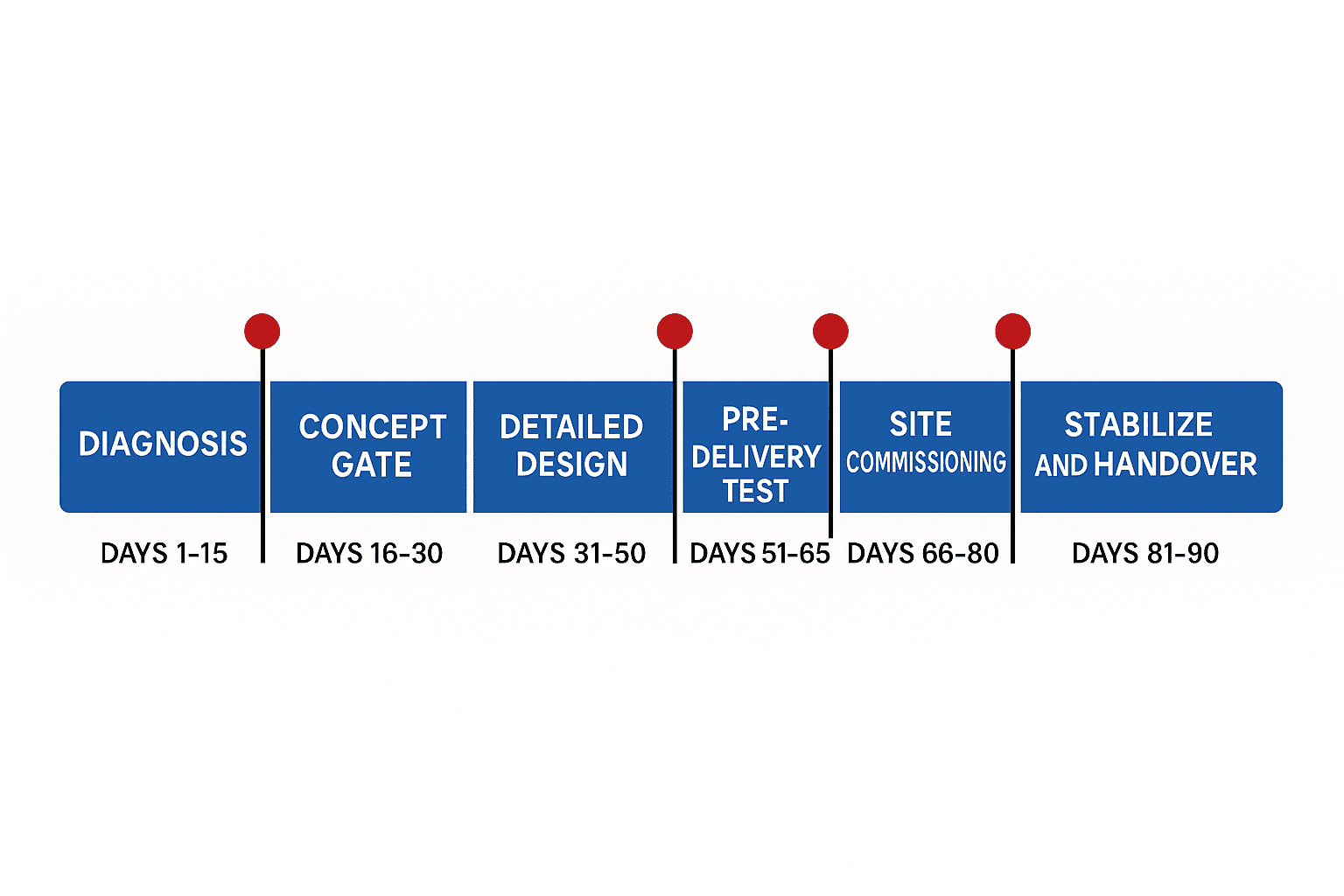
The following is a TOMAS TECH illustrative 90-day model, not a market average, standard delivery time, or performance guarantee. The actual plan depends on equipment scale, shutdown availability, procurement, approvals, and safety requirements.
| Period | Main activities | Gate decision |
|---|---|---|
| Days 1–15 | Site diagnosis, data collection, objective and constraint mapping | Scope, owners, knowns, unknowns, success conditions |
| Days 16–30 | Concept comparison, requirements, initial risk review | Selected option, exclusions, budget and shutdown conditions |
| Days 31–50 | Detailed design, interface freeze, procurement preparation | Drawings, I/O, data, components, change-freeze conditions |
| Days 51–65 | Build and configuration, pre-test, training preparation | Open issues, site readiness, recovery approach |
| Days 66–80 | Installation, connection, standalone and integrated tests | Safe operation, function, quality, and data evidence |
| Days 81–90 | Stabilization, training, as-builts, maintenance handover | Acceptance, open items, warranty interface, operational ownership |
The first 15 days do not need to produce a final answer. They produce reliable inputs for later decisions. At the Day 30 gate, record both the selected option and the rejected options with reasons. If interfaces remain open after Day 50, design changes are likely to concentrate during site work. Day 65 should be a readiness decision based on open issues and recovery options, not an automatic shipment because the calendar says so.
The final 10 days are not spare time. They are the transfer period in which operations and maintenance become the central participants. Do not hide open work to obtain a signature. Agree on any safe temporary operating condition, permanent action, due date, and owner. Ramp-up ends when the buying company can govern the system, not merely when the vendor leaves the site.
Vendor scoring matrix and warning signs
The weights below are a TOMAS TECH illustrative model, not a market standard or a guarantee of vendor performance. Adjust them to the project’s risks. An existing-equipment modification may give more weight to site investigation and recovery, while a data-integration project may emphasize architecture and cybersecurity.
| Evaluation item | Illustrative weight | How to verify |
|---|---|---|
| Requirement understanding and scope | 20 | Quality of assumptions, exclusions, questions, and alternatives |
| Technical integration | 20 | Connections across mechanical, electrical, controls, and data |
| Local execution and commissioning | 15 | Site team, shutdown response, and issue management |
| Safety and cybersecurity | 15 | Planned roles, assessment, access, and evidence |
| Deliverables and knowledge transfer | 15 | As-builts, source, training, and maintenance handover |
| Commercial and change control | 10 | Scope differences, rates, approvals, and warranty interface |
| Communication | 5 | Language, reporting, and escalation |
| Total | 100 | Score evidence, not price alone |
Warning signs include guaranteed benefits before a site review, very few questions, no exclusions, vague treatment of source code or as-built drawings, a test plan consisting only of “operation check,” no change-control method, unconditional remote-access requests, and no maintenance-team involvement. Broad promises to cover every standard also deserve a request for precise applicability and evidence.
A credible proposal states what remains unknown and gives a method and deadline for resolving it. It shows not only the vendor’s strong scope but also the work of the owner, other vendors, and product suppliers. The question is not simply whether the price is low, but whether uncertainty has been put into a controllable form.
Frequently asked questions
How is production engineering outsourcing different from staffing?
Outsourcing in this guide is a contracted body of work with deliverables and a responsibility boundary. The completion conditions cover analysis, design, implementation, testing, documentation, and training, rather than only headcount or time on site. On-site presence may be part of the package, but the core purchase is a result and its evidence.
How should production engineering outsourcing costs be compared?
Compare normalized scope, assumptions, exclusions, deliverables, site support, testing, documents, warranty, and change conditions, not only a market hourly rate. Time and materials can fit uncertain discovery, fixed price can fit clear implementation, and a milestone hybrid can reprice after uncertainty is reduced.
How much equipment commissioning support can be outsourced?
The scope can cover pre-installation checks, I/O testing, standalone and integrated tests, product trials, issue management, stabilization, training, and as-built documents. Night and holiday coverage, test material, shutdown coordination, permanent actions after containment, and remote-support conditions should be defined before quotation.
Can automation consulting and implementation be awarded to different companies?
Yes, if the consulting package leaves implementation-ready requirements, a boundary diagram, interfaces, assumptions, risks, and acceptance criteria. The interface between the two companies also needs roles for questions, design review, and change approval so that it does not become a responsibility gap.
What should the owner retain in FA system integration?
The owner should retain governance of the process objective, quality and performance acceptance, safety authority, data ownership, access approval, change decisions, and final acceptance. An outsourced design and implementation contract should still deliver the information and evidence required for those decisions.
Can BOI incentives apply to production engineering outsourcing?
BOI describes eligible machinery and automation activities and the Smart and Sustainable Industry framework, but an individual outsourcing agreement does not automatically qualify. Project-specific conditions such as the applicant, activity, equipment, and application timing should be checked with BOI or an appropriate specialist.
Conclusion
Production engineering outsourcing succeeds through the clarity of the responsibility package, not the number of outside people. The owner retains process targets, acceptance, safety authority, data ownership, and change approval, while bounded analysis, design, implementation, testing, documentation, and training can be delegated. Five work packages, complete RFP inputs, staged gates, a change-control ledger, and lifecycle roles for safety and cybersecurity connect quotation comparison, commissioning, and maintenance handover in one management system.
TOMAS TECH can support a Thailand or ASEAN factory from the early consideration stage by structuring the outsourced scope, RFP, equipment-controls-data interfaces, and acceptance evidence. If you want to define an executable responsibility boundary across factory IT, OT, and FA rather than purchase staffing, share your current situation and intended scope through our contact form.
Sources
- https://www.boi.go.th/index.php?_module=news&from_page=press_releases2&language=en&page=press_releases_detail&topic_id=139075
- https://www.boi.go.th/index.php?language=en&page=eligible_activities_new2
- https://www.worldbank.org/en/country/thailand/publication/thailand-economic-monitor-february-2026-advanced-green-manufacturing-for-growth
- https://www.iso.org/standard/51528.html
- https://www.iso.org/standard/73934.html
- https://webstore.iec.ch/en/publication/67631


