


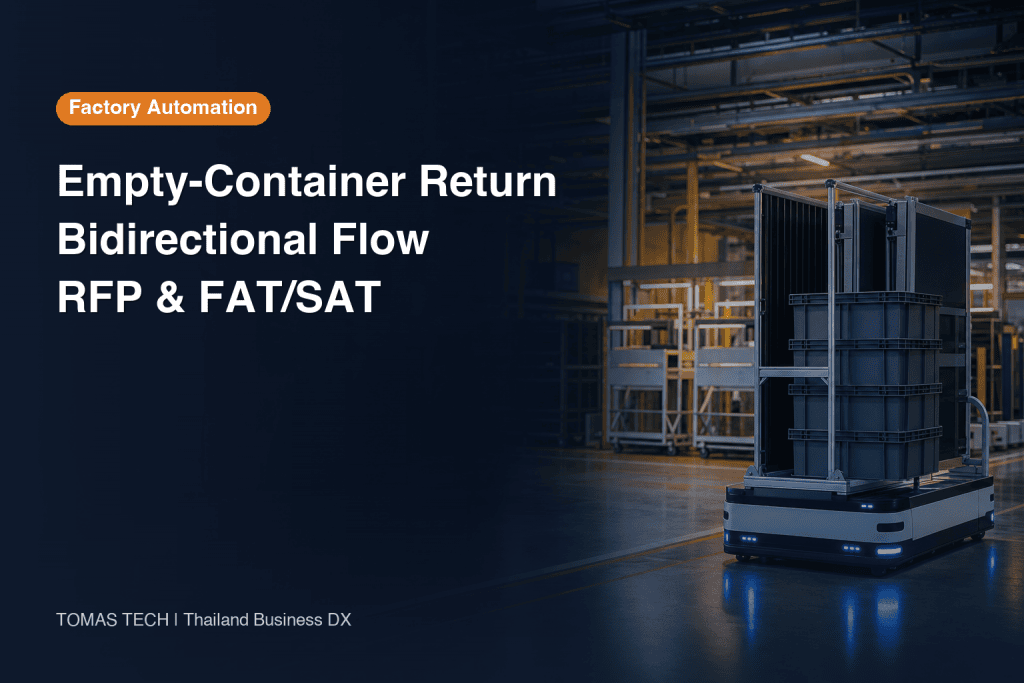
When a factory in Thailand plans empty-container return automation, treating the task as a free backhaul for an AGV or AMR that has just delivered parts is not enough. Replenishment and return are two directions of one production-logistics system. Container state, handoff-point congestion, full/empty decisions, priorities, downtime and manual recovery affect both directions. A fleet may keep moving while production stops because empties accumulate at lineside and the supply area runs out of returnable totes or racks.
This guide helps production engineering, logistics, manufacturing, maintenance, IT/OT and procurement teams turn empty-container return into a comparable RFP, FAT/SAT plan and operating model. “Empty container” includes returnable totes, boxes, racks, carts and roll cages. The objective is not to prescribe a vehicle, but to define the flow, information and acceptance evidence needed before an award.
Empty-container return automation is not just a backhaul
A supply trip ends when the correct material is handed over. A return trip first has to establish whether the container is truly empty, whether residual or mixed material remains, whether it is fit for reuse and whether its next destination is cleaning, sorting, a supermarket, a warehouse or a supplier. Without the return, the next replenishment cycle may not be prepared. Return is therefore an upstream condition for the next supply cycle, not housekeeping after production.
Draw the outbound and inbound material and information flows on one map. The outbound side includes material, container, transport order, lot and part number. The inbound side includes the empty, residual material, quarantine, container condition and return destination. During a gemba survey, ask more than whether a vehicle can pass. Identify who declares a container empty, where custody changes, how many units can wait, who resolves a mixed load and how the physical item is reconciled with the system record.
Plan both directions as one capacity model
Separate averages for replenishment and return conceal coincident peaks. Model changes, breaks, shift changes, setups, inbound-material release, quality holds and restart after a stoppage can increase supply and return demand at the same time. The RFP should contain real operating scenarios, not only an average move count.
As a proposed framework, describe for each scenario the supply trigger, empty-container trigger, handoff capacity, priority, acceptable waiting condition, manual fallback and required evidence. Capacity and time values must come from observation, standard work, the circulating-container population, the production plan and risk assessment; this article does not prescribe universal values.

Prioritize by production risk, not simply by request time
First-in-first-out dispatch can let a low-risk empty return delay an urgent line supply. Permanent supply priority can create the opposite failure: return points overflow and encroach on work, emergency or maintenance access. Priority needs to consider time to line starvation, remaining return-point capacity, time to container shortage, route occupancy, battery condition, restricted zones and the availability of a manual alternative.
Do not leave this logic as a vendor black box. Define which parameters the factory may approve, who can change them, how changes are logged, how the previous configuration is restored and which regression tests follow a change.
Define container identity and state before automated cart transport
Vehicle location alone cannot prove logistics accuracy. The system needs to know which container holds what, its current state and location, and its permitted next destination. Whether identity belongs to each tote, a cart, a roll cage or each load position depends on misdelivery risk, traceability needs, the reading environment, cost and maintainability.
Barcodes, two-dimensional codes, RFID, a vehicle job record and fixed station IDs have different failure modes involving distance, orientation, dirt, metal, duplicate reads, damaged labels and communications. Select against the failure scenario rather than the technology name. A no-read item must enter a controlled exception; it should not inherit the last successfully read part number.
Use a shared container-state model
The following is a proposed framework, not an external standard. Useful distinct states include ready for supply, moving outbound, at lineside, in use, awaiting empty decision, confirmed empty, awaiting collection, moving inbound, returned, residual material, quality hold, damaged container, unknown identity and manual control. Add cleaning, sorting, folding or supplier-return states where they exist.
Every state should have an entry event, exit event, owner, physical location, permitted next states, timeout action and evidence. A single “collect empty” bit can otherwise mix residual parts and damaged containers into the normal return stream.
| State | Example entry condition | Transition to prevent | Example evidence |
|---|---|---|---|
| Awaiting empty decision | Work completed and container at return position | Automatic assumption of empty | Completion signal, container ID, time |
| Confirmed empty | Agreed verification completed | Refill while part identity is unknown | Decision result, method and source |
| Awaiting collection | Handoff point available | Vehicle entry before station readiness | Queue record, occupancy and call history |
| Quality hold | Material or container awaiting disposition | Merge into the ordinary empty stream | Reason, affected lot and approver |
| Damaged container | Deformation, contamination or ID damage detected | Re-enter automated supply | Photo, damage class and quarantine location |
| Manual control | Explicit custody transfer from automation | Silent return to automated control | Operator, physical count and release approval |

Do not force the full/empty decision onto one sensor
A decision may use a work-complete signal, weight, photoelectric or distance sensing, vision, cover position, operator confirmation or material-consumption records. Part geometry, separators, bags, oil, reflections and container variation can defeat any method. Keep “unable to decide” separate from empty and full.
In the RFP, specify real container/part combinations, boundary samples, foreign material, dirty sensors, positional error, double stacking, residual parts and mixed items. Agree the ground truth, test order, expected state, logs and images, then give all bidders the same challenge. Derive acceptance from the production, quality and safety consequences of false-empty and delayed-return decisions rather than copying a generic accuracy threshold.
Return points and queues decide whether automated lineside supply works
Handoffs fail more often than open travel. An operator has not removed the tote, a cart is reversed, a stop is not engaged, a full queue receives another vehicle, or a PLC says ready while a physical obstruction remains. Small inconsistencies can block the entire flow.
Specify the return-point handshake
As a proposed framework, distinguish permission to enter, station occupied, correct container identity, full/empty decision complete, load stable, transfer equipment ready, safety condition satisfied, transfer complete, permission to leave and retry request. Fleet control, PLC, MES/WMS and local displays need consistent state names.
Do not equate a communication bit with physical completion. For conveyor transfer, confirm that the container has fully reached the receiver, is no longer on the vehicle and that the receiver can accept the next unit. For towing, check coupling, release, brake, direction, cart identity and load retention. Automated roll-cage transport must also address doors, casters, stops, protrusions and floor transitions.
Keep physical positions, logical queue and IDs synchronized
Painted floor boxes do not manage a queue if the system cannot say which container is in each position, how long it has waited and where it is going. Define correction procedures when an operator removes a middle item, adds one manually, uses the wrong position or a sensor double-counts.
When a queue is full, options include suppressing upstream calls, diverting to an approved alternate, changing dispatch priority, switching to manual collection or warning the line. Automatic diversion should be allowed only if destination compatibility, route safety and downstream sorting capacity are proven.
Select automated inter-process transport by load and handoff
OMRON’s official application page describes movement of raw material, WIP, carts, pallets and roll cages, as well as lineside replenishment, conveyor/lift interaction and fleet integration. This is vendor application information, not evidence that a particular factory’s empties are compatible. Test the most difficult container, narrowest handoff, real floor, ramps, crossings, elevators, doors and hygiene constraints.
An under-ride vehicle can preserve existing carts, but depends on standard underside clearance, wheels, stop location and load distribution. Towing can move several carts, but requires evaluation of swept path, coupling, reversing, release and train length. Top modules and conveyor transfer support automatic exchange, but introduce height, stops, pinch points, signal timing and power-loss recovery. Fork-style vehicles fit pallet applications but demand careful management of load stability and coexistence with pedestrians and conventional vehicles.
For system boundaries, see the AGV system integration guide. The AGV layout design guide helps evaluate crossings, passing, charging and emergency paths. Add container state and return queues to those system and layout views.
Make carts and roll cages part of the equipment specification
Compensating for inconsistent carts with vehicle sensors and software creates lifecycle complexity. Standardize ID, envelope, coupling and pickup points, wheel and caster condition, brake, stop, maximum load profile, center of gravity, protrusion, underside clearance, damage criteria and inspection. Survey every existing cart and classify it as compliant, modifiable, manual-only or retired.
Nesting, folding and stacking change shape and center of gravity after a container becomes empty. A retention method safe on the supply trip may be unsafe on return. Test lightweight empties exposed to air movement or vibration, protruding separators and incorrectly folded units.
Fix fleet, MES and PLC responsibility boundaries in the RFP
The official VDA page lists VDA 5050 version 3.0.0, released in March 2026, as the latest version. Official VDA information describes a zone concept for free navigation, path sharing, error display in local languages and a power-saving mode, while the trajectory and corridor concepts remain available. VDA 5050 is an optional, non-binding interface. It can reduce integration friction, but it does not automatically align route semantics, station handshakes, container state, priority or safety, nor does it guarantee complete interoperability or recovery. Contract the version, optional functions, messages, timeouts, error handling and validation configuration rather than accepting “VDA 5050 compatible” on its own.
OMRON’s MD Series brochure describes job queues and route and battery optimization as vendor functions. For a project, state whether optimization protects line supply, shortens travel or reduces congestion. Verify in FAT/SAT that a full return point or urgent supply changes behavior as intended.
Proposed responsibility-boundary table
This is an original RFP framework. Assign the designer, implementer, tester, approver and first responder for every row.
| Function | Boundary question | Acceptance evidence |
|---|---|---|
| Production demand | Who creates, cancels and reissues jobs? | Normal, duplicate, cancellation and resequencing logs |
| Container master | Which system owns ID, part, type, destination and state? | Add, change, disable and history records |
| Fleet control | Who decides dispatch, congestion, charging and prohibited zones? | Scenario replay and time-aligned logs |
| PLC integration | Who retains Ready, Busy, Complete and Fault? | Signal list, timing diagram and injected-fault results |
| MES/WMS | Who reconciles production and transport records? | Missing, duplicate, retry and reconciliation reports |
| Safety | Who integrates vehicle, station and operating-zone risks? | Risk assessment, validation and change record |
| Manual recovery | Who reconciles the item and approves return to automation? | Procedure, authority, training and recovery log |
| Maintenance | Who owns vehicle, cart, network, charger and station incidents? | Classification, escalation, parts and restart proof |
Engineer exceptions, manual recovery and downtime operation first
Automation earns its value by returning correctly from failure. Test obstruction, blocked route, ID no-read, wrong item, residual material, damaged cart, full handoff, transfer failure, communications loss, low charge, emergency stop, power loss and server restart before go-live.
Prevent retry loops
No universal retry count or delay exists. Define when repeated failure changes to quarantine, alternate route, alternate vehicle, manual custody or line notification. Retrying must not duplicate the job or container record. Preserve the original fault and every intervention.
Manual recovery must change more than a screen state. The operator reconciles physical ID, position, full/empty condition, part number, cart and local safety before authorized return to automated control. Lock the job so another vehicle cannot execute it during recovery.
Make downtime operation standard work
Fallback differs for fleet server, wireless, MES, PLC and charger failures. Define which vehicles or carts may be pushed or towed, brake release, isolation keys, manual records, temporary locations, traffic control and restart reconciliation. Prevent informal actions such as pushing an unassessed vehicle, towing after arbitrary power isolation or deleting all jobs.
Containers moved manually must remain visible to inventory control. Include a temporary identity or record, restart stocktake, cancellation of duplicates and reassessment of unfinished demand.

Assess people and vehicles within the operating zone
ISO’s official page says ISO 3691-4:2023 covers safety requirements and verification for driverless industrial trucks and their systems, was published in June 2023 and is to be revised. A procurement specification should identify the adopted edition, equipment scope, operating zone, intended use, associated equipment and verification responsibilities. Freeze the contractual edition and define how future change is assessed.
OSHA’s warehouse and robotics material discusses hazards involving forklifts, pedestrians, material handling, struck-by and caught-between events. It is US guidance, not Thai law. Applicable Thai legislation, factory rules, customer requirements and machinery, electrical, fire and occupational-safety obligations need local competent review.
Observe more than the mapped path: crossings, sight lines, doors, columns, rack ends, reach-in tasks, dropped loads, wet floors, cleaning, maintenance, manual carts, forklifts, visitors and shift change. A stopped vehicle may create a secondary obstruction or emergency-access hazard even when its detection function works.
Build a comparable empty-container return RFP
Thailand BOI reported Q1 2026 applications of 38 machinery, automation and robotics projects valued at THB 8.081 billion, and 61 Smart and Sustainable Industry applications valued at THB 7.071 billion. These figures provide investment context only. They do not size the empty-return market or establish incentive eligibility for a project; confirm current BOI conditions at filing.
Proposed RFP chapters
| Chapter | Factory input | Bidder response |
|---|---|---|
| Purpose and scope | Lines, supply/return boundary, stoppage risk | Assumptions, exclusions, method and constraints |
| Volume and variation | Container types, scenarios, changes and peaks | Capacity model, bottleneck and margin rationale |
| Container and cart | Drawings, mass, center of gravity, damage and mixed load | Compatibility, modifications, ID and retention |
| Return point | Layout, capacity, equipment signals and operator task | Handshake, queue and full-point behavior |
| Control and data | MES/WMS/PLC, identity, state and time | Architecture, API, logs, retry and access |
| Safety | Zone, traffic, existing vehicles and maintenance | Risk reduction, validation, residual risk and training |
| Exception | Failure set, fallback and downtime work | Transitions, recovery, locks and evidence |
| FAT/SAT | Test articles, scenarios, witnesses and evidence | Procedure, expected result, logs and correction |
| Support | Hours, language, local service and change control | Escalation, spares, backup and end-of-life notice |
| Commercial | Boundary, payment, acceptance and IP | WBS, inclusions, exclusions, warranty and changes |
Compare more than vehicle price. Require the same WBS for cart modification, return stations, charging, wireless, host integration, safety equipment, training, spares, software, recurring fees, layout change, new variants, local support and downtime exposure. Do not reuse generic prices or payback periods.
The in-plant logistics improvement guide helps remove unnecessary travel, inventory and unclear standard work before automation. Avoid automating a bad logistics rule.
Make FAT/SAT produce acceptance evidence, not a movement demo
FAT verifies the state model, dispatch, handshakes, exceptions, logs and documents in a controlled environment. SAT verifies the installed system in Thailand with real floors, wireless conditions, equipment, operators, containers, networks and shifts. Repeating one demonstration twice is not enough.
Proposed acceptance matrix
This is a proposal framework. Test quantity, duration and pass/fail criteria belong in the risk assessment and contract.
| Theme | FAT evidence | SAT evidence |
|---|---|---|
| Bidirectional capacity | Jobs, queues and priority logs by scenario | Real supply/return, accumulation and stop impact |
| Container state | Every state, prohibited transition and history | Operator action, wrong placement, mix and reconciliation |
| Return point | Timing, transfer and timeout | Real PLC/equipment, full point and maintenance activity |
| Dispatch | Congestion, charging, restricted zone and vehicle substitution | Crossings, mixed traffic, wireless variation and detour |
| Exception | Fault injection, retry, quarantine and recovery log | Manual custody and restart inventory reconciliation |
| Safety | Functions, design evidence and residual risk | Installed zone, work, maintenance and training record |
| Data | Missing, duplicate, time, retry and backup tests | MES/WMS, outage recovery and reconciliation report |
| Support | Diagnosis, part replacement and configuration restore | Local contact, training, spares and restart |
Each case needs a requirement ID, initial condition, input, expected physical behavior, expected data, result, evidence file, witness, open item and retest. Correlate video with fleet logs, PLC trends, MES records, container history and alarms using timestamps.
For each open item, record product, safety and capacity impact, temporary control, owner, due condition, retest and acceptance/payment treatment. “Tune after production starts” is not evidence. Separate conditional and final acceptance, then use a controlled ramp-up across shifts, changes, cleaning, charging, restart and maintenance recovery.
Use operating KPIs beyond vehicle utilization
A busy vehicle may be wasting travel or retrying. An idle fleet may still satisfy demand and protect production. Group KPIs by production outcome, flow, quality, recovery and asset condition.
As a proposed framework, track supply-related and empty-related production stops and manual substitution; call-to-handoff time distribution, overdue jobs, return-point dwell, full queues, empty travel and diversion; misdelivery, unknown ID, residual material, damage and inventory mismatch; exception cause, recovery time, recurrence and reconciliation difference; and charging, failure, cart nonconformance and software change.
Segment results by shift, line, variant, time, route and container type. Set targets from the factory baseline and risk, not a vendor brochure. Use review meetings to locate causes in demand design, equipment, operations, master data, maintenance or training rather than hiding exceptions.
Pre-award checklist
- Supply and return share one volume, peak and priority model.
- Container, cart and roll-cage identity, state, owner and source system are defined.
- Residual, mixed, damaged and unknown-ID items are separated from ordinary empties.
- Full/empty conditions, indeterminate results and boundary samples are agreed.
- Physical capacity, logical queue and handoff handshake are aligned.
- Cart envelope, wheels, coupling, brake, center of gravity and inspection are standardized.
- Fleet, PLC, MES/WMS and container-master responsibilities are assigned.
- Communications loss, power loss, blocked route, full queue, transfer failure and vehicle swap are tested.
- Manual recovery reconciles the physical item and system before approved restart.
- People, forklifts, doors, crossings, maintenance and emergencies are assessed by zone.
- Every FAT/SAT requirement has physical and data evidence.
- Conditional acceptance, open items, retest and final acceptance are distinct.
- KPIs cover production stops, dwell, misdelivery, unknown identity and recovery.
- Local support, language, spares, backup, change control and end-of-life notice are agreed.
Conclusion: accept a container-circulation system
Empty-container return automation is not about adding a return trip. It is about managing replenishment and return as one bidirectional flow, with container identity and state, full/empty decisions, handoff points, queues, dispatch, exceptions, manual recovery and downtime under one responsibility model. Boundaries among vehicles, carts, stations, PLC, fleet control and MES/WMS must be explicit. FAT/SAT must prove failure and recovery as well as normal movement.
Build acceptance criteria from the factory’s circulating containers, peak demand, stoppage risk and site conditions. After launch, review line starvation, return-point dwell, misdelivery, unknown identity, manual substitution and recovery. That is how automated lineside supply and automated inter-process transport become stable production capability rather than a vehicle demonstration.
TOMAS TECH can support factories in Thailand from site survey and bidirectional-flow mapping through container/cart standardization, RFP preparation, PLC/MES boundaries and FAT/SAT evidence design. You can contact us while the vehicle concept and bidder list are still open.
FAQ about empty-container return automation
Can empty return simply be added to the supply AGV’s backhaul?
Usually not as a job alone. Empty decision, residual material, identity, handoff capacity, queues, priority conflict and manual recovery need design. Even with vehicle headroom, undefined handoff and information states make operation unstable.
Is weight sensing or vision better for a full/empty decision?
It depends on parts, containers, separators, oil, reflection, residual risk and maintenance. Test real combinations and boundary samples, including indeterminate results. Route indeterminate items to controlled quarantine or manual verification.
Can existing carts be used for automated cart transport?
Yes where underside clearance, envelope, wheels, casters, brakes, coupling, load distribution, protrusion and condition match the vehicle concept. Survey all carts and classify them as compliant, modifiable, manual-only or retired.
What matters for automated roll-cage transport?
Check door retention, casters, stops, coupling, center of gravity, protrusion, floor transitions, turning, reversing and handoff. Empty cages are lighter and can behave differently. Include coexistence, maintenance access and emergency movement in SAT.
Does VDA 5050 guarantee immediate multi-vendor integration?
No. It may reduce interface friction, but version, optional functions, route semantics, station handshake, container state, error handling, safety and test configuration still require agreement and validation.
What is the essential difference between FAT and SAT?
FAT finds logic, state, exception and documentation issues in a controlled environment. SAT proves operation with the Thai site’s floor, wireless, equipment, people, containers and network. Both require traceable expectations, logs, correction and retest.
Is manually pushing material enough during an automation outage?
Only after push/tow conditions, brake release, isolation, traffic control, manual records, temporary locations and restart reconciliation are defined. Physical movement without information recovery causes inventory and job mismatch.
Which KPIs should empty-container return use?
Use production stops, call-to-handoff distribution, return-point dwell, full queues, misdelivery, unknown identity, residual material, manual substitution, exception causes and recovery time, not vehicle utilization alone.


