


AGV and AMR Cost: A Five-Year TCO Guide for Thai Factories
When buyers search for AGV price or AMR price, the first number they see is usually the vehicle price. Yet the budget for a working mobile-robot system in a Thai factory is not determined by the vehicle alone. A governable price includes the top module, charging and power, safety and site preparation, fleet management, WMS/MES/PLC/elevator interfaces, FAT/SAT, training, spares, service, software lifecycle management and cybersecurity. This guide does not claim a market-wide price range. Instead, it carries one explicitly hypothetical factory scenario through a complete five-year TCO calculation and shows how to compare AGV and AMR proposals on the same basis.
AGV and AMR cost is a governed system cost, not a unit price
If a request for quotation says only “three AMRs,” Proposal A may contain vehicles and chargers, Proposal B may add fleet software, and Proposal C may include commissioning. The quotations are not comparable. An apparently low bid can reverse after the buyer adds the elevator signals, fire-mode behaviour, Wi-Fi redesign, top modules, safety validation, night-shift cutover and Thai-language training.
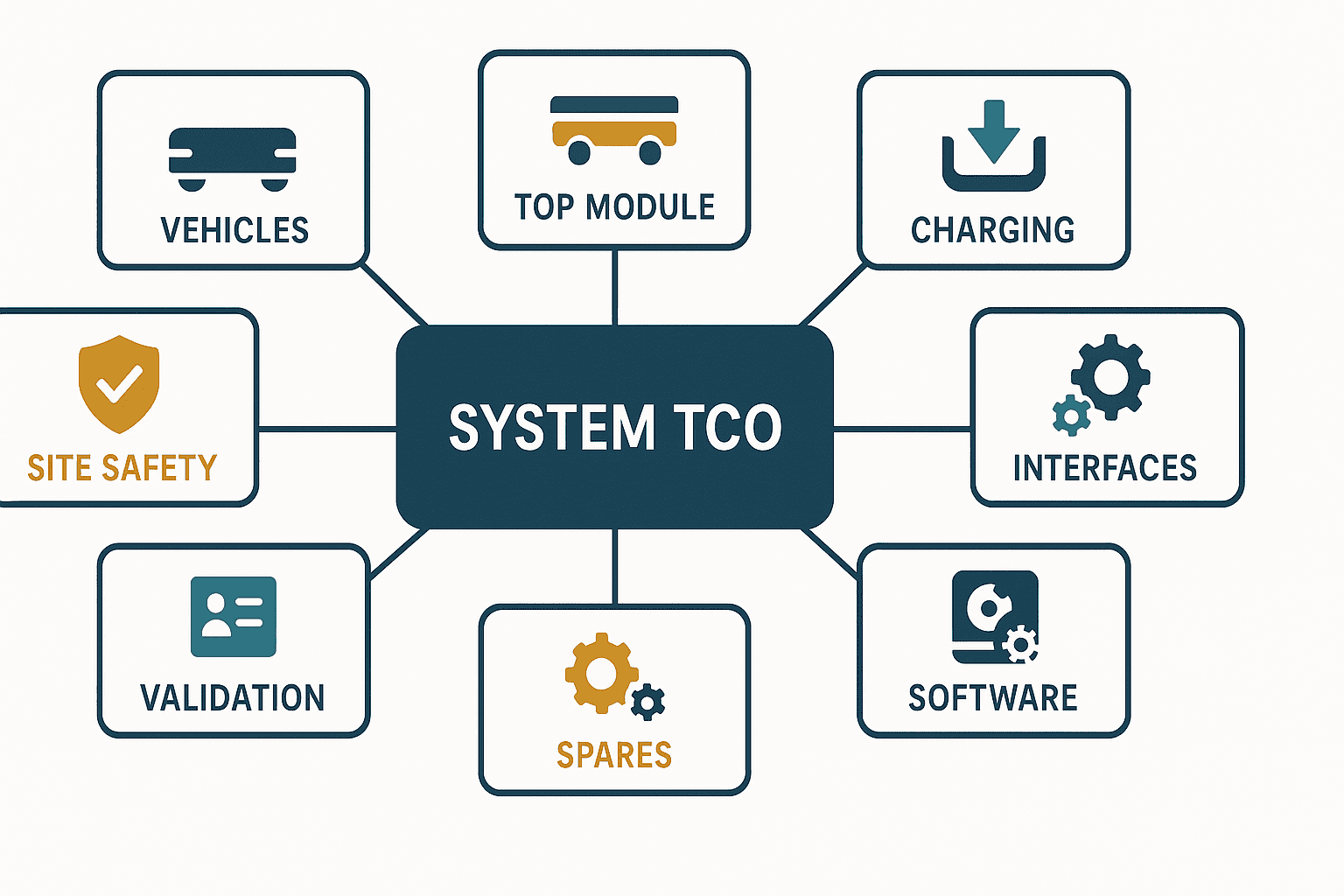
Manage the budget through at least eleven cost boxes:
- Vehicles: payload, speed, positioning, sensors, batteries, manual and maintenance modes.
- Top modules: roller, conveyor, lift, tugger, rack, fixture and load detection.
- Charging and power: automatic chargers, panels, cables, isolation, ventilation, power recovery and charging queues.
- Safety and site preparation: risk assessment, floors, aisles, crossings, doors, barriers, signs, lighting and escape routes.
- Fleet management: dispatch, traffic, maps, permissions, monitoring, history, servers and resilience.
- Enterprise and equipment interfaces: WMS, MES, ERP, PLC, conveyors, shutters, fire systems and elevators.
- Validation: design reviews, FAT, SAT, throughput trials, safety-function testing, failure recovery and evidence.
- Training and change: operator, supervisor, maintenance, IT/OT and EHS training, SOPs and exception ownership.
- Spares and service: wear parts, sensors, wheels, spare chargers, local response and response times.
- Lifecycle software: licences, upgrades, operating systems, API compatibility and data migration.
- Cybersecurity: identities, certificates, backups, logs, vulnerability response and remote-service control.
Use the same boxes in the RFP, quotation, acceptance plan and operating budget. That continuity reduces “not in our scope” gaps. Price is not only a number; it is a controlled register linking responsibility, evidence and acceptance.
Why AGV price and AMR price cannot be compared simplistically
An AGV often suits stable, repeatable flow along defined guidance or paths. An AMR often suits an authorised navigable area in which routes and priorities change. Product labels vary, however. “AGV is cheaper” and “AMR is flexible but expensive” are not reliable purchasing rules.
| Decision axis | Conditions often suited to AGV | Conditions often suited to AMR | Major cost driver |
|---|---|---|---|
| Material flow | Fixed, repetitive, few destinations | Changing destinations and priorities | Mapping, routing and dispatch complexity |
| Aisles | Easier to dedicate | More likely to be shared | Safe speed, yielding, crossings and traffic rules |
| Layout change | Infrequent | Frequent | Re-teaching, remapping and revalidation |
| Transfer | Mechanically consistent fixed points | Multiple machines and racks | Top module, positioning and handshake |
| Fleet | Homogeneous, simple dispatch | Multiple uses, dynamic dispatch | Server, licences and interoperability |
| Environment | Floor and route can be controlled | Obstacles change | Sensors, map upkeep, cleaning, lighting and floor repair |
For a dedicated lane carrying the same cart, an AGV may remain operationally simpler even after guidance work. For monthly layout changes and calls from several processes, an AMR may reduce change effort. Conversely, putting an AMR in a shared aisle does not guarantee capacity. Frequent yielding can make effective throughput far lower than catalogue speed.
Start AGV selection with the required completed moves per hour, load family, exceptions and availability—not the product label or maximum speed.
Safety standards address the system and operating zone
ISO 3691-4:2023 covers safety requirements and verification for driverless industrial trucks and their systems, explicitly including AGVs and AMRs as examples. Its public abstract notes that the condition of the operating zone significantly affects safe operation. A safety scanner on the vehicle is therefore not the whole solution. Floors, intersections, visibility, doors, pedestrian routes, overhanging loads and recovery work must be assessed as operating conditions.
A3’s official standards page describes ANSI/RIA R15.08-1-2020 and ANSI/A3 R15.08-2-2023 as addressing the industrial mobile robot and the system/application integration respectively. Applicable law and contractual standards depend on the installation country, equipment, use, customer requirement and export destination, and should be confirmed by competent specialists. This article is not a declaration of conformity or legal advice.
For machinery or equipment governed in an EU export context, Regulation (EU) 2023/1230 may also need review. It is not Thai law. The roles of manufacturer, integrator, importer and user should be determined project by project rather than inferred from the owner’s nationality.
Treating safety as an option creates either a mandatory variation after award or an unsafe operation. An RFP should ask for proposed applicable standards, a task-based risk assessment, residual risks, verification methods, change-triggered reassessment and the owner of the evidence.
Read official specifications to find hidden peripheral costs
Official specifications often reveal budget dependencies better than a price list. The OMRON HD Series specification page, for example, presents model performance and configuration information related to fleet operation, servers and charging. This is not a product endorsement; it is a way to form questions applicable to every candidate:
- Does payload capacity leave allowance for the top module, fixture and off-centre load?
- What verified speed applies with a real load, crossings, shared aisles and curves?
- How many chargers, where, at what power, under which charging strategy?
- Is the fleet server included? Who owns virtualisation, backup, resilience and monitoring?
- At which fleet sizes do licences, servers, wireless capacity, charging and crossing control step up?
- Under which floor, load, speed and sensor conditions does positioning accuracy apply?
- How does the system recover from offline operation, failed roaming, clock drift or expired certificates?
A catalogue value is the start of a question. Convert it into test conditions for the actual site before comparing bids.
One illustrative Thai-factory scenario—not a market quotation
All numbers below form a single hypothetical planning scenario. They are not vendor quotations, TOMAS TECH list prices, market ranges or performance guarantees. Every amount is nominal Thai baht, excluding tax; no foreign-exchange conversion is used.
| Item | Assumption |
|---|---|
| Operation | Two shifts, 250 days/year |
| Moves | 96/day, mixed pallets and carts |
| Route | Three processes, shared aisles, two doors, one freight elevator |
| Vehicles | Three units under one fleet manager |
| Interfaces | WMS, MES, PLC and elevator control |
| Evaluation | Five years; no discount rate, tax or residual value |
| Safety | Site risk assessment and acceptance testing included |
| Amounts | Illustrative; obtain formal bids after a site survey |
Three vehicles are a planning assumption, not a conclusion. Cycle-time, charging, congestion and reserve-capacity modelling must be followed by throughput confirmation during SAT.
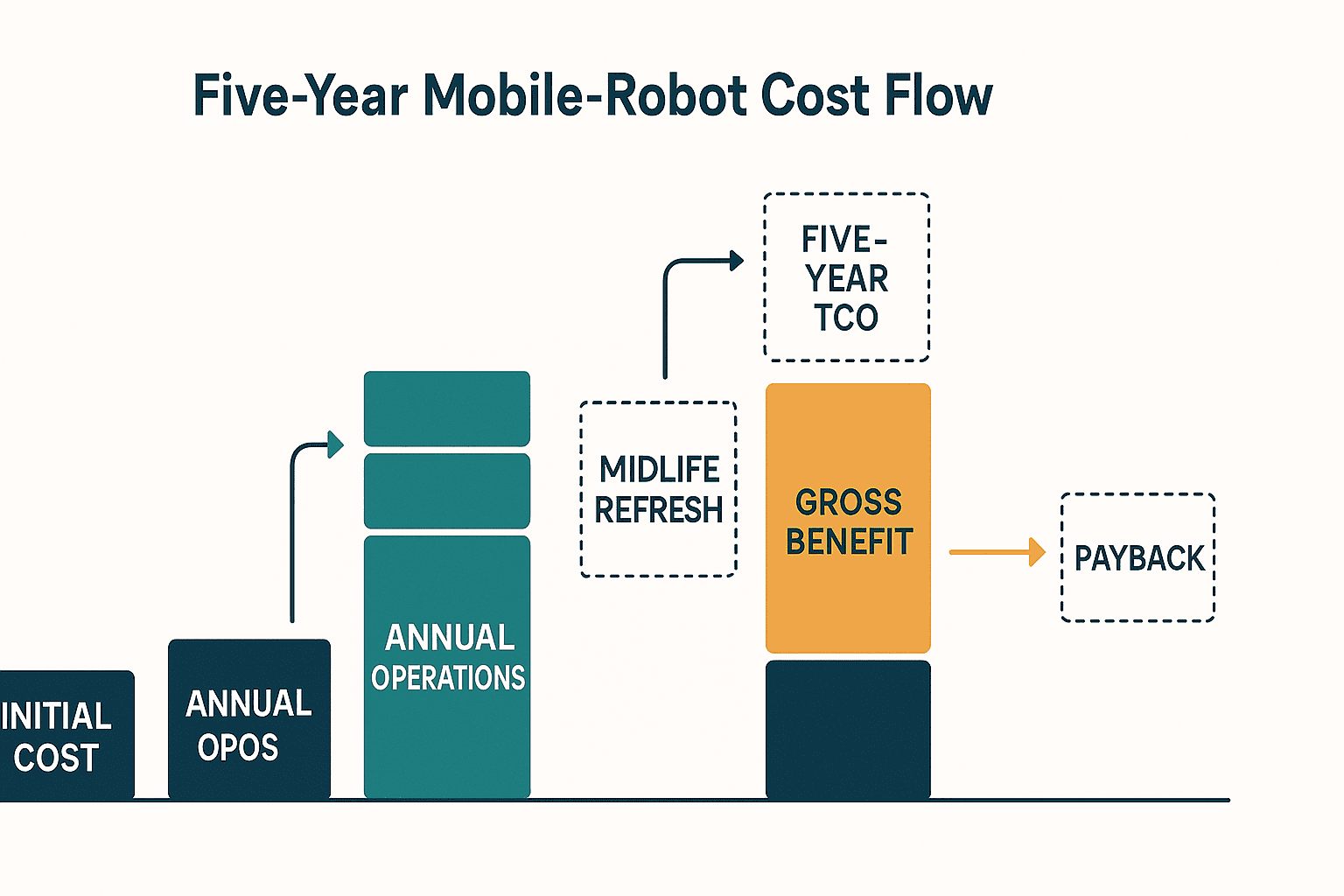
Illustrative initial cost: THB 10.24 million
| Initial-cost item | Formula | Assumed THB |
|---|---|---|
| Vehicles | 1,350,000 × 3 | 4,050,000 |
| Top modules | 320,000 × 3 | 960,000 |
| Chargers and electrical work | 260,000 × 2 | 520,000 |
| Safety, floor, aisle and door preparation | Lump sum | 850,000 |
| Fleet management and initial server build | Lump sum | 780,000 |
| WMS/MES/PLC/elevator interfaces | Lump sum | 1,350,000 |
| Engineering validation and FAT/SAT | Lump sum | 640,000 |
| Training, SOPs and multilingual material | Lump sum | 240,000 |
| Commissioning spares | Lump sum | 310,000 |
| Project and integration management | Lump sum | 540,000 |
| Total initial cost | Sum | 10,240,000 |
Vehicles represent 4,050,000 ÷ 10,240,000 = 39.55%, rounded to 39.6% of initial cost. In this scenario, budgeting only “unit price × quantity” omits roughly 60% of the initial programme. Do not transfer this ratio to another project. Long conveyor transfers, major elevator modifications, cold or hazardous environments and legacy WMS work can change it substantially.
Illustrative AGV running cost: THB 1.85 million per year
| Annual operating-cost item | Assumed THB/year |
|---|---|
| Software, fleet licences and support | 620,000 |
| Preventive maintenance and inspection | 420,000 |
| Wear parts, spares and battery provision | 300,000 |
| Network, server and cyber operations | 180,000 |
| Internal system owner, 0.3 FTE | 240,000 |
| Electricity | 90,000 |
| Total annual operating cost | 1,850,000 |
The model also places a THB 750,000 midlife refresh in year four. It bundles an illustrative allowance for batteries, wheels, sensors, a server or control components; it is not a general replacement interval.
Five-year TCO is:
10,240,000 + (1,850,000 × 5) + 750,000 = THB 20,240,000
Comparisons that omit running cost make the lowest initial bid look best. If specialist call-outs, fleet licences, API maintenance, cyber updates and batteries are excluded, every outage can require a new budget approval. Running cost protects availability; it is more than a maintenance fee.
Benefit and payback model: challenge realisation, not arithmetic
Assume these annual gross benefits for the same hypothetical factory:
| Benefit | Formula/assumption | Annual THB |
|---|---|---|
| Reassigned handling capacity | 6 positions × 360,000 × 70% realisation | 1,512,000 |
| Avoided forklift lease, fuel and maintenance | Contract-based planning assumption | 1,200,000 |
| Reduced line waiting | 60 hours × 22,000/hour × 50% realisation | 660,000 |
| Reduced damage and expedites | 420,000 × 60% realisation | 252,000 |
| Avoided recurring overflow logistics/headcount | Planning assumption | 900,000 |
| Annual gross benefit | Sum | 4,524,000 |
Annual net benefit is 4,524,000 − 1,850,000 = THB 2,674,000. Simple payback is 10,240,000 ÷ 2,674,000 = 3.83 years, shown as 3.8 years. Five-year gross benefit is 4,524,000 × 5 = THB 22,620,000. Its difference from five-year TCO is 22,620,000 − 20,240,000 = THB 2,380,000.
This is not an investment recommendation. The payback equation omits discounting, tax, financing, residual value, outage risk and the timing of the year-four refresh. “Six positions × 70%” does not mean six redundancies; it recognises only the portion financially realised through overtime avoidance, vacancy absorption, contractor reduction, avoided hiring or reassignment to value-adding work. If no redeployment or budget effect is agreed, set that benefit to zero in sensitivity analysis.
NIST MEP’s Robotics and Manufacturing Automation page says its support starts with a business assessment, provides tailored recommendations aligned to the business case, connects manufacturers with integrators and technology vendors, and rigorously measures results. Consistent with that business focus, agree which benefits can be financially realised and how results will be measured before treating an ROI worksheet as evidence.
Sensitivity analysis: identify the assumption that changes the decision
Holding initial and annual costs constant while varying gross annual benefit gives:
| Scenario | Gross annual benefit | Net annual benefit | Simple payback |
|---|---|---|---|
| Conservative | 3,200,000 | 1,350,000 | 7.59 years |
| Base | 4,524,000 | 2,674,000 | 3.83 years |
| Improvement achieved | 5,800,000 | 3,950,000 | 2.59 years |
Each result uses 10,240,000 ÷ (gross annual benefit − 1,850,000). The conservative case exceeds the five-year evaluation horizon. The project case therefore depends less on negotiating a vehicle discount than on whether waiting, outsourced handling, vacancies or avoided expansion will actually change.
Test these variables at ±20%, and sometimes zero:
- Actual daily moves and peak concentration
- Exceptions that cannot be automated
- Financial realisation of reassignment
- Stops and detours in shared aisles
- Available units after charging
- Enterprise-interface engineering effort
- Service response and downtime loss
- Battery and critical-component refresh timing
Precise unit prices cannot rescue an unsubstantiated benefit realisation rate.
Put WMS, MES, PLC and elevator integration in one responsibility model
Interface cost grows from mismatched state and ownership more often than from the number of APIs. If WMS creates a move, MES changes its priority, PLC releases the load, an elevator changes floors and the fleet manager assigns a vehicle, define which system is authoritative at each state.
A minimum state chain is requested → accepted → assigned → arrived → load_ready → transferred → delivered → closed. Design timeout, cancellation, reassignment, no-load, abnormal load, door failure, elevator busy and communication loss with the same care as the happy path.
For an elevator, separate call, arrival, door open, permission to enter, vehicle present, destination, and exit confirmation. Confirm human-sharing rules, fire mode, power recovery, manual rescue and rated load with the equipment owner. A few digital outputs do not close system responsibility.
For more detail, see the language-matched guides to AGV system integration, AGV and elevator integration and conveyor-top AMRs.
Fleet management and interoperability determine future cost
A one-unit demonstration can move after a destination is tapped. Production must govern priority, congestion, charging, failure, map versions, exclusions, multiple loads, multiple vendors and staged expansion. Confirm whether licensing is per vehicle or site; what happens when the server is unavailable; whether history can be exported; and how long API compatibility is maintained.
“Third-party vehicles can connect” is not an acceptance criterion. Test the common and vendor-specific boundaries of task assignment, maps, traffic, charging, error handling and safety. Even without a planned mixed fleet, define data ownership, configuration export and transition support to expose lock-in cost.
FAT and SAT convert price into accepted capability
FAT verifies specification and logic before site delivery: rated and offset loads, top modules, stopping, charging, fleet logic, APIs, roles, logging, backup and fault recovery. Simulator limitations should be carried into SAT explicitly.
SAT proves throughput on the real floor, lighting, Wi-Fi, doors, crossings, elevator, loads, workforce and shifts. Test the peak hour, simultaneous requests, a fault during charging, aisle closure, network loss and return from manual intervention—not only the daily average.
Example acceptance measures, with project-specific targets, include:
- Completion rate and reason for non-completion by load family
- p50, p90 and p95 move lead time by time window
- Available units including charging and queued tasks
- Manual interventions, reasons and mean recovery time
- State consistency across WMS/MES/PLC/elevator/fleet
- Expected, measured and recorded safety-function test evidence
- Backup restore, time synchronisation, certificate renewal and account disabling
“Three vehicles moved” does not prove throughput, recoverability or maintainability. Test evidence converts a price into purchased capability.

Thai-factory conditions often omitted from a quotation
Heat, dust, floor joints, rainy-season humidity, indoor/outdoor boundaries, shutters, metal racks, multiple languages, contractors, night shifts and local service coverage can all alter the design. Thai law and site rules for equipment imports, electrical work, factory permissions, networks, cross-border data, labour and safety must be checked by competent local functions.
BOI promotion depends on the project-time activity classification, equipment, investment, applicant, timing and approval conditions. The BOI announcement on first-half 2026 applications is an official view of investment activity, not proof that a particular AGV or AMR project qualifies. Project-specific confirmation is required from BOI, tax and legal specialists. Keep incentives out of the base TCO and add a separate case only after conditions are supportable.
Even a global-standard model needs Thai training, local spares, response coverage, import lead times, battery logistics, time-zone support and controlled remote access. Connect global engineering and local operations through one RACI.
AGV selection checklist for a comparable RFP
Use scenarios and data rather than copying a catalogue.
Operations and capacity
- Representative-day and peak-hour moves, load dimensions, weight and centre of gravity.
- Origins, destinations, priorities, deadlines, waiting, cancellations, reassignments and manual fallback.
- Measured handling time, queues, labour, stoppages, damage and outsourced cost.
- Expected three-year changes in volume, processes, layout and shifts.
Site and safety
- Floor, slopes, joints, doors, crossings, visibility, escape routes and shared tasks—not CAD alone.
- Applicable standards, risk ownership, validation method, residual risk and change control.
- Load drop/overhang, manual recovery, maintenance, towing and controlled access.
IT/OT and cyber
- Owners, protocols, states and timeouts for WMS/MES/ERP/PLC/elevator systems.
- Server/cloud, backup, time, logs, roles, certificates and vulnerability handling.
- Approval and audit for remote access, stop procedures and end-of-contract data return.
Commercial and lifecycle
- Initial, annual and five-year TCO through the same eleven cost boxes.
- Licence metrics, expansion price, overtime, travel, SLA and spare-part lead time.
- FAT/SAT success criteria, retest cost, delay accountability and warranty start.
- Product end-of-life, OS upgrade, API change and cyber-update policy.
Require each bidder to explain how many units and chargers meet the reference scenario and at what verified capacity. If a lower-price design needs four vehicles, do not compare its unit price with a higher-price three-vehicle design.
Progress through three investment gates
Gate 1—measure and define. For two to four weeks, measure material-move events, exceptions, peaks, stoppage impact, loads and routes. Mark which moves will remain manual.
Gate 2—limited pilot. Use one move family and a controlled zone, with real loads and shifts and an approved manual fallback. Measure throughput, interventions, recovery and operating burden—not demo completion.
Gate 3—production deployment. Expand only after FAT/SAT acceptance, SOPs, training, spares, support, KPI owners and change review are in place. Buy additional units based on observed throughput and charging data.
Each gate needs stop conditions. If floor work is not approved, elevator responsibility remains undefined, reassignment value is unrealised or peak capacity fails, compare route changes, partial automation, conveyors and better manual handling. Choosing not to deploy a robot can be sound investment governance.
FAQ
How much does an AGV or AMR cost?
This article does not publish a market-wide vehicle range because payload, top module, quantity, charging, safety, site work, fleet software, interfaces, validation and service change the system. Request quotations through the same eleven cost boxes.
Is an AGV cheaper than an AMR?
Not universally. AGV may simplify fixed repeat flow; AMR may reduce change effort in a dynamic layout. Compare required quantity, infrastructure, effective shared-aisle throughput and five-year change cost for the same task.
What belongs in AGV running cost?
Include fleet and software licences, support, preventive maintenance, wear parts, battery allowance, electricity, network, servers, backup, cyber operations and internal ownership. Identify out-of-contract work and overtime rates.
What should an AGV selection begin with?
Begin with move volume, peaks, loads, routes, exceptions, allowable downtime, shared work, safety responsibility and enterprise systems. Then compare vehicle type, guidance/autonomy, top module and charging.
How is mobile-robot payback calculated?
Simple payback divides initial cost by annual gross benefit minus annual operating cost. Separately test realisation, tax, discounting, midlife refresh, residual value and downtime. The 3.8-year result here belongs only to the hypothetical assumptions.
Should BOI incentives be included in TCO?
Keep them out of the base case before approval. Ask competent BOI, tax and legal specialists to confirm activity, equipment, applicant, timing and conditions; then show a separate supported case.
Does an onboard safety scanner remove the need for site modifications?
No such general conclusion is safe. Floors, crossings, doors, sightlines, people, loads and recovery tasks affect the operating-zone risk. Determine speed, segregation, routes, signs and equipment interfaces from risk assessment and site validation.
Can different AGV and AMR brands share a fleet manager?
Potentially, but “connectable” is insufficient. Test tasks, traffic, maps, charging, errors, safety boundaries and support ownership. Contract the common and vendor-specific scope.
Summary
AGV and AMR cost is not a robot price tag. It is the governed five-year cost of sustaining throughput, safety, integration, validation, operations and updates. Compare AGV and AMR against the same move scenario, peaks, exceptions, required quantity and acceptance evidence. The illustrative model here has THB 10.24 million initial cost, THB 1.85 million annual operating cost, THB 20.24 million five-year TCO and 3.83-year base simple payback. These are calculation assumptions, not market prices.
TOMAS TECH can support Thai factories before a vehicle type is selected: baseline measurement, AGV/AMR comparison, five-year TCO, RFP design, WMS/MES/PLC/elevator integration and FAT/SAT planning. You are welcome to contact TOMAS TECH while you are still aligning assumptions for a budgetary estimate.
References
- ISO 3691-4:2023 — Driverless industrial trucks and their systems
- A3 — Robot Safety Standard Documents
- OMRON — HD Series Autonomous Mobile Robots Specifications
- Thailand BOI — Investment applications in the first half of 2026
- EUR-Lex — Regulation (EU) 2023/1230
- NIST MEP — Robotics and Manufacturing Automation


