


Do you have a process where a forklift shuttles carts back and forth, one at a time, to feed parts to an automotive assembly line? A towing AGV (tugger AGV) is a system where a single tractor connects several carts into a train and moves them all in one trip. How does it differ from underride and forklift-type AGVs, and which sites is it suited for? Above all, “run design” — mixing different cart types, such as parts carts and kitting carts, into a single train and delivering them to multiple line-side stop points — is a challenge unique to the towing method that simply doesn’t exist for automation approaches built around a single cart type. This article walks through how the system works, how to design circulation routes and schedules, what it costs, and what to settle before requesting a quote.
What Is a Towing AGV (Tugger AGV)?
How One Tractor Tows Multiple Carts
To begin with, an automated guided vehicle (AGV) is a general term for material-handling equipment that travels a predetermined route without a driver to carry loads. We’ve covered the overall classification of AGVs and their guidance methods in our article on what an AGV is, so this article focuses specifically on the towing method as one drive type.
A towing AGV connects several carts to a single tractor through a tow hitch and pulls them as a train. The carts themselves have no drive power — only the tractor does. Load capacity per cart typically starts around a few hundred kilograms, and the more carts you connect, the more total volume you can move in a single trip. International guides on the subject identify this ability to move multiple loads in one run as the biggest difference between tugger AGVs and single-load forklift transport.
In English, this method goes by several overlapping names — tugger AGV, tow tractor AGV, towing AGV — but they all refer to the same underlying method. When requesting quotes or comparing catalogs, don’t mistake a difference in naming for a difference in system type.
Also Known as a “Tugger Train”
In English-speaking markets, a towing AGV is called a tugger AGV, and the connected train of carts itself is called a tugger train. As noted above, several names coexist, but the underlying system is identical.
The number of carts connected varies widely by site — published examples show trains of three, four, five, or more carts. Tractor capacity also varies enormously by model: small units handle a few hundred kilograms, while large units offer towing capacity exceeding 10 tons. This range is exactly why tugger AGVs can handle everything from passenger-car parts to heavy components.
Mixed-Cart Trains — An Idea Unique to Towing AGVs
Standardizing the Hitch Hardware
The key point is that carts connected in a train don’t all need to be the same specification. Being able to mix carts of different shapes and purposes — parts carts, kitting carts, cage carts — into a single train is a defining characteristic of the towing method itself. We cover automating one specific cart type, the cage cart, in our article on cage cart transport automation. This article doesn’t limit itself to one cart type — instead it focuses on the design challenge of moving several different cart types together in a single tugger train.
When cart types differ, the hitch height, pin shape, and caster orientation often don’t line up either, so you can’t simply string them together as-is. Sites typically standardize this by preparing adapter plates that absorb the differences in each cart’s hitch specification, or by unifying the hitch pitch (how many centimeters from the tractor each connection point sits) across every cart. Which manufacturer’s hitch standard to adopt is a decision worth settling early — the more cart manufacturers are mixed at a site, the more urgent this becomes.
Benefits and Constraints of Mixed Loading
The biggest benefit of mixed-cart trains is being able to move different part types and lot sizes in a single circuit, even when they’d otherwise need separate trips. A run that would only fill a parts cart halfway can gain loading efficiency simply by adding one kitting cart — that kind of flexible combination becomes possible.
There are constraints too. Placing a heavy cart toward the back of the train tends to increase the offtracking (the inward path deviation) at corners, while loading too much weight near the front throws off the tractor’s towing balance. When cart width and length vary by type, you need to work out how much total train length the site can tolerate, in conjunction with the shape of aisle intersections and corners. How you compose the train directly determines the route and schedule design covered next.
Route and Schedule Design — Run Counts, Stop Order, and Passing Bays
Fit with Milk-Run Operations
Towing AGVs are easiest to introduce into “milk-run” operations — transport that follows a fixed route and loads or unloads at multiple stations along the way. In automotive parts supply, the typical operation is to circulate among multiple line-side supply points, delivering full carts while collecting empty ones. International guides on the subject also point to this ease of adoption — because a milk run already has a clearly defined circuit and clearly defined load and unload points, the operational pattern itself doesn’t change when you move from manual towing to automation.
In practical terms, then, a towing AGV isn’t so much a completely new transport method as an option for automating an existing milk-run operation — one already carried out by hand or with a manned tow tractor — in the same basic form. Compared with underride or forklift-type AGVs, which typically require redesigning the operating route from scratch, the barrier to getting started is relatively low at sites where the circulation pattern is already established.
Deciding the Number of Runs
The first thing to settle when automating is the “run count” — how many circuits to schedule per shift. You work this out backward from two figures — the total hourly parts demand across all target line stop points, and the load capacity per run (determined by the type and number of carts connected).
When the current process relies on hand carts or forklifts delivering individually, each line stop point is often supplied at its own separate timing. Simply replacing that pattern one-for-one with towing AGV circuits tends to inflate the run count. What’s needed is to consolidate the demand timing across multiple line stop points and regroup them so a single circuit can cover several points at once — holding the run count down while still avoiding any gaps in supply. At sites where demand fluctuates, preparing two run-count patterns in advance, one for busy periods and one for slow periods, makes it much easier to adjust operations on the floor.
Load Units and Stop Order
The load unit — how many carts to connect per run, and in what order to connect which cart types — is just as important a design element as the run count. When mixing parts carts and kitting carts in the same run, connecting the cart bound for the earliest stop point closer to the tractor, and the cart bound for a later stop point toward the back of the train, reduces the effort needed for uncoupling at each stop.
Stop order needs to align not just with the physical layout of the plant floor but with the timing at which each line stop point actually needs parts — its JIT delivery window. Two stop points that sit close together geographically can still be inefficient to serve in the same run if their supply timing doesn’t match, while two points that are physically far apart can sometimes be combined efficiently if their timing is close. Rather than simply carrying over the stop order used in the existing manned-tractor operation, many sites find they can cut the run count itself by redesigning stop order as part of the automation project.
Designing Passing Bays (Refuge Space)
Because a towing AGV train can be quite long overall, narrow one-lane aisles will sometimes have no room for the train to pass an oncoming forklift or another AGV. That’s where “passing bays” come in — widened sections of aisle where the train can temporarily pull aside.
As a rule, passing bays go just ahead of aisle intersections or sections where multiple circuits overlap. If the number and placement of passing bays is insufficient, waiting to pass will delay the entire circuit, which can end up forcing you to add more runs to compensate. Conversely, deciding on passing-bay locations early, during route and run-count design, lets you run multiple towing AGVs at once while keeping aisle layout changes to a minimum. If there’s a future plan to add more vehicles, we recommend reserving room for passing bays at this stage.
How Towing AGVs Differ from Other Drive Types
Difference from Underride AGVs
An underride AGV slides underneath a single, fixed cart type and either lifts the entire cart or tows it via a pin or hook on the cart’s underside. The cart specification has to be standardized to match the AGV, and any cart outside that spec can’t be moved. A towing AGV, by contrast, only needs the hitch interface between tractor and cart to line up — the cart’s underside structure and specification can vary considerably and still be connected.
At sites where the process runs entirely on a single cart type, an underride AGV is the simpler install. At sites where parts carts, kitting carts, and cage carts are all mixed together, a towing AGV keeps per-cart modifications to a minimum.
Difference from Forklift-Type AGVs
A forklift-type AGV lifts pallet-sized loads with forks to shelve or unload them. It suits work that handles heavy loads reliably one at a time, including storage into racks. On the other hand, it can typically carry only one pallet per trip, which makes it a poor fit for circulating among multiple supply points and moving many carts together.
A towing AGV, conversely, has no fork-lift-and-store function, but it can move as many loads at once as it has carts connected. The division of labor is straightforward — forklift type for processes that need rack storage, towing type for processes centered on circulating transport.
Difference from Conveyor-Type AGVs
A conveyor-type AGV has rollers or a belt built into its top surface and handles high-frequency, fixed-quantity transport along a fixed route. It’s highly efficient where both the route and the shape of the goods being moved stay essentially constant, but it’s less adaptable to route changes or mixed-item loads than a towing AGV.
A towing AGV can handle a wide variety of load shapes simply by swapping carts, giving it a flexibility advantage over conveyor types at sites where the part mix or route tends to change.
Below is a comparison of the four drive types.
| Drive Type | Strengths | Weaknesses |
|---|---|---|
| Towing (tugger) | High-volume, long-distance, scheduled circuit transport with mixed cart types connected together | Single heavy-item transport, tight multi-directional turns in narrow aisles |
| Underride | Automated load-in and load-out for carts with a standardized specification | Sites where cart specifications vary |
| Forklift-type | Pallet-sized heavy loads, shelving and unloading | Scheduled circuits across many stations |
| Conveyor-type | High-frequency, fixed-quantity transport on a fixed route | Frequent route changes, mixed-item loads |
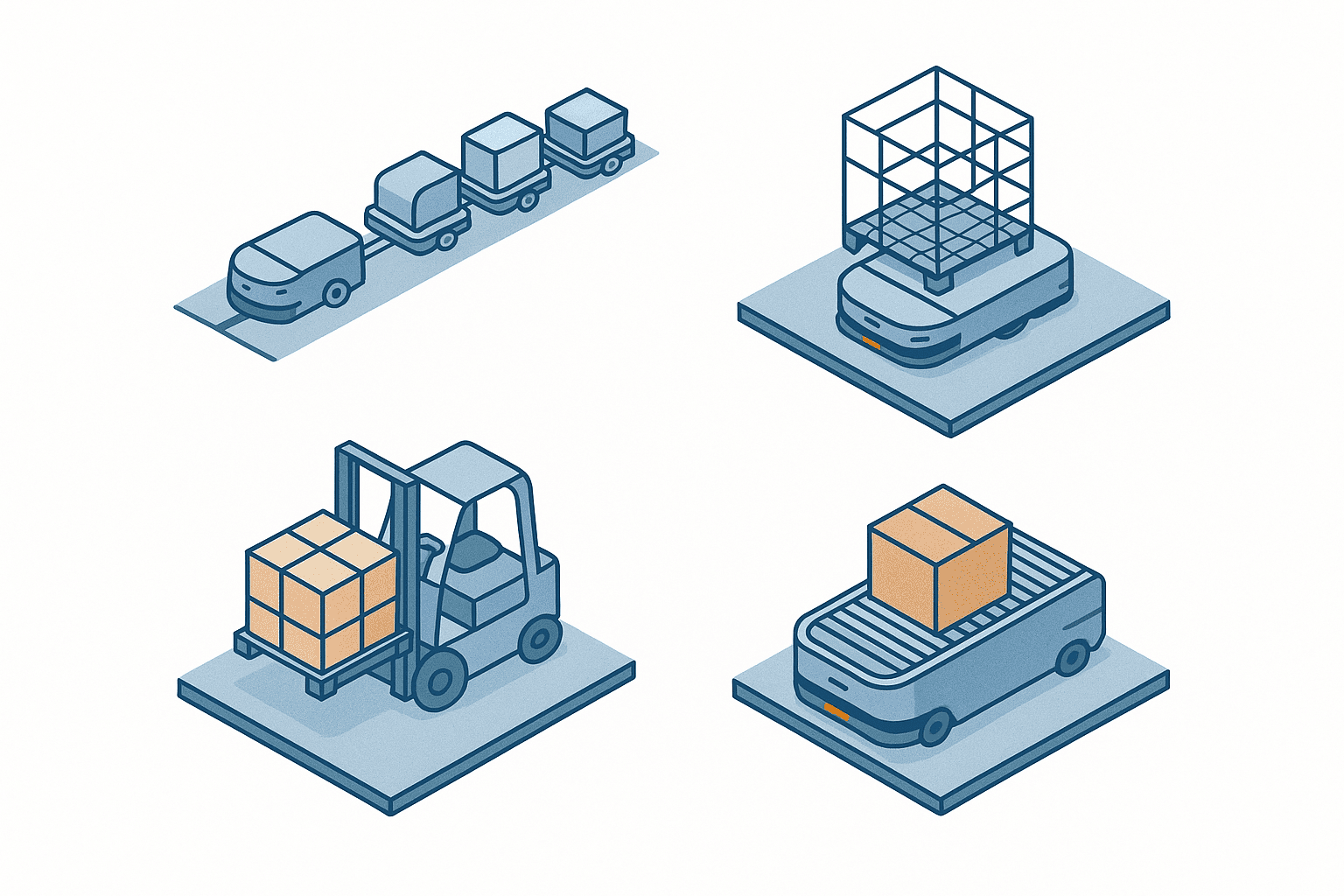
The figure above compares how the towing method — which mixes multiple cart types into a single train — and the other three methods each hold their loads and which route characteristics they suit. Now that we’ve placed the towing AGV in context, let’s look at which sites it fits.
Among AGV Types, Which Sites Suit — and Don’t Suit — Towing
Conditions That Favor Towing AGVs
Towing AGVs perform best at sites where the following conditions are present.
- A milk-run style transport pattern already exists, circulating among multiple supply points to load and unload
- Multiple cart types — parts carts, kitting carts, cage carts — already move along the same route
- Aisles are relatively long and straight, with transport distances ranging from tens to hundreds of meters
- There’s room to reduce the number of round trips itself by redesigning run counts and stop order
Line-side supply to automotive parts assembly lines is the process type that fits these conditions most closely. Circulating among multiple stations at fixed intervals, delivering full carts while collecting empty ones, matches exactly how towing AGVs are typically used.
Conditions That Don’t Favor Towing AGVs
Conversely, the following conditions make it harder for a towing AGV to deliver results.
- The aisle floor has many steps, slopes, or uneven expansion joints, raising the risk of a cart derailing
- There are many corners and no turning space to absorb the offtracking of a connected cart train
- Transport volume is low and dominated by single, one-off trips, where connecting multiple carts to one tractor offers little benefit
- Many routes require reversing while carts are still loaded
Floor condition in particular tends to get overlooked. In a connected train, the trailing carts don’t necessarily follow the exact path of the lead tractor when it changes direction, and even minor floor unevenness or a slight slope can cause a cart to weave or derail. We recommend walking the actual planned aisles early in the evaluation to physically measure the floor and corners.
For the broader selection questions — AGV versus AMR, or comparison with goods-to-person (GTP) shelf-carrying systems — see our AGV manufacturer comparison article and our shelf-carrying robot article. This article stays focused on evaluating the fit of the towing method itself.
Safety Considerations — Rear-End Collisions and Derailing
Blind Spots at the Hitch
There’s a structural issue at the connection points between carts — the tractor’s onboard safety scanner often can’t reach that area effectively. International technical guides point out that towed carts have no electrical connection, and in some cases no shared safety system is configured between tractor and cart at all. We cover this point in depth in our article on cage cart transport automation, so we won’t go further into it here — instead this section focuses on two related issues, rear-end collisions and derailing.
Preventing Rear-End Collisions and Sideswipes
The collision risk for a towing AGV needs to account for more than just forward detection by the tractor itself — it also has to cover cases where the rear end of the cart train contacts another vehicle or a worker. Because the train is long overall, visibility at intersections and corners suffers, raising the risk of a blind-corner collision with another forklift or a pedestrian. This loss of visibility becomes especially pronounced on runs where mixing multiple cart types stretches the train’s total length.
Measures a site can take include the following.
- Install high-visibility markings or reflective material on the rear of the cart train so other vehicles and workers can see it clearly
- Add advance warning signals, lights or sound, at intersections and corners to announce the AGV’s approach
- Size the aisle width where cart trains pass each other based on the full connected length and the turning path
- Separate the AGV’s circulation schedule from periods of heavy foot traffic, or set up deceleration zones
Managing Derailing and Offtracking
A connected cart train doesn’t trace the tractor’s exact turning path — each trailing cart cuts progressively further to the inside, producing offtracking. The smaller the corner radius, the larger this offtracking becomes, and the greater the chance that a cart’s wheel rides up onto an aisle curb or a floor step and derails. On mixed-cart runs where wheel diameter and caster structure vary by cart type, it’s easy to overlook that the amount of offtracking also varies cart by cart, even at the same corner.
The basic countermeasure is to calculate the minimum turning radius for the connected train during aisle design and shape corners to accommodate it. Floor expansion joints, pit covers, and even slight slopes can also cause derailing depending on cart wheel diameter, so walking the entire aisle in a pre-installation site survey is essential. At sites already running a manned tow tractor, identifying the specific spots where derailing or near-misses have occurred in that existing operation feeds directly into the automated design.
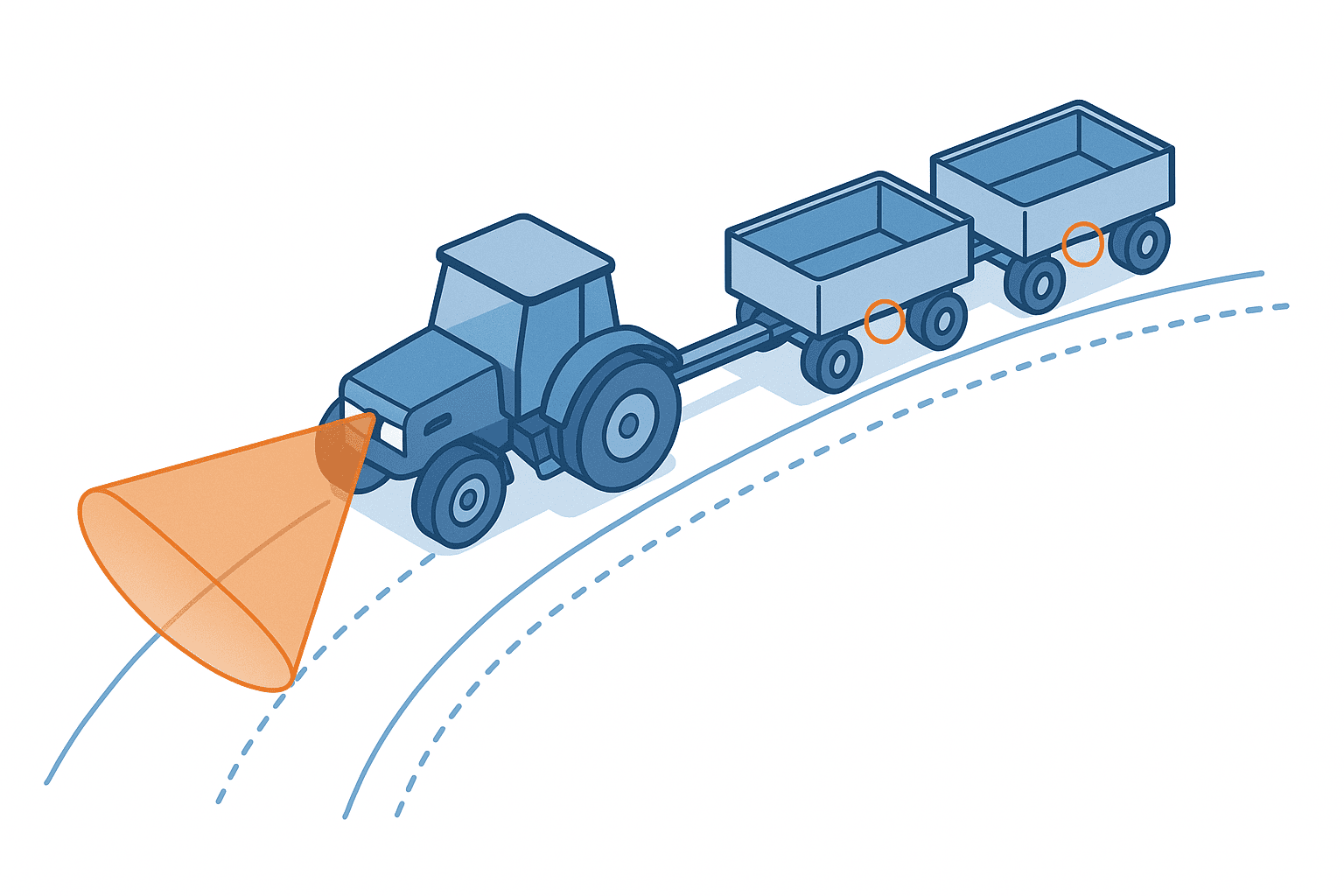
The figure above illustrates two risks specific to towing AGVs — the safety-scanner blind spot at the hitch, and offtracking at corners. With these safety considerations covered, let’s move on to cost.
Cost Benchmarks
The cost of a towing AGV varies with the price of the tractor itself plus the number of carts connected, the guidance method, and the specification of the safety system. Below is a simplified cost model assuming parts supply to a final assembly line at an automotive parts plant. The figures are just one example — replace them with your own labor-cost data and actual quotes when evaluating a real project.
The assumptions are as follows.
- Target process — parts supply to the final assembly line at an automotive parts plant (milk-run method)
- Before automation — forklift-based towing and transport run across two shifts, with the equivalent of 4 full-time workers engaged in transport work
- After automation — one towing AGV (one tractor plus four carts) is introduced, leaving the equivalent of 0.5 workers for supporting tasks such as monitoring, battery swaps, and cart coupling and uncoupling (a net reduction of the equivalent of 3.5 workers)
Based on these assumptions, the initial investment breaks down as follows.
| Item | Details | Amount (THB) |
|---|---|---|
| One tractor (tow vehicle) | Unit price including guidance and safety systems | 1,200,000 |
| Four carts | 80,000 baht per cart x 4 carts | 320,000 |
| Installation and on-site tuning | Route setup, safety sensor tuning, trial runs | 300,000 |
| Total initial investment | 1,820,000 |
Counting only labor-cost savings, conservatively, the annual benefit works out to 3.5 workers x 18,000 baht per month x 12 months = 756,000 baht, giving a simple payback period of 1,820,000 divided by 756,000, or roughly 2.4 years. This benefit isn’t determined by fleet size alone, though. Depending on how you design run counts and stop order, as covered in the previous section, the number of daily circuits and the operating hours required can differ even with the same fleet composition, which changes the payback period as well. Before adding or removing vehicles, we recommend first checking whether reviewing run counts and stop order can reduce the requirement on its own. For a broader look at how to think about AGV and AMR upfront costs, see our article on AGV price and cost.
Note that this model doesn’t include ongoing running costs such as maintenance or battery replacement. Even a relatively small configuration of one tractor and four carts will need roughly annual battery-degradation diagnostics and periodic replacement of worn hitch components. The amount typically stays within a few percent of the initial investment, but when you need a precise payback estimate, we recommend asking your vendor to include a maintenance cost breakdown in the quote.

The figure above lays out the initial investment breakdown alongside the annual labor-cost savings. Next, let’s turn this model into an actual purchasing decision.
What to Settle Before Placing an Order
Points to Confirm During a Site Survey
Before requesting a quote, there are items your own team should confirm.
- How many cart types will be transported, and how far can hitch hardware be standardized across them
- Aisle length, width, and corner radius, and whether there are floor steps or expansion joints
- Current transport frequency and the volume of goods moved per trip
- The location and time of day for intersections and areas with heavy foot traffic
- Any near-misses or derailing incidents recorded in the existing manned-tractor operation
None of this can be judged from documents alone — you need to walk the actual aisles to confirm it. Whether a corner can be navigated with the train’s full connected length, in particular, is easy to get wrong from floor-plan numbers alone.
Pre-Order Checklist
Right before comparing quotes or placing an order, confirm the following items.
- How will you standardize hitch hardware (pitch, height, adapters) across each cart type in the train
- Does the stop order for mixed loads align with the supply timing, the JIT delivery window, at each line stop point
- Have you confirmed on-site how the train’s full length interacts with visibility at aisle intersections and corners
- Where and how many passing bays will you install, and is there room to account for future fleet expansion
- Is there a defined process and owner for revising run counts and circuit schedules when demand shifts
- Have you recalculated the initial investment and annual benefit using your own actual labor-cost and transport-volume data
Frequently Asked Questions
What’s the difference between a towing AGV and a forklift-type AGV?
A towing AGV connects multiple carts to a single tractor and moves them together while circulating among several supply points. A forklift-type AGV lifts pallet-sized loads with forks to shelve or unload them, and it can typically carry only one pallet per trip. Towing AGVs suit processes centered on circulating transport, while forklift-type AGVs suit heavy loads that need to be shelved.
How many carts can a towing AGV connect?
International guides describe examples connecting three, four, five, or more carts. The upper limit depends on the tractor’s towing capacity, the corner radius of your aisles, and the load capacity per cart. Connecting more carts increases how much you can move in a single trip, but the added train length also demands more turning space and more passing bays, so the number needs to be decided in light of your actual aisle conditions.
Can different cart types be mixed into a single train?
Yes, as long as the hitch specification lines up. Even carts with different shapes, such as parts carts and kitting carts, can be connected into a single train once you absorb the specification differences with hitch pitch adjustments and adapter plates. When mixing cart types, connecting the cart bound for the earliest stop point closest to the tractor keeps uncoupling smooth at each stop.
What’s the minimum safety measure needed for a towing AGV?
You need measures that cover more than the tractor’s forward safety scanner — the sides of the connected train and the gaps between carts easily fall outside its monitoring range. Concrete measures include an operating rule against anyone stepping between carts, better visibility at the rear of the train, advance warning signals at intersections, and securing adequate turning radius during aisle design. We cover the hitch safety-system issue in more depth in our article on cage cart transport automation.
How much does it cost to introduce a towing AGV?
In this article’s model, covering one tractor, four carts, and installation and on-site tuning costs, the total initial investment comes to 1,820,000 baht. Estimating annual labor-cost savings at 756,000 baht gives a simple payback period of about 2.4 years. This is just one example based on specific assumptions, though, and the actual amount will shift with the number of carts, how you design run counts, and local labor-cost levels. For a real evaluation, we recommend recalculating with your own transport-volume and labor-cost data.
Summary
A towing AGV connects multiple carts to a single tractor and moves them together across several stations along a circuit route. Compared with underride, forklift-type, and conveyor-type systems, its defining feature is the ability to mix carts of different specifications — parts carts, kitting carts, and the like — into a single train. This article has laid out how designing run counts, load units, stop order, and passing bays is a set of considerations unique to the towing method, one that doesn’t exist for automation approaches built around a single cart type.
At the same time, sites with uneven floors or many corners face a higher risk of derailing and offtracking, and towing AGVs don’t suit processes centered on single heavy-item transport or rack storage. On the safety side, the gap between carts becoming a blind spot for the tractor’s safety scanner is an issue specific to this drive type that the others don’t share — we’ve left the deeper dive on that to our article on cage cart transport automation and focused this article mainly on measures against rear-end collisions and derailing.
On cost, a model covering one tractor, four carts, and installation costs produced a total initial investment of 1,820,000 baht, and estimating annual labor-cost savings at 756,000 baht gave a simple payback period of about 2.4 years. Because this payback period depends on how you design run counts and stop order, not just fleet size, the practical starting point is to substitute your own transport-volume and labor-cost data and first look for room to improve by revising the circuit route.
If you’re at the stage of evaluating a towing AGV and want help working out cart-mixing patterns or run-count design, or want to revisit this model’s assumptions using your own data, feel free to reach out through our contact page.
References
- An Expert’s Guide to Tugger AGV Systems and Automated Material Handling – MasterMover
- Need an AGV Tugger? All the Types, Specs, Prices – AGV Network
- A Guide to Tugger AGVs and AMRs, Key Things to Know Before Investing – FlexQube
- ISO 3691-4:2023 Industrial trucks – Safety requirements and verification, Part 4 – ISO
- How do tugger trains reduce labor costs in warehouses? – K.Hartwall
- AGV Guide, Industrial Automated Tugger System – Cyngn
- Latest 2026 Trends in Thai Labor Affairs and Labor Management (Tokyo Consulting Group, Japanese-language source) — covers 2026 updates to Thai labor law and HR management, including current wage and minimum-wage trends used as a reference point for this article’s labor-cost assumptions.


