


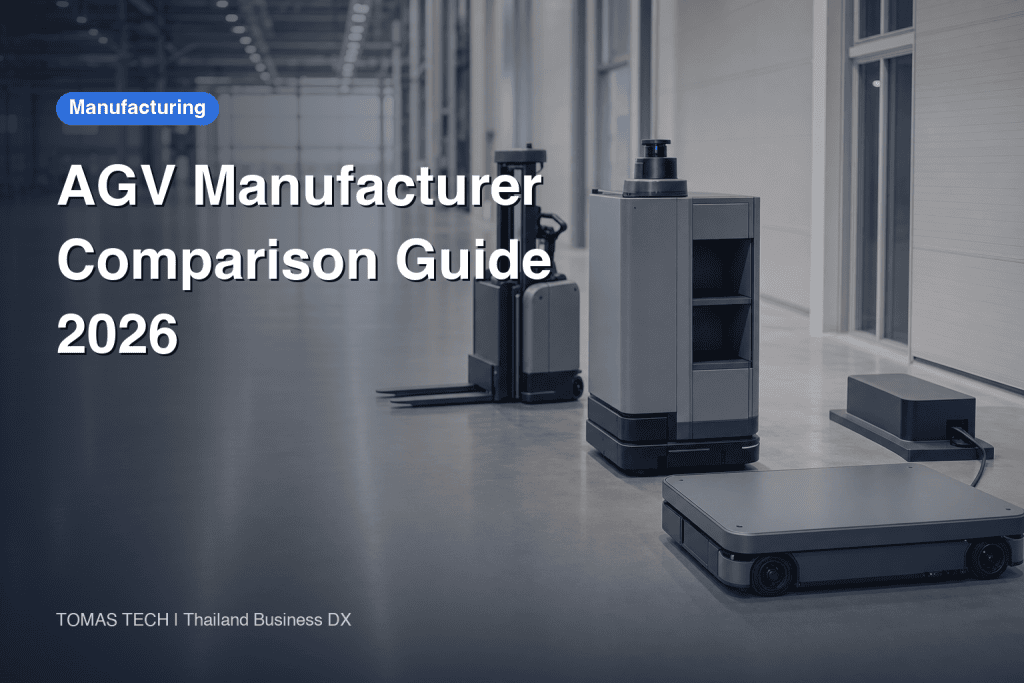
When an AGV manufacturer comparison starts, most project owners lay the vendor catalogues side by side and build a table of maximum payload, travel speed, runtime and navigation method. Yet three or five years into operation, the problems that actually hurt are almost always the ones that never appeared in that table. How does the maker evidence its conformity to the safety standard? Can its vehicles sit under the same traffic controller as another brand? Do spare parts come out of a warehouse inside Thailand? And should you own the fleet outright or subscribe to it? This article sets out four criteria for evaluating the company that builds the vehicle, rather than the vehicle itself.
Why lining up spec sheets rarely separates AGV manufacturers
Catalogue specifications cluster more tightly than you expect
Request quotations for AGVs and AMRs at a plant in Thailand and proposals arrive from Japanese, European, American, Chinese and Thai local dealers. The headline specifications in those documents are, in practice, remarkably similar. For under-riding latent-lift types, payload, travel speed and continuous runtime land in comparable ranges, and navigation usually settles into either SLAM or magnetic tape. That is natural in a mature technology field, partly because the suppliers of the core components — drive units, batteries, LiDAR — are globally few in number.
So building a comparison table of specifications is a necessary entry point, but it is not often where the decision is actually made. The difference sits in what the table does not show.
The costs that bite arrive in years three to seven
An AGV is capital equipment. Installation is not the finish line; the vehicle then runs every day for several years. Over that period, cost and effort surface in forms like these.
- Replacement of consumables such as batteries, rollers and drive modules
- Control software updates, and the re-validation of existing settings that follows them
- Map updates and route re-planning whenever the layout changes
- Traffic control software work when the second and third vehicles are added
- Conformity evidence demanded by auditors or by the head office safety department
None of these depend on vehicle performance. They depend on what kind of company the manufacturer is. When the discussion of how to choose an AGV stops at the specification table, this entire dimension stays invisible right up to the purchase order.
What this article does not cover
Absolute price levels and total cost of ownership modelling are handled separately. For the difference in upfront cost between AGVs and AMRs, and for the break-even analysis of which one wins as layout changes get more frequent, see AGV price and cost benchmarks. For fleet sizing and the design of routes, intersections and charging positions — the question of how many vehicles run where — see AGV layout design. If the definitions and categories of AGV and AMR still feel blurred, reading what an AGV is first will make the material below considerably easier to absorb.
What this article covers is the decision that sits upstream of all of that — which manufacturer’s vehicle you buy in the first place.
The big picture — four evaluation criteria that get overlooked
When comparing makers of automated guided vehicles, the criteria worth watching beyond performance and price organise into four.
| Criterion | What to verify specifically | What happens if you miss it |
|---|---|---|
| Safety standard conformity evidence | Whether conformity to ISO 3691-4:2023 rests on a self-declaration or on third-party certification | Auditors from head office safety or the insurer raise it after installation, and extra verification costs appear |
| Interoperability and standards support | Which version of VDA 5050 is supported, and which functions are not | You can no longer buy the second vehicle from another maker, which means de facto single-vendor lock-in |
| Local support and spare parts network | Whether engineers and parts stock exist inside Thailand, and the lead time if they do not | Every failure stops the line for days or weeks, and downtime cost eats into the vehicle price |
| Procurement model | Outright purchase or RaaS subscription, and where you place the crossover | You choose an ownership model that does not match the service life and lose money over the total term |
All four share one useful property — they can be verified on paper before the order is placed. A demonstration run will not reveal them, but asking will produce an answer. Put the other way round, if you do not ask, you will sign the contract without ever knowing. Each one is examined below.
Criterion 1 — how conformity to the safety standard is evidenced
What ISO 3691-4:2023 is
At the centre of international safety standards for driverless industrial trucks sits ISO 3691-4. Its full title is “Industrial trucks — Safety requirements and verification — Part 4: Driverless industrial trucks and their systems”, and as Part 4 of the industrial truck safety series it specifies the safety requirements and verification methods for driverless industrial vehicles and their systems. The 2023 edition is the second edition and replaces the 2020 edition.
Two points matter when reading this standard.
First, it covers AGVs and AMRs under the same standard. The scope lists automated guided vehicle, autonomous mobile robot, bots, automated guided cart and tunnel tugger side by side. In other words, the explanation “ours is an AMR, not an AGV, so this standard does not apply” does not hold as a general matter. If that line comes up during a sales conversation, it is fair to suspect the standard itself has not been read.
Second, it is a Type-C standard, a machine-specific safety standard. Safety standards are layered into Type-A, which sets basic concepts, Type-B, which covers common safety aspects, and Type-C, which sets detailed requirements for a specific machine. ISO 3691-4 belongs to this lowest layer, and it imposes concrete figures and procedures on one particular machine — the driverless industrial truck. That is precisely why it is worth the buyer’s time to press on what the phrase “we are compliant” actually means.

Three layers of responsibility — maker, integrator and user
The aspect of ISO 3691-4:2023 that the procurement side most needs to grasp is that responsibility is divided across three parties.
The vehicle manufacturer, or OEM, is responsible for building a vehicle that avoids hazards and reduces risk at the design stage. The maker must carry out a risk assessment, implement safety measures, then document the residual risks that remain and pass them on to the next stage.
The integrator, or system integrator, is responsible for the interface between the vehicle and the real site environment. A vehicle can be safe on its own while new risks appear at the seams — the handover point with an existing conveyor, the placement of the charging station, interference with other equipment. The integrator performs a risk assessment on those interfaces and, again, passes the residual risks on to the user.
The user, meaning the plant, is responsible for ensuring the AGV is operated safely inside its own premises. That includes day-to-day supervision, operator training and adherence to the operating conditions the maker has specified.
This division of responsibility sits on a different layer from the scope-of-work question covered in how to choose a robot system integrator. Integrator selection is about who installs the system; this is about who evidences the safety. Confusing the two produces the assumption that “the integrator handled the installation, so the integrator must hold the safety documentation”. In reality, only the manufacturer can issue conformity evidence for the vehicle itself.
Annex A and the operating zone — conformity evidence is evidence of conditional safety
Annex A of ISO 3691-4:2023 specifies the preparation of the operating zone. One example is a clearance of at least 0.5 metres on both sides of the travel path, over a height of 2.1 metres. This is not an absolute requirement, however. Where clearance cannot be maintained, alternative measures are accepted, such as activating a means of detecting a person between the vehicle and surrounding objects, providing an emergency stop or stopping device within 600 millimetres of the hazard point, or treating the area as a restricted zone or a confined zone. So the accurate reading is not “material stored beside the aisle equals immediate non-conformity” but “you must choose between taking an alternative measure and clearing the aisle”.
How to work through floor and aisle design itself is covered in AGV layout design. What matters here is the procurement implication that follows.
A manufacturer’s conformity evidence certifies that the vehicle is safe when used under the conditions the standard defines, and preparing those conditions is the user’s job. When comparing makers, therefore, the request to send is this — “please document the conditions we must prepare on our side in order to operate your vehicle as the standard requires, together with the alternative measures available if we cannot meet them”. The gap between makers that respond with a concrete document and makers that say “it will be fine” verbally is directly proportional to the volume of disputes after installation. Whether a maker can explain the conditions its evidence presupposes is stronger comparison material than whether it holds the evidence at all.
Self-declaration or third-party certification
This is the most practical point in this section. The single sentence “we conform to ISO 3691-4” can carry two broadly different meanings.
A self-declaration of conformity is where the maker performs its own risk assessment, assembles a technical construction file and declares conformity on its own responsibility. Much of European CE marking operates within this framework, and the procedure is entirely legitimate in itself. The problem is that how much verification actually sits behind the declaration is invisible from outside.
Third-party verification is where a test house such as TÜV or Applus+ carries out electromagnetic compatibility testing, electrical safety testing, hazard analysis and risk assessment based on the tables the standard defines, and evaluation of the control software, then issues the results as a certificate. At that level, you can at least confirm that an independent set of eyes has been over it.
In a practical AGV manufacturer comparison, the difference is teased out as follows.
- Ask to see the conformity documentation and check the name of the issuing body. If the issuer is the maker itself, it is a self-declaration; if it is a test house, it is third-party verification
- Check that the model number on the document matches the machine actually being quoted. Certificates carried over from a different model are not rare
- Check the issue date of the certificate and which edition of the standard it references, the 2020 or the 2023 edition
- Check how far the performance level, or PL, under ISO 13849-1 has been achieved for safety functions such as person detection and braking. The standard sets required levels per safety function, and functions involving person detection and braking carry high PL requirements
- Check that the technical construction file, electrical and functional schematics, risk assessment records, declarations of conformity for components, and the operating manual are all present
Note that a maker with third-party verification is not automatically the better choice. Third-party verification costs money, so smaller makers and companies building custom machines may stop at a self-declaration. The judgement is not “which of the two” but “does the buyer know which of the two it is, and is that sufficient against our own audit requirements”. For Japanese-affiliated companies, head office safety departments or insurers sometimes require third-party certification, so confirming the internal requirement before ordering avoids rework.
Criterion 2 — interoperability and VDA 5050 support
What VDA 5050 is
VDA 5050 is a specification that standardises the communication interface between AGVs or AMRs and the higher-level traffic control system, the fleet management system or master control. It is developed jointly by the German Association of the Automotive Industry (VDA) and the Materials Handling and Intralogistics association of VDMA, the German Mechanical Engineering Industry Association, and it is published as open source on GitHub. The first version appeared in August 2019, and revision 1.1 was published in July 2020. The joint working group driving the specification includes technical involvement from the Institute for Material Handling and Logistics (IFL) at the Karlsruhe Institute of Technology (KIT).
The problem the specification is trying to solve is straightforward. In a world without VDA 5050, every AGV maker requires its own proprietary traffic control software, so running vehicles from maker A and maker B on the same floor means two separate systems each directing traffic independently. Naturally, no single authority arbitrates who has priority at an intersection. The result is a forced choice between physically separating travel areas by maker, or standardising on one supplier in practice.

What changed in v3.0.0
Version 3.0.0, the latest release of VDA 5050, was formally adopted by VDMA and VDA on 17 February 2026 and published as open source on GitHub in March of the same year. The official VDA press release is dated 20 April 2026.
The revision took three years and ran at a scale of 32 on-site workshops, a core team of 25 people, and more than 243 pull requests merged. More than 40 of those pull requests originated from feedback submitted during the public review phase. As an indicator of transparency in specification development, those figures are worth noting.
Three changes carry the most meaning for buyers.
Zones have been added. You can now define zones on the floor and attach traffic rules to them, such as no entry, one-way travel, or explicit permission required from the control system. Earlier VDA 5050 assumed to a large extent that vehicles travelled along pre-determined paths, or trajectories, which fit awkwardly with AMRs that decide their own routes. Zones let the control side communicate rules even to freely navigating robots.
Path sharing has been added. An autonomously navigating robot can now notify the control system of the route it has planned for itself. That lets the control side direct traffic with knowledge of where each vehicle intends to travel. This is the technical foundation for letting vehicles from several makers share the same aisle or lift without colliding.
Operational refinements have been made. Error messages can now be displayed in a local language held on the vehicle. Considering what it means for a site in Thailand to see only Japanese or German error codes, this is a quietly significant improvement. A standard action for activating a power-saving mode has also been added.
The earlier trajectory approach and the obstacle-avoidance corridor concept are retained in 3.0, so compatibility with existing thinking is preserved.
Do not take “VDA 5050 support” at face value
This is the practical trap. The marketing phrase “VDA 5050 support” can in fact describe several quite different states.
| Actual state | Example wording | Effect on the buyer |
|---|---|---|
| All functions of a specific version implemented, with a track record of connecting to third-party control systems | “Full v2.0 support, proven connection to third-party FMS” | The intended mixed-fleet operation works largely as planned |
| Only some functions of a specific version implemented | “VDA 5050 supported” | Behaviour that relies on the unimplemented functions is unavailable from the control side |
| Implemented only against the maker’s own control system, including proprietary extensions | “Based on VDA 5050” | Connecting to a third-party controller ends up requiring custom development |
| Present only on the roadmap | “VDA 5050 support planned” | It does not connect to a third-party controller today |
The point that the supported version and the unsupported functions should be written into the purchase specification is also raised in AGV price and cost benchmarks, but in the context of manufacturer comparison what matters is reading which row of the table a given answer belongs to. At the comparison stage for automated guided vehicles, watch for the following.
- Does the answer contain a version number? Some makers will write “VDA 5050 v2.0” or “v3.0.0”; others stop at “VDA 5050 compliant”. The latter is more likely to be row three or row four
- Does the maker volunteer its unsupported functions? An honest maker lists unimplemented messages and actions plainly. An answer of “there are no unsupported functions” is grounds to suspect either that the implementation status is not tracked, or that proprietary extensions are being counted as support
- Is there a track record of connecting to third-party control systems? A maker that has only ever connected to its own controller will need time for adjustment in real operation even if the specification says otherwise. This is a question to ask about track record, not about specifications
How much future expansion to assume
The weight of VDA 5050 support changes with your expansion outlook. If you are installing one vehicle with no plan to add more for the time being, and the control software will remain the maker’s own, support is not decisive. If, on the other hand, there is a plan to increase the fleet within three years, or a possibility of introducing different vehicle types by process — under-riding latent lift, tugger, forked — this criterion gains weight immediately.
The realistic approach is to write into the specification, at the time of the first order, that vehicles from other makers may later be added under the same traffic controller, and to confirm in advance whether the maker would charge extra when that happens. Asked after the contract is signed, the answer usually arrives as a quotation for additional development.
Criterion 3 — local support and the spare parts network
In Thailand, downtime is decided by waiting for parts
For a plant based in Thailand, this criterion is probably the most acute of the four.
The model case we examined in robot maintenance and support structures assumes a Japanese-affiliated plant in Rayong, Thailand operating 12 articulated robots. In that case, the mean time to repair per failure was 52.0 hours, of which 42.0 hours were spent waiting for parts to arrive. As a ratio, that is 80.8 percent. In other words, 80 percent of the stoppage time is not about engineer skill or diagnostic speed. It is simply time spent waiting for a part to show up.
The equipment in that model case is articulated robots, not AGVs. But the structure itself — parts arrival dominating downtime — is determined by whether the stock location sits inside Thailand, so it works the same way for AGVs and AMRs. The breakdown of hours will vary by equipment type; treat the structure as common.
That structure has causes specific to being located in Thailand.
- Stock of core parts such as drive wheel units, batteries, LiDAR and safety sensors, and control boards sits at the head office in the home country or at a regional warehouse
- Air freight schedules, customs clearance and inland transport to the plant stack on top of one another, and a weekend or public holiday stretches it further
- Parts cannot be ordered until the cause has been identified, so diagnosis time pushes back the starting point of the parts order
None of the three disappears simply by choosing a good maker. But all of them change substantially depending on where the parts are.

Makers that can hold local stock, and makers that cannot
Holding parts stock inside Thailand requires an installed base large enough to turn that stock over. Inventory is capital, and it costs money simply to sit there. The presence of local stock is therefore roughly proportional to how many units the maker has shipped in Thailand.
A caution follows from this. A plant considering a small deployment of around one vehicle a year will often want to pick the maker that fits its own requirements most precisely. The makers able to meet niche requirements are usually the smaller ones, or the ones with a thin track record in Thailand. Yet those are exactly the makers without the financial capacity to hold local stock, so parts have to be shipped from the home country. Optimising the vehicle selection, in other words, easily becomes the same act as maximising the maintenance risk. This structure is especially worth keeping in mind for small deployments.
Conversely, a maker with a large installed base in Thailand may not offer a vehicle that fits your requirements perfectly, but its parts are nearby. Which of the two to take should be decided by how much money is lost per hour when that equipment stops.
Support items to verify
At the manufacturer comparison stage, get the following items confirmed in writing.
- Location and headcount of technical bases inside Thailand. Greater Bangkok only, or the Eastern Seaboard as well, meaning Chonburi and Rayong. Distance from your plant
- An item-level list of parts stocked inside Thailand. Not “we stock the main parts” but an actual list at part-number level
- Standard lead time for parts not held in stock. Actual figures including customs clearance, and ask for something close to the upper bound rather than the average
- Time from despatch to arrival when local stock exists. In the model case above, items held locally arrived in 2.0 hours. The gap against 42.0 hours is exactly the gap in downtime cost
- Whether remote diagnosis is possible. Can vehicle logs be pulled over the network and the cause identified? Where this works, the parts order starts earlier
- Who the first line of response is. The maker directly, a dealer, or the integrator. And in which language they respond — Thai, Japanese or English
- Whether a response time agreement, an SLA, is part of the contract. Not a verbal “we will come right away”, but something written into the contract document
Hand this list over and makers split cleanly into those that answer in writing and those whose sales representative answers verbally and leaves it there. That split is itself powerful comparison information.
Criterion 4 — choosing between outright purchase and RaaS
What RaaS is
Robot-as-a-Service (RaaS) is a procurement model in which you use a robot on a monthly fee rather than buying it. The advantages cited by providers include shifting capital expenditure to operating expenditure, maintenance being included in the subscription, easy scaling of fleet size up or down, and software updates supplied at no charge. Contract terms are flexible, and a short contract as a trial deployment is an available option.
For a sense of global pricing levels, published information shows the following.
| Type | Indicative monthly fee (USD per unit) |
|---|---|
| AMR, standalone | 1,500 to 3,000 |
| Conveyor-type AGV | 800 to 2,000 |
| Goods-to-person system, complete | 15,000 to 50,000 |
These figures come from cases outside Thailand, however. How far RaaS is actually offered for AGVs and AMRs in the Thai market varies by maker and by dealer, and it is not yet at a stage where published information supports generalisation. What can be said at present is that this is a procurement model spreading globally, while availability and terms in Thailand need to be confirmed case by case. When you do enquire, first establish what the monthly fee includes — maintenance, parts, software updates, a replacement unit during a breakdown.
Why outright purchase tends to win beyond three years
Let us check the crossover between RaaS and outright purchase with a simple calculation. All figures below are assumptions used for illustration and differ from any actual quotation.
Assumptions
- Outright purchase price, vehicle only = 60,000 USD per unit
- Annual maintenance fee under outright purchase = 8 percent of the vehicle price = 4,800 USD per year
- RaaS monthly fee = 2,000 USD per unit, sitting in the middle band of the standalone AMR range in the table above, maintenance included
- The comparison covers the vehicle and maintenance only. Integrator installation work, charger installation and higher-level system integration are excluded from both models and not counted here
Cumulative spend over n years
- Outright purchase = 60,000 + 4,800 × n
- RaaS = 24,000 × n
Calculating the crossover
The number of years n at which the two are equal is found by solving 60,000 + 4,800n = 24,000n, giving 60,000 = 19,200n, and therefore n = 3.125 years.
Year by year, it runs as follows.
| Years elapsed | Purchase, cumulative (USD) | RaaS, cumulative (USD) | Difference (purchase minus RaaS) |
|---|---|---|---|
| 1 year | 64,800 | 24,000 | +40,800 |
| 2 years | 69,600 | 48,000 | +21,600 |
| 3 years | 74,400 | 72,000 | +2,400 |
| 4 years | 79,200 | 96,000 | −16,800 |
| 5 years | 84,000 | 120,000 | −36,000 |
At the end of year three, outright purchase is still 2,400 USD more expensive; shortly after that, at about 3.1 years, the two swap places, and from year four onward purchase is ahead. Comparison articles published elsewhere show the same direction with a serving robot example, where the three-year total came to 7,200 USD for outright purchase against 14,400 USD for RaaS, making purchase roughly half the cost. The assumptions differ, so the numbers cannot be used directly, but the direction — the longer the service life, the more outright purchase wins — agrees.
Two points deserve attention.
The first is that as long as annual maintenance is set as a fixed percentage of the vehicle price, 8 percent here, this crossover is determined solely by the ratio between the monthly fee and the vehicle price. If maintenance is quoted as a flat contract instead, put that amount in directly and recalculate. At the same vehicle price of 60,000 USD, a RaaS monthly fee of 1,500 USD, or 18,000 USD a year, gives 60,000 = (18,000 − 4,800) × n and therefore n = about 4.5 years, while a monthly fee of 3,000 USD, or 36,000 USD a year, gives 60,000 = (36,000 − 4,800) × n and therefore n = about 1.9 years. “It flips at three years” is not a law; it is simply the result these two numbers produce. Recalculating with your own quotation is worth the effort.
The second concerns the treatment of one-off costs such as integrator installation work. If the same one-off amount is added to both models, the same constant is added to both sides of the equation, so the crossover year does not move. The crossover only moves when the one-off costs differ between the two models. RaaS contracts sometimes carry a setup fee, so check how that amount compares with the installation cost under outright purchase.
Deciding which one to take
This is not a question that arithmetic alone settles, so here are some practical decision inputs.
Where RaaS tends to fit
- Projects where the operating period is expected to be under three years, such as time-limited production or trials during a ramp-up phase
- A stage where the benefit cannot yet be estimated and you want to validate with one vehicle first
- Situations where the head office capital expenditure budget is unavailable but an operating expense line would be approved
- Areas where vehicle technology becomes obsolete quickly and replacement in a few years is already assumed
Where outright purchase tends to fit
- Steady-state transport processes expected to run for five years or more
- Cases where you want to capitalise the equipment as a production asset and depreciate it
- Core processes where having the equipment withdrawn at the end of the contract would be a problem
- Sites with a local maintenance structure where your own maintenance department can handle first response
Absolute price levels for AGVs and AMRs, and the argument over which of the two wins on total cost, are covered in AGV price and cost benchmarks. The interest of this article is not how much it costs but how you hold it, so for the amounts themselves please refer there.
Putting AGV comparison into practice — building the evaluation sheet
How to weight the four criteria
Scoring the four criteria with equal weight does not match reality. Weighting shifts with your own circumstances.
| Your situation | Criterion to weight heavily |
|---|---|
| A plan to expand to several vehicles within three years | Interoperability (VDA 5050) |
| Strict audits from head office safety or the insurer | Safety standard conformity evidence |
| 24-hour operation with a large loss per hour of stoppage | Local support and spare parts network |
| Benefit unknown and you want to try first | Procurement model (RaaS) |
| Ageing existing equipment and frequent layout changes | Interoperability and local support |
Where several rows apply, the baseline rule is to raise the weight of local support in proportion to the stoppage loss of the process. Equipment will stop at some point. What happens when it does was largely decided in advance, by the maker you chose.
Separate the RFI from the RFQ
Issue a request for quotation straight away and what comes back is a price and a model number. Place a request for information stage ahead of it, and have the verification items raised in this article answered in writing.
The RFI should ask for the issuer and covered model of the conformity evidence, the supported VDA 5050 version and the unsupported functions, the engineer headcount and stocked-item list inside Thailand, standard lead times, and the procurement models available. That alone narrows the field naturally. Makers that do not respond, or that keep to a verbal explanation from the sales representative, can be dropped at this stage. In our experience, a maker that cannot produce before installation the documents you will need after installation almost never produces them afterwards.
Issue the RFQ only to candidates that have passed the RFI. Ordering the process this way makes it easier to avoid a decision dragged along by the lowest price.
What to look for in a proof of concept
Bringing in a real machine for a demonstration or a short proof of concept is worthwhile, but without a narrow list of things to watch it ends at “quieter than I expected”.
- How the vehicle behaves in the actual aisle width and floor condition, including joints, slopes and drainage covers
- Deceleration and stopping behaviour when a person crosses the path, or when material has been left in the way
- Recovery behaviour when communication drops momentarily
- How it returns to charge, and the effect on other vehicles while charging
- How much of the map updating and route changing local staff can do themselves
That last item is particularly important. Does a layout change require calling out a maker engineer, or can your own staff handle it? That difference makes itself felt every single time after operation begins.
Do not decide by brand name
Finally, a word on why this article deliberately names no manufacturers.
The ranking of automated guided vehicle makers shifts with vehicle type, application, region and year. It is perfectly normal for the best maker for one process to not even be a candidate for another. A ranking of the form “top five recommended manufacturers” may work as reading material, but it cannot be used for a procurement decision.
What can be used is a procedure — build a question list against your own circumstances and compare the answers. When the questions are identical, differences in the quality of the answers reflect differences in the makers’ organisations. That is far more reproducible than trusting a league table somebody else assembled.
Common failure patterns in AGV manufacturer comparison
Failure 1 — comparing on price alone and missing the difference in standards conformity. When similar specifications come back with a spread in quoted price, part of that spread can be the cost of obtaining third-party verification and preparing technical documentation. Choose the cheaper option and it typically surfaces in this order — a head office audit demands additional verification, and the cost of that verification exceeds the money the cheaper quotation saved.
Failure 2 — taking “VDA 5050 support” at face value. The order is placed without getting the version and unsupported functions in writing, and when the second vehicle is to be bought from another maker, additional development on the control side turns out to be necessary. By that point single-vendor lock-in is already a fait accompli.
Failure 3 — settling for verbal promises on local support. The explanation “we have a support base in Thailand too” sometimes turns out to mean a dealer’s sales office with no resident engineers. Confirming engineer headcount and stocked items in writing prevents this.
Failure 4 — turning the first vehicle’s best answer into the company-wide standard. The first vehicle almost always goes into the process with the most favourable conditions. Make the maker that worked there the company standard and it breaks down in processes with worse conditions. If you are going to standardise, standardising the control interface — the VDA 5050 version — and the evaluation procedure is more effective than standardising the vehicle maker.
Failure 5 — leaving operating zone preparation until later. Meeting the conditions Annex A asks for means deciding either to stop the temporary storage beside the aisle and clear the width, or to take alternative measures such as person detection and zone restriction. Either choice involves changing how the site operates. Started only after the vehicle arrives, this always runs late. It is work to begin in parallel with the order.
How to run this at a Japanese-affiliated plant in Thailand
For Japanese manufacturers in Thailand considering AGVs and AMRs, a few local specifics sit on top of the four criteria above.
The language of the documentation. Where conformity evidence and technical documents exist only in English, or only in German or Chinese, explaining them to the head office safety department takes effort. Confirming in advance whether a Japanese summary can be supplied speeds up internal approval.
The operating capability of local staff. If local staff will handle map updates and daily inspections, whether the operator screens and training material are provided in Thai becomes the practical dividing line. The standardisation of local-language error messages in VDA 5050 v3.0.0 matters in exactly this context.
How often processes change. Plants in Thailand sometimes switch production items more frequently than plants in Japan. Whether to build a configuration that tolerates layout changes, or to build cheaply on the assumption that nothing changes, should be considered together with the route design discussion in AGV layout design.
The split of responsibility for installation and maintenance. Decide at the contract stage how far the maker, the integrator and your own maintenance department each carry. That mapping is set out in how to choose a robot system integrator.
Frequently asked questions
What is an AGV manufacturer?
A company that designs and builds the AGV or AMR vehicle itself. Many exist in Japan, Germany, China, South Korea and the United States, among others. Distinct from them is the system integrator, which installs the vehicle in the plant, connects it to existing equipment and brings it into operation. The two are sometimes the same company, but in most projects they are different companies. ISO 3691-4:2023 assigns different safety responsibilities to each of them and to the user.
What should I look at first when comparing AGV manufacturers?
Look first at how conformity to the safety standard is evidenced. Specifically, can the maker produce conformity documentation for ISO 3691-4:2023, is the issuer the maker itself or a third-party test house, and does the covered model match the machine being quoted. This check costs nothing and reveals a great deal about how the maker is organised. A maker that stumbles here usually shows the same tendency on the other three criteria.
Do the selection criteria change between AGVs and AMRs?
Not from the safety standard point of view. ISO 3691-4:2023 includes both AGVs and AMRs in its scope, so the reasoning “it is an AMR, therefore out of scope” does not hold. From the interoperability point of view, the weighting does change. An autonomously navigating AMR decides its own route, so the exchange of information with the control system is more complex than for an AGV. Zones and path sharing were added in VDA 5050 v3.0.0 precisely to fill this area. If you are choosing an AMR, verify the supported VDA 5050 version more rigorously.
Can an AGV that does not conform to ISO 3691-4 still be used?
No regulation has been identified that imposes blanket conformity to this standard inside Thailand. In practice, though, verification is needed for several reasons. Japanese-affiliated companies frequently have head office safety standards that reference international standards, and accountability in the event of an industrial accident, insurance underwriting conditions and the possibility of future export or equipment relocation all come into it. The practical framing is not “there is no legal obligation, so we will not check” but “decide what your own internal requirement is, then check against it”.
Should I avoid makers that do not support VDA 5050?
It depends on whether you plan to expand. If you install one vehicle, add no more for the time being and keep control within the maker’s own software, the absence of support is not immediately a problem. In that case, however, the decision should be taken in full awareness that you have given up the option of mixing in vehicles from other makers later. If there is any possibility of increasing the fleet within three years, we strongly recommend requiring the supported version and unsupported functions to be stated in the purchase specification.
How much do AMR prices vary between manufacturers?
A spread in quotations at equivalent specifications is normal. But that spread can reflect not only the vehicle cost but the cost of obtaining third-party verification, the cost of preparing technical documentation, the cost of holding local stock and the length of the warranty — in other words, the costs behind the four criteria discussed here. Absolute amounts and how to think about the cost breakdown are set out in AGV price and cost benchmarks, so please refer there. The position of this article is that what the difference buys matters more than the difference itself.
Is RaaS or outright purchase the better deal?
It depends on the service life. Under this article’s assumptions, a 60,000 USD vehicle, annual maintenance at 8 percent of the vehicle price and a RaaS monthly fee of 2,000 USD, the two swap places at about 3.1 years, and outright purchase is ahead from then on. But as long as annual maintenance is set as a fixed percentage of the vehicle price, this crossover is determined solely by the ratio between the monthly fee and the vehicle price, so it moves substantially — about 4.5 years at 1,500 USD a month, about 1.9 years at 3,000 USD. Recalculate with your own quotation. Note also that how far RaaS is offered for AGVs and AMRs in Thailand cannot be generalised from published information, so availability and terms need confirming case by case.
Is it safe to mix vehicles from several manufacturers?
Technically it is possible provided each vehicle and the control system support the same VDA 5050 version. Zones and path sharing in v3.0.0 have also made it easier to design configurations where vehicles from several makers share the same aisle or lift. The preconditions are that the supported versions line up, that unsupported functions do not affect your operation, and that the control system has a track record of connecting to several makers. Plan around a mixed fleet without verifying at specification level and the integration effort will exceed your estimate.
How should I verify whether local support really exists?
Asking in writing is the reliable route. The location and engineer headcount of technical bases inside Thailand, the item-level list of parts held in stock, the standard lead time for parts not in stock as an actual figure including customs, whether remote diagnosis is possible, the first-line contact and the languages supported, and whether a response time agreement is part of the contract. Turn those six items into a questionnaire and send it to each candidate, and differences in organisation show up quite clearly. Where the reply is a verbal “it will be fine”, ask again for a written answer.
Summary
What genuinely separates manufacturers in an AGV manufacturer comparison is not the catalogue specification table. Payload and travel speed are close to level across suppliers, and the four criteria that do not appear in that table keep working on you for three to seven years after installation.
- Safety standard conformity evidence. How the maker conforms to ISO 3691-4:2023. Self-declaration or third-party verification, and whether the covered model matches. Preparing the operating zone that Annex A asks for is the user’s responsibility, so the question is whether the maker can document those conditions
- Interoperability. Which VDA 5050 version is supported and which functions are not. In v3.0.0, formally adopted by VDMA and VDA on 17 February 2026, zones and path sharing were added, laying the foundation for putting vehicles from several makers under one controller. Whether the answer carries a version number, whether unsupported functions are volunteered, and whether there is a track record with third-party controllers together reveal what a maker really is
- Local support and the spare parts network. In the industrial robot model case, 80 percent of downtime was spent waiting for parts. The same structure applies to AGVs and AMRs. Confirm engineer headcount and the stocked-item list inside Thailand in writing. The smaller the deployment, the more easily vehicle optimisation and maintenance risk pull against each other
- Procurement model. On the assumption that annual maintenance is a fixed percentage of the vehicle price, the RaaS versus purchase crossover is determined solely by the ratio between the monthly fee and the vehicle price. It moves from about 1.9 years to about 4.5 years depending on the assumptions, so recalculate with your own quotation
None of the four requires running a vehicle. Ask, and an answer comes back. Put the other way round, if you do not ask, you will sign without knowing. Place an RFI ahead of the RFQ and collect the answers in writing. The quality of those answers is itself the strongest comparison information available.
If you are wrestling with AGV or AMR manufacturer selection, please talk to TOMAS TECH. Based in Bangkok, we provide production management systems and automation and labour-saving solutions to Japanese manufacturers in Thailand, and we can support the procurement-side work — organising the conformity evidence checklist, interviewing makers on VDA 5050 support status, comparing local support structures. You are welcome to get in touch even at the stage before you have narrowed down a model.
References
- VDA 5050 3.0.0 Release — Idealworks
- Version 3.0 of VDA 5050 released — VDA press release, 20 April 2026
- VDMA — Version 3.0 of VDA 5050 will help mobile robot fleets scale — The Robot Report
- VDA 5050 Explained — International Federation of Robotics
- VDA 5050 topic page — VDA
- ISO 3691-4:2023 Industrial trucks — Safety requirements and verification — Part 4
- What is ISO 3691-4 for AGV? The responsibility framework — AGV Network
- ISO 3691-4 requirements and Annex A operating zone preparation — GT Engineering
- ISO 3691-4:2023 Compliance Testing for Automated Guided Vehicles — Applus+ Laboratories
- Robot-as-a-Service (RaaS) Guide — Grabarobot
- RaaS advantages for AGV and AMR — AGV Network
- How to think about robot maintenance and support structures — TOMAS TECH