


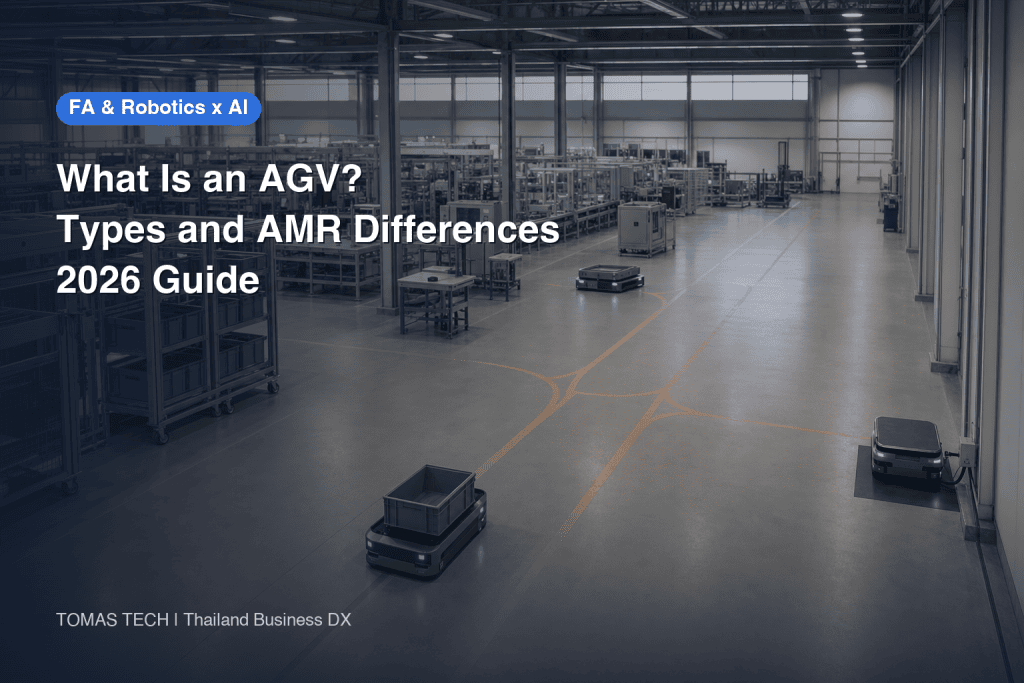
The moment a conversation turns to automating material flow inside a plant, the first term on the table is almost always AGV. Yet surprisingly few people on the shop floor can state precisely what an AGV is, and studies routinely move forward with AGV, AMR and AGF blurred into one another. This article works through the subject one layer at a time in the context of factories in Thailand and ASEAN — the definition, the difference against AMRs, the classification by guidance method and by body type, the safety requirements set out in ISO 3691-4:2023, and how to judge which processes are worth automating in the first place.
What is an AGV | Getting the definition of an automated guided vehicle right
A vehicle that runs a predetermined route with no driver on board
AGV stands for Automated Guided Vehicle. The core of the definition is remarkably simple. It is a vehicle that carries a load along a fixed, predetermined route without a driver on board. It reads external references placed in the environment — magnetic tape stuck to the floor, a guide wire buried under it, QR code markers laid out across the floor surface — and traces the route it has been given.
The point worth holding onto is that an AGV moves not because it is clever, but because a path has been prepared for it. Put in human terms, it is less like a driver reading a map and picking the shortest route, and more like a worker walking carefully along a painted line without stepping off it. That single characteristic explains everything that follows — the difference against AMRs, the weakness in the face of layout change, and, on the other side of the ledger, the high positioning accuracy.
How the term gets used loosely in practice
In everyday plant conversation, “driverless transport vehicle” and “automated guided vehicle” are used far more loosely than the standard definition allows. Plenty of sites use AGV as an umbrella term that also covers AMRs (autonomous mobile robots) and automated forklifts (AGFs). Which scope the person across the table has in mind is worth settling early in a study, not late. Discovering after the specification is frozen that what they actually pictured was a forklift can send you back to the floor construction plan.
Differences that come from the shape of the vehicle body are also covered in our article on automated forklifts and why deployments stall at pallets and drop points rather than travel. For this article at least, AGV is used in the narrow sense of a driverless transport vehicle that runs a fixed route.
What an AGV takes over is the distance between processes
What an AGV replaces is not machining, not assembly and not inspection. It is the distance that sits between one process and the next. Break down the work on a production floor and movement takes a larger share than most people expect — fetching material, carrying finished parts to the next process, returning empty containers. None of it adds a single unit of value to the product, while all of it reliably generates cost and risk in the form of walking time, forklift fuel and traffic conflicts in the aisles.
The value of deploying an AGV lies in shifting that non-value-adding movement from people to machines. Read the other way, in processes where there is little movement to begin with, or where every movement requires a judgement call or a visual check, an AGV delivers limited benefit. How to make that call is covered in the second half of this article.
The decisive gap against manual transport is variability
The biggest difference between a person pushing a trolley and an AGV doing the same job is not speed. Over a simple straight run, the person is often faster. The difference shows up in variability. Manual transport arrives at a time that shifts with how busy the day is, how experienced the operator is, and what else is competing for their attention. An AGV runs the same route at the same speed, so the spread of arrival times collapses.
That absence of variation is what removes work-in-process inventory from the downstream process. There is no longer any reason to keep two hours of buffer stock on hand as insurance against a late delivery. Measure the benefit of an AGV in labour cost alone and this inventory reduction drops straight out of the calculation. The structure in which transport stability, rather than transport volume, is where the value sits ties directly into the fleet-sizing logic covered in AGV layout design and why fleet size is not set by throughput.
AGV vs AMR | Is the route handed to the vehicle, or chosen by it

AGVs trace, AMRs think
The difference between an AGV and an AMR comes down to one question — who decides the travel route. An AGV follows a fixed route defined by magnetic tape, a guide wire or QR codes. The route lives in the facility, and the vehicle traces it faithfully. An AMR, by contrast, uses LiDAR, cameras and SLAM to recognise its surroundings autonomously, avoids obstacles automatically, and selects the best route available at that moment. The route is generated inside the vehicle.
You can see the difference just by watching them run. Put a trolley in the aisle, and the AGV, unable to leave its reference markers, stops short and waits. The AMR detects the obstacle, computes a detour and drives past it. Neither behaviour is correct or incorrect. They are two different design philosophies.
Response to layout change is where the gap is widest
The difference that bites hardest once a system is in operation is the cost of responding to layout change. For fixed-path AGVs that follow floor markers, changing a route means physical work — relaying magnetic tape, re-running a guide wire. Even a change of a few metres generates site work, and transport on that section stops while it is under way.
An AMR handles a layout change with a map update. Nothing on the floor is touched. In plants where lines are reconfigured frequently, or in warehouses where storage locations shift with seasonal demand, that difference shows up directly in operating cost. Conversely, on a volume production line whose layout will not move over a five-year horizon, there is little reason to pay for that flexibility.
On accuracy and repeatability, the AGV has the edge
Against that, the AGV has a strength of its own — it is purpose-built to travel a defined route precisely. Wherever the vehicle has to stop at the same position in the same orientation every single time, positioning repeatability drives productivity directly. Automatic handover to fixed equipment, docking with the inbound and outbound stations of an automated storage system and feeding a machine tool during a changeover are all cases in point.
Autonomous navigation buys the freedom to change route on the fly, and pays for it with a small amount of play in where the vehicle finally stops. Most AMRs correct the final position against a docking marker, but in a process built on the premise of always travelling the same path in the same order, simply fixing the route makes the whole design simpler. And a simple design is far easier to troubleshoot when something goes wrong.
Setting the two side by side
| Aspect | AGV (automated guided vehicle) | AMR (autonomous mobile robot) |
|---|---|---|
| Who sets the route | The facility (markers on the floor) | The vehicle (autonomous decision) |
| Main guidance means | Magnetic tape, guide wire, QR codes | LiDAR, cameras, SLAM |
| Response to an obstacle | Stops short and waits | Avoids automatically and detours |
| Layout change | Physically relay the floor markers | Handled by a map update |
| Best-suited environment | Volume lines with fixed paths, scheduled milk runs | High-mix floors with changing paths, warehouse picking support |
| Positioning repeatability | High | Depends on the correction mechanism |
| Environment preparation | Floor markers must be installed (fixed-path and grid-control types) | No markers needed, but the environment needs features |
Neither one is simply a better version of the other
Because AMRs are the newer technology, they are often taken to be a strict upgrade of AGVs. In practice they are not. The deciding factor is not how new the technology is, but how much the paths inside that particular plant actually change. If the paths do not change, sticking markers to the floor once keeps both the vehicle unit price and the control complexity down. If the paths do change, absorbing that with map updates costs less than repeating floor work.
Plenty of plants run both. The trunk route from the warehouse to the production building goes to AGVs, while variable routes inside the production building go to AMRs. The selection logic and the cost comparison are covered in detail in AGV implementation in Thai factories with cost and AMR comparison.
AGV guidance methods | Fixed-path, free-ranging and grid control
Guidance methods split into three families
What determines how an AGV travels is the guidance method, and these fall broadly into three classes — fixed-path, free-ranging and grid control. This classification is independent of the shape of the vehicle body. The same under-ride body can be built to run on a fixed path or under grid control. Keeping these two axes separate during a study removes a lot of confusion.
Because this article treats an AGV in the narrow sense of a vehicle that runs along markers on the floor, only fixed-path and grid control fall inside that definition. Free-ranging guidance uses no floor markers at all, which places it outside the AGV definition and inside the boundary zone shared with AMR technology. All three are introduced here to give the complete picture of the classification, but note up front that vehicles using free-ranging guidance are usually called AMRs in practice.
Fixed-path guidance | Laying a road on the floor
Fixed-path guidance means travelling along a marker installed on or below the floor surface. The common variants are magnetic guidance, where a sensor follows tape stuck to the floor; inductive guidance, where current runs through a wire buried under the floor and the vehicle detects the magnetic field; and optical guidance, where an optical sensor reads reflective tape on the floor.
Magnetic guidance is comparatively easy to install and easy to change, since a route revision is handled by re-laying the tape. The trade-off is that the tape wears under vehicle traffic and trolley castors, so periodic inspection and replacement are part of the deal. On floors where forklifts share the same aisle, that wear progresses faster than most plans assume.
Inductive guidance buries the wire below the floor, which makes it resistant to wear and well suited to long-lived volume lines. The flip side is that installation is major construction work, and the cost of changing a route is the highest of the three. Optical guidance reads floor tape with light, so installation is easy, but the method is sensitive to dirt, oil, water and lighting conditions. Where in the plant the markers are laid can change the stability of the same method entirely.
Free-ranging guidance | Leaving the floor untouched
Free-ranging guidance carries no guidance markers on the floor. Variants include measuring the position of surrounding walls and columns with a laser, referencing markers on the ceiling or walls, and using SLAM to estimate the vehicle’s own position from the shape of the surroundings. As noted above, this method sits outside the narrow AGV definition used in this article and inside the boundary zone shared with AMR technology. It is covered here purely to complete the picture of guidance as a classification axis.
The advantage of free-ranging guidance is that it requires no floor work and copes easily with route changes. The corresponding risk is that, since position is derived from the surrounding environment, a change in that environment can leave the vehicle unable to locate itself. A corridor walled in identical panels with few distinguishing features, an area where temporary pallet storage changes the scenery daily, a location open to the outside where sunlight conditions swing widely — these are the environments free-ranging guidance handles worst.
Grid control | Dividing the floor into a lattice
Grid control divides the floor into a lattice and has the vehicle travel along that lattice while reading markers, typically QR codes, placed at the intersections. The markers are discrete points rather than continuous lines, and the vehicle confirms its current position at each intersection as it proceeds. Because the route is issued as a path-finding problem across the lattice rather than as a line, travel sequences can be changed without re-laying any tape, giving the method an intermediate character.
It pairs well with warehouse-style operations running many vehicles simultaneously, but the accuracy of the initial installation, specifically placing the lattice intersections precisely, matters a great deal. Markers also fail to read once they get dirty or start peeling, so a cleaning and inspection plan is required.
The choice of guidance method locks in the floor and the layout
The character of the three methods can be summarised as follows.
| Guidance method | Typical means | Floor work | Route change | Main risk |
|---|---|---|---|---|
| Fixed-path | Magnetic tape, inductive wire, optical tape | Required | Re-lay the markers | Tape wear, floor contamination |
| Free-ranging | Laser ranging, SLAM, marker referencing | Not required | Handled in software | Loss of self-localisation when the environment changes |
| Grid control | QR codes and similar lattice markers on the floor | Required (discrete points) | Handled by path-finding | Marker soiling, initial installation accuracy |
What matters most is that the choice of guidance method decides your future layout freedom in advance. The moment fixed-path guidance is selected, that plant’s transport routes become things that cost money to change. It happens often enough that the cheapest method at the time of purchase turns out to be the most expensive one when the line is reconfigured three years later. Confirming whether the layout is likely to move over the next three to five years is, in practice, the real entry point to selecting a guidance method. How the choice of method feeds through into the quoted price is worked through in AGV price and total cost, where the break-even against AMRs is set by how often the layout changes.
The three AGV body types | Under-ride, tow and conveyor

Classifying AGVs by body shape gives three broad types — under-ride, tow and conveyor. It becomes easier to grasp if you think of it as a difference in the interface with the load, in other words how the vehicle receives the load and how it hands it over.
Under-ride type (low-profile) | Slides under the trolley and lifts it
The under-ride type drives underneath a trolley carrying the load, lifts it and transports it. Keeping the body height low lets the vehicle slide under low trolleys such as castor-mounted pallets and lift them directly. In many cases existing trolleys can be used unchanged, and the fact that the load is never transferred between containers is a significant advantage.
The shop-floor effect that is easiest to see is that operators walk less. The route an operator previously covered pushing a trolley to the next process is taken over wholesale by the AGV. The operator completes their work within their own station, and the round trips between processes disappear.
Because the body is low and compact, aisle width constraints are comparatively relaxed, which is another practical advantage. That said, both lifting height and payload are limited, so the shape of the trolley legs, the position of the castors and the clearance to the floor decide whether a given specification will work. Planning around existing trolleys and then measuring on site to find the leg spacing is a few centimetres short is far from a rare form of rework.
Tow type | Couples multiple trolleys and moves volume
The tow type couples several trolleys, cages or pallets together and pulls them. It can move a large quantity per trip, which suits high-volume transport, long-distance transport and scheduled milk runs. It is the form most often adopted for automating trunk routes, running from one end of the plant to the other, or from the warehouse building to the production building.
What matters in tow type design is the turning envelope of the coupled train. Add a third and fourth trolley and the rear units cut inside the path taken by the tractor. Where a column or a piece of equipment sits on the inside of a curve, the tractor clears it while the last trolley makes contact. The number of trolleys coupled directly sets the aisle width required, so adding units is not a simple route to higher efficiency.
The tow type also pairs well with scheduled milk runs, which travel a fixed sequence at fixed times. Fix the route and the timetable the way a bus line does, and have each process load and unload at its stop, and the transport plan itself becomes far simpler.
Conveyor type (top transfer) | Hands over to equipment automatically
The conveyor type carries rollers or a conveyor mechanism on top of the vehicle, allowing loads to be transferred automatically to and from fixed equipment. Provide a roller conveyor at the same height at the destination, and the load moves from the equipment to the AGV and from the AGV to the next piece of equipment without a person touching it. It is the format suited to integration with line equipment and automated storage systems.
The value of this type lies not in automating transport but in automating the handover as well. With under-ride and tow types, the job of taking the load off the trolley usually remains with a person. The conveyor type eliminates that job outright. For unattended night-shift operation, or for processes where you want to reduce human entry into a clean environment, that difference is decisive.
In exchange, transfer equipment is needed at both the origin and the destination, and the list of prerequisites grows to include heights, conveyor speeds and standardised load presentation. The scope of automation widens, but because existing equipment has to be modified, the plan has to carry the cost of those modifications as well.
Comparing the three types
| Type | Interface with the load | Best-suited use | Main prerequisites |
|---|---|---|---|
| Under-ride (low-profile) | Drives under the trolley and lifts it | Inter-process transport, reducing operator walking | Leg geometry and clearance of existing trolleys |
| Tow | Couples and pulls multiple trolleys | High-volume transport, long distances, scheduled milk runs | Aisle width matching the coupled turning envelope |
| Conveyor (top transfer) | Automatic handover via top rollers | Integration with line equipment and automated storage | Transfer equipment at both origin and destination |
Type selection works backwards from how the load is presented
Which of the three types to choose is not settled by comparing vehicle catalogues. What settles it is how the load is presented. What is being moved, in what container, at what weight, and at what height it is handed over. Once those are fixed, the type is almost automatically narrowed down.
If you want to keep using existing castor trolleys, the under-ride type becomes the candidate. If you want to move a batch from one end of the plant to the other a few times a day, it is the tow type. If you want material to flow between machines without human intervention, it is the conveyor type. Try to pick a type while load presentation still varies from process to process, however, and every type will look like a half fit. In that situation the first task is not vehicle selection. It is standardising containers and load presentation.
AGV safety standards | What ISO 3691-4:2023 sets out
An international standard covering driverless industrial trucks
The international standard governing AGV safety is ISO 3691-4. A revised edition was published in June 2023, and it covers driverless industrial trucks in general — AGVs, AMRs, automated guided carts and driverless tractors alike. AGVs and AMRs tend to be discussed as separate things, so the fact that safety standards treat them within a single framework is worth registering early in a study.
The scope runs across the whole lifecycle, from design to maintenance
What characterises this standard is that it addresses hazards across the whole lifecycle of design, operation and maintenance, not just the design of the vehicle. The underlying assumption is that safety is not something completed by the specification at the time of purchase. It is established through how the operating area is laid out, the daily operating rules and the maintenance procedures as well.
The safety functions for which the standard defines required performance include personnel detection settings, operating modes and braking systems. On personnel detection, it is not enough that a sensor is fitted. What is examined is whether the configuration is appropriate — which zones are covered, at which speed ranges, and how detection is performed. Braking systems work the same way, where the practical focus is whether stopping distance is assured at the assumed load.
The annexes are where the practical value sits
ISO 3691-4:2023 includes normative guidance on preparing the operating area as Annex A, and a catalogue of significant hazards as Annex B. In day-to-day practice, these two annexes are the useful part.
The operating area preparation covered by Annex A overlaps almost exactly with the reasons AGV deployments fail. Aisle widths, intersections, overlap with pedestrian routes, floor condition, and the interface with doors and shutters. None of these have anything to do with vehicle performance, yet all of them determine accident risk and stoppage frequency, and all of them are heavily constrained in an existing plant. The Annex B hazard catalogue works as a checklist for spotting the gaps in a risk assessment.
Know what falls outside the scope
The scope of the standard also states clearly what is excluded. Trucks guided solely by mechanical means such as rails, and trucks under remote control only, are outside the scope. The reasoning is that neither is regarded as driverless.
That boundary matters in practice too. Under the single umbrella of equipment that moves without a driver sits a mix of things that do and do not fall under this standard. Start a discussion of safety requirements without first confirming whether the vehicle in question is genuinely driverless, and the conversation proceeds with the required level of safety functionality misaligned from the outset.
A key harmonised standard for CE marking work
ISO 3691-4:2023 is also positioned as an important harmonised standard in the practical work of obtaining CE marking. For plants supplying product into Europe, or Japanese-owned sites that have to align with a European parent company’s safety standards, conformity to this standard can become a procurement condition.
There is a practical reason to reference the standard when deploying AGVs in a Thai plant as well. Regardless of whether a legal obligation applies, situations genuinely arise in a head office safety audit, an insurer’s risk assessment or a customer audit where you will be asked which standard the safety design was based on. We recommend confirming during vendor selection whether the supplier can produce documentation evidencing conformity. Concrete approaches to safety measures and vendor selection are also covered in AGV implementation in Thai factories with cost and AMR comparison.
How to judge which processes are worth an AGV

Processes where the benefit lands share a set of traits
Processes where an AGV delivers real benefit tend to share several characteristics. Read the other way, in processes where these do not apply, no amount of additional vehicle performance will produce a result.
- Transport distances are long, or the number of round trips is high, so total travel time is significant
- Transport routes and destinations are fixed and do not change substantially from day to day
- Load presentation is standardised, or there is room to standardise it
- No human judgement or visual check is required part way through the transport
- Late transport causes the downstream process to wait, or forces work-in-process inventory to be held
Conversely, processes where the destination changes each time, where load presentation varies, or where quantity and appearance are being checked during the move, need the process itself tidied up before automation. That is not a question of technical difficulty. It is a question of the work not yet being defined well enough to automate.
Do not get the sequence of the study wrong
The sequence of the study also shapes the outcome. In practice, following this order reduces rework.
| Stage | What to confirm | What it decides |
|---|---|---|
| Stage 1 | Measured transport distances, trip counts, cycle times and staffing today | Whether there is enough transport volume to be worth automating |
| Stage 2 | State of load and container standardisation, handover height and method | Which of the three body types applies (under-ride, tow, conveyor) |
| Stage 3 | Expected layout changes over three to five years, aisle and floor condition | The guidance method, and AGV versus AMR |
| Stage 4 | Overlap with pedestrian routes, intersections, doors, safety requirements | Safety design, operating rules and the scope of construction |
Most studies come unstuck by skipping Stage 1 and starting at Stage 2. Select a vehicle without measured transport volume and the justification for the investment never rises above the fact that other companies are doing it. On fleet sizing, AGV layout design and why fleet size is not set by throughput sets out in detail why transport volume alone does not determine how many vehicles you need.
Look at the drop point before you look at the move
Another point worth holding onto is that the reason an AGV stops on the floor lies more often in where the load is put down than in the travel section itself. The destination location was full, the previous load had not yet been collected, another trolley was sitting in the designated spot. None of these are travel system faults. They are problems in how the drop point is operated.
An AGV can only place a load in a defined position in a defined orientation. A person can decide that the space next door is free today and use it instead. An AGV has no such latitude. Deploy while the rules for the drop points are still vague, and you create a situation where transport stops even though the vehicle is working perfectly. Fixing the position, capacity and full-condition handling of each drop point before deployment is as important as vehicle selection, and often more so.
Starting in stages is a legitimate option
There is no requirement to automate all transport at once. Starting with a single route where the benefit is easy to read, confirming transport time and utilisation against real data, and then widening the scope, tends to get you there faster in the end. That staged approach is also a general principle when studying automation across a whole plant, and is set out as a sequencing question in factory automation across Southeast Asia and the Thailand roadmap.
Cost is deliberately left outside the scope of this article. What is spent on vehicles, floor work, system integration and safety measures varies enormously with plant conditions. For how to think about the total and its breakdown, see AGV price and total cost, where the break-even against AMRs is set by how often the layout changes.
Market trends in Thailand and ASEAN, and the BOI context
The Southeast Asian robot market is in an expansion phase
The Southeast Asian market for industrial and service robots is put at 4.8 billion US dollars as of 2026 and is forecast to expand to 19.27 billion US dollars by 2035. The compound annual growth rate is 16.70%. One of the factors cited as driving that growth is the incentive regime operated by Thailand’s BOI (Board of Investment), which is accelerating robot adoption.
A forecast of roughly fourfold growth over the nine years from 2026 to 2035 is fast by the standards of capital equipment sectors. That said, the figure describes the market as a whole and says nothing about the pace of adoption at any individual plant. What should be read out of it is that transport automation, AGVs included, is still a technology area part way through its adoption curve. Not everyone around you has finished deploying, and it is not the case that nobody is using it either.
Asia Pacific is the fastest-growing region in the AGV market
Narrowing to AGVs specifically, Asia Pacific is expected to be the fastest-growing region. The drivers behind that are advancing industrialisation, the expansion of manufacturing bases, and rising demand from e-commerce and warehouse automation.
There are two practical implications for a plant in Thailand. The first is that as deployment cases increase within the region, vendor support structures and parts supply become easier to secure. The second is that in a period where securing labour is becoming structurally harder, automating transport becomes a more realistic option to put on the table.
How to handle the BOI dimension
Given that BOI incentives are cited as one of the factors accelerating robot adoption in Thailand, there is real value in confirming whether the scheme applies early in the investment planning process. The point to watch particularly is that incentive requirements can influence equipment selection. Check the scheme after the specification and the supplier are locked in, and re-selecting to fit the conditions is effectively impossible.
How to approach automation investment in Thailand including BOI is covered in factory automation across Southeast Asia and the Thailand roadmap. Detailed scheme conditions are revised from time to time, so confirm the latest official information before making an actual application.
Market trends do not decide the deployment call
The fact that a market is growing is not a reason for your company to deploy now. What informs the decision is your own plant’s transport volume, the stability of its routes, load presentation, drop points and safety requirements. What the market data tells you amounts to roughly this — deferring the decision does not reduce your options, but the gap against the plants around you keeps widening.
Frequently asked questions
Should we choose an AGV or an AMR?
The deciding factor is not how new the technology is but how much the layout and the routes change. If routes are fixed and unlikely to change substantially, an AGV that follows markers laid on the floor gives you a simpler configuration and better positioning repeatability. If you run high-mix low-volume work with destinations that change frequently, or storage locations that move seasonally, the flexibility of an AMR handling route changes through a map update is what pays. Running AGVs on trunk routes and AMRs on variable routes within the same plant is also a realistic configuration.
What price range should we expect for an AGV?
This article deliberately avoids stating a price. The total cost of an AGV is not set by the vehicle unit price alone, because floor work matched to the guidance method, integration development against upper-level systems, safety measures and drop point preparation all get added on top. Even for the same vehicle, the make-up of the total differs substantially between a fixed-path deployment involving floor work and a free-ranging deployment requiring none. The cost breakdown and how to think about it are set out in AGV price and total cost, where the break-even against AMRs is set by how often the layout changes.
Is a driverless transport vehicle the same thing as an AGV?
The everyday term “driverless transport vehicle” is generally used as a synonym for AGV, but in practice it is often stretched to cover AMRs and automated forklifts (AGFs) too. This article distinguishes between AGVs, which travel along a fixed route, and AMRs, which recognise their environment and decide routes autonomously. In a meeting, aligning on the scope the other party means when they say driverless transport vehicle, right at the start, prevents specification mismatches later.
How should the types of AGV be classified?
There are two axes. The first is guidance method, which splits into fixed-path, free-ranging and grid control. The second is body shape, where under-ride, tow and conveyor types are the representative forms. The two axes are independent, so combinations such as a fixed-path tow type or a grid-control under-ride type all exist. Putting into words which combination your operation actually needs, before you start comparing catalogues, makes selection go considerably faster.
How do we choose between under-ride, tow and conveyor types?
Work backwards from load presentation and handover method. If you want to keep using existing castor trolleys and cut operator walking distance, it is the under-ride type. If you want to couple several trolleys and move volume over long distances or on a scheduled milk run, the tow type suits. If you want loads handed between line equipment or an automated storage system without human intervention, it is the conveyor type. Where the choice is genuinely close, deciding first who loads and unloads the goods and how, rather than debating the transport itself, narrows the type down naturally.
Summary
An AGV is a transport vehicle that carries loads without a driver along a fixed route defined by magnetic tape, a guide wire or QR codes — a driverless transport vehicle in the strict sense. The fact that the route belongs to the facility rather than the vehicle produces both its strength, positioning repeatability, and its weakness, vulnerability to layout change. An AMR, by contrast, recognises its environment autonomously through LiDAR, cameras and SLAM, travels flexible routes while avoiding obstacles, and absorbs a layout change through a map update alone.
The classification resolves onto two axes. Guidance method gives three families, fixed-path, free-ranging and grid control. Body shape gives three more — the under-ride type that drives under a trolley and lifts it, the tow type that couples multiple trolleys for high-volume, long-distance and scheduled milk run work, and the conveyor type that hands loads to and from fixed equipment using top-mounted rollers. Separating those two axes is the piece of thinking to do before you start comparing catalogues.
On safety, ISO 3691-4:2023 is the central standard. It treats AGVs and AMRs within the same driverless industrial truck framework and covers hazards across the whole lifecycle from design through to maintenance. On the market side, the Southeast Asian industrial and service robot market is forecast to expand from 4.8 billion US dollars in 2026 to 19.27 billion US dollars in 2035 at an annual average of 16.70%, and Asia Pacific is expected to be the fastest-growing region in the AGV market. What decides your deployment, however, is not market trends but your own transport volume, route stability, load presentation and drop point operation.
An AGV study moves faster when it starts by putting numbers on what you move today, how much of it, and along which routes, rather than by collecting vehicle catalogues. It is perfectly fine to be at the concept stage with neither model nor method decided, or to be unsure whether your transport is suited to automation at all. A conversation about your current line configuration and the transport issues you are seeing is a perfectly good starting point — please get in touch via our contact page.
References
- AGV and AMR Explained – Differences, How to Choose, Major Manufacturers and Deployment Costs, 2026 Edition – AINOW
- What Are AGVs and AMRs – Differences and Guidance Methods, the Basics of Driverless Transport Robots – Sharp
- Under-Ride Tow Type – AGV Navi, Meidensha
- What Types of AGV Are There – Kanaden
- Types of AGV Explained, and the Difference Between Optical and Magnetic Guidance – Ricoh
- ISO 3691-4:2023 Industrial trucks – Safety requirements and verification – ISO
- ISO 3691-4:2023 Compliance Testing for Automated Guided Vehicles (AGVs) – Applus+ Laboratories
- ISO 3691-4 – Updated edition published – Pilz
- Southeast Asia Industrial and Service Robot Market – MarkWide Research
- Asia Pacific Automated Guided Vehicle (AGV) Market – MarketsandMarkets


