


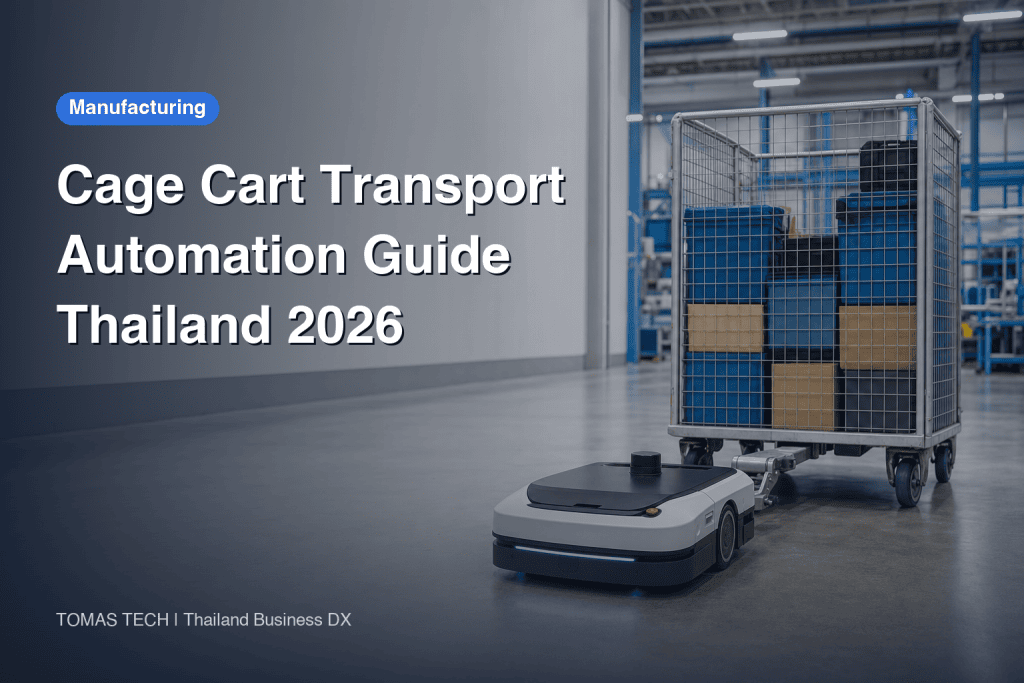
In Japanese-owned factories in Thailand, kanban parts supply and inter-process transport are, in many cases, handled not by forklifts or standard trolleys but by wire-mesh “cage carts” — also known as roll containers, with open mesh sides. Once you start looking into automating cage cart transport, you quickly land on AGV manufacturer catalogs and past case studies, but what they cover is “trolleys in general,” with little that digs into issues specific to cage carts. This article narrows the scope to cage carts alone and lays out the points you need to settle before considering automation.
What Automating Cage Cart Transport Means — and Why It Differs from “AGVs in General”
A cage cart is a trolley with mesh wire or pipe-frame sides, used to move parts bins or containers between processes without unloading them. Because the contents stay visible, cage carts pair well with visual kanban management, and being able to hand a cart straight to the next process without repacking has made them a shop-floor favorite. Unlike a flat trolley, though, a cage cart’s caster structure, whether it has coupling hardware, and its mesh — which is an open structure — all introduce constraints specific to pairing it with an AGV (automated guided vehicle) or AMR (autonomous mobile robot).
We covered the fundamentals of AGVs in general — how they work and the basics of deciding whether to introduce them — in our earlier post What Is an AGV? The Basics. That article treated the transport vehicle itself as the subject, without distinguishing whether the trolley being moved was a cage cart, a flat trolley, or a pallet. In practice, though, the cage cart’s own specifications — what you’re moving and how you’ll tow it — need to be settled before you can even meaningfully choose an AGV, or the selection process stalls. Is the AGV’s body narrow enough to slide underneath? Do the casters lock during towing? Is there coupling hardware to link carts into a train? None of this is answered by an AGV catalog — you have to look at the cage cart’s own spec sheet.
In other words, “automating cage cart transport” is, before it’s a question of choosing an AGV product, a question of taking stock of the cage carts you already have and the rules you operate them under. Skip this step and go straight to an AGV vendor, and you’re likely to end up redoing the selection once the actual hardware is brought in.
In real-world consultations, the material a manager brings to the first meeting is often a “shortlist of AGV candidates.” Narrowing candidates is necessary work in itself, but it’s rarer than you’d expect for a company to already have a full inventory of how many types of cage carts it owns, and each one’s width, weight, and caster spec. It’s not unusual for a factory to have cage carts of different specs mixed together depending on the parts supplier, or for caster construction to vary subtly by purchase year. If you order based purely on the AGV’s spec sheet, you often discover mismatches only once you bring the actual cart in — “this AGV can’t slide under this cart,” “this caster can’t lock while being towed” — and end up redoing the selection. Taking inventory of your cage carts is unglamorous work, but it’s a step you shouldn’t skip as the starting point for any automation study.
It’s also worth noting that many people researching cage cart automation start with broader search terms like “trolley automated transport” or “line feeding automation.” Much of what turns up under those searches treats pallets, flat trolleys, or the AGV/AMR product category itself as the subject, with limited practical coverage of issues specific to a cage cart’s mesh structure and caster spec. This article is meant to fill that gap — deliberately narrowing the focus to cage carts alone.
Three Independent Issues Hidden in Cage Cart Transport
When considering cage cart automation, it helps to break the issues into three: towing, loading/unloading, and detecting load shift or falling items. These three are independent of each other — solving one does not automatically solve the other two.
The first is towing. Whether you tow cage carts one at a time by sliding underneath them, or couple several into a train, changes both the AGV’s required structure and its cost significantly. The second is loading and unloading — the operational design of who loads and unloads the cage cart, and where. Even if the AGV can transport carts automatically, it’s common for the loading and unloading steps, which still require manual labor, to remain a bottleneck. The third is detecting load shift or falling items. Because a cage cart’s sides are mesh, camera-based image recognition struggles to catch subtle shifts in the contents or early signs of load collapse, and the AGV’s obstacle sensors — while able to detect obstacles along the route — don’t monitor the condition of the load on the cart it’s towing.
Many studies end up focusing solely on the towing question — “how many AGVs should we introduce” — and if loading/unloading and load-shift detection get pushed aside, the result after automation is often that people still end up stationed next to the cage cart, and the expected labor savings never materialize. It’s important to separate these three issues early and decide upfront how much of each you intend to solve with this investment.
Let’s look more closely at the loading/unloading issue. Even if an AGV can automatically move a cage cart from Process A to Process B, in many plants the work of loading parts onto the cart at Process A and unloading them at Process B still relies on manual labor. Unless you work out operational details in advance — setting up a stocker at the loading point to enforce first-in-first-out handling, or fixing the unloading point at a set spot beside the line — you’ll end up with the AGV arriving and workers waiting around the cart, and the time savings from automating the transport leg get offset by wait time for loading and unloading. It’s worth keeping in mind that automating the transport itself and shortening the overall process lead time, including loading and unloading, are not necessarily the same thing.
A note on detecting load shift and dropped items as well. With pallet transport, where loads are wrapped and secured, some vibration poses limited risk of shifting. With a cage cart, however, parts bins are often simply stacked without securing during loading, so vibration or sudden turns while moving can shift the load’s position, and in the worst case, parts can fall through gaps in the mesh. Detecting this with AGV sensors alone isn’t realistic; deciding on securing methods and load-height rules at the operational level, at the point of loading, is a more practical countermeasure than expecting too much from sensors.
Underride vs. Train-Type: The Difference and How to Choose
Cage cart towing methods broadly fall into two types: “underride” and “train (towing).”
In the underride type, the AGV body slides beneath the cage cart and either lifts it or couples to it for towing. As a domestic example, Sharp’s slim AGV (TYPE S) has a body just 400mm wide, and is said to be able to slide underneath and tow cage carts 850mm or wider. It supports cage carts 950–1,100mm wide as standard, with a rated load and underride towing capacity of 200kg each, a top speed of 40m/min, and magnetic guidance. This product has a published track record of automatically transporting products and materials at Kyocera’s Nagano Okaya plant. Since one AGV handles one cage cart, control per transport unit is simple, but moving multiple cage carts at once requires a proportionate number of AGVs.
The train type has a single AGV couple multiple cage carts into a line and tow them together; in English this is called a tugger AGV or towing AGV. According to MasterMover, some tugger AGV products support loads of up to 44,000 lbs, with automotive-industry cart trains typically around 4,400 lbs and aerospace or heavy-machinery configurations sometimes exceeding 22,000 lbs. One logistics case study reports moving “five times as many cage carts in a single run” compared to a traditional forklift operation. Coupling comes in two forms — manual coupling using a tow pin or ball hitch, and auto-couplers that engage and disengage automatically — and guidance methods are similarly split between natural feature navigation, which lets you change routes flexibly without laying floor infrastructure, and line-following, which has lower upfront cost but requires ongoing maintenance.
Which to choose depends on whether you prioritize per-run transport volume or layout flexibility. One often-overlooked factor is aisle design freedom. The underride type only needs enough width for the AGV body plus one cage cart, but the train type requires checking whether the full length of the coupled train can clear curves and avoid conflicts with other transport vehicles or worker pathways at intersections. Where you can’t substantially change an existing factory layout, this aisle condition often becomes the practical constraint on whether a train type is even viable. The main differences are summarized below.
| Point | Underride Type | Train Type (Towing) |
|---|---|---|
| Transport unit | One AGV per cage cart | One AGV couples and moves multiple carts at once |
| Upfront cost trend | Scales up with unit count | Higher per-unit cost, but often more favorable per transport volume |
| Layout freedom | Needs aisle width for AGV to slide under a cart | Needs aisle length and curve radius for the full train |
| Main safety concern | Centered on the AGV body’s surrounding detection | Blind spots between coupled carts (detailed in the next section) |
| Loading/unloading unit | One cart at a time | Often multiple carts together, though unloading points can be scattered |
As a rough guideline: if you operate few cage carts with varied destinations for inter-process transport, the underride type tends to fit; if you’re moving a large batch of cage carts along a fixed route for kanban supply, the train type tends to fit. When comparing the two approaches, it’s worth cross-checking each manufacturer’s strengths, as covered in our AGV Manufacturer Comparison, to avoid gaps in your selection process.
The two approaches also aren’t mutually exclusive — some factories mix them. For example, you might run your main parts-supply route with a train type for bulk transport, while handling low-volume, high-mix emergency deliveries or irregular inter-process moves individually with underride-type AGVs. Trying to force everything into a single approach often means stretching one method to cover transport patterns it isn’t well suited for, which can lead to over-specifying the AGV. It’s worth mapping out your transport patterns and including a mixed approach among the options you consider.

The Safety Blind Spot Unique to Train-Type Systems
The train type’s appeal is its efficiency in moving cage carts in bulk, but it comes with a safety issue that’s easy to overlook. According to AGVnetwork, tugger AGV trains have a safety scanner mounted on the front of the AGV body that stops the unit immediately if it detects an obstacle — but no safety system whatsoever exists between the coupled carts themselves. In other words, while the lead AGV can react to obstacles, the second cart onward, and the area around the coupling points, fall entirely outside what any sensor covers.
One mitigation discussed is fitting the tow hitch with a load-sensing dynamometer, but AGVnetwork also notes that this can be unreliable, since load fluctuations spike during starts and restarts. Braking distance also varies with load weight, travel speed, and floor condition, so the longer the train, the harder it becomes to predict stopping behavior — something that shouldn’t be ignored.
The maintenance burden that comes with different guidance methods is also worth weighing alongside this blind-spot issue. Line-following, which lays magnetic tape or a magnetic guide on the floor, tends to keep upfront costs low but brings ongoing maintenance work, such as dealing with tape wear or contamination. Natural feature navigation, on the other hand, requires no floor infrastructure and adapts flexibly to route changes, but changes in the surrounding environment — such as relocated shelving or newly installed equipment — can affect sensor recognition accuracy, requiring its own kind of environmental management after go-live. When considering a train type, it’s worth checking not only the coupling-point safety measures but also whether your chosen guidance method matches how often your environment actually changes.
This blind spot matters especially when towing coupled cage carts. Because cage carts are open on the sides with mesh, unlike a flat trolley or pallet with a fully enclosed load, it’s possible for part of the load to protrude, or for a person to try to slip through a gap between coupled carts. The same mesh structure that lets contents be seen from outside — a benefit for visual kanban checks — also creates safety risks: loads are more prone to protruding, and gaps are more accessible to hands or bodies. A situation where only the lead AGV reacts safely while everything from the second cart onward is essentially unguarded calls for more careful consideration when combined with a cage cart’s open structure than it would with a conventional, fully enclosed cart train.
A practical way to address this blind spot is to supplement sensor technology with operational rules rather than relying on sensors alone. Measures worth combining include clearly marking where workers may and may not cross alongside a coupled train, restricting crossing traffic during the time windows when the train passes, and having the person loading the cart visually confirm there’s no protruding load before dispatch. None of these require changes to sensors or AGV specifications — they’re all measures that can be handled operationally. Conversely, if you choose a train type on the assumption that “introducing an AGV automatically makes things safe” without setting these operational rules, the blind spot at the coupling points remains a real risk on the shop floor.
Safety requirements for unmanned industrial vehicles in general are covered by the international standard ISO 3691-4:2023, which lists AGVs, AMRs, automated guided carts, and tugger applications side by side, and lays out a framework assigning responsibility among manufacturers, system integrators, and users. The 2023 edition is the second edition, superseding the 2020 version. We’ve already covered this standard in our AGV Layout Design and AGV Manufacturer Comparison articles, so rather than repeat a general overview here, we’re focusing specifically on the issue unique to train operation — how to address the coupling-point blind spot. Even though the standard lays out a framework for dividing responsibility among the three parties, in practice the concrete question of how to implement coupling-point monitoring is left largely to each site’s own layout and operational rules.

Cost Estimates and How to Think About ROI
To get a sense of cost, let’s look at figures from public sources. According to AGVnetwork, electric tugger AGVs are typically priced in the $20,000–$120,000 range, with ROI (return on investment) usually taking 18–24 months, shrinking to 12–15 months under two-shift operation. MasterMover’s figures show ROI of 200% over three years under two-shift operation, rising to 649% over five years under three-shift operation. Here, ROI is the ratio of cumulative net benefit to investment — the larger the number, the greater the payoff relative to the investment.
These figures can’t be applied directly to your own operation, but let’s run through one rough calculation to get a sense of scale. Assume, out of AGVnetwork’s $20,000–$120,000 price range, a small-to-midsize configuration coupling a handful of cage carts, with an upfront investment of $60,000. Applying MasterMover’s two-shift ROI of 200% over three years to this assumption, the three-year cumulative net benefit works out to twice the investment, or $120,000; assuming the benefit accrues evenly over three years, that’s $40,000 in annual net benefit. Dividing the $60,000 investment by that annual figure gives a payback period of roughly 1.5 years, or about 18 months. Compared against AGVnetwork’s 12–15-month payback estimate for two-shift operation, this comes out somewhat longer, but it lands in the same order of magnitude — roughly one to one-and-a-half years — so given how much the result depends on the assumptions, it’s not a wildly off estimate.
That said, this is only a rough calculation built on assumed figures from public sources, and the actual payback period will vary substantially depending on the number of units introduced, the coupling method (manual coupling or auto-coupler), the guidance method (natural feature navigation or line-following), and how much of your existing cage cart fleet you can reuse as-is. At the early stage of considering an introduction, it’s realistic to use a rough estimate like this to get a sense of the order of magnitude, then request specific quotes from multiple manufacturers or integrators. For more on how to think about cost-effectiveness and the overall introduction process, see our article How to Approach AGV Introduction and Costs in Thailand.
It’s also worth flagging that the number of operating shifts has a bigger impact on ROI than it might first appear. Looking at MasterMover’s figures, ROI goes from 200% over three years under two-shift operation to 649% over five years under three-shift operation. This isn’t simply a matter of more operating hours — it’s likely because unmanned transport, which can run around the clock, can cover late-night and break-time operation that’s hard to staff with human transport. The flip side is that introducing a train-type AGV into a process with only single-shift operation and low utilization is likely to push the payback period well beyond what’s calculated here. Checking your own shift count and the actual utilization rate of the target process beforehand is essential to avoid overly optimistic expectations.
Background at Thai Factories — Labor Shortages and Rising Wages
Cage cart transport automation is being considered at Japanese-owned factories in Thailand for structural reasons that go beyond simple labor savings. According to JETRO, Thailand’s working-age population has already entered a declining phase, and the resulting labor shortage is producing a cost-push type of inflation, where wages keep rising even without strong economic growth. University enrollment rates have also passed 50%, and young people are increasingly avoiding manufacturing floor work, making it harder for manufacturers to hire and retain young talent — and, by extension, to pass down skills. Under these conditions, the outlook suggests that securing the workforce a company needs will only get harder unless automation and digitalization of simple tasks progresses.
Parts supply and inter-process transport using cage carts are exactly the kind of work that tends to get classified as “simple work.” Traveling a fixed route on a fixed schedule is work that even inexperienced workers can handle, but it’s also the kind of repetitive task that tends to drive high turnover. It’s probably closer to reality to position cage cart automation not as eliminating transport staff entirely, but as a way to redirect a limited workforce toward higher-value work like inspection and handling exceptions.
From the standpoint of overall logistics efficiency, research on milk-run logistics in Thailand is also worth referencing. Studies report that even under congested traffic conditions, introducing milk-run logistics — a system of circulating among multiple delivery points or processes to collect and deliver parts in a single consolidated run — allows full control over the procurement process, reducing the number of trucks dispatched and easing traffic conditions. The same logic applies to inter-process transport inside a factory: putting cage carts on a circulating route and automating it can improve overall factory flow, not just the efficiency of a single transport leg.
These two backdrops — the labor-supply side factor of labor shortages and rising wages, and the operational-side factor of standardizing the procurement process, as seen in milk-run logistics — complement each other. The tighter labor gets, the greater the need to automate transport work that circulates a fixed route at a fixed frequency, but if the route itself remains ad hoc, automating it will have limited effect. Standardizing routes and frequency with a milk-run-style approach in advance is itself a prerequisite that feeds into cage cart automation. Conversely, if transport routes keep changing case by case and frequency stays irregular, there may still be situations even after introducing an AGV where flexible human-driven transport is more nimble. It’s worth checking how far you can standardize routes and frequency before automating, alongside everything else.
Items to Settle on Paper Before You Place an Order
Before consulting a manufacturer or integrator about automating cage cart transport, we recommend reaching internal agreement on the following items and writing them down. If these stay ambiguous going into a consultation, quote assumptions won’t line up, making it harder to compare proposals.
Writing things down on paper carries more weight than simply serving as a memo. Verbal requests tend to drift slightly in nuance as they pass between departments, but documenting them lets manufacturing, purchasing, and health-and-safety staff share the same baseline assumptions. Items like cage cart specs or caster specs, which you can only really confirm by checking the physical hardware, are especially prone to gaps if you rely only on someone’s memory or word of mouth — keeping them in a written list is the surest way to avoid redoing work downstream.
- Whether to go with the underride type (one at a time) or the train type (coupled in a line)
- An inventory of your current cage carts’ width, height, weight, and caster specs
- Whether to standardize cage cart specs to match the AGV, or make the AGV side flexible enough to handle variation
- Whether the casters can lock while being towed
- Whether coupling hardware is present for forming a train, and whether you want manual coupling or an auto-coupler
- The operational flow for where and by whom loading and unloading is done
- The operational rules for how load shift or protruding loads are detected and who responds
- On-site confirmation of aisle width, curve radius, and whether the full train length can pass along the route
- Which guidance method you want — magnetic guidance, natural feature navigation, or line-following
- Your target payback period, and the shift count (two-shift or three-shift) behind that assumption
Of this list, “whether to standardize cage cart specs or make the AGV side flexible” is especially easy to overlook, but it’s the first wall a factory with multiple cage cart models hits. Standardizing specs simplifies the AGV design but incurs the cost of replacing existing cage carts. Making the AGV flexible instead lets you keep using existing cage carts as-is, but narrows your AGV options to the range of widths and weights it can handle. Deciding which is realistic for your company — by lining up the actual cage carts and checking them — will make the subsequent manufacturer selection go more smoothly.

Frequently Asked Questions
What’s the difference between automating trolley transport in general and automating cage carts specifically?
Flat trolleys and pallet trolleys usually have an enclosed load shape, which makes it comparatively easier for AGV sensors to gauge the condition of what’s being towed. A cage cart, by contrast, has open mesh sides, making it harder to detect load shift or protrusion. Even when researching trolley automation broadly, if the target is a cage cart, you’ll need to additionally check the towing method and coupling blind spots covered in this article.
Which method is better suited to line feeding automation?
For kanban supply that delivers a fixed quantity of parts to the line at a fixed time, the train type — which can move multiple cage carts together — tends to have an edge in transport efficiency. That said, if there are many lines with different destinations, the underride type, moving carts individually, can sometimes offer more flexibility. It’s worth mapping out your line feeding frequency and per-run transport volume to judge which pattern you’re closer to.
Where should we start with automating inter-process transport?
The standard approach is to start with a segment that has high transport volume and a fixed route. It also helps to decide upfront how much of the three issues — towing, loading/unloading, and load-shift detection — you intend to solve with this investment, which makes it easier to narrow the scope. Trying to automate transport across an entire factory all at once tends to surface individual constraints simultaneously — mismatched cage cart specs, insufficient aisle width — so it’s more realistic to pilot in a limited-impact segment, lock down the operational rules, and then expand from there.
Are tugger AGVs and towing AGVs the same thing?
Yes — “tugger AGV” and “towing AGV” are used essentially interchangeably. The terminology differs, but both refer to the same mechanism of coupling and towing multiple carts together.
What should we check for safety measures?
If you’re coupling carts into a train, be sure to check not just the safety scanner on the front of the AGV body, but also whether any safety system exists between the coupled carts. As covered in this article, a cage cart’s open structure makes this blind spot especially likely to become a real risk. It’s also worth adding to your selection checklist whether the manufacturer or integrator follows a safety standard for unmanned industrial vehicles, such as ISO 3691-4.
Can we keep using our existing cage carts as-is?
In some cases, yes, but it depends on constraints like the AGV’s underride width and caster structure. As with Sharp’s TYPE S covered in this article, it’s common for products to specify a defined range of compatible cage cart widths by manufacturer, so it’s essential to first inventory your existing cage cart specs and then check how many compatible AGV options exist. If no compatible product is found, options to consider include replacing the cage carts themselves, or replacing just the casters.
Summary
Automating cage cart transport comes down, before you even choose an AGV product, to deciding internally in advance how far you want to automate the three issues of towing, loading/unloading, and load-shift detection, and whether to standardize your cage cart specs or make the AGV side flexible. The underride and train types differ entirely in cost structure and risk — the train type is more efficient but has a blind spot where no safety system exists between coupled carts, and that blind spot matters even more with cage carts, given their open sides. Given the structural factors of labor shortages and rising wages in Thailand, the trend toward positioning cage cart automation as a substitute for simple transport labor is likely to continue, but sorting out specs and operational rules on paper before placing an order remains the surest way to avoid a detour.
To reiterate the position of this article: as long as cage cart transport automation is treated purely as a procurement question of “how many AGVs to buy,” rework on the shop floor is hard to avoid. Settle four decisions internally before consulting an AGV manufacturer — the towing method, the operational design for loading and unloading, your approach to load-shift detection, and which side (cage cart or AGV) you’ll standardize to. Having these settled means that when you collect quotes from multiple manufacturers, you can compare them fairly on a level footing, which in turn leads to an introduction with fewer detours.
Even at an early stage, before you’ve assembled a full inventory list of your cage carts or a layout diagram, you’re welcome to reach out just to discuss the thinking behind choosing a method. Feel free to contact us at any stage of your planning via our contact page.


