


Most people who start looking into shelf-carrying robots arrive with two things at once — a vague hope that installing them will fix a labour shortage, and a nagging uncertainty about how they actually differ from an AGV or an AMR. In practice, what decides the investment is neither the way the robot drives nor its newest feature. It is whether your own warehouse meets the conditions under which the idea of moving the shelf itself holds up. This article separates the terminology first, then sets out the decision criteria in the order that matters, weighing the reduction in walking time against the money that has to go into dedicated shelving.
What a shelf-carrying robot is, and how it differs from an AGV and an AMR
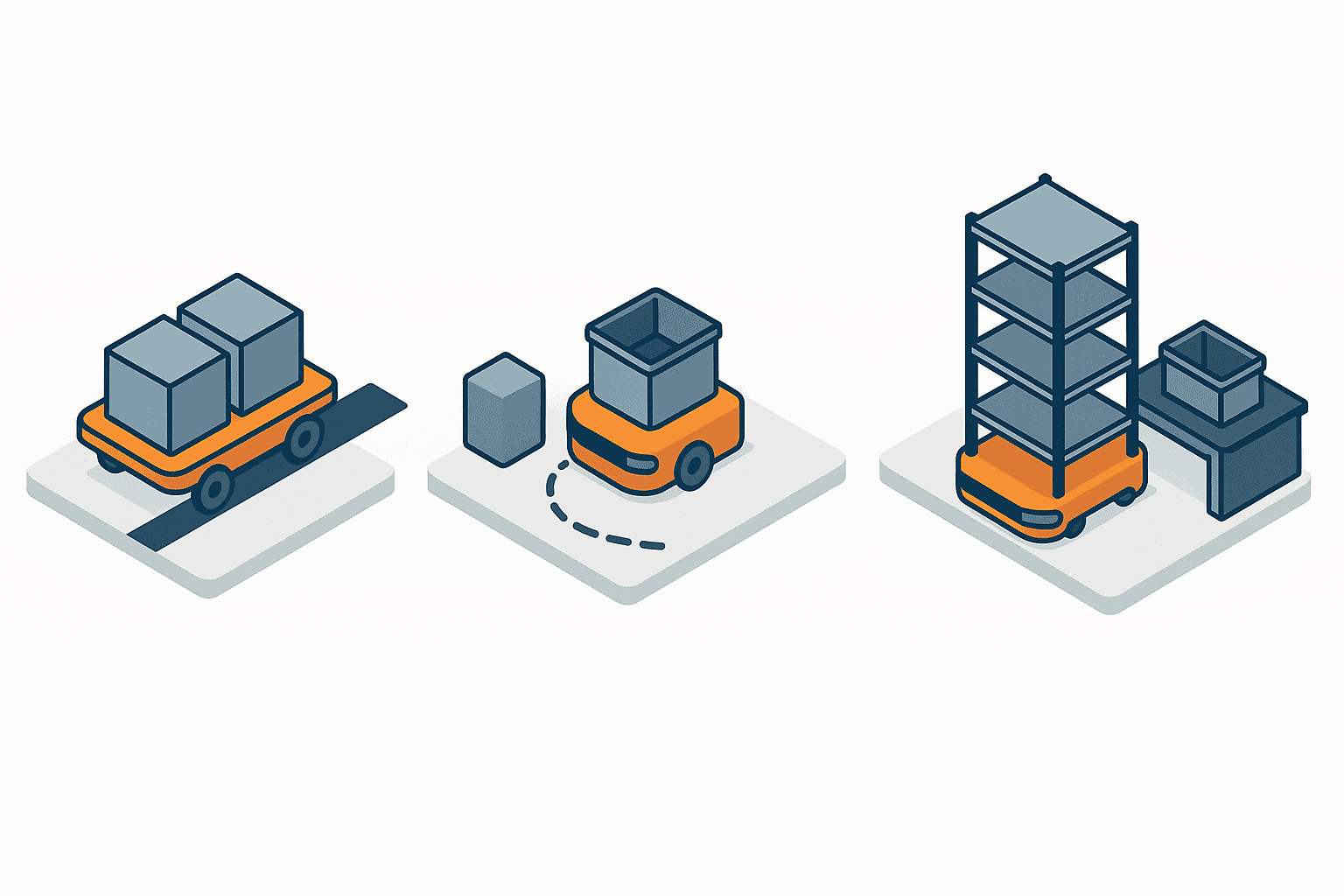
The first thing that derails a shelf-carrying robot project is not technical difficulty. It is the overlap between terms. The moment a company sets out to automate movement inside a warehouse or a plant, three words land on the shortlist at the same time — AGV, AMR and GTP. All three appear to describe the same thing, a cart that drives without a driver, so internal approval documents and requests for quotation tend to bundle them together. Yet they differ by an order of magnitude in investment, in the construction work they require, and in how painful it is to unwind them when the decision turns out to be wrong. Until you pull them apart, a comparison table is not actually comparing anything.
GTP replaces the person walking with the shelf moving
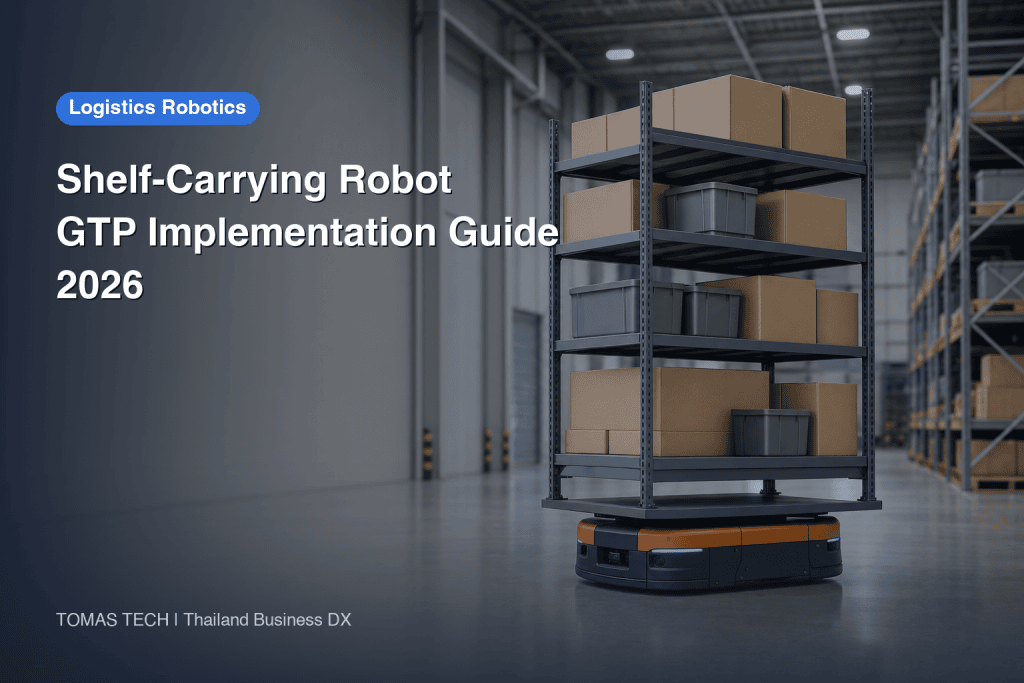
A shelf-carrying robot is a robot built around the method generally called GTP, short for Goods to Person. The robot drives underneath a storage shelf, lifts the whole shelf clear of the floor, and carries it to a station where an operator is waiting. The operator stays in one place and concentrates on a single motion, taking an item out of the shelf that has arrived or putting one into it. Conventional picking is the opposite loop — a person reads a list, walks to the shelf location, searches, takes the item, then walks to the next location and repeats. GTP inverts that sequence. Instead of moving the person, it moves the goods.
The point worth fixing in your mind here is that the essence of GTP is not its driving technology. The ability to navigate autonomously sits on the same technical line as the AMR described below. What separates GTP from everything else is a single fact — the thing being carried is a dedicated shelf. You cannot simply keep the racking you already own. It has to be replaced with shelving built at a height the robot can drive under, and rigid enough that the contents do not collapse when the whole unit is lifted. That dedicated shelving is both the source of the benefit and the single largest driver of the price tag.
The difference between AGV, AMR and a shelf-carrying robot is not only how they travel
Line the three terms up against three questions — what moves, how the route is determined, and which process it suits — and the outlines become sharp.
| Term | What moves | How the route is determined | Best-suited process |
|---|---|---|---|
| AGV | A cart or a tow tractor | A fixed route following magnetic tape or rails | High-volume shuttling between two fixed points |
| AMR | The robot itself, on its own | Autonomous navigation using sensors and a map, with no floor work | Sites where the layout changes, many-to-many transport |
| GTP (shelf-carrying robot) | An entire dedicated shelf | The same autonomous navigation as an AMR, but dedicated shelving is a precondition | High-mix low-volume picking, warehouses with long walking distances |
An AGV runs along a fixed route laid into the floor as magnetic tape or rails. Because the route is physically determined, its behaviour is stable, but every layout change means redoing the floor-side installation. An AMR is an autonomously navigating machine that can be introduced into the existing layout with no floor work at all. It holds the site as a map and decides its own path while avoiding obstacles. GTP, then, is best understood as a mechanism that uses the same autonomous navigation as an AMR while restricting what it carries to dedicated shelving.
The practical conclusion that follows is blunt. Choosing between an AGV and an AMR is a facilities question, about what you are willing to lay into the floor and how much the layout will change. Choosing whether to adopt GTP is an operations question, about whether there is enough walking time on your floor to justify replacing every shelf. Both sit inside the same category called transport robots, yet the information you need to gather before deciding is completely different.
Adjacent topics that get mixed into your search results
While researching shelf-carrying robots, several neighbouring topics will surface alongside them. Separating these early makes everything you read afterwards go faster.
The first is the wish to move roll containers or cage carts as they are. That is transport automation aimed at carts you already own, and the leading methods there are different ones, such as the tunnelling type that drives under a cart or the train type that tows several. If the requirement is to move the carts already in use without a driver, rather than to replace shelving, you will reach a landing point faster by researching roll container transport automation instead of GTP.
The second is the technology of a robot arm gripping goods. A mechanism in which an arm grasps an individual item and transfers it into another container is an entirely separate category from GTP. GTP is a mechanism in which the goods come to the person, and the hand that actually reaches out and takes the item is still human. If what you want to automate is the act of grasping, see Picking Robot Adoption. If, on the other hand, you are content for people to keep grasping and only want to erase the time they spend walking, GTP, the subject of this article, is what applies. The two can be combined, but as investment decisions they should be evaluated as entirely different things.
The third is the comparison against a fixed automated storage system. An automated warehouse that uses ceiling height to store densely and a GTP system that uses floor area to move shelves around overlap in one goal, raising storage density, and so they frequently end up on the same page of a comparison. That comparison is valid, but the building conditions and the scale of investment differ so much that we return to it in the later section on matching methods to processes.
Three numbers behind shelf-carrying robot benefits, and how to read them

With the terminology separated, the next thing to examine is what the benefits really look like. This is a field where material produced by the side promoting adoption and the lived experience of sites already running the equipment drift apart easily. Getting into the habit of asking under what conditions a figure was produced, rather than swallowing it whole, also makes your internal approval case much harder to knock down.
| Benefit | Level indicated by the sources | How to read it |
|---|---|---|
| Reduction in picking walk time | Roughly 60% of working time is said to be spent walking | The longer the walking distance, the larger the benefit |
| Storage space efficiency | A reduction of up to 50% is cited as an estimate | An individual-case figure that cannot be generalised |
| Fewer shipping errors | The structure lets the operator stay in place and focus on taking items | Nowhere is it stated that errors reach zero |
Each of these deserves a look at the background behind the number.
Roughly 60% of picking time disappears into walking
The most frequently quoted evidence for GTP is the breakdown of picking time. It is generally held that roughly 60% of picking working time is consumed by the act of walking. Turned around, that means only about four tenths of the time is spent actually touching and retrieving goods. Because GTP goes directly after that walking time, it is, in principle, a method with a high ceiling on the benefit it can deliver.
The caution here is that the roughly 60% figure will not necessarily hold for you. The ratio moves enormously with the floor area of the warehouse, the arrangement of the shelves, and the number of lines in a typical order. In a small warehouse with only a few rows of shelving, where an operator can reach every item within a few steps, the walking share will be far lower. Installing GTP at a site like that leaves very little time to erase, and therefore no fund from which to recover the investment in dedicated shelving. The first step in estimating the benefit is not to borrow another company’s ratio. It is to stand on your own floor with a stopwatch a few times and measure the split between walking and handling for yourself.
Fewer aisles mean denser storage
The other benefit that comes up constantly is storage efficiency. In a conventional warehouse where people walk between shelves to pick, aisles wide enough for an operator and a cart have to be reserved between every rack. With GTP, people never enter the shelf area, so the aisles can be designed to the width of a robot rather than the width of a person. The result is that more shelving fits into the same floor area.
Research articles put a figure of up to a 50% reduction on this effect. That figure, however, came out of a specific set of conditions and is based on individual cases. It does not mean that any warehouse will halve its footprint. The actual gain shifts substantially with how wide your aisles currently are, how much of the available shelf height you are already using, and how the building’s columns are laid out. Writing “storage space will be cut in half” into an approval document guarantees that you will be asked to explain the gap once the system is live. A safer formulation internally is that the assumption behind aisle width changes, which raises storage density, and the size of the gain depends on how the aisles are designed today.
Incidentally, in the sense of making effective use of a footprint, this points in the same direction as an automated storage system that goes dense by using ceiling height. If you want to compare the two including building conditions and investment scale, see Automated Warehouse Pricing as well.
Nobody claims that shipping errors go to zero
The third benefit is a reduction in shipping errors. With GTP the operator stands at a fixed station and simply takes the instructed item from the shelf that has been delivered. Searching while walking, mistaking one similar-looking item for another, tracking a line on a paper slip while moving between locations — all of that disappears, so it is fair to say that the structure itself makes mistakes less likely. Adding an indicator display or weight detection at the station reduces them further.
Even so, the phrase “zero shipping errors” circulates as a claim attached to particular cases, not as a guaranteed general performance figure. Errors made by whoever replenishes the shelves, items getting mixed up inside a shelf, mistakes in the packing process after the item leaves the station — there are several error paths that remain entirely outside GTP. The practical way to size the benefit is at the grain of saying that, among the mistakes currently occurring in picking, the share caused by walking and searching will fall. Sorting your own shipping errors by process makes it very clear which portion GTP removes and which portion it does not.
Cost and ROI for shelf-carrying robots, and the RaaS option
Once the shape of the benefit is clear, the next question is cost. GTP is not a mechanism whose price is settled by how many robots you buy, so the cost structure has to be broken apart and understood piece by piece.
The price band for the robot itself
For shelf-carrying GTP robots, a unit price of roughly USD 25,000-50,000 is indicated. Broken down by capability, machines positioned in the mid-range are given as USD 25,000-40,000, while the high-capability band that includes case handling and WMS integration is given as USD 40,000-60,000. Among specific models, the Geek+ M100 and the Quicktron M100 are named as examples in the mid-range band.
| Category | Indicated price band | What it covers |
|---|---|---|
| Shelf-carrying GTP robots in general | USD 25,000-50,000 per unit | The common range for the machine itself |
| Mid-range band | USD 25,000-40,000 per unit | The band in which Geek+ M100 and Quicktron M100 are cited |
| High-capability band | USD 40,000-60,000 per unit | Configurations including case handling and WMS integration |
| RaaS (monthly subscription) | USD 1,000-2,500 per unit per month | A procurement model that levels out the initial investment |
One structural point about pricing is worth holding on to, and it concerns the supply side. Chinese suppliers are reported to quote price bands roughly 40-60% below Western systems. That gap is far too large to ignore, but deciding on price alone tends to produce differences later in the availability of spare parts, in the local service organisation, and in how much of the WMS interface specification the vendor is willing to disclose. When comparing quotations, first build a single list of what is and is not included beneath each headline unit price, then put the numbers side by side.
What sits outside the robot price
The single biggest reason companies misjudge the cost of GTP is budgeting from the robot alone. In reality you also need dedicated shelving, stations, the control system, a wireless environment, work to bring the floor within flatness tolerance, charging equipment, and development to connect the system to your WMS or your existing production management system. Dedicated shelving in particular scales with the volume stored in the target area, so cutting the number of robots does not bring the number down. This is the decisive difference from an AGV or an AMR. With those, you can tune the investment by adding or removing units in line with the number of transport runs, whereas GTP puts a fixed investment, replacing the shelving, at the front of the project.
As a point of comparison, it helps to know the cost profile of automation that involves changing the layout. Retrofitting a conveyor loop into narrow aisles is said to exceed USD 200 per square foot, while introducing mobile robots including GTP is put at roughly USD 30,000-50,000 per unit. Fixed equipment laid into the building and mobile machines bought unit by unit grow in cost in completely different ways. If there is a strong chance of a future layout change, leaning toward the mobile side leaves less to regret.
RaaS lowers the barrier of initial investment, but the terms need checking
As a benchmark for payback, a period of roughly 2-3 years against the initial investment is indicated. What has spread as a way of dealing with that number is not a means of shortening it, but a means of levelling the initial investment itself, and it is called RaaS, or Robot as a Service. For shelf-carrying robots, the RaaS model is quoted at USD 1,000-2,500 per unit per month.
If you are evaluating RaaS, three checks are worth making in practice. First, what the monthly fee includes. Whether maintenance, parts replacement, software updates and the provision of a replacement unit during a breakdown are covered, or whether it is a bare rental of the machine, changes the real burden substantially. Second, the exit terms. If the benefit falls short of expectations, at what point can you reduce the number of units, and how is the remaining contract period treated? Settle that before signing. Third, the contract currency. Contracts of this kind are frequently denominated in USD, and for a local subsidiary budgeting in baht, the monthly cost then moves with the exchange rate. Unless the assumed rate is written into the approval document, you will be explaining a budget overrun partway through the year.
There is also a configuration in which the dedicated shelving and the system are bought outright and only the robots go onto RaaS. In that case the compression of initial investment is limited. Deciding in advance whether your purpose in considering RaaS is to hold down initial investment or to keep the fleet size flexible makes it far easier to judge whether a given proposal is a good one.
Four criteria that separate a good fit from a poor one
Putting the benefits and the costs together brings the conditions for a well-suited site into view. One research article gives a sense of scale at which the benefit tends to appear, namely a gross floor area of 500 tsubo or more, tsubo being the floor-area unit used in the source, and 20 or more operators. Adding the composition of the items handled and the volatility of shipping volumes to those two gives four practical criteria.
| Criterion | Level indicated as a guide | What tends to happen if you fall short |
|---|---|---|
| Storage area | A gross floor area of 500 tsubo or more | Installing shelves and stations makes the aisles more cramped, not less |
| Number of operators | 20 or more people picking | The absolute labour saving is too small to absorb the investment |
| SKU profile | High mix, with few lines per order | The same shelf gets called repeatedly and robots sit idle |
| Shipping peaks | Large swings, with extra staff added in busy periods | Normal-day capacity is already sufficient, weakening the case |
Storage area and operator count are the axes that set the absolute size of the benefit. Even if the ratio of roughly 60% walking time is accurate, if only five people are doing the walking, the total time that can be erased is limited. Because GTP is a method that puts the fixed investment of shelf replacement first, the total labour it removes has to clear a certain bar, or you will never reach the 2-3 years given as the payback benchmark.
SKU profile and shipping peaks are the axes that set how efficiently the robots work. GTP moves one shelf per call. It follows that shipping patterns in which a single order picks small quantities of many different items, in other words a high-mix low-volume site, produce the longest walk eliminated per shelf movement and therefore the highest efficiency. Conversely, at a site shipping large volumes of a small number of standard items, the same shelf simply gets called over and over, and a person standing in one spot picking continuously often turns out to be faster. The same logic applies to shipping peaks. Where the gap between normal and busy periods is small, the existing staffing already copes, and the motivation to invest is weak.
Choosing not to install at a small site is also a correct answer
It is worth stating the inverse implication explicitly. A shelf-carrying robot is a method whose investment is hard to recover at a small site. Because the structure puts the fixed cost of dedicated shelving and a control system first, no amount of operational cleverness will make the arithmetic work where the labour to be removed is small.
What a small site should examine first is the set of low-cost improvements — reviewing shelf layout, tightening location management, and formalising instruction and verification through indicator displays or handheld terminals. Reduce walking distance and search time with those, and if a structural difficulty in securing people still remains afterwards, that is the realistic point at which to consider automating transport. If you want to move step by step on transport automation itself, How to Introduce AGVs and What They Cost lays out the adoption process including floor work and fleet sizing. Because the fixed investment is far lighter than GTP, it is a method that lends itself to starting small and expanding.
Matching logistics robots to processes, where AGV, AMR and GTP each fit
The mechanisms lumped together under the phrase logistics robots in fact divide quite sharply by process. Here we map AGV, AMR and GTP onto the processes each one suits.
High-volume shuttling along a fixed route inside a site, for example from a receiving bay to a storage area, or from a production line to a shipping preparation area, is where an AGV works most naturally. If the route never changes, the stability of a fixed route is simply an advantage. Once conditions such as locations changing daily inside the storage area, layouts being reorganised by season, or multiple hand-off points needing to be crossed enter the picture, an AMR fits better. Because no floor work is required, there is nothing on the equipment side to redo each time the layout changes.
Then there is the picking process itself. Where people walking to collect goods is the bottleneck for the whole operation, GTP enters the candidate list. Put the other way, if the picking walk is short and the bottleneck sits in receiving, shipping or packing, installing GTP will not change the overall lead time at all.
| Process | First candidate | Decision point |
|---|---|---|
| High-volume transport between two fixed points | AGV | Is the route fixed, and is floor-side installation acceptable? |
| Internal transport where the layout changes | AMR | Do you want adoption without construction, and are the paths many-to-many? |
| Picking processes with long walking distances | GTP (shelf-carrying robot) | Is there enough labour to recover the investment in dedicated shelving? |
| Maximum storage density above all else | Automated storage system | Can the building height and the investment scale be accommodated? |
As for where the industry is heading, the direction is away from committing to a single method. Major GTP suppliers such as Geek+ and Quicktron have been rolling out integrated platforms from 2025 into 2026 that combine tote-level handling (Tote-to-Person), case-level handling (Pallet-to-Person) and shelf-level handling (Shelf-to-Person), and configurations that combine several methods on one control platform, rather than single-function machines, are said to be becoming the mainstream. What this trend means is that the question shifts away from whether to install a shelf-carrying robot and toward which groups of items you handle at shelf level and which you handle at tote level. Being able to present your target items divided by handling unit at the point of requesting a quotation raises the precision of the proposals you get back.
Why shelf-carrying robots are being discussed more in Thailand and ASEAN
There are several structural reasons why logistics robots have come up more often in Thailand and the rest of Southeast Asia over the last few years. Here we separate what can be confirmed with data from what is our own reading of the situation.
The shape of shipments is changing toward high mix and low volume
The first reason is a change in what is being shipped and how it is packed. Thailand’s e-commerce market grew 14% year on year in 2024 to reach a scale of 1.1 trillion baht, and social commerce is reported to have grown 18.6% year on year in 2025. A rising share of e-commerce and social commerce means the shipping unit moves from the case to the individual item, with fewer lines per shipment and far more shipments. That is a change pointing exactly at the conditions where GTP fits, a high-mix low-volume site with few lines per order. Keep a logistics design premised on case-level handling in place, and headcount has to rise more or less linearly with shipment count.
On top of that, the expansion of quick commerce in Bangkok, meaning services that sell delivery within 15 to 30 minutes, is reported to be pushing up demand for micro-fulfilment in urban areas. Handling a wide range of items in a small footprint and shipping them in a short window demands both storage density and picking speed, which is precisely the combination that raises interest in labour-saving equipment.
Market size and the investment climate
The second reason is the investment climate across the region. Mordor Intelligence estimates the Southeast Asian warehouse automation market at USD 810 million in 2025, USD 910 million in 2026 and USD 1.63 billion in 2031, a CAGR of 12.36%. Within that total, the mobile robot segment, which includes GTP, accounted for 29.76% of the whole market as of 2025, or USD 240 million, and its CAGR through 2031 is put at 13.92%, making it one of the fastest-growing segments alongside automated storage systems.
Looking at Thailand specifically, it held 24% of the Southeast Asian industrial and service robot market as of 2024, the largest share in the region. Its warehouse robotics market is forecast to expand from USD 23 million in 2024 to close to USD 79 million by 2030. In the Eastern Economic Corridor (EEC), moreover, automated storage systems for EV battery storage are reported to qualify for tax incentives, so there are now areas where the institutional framework actively supports the investment decision.
Hiring difficulty weighs more than wage levels
The third reason, and in practice the largest, is securing people. Thailand’s minimum wage was revised to 400 baht per day in Bangkok in July 2025, and the range across provinces as of 2026 is given as 337-400 baht. Looked at as numbers alone, this is not a picture of runaway wage inflation. Labour-saving projects nonetheless move forward because the problem is less the amount than the difficulty of hiring and developing people at all.
One data point supports that reading. Only 15% of graduates of vocational training in Thailand are reported to hold material handling automation skills, while demand for that kind of talent is growing at 25% a year. In other words, even where a company wants to automate, the supply of people who can run the equipment is not keeping up. This cuts two ways. It is hard to hire people for simple manual work, and it is equally hard to hire people who can maintain automated equipment. When evaluating a shelf-carrying robot, who will handle day-to-day maintenance after go-live deserves as much attention as which model you select. If you want to look at responses to labour costs across the board, see Countermeasures for Rising Labour Costs in Thailand 2026 as well.
A practical view when evaluating this in Thailand
From here on, this is our own reading. First, we were not able to confirm primary sources naming specific companies in Thailand that have installed shelf-carrying robots, so this article does not present Thai adoption cases as established fact. What is useful is that the decision criteria themselves are the same regardless of country. Measure five things — the walking share of picking time, storage area, operator count, SKU profile and the volatility of shipping volumes — and any site in any country converges on a conclusion in the same order.
On top of that, three circumstances specific to Thailand are worth naming. The first is timing. Because GTP involves replacing the shelving, dropping it into a warehouse already running at full tilt is a heavy burden, so it tends to be evaluated alongside a site relocation prompted by rising land and rental costs around Bangkok, or alongside a rebuild or expansion of the warehouse itself. The real starting point for evaluation is when a site that is already tight develops the motive to store more without changing the building.
The second is the maintenance organisation after go-live. As noted above, people with automation skills are in short supply, so the vendor’s local support structure, the location of the parts inventory, the languages supported and the lead time for an on-site visit should all be checked at the quotation stage. The third is contract currency and the outlook for maintenance costs. Both the robots themselves and RaaS contracts are commonly denominated in USD, and if you are planning several years of operation, we recommend writing the assumed exchange rate into the approval document.
What to settle before you request a quotation
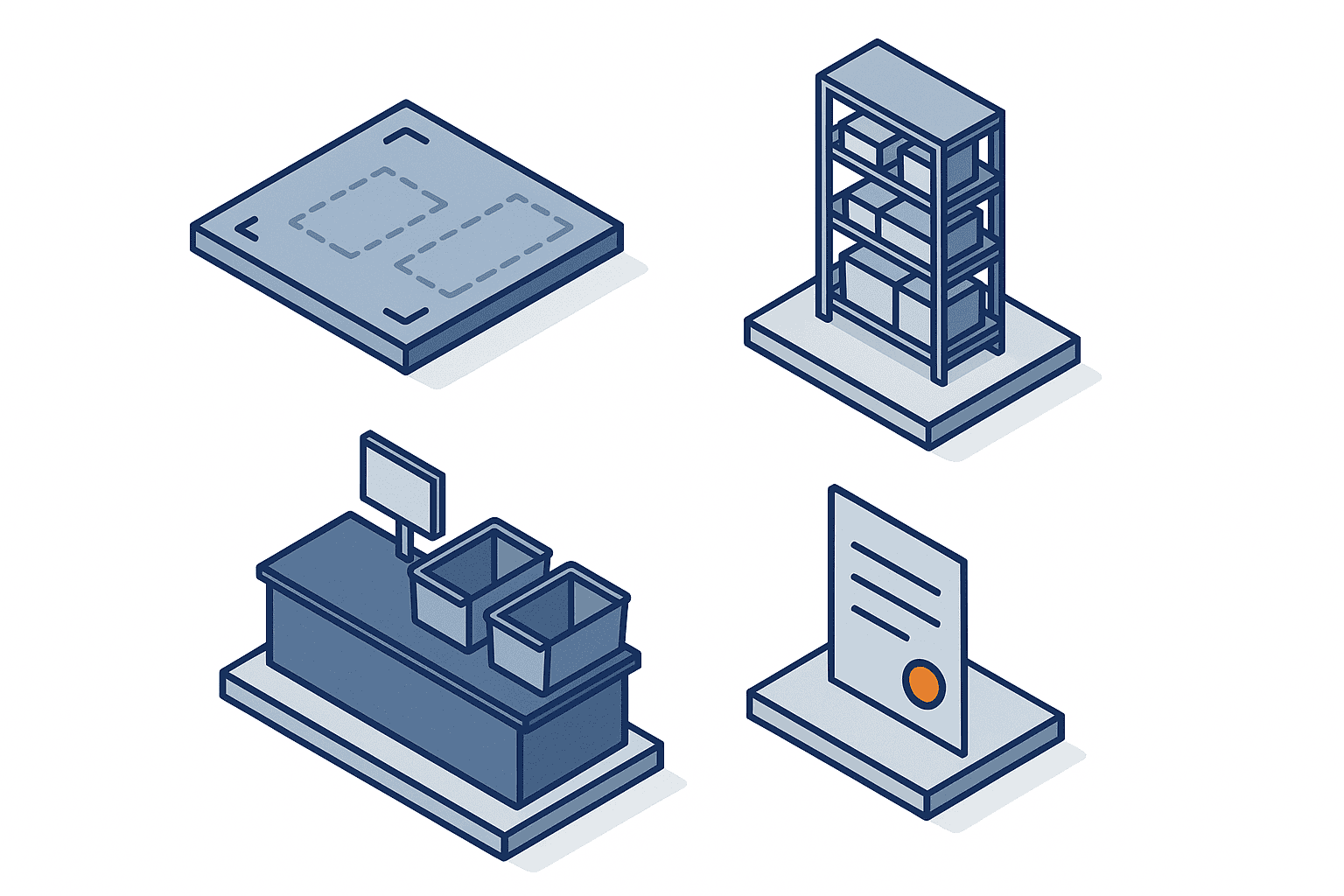
The points made so far can be turned into a list of items to fix on your own side before asking a vendor or a system integrator for a quotation. Send out a request without this information and each company will propose from a different set of assumptions, which makes the prices impossible to compare.
| Item to confirm | What to settle |
|---|---|
| Scope of the target area | Which storage areas and which item groups are in scope |
| Measured walking time | The share of walking within current picking work |
| Storage area and shelf count | Gross floor area of the target area and the expected number of dedicated shelves |
| Operator count | How many people are involved in picking, and how they are deployed by shift |
| SKU profile | Number of items, and average lines per order |
| Shipping peaks | The gap in shipment count between busy and normal periods |
| Building conditions | Floor flatness, ceiling height, column layout, wireless environment |
| System integration | The scope of connection to WMS or production management systems, and who pays for the development |
| Procurement model | Outright purchase or RaaS, and for RaaS the exit terms and contract currency |
| Maintenance structure | Who handles routine maintenance, parts supply, and the on-site response lead time |
The two entries in this table most often treated lightly are building conditions and system integration. On building conditions, floor flatness outside the assumed tolerance makes travel unstable and produces floor repair work after the fact. The wireless environment behaves the same way, since interference with existing equipment breaks communication and stops the robots. Neither cost appears in a quotation for the machines, so treat any quotation not preceded by a site survey as a rough order of magnitude.
On system integration, we recommend deciding who bears the development cost early. GTP is not a machine that carries shelves so much as a system that decides which shelf to call and when, and the basis for that decision comes from your existing WMS and inventory data. Where the integration design is weak, the robots run but no instructions arrive, or inventory discrepancies cause the wrong shelf to be called and the operator finds nothing there. Naming the systems to be connected, the fields to be exchanged and the update frequency in the request for quotation puts every proposal at the same level of detail.
One further item to settle internally is who will own the shelf placement rules after go-live. With GTP, optimising placement, such as concentrating fast-moving items on shelves with the shortest robot round trip, has a decisive effect on the benefit. Those placement rules need revisiting every time the sales mix shifts, and while some configurations handle this automatically, others expect people to review it periodically. Go live with that responsibility unassigned and you can end up in a situation where the benefit appeared immediately after adoption but had drifted back to the starting point six months later.
Frequently asked questions
What is a shelf-carrying robot?
It is a robot that drives underneath a storage shelf, lifts the entire shelf, and carries it to a station where an operator is waiting. The method is generally called GTP, or Goods to Person. Where conventional picking has a person walk to the shelf to fetch goods, the distinguishing feature here is that the goods move while the person does not. The operator stays in one place and concentrates only on taking items from the shelf that has arrived or putting items into it. Because dedicated shelving is required, existing racking cannot simply be reused.
How does a shelf-carrying robot differ from an AGV or an AMR?
The difference is not in how they travel but in what they carry. An AGV is a transport vehicle that runs a fixed route along magnetic tape or rails, and an AMR is a transport robot that navigates autonomously using sensors and a map with no floor work required. A shelf-carrying robot uses the same autonomous navigation as an AMR, but what it carries is limited to dedicated storage shelving. Choosing between an AGV and an AMR is therefore a facilities question, whereas choosing whether to adopt a shelf-carrying robot is an operations judgement about whether there is enough walking time on the floor to justify replacing every shelf.
How much does a shelf-carrying robot cost?
The unit price of a shelf-carrying GTP robot is given as roughly USD 25,000-50,000, with the mid-range band at USD 25,000-40,000 and the high-capability band including case handling and WMS integration at USD 40,000-60,000. Beyond the machine itself, however, you also need dedicated shelving, stations, the control system, a wireless environment and development for system integration. Under the monthly RaaS model, a band of USD 1,000-2,500 per unit per month is indicated. Payback is given as roughly 2-3 years, but that figure assumes a site with enough labour to remove in the first place.
Does storage space really halve with a shelf-carrying robot?
Research articles cite an estimate of up to a 50% reduction, but this is an individual-case figure and does not mean that any warehouse will halve its footprint. The size of the reduction depends on how your aisles are currently designed, how much shelf height you are using, and how the building’s columns are placed. It is certainly true that once people no longer walk between the shelves, aisles can be designed to robot width, so the closest description of reality is that the assumption behind aisle design changes, and storage density rises as a result.
At what scale does the benefit start to appear?
One research article gives a guide of a gross floor area of 500 tsubo or more and 20 or more operators. Because a shelf-carrying robot is a method that puts the fixed investment of dedicated shelving first, the total labour removed has to clear a certain level for the payback arithmetic to work. Add a high item mix with few lines per order and large swings in shipping volume, and the fit becomes stronger still. At a small site, examining low-cost improvements first, such as reviewing shelf layout and formalising instruction and verification, produces a better return on investment.
Can it be adopted in Thailand?
Technically yes, but we have not been able to confirm primary sources for specific adoption cases within Thailand, so we cannot state them as fact. The decision criteria themselves are the same in any country. Circumstances particular to Thailand include the growth of the e-commerce market driving more piece-level shipments, a limited supply of people with automation skills that makes settling the post-adoption maintenance structure a priority, and contracts commonly denominated in USD, which means the assumed exchange rate should be written into the approval document. Because the method involves replacing shelving, it is also frequently evaluated in step with a site relocation or a warehouse expansion.
What should I do if I want to move roll containers or cage carts as they are?
That use case falls outside the scope of shelf-carrying robots. A shelf-carrying robot is a mechanism that lifts and moves dedicated storage shelving, so if you want to move the roll containers or cage carts already in use without a driver, the methods to look at are cart transport automation approaches such as the tunnelling type or the train type. Because they make use of the carts you already own, no shelf replacement is needed and the initial investment is lighter. Deciding first whether the objective is to cut walking time or to remove the driver from cart movement will keep your research pointed in the right direction.
Summary
The decision on a shelf-carrying robot does not start from a performance comparison against AGVs and AMRs. What settles it is whether your own site meets the conditions under which carrying the whole shelf makes sense, namely the walking share of working time, storage area, operator count, SKU profile and the volatility of shipping volumes. The figure that roughly 60% of picking time is consumed by walking is a figure that pays off at sites where the walk is long, and where every item is within a few steps there is simply no time to erase. The estimate of up to a 50% reduction in storage space is likewise an individual-case number, not a guaranteed value. Start by measuring your own operation, then check your scale against the guides of 500 tsubo or more of gross floor area and 20 or more operators. Build the budget on the premise that beyond the USD 25,000-50,000 unit price sit the fixed investments of dedicated shelving and system integration. If you cannot reach the 2-3 years given as the payback benchmark, do not force the adoption, and begin instead with a layout review and formalised work instructions. Follow that order and you will avoid the failure of choosing something for its novelty and regretting it.
In the course of providing production management, energy management and other shop-floor solutions to Japanese-affiliated manufacturers and logistics operators in Thailand, we are often asked to help with exactly this kind of separation of issues, questions such as whether a particular warehouse suits a shelf-carrying robot and what should be measured first. You are welcome to get in touch well before the model selection stage, including when you simply want help taking stock of the processes in scope. Please reach us through the contact page.
References
- COOOLa WES — What is GTP
- aiwaok — GTP Goods to Person
- Graba Robot — Warehouse Robot Price Guide
- ChoZan — Geek Plus
- Quicktron — Shelf to Person Solutions
- Mordor Intelligence — South East Asia Warehouse Automation Market
- Mordor Intelligence — Southeast Asia Industrial and Service Robot Market
- Digital in Asia — Thailand Digital Market Overview 2026
- Thai Law Online — Minimum Wage in Thailand


