


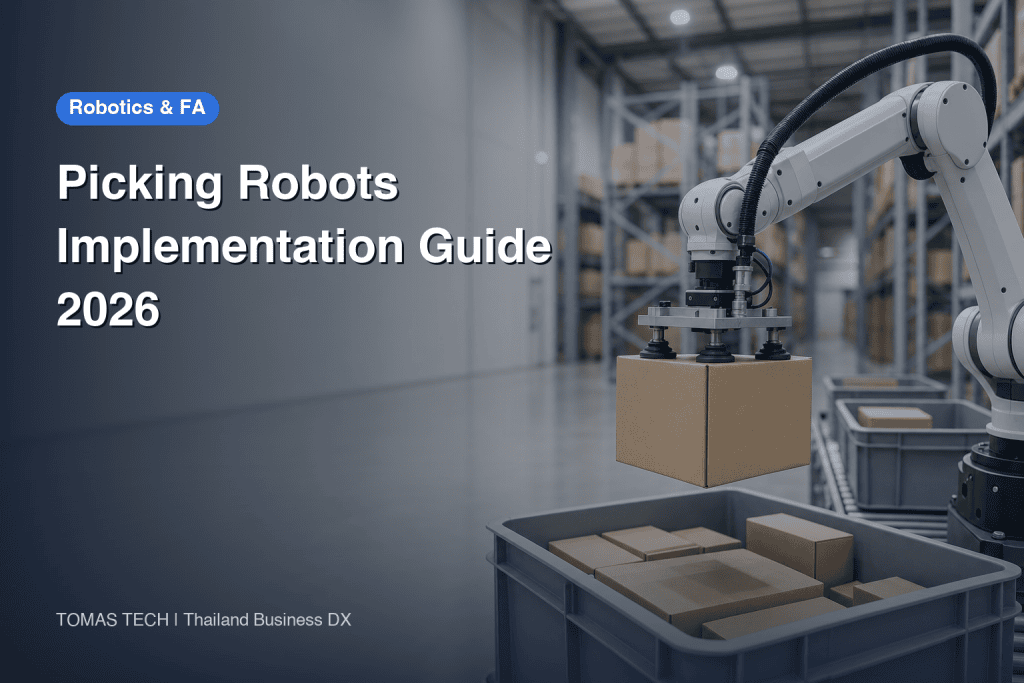
If you landed on this page while evaluating picking robots, you are most likely building your decision around one question — can the robot grip our products or not? In practice, though, what decides whether the investment pays back is rarely the sophistication of the grasping algorithm. It is the state in which the products are supplied to the robot, and how often the mix of items you handle changes. This article sets the comparison of gripping technologies aside for a moment and lays out the order in which to judge fit, using two axes: supply condition and SKU churn.
What a picking robot is, and the three terms that get confused

The first thing that derails a picking robot project is not technical difficulty. It is terminology. When a company sets out to automate a shipping process in logistics or production, three different mechanisms usually end up on the shortlist. The first is the subject of this article, the piece-level picking robot, often called a piece picking robot. A robot arm grips products one at a time and moves them into another container or onto a conveyor. The second is DPS/DAS, the digital picking system, where a person picks items following instructions from a handheld terminal or an indicator light. No robot appears here at all, and what gets automated is only the instruction layer of what to take, from where, and how many. The third is the palletizing robot, which stacks cases or cartons onto a pallet.
These three differ completely in investment size, in how the benefit shows up, and in how hard it is to recover when something goes wrong. Despite that, internal approval documents and requests for quotation to system integrators tend to compress all three into a single phrase, automating picking. When the premise is misaligned and quotes go out to several vendors, company A proposes a piece picking robot cell, company B proposes an indicator-light system, and company C proposes a case-level palletizer. What comes back is a comparison table where only the prices line up. It looks like decision-making material, but since each vendor automated a different process, comparing them is meaningless. Separating the three terms is not semantics. It is the practical work of putting every quote on the same footing.
| Mechanism | What is automated | Unit handled | Typical processes |
|---|---|---|---|
| Picking robot | The physical act of gripping and moving a product | Individual pieces | Shipping sortation, feeding assembly parts, feeding items into inspection |
| DPS/DAS | The instruction and verification of what to take and how many | Individual pieces, picked by people | High-mix low-volume shipping, improvement of manual operations |
| Palletizing robot | Stacking cases onto a pallet | Cases and cartons | Pre-shipment stacking, depalletizing on receipt |
Once the three are separated, the article you should be reading changes as well. If you intend to keep people picking and only want to tighten the instruction and verification layer, How to Choose a Picking System (DPS/DAS) is closer to what you need. If you want to automate case-level stacking, or simply want a sense of price first, see Palletizing Robot Pricing. Palletizing carries a different technical character, because the placement point keeps changing with the stacking pattern and has to be recalculated every cycle, which makes it a separate discussion from piece picking.
One more relationship worth clarifying is the one with robot vision. A picking robot cannot exist without an eye that recognises the position and orientation of the target. In that sense robot vision is a component of a picking robot, but robot vision as a technology is not picking-specific, and it is equally used for positioning and visual inspection. If you want the cost structure and the payback calculation from the broader robot vision perspective, see Robot Vision Cost and Payback. This article does not go deep into the cost structure of vision itself, and instead stays on the issues specific to piece picking, namely supply condition and SKU churn.
What picking robot accuracy and throughput actually look like
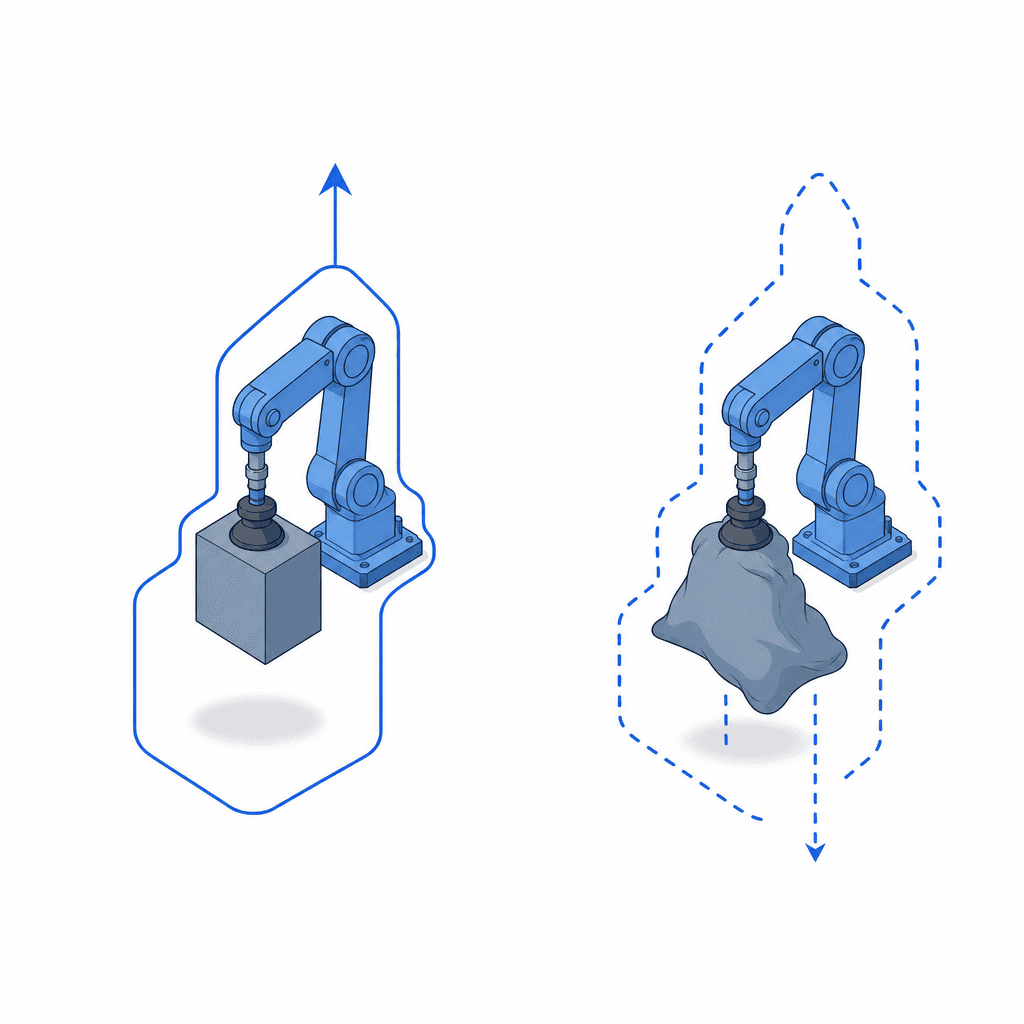
With the terms separated, the next thing to pin down is real-world performance. Many evaluations go wrong at this point because the high accuracy figures that appear in brochures and case studies are read as general performance values that hold regardless of what is being picked. In reality, the same robot running the same algorithm will show wildly different success rates depending on the physical properties of the goods and the way they are presented.
Accuracy shifts sharply between rigid and deformable items
According to Mordor Intelligence, AI vision achieves a pick accuracy of 95% or higher on rigid items, meaning goods that are hard and hold their shape. For deformable goods such as bagged products, the same research puts accuracy at 75-80%. This gap is not a sign of immature technology that will close shortly. It is structural, because the physical properties of the goods propagate directly into performance. A rigid item is easy to match against a stored model from the shape a 3D camera captures, and suction or grip points settle in stable positions. A deformable item changes shape the moment it is placed and changes shape again the moment it is gripped, so the position that was recognised and the position that can actually be grasped drift apart.
The practical meaning of these numbers is clear. If the items leaving your site are mostly bagged foods or soft packaging, the first thing to do is not to work harder on robot selection. It is to count what share of the target process consists of rigid items. An accuracy level of 75-80% means roughly one miss in every four or five attempts, and unless you design an operation in which people absorb that recovery, the line stops.
Bulk supply and presented supply change the difficulty
Supply condition matters about as much as physical properties. Taking items out of a bin where they are piled up at random is called random bin picking, or bulk picking. In the technical literature, the current level of grasp success on novel and previously unseen objects sits in the mid-80% to low-90% range. What deserves attention is the analysis that the bottleneck is shifting away from the grasping algorithm itself and toward the 3D perception side, because from a single viewpoint most of the pile is occluded and simply cannot be seen.
In other words, the ceiling on success rate is set less by an inability to grip than by an inability to see. Turned around, that means the same robot can reach a higher success rate through work done around it, such as presenting items in an aligned state upstream, dividing them into compartmented trays, or adding camera viewpoints. For an investment decision, checking whether your process has room to change the supply condition is more productive than lining up specification sheets for individual robots.
| What the source measured | Reported level | Where it matters |
|---|---|---|
| AI vision pick accuracy on rigid items | 95% or higher | The prime candidate process to start with |
| Grasp success on novel objects in bulk supply | Mid-80% to low-90% range | Improvable by adding viewpoints or aligning upstream |
| Pick accuracy on deformable goods | 75-80% | Design on the premise of staffing for recovery |
When supply condition comes up, people sometimes hear it as a verdict that bulk supply rules them out. That is not the case. What we want you to take from this is a point about how to allocate budget. There are situations where spending a slice of the same capital on modifying how goods are supplied contributes more to the success rate than upgrading the grade of the robot itself.
Throughput figures set the premise for process design
Processing capacity also needs a reality check. A common figure for piece-level picking robots is 400 to 600 items per hour. The Mordor Intelligence research cited above does mention a maximum of 1,200 picks/hour, but that should be read as a ceiling under favourable conditions, not a number you will see in a mixed-SKU shipping operation.
This benchmark matters because it feeds straight into how many units you need. Divide your peak shipping volume by the processing capacity and you get a rough cell count. Skip this step and install a single unit, and you end up with a half-finished operation that has spare capacity on ordinary days but reverts to throwing people at the problem on peak days. Before you select a robot, we recommend getting a firm hourly figure for your own peak shipping volume.
How procurement changed, RaaS and falling industrial robot prices
Alongside real-world performance, the other thing that has shifted substantially in the last few years is how these systems are procured. If industrial robot price is one of your decision inputs, this is the area where the premise has moved, and carrying an old sense of market rates into the evaluation will lead you to the wrong conclusion.
Mordor Intelligence reports that the price of the collaborative arm itself has fallen from USD 50,000 in 2020 to under USD 15,000 today. That is the price of the arm alone, of course. The hand, the vision system, the frame, safety fencing and safety devices, surrounding conveyors and the system integration work are all additional. Even so, the fact that hardware now accounts for a smaller share of the total system means the centre of gravity in the investment decision has moved from whether you can afford a robot to how you design the process.
The larger shift is the spread of RaaS (Robot as a Service), a monthly subscription model of procurement. The same research puts RaaS at 60.30% of 2025 deployments. More than half of adoptions are now subscriptions rather than outright purchases, which tells you that mid-sized sites wanting to limit upfront capital have more realistic options than they used to.
| Procurement model | Upfront cost | Where it fits |
|---|---|---|
| Outright purchase | Large | The target process is stable and expected to run the same way for years |
| RaaS (monthly subscription) | Small | Demand fluctuates, or you want to validate results and adjust unit count as you go |
The market itself is also expected to expand. Mordor Intelligence estimates the piece picking robot market at USD 1.7 billion in 2025 and USD 2.58 billion in 2026, and projects USD 20.78 billion by 2031 at a CAGR of 51.78% from 2026 to 2031. That said, market sizing of this kind rests on assumptions that differ by research house, and the spread between published figures is wide. Rather than treating any one number as the correct answer, it is safer to take away the direction of travel, which is a market in an expansion phase accompanied by a change in how the equipment is procured.
Technology keeps moving as well. Vulcan, the robot Amazon announced in Germany in May 2025, is the company’s first robot with tactile sensing. It picks from and stows into shelving using a 3D force sensor and a suction cup arm, and is reported to handle roughly 75% of the items it is asked to stow. It is running at sites in Spokane, Washington and in Hamburg, Germany, with reported plans to expand to further US and German sites in 2026. What is worth noticing is that even an operator with one of the largest logistics networks in the world puts a number on what it can handle, roughly 75%. Carving out the range that can be handled instead of handing over the entire volume is an approach that applies at any scale.
Robot hand selection works backward from the product, not the catalogue
We are regularly asked about robot hand selection, and in most cases the question arrives in the wrong order. Rather than comparing hand catalogues and then fitting the products to them, the correct sequence is to fix the physical properties and supply condition of the target goods first, and work backward from there to the gripping method.
The starting point is the rigid-versus-deformable split from the previous section. For goods with hard, smooth surfaces, suction is the first candidate, and you are in the territory where the 95% or higher accuracy level reported for rigid items is achievable. For goods with rough or air-permeable surfaces, or with no fixed shape, suction will not hold them, and you need a design based on finger-style gripping or dedicated tooling per item. Fitting one robot with several hand types and switching between them is possible, but changeover time eats into throughput, so do not assume the 400 to 600 items per hour benchmark will hold as-is.
The other thing that drives hand selection is your outlook on SKU count. If the item list is fixed, a dedicated hand optimised for those goods gives the highest success rate and the highest speed. In a site where the item list turns over every quarter, however, the more you engineer a dedicated hand, the more reinvestment and reteaching each turnover demands. There is an instructive industry development here. In September 2024, Berkshire Grey announced a formal partnership with the automated storage vendor Kardex (AutoStore), promoting the claim that it performs from day one without prior SKU data registration or teaching, and is reported to advertise picking accuracy of 99.99%. The very fact that “no teaching required” works as a product differentiator tells you how large a practical barrier reteaching is in high-SKU environments.
For that reason we recommend the following order for hand selection. First, sort the goods handled in the target process into rigid and deformable. Next, count the share each represents, and carve out the processes where rigid items dominate as your priority target. Finally, decide the holding method that suits that group of goods. Follow this order and you will avoid writing a requirement specification for a hand that grips anything, which nobody can deliver.
Two axes that separate a good fit from a bad one
Bringing the discussion together as a set of decision axes, whether a picking robot fits is broadly determined by two things — the supply condition of the goods, and how frequently the SKU mix changes.
On the supply axis, the closer you are to presented, aligned supply, the better the fit, and the closer you are to fully random bulk, the harder it gets. On the SKU churn axis, the more fixed the item list, the better the fit, and the more often it turns over, the more hidden costs accumulate in the form of reteaching and rebuilt tooling. Line your processes up on these two axes and the order in which to tackle them falls out naturally. A process built around rigid items, where aligned supply is achievable and the SKU list is stable, is the first candidate. A process dominated by deformable goods, supplied in bulk, with an item list that turns over monthly, is not technically impossible, but it is not what your first robot should attempt.
To make the sequence concrete, here is a worked example using a fictional company. Every number below is an assumption for our own illustrative calculation, not a fact confirmed by research. Picture the Thai subsidiary of a Japanese consumer goods manufacturer with a shipping site outside Bangkok. The site handles 2,000 items, but a breakdown of shipped volume shows that the top 300 items account for roughly 70% of all pieces shipped, and about 80% of those 300 are boxed rigid goods. Trying to have a robot handle all 2,000 items would run head-on into both the deformable goods problem and the high-SKU problem. Carving out only the rigid goods among the top 300 as the target process, however, makes it far easier to establish aligned supply and supports a high expected success rate. The remaining items stay manual, supported by DPS/DAS for instruction and verification, and that coexistence design is the realistic one.
The essential point is that you do not have to automate everything. Just as Amazon’s Vulcan expresses its coverage as roughly 75% of the items it is asked to stow, a picking robot today is equipment you point at a selected subset. The moment full coverage goes into the requirement specification, either no vendor is able to deliver, or the only vendors left are the ones who said yes and will cause a problem later.
Conversely, we recommend leaving the following processes out of scope for your first installation. The first is any process where bagged or irregularly shaped goods make up the majority, since the operation would have to be designed around the 75-80% accuracy level, which is too demanding as an evaluation for a first machine. The second is a process where the SKU list turns over substantially every month. The third is a process where peak shipping volume greatly exceeds the 400 to 600 items per hour capacity benchmark, so that no real benefit appears unless several units go in at once. None of these is technically impossible. They simply belong later in the sequence.
Why picking robots are being considered in Thailand and ASEAN
There are several structural reasons why picking automation has come up more often in Thailand and the rest of Southeast Asia over the past few years.
First, the shipping profile is changing. Thailand’s e-commerce market grew 14% year on year in 2024 to reach a scale of 1.1 trillion baht, and social commerce is reported to have grown 18.6% year on year in 2025. As the share of e-commerce and social commerce rises, the shipping unit moves from cases to individual pieces, the number of lines per order falls and the number of orders rises. That is precisely the direction that increases the load on piece picking, and a logistics design built around case-level flow will run short of people. At the same time, there are observations that logistics in Thailand is not as optimised as in Vietnam or China. That is another way of saying there is still room to engineer improvements on the floor.
Second, securing labour. Thailand’s minimum wage was revised to 400 baht per day in Bangkok in July 2025, with no clear move toward a further increase as of 2026, and the range by province is reported at 337 to 400 baht. In other words, wages themselves are not spiking. Automation still advances because the binding constraint is less the amount than the inability to hire. Thailand’s labour market is described as facing an ageing workforce and rising household debt, and labour organisations are reported to be prioritising protections for informal employment and workforce upskilling over minimum wage increases. On top of that, logistics wages across APAC are forecast to rise faster than consumer price inflation through 2027 as labour supply contracts, with the average forecast wage increase within Southeast Asia at 5.3% and Vietnam highest at 7.1%. There is also the observation that 3PL providers across Asia may begin to make wage escalation clauses standard contract terms, which means the trend is not somebody else’s problem even for companies that outsource their logistics. If you want to look at labour cost countermeasures more broadly, see Countermeasures for Rising Labour Costs in Thailand 2026 as well.
Third, the regional investment environment. Mordor Intelligence estimates the Southeast Asian warehouse automation market at USD 810 million in 2025, expanding to USD 1.63 billion in 2031 at a CAGR of 12.36%. By country, Indonesia leads with 28.63% of 2025 revenue, while Vietnam is expected to grow fastest at a 13% CAGR on the back of mega-hub construction by e-commerce operators. For a company based in Thailand, that relative positioning, with neighbouring countries moving first on automation investment, is part of the context for the decision.
We should note that this research did not turn up verifiable primary sources on which specific companies in Thailand have deployed picking robots. This article therefore does not present Thai deployment examples as established fact. What is useful is that the decision axes themselves are the same regardless of country. From Japan, Dexterity Robotics is reported to have signed with Sumitomo Corporation in 2022 with a plan to deploy 1,500 robots into Japanese warehouses by 2026. The processes automated first in cases like these are the ones where supply condition has been arranged and SKUs are managed, and that observation transfers directly to selecting a target process on a Thai site.
The RaaS model may suit mid-sized factories and logistics sites in Thailand, because it allows results to be validated while keeping upfront capital low. Two practical checks are needed, however. One is the termination condition. If the results do not materialise, at what point can the contract be cancelled, and how is the remaining term treated? Settle that in advance. The other is currency. Contracts of this type are frequently denominated in USD, and for a local subsidiary budgeting in baht, the monthly cost moves with the exchange rate. Unless the exchange rate assumption is written into the approval document, you will be explaining a mid-year budget overrun.
What to settle before you request a quote
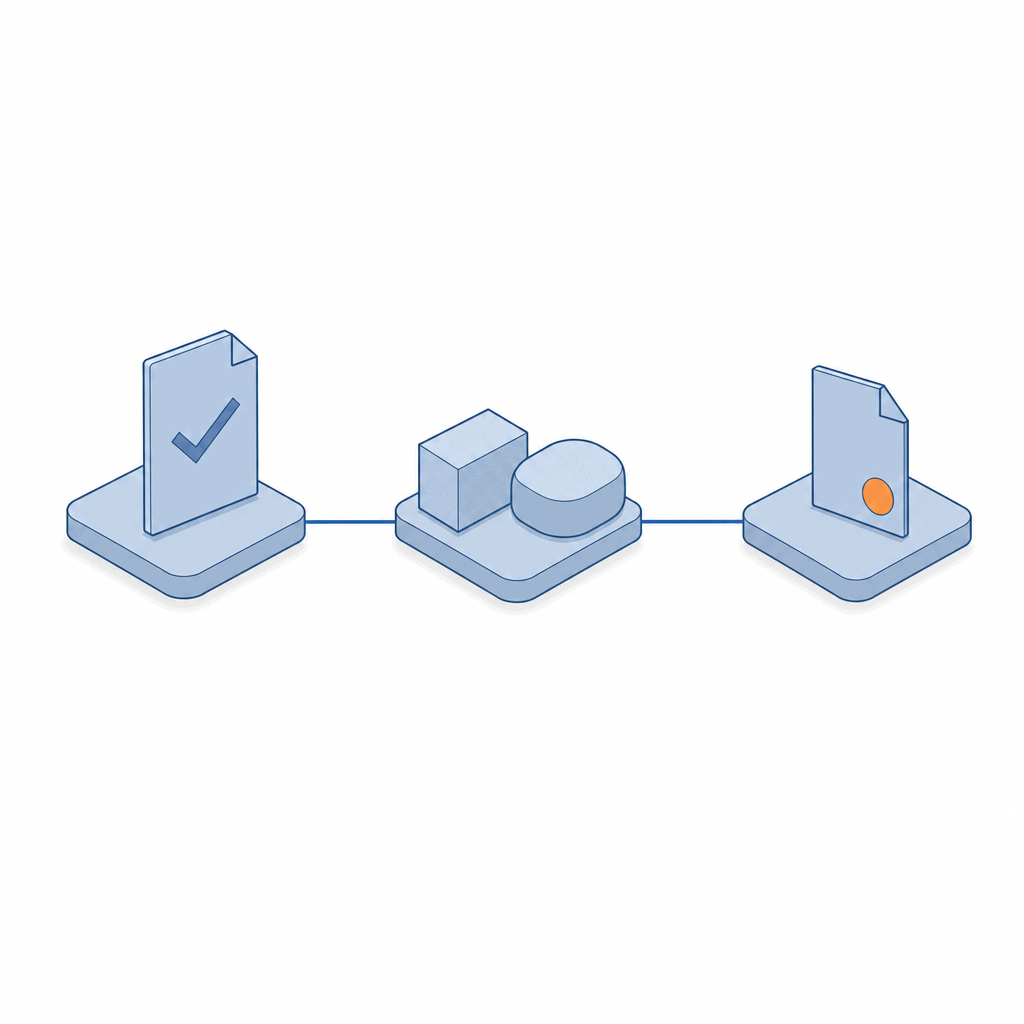
The points above translate into a set of items your own organisation should settle before requesting quotes from integrators and vendors. Send out a request without this information and each vendor will respond on a different premise, leaving you unable to compare the prices at all.
| Item to confirm | What to settle |
|---|---|
| Scope of the target process | Which item groups are in scope, and whether it is all volume or part |
| Physical properties of the goods | The mix of rigid and deformable items |
| Supply condition | Bulk or aligned supply, and whether the upstream process can be changed |
| SKU churn | How often items turn over, and who handles reconfiguration when they do |
| Throughput requirement | Pieces shipped per hour at peak |
| Procurement model | Outright purchase or RaaS, and for RaaS the termination terms and currency |
| Exception handling | Who recovers a missed pick, and how |
Of everything in that table, the item most often underweighted internally is the last one, exception handling. Accuracy of 95% or higher on rigid items and 75-80% on deformable goods is another way of saying that missed picks will definitely occur. Whether an alarm sounds and a person comes over, whether a downstream process catches it and creates rework, or whether it flows straight through and becomes a shipping error, changes both the staffing you need and the labour saving you actually realise. Calculate the labour saving without settling this, and after go-live you will find that somebody is standing next to the robot the whole time anyway.
The other thing to decide internally is who handles reconfiguration when SKUs turn over. Item changes are driven by purchasing and sales, not by the robot’s convenience. If your configuration requires reteaching or tooling changes, you need to decide before signing whether local maintenance staff can carry out that work or whether the vendor is called in each time. If the answer is that the vendor is called in, have that cost and the response lead time included in the quote. Leave this blank at go-live and you can end up with a robot that sits idle from the week after the item list changes.
Frequently asked questions
What is a picking robot
It is equipment in which a robot arm grips products one at a time and transfers them to another container or conveyor, also known as a piece picking robot. It differs both in the unit it handles and in the issues that drive the investment decision from DPS/DAS, where a person picks following instructions from a handheld terminal or an indicator light, and from a palletizing robot, which stacks cases onto a pallet. Request quotes without separating these three and each vendor will build its proposal on a different process, leaving nothing you can compare.
How much does a picking robot cost
For the collaborative arm itself, research indicates that the price has fallen from USD 50,000 in 2020 to under USD 15,000 today. That covers hardware only, and the hand, vision system, safety devices, surrounding equipment and system integration are all additional. On top of that, the monthly subscription RaaS model has spread, with one research house putting it at 60.30% of 2025 deployments. RaaS is worth considering if you want to limit upfront capital, but settle the termination terms and the contract currency in advance.
What kinds of goods suit a piece picking robot
Rigid goods that are hard and hold their shape. AI vision pick accuracy on rigid items is reported to reach 95% or higher, while for deformable goods such as bagged products it stays at 75-80%. In addition, when picking from goods supplied in bulk, grasp success on novel and unseen objects currently sits in the mid-80% to low-90% range, with occlusion, where most of the pile is hidden from view, cited as the main bottleneck. The standard approach is to start with a process built on rigid items, where aligned supply is achievable and the item list is stable.
How should we select a robot hand
Do not select from hand catalogues. Fix the physical properties and supply condition of the target goods first, then work backward. Goods with hard, smooth surfaces make suction the first candidate, while rough-surfaced or irregularly shaped goods call for finger-style gripping or dedicated tooling. A configuration that switches between several methods is possible, but changeover time eats into throughput, so it is safer not to assume the general benchmark of 400 to 600 items per hour will hold. In sites where the item list turns over frequently, note that the more you engineer a dedicated hand, the more reinvestment it triggers.
Are there cases where improvement without robots is better
Yes. If shipping volume is growing only gradually and your real problems are instruction errors and missed verification, keeping people on the picking task while tightening the instruction and verification layer will deliver a better return. In that case How to Choose a Picking System (DPS/DAS) is the more useful reference. Robotics starts to pay off when you have a process whose supply condition can be arranged and you also face a structural difficulty in hiring.
Can this be deployed in Thailand
Technically yes, but this research was unable to confirm primary sources on specific deployments within Thailand, so we cannot state anything definitive on that point. The decision axes themselves are the same everywhere, and the sequence of starting with a rigid-goods process where supply can be arranged and SKUs are stable does not change. Factors specific to Thailand include a growing e-commerce market that is increasing piece-level shipping, the fact that difficulty in hiring rather than the wage level itself tends to drive the investment decision, and the need to write an exchange rate assumption into the approval document because RaaS contracts are frequently denominated in USD.
Summary
A picking robot decision does not begin with comparing gripping technologies. What decides it is three things — whether the target goods are rigid or deformable, whether they are supplied in bulk or aligned, and how frequently the SKU mix changes. The accuracy gap between 95% or higher for rigid items and 75-80% for deformable goods is not a sign of immature technology but the result of a design decision, and it is largely settled by which group of goods you choose to target. Start by sorting your shipped items into rigid and deformable, count how many of your highest-volume items are rigid, and carve that out as the target process. Estimate the number of units from the 400 to 600 items per hour benchmark, and decide the recovery procedure for missed picks and the owner of reconfiguration at SKU turnover before you commit. Follow that order and you will avoid writing an undeliverable requirement specification premised on automating everything.
In the course of providing shop-floor solutions such as production management and energy management to Japanese manufacturers in Thailand, we are often asked to help draw exactly these lines — which processes are suited to robotics, and whether a task should be improved with a system while people continue to do the work or handed over to a robot. It is entirely fine if you are not yet at the stage of selecting a specific machine and want to start by taking inventory of candidate processes. Feel free to get in touch through our contact page.
References
- About Amazon — Amazon Vulcan robot pick and stow with touch
- IEEE Spectrum — Amazon Robotics Vulcan Warehouse Picking
- Mordor Intelligence — Piece Picking Robots Market
- Mordor Intelligence — South East Asia Warehouse Automation Market
- Siemens — Robotic Picking System and Method
- AMD Machines — AI Vision Enables Random Bin Picking at Scale
- Kardex — Berkshire Grey Announces Formal Partnership with Kardex
- The Robot Report — Dexterity Picks Up 95M Funding for Container Unloading Robots
- Dematic — Robotics Solutions
- RoboDK — The Essential Guide to Robotic Palletizing
- Thairath — Thailand Labour Market Interview
- Thai Law Online — Minimum Wage in Thailand
- Value Chain Asia — Asia Warehouse Labour Shortage 2026
- GotPaid Asia — State of Payroll Southeast Asia 2026
- Digital in Asia — Thailand Digital Market Overview 2026


