


Every time lines and workers are added, updates to the skill matrix in Excel fall further behind. (Japanese plants also call it a rikiryo-hyo, or competency chart, or a hoshitorihyo, a chart of marks.) As an ISO audit approaches, the leader of each line cross-checks training records against the skill matrix and corrects it. On a morning when someone is absent, the question “who can take this process?” is settled by the leader’s memory. This situation is not unusual at Japanese-affiliated factories in Thailand. Then products and proposals arrive saying “AI can build and update your skill matrix,” and you need to judge how much you can hand over to it and what you should buy.
This article makes one argument. Whether skill matrix AI succeeds depends not on the accuracy of the AI’s estimates, but on whether you decided the following three things first. (1) The granularity of skill items and the criteria for judging levels (process × work element × level; who judges “can do,” and by what). (2) The evidence for each level (a record of which basis was used, whether training records, practical checks or quality results, and who certified it). (3) Where to draw the line on AI use (use it for drafting items, consolidating records, and proposing candidates for training and assignment, but do not let AI automatically decide people’s evaluations, wages or treatment; people decide and record those). AI is fast at “creating items,” “gathering records” and “proposing candidates,” but “certifying” remains a human job.
How to preserve veterans’ tacit knowledge as work standards is covered in Skill Transfer AI 2026 — Capture Tacit Knowledge in Three Tiers. This article focuses on the next stage, namely the mechanism for recording, certifying and updating who has reached which level against the standards you have preserved. The model plant’s headcount, number of processes, unit rates, costs, case counts and payback periods in this article are all placeholder figures set for this article. They are not industry averages, survey values, or vendor prices.
Why manufacturers need skill matrix AI
How quickly required skills are changing
The World Economic Forum (WEF) “Future of Jobs Report 2025” sets out the outlook for 2025–2030 based on a survey of more than 1,000 employers (collectively representing more than 14 million workers, across 22 industry clusters and 55 economies). Employers expect 39% of workers’ core skills to change by 2030 (the figure was 44% in the 2023 edition and 57% in the 2020 edition).
The same report states that if the world’s workforce were 100 people, 59 would need training by 2030; of these, 29 would be upskilled in their current roles, 19 would be upskilled and could be redeployed within their organization, and 11 would be unlikely to receive the training they need. Skill gaps are identified as the biggest barrier to business transformation, cited as a major barrier by 63% of employers. 85% of employers plan to prioritize upskilling their workforce.
For Southeast Asia, the share of employers headquartered in the region who emphasize upskilling was 96% (global average 85%). Among employers operating in Thailand, 62% reported difficulty attracting talent to their industry and 46% reported difficulty attracting talent to their own organization. Employers operating in Thailand also ranked funding for reskilling and upskilling, and flexibility in hiring and firing, as the top two public policies that would help expand the talent pool (the number of Thai respondents could not be confirmed in the body of the report).
If “what to train” shifts over a span of a few years, a factory that does not accurately know “who can do what right now” cannot set training priorities. The skill matrix is the ledger for understanding that current state.
People and skills in Thailand
According to The Star (October 8, 2026), which carried an article from the Thai English-language newspaper The Nation, Thailand had 401,000 unemployed people in the second quarter of 2026, up 10% year on year, of whom about 174,000 (44% of all unemployed) were young graduates aged 20–24. It also reported that the share of graduates in STEM fields fell from 23.2% in 2020 to 22.3% in 2025. The article’s headline speaks of a “skills mismatch.” The picture is not only a shortage of people, but a shortage of people with the required skills.
The Eastern Economic Corridor (EEC) Office has published workforce demand for EEC target industries of 156,879 positions in total over 2025–2029, and 503,001 positions across the clusters as a whole (page updated September 28, 2026). From a factory’s point of view, hiring ready-made talent from outside is not enough; you need to record the skills of the people you develop in-house and put them to use in assignments.
The regulations also require records of “who trained whom in what”
Under Thailand’s Skill Development Promotion Act, an employer with 100 or more employees that provides skill development to at least 50% of all employees in each calendar year (in-house training, taking and passing national skill standard tests, obtaining knowledge and ability certification, or a combination of these) is not required to contribute to the Skill Development Fund for that year. The details come in a later section; the point here is that records that let you count training results person by person are also needed for legal compliance.
Why the Excel skill matrix reaches its limits
There is nothing wrong with an Excel skill matrix as such. For a line of a few dozen people, Excel works well enough. The limits arrive when situations like the following pile up.
- Each line’s leader keeps a separate file, and process names and the meaning of levels are not aligned
- When a work instruction is revised, nobody knows which workers’ certifications have become outdated
- Training records (paper attendance slips, OJT checksheets) and the skill matrix are managed separately and reconciled all at once before audits
- Finding a substitute when someone is absent means opening files and searching by eye
- Workers such as Thai and Myanmar nationals cannot check their own certification status in a language they can read
In these situations the skill matrix becomes “a table made for audits” and stops being used for decisions on the shop floor. Systematization and the use of AI are means of returning this table to a state where the shop floor can use it.
What is a skill matrix? Competency management, multi-skilling and the ISO 9001 competence requirement
Skill matrix, competency chart, hoshitorihyo, training matrix
A skill matrix is a table that lists workers down the side and processes or work elements across the top, with each cell recording “at what level that person can do that work.” In Japanese plants it is also called a rikiryo-hyo (competency chart) or a hoshitorihyo (a chart of marks), and in English-speaking countries it is called a skills matrix or training matrix. Whatever the name, its role comes down to three things.
- Understanding the current state: who can do what, at what level
- Planning: whom to train in what so that you can withstand absences (multi-skilling)
- Evidence: showing auditors and customers that competence exists
Summary of ISO 9001 clause 7.2 “Competence”
ISO 9001:2015 clause 7.2 “Competence” requires, in summary, the following four things (according to commentary by an auditor training organization that quotes the text of the standard).
| Item | Summary of the requirement | Example of how a skill matrix responds |
|---|---|---|
| a) | Determine the necessary competence of persons doing work that affects the performance and effectiveness of the quality management system | A list of process × work element, and the level required for each task |
| b) | Ensure that these persons are competent on the basis of appropriate education, training or experience | Each worker’s current level and its certification |
| c) | Where applicable, take actions to acquire the necessary competence, and evaluate the effectiveness of the actions taken | Training plans and records of re-evaluation after training |
| d) | Retain appropriate documented information as evidence of competence | Training records, records of practical checks, certificates, records of who certified |
As a note, applicable actions can include providing training to currently employed persons, mentoring them, reassigning them, or hiring or contracting competent persons.
What matters here is d). A “circle” or “level 3” in a skill matrix is not, by itself, evidence of competence. The training records and practical check records that show “why it is level 3,” together with who certified it, need to be linked to it as evidence.
Publication of ISO 9001:2026
ISO 9001:2026, the revised edition of ISO 9001, was published on September 16, 2026 (announcement by the certification body SGS; LRQA had also announced, before publication, that it was scheduled to be published on that date). According to SGS, the new edition places greater emphasis on leadership, quality culture, ethical behavior, and the management of risks and opportunities, and maintains the Annex SL high-level structure. LRQA explains that quality culture and ethical behavior have been built into the requirements, particularly in relation to leadership, awareness and the environment for the operation of processes. On the transition period, LRQA expects “three years, in line with recent ISO management system revisions,” running until around September 2029.
How the text of clause 7.2 (Competence) has changed in the new edition could not be confirmed in the research for this article. Plan your transition to the new edition based on the latest information from your own certification body. It is reasonable to proceed with building the skill matrix mechanism on the premise that, under either edition, determining competence and retaining evidence are the foundation.
What IATF 16949 adds
IATF 16949, which automotive parts manufacturers obtain, adds to the ISO 9001 competence requirements a “documented process” for identifying training needs and achieving competence (7.2.1). It requires OJT for personnel with new or modified responsibilities affecting conformity to quality requirements (7.2.2), with content matched to the personnel’s level of education and the complexity of the tasks. Persons whose work affects quality must also be informed of the consequences of nonconformity with customer requirements. Commentary by a standards consultant gives the example of retaining evidence of competence (certificates, licenses, training records and so on) as documented information and managing it with a training matrix.
Preparation for the IATF 16949 revision is summarized in IATF 16949 2nd Edition Preparation — Build Audit Evidence in 90 Days.
How competency management relates to multi-skilling
Competency management means holding accurate information on “what each person can do,” and multi-skilling means creating “a state in which several people can do one process.” The former is a precondition for the latter. If you set multi-skilling targets while competence records are inaccurate, you get “processes that are covered on paper but that nobody can actually take.” Conversely, if competence records are accurate, you can see in numbers which processes are thin and set training priorities.
What skill matrix AI can and cannot do
What is called “skill matrix AI” varies considerably from product to product. Broadly, AI plays three roles: “drafting,” “consolidating” and “proposing candidates.” “Certifying” and “deciding” remain human jobs.
| Function | Scope to leave to AI | Scope for people to decide |
|---|---|---|
| Creating skill items | Draft process × work element items from work instructions | Fixing the granularity, deleting unnecessary items, judging importance |
| Multilingual support | Drafts of item names, descriptions and judging criteria in Thai, English and other languages | Checking that the wording is understood on the shop floor, standardizing terms |
| Judging levels | Consolidating training records, practical checks and quality results, and presenting the material for judgment | Certifying the level (recording the certifier) |
| Expiry and recertification | Detecting and notifying expired qualifications and recertification targets due to work instruction revisions | Carrying out and approving recertification |
| Training plans | Presenting processes with low coverage rates and training candidates | Deciding whom to train and when |
| Substitutes for absences | Presenting a list of qualified candidates | Deciding the actual assignment |
| Audit response | Outputting a list of competence evidence and an audit trail | Checking and explaining the content |
| HR evaluation and treatment | Not used (using it would require a separate legal review and design) | Deciding evaluations, wages and promotions |
Skill inference built for office work does not suit shop-floor workers
Some products “infer” skills with AI. For example, according to Microsoft’s official documentation, “People Skills” (Microsoft 365 Copilot) uses an LLM to infer skills from Microsoft Graph profiles and activity signals (documents, emails, chats, meetings) and maps them to a base taxonomy derived from LinkedIn. Inferences are normally refreshed every 30 days, and administrators can exclude specific skills from AI inference or turn AI inference off at the organization or individual level.
However, the same official documentation states explicitly that performance may be limited for users who do not spend much time in the Microsoft 365 ecosystem (giving frontline and field workers as examples). Factory workers do their jobs with equipment and products, not emails and documents. Office-oriented skill inference products cannot be repurposed as-is for multi-skilling management in a factory. What should be fed in is shop-floor data: work instructions, equipment, training records, practical checks, test and qualification records, and quality results.
Where generative AI is fast is “drafting items”
The use that tends to produce results on the shop floor is drafting skill items from work instructions. Reading hundreds of pages of work instructions and writing out the work elements for each process can take people several weeks. Generative AI produces a draft quickly. However, drafts always contain errors and uneven granularity. If you skip the step in which shop-floor leaders finalize the items, certifications pile up on top of wrong items.
Decide first: the granularity of skill items and the criteria for judging levels
Before choosing a system or AI, there is an order in which to decide things.
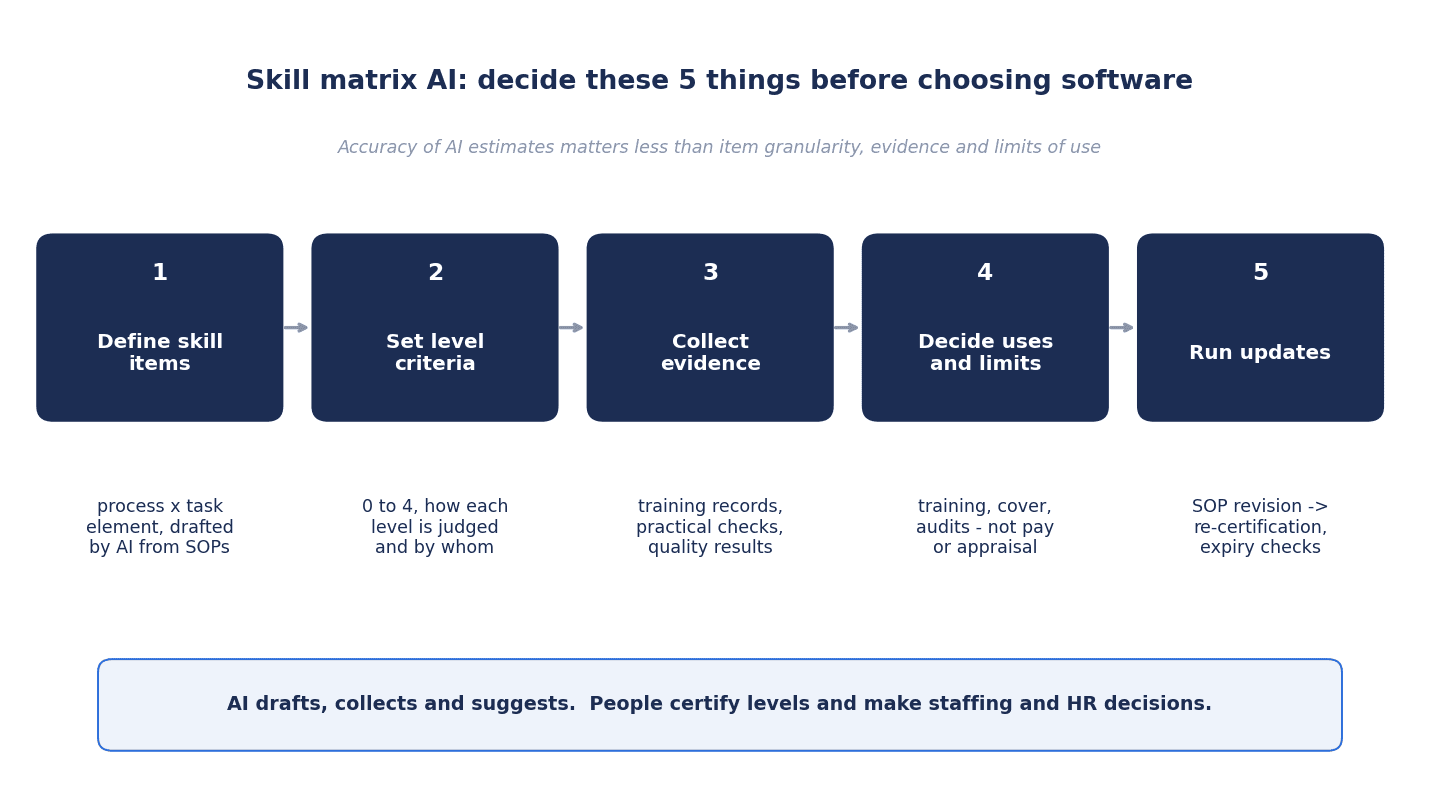
- Defining skill items: identify process × work element from the work instructions. Draft with generative AI, and shop-floor leaders finalize
- Criteria for judging levels: for each level, decide the judging method (practical check, written test, quality results) and the certifier
- Consolidating evidence: link training records, practical checks, qualifications, quality results and attendance. Migrate from paper and Excel
- Uses and where to draw the line: use it for training plans, substitute candidates for absences, multi-skilling targets and audit trails. Do not use it to automatically decide evaluations, wages or treatment
- Running updates: when a work instruction is revised, skill items change and recertification is needed. Decide on rechecks for expirations and who approves
Granularity of skill items
If the granularity is too coarse (for example, “assembly”), you end up with a level 2 person who can actually only tighten screws. If it is too fine (for example, “tighten M4 screws to the specified torque” as a separate item for each part), the items run into the thousands and nobody can update them. As a guide, cut items at the unit where “if you cannot do this task, you cannot be assigned alone to that process.” Aligning items with the units of work elements in the work instructions makes it easier to link revisions of the instructions with revisions of the skill items.
Developing the work instructions themselves as video and in Thai is covered in Work Instruction Video AI | Multilingual Video Manuals and Payback in Thai Factories 2026. The relationship is that the work instructions are “the teaching material,” and the skill matrix is “the certification and record of the results of teaching.”
Example of level definitions
The following is a five-level example. The key point is less the numbers themselves than deciding the judging method and certifier for each level.
| Level | State | Example of judging method | Example of certifier |
|---|---|---|---|
| 0 | Untrained | None | None |
| 1 | Can do the work with an instructor present | Record of attending training | Instructor |
| 2 | Can do the work alone | Practical check (confirming with a checksheet that the work follows the procedure) | Team leader or line leader |
| 3 | Can do the work within standards for both quality and speed | Practical check + quality results over a set period (defects, rework) and work time | Supervisor or section manager |
| 4 | Can instruct others | Track record of instructing + review of the instruction content | Section manager + quality assurance |
In this example, the threshold for counting multi-skilling is set at “level 2 or above”. Whether a person can be assigned alone without an instructor is the dividing line for whether they can be used when someone is absent. For critical safety parts and special processes (welding, heat treatment, inspection and so on), additional conditions (qualifications, written tests) are sometimes attached to the level 2 judgment.
Always record “who certified it”
Even when AI assembles the material for judgment, the action of raising a level is performed by a person, and that person’s name and the date and time are kept on record. What audits ask is “who approved this level, and on what basis?” A level display with no record of the certifier is not evidence, however neat it looks.
If you are struggling at the stage of putting veterans’ judgment criteria into words as standards, Skilled Worker Knowledge Transfer with AI | Thai Factory Guide may also help. Without standards, you cannot define “within standards” for level 3.
Consolidating evidence: digitizing training records and linking practical checks and quality results
Types of records to gather
| Record | Main storage location (common current state) | How it is used in the skill matrix |
|---|---|---|
| Training attendance records | Paper attendance slips, Excel | Basis for level 1, totaling training results |
| OJT and practical check checksheets | Paper, files for each line | Basis for level 2 |
| Qualifications and tests (in-house tests, national skill standards and so on) | HR files, copies of certificates | Conditions for special processes, managing expiry dates |
| Quality results (defects, rework) | MES, quality records, daily reports | Material for judging level 3 |
| Work time and labor hours | Labor hour records, daily reports | Material for judging level 3 |
| Attendance | Attendance system | Identifying absences, attendance status of substitute candidates |
| Versions of work instructions | Document management, shared folders | Identifying recertification targets at revision |
Digitizing training records does not mean scanning and saving paper attendance slips. It means holding “who received training on which item, when, with which version of the work instruction, and who confirmed it” as searchable data. Paper records can be read with AI-OCR, but the work of shaping the results into data by person and by item remains. In the first stage of migration, it is more realistic to take stock of the current certification status once and record digitally from that point on than to digitize every past record.
Linking with attendance, labor hours and document management
To present substitute candidates when someone is absent, you must know “among the people at work today, who is at level 2 or above for that process.” This requires a link with attendance data. How to choose an attendance system is laid out in Attendance Management System for Thai Factories | 4 Criteria.
If you use work time to judge level 3, labor hour records need to be captured by process and by worker. For designing the granularity of labor hours, see Labor Hour Management System — Booking Granularity, Attendance Reconciliation and RFP for Thai Factories.
To link work instruction revisions to recertification, have the document management side hold “which version of which work instruction corresponds to which skill item.” Version control and approval mechanisms are explained in Document Management System for Factories — 3 Axes to Compare.
Keep evaluations from before and after training
ISO 9001 7.2 c) requires evaluating the effectiveness of actions taken. The handbook of the Department of Skill Development (DSD) of Thailand’s Ministry of Labour (2017 edition) also states that when applying through the DSD e-Service for certification of a training course, the employer submits the method and criteria for evaluating the ability of trained employees, and follows up to evaluate that ability has improved by 50% or more after training (the current e-Service requirements need to be checked in the latest version). A design that keeps evaluations from before and after training as records can serve both the ISO effectiveness evaluation and Thai training certification practice.
Managing multi-skilling: coverage rates and how to present substitute candidates
Use the coverage rate to find thin processes
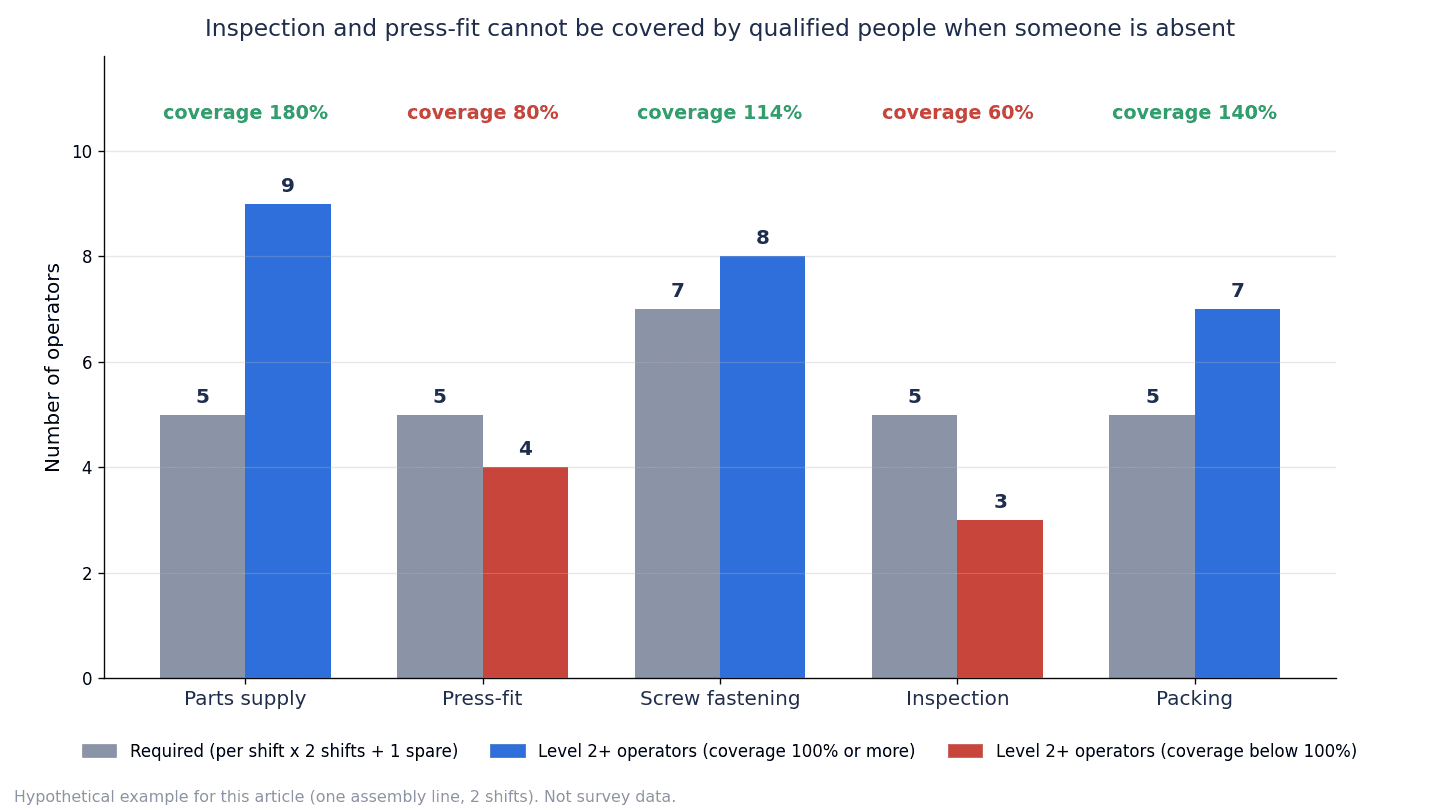
The first thing to look at in managing multi-skilling is the coverage rate for each process. Here, “coverage rate = number of people at level 2 or above ÷ required headcount.” The following is a placeholder example assuming five processes on an assembly line (two shifts) at the model plant. Required headcount is counted as “people assigned per shift × 2 shifts + 1 spare to cover absences.” Parts supply, press-fitting, inspection and packing have 2 people per shift, so 5 people; screw tightening has 3 people per shift, so 7 people.
| Process | Required headcount | People at level 2 or above | Coverage rate |
|---|---|---|---|
| Parts supply | 5 | 9 | 180% |
| Press-fitting | 5 | 4 | 80% |
| Screw tightening | 7 | 8 | 114% |
| Inspection | 5 | 3 | 60% |
| Packing | 5 | 7 | 140% |
Coverage rates are rounded to the nearest whole number (screw tightening is 8 ÷ 7 = 1.142…, so 114%).
Here is how to read this table. Press-fitting (80%) has exactly the 4 people for normal staffing, so when someone is absent the gap cannot be filled with a qualified person. Inspection (60%) is in a state where, even with no absences, normal staffing for two shifts (4 people) cannot be met with qualified people alone. Multi-skilling training gives priority to these two processes. Parts supply (180%) has many people, but that in itself is not a problem. Read it as having candidates to train for other processes.
How to present substitute candidates
Substitute candidates for an absence are less likely to clash with shop-floor judgment if narrowed down in the following order.
- They are at work that day
- They are at level 2 or above for the process with the absence (for special processes, the required qualification is valid)
- Taking that person away does not push the coverage rate of their original process below 100%
- There are no problems with their recent quality results
What AI or a rules engine produces is these “candidates”; the leader makes the final decision on whom to assign. When no candidates come out (all qualified people are already assigned), that in itself becomes measured data on “insufficient coverage.” The number of “substitute assignment losses” after introduction is counted from these records.
Division of roles with shift planning
The skill matrix holds “who can do what,” and shift management decides “who works when.” The ideal link is to pass level information from the skill matrix to shift planning and build combinations that meet the skills required for each shift. Design on the shift side is covered in Shift Management Systems — Thai Factory Selection Guide.
How to set multi-skilling targets
The target is not “everyone can do every process.” Training takes time, and levels drop if they are not used. A realistic target is getting the coverage rate of every process to 100% or more, and then building in more spare capacity for critical processes. If you plan in the order of using people from processes with room to spare in coverage (such as parts supply in the example) as training candidates for processes below 100%, training investment goes to the thin processes.
Choosing a skills matrix software approach: Excel, HR and LMS skill features, dedicated shop-floor products, custom development
Four options
| Option | Suited to | Points to watch |
|---|---|---|
| Excel (with a common template) | Few workers, a single site, wanting to align items and level criteria first | Limits on linking to evidence, expiry management and simultaneous editing. Scattered versions |
| Skill features of HR and LMS products | A company-wide talent management platform already exists, wanting to manage white-collar staff as well | Need to confirm whether it fits process × work element granularity and records of shop-floor practical checks |
| Dedicated skill management products for the shop floor | Many processes, audit response and expiry management as the main goals, multiple sites | Scope of links with attendance, MES and document management. Display in Thai and other languages |
| Custom development (added to existing systems) | Having a unique process structure or in-house tests, wanting tight links with existing MES or attendance | Who owns maintenance, documentation of specifications, cost of modifications after development |
Product examples (vendor claims)
The following do not recommend any specific product; they are examples showing what kinds of functions are advertised. The functions and effect figures are each company’s claims, and the calculation methods and comparison baselines could not be confirmed on the companies’ pages. None of the official pages list prices.
- Workday Skills Cloud: According to the company, it uses AI to visualize and analyze relationships between skills within an organization, and provides job recommendations and learning content recommendations based on skill gaps. The company states that 30% of the Fortune 500 use it, with internal hire rates 26% higher on average and voluntary turnover 5% lower (averages for July 2023 to June 2025).
- SAP SuccessFactors Talent Intelligence Hub: According to an October 2023 announcement, it is an AI-based skills foundation built into the SuccessFactors HXM suite that combines skills data from multiple sources, including third-party data, and makes upskilling recommendations based on skill gaps, among other functions.
- Microsoft People Skills: As described above, it infers skills from Microsoft 365 activity, and the official documentation itself states that performance may be limited for field workers.
- Poka (a Connected Worker Platform for the shop floor): According to the company’s page, it advertises visualization of skills and qualification expirations by shift and site, a function that automatically assigns work only to qualified workers, competence confirmation through tests and approval and recertification by experienced shop-floor staff, and a function that uses industrial AI to convert paper training materials into step-by-step digital training. The effects the company claims are 42% faster onboarding of new hires, an 87% reduction in turnover, an 11% improvement in new hires’ OEE, and a 77% reduction in time spent creating training content with AI.
- AG5 (dedicated skills matrix software): According to the company’s page, it advertises centralizing spreadsheet skill matrices, filters by shift, department, role and equipment, monitoring of qualification expiry dates and renewals, and presentation of audit trails for ISO and safety audits, and it has a function called “AI skills merge.” As a customer story, it describes presenting certificates and competence at audits going from 4 weeks to 20 minutes (Busch Vacuums).
Functions like Poka’s “automatically assign only to qualified workers” are convenient, but as discussed later, designs that use AI to assign people involve legal issues. Whether to enable automatic assignment is a decision to make internally, separately from whether the function exists.
Criteria for selection
When comparing options, look at whether they can answer the following questions.
- Can it hold your own process × work element granularity as items as-is?
- Can you set a judging method and certifier for each level, and is the certification history kept?
- Can it identify the people who need recertification in step with work instruction revisions?
- By what methods can it link with attendance, labor hours, document management and MES?
- Can workers check their own certification status in a language they can read, such as Thai?
- Can it output lists for audits with certifiers and the basis attached?
- Can AI functions (inference, automatic assignment) be turned off per item or per function?
Points to watch in Thailand: the Skill Development Promotion Act, skill standard wages, PDPA, multiple languages
The Skill Development Promotion Act’s 50% and fund contributions
According to the handbook of the Department of Skill Development (DSD) of Thailand’s Ministry of Labour (2017 edition), under the Skill Development Promotion Act (enacted 2002, since amended), employers with 100 or more employees (industrial, commercial and other businesses) that provide skill development to at least 50% of all employees in each calendar year through any of, or a combination of, (1) skill training for their own employees, (2) taking and passing national skill standard tests, and (3) obtaining knowledge and ability certification, are not required to contribute to the Skill Development Fund for that year. If the target is not met, the employer contributes to the fund at a rate of 1% of the base wage used for calculating contributions, and files a return during March of the following year. If there are branches, employee numbers for all branches are combined.
The contribution is calculated as “base wage × number of people short of 50% × number of months with a contribution obligation × contribution rate set by ministerial notification,” and after the deadline a surcharge of 1.5% per month is added to the unpaid amount. The DSD’s table of base wages for contributions shows, for returns covering 2025, a base of 337 baht per day, the minimum wage in the province with the lowest minimum wage, × 30 days = 10,110 baht, giving 10,110 × 12 × 1% = 1,213.20 baht (per person short, for 12 months). The base amount for 2026 could not be confirmed in this table. It was also reported that in February 2025 the DSD urged covered companies to file by March 31.
The handbook is the 2017 edition, and the detailed rules need to be checked in the latest version.
National skill standards and skill standard wages
Thailand has a system of “wages based on skill standards,” which uses national skill standards as the yardstick to set minimum daily rates by occupation and level. No. 15 was published in the Royal Gazette on June 16, 2026 and is set to take effect 90 days after publication in the Royal Gazette. For example, a flux-core welder receives 550 baht at level 1 and 650 baht at level 2, a MIG welder 550 baht at level 1 and 650 baht at level 2, and an industrial robot maintenance technician 630 baht at level 1. When employers assign workers to jobs that require all or part of the relevant skill standard, they must pay at least the wage rate for that occupation and level, and those who have passed the test exercise this right by submitting their certificate. The previous No. 14 (dated April 9, 2025) covered 13 occupations at daily rates of 485–800 baht.
The 50% under the Skill Development Promotion Act can count not only in-house training but also people who have passed national skill standard tests. And skill standard wages set minimum daily rates by occupation and level on the premise of passing national skill standard tests. If you hold “national skill standard level” as an item in the skill matrix, you can use it both for managing the statutory training ratio and as the basis for paying skill wages. This is the author’s view, not a format the regulations require. Confirm how wages are handled with HR and labor specialists.
Tax treatment of training costs
According to the DSD handbook, training costs certified by the registrar under the Skill Development Promotion Act can be exempted from income tax by an additional 100% with the Revenue Department (in the case of training conducted in-house; for training at external providers, the Revenue Department decides based on the training institution’s receipts). Commentary from the accounting firm RSM cites Royal Decree No. 437 as the basis. Our understanding is that there is an additional 100% deduction on top of the ordinary deductible expense. Confirm eligibility and procedures with accounting and tax specialists.
Under the EEC talent development model, for short-term upskilling and reskilling training (Type B), the government subsidizes up to 50% of training costs, and the private sector can receive a 2.5 times tax deduction (EEC Office page).
Moves to develop AI talent
In May 2025, the DSD and Microsoft announced “THAI Academy,” which provides AI training at the DSD’s 77 training centers nationwide. The initial target is about 100,000 workers and job seekers, and at the time of the announcement 40,521 people had participated and 16,476 had completed the training and been certified. In July 2026, the Thai government launched a skills reform across five ministries (upskilling, reskilling, lifelong learning, a credit bank for transferring credits and so on), but reports pointed out that no additional budget, number of trainees or timeline for achieving the main targets was given.
Skill matrices for shop-floor workers and developing the people who use AI are separate topics, but they are connected. Training is needed so that the shop-floor leaders and quality assurance staff who run the skill matrix can spot errors in generative AI drafts. Designing that training is covered in Manufacturing AI Training in Thailand — Curriculum and RFP Guide.
PDPA: skills data is personal data
Thailand’s Personal Data Protection Act (PDPA) has been fully in force since June 1, 2022. According to commentary by the law firm DLA Piper, collecting, using and disclosing personal data in principle requires the data subject’s consent, except where there is another legal basis such as performance of a contract, a legal obligation, or the legitimate interests of the controller (Section 24). When relying on legitimate interests, the burden of proof ultimately falls on the data controller, and the judgment rests on three elements: purpose, necessity and balancing of interests (commentary by the law firm Formichella & Sritawat).
What goes into a skill matrix is personal data such as names, departments, training records, levels and quality results. The points to note are as follows.
- Consent is not always required just because it is employee data. Decide which legal basis applies to the processing for each purpose, and record it
- Do not mix in sensitive data. Sensitive data under the PDPA (Section 26) includes health, disability and biometric data, and requires explicit consent unless there is another legal basis. When linking attendance data from face recognition or fingerprints, it may fall under sensitive data as biometric data, so a design that passes only the clock-in and clock-out results to the skill matrix side is the safer choice
- Cross-border transfers. When placing data at the head office in Japan or in an overseas cloud, either an adequate level of protection at the destination, or an exception or appropriate safeguards (such as standard contractual clauses), is required
- Penalties. Administrative fines are reported to be capped at 5 million baht, punitive damages at up to 2 times actual damages, and criminal liability for directors and managers is also possible
The boundary between factory data and personal information is covered in detail in Factory IoT Personal Data Protection 2026 | Thailand PDPA.
Multiple languages
In factories in Thailand, workers often use Thai, Burmese and other languages, while managers use Japanese or English. If skill items and judging criteria exist only in Japanese, workers cannot check what is required of them. Build in a procedure where generative AI drafts translations of item names and descriptions, and representatives of leaders and workers confirm that the wording is understood in shop-floor language. Inconsistent terms in translation can also cause the same task to be registered as separate items.
Risks and where to draw the line when evaluating people with AI
High-risk classification under the EU AI Act
Factories with a parent company or customers in Europe also need to keep track of developments under the EU AI Act. Annex III point 4 of the EU AI Act, “Employment, workers’ management and access to self-employment,” classifies as high-risk AI (a) AI used for recruitment and selection, and (b) AI used to make decisions affecting terms of work-related relationships, promotion or termination, to allocate tasks based on individual behavior or personal traits or characteristics, or to monitor and evaluate the performance and behavior of persons in such relationships.
A design that uses skill matrix AI for “allocating tasks” or “evaluating performance” may fall under (b). Whether it does depends on conditions such as what it is used for, whether it is used within the EU, and whether you are the provider or the deployer, and this article does not draw a definitive conclusion.
On timing, the Digital Omnibus on AI, Regulation (EU) 2026/1744, was published in the Official Journal of the EU on July 24, 2026 and entered into force on July 27, 2026 (commentary by the law firm A&O Shearman). As a result, the application of obligations for stand-alone high-risk AI under Annex III (Chapter III, Sections 1–3) was postponed to December 2, 2027, and for AI embedded in products under Annex I to August 2, 2028. The postponement is not a proposal; it has been decided and is in force. Transparency obligations (Article 50) and others have applied from August 2, 2026, as originally scheduled.
The same amendment revised the definition of “safety component” to focus on whether it performs a safety function and whether its failure endangers health and safety, and systems used solely for convenience, automation, optimization or quality control are not covered unless their failure creates health and safety risks. The author’s reading is that factory quality control AI may fall outside the scope via the product-embedded route, but if it is used to evaluate or assign people, the Annex III point 4 issue remains separately.
Drawing the line in practice
| Use | Recommended handling | Reason |
|---|---|---|
| Drafting skill items, drafting translations | Leave to AI, people finalize | Not directly linked to evaluation or treatment of people |
| Detecting expirations and recertification targets | Leave to AI or rules | Matching facts, with no judgment involved |
| Presenting training plans and substitute candidates | AI only proposes candidates, people decide | Close to allocating tasks, so the final decision stays with people |
| Certifying levels | People certify and the certifier is recorded | Needed as evidence of competence |
| HR evaluation, wages, promotion | Do not automatically apply AI inferences | High-risk issues in the employment field, accountability |
Even with a mechanism in which people decide, if people simply approve AI candidates as-is every time, in substance it is no different from automated decision-making. Build the following three things into operations.
- Explainability: the screen can show why that person came up as a candidate (which level and which records are the basis)
- Ability to object: when workers think their level or records are wrong, there is a contact point and a procedure for raising it
- Records of human review: the person who approved, the date and time, and the reason for any rejection are kept
A framework for managing AI use internally is introduced in ISO 42001 Implementation in 90 Days for Thai Manufacturers. If you are considering a design that uses AI to evaluate or treat people, get a case-by-case legal review from the perspective of the PDPA and (where applicable) the EU AI Act.
How workers see it
In a Deloitte survey conducted in spring to summer 2022 of 1,021 workers and 225 business and HR executives across 10 countries, 79% of workers said they were willing to share their skills data for purposes such as matching to work, and a further 14% said they would be willing to share it on condition of responsible use and something in return. The same survey states that organizations that have embedded a skills-based approach are 63% more likely to achieve 11 business and workforce outcomes, while fewer than 1 in 5 organizations have adopted skills-based practices at scale in a clear and repeatable way across the organization.
This is a 2022 survey of workers in general across 10 countries, and it does not necessarily apply as-is to factory workers in Thailand. Still, one implication can be read from it: if you can explain “what it is used for” and “what workers get in return (training opportunities, skill allowances, choices of assignment),” workers are more likely to accept the recording of their skills data.
Model calculation of costs and benefits (placeholder figures)
The figures from here on are not vendor or survey figures, but placeholders set to show the structure of the calculation. Replace them with your own figures.
Model plant assumptions
- One site of a Japanese-affiliated parts manufacturer in Thailand, 600 workers, about 120 processes
- The skill matrix is managed in Excel by each line’s leader
- 25 supervisors and leaders
- Currency is THB
| Assumption | Value (placeholder) | Breakdown and calculation |
|---|---|---|
| Initial cost I | 1,200,000 THB | Support for defining skill items and building level criteria 400,000 + system build, data migration, and links with attendance and training records 800,000 |
| Annual operating cost L | 300,000 THB/year | Total of licenses, maintenance and operational support |
| Benefit A: management hours | 360,000 THB/year | 25 supervisors and leaders × 4 hours per month × 12 months × hourly rate 300 THB |
| Benefit B: reduction in substitute assignment losses | 60,000 × n THB/year | 5,000 THB per case × 12 months × n cases per month |
Benefit A is the time supervisors and leaders spend updating the skill matrix, reconciling before audits, and searching for substitutes when someone is absent. Benefit B is the effect of reducing, by n cases a month, losses where a qualified person cannot be found quickly when someone is absent, so the line’s start-up is delayed, or an unqualified person is assigned and rework results. Benefit A is supervisors’ time and Benefit B is line losses; they are different things. We do not double count. The “time” spent searching for a substitute during an absence goes into Benefit A, and the “line loss” that results when no substitute is found goes into Benefit B, so that the same event is not counted in both.
Main case (n = 5 cases/month)
| Item | Main case (n = 5 cases/month) | Calculation |
|---|---|---|
| Benefit A: management hours | 360,000 THB/year | 25 × 4 × 12 × 300 |
| Benefit B: reduction in substitute assignment losses | 300,000 THB/year | 5,000 × 12 × 5 |
| Annual operating cost | −300,000 THB/year | Placeholder |
| Annual net benefit | 360,000 THB/year | 360,000 + 300,000 − 300,000 |
| Simple payback period | About 3.3 years | 1,200,000 ÷ 360,000 = 3.33 |
As a general formula, annual net benefit = 360,000 + 60,000n − 300,000 = 60,000 + 60,000n (THB/year).
Changing the number of substitute assignment losses
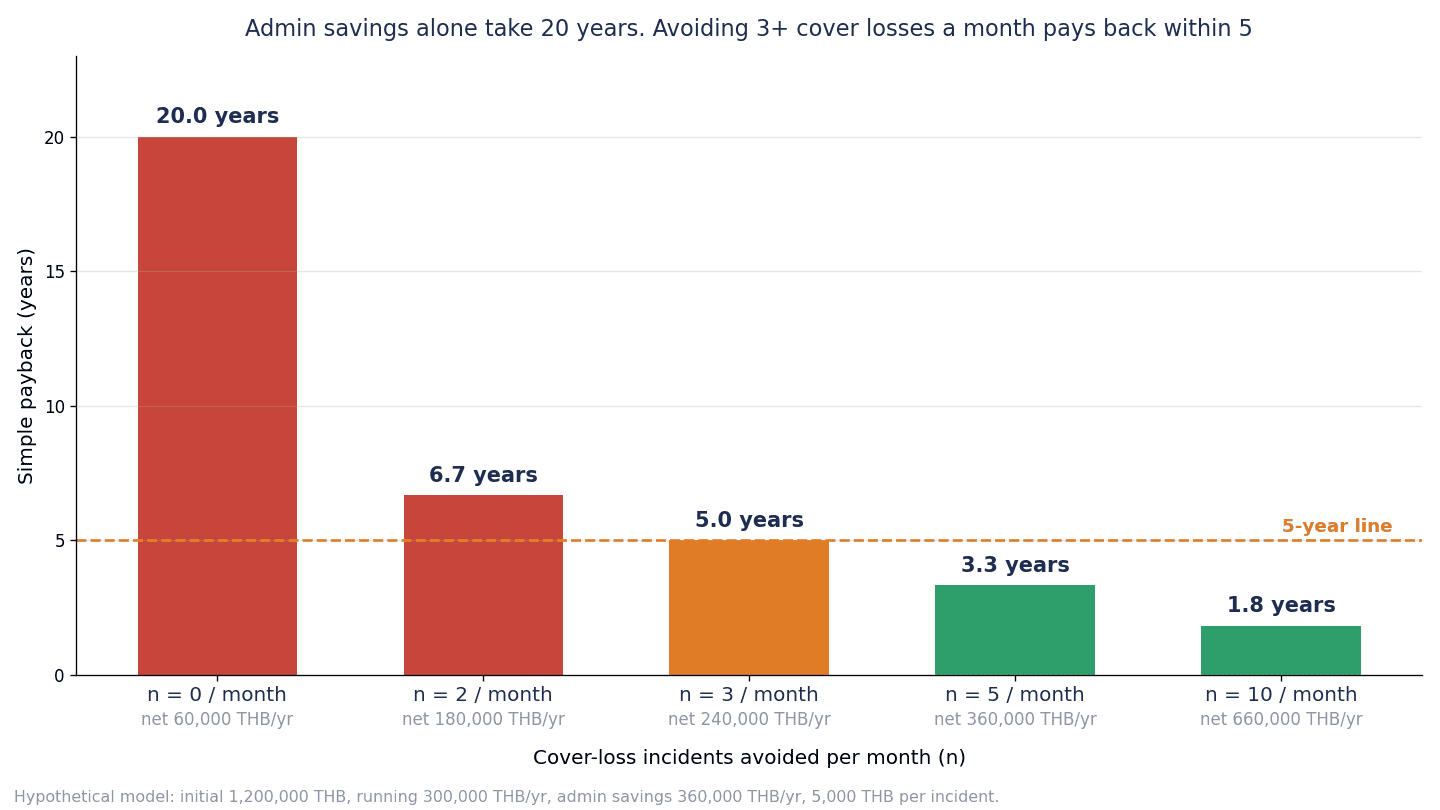
| Cases reduced per month n | Benefit B (THB/year) | Annual net benefit (THB/year) | Simple payback period |
|---|---|---|---|
| 0 cases | 0 | 60,000 | 20 years (1,200,000 ÷ 60,000) |
| 2 cases | 120,000 | 180,000 | About 6.7 years (1,200,000 ÷ 180,000 = 6.67) |
| 3 cases | 180,000 | 240,000 | 5.0 years (1,200,000 ÷ 240,000) |
| 5 cases | 300,000 | 360,000 | About 3.3 years (1,200,000 ÷ 360,000 = 3.33) |
| 10 cases | 600,000 | 660,000 | About 1.8 years (1,200,000 ÷ 660,000 = 1.82) |
The condition for payback within 5 years is an annual net benefit of 240,000 THB or more (1,200,000 ÷ 5). From 60,000 + 60,000n ≥ 240,000 we get 60,000n ≥ 180,000, so n ≥ 3 cases/month is the dividing line. At n = 0, that is, with only the reduction in management hours, payback takes 20 years and does not happen within 5 years. Even at n = 2 it is about 6.7 years, exceeding 5 years.
Replace n and the loss per case with measured values
Do not set n and the loss per case (5,000 THB) by guesswork. For 3 months before introduction, record and measure delays in line start-up during absences and rework caused by assigning unqualified people, and replace the figures in the calculation. The records from the 3 months before introduction become the baseline for the number of occurrences. After introduction, count the same cases using records such as the “no substitute candidate came out” records described in the earlier section, and take the difference from before introduction as n.
Also, Benefit A (time converted into money) does not become a cash reduction unless the freed-up time is redirected to other work. Unless you decide what supervisors will do with the freed-up time (delivering training, quality improvement activities and so on), Benefit A ends up as “a benefit on paper.”
What this calculation does not include
The following may have benefits, but they are not included in the calculation.
- Fewer audit findings
- Evaluations in customer audits
- Effects on turnover
- Managing training results related to Thailand’s Skill Development Promotion Act (achieving 50% and whether fund contributions are required)
- Tax treatment of training costs (the additional 100% deduction)
Because contributions to the Skill Development Fund are determined by an amount per person short, whether better records reduce contributions depends on each company’s training results. Eligibility for tax treatment is also determined case by case. If you want to include these as benefits, calculate them separately with your own actual figures and figures reviewed by specialists.
What the calculation tells us
Reducing supervisors’ administrative time alone takes 20 years to pay back. What justifies the investment is how much you can reduce the losses where a qualified person cannot fill an absence, so the line is delayed or rework results. In this model, 3 cases a month was the dividing line for 5-year payback. That is why it makes sense to start with lines that have processes whose coverage rate is below 100% (inspection and press-fitting in the earlier example), and to measure substitute assignment losses before introduction. Confirming the effect on a line with thin processes before expanding is less likely to lead to a wrong investment decision than systematizing the whole factory at once.
What to include in an RFP for a skills matrix system
When asking vendors for proposals, write down not just a list of functions but the assumptions about your own operations.
| Category | Item to include in the RFP | Examples of specific content |
|---|---|---|
| Scope | Target sites, lines, number of processes, number of workers | Start with 1 site, 600 workers and about 120 processes, with plans to roll out to other lines |
| Item definitions | Hierarchy and granularity of skill items | Process × work element. We want to map them to the work elements in the work instructions |
| Levels | Number of levels, and judging method and certifier for each level | 5 levels from 0 to 4. A judging method and certifier can be set for each level, and certification history is kept |
| Evidence | Importing training records, practical checks, qualifications and quality results | How paper records are migrated, importing existing Excel, storing attachments |
| Revision linkage | Recertification when work instructions are revised | Map document management versions to skill items, and notify recertification targets on revision |
| Expiry management | Expiry dates of qualifications and certifications | Notification before expiry, display on expiry, and exclusion from assignment candidates |
| Multi-skilling | Coverage rates and substitute candidates | Display of coverage rates by process, presentation of substitute candidates from those at work (final decision by people) |
| Integration | Attendance, labor hours, document management, MES, HR | Integration method (API, files) and frequency, items for each integration target |
| AI functions | Processing done by AI, and the extent that can be turned off | Drafting items, drafting translations, presenting candidates. Inference and automatic assignment can be turned off per function |
| Languages | Display language of screens and items | Japanese, English, Thai. Other languages needed on worker-facing screens |
| Audit trail | Output for audits | Output competence lists by worker and by process, with basis records and certifiers |
| Personal data | PDPA compliance | Data storage location, whether there are cross-border transfers, access rights, retention periods and deletion |
What to check in the PoC: five cases to test on purpose
Even if the demo screens look good, the trouble in operations comes with exceptions. In the PoC (proof of concept), deliberately trigger the following cases and check.
- Work instruction revision: revise the work instruction for a process, and check whether recertification notifications go out to the people certified on the corresponding skill items. How are certifications from before the revision displayed?
- Substitute candidates during absences: mark a person at level 2 or above for a process as absent, and check whether substitute candidates come out. Do the candidates match the people a shop-floor leader would choose? Does taking a candidate away lower the coverage rate of the original process too far?
- Multilingual display: can workers read skill items and judging criteria in Thai, Burmese and other languages? Is there any garbled text or broken layout?
- Audit trail output: for any worker, can the level, the basis records, the certifier, and the date and time be output in a form that can be presented at an audit?
- Errors in AI drafts: what kinds of errors are mixed into the skill item drafts that AI created from work instructions? Can missing work elements, uneven granularity and translation errors be found through the leaders’ review procedure?
What to measure in the PoC
| Item to measure | How to read it |
|---|---|
| Match rate of substitute candidates | The share of cases where the system’s candidates matched the leader’s judgment. Record the reasons for mismatches |
| Missed recertification notifications | The number of workers corresponding to the revised work instruction who did not receive a notification |
| Time to create audit lists | Time compared with manual work before introduction |
| Amount of correction to AI drafts | The number of draft items that leaders corrected, deleted or added |
| Number of substitute assignment losses | Measured value of n in the calculation. Compare the number during the PoC period with before introduction |
Frequently asked questions
What is a skill matrix?
It is a table that lists workers down the side and processes or work elements across the top, with each cell recording at what level that person can do that work. It is also called a competency chart, a hoshitorihyo (the Japanese term for a chart of marks) or a training matrix. Its roles are three: understanding the current state, planning multi-skilling, and evidence of competence. The symbols in the table are not evidence on their own; they need to be linked to training records, records of practical checks, and the certifier.
Can AI create a skill matrix?
Drafts of skill items can be created with generative AI using work instructions as input. However, drafts contain errors and uneven granularity, so shop-floor leaders need to finalize them. Having AI “infer” each worker’s level is not a good fit, because there is little data on shop-floor workers. Microsoft’s official documentation also states that its skill inference may have limited performance for field workers. People certify levels and record the certifier.
How much does a competency management system cost?
Prices were not listed on the official pages of the products researched for this article. Costs vary greatly depending on the number of people and processes covered, the systems to be integrated, and who defines the skill items. In this article’s model calculation we set placeholders of 1,200,000 THB in initial costs and 300,000 THB in annual operating costs, but these figures are only to show the structure of the calculation. When comparing quotations, check whether support for defining items and building level criteria is included.
Is a skill matrix enough for ISO 9001 competence records?
Often a skill matrix alone is not enough. ISO 9001 clause 7.2 requires determining the necessary competence, ensuring that persons are competent, evaluating the effectiveness of actions, and retaining documented information as evidence of competence. A skill matrix can be used to determine competence and list the current state, but to present it as evidence, training records, practical check records and records of the certifier need to be linked to the level display. How clause 7.2 changed in ISO 9001:2026 (published September 16, 2026) could not be confirmed in this article, so check with your certification body.
How should multi-skilling be managed?
Calculate a coverage rate for each process as “number of people at level 2 or above (able to work alone without an instructor) ÷ required headcount,” and give training priority to processes below 100%. Rather than aiming for everyone to be able to do every process, it is more realistic to get the coverage rate of every process to 100% or more and build in more spare capacity for critical processes. Narrow down substitute candidates for absences by attendance status, level, the coverage rate of the original process and quality results, and people decide the final assignment.
Is it acceptable to evaluate workers with AI?
Designs that automatically apply AI inferences to HR evaluations, wages or promotions should be avoided. Under Thailand’s PDPA, the legal basis for processing needs to be sorted out for each purpose, and if there is a parent company or customers in Europe, it may fall under Annex III point 4 of the EU AI Act (AI used for allocating tasks, evaluating performance and so on). Keep AI to the point of producing candidates and material for judgment; people decide, and those records are kept. If you use AI to evaluate people, get a case-by-case legal review.
Where should digitizing training records start?
Rather than digitizing every past paper record, it is more realistic to take stock of the current certification status once and record training and certification digitally from that point on. First, align the skill items and level criteria, and make it possible to record in those units. Digitizing records whose units are not aligned does not make them usable for searching or totaling.
Summary
- Whether skill matrix AI succeeds depends not on the accuracy of the AI’s estimates, but on whether you first decided the granularity of skill items and the criteria for judging levels, the evidence for levels, and where to draw the line on AI use
- The order of decisions is (1) defining skill items, (2) criteria for judging levels, (3) consolidating evidence, (4) uses and where to draw the line, (5) running updates
- Use AI for drafting items, consolidating records and proposing candidates; people decide and record level certification, final assignment decisions, and HR evaluation and treatment
- Office-oriented skill inference products may have limited performance for shop-floor workers. Feed in shop-floor data such as work instructions, training records, practical checks and quality results
- Manage multi-skilling by coverage rate per process, and train first for processes below 100%
- In Thailand, take into account the 50% under the Skill Development Promotion Act, national skill standards and skill standard wages, and the PDPA, and if you have ties to Europe, also check the employment-field issues under the EU AI Act
- In the model calculation, reducing management hours alone took 20 years to pay back, and whether you can reduce substitute assignment losses during absences by 3 or more cases a month was the dividing line for 5-year payback. Measure this loss before introduction
TOMAS TECH helps factories in Thailand build skill matrix mechanisms suited to their operations, connect them with existing systems such as attendance and document management, and make use of generative AI. You can consult us even before a product has been chosen, for example at the stage of identifying skill items or defining levels. Please contact us through this form.
References
- Auditor Training Online: Defining ISO 9001 Clause 7.2 Competence (January 29, 2023)
- SGS: ISO 9001:2026 Published: What You Need to Know (September 16, 2026)
- LRQA: ISO 9001 publication date confirmed
- LRQA: ISO 9001 FDIS update
- Advisera 16949Academy: How to ensure competence of your employees according to IATF 16949 (October 4, 2017)
- Department of Skill Development (DSD), Ministry of Labour, Thailand: Handbook for employers obligated to contribute to the Skill Development Fund, B.E. 2560 edition (December 2017)
- Department of Skill Development (DSD), Ministry of Labour, Thailand: Table of minimum wages used as the base for calculating Skill Development Fund contributions
- RSM Thailand: Thai Tax System (August 31, 2015)
- Bangkok Biz News: Royal Gazette publication of wages based on skill standards, No. 15 (June 16, 2026)
- Public Relations Department, Thailand (PRD): Wage Rates According to Skill Standards in 13 Fields (May 23, 2025)
- DLA Piper: Data Protection Laws of the World – Thailand
- Formichella & Sritawat (Legal 500): PDPA (Thailand) Exception to Rule of Section 19 (December 2, 2024)
- artificialintelligenceact.eu: Annex III High-Risk AI Systems Referred to in Article 6(2)
- A&O Shearman: EU Digital Omnibus on AI: The wait is over but the compliance clock is running (July 2026)
- World Economic Forum: Future of Jobs Report 2025 (January 2025)
- The Star: 174,000 young Thai graduates unemployed amid skills mismatch (October 8, 2026)
- Eastern Economic Corridor Office of Thailand: Human Capital Development under the EEC Model
- Deloitte: Building tomorrow’s skills-based organization (2022)
- Microsoft Learn: People Skills AI Inference engine
- Workday: Workday Skills Cloud
- SAP News Center: Talent Intelligence Hub (October 3, 2023)
- Poka: Skills Management and Training Matrix Software
- AG5: Skills Matrix Software
- Microsoft News Center Asia: Department of Skill Development collaborates with Microsoft to upskill Thai workforce in AI through THAI Academy initiative (May 6, 2025)
- Pattaya Mail: DSD urges skill fund submission by March 31 (February 2, 2025)
- Nation Thailand: Thailand launches five-ministry skills overhaul to confront AI and ageing workforce (July 21, 2026)


