


Skilled Worker Knowledge Transfer with AI | Thai Factory Guide
Skilled worker knowledge transfer with AI is not an attempt to copy a veteran’s mind into a machine or replace experienced people. It is a disciplined way to preserve observable evidence—video, photographs, machine and quality data, interviews, and exception logs—then separate stable standards from contextual judgment and make both searchable across languages. People retain authority for decisions; AI helps them find, compare, and trace the evidence.
This guide brings together digital knowledge transfer, AI-assisted work standards, manufacturing RAG, and multilingual work instructions for factories in Thailand. The practical center is a 90-day pilot with worker participation, informed consent, access control, versioning, auditability, safety gates, and human approval.
Why skilled worker knowledge transfer with AI is not only a labor-shortage project
Many factories already have standard operating procedures, yet crucial reasons remain undocumented. A veteran may react to a sound, a material variation, humidity, subtle vibration, or an upstream condition without consciously describing every cue. A new operator can memorize the sequence and still be unable to decide when to stop, which exception is tolerable, or who must approve a deviation.
Adding generative AI before fixing this information problem can make it worse. If sources, conditions, and approval status are unclear, a model may produce a fluent answer that is unsafe on the actual line. The first design questions are therefore not about model size. They are about provenance, applicability, ownership, approval, revision history, and escalation.
Thailand’s investment environment makes the combination of technology and workforce development especially relevant. Thailand BOI / OSOS reported realized capital expenditure of THB 530 billion, or USD 16.11 billion, in the first half of 2026, with AI-linked sectors accounting for half. The same announcement reported approval of 132 smart and sustainable manufacturing projects worth THB 17 billion, or USD 516.8 million, and described Skill Bridge as covering 35 targeted curricula and more than 60,000 engineers and technical workers. These figures do not predict the return of any individual factory project, but they show why equipment investment and capability building should be designed together. Thailand BOI / OSOS
The World Economic Forum’s 2026 work mapped more than 80 industrial roles across seven manufacturing and supply-chain functions. Its findings say three in four industrial jobs are expected to evolve and about 40% of future industrial skills are new or emerging. It also reported that 86% of employers expect AI and information-processing technologies to transform business by 2030, while 63% identify skills gaps as the greatest barrier. These are WEF findings rather than universal certainties, but they support treating knowledge transfer as work redesign, not preservation of a frozen past. WEF Human-Machine Collaboration Framework
Digital knowledge transfer begins by turning tacit knowledge into traceable evidence
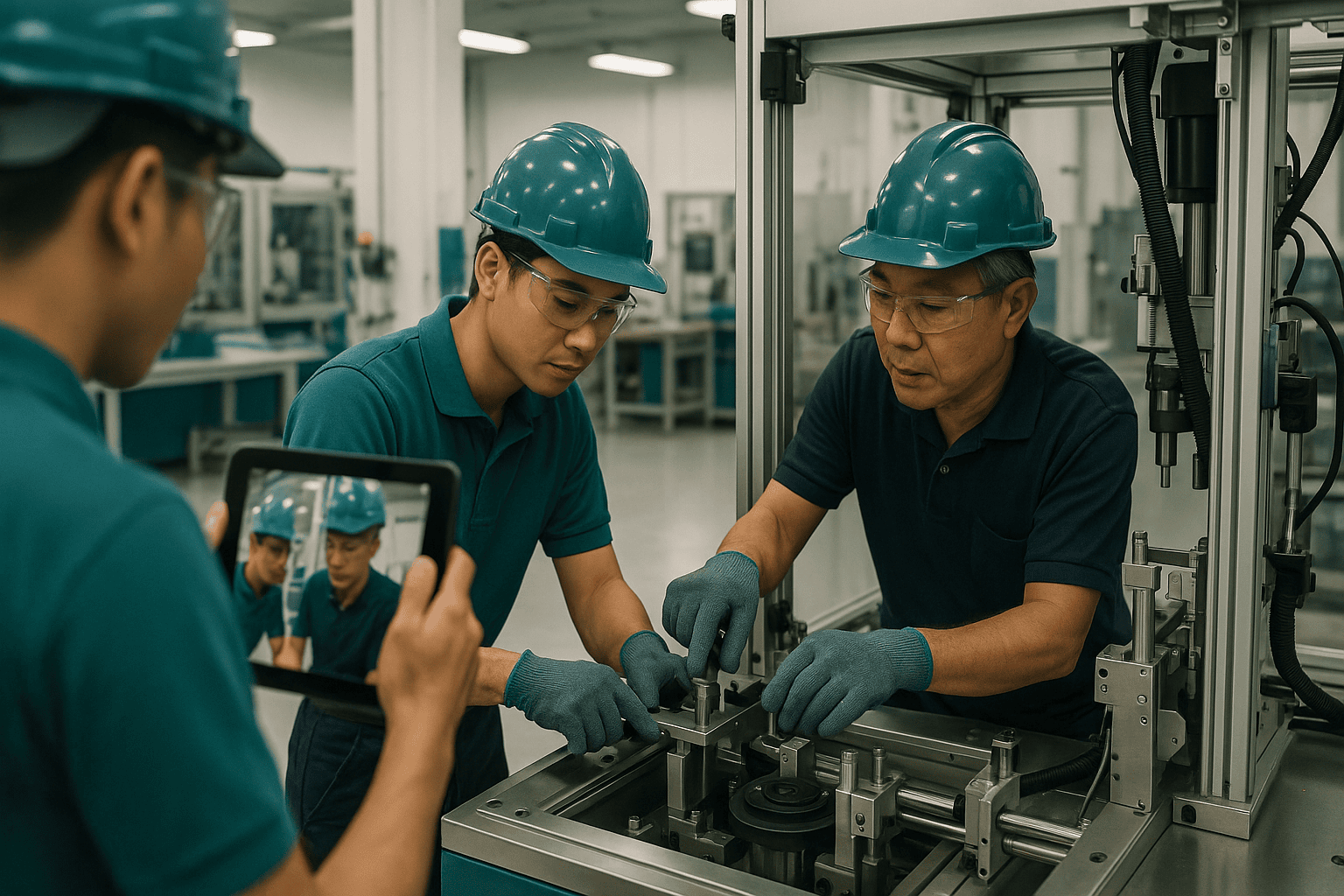
Interviews alone rarely capture tacit knowledge. People automate familiar actions and may be unable to narrate every micro-decision. The better approach is to connect what the expert says with what actually happened.
| Evidence type | What to capture | What it must link to | Primary use |
|---|---|---|---|
| Work video and photos | Sequence, hand position, jig, inspection points | Process, machine, part, operating condition | Reproduction and training |
| Machine and sensor data | Temperature, pressure, vibration, alarms | Time, lot, asset ID | State before and after a decision |
| Quality evidence | Measurements, defect class, recheck | Lot, material, process condition | Explore possible causes and outcomes |
| Veteran interview | Cues, anomalies, stop conditions | Video timestamp and scene | Explain decision rationale |
| Exception log | Deviation, response, approval, result | Impact area and recovery result | Build exception patterns |
| Revision and approval log | Reason, approver, effective date | Standard, version, line | Auditability and misuse prevention |
The objective is not merely to record video. A specific scene needs to connect to the machine state, quality outcome, and expert explanation through shared identifiers. A label such as “good example” is not enough; another part or machine may require a different action. Store process, product family, machine, material, operating condition, author, reviewer, effective date, and expiry or replacement status as metadata.
Recording also needs a consent design. Workers should know the purpose, viewers, retention period, deletion route, and whether the material can be used for performance evaluation. The project must demonstrate through access rules and governance—not just a reassuring statement—that it is creating a safety, quality, and learning asset rather than a surveillance system.
Use comparison questions to surface expert judgment
Asking only “Why did you do that?” often produces “experience” as the answer. Place a normal case beside an abnormal one and ask: What did you notice first? Which change would reverse your decision? What signal does a new operator miss? Where is the stop boundary? Which evidence would make you call quality or maintenance?
Do not promote one person’s explanation directly into a standard. A second veteran and relevant quality, safety, and equipment specialists should review the evidence. Separate reproducible consensus from a personal hypothesis. If reviewers disagree, retain the disagreement as “unconfirmed,” “conditional,” or “requires further testing.” Artificial consensus is less safe than explicit uncertainty.
AI-assisted work standards must separate rules from contextual judgment
Converting every craft insight into a rigid sequence destroys useful flexibility. Leaving everything as “case by case” prevents transfer. A practical knowledge model divides the content by how it can be used.
| Knowledge class | Content | AI role | Human role |
|---|---|---|---|
| Stable standard | Mandatory sequence, specification, safety rule | Retrieve the current approved instruction | Execute and stop on abnormality |
| Conditional standard | Branches by part, machine, material, environment | Find candidates matching conditions | Verify conditions and select |
| Judgment guide | Cues, diagnostic order, escalation threshold | Show similar cases with evidence | Diagnose, approve, remain accountable |
| Unconfirmed hypothesis | Experienced view not yet validated | Label clearly as a hypothesis | Design tests and decide adoption |
| Prohibition or stop rule | Safety or quality boundary | Warn and escalate | Stop immediately and make formal decision |
This model changes the AI from an authority that issues a “correct answer” into an assistant that presents approved information and comparable cases with evidence. The WEF Activation Playbook similarly recommends redesign around complementary human and machine strengths, with human contribution shifting toward judgment, accountability, exception handling, and governance. WEF Activation Playbook
The ILO’s work on skills in the age of AI says adoption reshapes cognitive, socioemotional, digital, and AI skills while AI literacy, adaptability, resilience, and human agency remain essential. An AI work-standard project should strengthen operators’ ability to inspect the basis of a recommendation and build new skills, not remove their agency. ILO, Changing landscape of skills in the age of AI
Treat a standard as a maintained product
Every standard needs an owner, approver, applicable process, conditions, version, effective date, and a trigger for review. A proposed improvement should not overwrite the current version. Keep it as a candidate, test it, approve it, and then make it effective. Preserve superseded versions with a reason and date so investigators can reconstruct what applied at the time of an event.
Japan’s Ministry of Economy, Trade and Industry describes on-site data and implementation and operational know-how as strengths in its overview of the 2026 Manufacturing White Paper. It presents a loop of data acquisition, model evaluation and improvement, and horizontal deployment. That supports proving and refining a knowledge system in one operating context before expanding it. METI 2026 Manufacturing White Paper overview
Manufacturing RAG should return evidence, not unsupported answers
Manufacturing retrieval-augmented generation is more than letting a chatbot read internal files. It retrieves approved information relevant to a question, constructs an answer within that evidence, and displays the sources. On the shop floor, preventing retrieval of the wrong revision or unauthorized material matters as much as semantic relevance.
A controlled flow looks like this:
- The operator asks a question with the machine, part, symptom, and preferred language.
- The system checks identity, role, qualification, and access rights.
- It searches current approved standards, judgment guides, and relevant past cases.
- The answer carries source, version, applicability, and approval status.
- A stop condition or insufficient evidence narrows the answer and triggers escalation.
- The user records whether the result helped or contained an error, feeding improvement.
The interface should prioritize the standard title, referenced section, video scene, machine condition, approver, and revision date over a polished paragraph. Establish policies such as “no answer without a source,” “exclude superseded versions,” “label unapproved material,” and “never close a safety decision through AI alone.”
For a broader architecture around permissions and operations, see our guide to an internal AI platform for Thai factories. The organizational side of capability building is covered in AI workforce development for manufacturing in Thailand.
Minimum metadata for manufacturing RAG
Searching by document title alone can retrieve a procedure for a similar but different asset. Each knowledge unit should carry process, line, machine, product family, material, language, version, approval state, effective date, confidentiality class, author, and approver. Divide long videos by activity or decision scene, but retain a pointer to the original recording.
Unanswered searches are useful evidence too. They can reveal missing standards, inconsistent terminology, training needs, or an access-control error. Search logs may also contain personal or confidential information, so define who can inspect them and how long they are retained.

Multilingual work instructions start with terminology control, not translation
Factories in Thailand often operate across Thai, Japanese, English, and additional languages. Machine-translating a completed Japanese procedure can create several names for the same part or weaken the distinction between caution and prohibition. Before translation, control terminology, sentence structure, and identifiers.
Create an approved glossary for machine names, parts, defects, tools, processes, and stop classes. Record shop-floor aliases and let search map them to the formal term. Use one action per sentence, explicit actors, separate conditions from actions, and approved templates for warnings and prohibitions. Give diagrams and photographs language-independent step and image IDs so every language points to the same evidence.
| Multilingual issue | Common failure | Practical control |
|---|---|---|
| Terminology | Several translations for one part | Approved glossary and alias dictionary |
| Warning strength | Prohibition becomes a suggestion | Standard phrases by hazard class |
| Part and machine identity | Similar names are confused | Language-independent asset and part IDs |
| Figures | Numbering drifts between languages | Shared step and image IDs |
| Revision | Only one language is updated | Release all languages as one controlled version |
| Search | A mother-tongue query returns nothing | Multilingual synonyms and term expansion |
Review AI-generated translation from two perspectives: a native shop-floor reader and a technical owner. A sentence may sound natural yet be technically wrong, or be technically literal but unfamiliar to operators. Safety- and quality-critical content must not become effective before human approval.
Consistent item and inventory master data also affects retrieval quality. Our article on AI inventory optimization explains the relationship between master data and AI use.
Embed human approval, safety, and worker consent in the workflow
In 2026, the ILO adopted its first-ever conclusions on AI in manufacturing work. Its recommendations include lifelong learning, conditions that enable productivity, occupational safety and health, decent work, regulatory attention, and social dialogue. Manufacturing supports almost 500 million workers worldwide according to the same source, reinforcing why this cannot be an IT-only project. ILO, AI in manufacturing work
Put explicit approval gates into the operating system:
- Capture plan: the line owner and worker representatives review purpose, scope, consent, and retention.
- Knowledge registration: the author records origin and applicability.
- Technical review: quality, safety, equipment, or other accountable functions verify content.
- Translation review: a native reader and technical owner verify terms and meaning.
- Release approval: the designated owner activates the current version.
- AI-assisted use: a qualified person approves safety- or quality-relevant decisions.
- Revision: reported errors and line changes create a new version while history remains.
If evidence is insufficient, the system should say it cannot determine an answer even when the model could generate a confident sentence. A lower answer rate can be the safer result. For machine stops, quality disposition, and worker safety, display the authorized contact and escalation path with the retrieved guidance.
The 90-day pilot: gates at Day 0, 30, 60, and 90
The purpose of a 90-day pilot is not to stage an impressive chatbot demonstration. It is to determine whether the organization can continuously capture evidence, turn it into approved knowledge, and reuse it safely in multiple languages. Limit scope to one process, a defined product family, and a clear exception theme.
| Gate | Main activity | Evidence reviewed | Continue if… |
|---|---|---|---|
| Day 0 | Define process, purpose, ownership, exclusions, and consent | Current standards, training pain points, responsibility map | Problem and accountability are explicit |
| Day 30 | Capture video, photos, data, interviews, and exceptions | Linked evidence, glossary, initial knowledge units | Another reviewer can retrace the basis |
| Day 60 | Approve standards and judgment guides; test multilingual RAG | Sources, version, access, translation review | Misuse and unauthorized retrieval are controlled |
| Day 90 | Run acceptance scenarios and decide operations | Use logs, unanswered questions, corrections, approvals | Expand, improve, or stop based on evidence |
Day 0: define the decision problem, not the technology
“Preserve veteran knowledge” is too broad. A useful statement is closer to: “Enable a newly assigned operator to inspect evidence for normal, caution, and stop decisions during changeover on the selected process.” It identifies the user, event, decision, and action.
At the same time, define capture exclusions such as restricted areas, personal information, customer drawings, export-controlled data, and contractually confidential information. Document responsibility across operations, quality, safety, IT, HR or labor relations, and management.
Day 30: build an evidence ledger
Do not optimize for the number of recordings. Verify that evidence connects. For an exception, a reviewer should be able to trace the work scene, machine state, quality outcome, veteran explanation, and approved response. Ask someone other than the author to explain applicability from the ledger.
Day 60: test retrieval and translation with a closed user group
Invite a limited set of users to ask questions in their working languages. Test not just correct retrieval but safe failure: Does the system refuse to improvise when evidence is absent? Does it avoid superseded versions? Does it respect permissions? Does it escalate a safety question?
Day 90: make the next decision against acceptance conditions
Do not reduce acceptance to a single accuracy score. Review whether important scenarios are covered, users can return to the evidence, corrections propagate, translations are understood, approvals are workable, and the operations team can maintain the system. Even a successful pilot should not be copied to a different process without checking contextual differences.

Estimate pilot cost beyond the AI license
The cost of AI-enabled knowledge transfer includes evidence capture, data connection, knowledge modeling, translation review, access control, training, operations, and revision. It is more reliable to define scope and deliverables before requesting prices than to assume a fixed amount.
| Cost area | Deliverable | Scope question |
|---|---|---|
| Evidence capture | Recording, interviews, data extraction | Which process and exceptions are included? |
| Knowledge design | Classification, metadata, standardization | Are current documents version-controlled? |
| Multilingual layer | Glossary, translation, operator review | Which languages and approvers? |
| RAG and integration | Retrieval, permissions, system connections | Connect to repositories and identity systems? |
| Safety and governance | Logging, approval, audit, protection | What confidentiality and stop rules apply? |
| Adoption | Training, support, improvement review | Who owns daily maintenance? |
When comparing providers, test source display, version control, authorization, deletion, logging, export, model-change impact, and failure operation—not only conversational fluency. Agree before contracting how the factory receives its data and knowledge assets at the end of the pilot.
Common failure patterns and corrections
Failure: recording large volumes of veteran video without indexing
Long footage is hard to retrieve and lacks applicability. Segment by decision scene and connect process, machine, part, condition, and result. Review traceability of the evidence chain, not video count.
Failure: loading every company document into generative AI
Superseded, unapproved, and unauthorized files reduce trust and create risk. Begin with a controlled process and curate approval states and metadata before indexing.
Failure: finishing Japanese first and translating later
Without terminology control and shared IDs, meanings drift. Include multilingual users from the start and establish the glossary and identifiers before production translation.
Failure: making the initiative look like a veteran appraisal system
Fear of surveillance or evaluation suppresses good knowledge. State the purpose, access, consent, deletion, and evaluation policy. Treat veterans as designers and approvers, not extraction targets.
Failure: using answer rate as the only success measure
Refusing to guess is a quality behavior. Include source traceability, correction, escalation, and maintainability in acceptance.
Readiness checklist
- The target process, users, decisions, and exclusions fit in one clear statement.
- Workers receive an explanation and consent route for recording and data use.
- Stable standards, conditional rules, judgment guides, hypotheses, and stop conditions are distinct.
- Documents, video, and data share identifiers.
- Current, superseded, and unapproved versions are distinguishable.
- A multilingual glossary covers equipment, parts, defects, and tools.
- RAG answers display sources, version, and applicability.
- Unauthorized material is excluded from retrieval and display.
- Human approval and escalation exist for safety and quality decisions.
- Errors can be reported, corrected, reapproved, and republished.
- Owners are assigned to the Day 0, 30, 60, and 90 gates.
- Exit terms preserve access to factory data and knowledge assets.
FAQ about skilled worker knowledge transfer with AI
How is the cost of skilled worker knowledge transfer with AI determined?
It depends on process scope, evidence sources, the condition of existing documentation, system connections, languages, approvals, and safety controls. Estimate recording, knowledge structuring, translation review, permission design, training, and maintenance alongside AI use. A defined 90-day pilot for one process creates a comparable basis for proposals.
What data should a digital knowledge-transfer project capture first?
Use work video and photographs, machine or sensor states, quality outcomes, veteran interviews, and exception logs—not documents alone. Capture only what supports a defined decision and connect it through process, lot, asset, and time identifiers. Do not collect data without a purpose, consent route, or clear authority.
Can multilingual work instructions be deployed with AI translation alone?
AI can create a draft, but controlled release requires an approved glossary, shared step IDs, standardized hazard language, and review by both a native operator and technical owner. All language versions should be governed as the same revision so one does not remain outdated.
How should AI work standards address safety and worker consent?
Explain purpose, viewers, retention, deletion, and performance-evaluation policy, then implement those commitments through access controls. AI should never override stop conditions and must escalate safety- and quality-relevant decisions to an authorized person. Workers should participate in design and approval.
How should a manufacturing RAG pilot measure success?
Avoid assuming an accuracy or time-saving figure. Test coverage of critical scenarios, traceability to sources, current-version retrieval, permissions, translation comprehension, correction flow, safe refusal, escalation, and operational maintainability. Set acceptance conditions at Day 0 and review evidence at Day 30, 60, and 90.
Conclusion: preserve evidence that the factory can govern and pass on
Skilled worker knowledge transfer with AI is not about entrusting expertise to a model. It is about preserving observable evidence, separating stable standards from contextual judgment, retrieving approved knowledge with manufacturing RAG, and giving multilingual operators access to the same controlled revision. Worker participation, consent, permissions, safety, human approval, and versioning make that system trustworthy.
The 90-day pilot begins with problem definition and governance at Day 0, links evidence at Day 30, tests controlled multilingual retrieval at Day 60, and decides operational viability at Day 90. Prioritizing traceability, safe refusal, and maintainability over fluent demonstrations turns knowledge capture from a one-off archive into a continuous standardization practice.
If your Thai factory is still deciding which process to start with, how to structure the evidence ledger, or how to scope multilingual RAG, you can contact TOMAS TECH at the planning stage. We can assess existing standards and data and shape a focused 90-day pilot that keeps experienced workers at the center.
Sources
- Thailand BOI / OSOS: Thailand AI and Tech Inflows Surge
- ILO: Changing landscape of skills in the age of AI
- WEF: Human-Machine Collaboration Framework
- WEF: Human-Machine Collaboration in Industrial Operations — Activation Playbook
- ILO: First-ever conclusions on AI in manufacturing work
- METI: 2026 Manufacturing White Paper overview


