


Search for an attendance management system for a Thai factory and you will mostly land on comparison articles written for the Japanese domestic market. Feature matrices for the major services, pricing tiers, a rundown of clock-in methods. The information is organised well enough, but the moment you try to move an actual Thai plant toward a decision, you stall on questions that appear in none of those columns. How do you calculate overtime premiums across a three-shift line? Who tracks the expiry date of every foreign worker’s work permit, and how? What is the legal status of fingerprint clock-in data under PDPA? How does the attendance data you collect connect to process-level product cost? This article is not another product comparison. It sets out the selection criteria a Thai site actually needs to judge against.
Why a system built for Japan is not enough
This is not an argument that Japanese attendance systems are inferior. They simply assume a different labour environment. Products designed around a typical Japanese workplace are built for fixed shifts, the variable working hours schemes used in Japan, and overtime calculations that follow Japanese labour standards law. The issues a Thai manufacturing site carries sit somewhere off that centre.
The gap opens up in four areas.
| Issue | What actually happens at a Thai plant | What Japan-oriented products tend to miss |
|---|---|---|
| Three-shift rotation and overtime premiums | Round-the-clock lines run rotating shifts, night work crosses the date boundary, and holiday work plus holiday overtime are routine | Shift patterns cannot be combined with premium categories, so exceptions pile up in the closing process for periods that straddle a month boundary |
| Foreign worker employment management | For operators of Myanmar, Cambodian or Lao nationality, work permit validity has to be tracked person by person | The HR master has no field for a work permit number or expiry date at all, so it ends up in a separate spreadsheet |
| Biometric clock-in and PDPA | Fingerprint or facial recognition is used to stop buddy punching, and that biometric data counts as sensitive data | Consent records, retention periods and access rights are not offered as standard product features |
| Labour cost data feeding product cost | You want to allocate line-level and process-level labour cost into monthly manufacturing cost | Attendance output is designed for payroll, with no process or order axis |
All four look like something you can patch by hand later. Plenty of sites do exactly that, starting with a spreadsheet. The problem is that the volume of patching grows with the site, and it tends to concentrate on one person. Once headcount reaches a few hundred, we regularly hear the same story, that the monthly close only gets done because one administrator works late.
Before the system selection discussion starts, decide which of the four is actually biting at your site. Trying to satisfy all four from day one inflates the requirements, and the decision drifts toward the familiar outcome where the most expensive proposal looks the most convincing.
Automating attendance and overtime on a three-shift line
Where paper timecards and spreadsheet totals break
The common arrangement at Thai factories is still a paper timecard punched at the gate and a spreadsheet totalled at month end. That approach usually fails in the following places.
- Date handling for shifts that cross midnight. A shift starting at 22:00 and ending at 06:00 the next morning has to be counted against one day or the other, and with no written rule each administrator interprets it differently
- The distinction between holiday work and holiday overtime. The premium category changes when someone works on a designated holiday versus works on a holiday and then continues past normal hours, but the summary sheet has no column for it
- Reconciliation against prior approval. Even where overtime requires advance approval, the approval records sit on paper somewhere else and never get matched against the actuals
- Corrections just before the deadline. Missed-punch claims all arrive at month end, and payroll receives the data before the checking is finished
None of these is a large error on its own, but every one of them lands directly on what someone is paid. From the employee’s side it is a single fact, that the numbers do not add up, and if it cannot be explained it accumulates as distrust. Locally, it is not unusual to hear of a labour dispute that began not with a production problem but with a discrepancy in overtime pay. Whether you can show inspectors a documented link between hours worked and amounts paid is a question about the same design.

The statutory framework worth knowing
Under Thai labour protection law, working hours for general work are capped at 8 hours per day and 48 hours per week. Work beyond that is treated as overtime, and it is widely understood that overtime on a normal working day carries a premium of 1.5 times the normal wage, holiday work 2 times, and overtime worked on a holiday 3 times.
Which category actually applies, however, depends on the type of work, the work rules in force, and agreements between employer and employees. Work involving hazardous conditions is treated as subject to a shorter cap in some cases. This article covers the framework only. Confirm the specific conditions that apply to your operation against your own work rules and with a local labour specialist. What you need for a system selection is not memorised legal text but the ability to state clearly how many premium patterns your own site runs.
Decisions to make before you automate
Automating attendance calculation is not the kind of work that finishes when the system is installed. Most of the implementation effort goes into writing down, as rules, judgements that until now lived in someone’s head. At minimum, agree internally on the following before you start.
- Shift pattern definitions. Scheduled hours for morning, day and night shifts, how breaks are taken, and the rotation cycle
- The attribution rule for shifts crossing midnight. Pick one basis, either the start date or the end date, and stay with it
- Conditions for overtime. Whether advance application is mandatory, whether actual hours alone are accepted, and at what level supervisor approval happens
- Rounding. The increment used for totals, and how lateness and early departure are handled
- The route for exceptions. When a punch is missed or a terminal fails, who corrects the record and on what evidence
The last of these is the one most often overlooked. No mechanism reduces missed punches to zero. Who holds the correction authority, and whether the correction history survives, determines how much the records can be relied on later. Corrections should be restricted to named people, and the fact that a correction was made should not be erasable. Confirm both when you evaluate products.
Connecting foreign worker permits to attendance
The move to e-Work Permit is already complete
At many Thai manufacturing sites, part of production is carried by workers from neighbouring countries including Myanmar, Cambodia and Laos. Work permits sit at the centre of managing that population, and the shape of the procedure has changed substantially over the past few years.
The Ministry of Labour launched the e-Work Permit online system for foreign workers on 13 October 2025, running nationwide on a 24-hour basis, and has been moving the paper work permit, the so-called blue book, over to electronic application.
Paper applications were kept alive as a transitional measure, and that deadline was extended beyond the original date, remaining valid until 28 July 2026. According to commentary published by DeeMED Consulting dated 1 August 2026, acceptance of paper and manual applications ended completely on 28 July 2026, and new issuance, renewal, amendment of recorded details and cancellation now all run through the e-Work Permit platform. Exceptions remain in limited circumstances, such as handling during technical failures of the system and the Rapid Process available to TIESC companies, but as a general rule there is no longer a route outside the online channel.
There are two practical consequences. The first is that the starting point of the procedure has moved from the desk of the site’s administrative staff to an online application. The second is that permit status is now much easier to handle as data. That second point works in favour of how you design attendance management.
Put the expiry alerts inside the attendance system
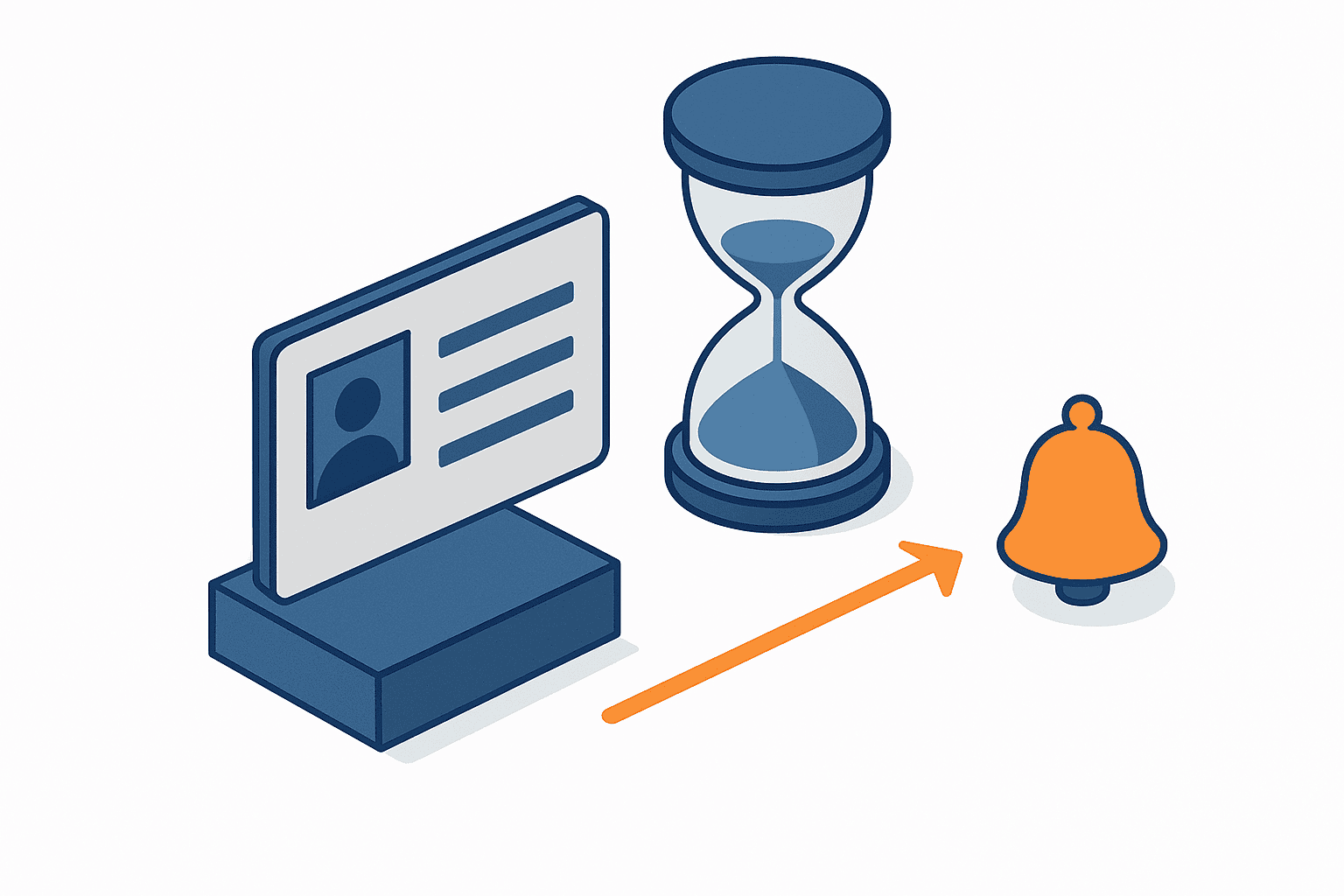
The heaviest part of work permit management is not obtaining the permit but tracking expiry. Plenty of sites still have one administrator watching several dozen to several hundred expiry dates in a spreadsheet. If a renewal deadline falls in the week that person is on leave, it is simply missed.
If you are introducing an attendance management system, the sensible move is to pull that expiry tracking into the HR master itself. The reason is straightforward. The attendance system is one of the few mechanisms that references every employee’s active status every single day. A workable design looks like this.
- Hold work permit number, permit expiry, passport expiry and visa-related dates as fields on the employee master
- Generate alerts automatically at staged intervals such as 90, 60 and 30 days before expiry, notifying both the administrative team and the line manager
- Include a list of employees approaching expiry as a standard item in the monthly labour report
- Manage renewal progress status on the same screen, distinguishing applications in progress from completed ones
Having the clock-in terminal detect an expired permit and block entry is technically possible. The decision on whether someone may work, however, sits within the responsibility of the labour function and should not be delegated to an automatic judgement by a terminal. The system handles detection and notification. People make the decision. Draw that line at the outset or you will end up with a different argument on the floor about who stopped the terminal and why.
Biometric clock-in and PDPA compliance
Fingerprint data is treated as sensitive information
More sites are adopting fingerprint or facial recognition as a way of preventing buddy punching. Someone clocking in on a colleague’s borrowed ID card is a problem that can arise in any country’s factory, and biometrics address it directly.
At the same time, under Thailand’s Personal Data Protection Act (PDPA), biometric data such as fingerprints is classified as sensitive data. It cannot be collected or retained without explicit consent from the individual, and where biometrics are used for attendance management, obtaining explicit consent and putting appropriate security measures in place are both mandatory.
The case to watch here is the site that treats consent as blanket-covered simply because a clause appears somewhere in the work rules. What is required for sensitive data is explicit consent, which presupposes that the individual understands for what purpose, which data, and for how long it will be retained before expressing agreement. Slipping it into the stack of documents signed on the first day of employment is hard to defend afterwards.

Items to settle internally before rollout
Whether to use biometrics is an operational choice more than a technical one. Having answers ready for the following items while you are still evaluating will speed up the decision.
- Consent form format and language. Thai is the baseline, and explanation in an employee’s own language such as Burmese may be required
- An alternative for employees who decline. Whether ID card or PIN clock-in can be kept running in parallel
- The scope of retained data. Ask the vendor in what form the authentication information is stored, and whether the original image is retained
- Retention period and deletion. When a leaver’s data is deleted, and by whose action
- Access rights. Who can view or export that data, and whether those operations are logged
- Management of subcontractors. For cloud products, where the data is stored and who can touch it
The alternative option matters most. Where declining is not realistically available, a question remains over whether the consent was freely given. Operationally you will need the alternative anyway, since there will always be a number of workers whose fingerprints do not read reliably.
PDPA compliance is not a question about the attendance system alone. It is part of how the whole site manages personal data. Using attendance as the entry point for a broader inventory of the personal data held internally is, in our view, a realistic sequence.
Feeding attendance and labour cost into production cost calculation
Aggregate labour cost hides the real picture
If you justify an attendance management system purely on reduced payroll processing effort, the number comes out small. The larger effect appears when attendance data becomes an input to cost calculation.
At most sites, the labour cost that emerges from payroll is a departmental total. At that granularity you cannot see how much human time went into which process for which product. As a result, labour cost in manufacturing cost gets allocated by production volume or machine hours. Allocation is not wrong in itself, but in reality labour concentrates on products with frequent changeovers, or rework appears on a particular line. Allocation erases that skew.
If attendance data is captured on a process or order axis, the skew becomes visible as numbers. Once visible, you can separate whether a product with poor margins is suffering from material cost or from consuming extra human time. How the cost calculation side should receive that data is covered in more detail in what to look at when implementing a manufacturing cost management system.
Regulatory changes keep moving the unit cost of labour
Labour cost calculation is affected not only by hours but by the unit rate side. In Thailand, the rules bearing on unit rates have been moving in succession, and when you design the link between attendance and payroll you need to build on the assumption that these may change.
First, the Employee Welfare Fund (EWF) starts from October 2026. It applies to private employers with 10 or more employees, with employer and employee each contributing 0.25 percent of wages. The rate is expected to rise in stages to 0.50 percent by 2031. No wage ceiling is applied in the calculation. Companies holding a qualifying in-house provident fund may be exempt under certain conditions. Implementation was originally scheduled for October 2025 and was postponed by one year to 1 October 2026.
Separately, the wage ceiling used to calculate social security contributions was raised with effect from 1 January 2026. This change affects the total employer burden and calls for a review of labour cost unit rates.
Minimum wages need to be viewed on the understanding that they vary by region. In industrial cluster provinces such as Chonburi and Rayong, there are areas where a minimum wage at the level of 400 THB per day already applies, while some assessments hold that no further nationwide across-the-board increase is expected for 2026. The applicable amount can change by region and over time, so check the latest announcement for the province where your operation sits.
| Item | Content | Effect on labour cost |
|---|---|---|
| Employee Welfare Fund (EWF) | Starts October 2026. Applies to private employers with 10 or more employees. Employer and employee each contribute 0.25 percent of wages, rising in stages to 0.50 percent by 2031. No wage ceiling | Employer burden increases. Companies holding a qualifying provident fund may be exempt under certain conditions |
| Social security calculation ceiling | Wage ceiling raised with effect from 1 January 2026 | Employer burden increases for employees whose wages sit near the ceiling |
| Minimum wage | Varies by region, with a level of 400 THB per day applying in some areas of industrial cluster provinces | A higher base wage feeds through to overtime rates, so the effect reaches overtime hours as well |
Of the figures in the table, the EWF contribution rate and eligibility conditions are based on published material, though operational details may still be issued shortly before implementation. Treat minimum wages and the social security ceiling as items whose amounts can be updated.
Design decisions for the integration
Connecting attendance to cost does not have to happen in a single leap. Splitting it into stages is more realistic.
- Stage one, break attendance data down from department level to process level. Starting with the main lines only is enough
- Stage two, record indirect time (setup, cleaning, training, waiting) separately from direct work time
- Stage three, reconcile against actuals from the production management system and produce labour cost by product and by order
Skipping stage two and jumping to stage three lets indirect time bleed into direct work time, and labour cost per product comes out higher than reality. Keeping the sequence gets you there faster in the end. For what the production management system side can and cannot handle, see also our primer on what a production management system is.
How to run selection and rollout at a Thai plant
Narrow the selection criteria to four
When you write an RFP, trying to cover every feature produces several dozen line items, vendors answer “supported” to all of them, and nothing differentiates. For a Thai site, narrowing to the following four and asking concretely works better.
| Selection criterion | Question to ask the vendor | How to go beyond a yes |
|---|---|---|
| Shift and overtime premium calculation | Can our rotation patterns and premium categories be configured as they are? Can the attribution rule for shifts crossing midnight be chosen? | Hand over your actual shift roster and have them reproduce it in the configuration screen |
| Work permit integration | Can the employee master hold work permit number and expiry date, and issue expiry alerts? | Have them show the notification recipients and timing on screen |
| PDPA compliance | How is biometric data stored, how are consent records managed, and how are access logs captured? | Confirm whether consent management is a standard feature, and if not, ask for a proposed operational workaround |
| Cost calculation integration | Can actual hours be output by process and by order, and in what format? | Receive an actual sample output file and verify that the cost side can read it |
On all four, the quality of the answer separates vendors by real implementation experience. On the work permit and PDPA items in particular, a vendor with no track record at Thai sites will not be able to give you a concrete answer.
Rollout approach and team structure
A standard sequence for the rollout looks like this.
- Current state assessment. Inventory the existing attendance rules and exception handling. Allow one to two months
- Requirements freeze. Set priorities for your own site around the four criteria above
- Vendor selection. Evaluate through to hands-on reproduction on the actual product
- Pilot. Limit to one line or one department and run one to two payroll closings
- Full rollout. Extend after reflecting the exceptions surfaced during the pilot
Running the pilot through at least one full payroll closing is worth doing. Punch collection can go perfectly smoothly and exceptions will still erupt at the closing and payroll integration stage.
On team structure, the site needs someone who will own the project. Ideally that is a person who understands administrative and HR practice and can also follow the system side, but many companies do not station a dedicated IT person at their Thai plant, in which case an administrative staff member takes it on alongside their existing job. A realistic division of roles for running a project under those conditions is set out in how to fill the IT staffing gap at overseas plants, which is worth reading while you are still thinking about structure.
Frequently asked questions
Can an attendance management system handle Thai labour law?
It depends on the product. Products developed and supplied within Thailand, or supplied by vendors with implementation experience at Thai sites, generally support calculation based on the 8-hour day and 48-hour week and the premium categories for holiday work as standard. Bringing a Japan-market product across as it is means handling premium rates through additional development, which extends both cost and schedule. The reliable approach is to work out how many premium patterns you run, present that, and take quotations against it.
Can work permit management for foreign workers be handled in the same system?
Yes, if the product allows work permit number and expiry date to be added as extended fields on the employee master. Few products offer this as a standard feature, but the expiry alert mechanism is relatively easy to implement. Since 28 July 2026, work permit procedures have run through the e-Work Permit platform, which makes this a good moment to move internal management from a paper register to data as well.
Is PDPA compliance mandatory if we use fingerprint authentication?
Yes. Biometric data such as fingerprints is classified as sensitive information under PDPA and cannot be collected or retained without explicit consent from the individual. Design for consent collection and record keeping, appropriate security measures, defined retention periods and managed access rights. Preparing an alternative for employees who decline is also necessary, from both an operational and a legal standpoint.
Can attendance data be integrated with a production management system?
It comes down to output granularity. A product that can only produce departmental totals is not usable as an input to cost calculation. The deciding points are whether actual hours can be output by process and by order, and whether the receiving side can work with that format. Take a sample output during selection and actually test whether the cost side can read it. An answer of “we can export CSV” on its own leaves open the possibility that the column structure does not match.
How long does implementation take?
It varies with scale and requirements, but budgeting around six months from current state assessment to full rollout is realistic. Within that, allow two to three months for assessment and requirements, one month for vendor selection, one to two months for the pilot and one month for the full rollout. Where existing attendance rules are undocumented, the initial assessment tends to run longer.
Is it worth implementing at a small site?
At a few dozen employees, spreadsheet management has not necessarily broken down yet. That said, if you employ foreign workers, or if you are considering biometrics, it is safer to put a proper record management structure in place regardless of scale. The Employee Welfare Fund starting in October 2026 also applies to private employers with 10 or more employees, so payroll-side processing is increasing even at small sites.
Summary
When you select an attendance management system for a Thai factory, carrying over the axes used in Japan-market comparison articles leaves you short of the material you need to decide. Here are the points covered in this article.
- There are four issues to examine. Shift and overtime premium calculation, work permit integration, PDPA compliance, and cost calculation integration
- Most of the effort in automation goes into writing down, as rules, judgements that lived in someone’s head. Always confirm correction authority and correction history
- Work permit procedures were consolidated into e-Work Permit as of 28 July 2026. Pulling expiry management into the attendance system is the sensible design
- Biometric data is sensitive information under PDPA. Cover explicit consent, alternatives, retention periods and access rights in the design
- Regulatory changes affecting labour cost unit rates keep coming, including the Employee Welfare Fund starting in October 2026. Design on the assumption that unit rates will move
- Attendance data becomes an input to cost calculation only once it is captured by process. Do not skip separating indirect time
- Keep the RFP to four criteria and evaluate through to hands-on reproduction on the actual product
The first thing to do is not to collect product brochures but to write out your own attendance rules and exception handling. Once you write them out, you will find more unwritten judgement calls remaining than you expected. With that inventory finished, the conversation with vendors becomes far more concrete.
TOMAS TECH has supported shop-floor data use at Japanese-affiliated plants across Thailand and ASEAN through PEGASUS and other production and energy management systems. How to connect attendance, labour cost and manufacturing cost is a design question we have worked through repeatedly. Even at an early stage, before you have shortlisted any product, we are happy to start from the inventory of your own attendance rules. Reach us through the contact page whenever it suits you.
References
- Labour Minister launches e-Work Permit online system for foreign worker registration — Ministry of Labour of Thailand, official news release. The 13 October 2025 launch of e-Work Permit and its nationwide 24-hour operation
- Thailand Immigration e-Work Permit processing update now extended until 28 July 2026 — Vialto Partners regional alert. How the transitional measure for paper applications was extended to 28 July 2026
- Thailand’s e-Work Permit Is Now Fully Mandatory — DeeMED Consulting, dated 1 August 2026. The end of paper and manual application acceptance, consolidation into the online platform, and the remaining exceptions
- Postponement of the Employee Welfare Fund implementation — Nagashima Ohno & Tsunematsu. How Employee Welfare Fund implementation was postponed to 1 October 2026
- Thailand to implement national Employee Welfare Fund — Lockton. The 0.25 percent contribution rate, the staged increase, and exemption conditions
- Thailand Increases Social Security Base Wages and Benefits — Tilleke & Gibbins. The increase in the social security calculation ceiling effective 1 January 2026
- Minimum Wage in Thailand — BigBeat. Referenced with reservations regarding regional variation in minimum wages
- Thailand Personal Data Protection Act (PDPA) Compliance Support — KPMG Japan. Biometric data as sensitive information and the explicit consent requirement


