


Introduction: What Happens in Plants That Run Concessions on Paper and Email
Many plants considering a concession management system for manufacturing still run concession requests on paper, email and Excel. A concession is permission to use or release (move to the next process step, or ship) a product that does not meet requirements, under conditions. When the process is manual, the following tends to happen:
- Concession approval emails get buried in personal inboxes, and the shop floor cannot tell whether a concession has been approved
- Concession product is shipped beyond the quantity limit or after the expiry date
- Concession lots are not linked to shipment records, so the plant cannot answer customer audits or inquiries
- Concessions are granted again and again for the same nonconformity without leading to corrective action
- Where to draw the line between concessions that need customer approval and concessions the plant may decide internally differs from person to person
In this article, we take the view that implementing concession management is not “digitizing the concession request form.” We see it as designing the following five elements as one:
- Define the facts and scope of the nonconformity (lot, quantity, characteristic, measured value, limit)
- Based on an impact assessment, decide the disposition (use as is, rework, repair, regrade, scrap) and the approver (an authorized person in the company, or whether customer approval is required)
- Enforce the approved conditions (quantity limit, expiry, marking, additional inspection) in the system
- Make concession lots and serial numbers traceable all the way to shipment records
- Link concessions to corrective action so that concessions for the same nonconformity are not repeated
Three caveats up front. First, this article is not a product recommendation or ranking. We only describe each vendor’s functions with attribution to that vendor’s official descriptions. Second, the cost model in the second half uses hypothetical figures prepared for this article. Third, a concession is not a procedure that turns nonconforming product into conforming product. Even after a concession is granted, the product remains nonconforming; the concession only permits its use or shipment within the defined conditions. This premise is the starting point for the entire system design.
This article is written for people in quality assurance, quality control, production engineering, production control, plant management, or IT and DX roles at Japanese headquarters, working in plants in Thailand that make automotive parts, electronic components, machinery, metal parts, plastic moldings and similar products. Quality hold (quarantine and release), the rework process, alternate part approval, receiving inspection, the shipping gate, in-process defect tracing, verifying corrective action effectiveness, engineering change and MES selection are each left to their dedicated articles. Here we only explain the boundaries and link to them.
Why Plants in Thailand Should Review Concession Control Now
We briefly summarize the background, with the year and basis stated for each figure. These figures describe the industry as a whole and do not represent the situation at any reader’s plant.
First, automotive. According to an announcement by the Federation of Thai Industries (FTI) on January 28, 2026, Thailand’s automobile production in 2025 was 1,455,569 units. This exceeded the target of 1.45 million units but was −0.9% year on year. The target for 2026 has been set at 1.5 million units. Krungsri Research’s automobile industry outlook (published August 3, 2026) expects production in 2026 to 2028 to grow modestly at 0.5 to 1.5% per year. According to the same report, production in January to April 2026 was 473,545 units (+4.0% year on year). The same report lists as risks rising costs of raw materials and parts and shortages in the supply of some parts. Examples of the causes are the prolonged situation in the Middle East and China’s export controls on rare earths. For auto parts, Krungsri Research’s outlook (published May 7, 2026) expects production in 2026 to 2028 to grow by 1.5 to 2.5% per year.
In our view, when parts sources and specifications are in flux, decisions of the type “this is not to specification, but can we use it if it is within limits?” tend to increase. If those decisions are handled in personal inboxes, gaps in the records accumulate.
There is also investment activity. According to Thailand Board of Investment (BOI) Press Release No. 15/2569 (January 26, 2026), investment applications for full-year 2025 in the automotive and parts sector were 84,085 million baht across 288 projects. In the electrical and electronics (E&E) sector they were 277,645 million baht across 470 projects. As new lines and new customers are added, customer-specific concession rules multiply as well.
For the situation of Japanese companies, there is JETRO’s “FY2025 Survey on Business Conditions of Japanese-Affiliated Companies Overseas (Asia and Oceania).” The survey was conducted in August to September 2025, and 646 companies in Thailand gave valid responses (of which 333 were manufacturers). Among the responding companies in Thailand (n=632), 63.3% expected an operating profit for 2025. In our view, the cost of rework-type losses such as re-sorting and customer response is a factor that should not be overlooked when securing profit.
Standards are also moving. On the IATF statistics page (updated September 28, 2026), by share of each clause in the total volume of major nonconformities over the most recent 12 months, 10.2.3 Problem solving ranks high at 12.10% and 10.2.1 Nonconformity and corrective action at 5.60%. The 8.7 clauses are not in the top 10. We read this result as indicating that a design which connects records not only for the concession decision itself but also through the subsequent problem solving and corrective action is important.
In addition, ISO 9001:2026 (Edition 6) was published on September 16, 2026, and ISO 9001:2015 has been withdrawn. For IATF 16949, the 2016 edition (first edition) is current. The second edition is planned for publication in mid-2027 according to IATF communiqué SC-2026-005 (July 2026), and the dates are described as indicative. A period when standard editions are changing is also an opportunity to review internal procedures and system requirements.
The Overall Concession Flow: Six Blocks from Request to Record Retention
We expand the five design elements from the introduction into a business flow of six blocks.
| Block | Main content | Linked systems |
|---|---|---|
| 1 Nonconformity report | Record lot, quantity, characteristic and measured value | QMS records, lot status and quality hold in ERP/MES/WMS |
| 2 Impact assessment | Assess the impact on function, safety, customer specification and law | QMS records |
| 3 Disposition decision | Choose from use as is, rework, repair, regrade and scrap | QMS records |
| 4 Approval | An authorized person in the company (such as an MRB) and, where required, customer approval | QMS records and audit trail |
| 5 Conditional release | Enforce quantity limit, expiry, marking and additional inspection | QMS records, shipping block and serial list in ERP/WMS |
| 6 Close-out | Link to corrective action, record retention | QMS records, shipment records in ERP |
The key point is that every block is linked to QMS records and the audit trail. The record keeps who decided what, when and why. The other point is that lot status, shipping block, quality hold and the serial list on the ERP, MES and WMS side are linked with quality decisions at three places: the nonconformity report, conditional release and close-out.
In this article, we take the view that a concession is not a document that is “finished once approved.” A concession is a conditional decision and stays linked to the lot, quantity and approver. It is checked against its conditions at every shipment, lapses when it expires, and is finally closed out with corrective action and record retention. Whether a plant can handle this “record that keeps moving while carrying conditions” is the difference between paper and email on one side and a system on the other.
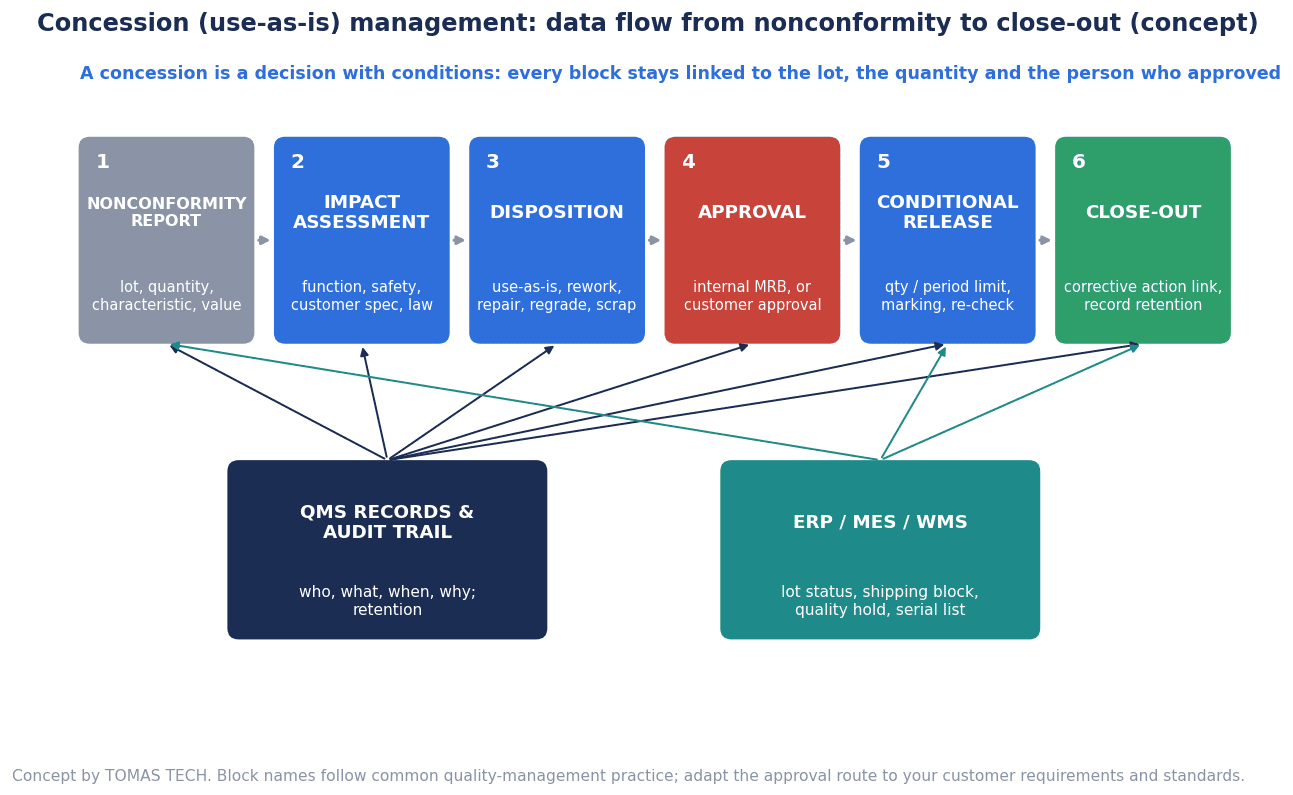
Figure 1. Data flow of concession management. The flow proceeds in the order 1 NONCONFORMITY REPORT, 2 IMPACT ASSESSMENT, 3 DISPOSITION, 4 APPROVAL, 5 CONDITIONAL RELEASE and 6 CLOSE-OUT. In the lower row, QMS records and the audit trail are linked to all of 1 to 6, and ERP/MES/WMS (lot status, shipping block, quality hold, serial list) are linked to 1, 5 and 6.
What Is a Concession in Quality Management? How It Differs from Deviation Permit, Correction, Rework, Repair, Regrade and Scrap
To answer what a concession is in quality management, we start with the definitions of the terms. In Japanese practice, the word “tokusai” is short for “tokubetsu saiyo,” the JIS translation of concession. Here we use the definitions in JIS Q 9000:2015, the identical translation of ISO 9000:2015. Note that ISO 9000:2026 (Edition 5) was published in May 2026 and the 2015 edition has been withdrawn. The definitions below are from the 2015 edition, and the numbering and wording may have changed in the 2026 edition (we have not checked the text of the 2026 edition in this article).
| Term (number in JIS Q 9000:2015) | Key point of the definition | Does the product conform to requirements? |
|---|---|---|
| Nonconformity (3.6.9) | Non-fulfilment of a requirement | Does not conform |
| Correction (3.12.3) | Action to eliminate a detected nonconformity. Examples include rework and regrade | Depends on the action taken |
| Regrade (3.12.4) | Alteration of the grade so that the product conforms to requirements differing from the initial ones | Does not conform to the initial requirements |
| Concession (3.12.5) | Permission to use or release a product that does not conform to specified requirements | Remains nonconforming |
| Deviation permit (3.12.6) | Permission to depart from the originally specified requirements, granted prior to realization of the product | Differs from the initial requirements |
| Release (3.12.7) | Permission to proceed to the next stage of a process or the next process | (An act of decision) |
| Rework (3.12.8) | Action on a nonconforming product to make it conform to the requirements | Aims to make it conform |
| Repair (3.12.9) | Action on a nonconforming product to make it acceptable for the intended use | Does not necessarily conform |
| Scrap (3.12.10) | Action on a nonconforming product to preclude its originally intended use (examples: recycling, destruction) | (Not used) |
The definition of concession carries a note. The note to 3.12.5 in JIS Q 9000:2015 states that a concession is generally limited to the delivery of a product that has nonconforming characteristics within specific limits, and is generally given for a limited quantity or period and for a specific use. The note to deviation permit (3.12.6) likewise states that it is generally given for a limited quantity or period and for a specific use. The English original has the same structure. In the ISO 9000:2015 definitions (checked via the terminology collection of the European Union Agency for Railways, ERA), concession begins with “Permission to use or release,” and deviation permit carries the qualification “prior to its realization.”
From this, the difference between a concession and a deviation permit becomes clear:
- A concession permits the use or release of a product that has already become nonconforming.
- A deviation permit allows departure from the original requirements before the product is made.
Neither changes the product into a “conforming” product. A concession is permission to use the product as it is, still nonconforming, within limits and conditions. A deviation permit is advance permission to make the product under conditions different from the original ones. Because it concerns a change before production, a deviation permit sits close to 4M change management. The boundary of 4M changes and first-article confirmation are covered in our article on 4M change management systems.
The note on repair also needs attention. Note 1 to 3.12.9 in JIS Q 9000:2015 states that successful repair of a nonconforming product does not necessarily make the product conform to the requirements, and that a concession can be required in conjunction with repair. In other words, there are cases where “it has been repaired, so there is no problem” does not hold. In our view, providing a field in the system to decide whether a concession is required when the repair disposition is selected makes it easier to prevent that decision from being missed.
Rework is an action aimed at making the product conform to the requirements. The rework process, work instructions and re-inspection flow are left to our article on manufacturing rework control systems. This article covers selecting rework as one of the dispositions and linking its record to the concession record.
Also, the Japanese term used in JIS for 3.12.10 corresponds to “scrap.” This article also uses “scrap” as the name of that disposition.
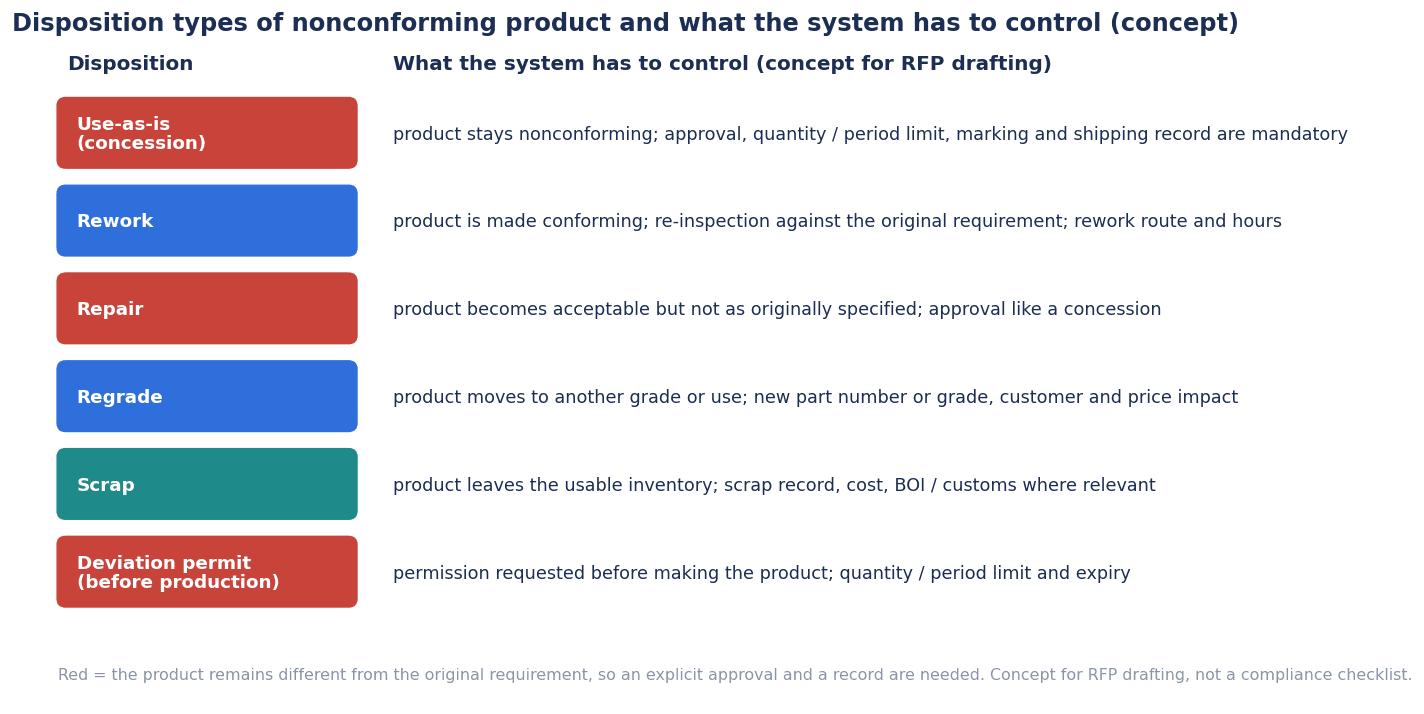
Figure 2. The mapping between dispositions (use as is (concession), rework, repair, regrade, scrap, deviation permit before production) and what the system should manage (approval, limits on quantity and period, marking, shipment records, re-inspection, grade change, scrap records, expiry). Red marks dispositions in which the product remains different from the initial requirements. This is a conceptual diagram for writing an RFP and is not a substitute for customer requirements or standards.
What Standards Require for Concessions: 8.7 of ISO 9001:2015 and 8.7.1.1 of IATF 16949
Next, we check the requirements of the standards. The ISO 9001 clauses cited here are from ISO 9001:2015 (JIS Q 9001:2015). The numbering and wording may have changed in ISO 9001:2026, published on September 16, 2026 (we have not checked the text of the 2026 edition in this article). The comparison table in a secondary source by the consulting firm Advisera classifies 8.7 as “No change,” but we have not verified this against the ISO original in this article.
| Clause (ISO 9001:2015) | Key point of the requirement | Implication for the system (our view) |
|---|---|---|
| 8.6 Release of products and services | Retain documented information on a) evidence of conformity with the acceptance criteria and b) traceability to the person(s) authorizing the release | Record the ship or no-ship decision and the person authorizing it |
| 8.7.1 Control of nonconforming outputs | Identify and control nonconforming outputs. Take action based on the nature of the nonconformity and its effect. Deal with them in one or more of the following ways: a) correction, b) segregation, containment, return or suspension of provision, c) informing the customer, d) obtaining authorization for acceptance under concession. When correction is made, verify conformity to the requirements | Records of the disposition and approval, and records of verification results after correction |
| 8.7.2 Documented information | Retain documented information that a) describes the nonconformity, b) describes the actions taken, c) describes any concessions obtained, d) identifies the authority deciding the action in respect of the nonconformity | Tie the request, action, concession and deciding authority together in one record |
8.7.1 lists obtaining authorization for acceptance under concession as one of the actions. 8.7.2 requires documented information on the concessions obtained and the identification of the deciding authority. Paper and email can satisfy this, but as the number of cases grows, the work of keeping the records consistent becomes a burden in itself.
In the automotive industry, IATF 16949:2016 contains 8.7.1.1 “Customer authorization for concession.” In the text as revised by SI 9 (effective October 2017) of the official IATF document “Sanctioned Interpretations,” the following two points are required:
- Whenever the product or manufacturing process is different from that which is currently approved, obtain a customer concession or deviation permit prior to further processing
- Obtain customer authorization prior to further processing for “use as is” and rework for repair (see 8.7.1.5) dispositions of nonconforming product. If sub-components are reused in the manufacturing process, that reuse is to be clearly communicated to the customer in the concession or deviation permit
IATF 16949 also has other subclauses on rework, repair, suspect product, customer notification and so on. For 8.7.1.7 “Nonconforming product disposition,” FAQ 11 in the IATF FAQs (June 2026 edition) explains the intent of rendering product unusable before disposal. The explanation is that this is to prevent product from flowing into the unofficial repair market or into vehicles, or from being shipped to a customer by mistake, and that it does not require grinding up the product.
As noted above, the second edition of IATF 16949 is planned for publication in mid-2027, and the dates are indicative.
In aerospace, AS9100D is used, but we have not been able to check its text in this article. An article by NASA OSMA (April 17, 2024) states that AS9100 is structured as the ISO 9001 text plus additional industry requirements, that it is planned to be renumbered IA9100 at its next revision, and that publication was expected, as of 2024, in the fourth quarter of 2026.
Finally, according to ISO’s own description, more than one million ISO 9001 certificates have been issued in 189 countries, and ISO 9001 is the only standard in the ISO 9000 family that can be certified to (certification is not mandatory). Concession records are records that may be examined in such certification audits and in customer audits.
The Request: How to Define the Facts and Scope of a Nonconformity
The first block of concession management is the nonconformity report and the concession request. In this article, we take the view that if the description of the nonconformity is vague, the impact assessment and approval that follow will also be vague. With a request that says “the dimension is slightly out,” the approver cannot explain what was accepted and to what extent.
The fields we would make mandatory on the request screen are as follows:
- Object: part number, lot number, serial number (if any), quantity
- Nature of the nonconformity: characteristic, specification and tolerance, measured value, measurement method and measuring instrument
- Point of occurrence: the process, equipment and date and time where it occurred, and the process where it was found
- Scope of suspect product: whether to include other lots made with the same material, the same equipment and the same conditions
- Status of the physical product: quarantine location, hold status, marking method
- Requester and request date, related customer and customer part number
The scope of suspect product is especially important. Even if a concession is applied to the lot that was found, the problem remains if another lot made under the same conditions has been shipped. Specifying the scope depends on whether the lot genealogy (from which material lot and on which equipment the product was made) can be traced.
The operation of quarantining, holding and releasing physical product itself is covered in our article on quality hold management systems. The concession request is the entry point for deciding the disposition of product on hold, and it is important not to build a second, duplicate mechanism alongside the hold system.
As examples of implementation on the product side, we introduce the official descriptions of two companies. According to Infor’s official documentation (Infor LN 10.7), items found to be nonconforming in purchasing, operations or production can be moved to quarantine inventory, and items in quarantine inventory can be evaluated with the dispositions Return to Vendor, Rework (to a new specification or to the existing specification), Reclassify, Scrap and Use as is. For Microsoft Dynamics 365 Supply Chain Management, Microsoft Learn explains that a nonconformance order describes the quantity of nonconforming items, the source of the problem, the problem type and descriptive notes, and that nonconformance tags and reports can indicate statuses such as Unusable or Restricted usage.
Whichever product is used, whether request fields can be added or removed per customer and per item, and whether measured values can be referenced from inspection records without retyping, are points worth confirming in the RFP.
Impact Assessment and Disposition: Who Decides
The second and third blocks are the impact assessment and the disposition decision. The impact assessment evaluates whether the nonconformity affects the following:
- Function: impact on assembly, performance and durability
- Safety: impact on the safety of users or vehicles
- Customer specification: impact on drawings, specifications and customer-specific requirements
- Law: impact on regulations and certifications in the destination market
Based on the result of the assessment, the disposition is chosen. The candidates are use as is (concession), rework, repair, regrade and scrap. In this article, we take the view that the design should make the approver change by disposition. For example, the weight of approval differs between making the product conform to the initial requirements through rework and accepting it as is under a concession. In the system, one possible design is to determine the approval route automatically from the combination of disposition and customer requirements.
On the question of who decides, 8.7.2 d) of ISO 9001:2015 requires identifying the authority deciding the action in respect of the nonconformity. In some plants, this role is taken by a body called the Material Review Board (MRB). MRB is a commonly used name for a body in which representatives from quality, engineering, manufacturing and other functions decide the disposition of nonconforming product. The standard does not require a body with the name MRB. There are also products that name a review-board function, as in the case of Infor LN, which has a menu item called “Review board.”
As one example of customer-side rules, there is the supplier manual (2018 edition) published by Oetiker Sweden AB in Sweden. In this manual, a deviation request from a supplier regarding nonconforming product is to be reviewed and approved by the company’s responsible quality engineer, and, where necessary, approval from the company’s own customer is also to be obtained before shipment. Deviation approval is limited to a specific delivery period, order or quantity of parts. Permanent deviations are not accepted, and quantity-based approval is preferred. The manual also states that a request for deviation approval must always include corrective action. This is one example from a European Tier 1 supplier and does not apply to every customer. Still, the idea of giving a deadline and a quantity limit and linking to corrective action is useful as a reference for designing the system fields.
Some dispositions are easily confused with the use of alternate parts. A concession that uses nonconforming product as is and the approval of an alternate part that replaces the part on the drawing with another approved part are separate procedures. How to handle alternate part approval is left to our article on alternate part approval control. In this article, we recommend a design in which the request screen first makes the user choose “concession, alternate part or deviation permit,” to prevent mix-ups.
Customer Authorization for Concessions and Concession Requests from Suppliers
Whether a concession needs customer approval is determined by customer requirements and the applicable standards. It cannot be generalized either as “a concession always needs customer approval” or as “internal approval is sufficient.” Where IATF 16949 is applied in the automotive industry, within the scope of 8.7.1.1 (SI 9) described above, a customer concession or deviation permit is required before further processing with product or a manufacturing process different from what is approved, and customer approval is required before further processing with use as is and rework for repair dispositions. On top of that, customer-specific requirements are added.
In this article, we recommend holding the need for customer approval in master data rather than relying on the memory of the person in charge. For each combination of customer, item and disposition, define “customer approval required” or “decided by an authorized person in the company,” and determine it automatically at the time of the request. When the decision rules are changed, keep the change history and the reason.
The customer approval record should include the customer’s approval number, approver, approval date, the approved conditions (quantity limit, expiry, marking, additional inspection) and an attachment of the approval document. If the approval is granted with conditions that differ from the request, the approved conditions become the conditions the system enforces.
There are also cases where the plant, acting as the customer, receives concession requests from suppliers. The flow is as follows:
- The supplier requests a concession
- The plant carries out an impact assessment
- Where necessary, the plant requests a concession from its own customer
- The approved conditions are reflected in the reply to the supplier and in the plant’s own receiving conditions
If this back-and-forth is not recorded outside email, the receiving staff cannot notice that concession product has arrived. The flow of receiving inspection and use permission per supplier is covered in our article on receiving inspection systems. Linking the concession approval to the received lot and stopping deliveries that exceed the approved quantity at the receiving stage is the point where the two mechanisms meet.
As a product-side example, Oracle explains in the data sheet for Oracle Fusion Cloud Quality Management (Version 3.0, 2024) that SCARs (supplier corrective action requests) are assigned to suppliers through the supplier portal. Which screens and which records are used for the back-and-forth with suppliers is worth spelling out in the RFP.
Conditional Release: Enforcing Quantity Limits, Expiry, Marking and Additional Inspection
The fifth block is conditional release. In this article, we see this as the core of a concession management system. Instead of people remembering the approved conditions, the system enforces them.
| Condition | What the system does (our view) |
|---|---|
| Quantity limit | Stop shipping instructions and allocations that exceed the approved quantity. Show the remaining quantity on screen |
| Expiry | When the expiry date arrives, let the concession lapse automatically and return the affected lots to a non-shippable state |
| Marking | Issue instructions to show the concession number on the product, the box and the shipping label, and record the result of checking the marking |
| Additional inspection | Instruct the inspection specified as an approval condition, and stop shipment until the result is recorded |
| Restricted use | Stop shipments to anything other than the approved customer, part number and delivery destination |
The marking method (label format, marking position and so on) is determined by customer requirements and internal procedures. In this article we treat it as a design requirement, not as a clause of a standard.
This enforcement is not completed within the QMS alone, because shipping instructions and inventory allocation are performed in ERP and WMS. Link the concession approval status, remaining quantity and expiry to the lot status in ERP and WMS, and put lots that fall outside the conditions under a shipping block. Also make sure there is no contradiction with the quality hold status. For example, when a concession is approved for a lot under quality hold, release the hold and permit shipment at the same time, with records.
The final shipping decision and the layer of physical segregation are covered in our article on defect outflow prevention. Because concession product is handled as an exception, “nonconforming product that may be shipped,” it needs to be built into the shipping gate decision logic as an exception. If exceptions are handled by individual manual work, the shipping gate loses much of its meaning.
Marking and Traceability: Linking Lots and Serial Numbers to Shipment Records
In this article, we take the view that concession product needs to remain traceable even after shipment. The goal is to be able to answer immediately when a customer asks, “When, where and how many of that concession product were shipped?”
8.6 of ISO 9001:2015 requires that, for release, evidence of conformity with the acceptance criteria and traceability to the person(s) authorizing the release be retained as documented information (this is the text of the 2015 edition; the numbering and wording may have changed in the 2026 edition). For concession product, not meeting the acceptance criteria is itself the premise. In our view, it is therefore important to link the release record to “which concession approval the shipment was based on.”
The linkages needed for traceability run in three directions:
- From the concession number, look up the affected lots and serial numbers
- From lots and serial numbers, look up the shipping instruction, shipping date, customer, delivery destination and quantity
- From a customer inquiry (part number, lot, delivery date), look up the relevant concession number
The third, reverse lookup in particular is difficult with paper and email. Hold the concession number on the shipment record side as well, and build a structure that can be searched from either direction.
As a product-side example, Oracle explains in the data sheet for Oracle Fusion Cloud Quality Management that genealogy can be recorded for tracking lot-controlled and serial-controlled items.
Mechanisms for identifying the lot of defects found in process and tracing their causes are covered in our article on in-process defect tracing. Whether the traceability mechanism actually works can be confirmed with a mock recall test. For the test procedure and acceptance criteria, see our article on mock recall testing and traceability. In this article, we recommend including concession lots in the scope of mock recalls.
Linking to Corrective Action: Not Repeating Concessions for the Same Nonconformity
The sixth block is close-out. What matters here is the link to corrective action. A concession decides how to handle the nonconforming product in front of you. It does not eliminate the cause of the nonconformity. If concessions keep being granted for the same nonconformity, the cause is still there.
The Oetiker Sweden supplier manual (2018 edition) mentioned above states that a request for deviation approval must include corrective action. In this article, we recommend bringing this idea into the system and linking concession requests to corrective action records one-to-one or many-to-one. A design in which a concession without a corrective action record cannot be closed out is also possible.
One way of carrying out corrective action is 8D. According to ASQ’s explanation, 8D is a problem-solving method commonly used in the automotive industry and consists of the stages D1 to D8. The stages most closely related to concessions are the following:
- D3: Develop and implement an interim containment plan (containment actions that isolate the problem)
- D4: Identify and verify the root cause
- D5: Choose and verify permanent corrections
- D6: Implement corrective actions and confirm their effects
- D7: Take preventive measures
In our view, concessions often occur in parallel with the interim containment in D3. If the permanent measures in D5 and D6 work, concessions for the same nonconformity become less likely to recur.
As noted above, on the IATF statistics page (updated September 28, 2026), by share of each clause in the total volume of major nonconformities over the most recent 12 months, 10.2.3 Problem solving was 12.10% and 10.2.1 Nonconformity and corrective action was 5.60%. In our view, linking concession records to corrective action also helps prepare for these clauses.
To make recurrence visible, aggregate the number of concessions, the reasons, suppliers, processes and part numbers. As a product-side example, MasterControl explains that nonconformance trends can be analyzed by material, shift, machine, supplier and so on.
The operation of verifying corrective action effectiveness is left to our article on corrective action effectiveness. When the permanent measure becomes a change to drawings or specifications, it goes into the engineering change flow. For managing revision numbers and effectivity dates, see our article on engineering change PLM and ERP integration.
Thailand’s Product Liability Act and Concession Records
Thailand has a product liability law. Its formal English title is the Liability for Damage Arising from Unsafe Goods Act B.E. 2551, and it is commonly called the Product Liability Act B.E. 2551 (2008). The content below is based on an unofficial English translation by staff of the Office of the Consumer Protection Board (OCPB) of Thailand. Officially, only the Thai text is valid. Also, this article is not legal advice.
| Section | Key point of the content (based on the unofficial English translation) |
|---|---|
| Section 2 | Comes into force one year after publication in the Government Gazette (February 20, 2008) |
| Section 4 | Defines unsafe goods (goods that cause or may cause damage due to a manufacturing defect, a design defect, lack of instructions or warnings and so on), entrepreneurs (the manufacturer or the person who hires others to manufacture, the importer, the seller where the manufacturer and others cannot be identified, and anyone who presents themselves as the manufacturer or similar) and damage |
| Section 5 | For damage caused by unsafe goods sold to a consumer, all entrepreneurs are jointly liable to the injured person, regardless of whether the damage arose from intent or negligence |
| Section 6 | The injured person proves matters such as that the damage was caused by the entrepreneur’s goods, but does not need to prove which entrepreneur caused the damage |
| Section 7 | An entrepreneur is not liable if it proves any of the following: (1) the goods are not unsafe goods, (2) the injured person knew that the goods were unsafe, or (3) the damage arose from incorrect use or storage even though correct and clear instructions for use or warnings were given |
| Section 8 | A manufacturer of components is not liable if it proves that the unsafety arose from the design, assembly, instructions, warnings or similar of the manufacturer of the finished goods |
| Section 9 | Liability cannot be excluded or limited by an agreement with the consumer made before the damage occurs or by a notice from the entrepreneur |
| Section 11(2) | The court may order punitive damages of up to twice the actual damages |
| Section 12 | A claim can no longer be made after 3 years from the date the injured person knew of the damage and of the person liable for compensation, or after 10 years from the date the goods were sold |
The word concession does not appear in the text of this law. Whether concession product is unsafe goods is decided according to the individual circumstances.
With that said, in this article we take the view that documenting the concession approval record, the approved conditions, marking and traceability may serve as a practical basis for preparing, should the need arise, the proof under Section 7. For example, being able to show which characteristic was nonconforming within which limit, who approved it based on which impact assessment, and which lots were shipped where helps explain the facts. On the other hand, having records does not in itself determine whether there is liability. Please confirm legal judgments with experts in Thai law.
Division of Roles Among ERP, MES, QMS and WMS
Concession management is a business process that is hard to complete within a single system. In this article, we organize the data flow as follows:
- Inspection and occurrence of nonconformity: record inspection results and nonconformities in MES or QMS
- Concession request and approval: manage the request, impact assessment, disposition and approval in QMS
- Lot status and shipping block: manage lot status, quality hold and shipping block in ERP or WMS
- Shipment records: record shipping instructions, actual shipments, customer and quantity in ERP
- Corrective action: manage corrective action and effectiveness verification in QMS
Which product holds which function depends on the plant’s existing systems. For reference, we present each company’s official description with attribution, in alphabetical order. The following is an introduction to the existence of functions, not a comparison of strengths or a recommendation. Also, for none of the products have we been able to confirm on the official pages whether there are dedicated fields for concession expiry or quantity limits.
| Product (provider) | Key points of the official description (retrieved October 17, 2026) |
|---|---|
| ETQ Reliance (Octave Intelligence plc) | The company describes Quality Events as an application that tracks and manages the investigation of unplanned events and deviations affecting product quality, safety and so on. It explains that deviation management includes customer complaints, planned deviations, NCM, CAPA and others |
| Infor LN | Infor’s documentation (LN 10.7) lists Return to Vendor, Rework, Reclassify, Scrap and Use as is as dispositions for quarantine inventory, and explains that an NCR can be issued |
| MasterControl | The company explains that nonconformances proceed through five stages: initiation, investigation, recommendation, disposition and management approval. It also explains that its deviation management product can be integrated with the management of other quality events |
| Microsoft Dynamics 365 Supply Chain Management | Microsoft Learn explains the six default nonconformance types, creating quality orders from nonconformances, and segregating inventory with quarantine orders |
| Oracle Fusion Cloud Quality Management | The company describes quality management in four stages, Define, Identify, Analyze and Correct, and explains that resolving quality issues and CAPA connects directly to the engineering change order (ECO) process |
| PTC Windchill | PTC Help Center (Windchill 11.2.1.0) describes a deviation as a request for permission to depart from manufacturing specifications before parts are made, and a waiver as a request to accept nonconforming material after it has been made |
| SAP S/4HANA Quality Management | SAP Learning explains the usage decision, in which, after the quality technician records the inspection results, the quality engineer decides whether the inspection lot is accepted or rejected. The same course has units such as Quality Notifications, 8D and Production Deviation |
| Siemens Opcenter X Quality | The company describes it as a cloud QMS that covers recording and managing events related to nonconforming product, supporting PPAP and more |
That PTC’s deviation and waiver correspond respectively to the deviation permit and concession of ISO 9000 is our interpretation in this article, not a statement by PTC. SAP’s usage decision is described as an operation that decides whether the inspection lot is accepted or rejected and posts the stock to a stock category.
Before choosing a product, the first step is to decide, for your own operations, “which system is the master for which data.” In particular, which system holds the concession approval status, and when ERP and WMS receive it, bears directly on how reliable conditional release is. How to approach MES selection is covered in our Thailand MES selection guide.
Common Stumbling Points in Plants in Thailand
Here we list, as our own view, points where plants in Thailand tend to stumble when putting concession management into a system. These are not backed by figures; they are a list of issues worth checking at the design stage.
The first is the double standard between headquarters standards and local customer requirements. The quality rules of Japanese headquarters and the requirements of each customer in Thailand sometimes conflict. If these are put into the system without deciding which takes priority, the approval routes become complicated. We recommend holding each customer’s requirements in master data and documenting their relationship to the headquarters standard.
The second is the language of requests and approvals. Plants where the shop floor uses Thai, engineers use English and headquarters uses Japanese are not unusual. Even if the screen language can be switched, free-text fields remain in the language of whoever wrote them. A design that describes the nonconformity through selection fields (characteristic, type of nonconformity) and measured values, without relying too much on free text, is effective.
The third is delegation and authority when the approver is absent. If it is not decided in advance who can approve on behalf of an approver who is away on a business trip or on leave, concessions either stall or someone without authority approves them. Define the scope of delegated approval (disposition, amount, customer) and keep a record of approvals made by a delegate.
The fourth is the hybrid period during migration. Right after a system goes live, approvals by email and signatures on paper tend to remain. Decide in the migration plan how concessions approved outside the system will be registered, and whether shipments will be stopped until they are registered.
The fifth is merely forwarding requests from suppliers. Some plants forward a supplier’s concession request to their own customer as it is. The plant’s own impact assessment is then not left on record, and the plant cannot explain it when the customer asks.
The sixth is stock of expired concession product. Concession product sometimes stays in the warehouse after the concession has expired. An operation is needed that lists expired stock and decides whether to request again, rework or scrap.
The seventh is the handling of scrap when using bonded raw materials under BOI privileges. Scrap procedures can be related to BOI rules. This article does not go into the details, but we recommend confirming with the department responsible for BOI matters when designing the scrap disposition.
Requirements to Write in the RFP: Functions and Integration of a Concession Management System
From here on are examples of requirements to write in an RFP (request for proposal). They are organized as our view in this article and are not a substitute for customer requirements or standards.
| Area | Example requirements to write in the RFP |
|---|---|
| Description of the nonconformity | Can hold part number, lot number, serial number, quantity, characteristic, specification and tolerance, and measured value as mandatory fields |
| Suspect product | Can specify other lots made with the same material, equipment and conditions as the scope, and hold them together |
| Impact assessment | Can record the assessment results for function, safety, customer specification and law, and the assessor |
| Disposition | Can select use as is, rework, repair, regrade and scrap, and can change the mandatory fields by disposition |
| Approval route | Can determine the approval route by the combination of disposition and customer requirements. Can define the scope of delegated approval |
| Customer approval | Can attach the customer’s approval number, approver, approval date and approval document. Can register the approved conditions as the conditions to enforce |
| Enforcement of conditions | Holds quantity limit, expiry, marking, additional inspection and restricted use as conditions, and can check them at the shipping instruction stage |
| ERP and WMS integration | Shares concession status and remaining quantity, and can put lots that fall outside the conditions under a shipping block. Does not contradict the quality hold status |
| Traceability | Can search across concession number, lot, serial number and shipment records in any direction |
| Link to corrective action | Links concessions to corrective action, and can aggregate trends by count, reason, supplier and process |
| Audit trail and record retention | Keeps who changed what, when and why. Can set the retention period for records |
| Multiple languages | Can provide screens and forms in Thai, English and Japanese |
| Supplier requests | Accepts concession requests from suppliers and can reflect them in the reply and in receiving conditions |
| Data export | Can export concession records and attachments in bulk in a general-purpose format |
| Documents | Includes FAT and SAT plans, procedures and result reports among the deliverables |
In our view, writing in the RFP not only whether a function exists but also “on which screen, by whom and using which records” it is performed makes proposals easier to compare. In particular, whether enforcement of conditions ends inside the QMS screens or can stop shipping instructions in ERP and WMS is a point where proposals tend to differ.
FAT/SAT Acceptance Criteria for Concession Management: Confirming That Concession Conditions Really Stop Shipments
In FAT (factory acceptance test, carried out before factory shipment) and SAT (site acceptance test, carried out on site), confirm whether concession conditions actually stop shipments. The following are example acceptance criteria, as our view in this article.
| Test | Example acceptance criteria |
|---|---|
| FAT | With simulated data, the full flow of request, approval, conditional release and close-out goes through |
| FAT | A shipping instruction that exceeds the quantity limit is stopped |
| FAT | A concession past its expiry lapses automatically, and the affected lots cannot be shipped |
| FAT | Concession product without approval cannot be shipped |
| FAT | The shipment destinations of concession lots can be looked up in reverse from the concession number |
| FAT | The audit trail keeps who changed what, when and why |
| SAT | With actual lots and serial numbers, the shipping block in ERP or WMS is triggered in step |
| SAT | Concession requests from suppliers can be accepted and reflected in receiving conditions |
| SAT | After a power outage or communication failure, the approval status and shipping block status are restored correctly |
| SAT | Concession records and attachments can be exported and their content checked |
In this article, we recommend receiving not only a pass or fail list of FAT and SAT results but also the data and records used in the tests themselves. For example, in the quantity limit test, receive as records the approved quantity, the quantity in the shipping instruction and the remaining quantity at the point the shipment was stopped, and recalculate them yourselves. With only screenshots of the results, you cannot later confirm whether the conditions were judged correctly.
Cost and Benefit Model (Hypothetical Figures)
Here we set out a model calculation to show how to think about costs and benefits. The following are hypothetical figures prepared for this article. They are not figures from a real plant.
The assumed plant is a Japanese-affiliated auto parts plant in Thailand. Annual concession requests (the total of internal concessions and concessions that require customer approval) are assumed to be 360 (30 per month). Requests are made on paper and by email, and a quality assurance staff member tracks approval status in Excel. Exceeded quantity limits and expiry dates, missing marking and mismatches with shipment records are found after the fact, causing re-sorting, re-inspection, customer response work and shipping delays. Into this situation, a concession management system is introduced with requests, impact assessment, approval routes by disposition, enforcement of conditions, integration with ERP and WMS, and links to corrective action.
Only two cost items related to concessions are counted. General quality costs, the losses from the defects themselves, and annual license and maintenance costs are not counted.
| Item | Current | After, base case | After, sensitivity case |
|---|---|---|---|
| A Labor hours per case (requester side + approver side + customer contact) | 2.0 + 3.0 + 1.0 = 6.0 hours | 1.0 + 1.5 + 0.5 = 3.0 hours | 1.0 + 2.5 + 0.5 = 4.0 hours |
| A Annual labor hours (× 360 cases) | 2,160 person-hours | 1,080 person-hours | 1,440 person-hours |
| A Annual cost (hourly rate 200 THB, hypothetical) | 432,000 THB | 216,000 THB | 288,000 THB |
| B Number of cases where conditions were not complied with | 36 per year (10% of requests) | 9 per year | 18 per year |
| B Rework-type cost per case (hypothetical) | 12,500 THB | 10,000 THB | 10,000 THB |
| B Annual cost | 450,000 THB | 90,000 THB | 180,000 THB |
| Total annual cost (A + B) | 882,000 THB | 306,000 THB | 468,000 THB |
| Annual savings | – | 576,000 THB | 414,000 THB |
| Payback period (initial cost 1,800,000 THB) | – | About 3.13 years | About 4.35 years |
The initial cost is assumed to be 1,800,000 THB. The breakdown is 700,000 THB for QMS software and workflow configuration, 500,000 THB for integration with ERP, MES and WMS, 300,000 THB for master data setup (dispositions, approval routes, customer-specific requirements) and training, and 300,000 THB for FAT, SAT and documentation (700,000 + 500,000 + 300,000 + 300,000 = 1,800,000 THB).
In the base case, A is 3.0 hours per case × 360 cases = 1,080 person-hours, and 1,080 × 200 = 216,000 THB per year (a saving of 216,000 THB). For B, assuming enforcement of conditions reduces non-compliance to 9 cases per year and complete records reduce the cost per case to 10,000 THB, the cost is 9 × 10,000 = 90,000 THB per year (a saving of 360,000 THB). The total after the measures is 306,000 THB per year, and the saving is 882,000 − 306,000 = 576,000 THB per year. The payback period is 1,800,000 ÷ 576,000 ≈ 3.13 years (about 3 years and 2 months).
The sensitivity case assumes that the back-and-forth for customer approval stays on email, approver-side labor falls only to 2.5 hours per case, and non-compliance with conditions falls only to 18 cases per year. A is 4.0 hours × 360 cases = 1,440 person-hours, and 1,440 × 200 = 288,000 THB per year (a saving of 144,000 THB). B is 18 × 10,000 = 180,000 THB per year (a saving of 270,000 THB). The total after the measures is 468,000 THB per year, and the saving is 882,000 − 468,000 = 414,000 THB per year. The payback period is 1,800,000 ÷ 414,000 ≈ 4.35 years (about 4 years and 4 months).
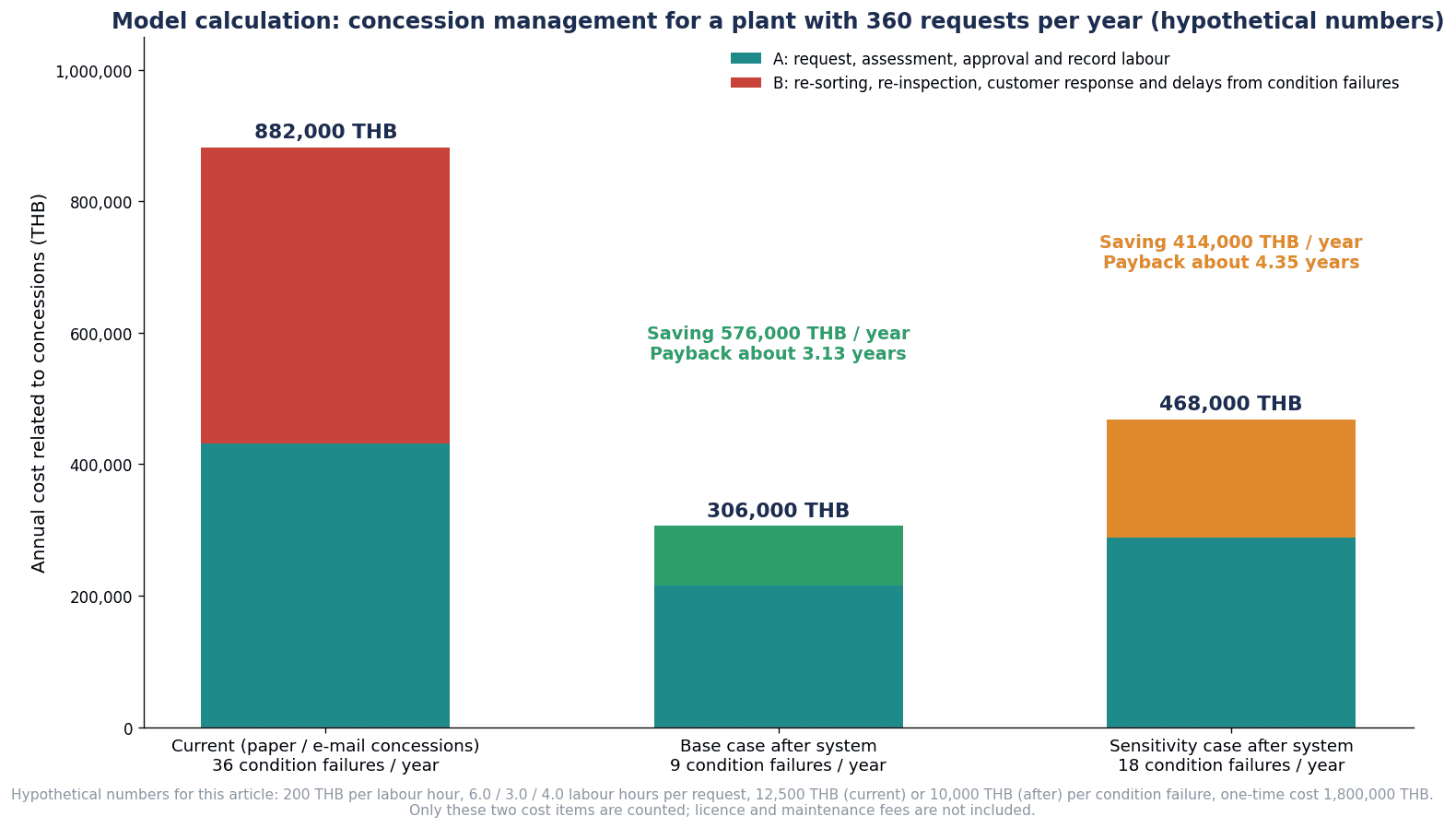
Figure 3. Annual costs for the current state, after the base case and after the sensitivity case (A labor and B rework-type costs stacked), together with the savings and payback periods. These are hypothetical figures prepared for this article.
A note on how to read this. The payback period changes considerably depending on whether the approval back-and-forth, including customer approval, is completed inside the system, and on the number of non-compliance cases and the cost per case. The difference between the base case and the sensitivity case comes mainly from these two points. In addition, annual license and maintenance costs need to be estimated separately, and including them makes the payback period longer still.
In this article, we recommend recording, before implementation, the number of concession requests over the most recent year, the person-hours for requesting and approving per case, and the number of non-compliance cases and their response costs. Without this, you cannot confirm the effect after implementation. Note also that implementing a concession management system does not by itself reduce the occurrence of nonconformities. What it improves is the management of concession decisions and conditions, records, and the visibility of recurrence. Reducing nonconformities themselves is the role of corrective action.
FAQ: Concession vs Deviation Permit, Customer Approval, Expiry and Quantity
What is a concession?
It is permission to use or release a product that does not conform to specified requirements (the definition in 3.12.5 of ISO 9000:2015 and JIS Q 9000:2015; the numbering and wording may have changed in the 2026 edition). The Japanese term “tokusai” is short for “tokubetsu saiyo,” the JIS term for concession.
What is the difference between a concession and a deviation permit?
A concession permits the use or release of a product that has already become nonconforming. A deviation permit allows departure from the originally specified requirements prior to realization of the product (both are definitions in JIS Q 9000:2015). The main difference is whether it is after the product is made or before.
Does a concession make the product conforming?
No. Even after a concession is granted, the product remains nonconforming. A concession permits using or shipping that product within defined limits, quantity, period and use. That is why records for marking and traceability are needed.
Does a concession always require customer approval?
It cannot be stated uniformly. Whether customer approval is required is determined by customer requirements and the applicable standards. For example, 8.7.1.1 of IATF 16949:2016 (SI 9, effective October 2017) requires a customer concession or deviation permit before further processing with product or a manufacturing process different from what is approved, and customer approval before further processing with use as is or rework for repair dispositions. Please check each customer’s requirements in the contract and in the customer’s quality manual.
How are the expiry and quantity limit of a concession decided?
The note to the ISO 9000:2015 definition states that a concession is generally given for a limited quantity or period, but there is no requirement for specific numerical values. As one example of customer-side rules, the Oetiker Sweden supplier manual (2018 edition) limits deviation approval to a delivery period, order or quantity, does not accept permanent deviations, and prefers quantity-based approval. The actual limit and expiry are decided by the impact assessment and the customer’s approval conditions.
What should be kept in concession records?
8.7.2 of ISO 9001:2015 requires retaining documented information that describes a) the nonconformity, b) the actions taken, c) any concessions obtained, and d) identifies the authority deciding the action in respect of the nonconformity (this is the text of the 2015 edition; the numbering and wording may have changed in the 2026 edition). In this article, we recommend also keeping the approved conditions, marking, the affected lots and shipment records, and the link to corrective action.
What should at minimum be confirmed in the RFP and FAT/SAT for a concession management system?
In our view, the following four points: a shipping instruction that exceeds the quantity limit is stopped; a concession past its expiry lapses automatically; concession product without approval cannot be shipped; and shipment destinations can be looked up in reverse from the concession number. We also recommend receiving the test data and records and recalculating them yourselves.
Summary
- A concession is not a procedure that makes nonconforming product conforming. The product remains nonconforming, and its use or shipment is permitted under conditions.
- A deviation permit is permission before production; a concession is permission after production. Both are generally given for a limited quantity or period.
- We checked the text of the standards within the scope of 8.7 of ISO 9001:2015 and 8.7.1.1 (SI 9) of IATF 16949:2016. The numbering and wording may have changed in ISO 9001:2026.
- Whether customer approval is required is determined by customer requirements and the applicable standards. We recommend a design that holds this in master data and determines it at the time of the request.
- The core of the system is enforcing the quantity limit, expiry, marking and additional inspection all the way to shipping instructions in ERP and WMS.
- Link concession lots and serial numbers to shipment records so that lookups work from either direction.
- Link concessions to corrective action so that concessions for the same nonconformity are not repeated.
- The cost model uses hypothetical figures, but the payback period changes considerably with the approval back-and-forth and the number of non-compliance cases. We recommend recording the current state before implementation.
TOMAS TECH supports manufacturers in Thailand from both the IT and OT sides, from integration design for ERP, MES, QMS and WMS to RFP preparation support and FAT and SAT planning. For consultation on building a concession management process, please feel free to contact us via our contact page.
References
- ISO, ISO 9001:2026 Quality management systems — Requirements (Edition 6, published September 2026, ISO 9001:2015 withdrawn)
- ISO, ISO 9000:2026 Quality management — Fundamentals and vocabulary (Edition 5, published May 2026, ISO 9000:2015 withdrawn)
- JIS Q 9001:2015 Quality management systems — Requirements (identical translation of ISO 9001:2015, public text on kikakurui.com)
- JIS Q 9000:2015 Quality management systems — Fundamentals and vocabulary (identical translation of ISO 9000:2015, public text on kikakurui.com)
- European Union Agency for Railways, Railway Terminology Collection: Concession (source ISO 9000:2015)
- European Union Agency for Railways, Railway Terminology Collection: Deviation permit (source ISO 9000:2015)
- IATF Global Oversight, IATF 16949:2016 Sanctioned Interpretations (November 2025 edition)
- IATF Global Oversight, IATF 16949:2016 Frequently Asked Questions (June 2026 edition)
- IATF Global Oversight, Stakeholder Communiqué SC-2026-005 IATF 16949 2nd Edition status (July 2026)
- IATF Global Oversight, Stakeholder Communiqué SC-2024-006 IATF 16949 Revision 2 (October 2024)
- IATF Global Oversight, Statistics (updated September 28, 2026)
- NASA OSMA, Status of the Development of IA9100 (April 17, 2024)
- OCPB staff translation, The Product Liability Act B.E. 2551 (2008) (unofficial English translation, published on ASEAN Consumer)
- OCPB, Royal Thai Government Gazette Volume 125 Part 36 a, Liability for Damage Arising from Unsafe Goods Act B.E. 2551 (February 20, 2008, English version)
- Motor Expo, FTI reveals 2025 total automobile production of 1,455,569 units (January 28, 2026)
- Argus Media, Thailand EV boom drives auto market in 2025 (reporting the FTI announcement of January 28, 2026)
- Krungsri Research, Industry Outlook 2026-2028: Automobile Industry (August 3, 2026)
- Krungsri Research, Industry Outlook 2026-2028: Auto Parts Industry (May 7, 2026)
- Thailand BOI, Press Release No. 15/2569: Thailand’s Investment Applications Reach New Highs in 2025 (January 26, 2026)
- JETRO Overseas Research Department, FY2025 Survey on Business Conditions of Japanese-Affiliated Companies Overseas (Asia and Oceania) (November 26, 2025)
- Oetiker Sweden AB, Supplier Manual OSW-PU-04-11 Rev.1 (February 1, 2018)
- ASQ, What is 8D? Eight Disciplines Problem Solving Process
- ETQ Reliance (Octave Intelligence plc), Reliance Quality Events (retrieved October 17, 2026)
- Infor Documentation, Infor LN 10.7: Handling quarantine inventory using NCR
- MasterControl, Nonconformance Management Software (retrieved October 17, 2026)
- MasterControl, Deviation Management Software (retrieved October 17, 2026)
- Microsoft Learn, Dynamics 365 Supply Chain Management: Quality and nonconformance management overview
- Microsoft Learn, Dynamics 365 Supply Chain Management: Quality orders
- Oracle Help Center, Oracle Supply Chain & Manufacturing 26C: Overview of Quality Management
- Oracle, Data Sheet: Oracle Fusion Cloud Quality Management Version 3.0 (2024)
- PTC Help Center, Windchill 11.2.1.0: Physical Implementation
- SAP Learning, Applying SAP S/4HANA Quality Management: Executing a Usage Decision
- Siemens Digital Industries Software, Opcenter X Quality (retrieved October 17, 2026)
- Advisera, ISO 9001:2015 vs. ISO 9001:2026 – Main differences (secondary source)


