



Defect outflow prevention is usually treated as an inspection problem — buy a better camera, tighten the sampling plan, and the escapes stop. Yet when you actually walk back through a customer complaint, the same two paths keep appearing. The inspection did detect the defect, but the shipping hold decision was overridden with “it should be fine this time.” Or the part was correctly judged NG and then drifted onto a good-parts pallet because nothing physically stopped it. This article takes the perspective of a Japanese-owned plant operating in Thailand and lays out a three-layer design that stops outflow at the shipping gate — written shipping judgment criteria, physical quarantine of NG material, and lot traceback all the way to the delivery point — together with a costed model-plant case that shows what the three layers are worth.
Why defect outflow prevention is not solved by inspection accuracy alone
Inspection is a probability game. With sampling inspection, a statistical escape rate always remains. Even with 100% inspection, as long as a human makes the call, you cannot drive misses below a few parts in several thousand. Vision systems and machine learning have genuinely raised detection rates in recent years, and the practical steps for automating the inspection process itself are covered in our guide to implementing AI visual inspection.
What happens after detection, however, is not a question of inspection technology. It is a question of how the work is designed. Calling this “governance” makes it sound grander than it is. In practice it comes down to three questions.
- Who decides that a lot may ship, and on the basis of which measured value
- When the decision is not to ship, where does the material physically go, and how is it isolated
- If something does escape, how many minutes does it take to say which lot is sitting at which customer
However capable the inspection equipment is, outflow will not stop while these three remain vague. The reverse is also true. Even with a merely adequate detection rate, a plant that has settled these three sees outflow drop sharply, and when something does escape, the blast radius stays small. This article is about everything behind the inspection.
For the containment and first-response side — what to do once material has already reached the customer — see our separate piece on building a faster complaint response capability. This article sits one step earlier, focused purely on the in-plant design that keeps defects from reaching the customer in the first place.
Outflow is a handover failure, not a quality department failure
A second shift in perspective is needed. Outflow is habitually treated as quality assurance’s problem, but the actual moment a defective part leaves the company is a moment of handover — production to logistics, logistics to the customer. Outflow begins when material that has been judged defective inside the process gets handed over to the next process or to the warehouse anyway.
So the place to intervene is not the inspection room. It is the handover boundary. There are three of them worth defending: transfers between processes, receipt into the finished goods warehouse, and truck loading at the shipping dock. Putting a judgment and a quarantine mechanism on each of those three boundaries is what this article means by a shipping judgment gate.
The three structural holes that let defects escape
Walk enough shop floors and you find that outflow is rarely individual carelessness. It converges on three structural holes.
Hole 1 — shipping judgment criteria live in the inspector’s head
This is by far the most common. There is a criterion on paper, something like “scratches up to 2 mm are acceptable,” but the boundary sample is a single faded physical part from ten years ago, and the die has since changed so the shape no longer matches current production. Or the standard says only “no significant deformation,” with no definition of what significant means. In that state, the criterion exists only inside the head of a veteran inspector.
What makes this structure dangerous is that the bias is not random. It runs systematically toward leniency. The delivery date is close, stock is short, this customer has never complained before. Every one of those pressures pushes toward shipping, and none of them pushes toward stopping. The vaguer the criterion, the more room the pressure has to work.
In Thailand specifically, inspector turnover amplifies the variation. When the criterion is stored in people rather than in documents, it resets the moment that person leaves. A newly hired inspector cannot see the predecessor’s judgment history, so they rebuild a personal standard from scratch. The result is that the same product has a different accept-reject line today than it did three months ago.
Hole 2 — an NG judgment that is not backed by physical quarantine
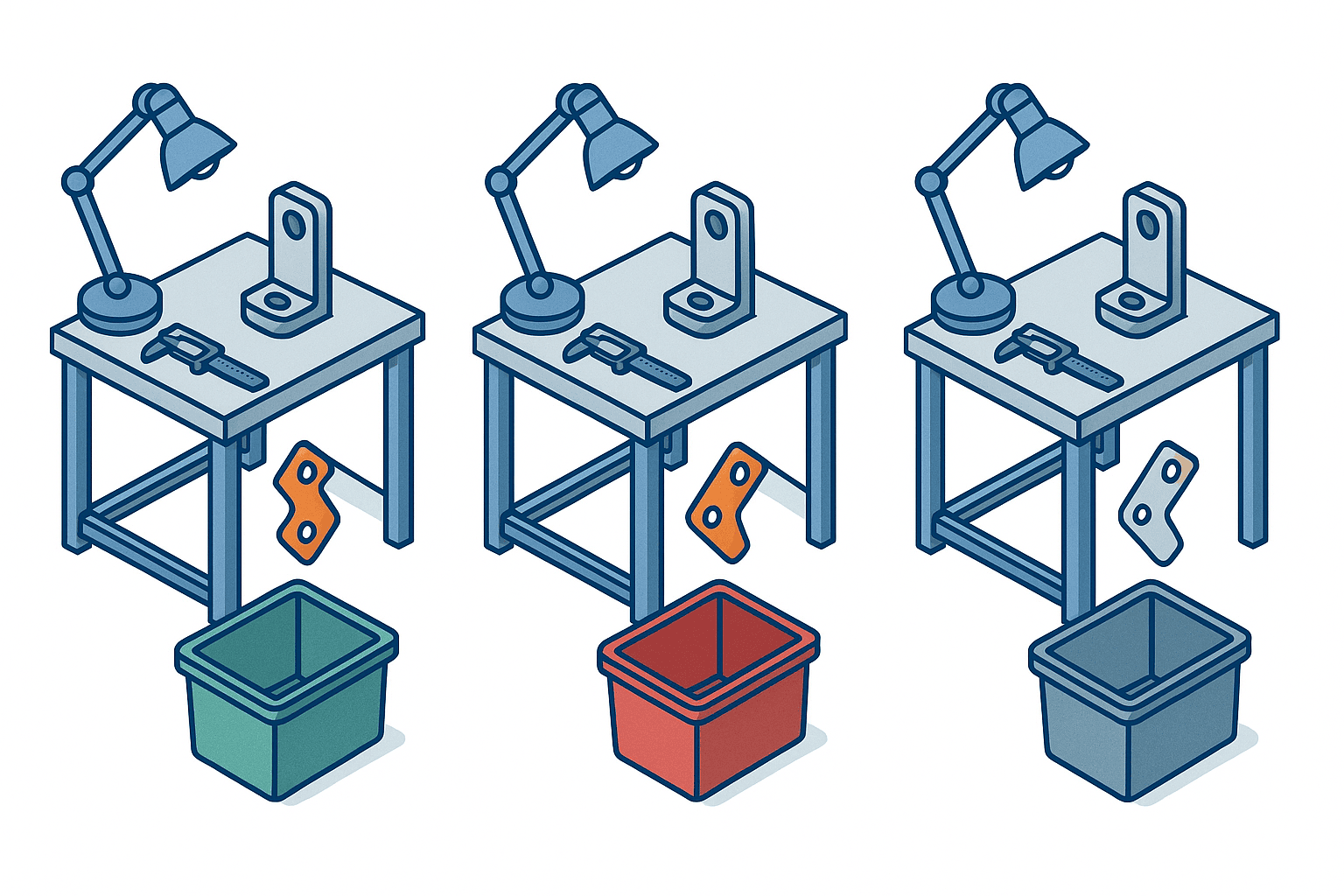
The second pattern is one where the judgment was correctly NG but the material did not stop. The classic route is a paper tag laid on a tray of NG parts, the tray parked at the edge of a workbench, and an operator on the next shift missing the tag and moving it into a good-parts container. Or a quarantine area that exists but is not locked, so when parts run short, “just one” gets taken out.
Paper tags and verbal handovers are most likely to break at shift changes and lot changeovers. A plant running three shifts a day for 250 working days a year generates 750 handovers annually. Assume a communication failure rate of 0.5% per handover and you get close to four broken handovers a year. Not every broken handover becomes an outflow, but where quarantine is not physically guaranteed, those four are all outflow candidates. On a Japanese customer’s quality scorecard, several escapes a year is generally a level that is hard to recover from.
Hole 3 — no lot traceback, so the recall scope becomes everything
The third hole does not cause outflow. It multiplies the damage after outflow by an order of magnitude. When a customer calls to say “there is a problem with last month’s delivery,” you cannot narrow the recall scope unless you can trace which lot, produced under which conditions, went out on which shipment, to which customer at which site. What is left is sorting everything shipped in the suspect period.
A sort that would have been 200 pieces if you could narrow it becomes 20,000 pieces because you cannot. That gap converts directly into cost and into lost trust. The related question of whether those records can be produced on the spot during a customer audit is covered in traceability for customer audits in Thailand. Here we are not dealing with audit readiness but with the operational job of fixing the recall boundary in the moment a defect surfaces.
Layer 1 — move shipping judgment criteria out of people and into documents and numbers
The first of the three layers is getting the judgment criteria out of people’s heads.
The five elements a usable shipping judgment standard needs
Most plants have a document called a judgment standard. Far fewer have one that is actually usable at the point of decision. A usable standard has all five of the following.
| Element | What it specifies | Common failure |
|---|---|---|
| Measurement method | Which instrument, which location, how many times | No instrument specified, so people use their own tools |
| Judgment value | The accept-reject boundary as a number | Only qualitative wording such as “significant” or “severe” |
| Boundary sample | A physical part or image near the boundary | Only an old sample whose shape differs from current production |
| Approver | Who is qualified to judge and who approves | A single stamp that anyone can use |
| Exception handling | Where to escalate when a call cannot be made | Undefined, so it is decided by whoever is in the room |
The element with the largest effect is digitising the boundary samples. Photograph parts near the boundary under fixed lighting, put the acceptable and unacceptable images side by side, and make them viewable on a tablet. Judgment variation shrinks visibly. Unlike physical samples, digital ones do not degrade, several lines can reference the same image simultaneously, and every die change leaves an update history.
Decide judgment authority and escalation before you need them
Even after you put numbers on the criteria, borderline product will still appear. That is why the decisive step is deciding in advance what happens when a call cannot be made.
Define a shipping hold decision as a formal operational status in its own right, and run it so that the person who puts a lot on hold is never penalised for it. In a culture where an inspector who raises a hold gets interrogated by their supervisor about why they stopped the line, nobody stops anything. State the opposite explicitly — when in doubt, stop, and stopping is something we evaluate positively — and judgments start settling on the safe side.
Define the escalation target by person and by time of day, not by job title. Day shift goes to the QA section manager, night shift to the duty supervisor in production, and if neither is available the lot is held until the next morning and does not ship. Writing down that last clause, that the lot does not ship when nobody is available, is the final line of defence against night and weekend outflow.
Multilingual work standards, a Thailand-specific issue
In Thai plants it is not unusual for the judgment standard to be written in Japanese, with only a summary translated into Thai, while the operators actually making the call speak Burmese or Khmer as their first language. In that state, saying “the criteria are documented” is not true in any operational sense. The judgment reverts to intuition.
The realistic answer is to cut the word count and replace it with drawings, numbers and photographs. Compress the criterion onto a single sheet, put an acceptable photograph and an unacceptable photograph side by side, and write only the dimensional values. Add one line of Thai text and stop there. This format does not depend on translation quality, and operators who share no common language converge on the same judgment far more reliably.
Communicating revisions is another point that jams in multilingual environments. Posting the revised version on a noticeboard does not mean it gets read. If you replace the digital boundary sample at every revision and make the previous version impossible to open, only the current version is in use whether or not anyone reads the noticeboard.
Layer 2 — physically separate NG material from the flow
Deciding to stop something in Layer 1 means nothing if the material moves anyway. Layer 2 converts the decision into a physical change of state.

Red tags, a quarantine area, and a lock
Red tag operation is old-fashioned and still works. The point is not the colour. It is that the tag, the material and the location are bound together as a set of three.
- Fix the red tag to the container rather than to the product, and move the container as a unit
- Place the quarantine area where it is visible from the aisle, and mark its boundary with a painted line on the floor
- Require a lock and a written record for anything removed from the quarantine area
The third point is missing in a great many plants, and that is where the hole is. The lock is not there to prevent fraud. It is there to guarantee that removing something always leaves a record. Having the keyholder reconcile the removal log against physical stock once a day is enough to cut quarantine leakage dramatically.
Barcode verification at the shipping gate
Red tags work inside the process, but between the finished goods warehouse and the shipping dock you need a different mechanism. What works there is a barcode check immediately before loading.
The operator scans the lot numbers on the shipping instruction against the labels on the pallets actually being loaded. If even one lot has a judgment status other than “accepted,” a buzzer sounds and the shipping document cannot be issued. The mechanism is simple, and it functions as the last barrier before the truck leaves.
The critical detail is that the result of the check must not be overridable by human judgment. The moment you design in a “skip because it is urgent” path, that skip becomes routine. If exceptions genuinely must exist, make the skip physically require the QA manager’s ID card, so a record is always left behind.
Deviation approvals are the single biggest hole
Shipping NG material with the customer’s agreement — a deviation approval or special acceptance — is a legitimate business process. The problem is that it is often completed verbally.
The most dangerous shape is shipping on the basis of “I phoned the contact at the customer and got a verbal OK,” and then discovering, when it becomes an issue later, that no record exists on the customer’s side. A deviation approval should be recorded in writing with the target lot numbers, the quantity, the deviating characteristic and its measured value, an expiry date, and the name of the approver on the customer side, and it must not carry over automatically to the next lot. Issue a deviation approval without an expiry date and six months later someone will believe “that was already approved,” turning it into a permanent outflow channel.
Layer 3 — make lot traceback to the delivery point actually work
Layer 3 does not reduce the number of escapes. It reduces the damage per escape by an order of magnitude.
Which links have to exist for traceback to work
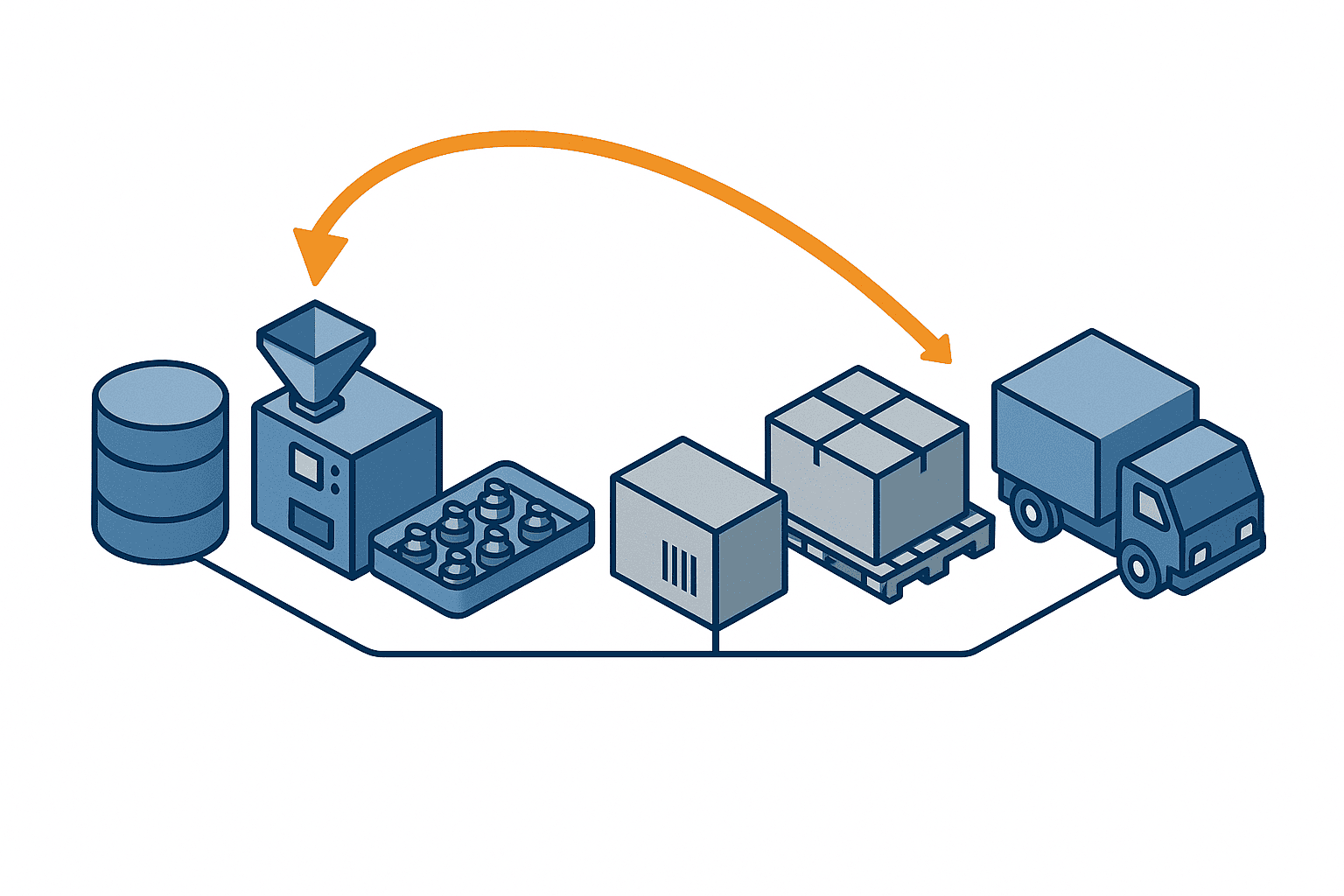
Lot traceback means starting from the product where the defect was found, identifying the shipping unit and the customer it belonged to, and then locating every other product made under the same conditions. For that to work, the following chain has to be unbroken.
| Link | Record required | Where it usually breaks |
|---|---|---|
| Material to production lot | Incoming lot number and issue record | When several incoming lots are mixed at issue |
| Production lot to conditions | Equipment ID, die ID, setpoint values, operator | Transitional parts made during changeover |
| Production lot to inspection result | Inspection timestamp, measured value, inspector | Overwriting on re-inspection |
| Production lot to packing unit | Correspondence to carton or pallet number | When leftovers are consolidated into one carton |
| Packing unit to shipment | Ship date, truck, delivery point, quantity | When goods are forwarded via the customer’s own warehouse |
Read that table and the pattern becomes clear. Traceback fails not because records are missing but because records are not connected. In most plants each of those five records exists in some form. But the incoming material ledger is a spreadsheet in purchasing, the production conditions are on paper shift reports at the machine, the inspection results are a file in the quality department, and the shipment records are in the logistics system — and reconciling them takes days. That state should not be called having traceability.
Joining in-process defect tracking to shipment traceability
Most plants already have some form of in-process defect tracking — a shift report or check sheet recording which machine produced which defect in which time window. The method for walking back to the source of an in-process defect is covered in detail in tracing in-process defects to their cause, so we will not repeat it. What matters here is that this record is usually not connected to shipment traceability.
The joint between them is the packing unit. Production lots go into cartons, cartons go onto pallets, pallets go onto shipments. Record that correspondence and the production lot becomes one continuous line all the way to the customer. Without it, no matter how granular your in-process defect tracking is, you cannot determine the scope of what reached the customer.
Concretely, this is three scans. Print a barcode containing the lot number on the carton label at packing, scan the cartons when building the pallet to register the parent-child relationship, and scan the pallet at shipping to bind it to the shipment record. Scanning takes under a minute per pallet and adds no meaningful load to the existing packing process. For sector-specific requirements, building automotive parts traceability for IATF 16949 covers the automotive case.
How many minutes does traceback need to take
The elapsed time from the customer’s call to a confirmed recall scope translates directly into cost. Setting these bands makes the discussion concrete.
- Immediate to 30 minutes gives you a good chance of keeping the customer’s line running
- A few hours means the customer’s line will stop, but you can still narrow your own sorting scope
- The next day or later means sorting everything shipped in the suspect period becomes the default outcome
To aim at 30 minutes, traceback cannot be a person reconciling ledgers. It has to be a screen where entering one lot number returns the delivery points and quantities as a list. Whether that one screen exists changes the cost of the identical defect by a factor of ten or more.
How much system do you actually need behind shipping judgment
When you set out to build the three layers, the first thing that stalls the investment decision is scope. The design of the underlying data platform for identifying defect causes is covered in choosing a quality data management system. This section is not about that whole picture — it is limited to the minimum needed to run the shipping judgment gate.
Dividing the work with your existing production management system
Most plants already run a production management system and an accounting system, and shipment records already sit in one of them. Filling only the gaps in what exists is faster, cheaper and more likely to stick than installing something new from zero.
| Function | Often covered by the existing system | Commonly needs to be added |
|---|---|---|
| Incoming lot record | Often covered | Link to the issue record |
| Production condition record | Often not covered | Automatic collection from equipment |
| Inspection result record | Partially covered | Storing measured values as numbers, with history |
| Link to packing unit | Often not covered | Label printing and scanning |
| Shipment record | Often covered | Lookup at lot granularity |
Skip this exercise and try to install a full traceability system as a package, and you get functional overlap with the existing system, duplicate data entry, and a shop floor that stops using it. The realistic policy is to inventory what is already being captured, then fill only the broken links.
The order to migrate off paper and spreadsheets
You do not need to digitise every process at once. Priority follows damage exposure.
| Priority | Target | Reason |
|---|---|---|
| First | Link between packing unit and shipment record | Without it, traceback cannot work even in principle |
| Second | Storing inspection results as numbers | Keeping measured values, not just pass or fail, lets you revisit criteria later |
| Third | Automatic collection of production conditions | Requires work on the equipment side and takes time |
| Fourth | Link to incoming material | Requires supplier cooperation and takes the longest |
The first and second priorities require no changes to existing equipment, so they typically take shape within about three months of starting. From the third priority onward, difficulty varies enormously with the age of the equipment, so it is entirely reasonable to confirm the results of the first two before deciding. Using the accumulated inspection data for defect trend analysis is a separate topic, covered in AI analysis of quality inspection data. Layer 3 in this article is purely a mechanism for fixing the scope. Analysis comes after that.
Costed model plant and payback
From here we work in concrete numbers. What follows is not a real company. It is a hypothetical model plant constructed to represent a Japanese-owned second-tier supplier in eastern Thailand. Change the assumptions and the conclusion changes, so read it by substituting your own figures. Amounts are in Thai baht, with reference conversions to Japanese yen at an assumed rate of 1 THB = 4.5 JPY.
Assumptions
| Item | Value |
|---|---|
| Location and sector | Eastern Thailand, second-tier supplier in metal machining and assembly |
| Headcount | 320 people, of whom 24 are in inspection |
| Annual shipment value | 480,000,000 THB |
| Main customers | 6 companies, of which 3 are Japanese automotive Tier 1 |
| Annual outflow complaints | 15 cases, three-year average |
| Complaint causes | Judgment variation 7, quarantine leakage 4, other 4 |
Assume that of those 15 outflow complaints, 5 escalated into sorting everything shipped in the suspect period because lot traceback was not possible.
Current cost of outflow
Building up the cost of a single outflow complaint gives the following.
| Cost item | Amount (THB) |
|---|---|
| Outsourced sorting | 45,000 |
| Emergency freight and special deliveries for replacements | 60,000 |
| Corrective action report and customer visit, 32 hours at 850 THB | 27,200 |
| Scrapping defective parts and remaking them | 38,000 |
| Total per case | 170,200 |
From that unit cost we derive the annual total. Taking the breakdown first, normal complaint handling is 15 cases at 2,553,000 THB, and the additional cost of the 5 cases that escalated into full sorting is 180,000 THB per case, or 900,000 THB. That 180,000 THB of additional cost covers the increase in outsourced sorting fees as the sorting scope widens from a few hundred pieces to tens of thousands, plus the cost of arranging replacement parts during the shipment freeze until sorting is complete.
| Category | Amount (THB) |
|---|---|
| Normal complaint handling, 15 cases at 170,200 | 2,553,000 |
| Additional cost of 5 cases escalating to full sorting, 5 at 180,000 | 900,000 |
| Annual total | 3,453,000 |
Against annual shipment value of 480,000,000 THB, that is 0.72%. For reference, at 1 THB = 4.5 JPY, 3,453,000 THB per year is roughly 15,540,000 JPY. At 0.72% of revenue it looks small at first glance, but in a business running a 5% operating margin, more than 14% of the profit is being consumed by outflow response.
There is a long-standing rule of thumb in quality costing that if prevention costs one, fixing it inside the process costs ten, and fixing it after it reaches the customer costs a hundred. It is not a rigorous accounting law, only an indication of orders of magnitude. Still, the breakdown above is consistent with it. Most of the post-outflow cost sits in outsourced sorting and emergency freight, which have nothing to do with remaking the part.
Investment across the three layers
| Layer | Main measures | Initial investment (THB) | Annual running cost (THB) |
|---|---|---|---|
| Layer 1, judgment criteria | Digitised boundary samples, judgment criteria master, 10 reference tablets | 520,000 | 104,000 |
| Layer 2, physical quarantine | Quarantine area build-out, red tag operation, shipping gate verification with 6 handhelds and 2 gate PCs | 810,000 | 162,000 |
| Layer 3, lot traceback | Lot linkage database, label printing, shipment record integration, traceback screen | 1,340,000 | 268,000 |
| Three layers combined | All of the above | 2,670,000 | 534,000 |
The initial investment of 2,670,000 THB is roughly 12,015,000 JPY at 1 THB = 4.5 JPY. It equals about 0.77 times the annual outflow cost of 3,453,000 THB. A separate estimate that breaks down the cost of building a traceability platform itself by process count and plant scale is available in traceability system build cost. Treat Layer 3 in this article as the slice of that platform which bears directly on shipping judgment.
Benefit and payback period
Benefits are calculated layer by layer and stacked in sequence, so that reductions achieved by an upper layer are not double-counted by a lower one.
| Stage | Assumed change | Annual cost after applying (THB) |
|---|---|---|
| Current | 15 escapes, of which 5 escalate to full sorting | 3,453,000 |
| After Layer 1 | Judgment variation cases fall from 7 to 3. Total escapes 11 | 2,538,200 |
| After Layer 2 | Quarantine leakage cases fall from 4 to 1. Total escapes 8 | 1,847,600 |
| After Layer 3 | Full sorting goes to zero, and sorting cost for the remaining 8 cases falls from 45,000 to 20,000 | 1,161,600 |
The number of cases escalating to full sorting is carried forward at the current incidence of one in three and rounded to one decimal place, giving 3.7 cases after Layer 1 and 2.7 cases after Layer 2. Layer by layer, the benefit is 914,800 THB for Layer 1 as 3,453,000 minus 2,538,200, then 690,600 THB for Layer 2 as 2,538,200 minus 1,847,600, then 686,000 THB for Layer 3 as 1,847,600 minus 1,161,600. The total annual benefit is 2,291,400 THB, a reduction of about 66%. Subtracting the annual running cost of 534,000 THB leaves a net benefit of 1,757,400 THB.
Dividing the initial investment of 2,670,000 THB by the net benefit of 1,757,400 THB gives 1.52 years, or about 18.2 months to payback.
If the benefit falls short of the assumption
In an investment decision it is safer to look at the downside first. Here we assume the case-count reductions from Layers 1 and 2 reach only 70% of the assumption. Layer 3 traceback is not multiplied by that factor, because once the data is in place it works regardless of how well the operational discipline has bedded in.
- The reduction in judgment variation cases falls from 4 to 2.8, and the reduction in quarantine leakage cases falls from 3 to 2.1
- Remaining escapes rise from 8 to 10.1
- The number of cases that would have escalated to full sorting without Layer 3, calculated at the same incidence, is 3.4. Layer 3 takes this to zero
- Annual cost after Layer 3 is 10.1 cases at 145,200 THB, or 1,466,520 THB
- Total annual benefit is 3,453,000 minus 1,466,520, or 1,986,480 THB, and net of running cost the benefit is 1,452,480 THB
- Payback is 2,670,000 divided by 1,452,480, or 1.84 years, about 22.1 months
Even with the benefit cut by 30%, payback stays at about 22.1 months. Within that range the investment case still holds up.
Now return the assumptions to the standard case, keep the benefit as originally assumed, and look at what happens if you drop Layer 3 and implement only Layers 1 and 2. The initial investment falls to 1,330,000 THB, and with a benefit of 1,605,400 THB less running costs of 266,000 THB, the net benefit is 1,339,400 THB, so payback looks attractively short at about 11.9 months. But without Layer 3 you cannot stop escalation to full sorting, and the damage per escape stays large. Looking only at short-term payback, dropping Layer 3 is a defensible call — but it means carrying the exposure of one serious escape indefinitely.
External pressures raising the bar for defect outflow prevention in Thailand
The cost of an escape rises when customers are cutting production
Thailand’s automotive industry is currently in a period of flat to declining output. According to a JETRO article dated 17 August 2026, Thai automobile production in the first half of 2026 was 717,212 units, down 1.0% year on year, and the Federation of Thai Industries cut its full-year outlook from 1.5 million units to 1.45 million.
When volumes are not growing, both vehicle makers and parts makers tend to hold thinner inventory. The thinner the inventory, the more directly a shipment freeze or a sorting exercise caused by a defect escape hits the customer’s line, so the same single escape does more damage on the customer side. Put another way, a downturn is precisely when the relative value of investing to remove even one escape goes up.
Customer audits ask how you stop material, not how accurately you inspect
When a Japanese automotive or electronics customer in Thailand audits a second-tier supplier, what gets examined is not the performance of the inspection equipment. What is actually looked at is the record produced when an NG judgment occurs, the agreement between physical stock in the quarantine area and the ledger, the written deviation approvals, and the response time to the request “show me where this lot was shipped.”
In other words, the audit checklist maps directly onto the three layers described here. Investing in equipment does not reduce audit findings, because the audit is looking at how you stop material, not at your machines. The practical mechanics of presenting records on the day of the audit are collected in traceability for customer audits in Thailand.
Inspector retention, and why criteria should not accumulate in people
In Thai manufacturing, we frequently hear on site that inspection roles turn over more readily than other processes. A plausible reading is that wage levels are not very different from production roles, while the judgment skill an inspector builds up is not easily recognised as a portable qualification outside the company.
In that environment, making the judgment criteria dependent on individual experience means the standard moves every time one person leaves. The digital boundary samples and numerical criteria described in Layer 1 also function as insurance against turnover. If a new hire can pull up the predecessor’s judgment history and the boundary samples on a tablet, the time to working independently should shorten considerably.
Work standards on a multilingual shop floor
The argument for replacing judgment criteria with drawings and numbers was made in Layer 1, and the same problem applies to quarantine procedures. Any attempt to convey a procedure in words loses information at the translation step.
The countermeasure is to convert procedures from words into physical states. The colour of the red tag, the painted line on the floor of the quarantine area, the locked door, the buzzer that sounds when the barcode does not match. None of these require translation. In a multilingual environment, designing a state that is understandable without words beats documentation.
Regulatory developments in 2026 raising the required standard
The regulatory environment around manufacturing in Thailand has moved during 2026 in a direction that raises the importance of defect outflow prevention.
Thailand’s Product Liability Act B.E. 2551 is already in force. A consumer need only show that the product caused damage through normal use, and the burden falls on the business to prove that the product was not unsafe. Business here covers not only manufacturers and importers but also, where the manufacturer cannot be identified, the seller. For a parts maker sitting in the middle of the supply chain, the fact that being unable to trace a lot back to its manufacturer directly widens where liability lands is not something to ignore.
On 16 June 2026 the Thai Cabinet approved a defective goods liability bill submitted by the Office of the Consumer Protection Board, generally referred to as the lemon law. According to law firm commentary, the bill presumes that a defect existed at the time of delivery if a fault arises within six months for general goods or within one year for automobiles, and places the burden of rebuttal on the seller. A claim for replacement is available only where a serious defect is found, within 7 days of receipt for general goods and within 14 days of receipt for electrical and electronic products. Defects short of serious are handled by repair, with the intended deadlines being 60 days for general goods, 90 days for automobiles and 60 days for motorcycles. The scope is reported to cover not only consumer transactions but also business-to-business transactions, which makes it directly relevant to companies supplying parts. The bill passed its first reading in the House of Representatives on 24 June 2026 and is at the committee stage. The final text is not yet settled, so nothing can be stated definitively, but if enacted, the pressure from finished-goods makers pushing recall requirements down to parts suppliers is likely to intensify.
There is also a milestone on the quality management side. According to a notice from ISO/TC 176/SC 2 dated 7 August 2026, ISO/FDIS 9001 was approved by an overwhelming majority, and the sixth edition of ISO 9001 is scheduled for publication on 16 September 2026. At the time of writing it has not yet been published, so its content cannot be described definitively, but after publication, quality management system reviews will proceed in sequence through the transition period.
On the product regulation side, mandatory standards from the Thai Industrial Standards Institute (TISI) continue to be updated. Announcements for 2026 include TIS 2134-2565 for room air conditioners becoming mandatory from 4 April, TIS 866 Part 30-1-2561 for three-phase induction motors from 18 April, and TIS 2948-2562 for food contact paper together with TIS 3438-2565 for cooking paper from 22 June. It is worth noting that each standard defines its scope in detail — the three-phase induction motor standard, for example, covers the range from 0.12 kW to 375 kW. Because products covered by mandatory standards can be subject to sales suspension or recall if non-conformity is found, plants handling affected products need to build a standards-conformity check into their shipping judgment.
Developments in Japan are also instructive. According to figures published by Japan’s Ministry of Land, Infrastructure, Transport and Tourism, automobile recall notifications in fiscal 2025 totalled 358, an increase of 21 over the previous fiscal year, while the total number of vehicles covered was 4,014,432, a decrease of 3,550,536 from the previous fiscal year. The vehicle count is down but the number of notifications is up, which suggests the frequency with which faults are detected and escalated to a notification has not fallen. For a Thai supplier whose ultimate customers are Japanese vehicle makers, that level of notification volume means customers will continue to demand the ability to fix the recall scope quickly.
How to phase the rollout
You do not need to stand up all three layers at once. Here is an example phased in 90-day blocks.
| Period | Main activity | Milestone |
|---|---|---|
| Days 1 to 30 | Classify the past two years of outflow complaints by cause, inventory the judgment standards | Identify which layer has the holes, in case counts |
| Days 31 to 60 | Put numbers on the judgment criteria for the top 3 products, photograph and digitise the boundary samples | Layer 1 running on the main line |
| Days 61 to 90 | Build out the quarantine area and lock operation, trial shipping gate verification on one line | Layer 2 benefit measured on one line |
| Days 91 to 180 | Link packing units to shipment records, build the traceback screen | Layer 3 running on all lines |
Producing the case counts by cause in the first 30 days is the pivot of this whole approach. Whether the holes are mostly in judgment criteria or mostly in quarantine differs by plant, and getting the order wrong stretches the time before any benefit appears. Simply rereading past complaint reports and sorting them into judgment variation, quarantine leakage and other will make the investment priority substantially clearer.
Frequently asked questions
How far should we quantify the criteria behind a shipping hold decision?
You do not need to quantify every characteristic. Prioritise the ones that have historically caused complaints or internal defects. Rank complaint causes by case count and you will often find them concentrated in the top few items. Nail down just those top items with numbers and boundary samples, leave the rest in qualitative wording, and judgment variation still falls sharply. Aiming to quantify every characteristic in the first year inflates the workload and the effort tends to stall partway.
Where is the realistic place to start with in-process defect tracking?
Start with the link between packing unit and production lot. Automatic data collection from equipment looks attractive, but it depends on the age and communication specification of the machines, and the gap between kickoff and going live is long. Printing a label containing the lot number at packing and scanning it during pallet build, by contrast, can be started without touching any existing equipment. Connecting that single link alone shortens traceback time from days to minutes.
Does shipment traceability need to extend beyond the customer’s warehouse?
The baseline is holding your own shipment records with certainty — which delivery point received which lot, in what quantity, on what date. Distribution beyond the customer’s warehouse cannot be traced by you, so the premise is that you will ask the customer to provide that information. That said, holding the delivery point at receiving-location granularity rather than at plant granularity lets the customer narrow the scope faster, which in turn keeps the recall boundary smaller. The granularity of the delivery point code is something to settle early in the system build.
Will installing a defect root cause system stop outflow on its own?
A defect root cause system shortens the time it takes to reach the cause after an escape. It is not a mechanism that stops the escape itself. What stops escapes is the judgment criteria of Layer 1 and the physical quarantine of Layer 2. The effective sequence is to build the stopping mechanism first, then layer root cause identification and traceback on top of it. Run it in the reverse order and you tend to end up knowing the cause quickly while the escapes continue.
We run 100% inspection, so why does defect outflow still happen?
Because 100% inspection is not a mechanism for driving misses to zero. Human 100% inspection leaves a residual miss rate, and defects generated in processes downstream of inspection are never inspected at all. On top of that, as described above, there is the path where a part is correctly judged defective and then slips back into the flow because it was never quarantined. It is also worth noting that the more thoroughly a plant performs 100% inspection, the more strongly the assumption “we inspected it, so it is fine” takes hold, and the thinner the controls after the judgment tend to become.
Conclusion
Defect outflow prevention is not a story about raising the performance of inspection equipment. It is a story about designing the decision and the material movement that follow inspection. Move the judgment criteria out of people’s heads into documents and numbers. Physically separate NG material from the flow. Connect lot traceback to the delivery point as one continuous line. Which of these three layers has the hole becomes visible in case counts as soon as you classify past complaints by cause.
In the model plant used here, against an annual outflow cost of 3,453,000 THB, an initial investment of 2,670,000 THB and an annual running cost of 534,000 THB produced a net annual benefit of 1,757,400 THB and payback in about 18.2 months. Even assuming the benefit reaches only 70% of expectations, payback is about 22.1 months. The assumptions differ from plant to plant, but the way the calculation is assembled should transfer directly.
2026 is a year in which Thailand’s defective goods liability bill is under deliberation, the sixth edition of ISO 9001 is scheduled for publication, and additional mandatory standards take effect together. Before customer requirements ratchet up, start by confirming where your own shipping judgment gate actually sits.
If you are at the stage of wanting to work out where to begin in your own plant, whether that is building shipping judgment criteria or setting up lot traceback, we are glad to talk it through. It is worth a conversation even at the consideration stage, before any concrete implementation plan is fixed, so please get in touch through our contact page. Working from the realities of manufacturing in Thailand, we will start by understanding how your records are currently held and think through a practical path forward with you.
References
- ISO 9001 revision update — Notice dated 7 August 2026 from ISO/TC 176/SC 2. Primary source for the approval of ISO/FDIS 9001 and the scheduled 16 September 2026 publication of the sixth edition
- Thailand Cabinet Approves Draft Lemon Law — Commentary dated 7 July 2026 from Baker McKenzie, covering the 16 June 2026 Cabinet approval and the standing of the bill
- New draft Lemon Law to protect buyers from defective products — Commentary dated 23 July 2026 from Forvis Mazars Thailand, with the specific replacement claim windows, repair deadlines and defect presumption periods
- Thailand’s Product Liability Law and Consumer Case Procedures Act — Commentary from Price Sanond on the definition of a business under the Product Liability Act, the reversal of the burden of proof, and limitation periods
- Recall Notifications and Vehicles Covered by Fiscal Year — Automobile Defect Information Hotline of Japan’s Ministry of Land, Infrastructure, Transport and Tourism. Published figures of 358 recall notifications and 4,014,432 vehicles covered for fiscal 2025
- Thailand’s First-Half Automobile Production Falls 1.0 Percent Year on Year — JETRO article dated 17 August 2026, with first-half 2026 Thai automobile production of 717,212 units and the full-year outlook from the Federation of Thai Industries
- Thailand TISI Standards Taking Effect in 2026 — Testcoo article dated 13 March 2026, with the standard numbers and effective dates for TIS 2134-2565 and other standards becoming mandatory in 2026
- The 1-10-100 Rule — Explanation of the rule of thumb that quality costs rise by an order of magnitude at each stage from prevention to detection, correction and failure


