


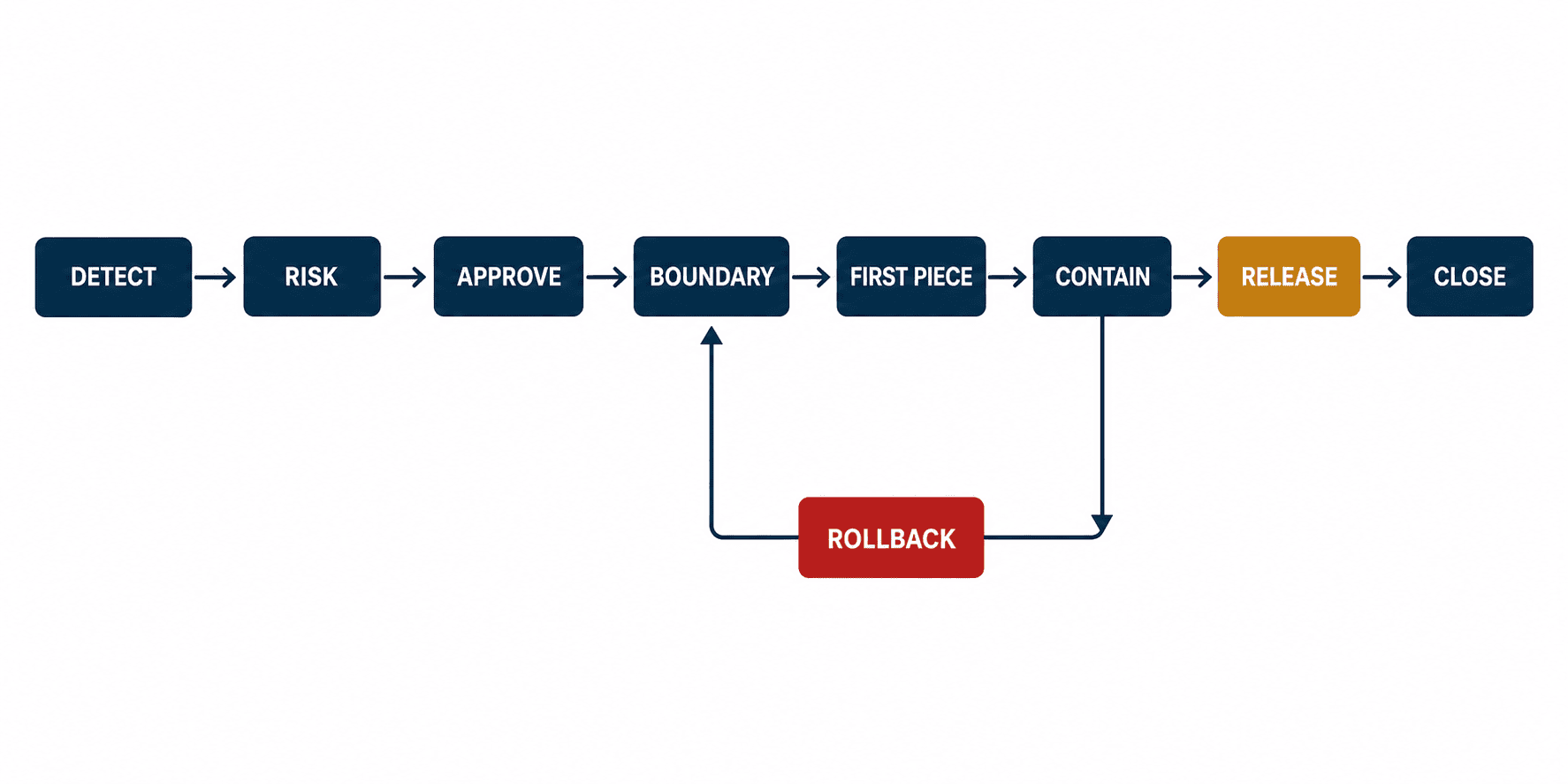
A 4M change management system can create an impressive register while still leaving the factory unable to answer three basic questions: Which serial number was the first unit made under the new condition? What evidence released the first piece? If the change fails, which material lots and finished products must be contained? Man, Machine, Material and Method should therefore not be managed as labels on a change request. They must drive an executable release-control loop covering planned and unplanned change detection, risk and approval, the effective boundary, first-piece validation, temporary containment, evidence, rollback and closure. This guide turns that loop into practical RFP, FAT and SAT criteria for a Thai factory and a focused 90-day pilot.
Executive answer: manage a release, not a change log
The success of 4M change control is not the number of submitted requests or electronic approvals. It is the ability to separate products made before and after a change, prevent production under an unapproved condition, release volume production from first-piece evidence, and limit containment when an abnormality occurs.
A capable system connects the following states under one immutable change ID:
- Detect planned and unplanned changes.
- Assess affected parts, processes, equipment, material, operators and controlled documents.
- Route risk-based approvals to the required roles.
- Reserve and then confirm an effective boundary using time plus first and last serial or batch.
- Execute first-piece checks and temporary containment.
- Release production when evidence is complete or initiate rollback when it is not.
- Close remaining training, document, material and action items.
The data model in this article is a practical design proposal, not a substitute for a standard, customer-specific requirement or company procedure. When comparing products, do not stop at “Can the software register 4M?” Ask: “Can it reproduce the boundary and the release decision from evidence?”
Why review 4M change management in 2026?
The current quality-management landscape is a useful reason to examine whether change control is a live operating process or only document administration. On 29 August 2026, the ISO product page lists ISO 9001 Edition 6 as “under publication” with publication expected in September 2026. It must not be represented as already in force. ISO’s separate 2026 edition overview describes clearer wording, stronger emphasis on leadership, quality culture and accountability, clearer treatment of risks and opportunities, and a new Annex A. A factory can prepare by improving traceable decision-making; it should not claim conformity to unpublished requirements.
The ISO/TC 176/SC 2 implementation page continues to list guidance on how change is addressed within ISO 9001:2015. The operational lesson is that change is not confined to one request form. It affects planning, controlled information, operations, review and improvement.
For automotive organizations, the IATF active stakeholder communiqués include 2026-005, titled “IATF 16949 2nd Edition Update Information.” That title reports an update process; it is not evidence that a second edition has been published. The official IATF Sanctioned Interpretations page also states that SIs #27–30 were issued and effective in November 2025. Applicability and customer-specific requirements must be confirmed by the responsible quality team against current official documents.
The official IATF SI PDF includes control-plan information such as issue/revision date and engineering change level and describes direct links to systems managing detailed control-plan information in applicable cases. The practical implication is not merely to store a PDF. Product genealogy should identify the control-plan version that was effective for the product.
The AIAG manuals catalogue lists APQP 3rd Edition and the standalone Control Plan 1st Edition. AIAG identifies the Control Plan manual as published in March 2024 and describes guidance including Safe Launch, highly automated manufacturing examples and software-supported control-plan management. These are strong reasons to include post-change launch controls and evidence in system acceptance.
Treat 4M as interacting impacts, not a single classification
A real change rarely belongs to only one M. A new raw-material lot is primarily Material, but revised process settings affect Method, sensitivity to fixture wear affects Machine, and new inspection judgement may require Man training. If a system forces one category, it encourages an incomplete impact assessment.
| 4M dimension | Typical changes | Related impacts to assess |
|---|---|---|
| Man | new operator, temporary support, qualification renewal, shift transfer | training revision, certification, authority and supervision |
| Machine | equipment, fixture, die, sensor or PLC change | parameters, calibration, maintenance, program revision and safety |
| Material | supplier, grade, formulation, substitute or lot switch | incoming inspection, storage, shelf life and material genealogy |
| Method | sequence, recipe, inspection, work standard or handling change | PFMEA, Control Plan, instructions, capability and training |
Store a primary category if it helps reporting, but allow multiple affected dimensions. Link the change to structured master IDs for part, process, equipment, tool, material, supplier, operator qualification and document revision. A narrative description remains useful, but it cannot by itself block an unqualified operator, compare a PLC setpoint or retrieve every affected serial number.
Bring planned and unplanned changes into the same control loop
Forms capture planned changes. Factory risk often starts with facts that occur first: an on-shift PLC setpoint adjustment, material issued from an unapproved lot, a replaced fixture, an inspection recipe edited at the machine, an expired operator qualification, or a mismatch between drawing and work instruction.
The system should compare evidence from:
- MES part, routing, equipment and operator transactions;
- PLC, SCADA and inspection-equipment parameters and recipe versions;
- ERP/WMS material issue, supplier and lot data;
- drawing, work instruction, Control Plan and PFMEA revisions;
- maintenance replacement, tooling, die and calibration events;
- identity, access and qualification records.
Automated detection is not automated approval. A detected difference should be classified as execution of an approved change, an unapproved difference, a collection fault or a permitted variance. Unapproved differences enter a controlled exception queue and, where risk warrants it, interlock process completion or shipment.
Build an executable closed-loop change release
“Requested, approved, completed” is too coarse. A practical state model distinguishes Draft, Risk Review, Approved, Scheduled, Executing, First-piece Hold, Temporary Containment, Released, Rolled Back and Closed. Each transition defines required evidence, authorized roles and escalation for overdue work.
1. Fix the request and scope
Record the purpose, before/after condition, affected parts, process, equipment, site, customer and intended execution window. Select scope objects from master data so they can later be joined to genealogy. An emergency flag must not silently remove governance: record which normal controls were bypassed, the compensating control, approver and expiry.
2. Determine risk and approval from rules
Assess safety and regulatory impact, special characteristics, customer-specific requirements, capability, substitute material, new supplier, software, inspection method, rework and training. A score can support prioritization, but critical triggers should impose mandatory gates even when the total score is low.
Approval must preserve who approved which revision of the request and evidence, at what time and under which role. If scope or a release condition changes after approval, invalidate the affected approvals, show the difference and route a fresh decision.
3. Reserve the effective boundary, then confirm it from production facts
“Effective on 29 August” cannot separate night shift, work in progress, residual material and parallel lines. Keep planned and actual boundaries separately. Confirm the last old-condition product and first new-condition product from serial, batch, production order, material issue, tool change and equipment event evidence.
4. Hold first pieces and release from evidence
Keep first pieces physically and digitally separate from normal output. Generate the inspection plan before execution based on risk. Store the measured values with instrument ID, calibration status, inspection-program revision, timestamp, operator and product serial. A typed “PASS” without the measurement context is weak release evidence.
5. Execute containment and rollback
For changes whose uncertainty remains after the first piece, activate extra checks, increased sampling, identification, shipment hold or observation for a defined quantity or time. Make the exit rule machine-evaluable: required quantity completed, all required checks present, no unresolved nonconformity and authorized release.
When validation fails, launch the approved rollback or containment procedure. Preserve the old configuration package, affected-product query and disposition. A rollback is itself a controlled execution with a new boundary; it should never erase the failed attempt.
6. Separate production release from case closure
Releasing volume production does not mean all change work is complete. Training, controlled documents, PFMEA, Control Plan, maintenance instructions, spare parts and residual material disposition must be closed. Perform a post-implementation review using measured data. Do not promise improvement percentages before the factory establishes a baseline.
Define the effective boundary with time and serial identity
The effective boundary is where 4M management meets traceability. A single date is ambiguous when messages arrive late, clocks drift, data is entered manually or work in progress spans a shift. Store the following as one boundary record.
| Boundary field | Purpose | Required design decision |
|---|---|---|
| planned effective time | intended release window | time zone, shift rule and postponement authority |
| source time | when the event occurred at source | clock authority, precision and unsynchronized-clock handling |
| receive time | when the platform received it | late arrival and offline resend identification |
| last old serial/batch | final product under the old condition | gaps, re-entry and split-lot rules |
| first new serial/batch | first product under the new condition | consistency with first-piece hold |
| material boundary | last old and first new material use | residual, purge, mixing and scrap rules |
| change execution ID | identity of the execution | retry, cancellation and rollback relationship |
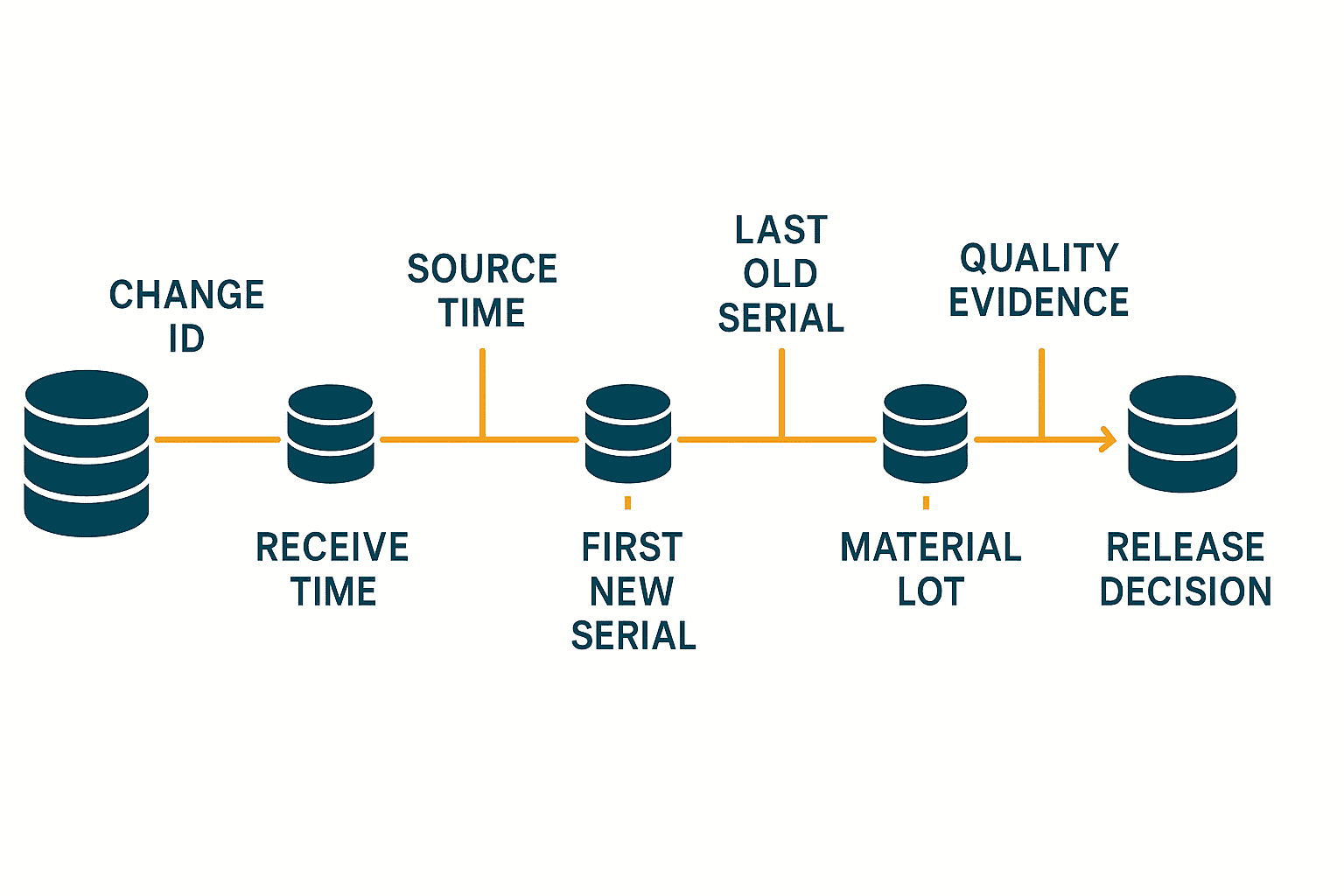
The difference between source and receive time does not automatically determine the effective time. It exposes late events and helps assess confidence in the boundary. If the boundary cannot be proven, do not invent precision. Expand the affected set conservatively and record the quality authority’s decision and rationale.
Connect material lot genealogy to the change boundary
Material traceability is not complete when a receiving label is scanned. The lot must remain linked through storage, splitting, mixing, issue, line loading, residual material, return, scrap and work in progress to actual consumption in finished products.
At a material change, record the last issue of the old lot, first issue of the new lot, purge or residual treatment and any mixing interval. When mixing cannot be avoided, do not force a single-lot answer. Preserve candidate lots, amounts or time windows, and enlarge the affected set rather than understate it.
Acceptance testing should cover relabeling, wrong-lot issue, offline issue, split containers, returned material and simultaneous use of multiple lots. Evaluate traceability in both directions: finished product to source material, and material lot to every potentially affected product. The result must show uncertainty, not hide it.
Join in-process defect tracking with first-piece validation
A defect attachment on a change page is not enough for analysis. Link each defect event to serial, operation, equipment, material lot, operator, recipe revision, measured value, decision rule and change execution ID. The question becomes “Which defect occurred under which combination inside which effective boundary?” rather than merely “Was it after the change?”
Preserve the first failure, retest, sorting, rework, scrap and concession as an append-only history. If the initial result is overwritten by the final pass, instability after a change disappears from reports. First-piece and normal inspection can share the same measurement platform, but the evidence used for release should be revision-locked and electronically approved.
Temporary containment instructions must reach the shop-floor terminal with their target and exit condition. If a required check is missing, the target serial cannot complete the operation or ship. For offline operation, the device must still preserve serial identity and the actual inspection time for later synchronization.
Four connected graphs for a quality data management system
A quality data repository cannot explain 4M causality by itself. Connect four object graphs using stable identifiers:
- Change graph: request, risk, approval, execution, rollback and closure.
- Genealogy graph: material, work in progress, product, equipment, process, operator and time.
- Quality evidence graph: specification, measurement, instrument, judgement, nonconformity and rework.
- Release decision graph: hold, first piece, containment, release and shipment decision.
Exchange immutable IDs, revisions and event times, not only screen URLs. ERP material codes, MES serials, QMS nonconformity IDs and document revisions can remain in different systems if their mapping has an effective period and ownership. Avoid waiting for perfect enterprise master data. Build a minimal ID contract for the pilot product and operate an exception queue while expanding.
For the evidence layer, see our detailed guide to a process parameter recording system. For secure data acquisition from brownfield equipment, see industrial IoT gateway selection for Thai factories. The 4M loop described here sits above those layers and turns facts into approved release decisions.
Access control, audit evidence and OT security
Because a 4M platform can affect equipment settings and operator permissions, segregation of duties matters. A requester should not self-approve the final release. Separate the person who changes equipment from the person who validates it. Automatically review emergency privileges.
An audit trail needs more than an actor name. Keep before/after values, reason, approved object revision, authentication method, device, timestamp, failed operations and API updates. Separate the ability to administer business workflows from the ability to alter or delete audit logs. Specify retention, export and clock synchronization in the RFP.
Do not write an approved recipe blindly to a PLC or inspection machine. Verify target equipment identity, current revision, safe machine state, work authorization, backup and signed package; then read back the result. Where old equipment cannot support automated deployment, define two-person verification and captured evidence as a compensating control.
RFP, FAT and SAT acceptance matrix
Compare vendors using the same input, expected result, evidence and decision owner—not a checklist of feature names.
| Acceptance topic | RFP requirement | FAT demonstration | SAT factory demonstration | Pass evidence |
|---|---|---|---|---|
| Planned change | before/after, scope, approval and revision control | modification after approval triggers reapproval | execute with real part and roles | revision history, approval object, audit log |
| Unplanned change | detect PLC, material and document differences | inject an unauthorized parameter | detect and isolate on actual equipment | difference, detection time and disposition |
| Effective boundary | source/receive time plus serial/batch | test late, missing and resent events | verify last old and first new products | boundary record and physical reconciliation |
| First-piece release | inspection plan, instrument and authority | failed first piece blocks release | hold and release using real measurement | values, calibration status and approval |
| Temporary containment | additional check and exit rules | block a serial missing a required check | preserve rule through shift handover | target list, completed checks and release |
| Material genealogy | split, mix and returned-material handling | trace both directions and wrong issue | reconcile warehouse to finished product | genealogy export and exceptions |
| In-process defects | append NG, retest and rework | prevent overwrite and search by change | retrieve affected serials from a defect | defect history and affected-product list |
| Rollback | restore old revision and contain product | restore after failed execution | execute safe procedure on plant asset | backup, readback and containment record |
| Integration outage | offline queue, resend and deduplication | inject network loss and duplicate events | recover after a plant network outage | missing/duplicate comparison and resend log |
| Authorization | segregation, API audit and protected logs | attempt forbidden action and emergency access | verify actual identity lifecycle | role matrix, audit log and review evidence |
Avoid a pass criterion such as “works normally.” Define which differences must be zero and which exceptions may be accepted with explanation. For a boundary test, compare an expected serial set against the system result, classify missing, excess and uncertain records, and retain the reconciliation. Numeric thresholds should come from product risk and a measured baseline, not from a generic sales claim.
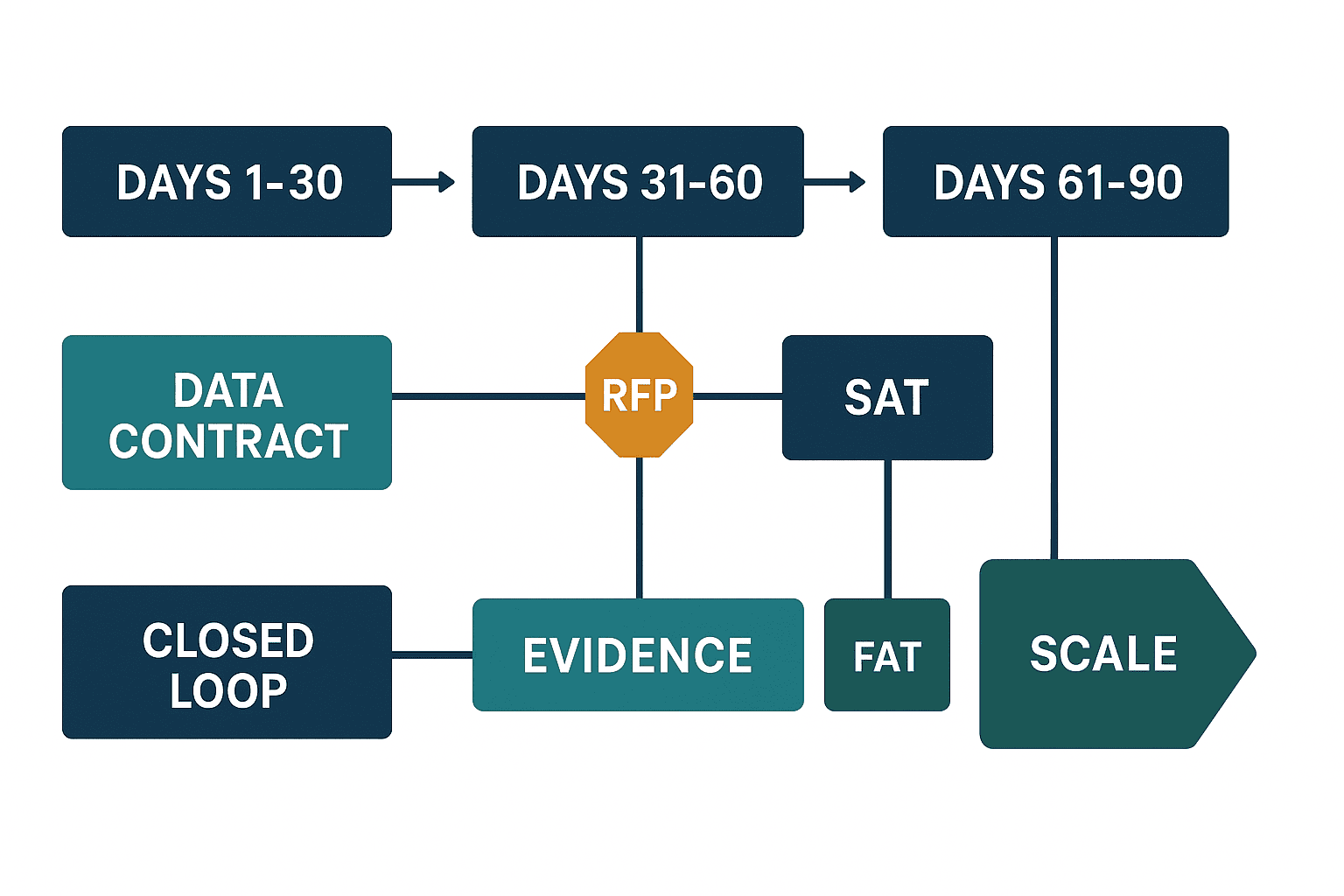
A 90-day pilot that produces a deployment decision
A pilot is not a miniature enterprise rollout. It is a short period for testing the highest-risk assumptions with evidence. Select one product family, one or two operations, and materials or equipment where changes actually occur. A stable line with no real change can validate screens but not the operating model.
Days 1–30: baseline and data contract
- Review past changes and measure approval delays, unknown boundaries, incomplete first-piece evidence and affected-product retrieval time.
- Map IDs for part, process, equipment, material, operator and document revision.
- Select representative planned and unplanned scenarios.
- Define states and required evidence for boundary, first piece, containment and release.
- Start with read-only ERP, MES, QMS, PLC/SCADA and document connections.
- Agree the FAT/SAT expected dataset, scripts and decision owners.
The deliverables are an event dictionary, ID contract, state transition model, exception rules and acceptance script—not a long list of mock-up screens. If a baseline is not measurable, do not create an improvement target; make the baseline measurable first.
Days 31–60: run one complete loop
- Submit a planned change and complete risk-based approvals.
- Reserve the intended boundary and confirm the actual last old and first new units.
- Hold a first piece and release it from inspection evidence.
- Execute temporary containment across a shift change.
- Simulate an unauthorized PLC difference or wrong material issue.
- Reproduce network loss, late arrival, duplicate delivery and manual correction during FAT.
Do not hide legacy equipment that requires a manual step. Make the operator, verifier, due time and evidence mandatory and connect the manual step to the same change ID.
Days 61–90: SAT, handover and investment decision
- Conduct SAT with real plant identities, shifts, equipment and material.
- Test affected-product retrieval, rollback and shipment hold using actual data.
- Have Quality, Production, Engineering and IT/OT jointly judge evidence.
- Assign exception-queue owners, service levels and escalation.
- Test training, access provisioning, audit review and backup restoration.
- Compare the baseline with pilot results and define conditions for the next line.
Useful pilot measures include repeatability of the affected-product set, number of unconfirmed boundaries, detected unauthorized differences, completeness of first-piece evidence, change-to-close lead time and exception age. Report only measured results; do not treat a vendor benchmark as factory benefit.
Investment planning and Thailand BOI information
The Thailand BOI first-half 2026 announcement reports 132 applications under Smart and Sustainable Industry worth approximately THB 17.2 billion, covering machinery upgrades, digital technology, automation and robotics. These figures describe applications and announced value, not completed projects or guaranteed outcomes. They nevertheless show why machinery and digital investments should include change governance, traceability and acceptance evidence from the initial specification.
The BOI Smart and Sustainable Industry page lists conditions including a minimum efficiency-improvement investment of THB 1 million excluding land and working capital, together with incentive information. Eligibility depends on the activity, investment scope, timing and current rules. A 4M system is not automatically eligible. Confirm the latest announcement and the specific project with BOI or a qualified adviser before using an incentive in the business case.
Compare total implementation cost, not software licensing alone: equipment connectivity, master-data preparation, inspection integration, scanners and labels, network, cybersecurity, migration, training, operations, and FAT/SAT evidence. A staged rollout can start at high-risk change boundaries rather than making every machine connection a first-year prerequisite.
Common failure modes
Digitizing the approval form first
A web form can reproduce paper without connecting the approved condition to equipment, material and product. At minimum, close the loop for pilot serials, material lots and recipe revisions.
Dividing before and after by date only
A calendar date misclassifies work in progress, night shift, parallel lines and late events. Combine last-old/first-new identity, material-use events and source/receive time, and show uncertainty explicitly.
Closing the case after one first-piece pass
One passed unit does not prove stability across all conditions. Apply risk-based temporary containment and close only after training, documents and residual material are completed.
Collecting data only for audits
Audit-only data creates duplicate entry. Use the data every day to block an unauthorized difference, hold a first piece and retrieve affected product. Audit evidence then becomes a by-product of normal control.
Accepting the system with clean vendor demo data
Clean master data and uninterrupted connectivity hide the exceptions that matter. SAT must include the factory’s missing serials, mixed lots, brownfield assets, outages, shift handovers and manual corrections.
Frequently asked questions about 4M change management systems
What does 4M change management include?
It connects the before/after condition of Man, Machine, Material and Method with affected scope, risk, approval, effective boundary, first-piece validation, containment, rollback and closure. The value comes from executing controls against production facts, not from selecting a category.
Can the quality data system and 4M system be separate products?
Yes, provided they share stable references for change, serial, material lot, process, equipment, measurement and controlled-document revision. Use APIs or events with effective dates; a screen link alone is insufficient.
How much in-process defect history should be retained?
Preserve the first failure, retest, sorting, rework, scrap and concession and link each step to the 4M condition effective at that time. Retention and mandatory fields must follow product risk, regulation and customer requirements.
How should mixed lots and returned material be traced?
Keep candidate lots, quantity or time window, mixing interval and residual treatment. Do not force a false single-lot answer. Search conservatively and test split containers, relabeling and offline use during SAT.
Does this guarantee ISO 9001:2026 or a future IATF edition compliance?
No. On 29 August 2026, ISO lists Edition 6 as under publication, and IATF publishes second-edition update information. This article proposes stronger evidence control; it does not guarantee conformity. Review official publications, transition rules and customer-specific requirements when issued.
Can the whole enterprise deploy in 90 days?
The 90-day plan is a pilot for one product family and a complete change-release loop. Enterprise duration depends on equipment, data, process variation and customer requirements. Use pilot evidence to estimate the next wave.
Summary
A 4M change management system creates value when it detects planned and unplanned differences and controls risk, approval, the effective boundary, first-piece evidence, temporary containment, quality records, rollback and closure. Combine source and receive time with the last old and first new product, then connect the change ID to material, product and measurement genealogy. Specify failure scenarios and evidence in the RFP, reproduce them during FAT, and use the factory’s own exceptions during SAT. A 90-day pilot should accept one complete release-control loop with real data—not merely deliver a set of screens.
If your Thai factory is still defining the scope for 4M control, quality data management or material-lot genealogy, TOMAS TECH can help structure the pilot boundary and RFP/FAT/SAT evidence before product selection. Contact TOMAS TECH to discuss the current workflow and the boundary that is difficult to prove.


