


Introduction: Three Things to Decide Before Introducing KY Hazard Prediction AI
Before looking at KY hazard prediction AI, it helps to lay out the problems on the shop floor. After the morning meeting, each team fills in a KY sheet, does pointing and calling, and then starts work. Japanese-owned companies that keep this head-office habit alive in their Thai factories often hear comments like these: “The same hazards get written down every morning, and it has become a formality.” “We cannot tell whether Thai and Myanmar workers really understand when we only give them material in Japanese or Thai.” “When it comes to changeovers, cleaning, maintenance or confined-space work, identifying hazards depends on the supervisor’s experience.” “KY sheets are still on paper, so after an accident we cannot trace that day’s KY.”
It is also worth checking the scale of occupational injuries in Thailand. According to a report compiled by the Workmen’s Compensation Fund Office of Thailand’s Social Security Office (SSO), work-related injuries and illnesses among workers covered by the Workmen’s Compensation Fund numbered 87,728 in B.E. 2567 (2024). Of these, 595 were deaths. The same report states that, as a five-year average for B.E. 2563 to 2567 (all industries), the most common cause was being cut or pierced by objects (23.88%) and the most commonly injured body part was the fingers (30.40%). We consider cuts and punctures to the fingers to be one of the themes that pre-task KY has dealt with day after day.
How should generative AI be used against these problems? In this article, we take the view that when you bring AI into KY activity, what you decide first is not the name of a tool but the following three things.
- Division of roles: AI handles drafting hazard candidates, listing countermeasure options and translating into multiple languages. Narrowing down the key hazards and deciding “this is what we will do” is done by the supervisor and the team.
- Evidence: Have the AI refer to work procedures, equipment specifications, SDS, past accidents and near-misses, and previous KY records, and make it show the source for each hazard it raises. Make sure people can reject candidates whose evidence is outdated or missing.
- Verification: In the RFP, PoC and acceptance tests, count and record “missed hazards (hazards that did not come up)”, “wrong countermeasures (countermeasures that came up but are wrong)” and “language (whether workers understood)” separately.
What Is KY Activity? KYT, the 4-Round Method and JHA
KY activity (kiken yochi, hazard prediction activity) is an activity in which co-workers talk together before work to find hazards hidden in the task, decide on countermeasures and carry them out. Its training method is KYT (hazard prediction training). According to the glossary on the “Workplace Safety Site” of Japan’s Ministry of Health, Labour and Welfare (MHLW), KYT takes its name from the initials of kiken (hazard), yochi (prediction) and training, and it is linked with the Zero Accident Campaign as a method for discovering, grasping and resolving hazard factors hidden in workplaces and tasks.
According to the same glossary, the basis of KYT is the following 4-round method.
- 1R “What hazards are hidden here?”: the team brings out the hidden hazards
- 2R “These are the key hazards”: the team narrows down the important hazards and confirms them by pointing and calling them out together
- 3R “What would you do?”: the team proposes countermeasures for the narrowed-down hazards
- 4R “This is what we will do”: the team decides the priority action items and the team action target
Combining this 4-round method with pointing and calling, a means of safety confirmation, is described as the standard approach.
In English-speaking countries, a similar idea is called JHA (Job Hazard Analysis) or JSA (Job Safety Analysis). The US Occupational Safety and Health Administration (OSHA) guide “Job Hazard Analysis” (Publication 3071, 2002 revised edition) describes JHA as a technique that focuses on job tasks to identify hazards before they occur, focusing on the relationship between the worker, the task, the tools and the work environment. We consider that KYT places its weight on team discussion, while JHA places its weight on documenting the job broken down into steps.
KY activity is also related to risk assessment. The MHLW “Guidelines on Investigation of Dangers or Harmful Effects” (published on March 10, 2006, Heisei 18) set out a flow of identifying hazards and harmful effects, estimating risks, setting priorities and considering risk reduction measures, and then implementing them. If risk assessment is an “evaluation at the planning stage”, carried out for example when something changes, we consider KY activity to be a “check just before work” that re-confirms hazards under that day’s conditions.
As for international standards, according to secondary sources, clause 6.1.2 of ISO 45001:2018 deals with hazard identification and clause 5.4 with consultation and participation of workers. We consider KY activity to be one mechanism through which workers participate in hazard identification.
What Changes When You Use AI for KY Activity
Even when we talk about using generative AI for KY activity, we consider that what it can do falls broadly into four areas.
- Drafting hazard candidates: when the task, equipment and location are entered, the AI lists the hazards that could occur.
- Listing countermeasure options: for the narrowed-down hazards, the AI lists countermeasure options based on work procedures and past countermeasures.
- Multilingual support: the AI translates the content of the KY sheet and the action target into the workers’ languages, such as Thai and Myanmar, and reads them aloud.
- Recording: KY sheets are digitized, discussions are recorded as audio, and records can be searched by task, date and equipment.
We consider that item 4, recording, is useful for searching and for tracing after an accident even with a simple “digital KY sheet” that does not use AI. We consider the value of generative AI to lie in being able to use recorded past KY and accident information to draft candidates for the next KY.
This article covers support for text- and voice-based dialogue before work starts. Using camera footage to detect, for example, workers not wearing PPE is covered in “Factory AI Camera PPE Detection: Site Rules, False Alerts and Acceptance“. Classifying and aggregating near-miss reports after the fact is covered in “Near-Miss Report AI Analysis: Implementation Guide for Thai Factories“. For the overall picture of safety management AI, including video monitoring, see “AI Safety Management in a Factory — The 3 Layers Behind Detection“. Assessment of working posture is summarized in “AI Ergonomic Assessment in Factories: RULA, REBA and Camera Acceptance“. In contrast to these, KY activity is an activity in which people imagine, before work, “what could happen from here” and agree on it.
Core Point 1: Divide Roles Between AI and People Using the Four Rounds of KYT
We consider that the first thing to decide is “which rounds AI should help with, and which rounds people should do”. This framework is our own inference from the structure of the method, not a claim written in MHLW materials or other sources.
| Round | What happens | Role of AI | Role of people |
|---|---|---|---|
| 1R What hazards are hidden here? | The team brings out hidden hazards | Lists hazard candidates with sources, based on work procedures, equipment information and past accidents and near-misses | The supervisor and team read the candidates and add hazards that are missing under today’s site conditions (people, equipment, weather, mixed work) |
| 2R These are the key hazards | The team narrows down the important hazards and confirms them by pointing and calling them out together | Does not do this (limited to displaying the candidates and sources from 1R) | The team discusses and narrows down, and does pointing and calling together in the language used on the spot |
| 3R What would you do? | The team proposes countermeasures | Lists countermeasure options based on work procedures and past countermeasures, and shows the evidence | Checks whether they can be carried out on site and do not conflict with the work procedure, and adds options |
| 4R This is what we will do | The team decides the priority action items and the team action target | Does not do this (only handles translation and recording of what has been decided) | The team agrees, and the supervisor finalizes |
The key point is to give AI the role of “adding material to think with” and not the role of “deciding”. 1R and 3R are rounds where more options are better, and people can simply remove off-target candidates. 2R and 4R are rounds in which the team confirms the hazards in its own words and commits to action. If these are replaced by AI output, workers end up just reading aloud “what the AI decided”, and we consider that this would weaken the purpose of KY activity, which is to sharpen sensitivity to hazards.
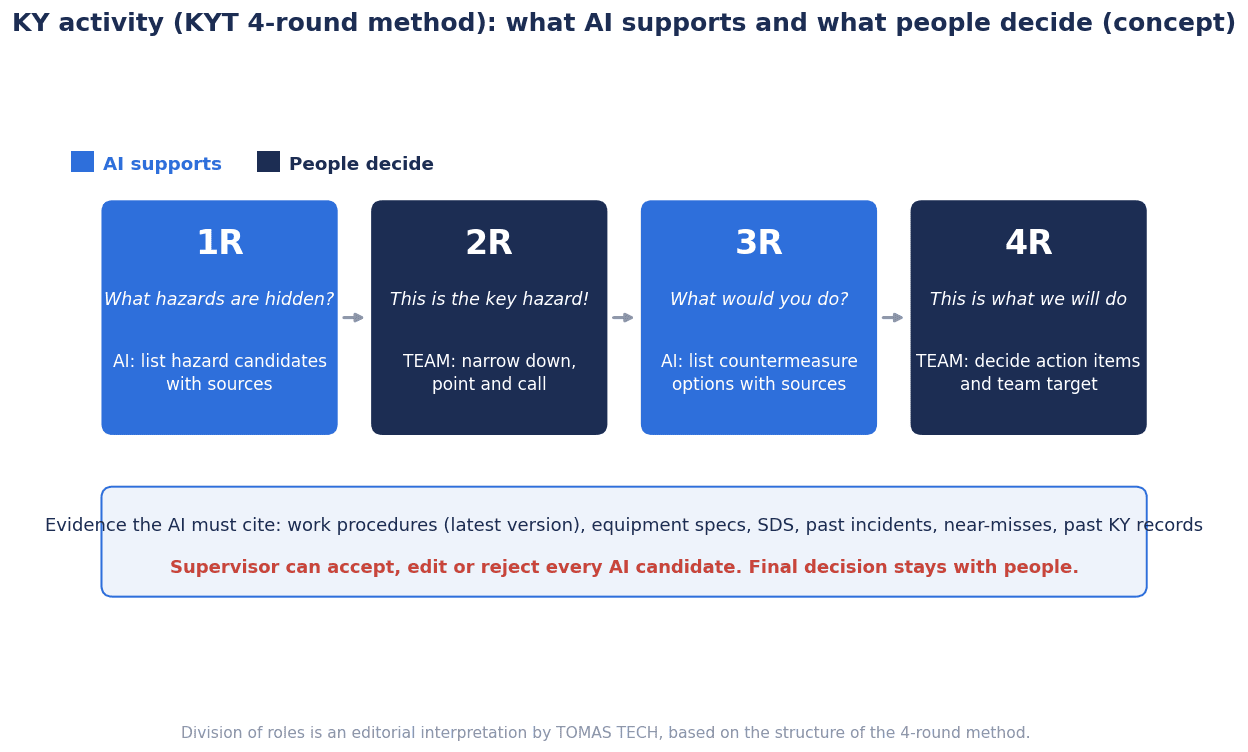
Another key point is to keep, on screen and in logs, which AI candidates the supervisor adopted or rejected and what was added. An operation in which the AI output is simply printed and only the signature box is filled in risks doing nothing more than speeding up, with AI, the same formalization that paper KY sheets suffered from.
The Rules Are Already Written on the Premise That People Decide
We consider that the rules in Japan and Thailand were originally written with a division of roles in which “people on site identify hazards, and the employer decides and implements”.
The MHLW risk assessment guidelines in Japan state, as part of the implementation structure, that the employer should endeavor to have supervisors and others who know the details of the work carry out hazard identification, risk estimation and consideration of risk reduction measures (4(1)(d)). The enforcement notice then explains that “the decision on and implementation of risk reduction measures should be carried out under the responsibility of the employer”, and that these are therefore not included in the matters assigned to supervisors and others. What supervisors and others take on is up to “consideration”, and we consider AI to sit one step before that, providing “material for consideration”.
Thailand’s Occupational Safety, Health and Environment Act B.E.2554 (2011), according to the English translation, imposes the following obligations on employers.
| Section (per the English translation) | Content | Relation to KY activity |
|---|---|---|
| Section 14 | When having employees work under conditions that pose hazards, inform them of the hazards that may arise from the work and distribute the work manual to all of them. Timing: before starting work, when the work changes, and when the workplace changes | The duty to communicate hazards before work lies with the employer. AI output remains a draft of what is to be communicated |
| Section 16 | Provide safety, health and environment training to executives, supervisors and employees. On hiring, change of work, change of workplace and change of machinery or equipment, train everyone before starting work | KY before non-routine work or equipment changes can also serve as a training opportunity |
| Section 21 | When a supervisor becomes aware of a defect or damage that may be harmful, the supervisor takes preventive action immediately within the scope of their responsibility | Responding to hazards the supervisor notices during KY is the supervisor’s responsibility |
| Section 32 | The employer carries out hazard assessment and other tasks and submits them to the Director-General (the target industries, sizes and methods are set by ministerial notification) | KY records become material for reviewing the hazard assessment |
This English translation is an unofficial translation posted by Prince of Songkla University, and legal citation requires checking the original Thai text.
On the role of supervisors, the Ministerial Regulation on “Arrangement of Safety Officers, Personnel, Units or Groups of Persons” B.E.2565 (2022; published in the Royal Gazette on June 17, B.E. 2565) is specific. This regulation divides safety officers by position into two categories, supervisor level and management level (ข้อ6). The duties of a supervisor-level safety officer (จป.หัวหน้างาน, a safety officer role held concurrently by a supervisor) (ข้อ9) include (1) supervising compliance with safety work procedures, (2) analyzing the work of the unit in charge and identifying hazards and risks at an early stage, (4) teaching correct work methods, and (5) inspecting the safety condition of machines, tools and equipment before work every day. Item (2) may also be carried out jointly with a technical-level or higher safety officer. We consider these supervisor-level duties, especially the hazard identification in (2), to be KY activity itself. Even if AI supports the drafting of candidates, this duty does not move away from the supervisor.
The regulation also sets out the safety committee. A workplace with 50 or more employees sets up a safety committee within 30 days of meeting the headcount requirement (ข้อ25), and the committee submits items such as its review of safety work procedures to the employer and meets at least once a month (ข้อ32 and ข้อ33). We consider the policy for introducing AI and the scope of work procedures that AI refers to to be suitable agenda items for the safety committee.
For factories that handle products or machinery for the EU, the EU AI Act (Regulation (EU) 2024/1689) is also a useful reference. Article 14(4) requires that overseers be able to understand the capabilities and limitations of the AI, remain aware of the tendency to automatically rely on its output (automation bias), correctly interpret the output, and decide not to use it. When AI is used as a safety component, it can become high-risk if it meets both of the two conditions in Article 6(1) (that it is a safety component of a product covered by the Union harmonisation legislation in Annex I, or is itself such a product, and that the product is required to undergo a third-party conformity assessment). Whether KY support AI falls under this is a case-by-case judgment, and this article does not make a definitive statement on it. Nor does it mean that the EU AI Act applies directly to factories in Thailand; the idea that “people understand the limitations and can decide not to use it” is positioned as a reference for design.
What Research Shows About the Limits of LLMs on Their Own
Research on how many hazards generative AI can pick up is all conducted under limited conditions, and the figures cannot be applied as they are to KY in manufacturing. We set them out alongside their conditions.
| Study | Conditions | Findings | Caution in use |
|---|---|---|---|
| ISARC 2025 (Chaudhary et al.) | 16 images of construction work; 120 hazards identified by a panel of 17 experts used as the ground truth; 5 LLMs evaluated zero-shot, with no training and no guidelines | Averaged over the 16 images, overall recall was 0.30. Recall by model was 0.29 to 0.33. The authors concluded that LLMs did not perform very well under these conditions | Values for construction, image input and zero-shot. Not a missed-hazard rate for text-based KY or for manufacturing |
| CIB Conferences 2026 (Lawani et al.) | A pilot study in the UK comparing point-of-work risk assessments by 25 postgraduate students with one assessment produced by ChatGPT | The students identified 21 types of hazards and the AI 20 types. The AI raised 9 types the students missed, and the students raised 10 types the AI missed. The authors concluded that human oversight is needed at present | A comparison between students and a single AI output. Use only as qualitative support that the two can be complementary |
| Sammour et al. (arXiv, 2024) | 385 questions from the exam of a US safety professional certification (BCSP) | GPT-4o’s correct-answer rate was 84.6%. It did relatively well in safety management systems and hazard identification and control, and was weak in calculations, emergency response and fire protection. The correct-answer rate changed with different prompts | A correct-answer rate on knowledge questions, not the accuracy of on-site hazard identification or KY |
From these, no general figure such as “AI misses X% of hazards” can be stated. In this survey, we did not find any peer-reviewed paper that counted missed hazards in text-based KY or JHA in manufacturing. We consider that what can be said comes down to the following two points.
First, when an LLM is asked to list hazards without being given evidence, the missed hazards are large, at least under some conditions. The ISARC study used image input, but we consider its zero-shot condition, with no work procedures or past accidents given, to be similar to a use in which “only the task name is entered and the AI is asked to produce a KY sheet”.
Second, AI and people can each raise hazards the other missed. We consider that a division of roles in which AI is added to 1R not as “a replacement for people” but as “one more point of view” is consistent with the results of the CIB pilot study.
The generative AI profile of the US National Institute of Standards and Technology (NIST), “NIST AI 600-1” (July 2024), defines confabulation as “the production of confidently stated but erroneous or false content” and notes that it is colloquially also called hallucination. According to NIST, confabulation is a natural result of the way generative models are designed; models can confabulate even the logic and citations used to justify their output, which leads people to over-trust it. In KY, we consider that this would appear in the form of a plausible countermeasure that actually conflicts with the company’s own work procedure.
Core Point 2: A Design That Makes AI Refer to Evidence and Show Its Sources
As a countermeasure against missed hazards and plausible errors, this article recommends a design in which the AI refers to the company’s own documents and shows the source for each hazard and countermeasure. As a guide to what it should refer to, the items listed in 7(1) of the MHLW guidelines as information to be obtained for the investigation are useful. Combined with the explanations in the enforcement notice and reinterpreted as reference data for KY support AI, they look like this.
| Item in the guidelines and notice | Main content | Examples of data for AI to refer to |
|---|---|---|
| 7(1)(a) Work standards, work procedures, etc. | Work steps and precautions | The latest versions of work procedures and work standards |
| 7(1)(b) Specifications, SDS, etc. | Specifications of machinery and equipment, hazards of chemical substances | Equipment instruction manuals, SDS |
| 7(1)(c) Layout of machinery and equipment, etc. | Arrangement of equipment | Line layout drawings, drawings of aisles and storage areas |
| 7(1)(d) Work environment measurement results, etc. | Condition of the work environment | Results of work environment measurements |
| 7(1)(e) Information on mixed work | Situations where several employers or departments work in the same place | Contractors’ work schedules, schedules of construction work on the premises |
| 7(1)(f) Accident cases, accident statistics, etc. | Per notice 7(3)(f), includes accident cases at the workplace, near-misses, trouble records, and tasks that workers feel uneasy about day to day | Company accident reports, near-miss reports, equipment trouble records |
| 7(1)(g) Others | Per notice 7(3)(g), includes results of hazard prediction activity (KYT), results of workplace patrols, etc. | Past KY sheets, findings from safety patrols |
The guidelines call for materials on non-routine work to be included as well. The OSHA guide also lists “review your accident history (including near misses)” as one of the ways to get started with JHA.
For the AI to refer to near-miss reports, the reports need to be in a form that can be searched by task, equipment and location. Classifying and aggregating reports is covered in “Near-Miss Report AI Analysis“.
As a response to confabulation, NIST AI 600-1 lists reviewing and verifying sources and citations in outputs as part of pre-deployment risk measurement and ongoing monitoring (MS-2.5-003). It also lists documenting the extent to which human domain knowledge, such as RAG (retrieval-augmented generation) and business rules, was used (MS-2.5-002), and verifying that RAG data is grounded (MS-2.5-005). For KY support AI, we consider that these translate into screen requirements such as the following.
- For each hazard candidate and countermeasure option, display the name, version and relevant section of the document referred to
- Mark candidates with no referenced document (candidates that came from the AI’s general knowledge) so that they can be recognized as such
- Allow the supervisor to reject a candidate as “evidence outdated”, “no evidence” or “does not apply to this site”, and record the reason
Whether the work procedures the AI refers to are the latest versions also matters. Mechanisms that prevent the AI from answering with old versions are covered in “Factory RAG Document Version Control: Implementation and Acceptance“. For tasks without proper work procedures, an approach in which AI drafts the procedure, which is then approved and checked against the site, is covered in “Creating Manufacturing Work Instructions with AI: From Draft to Approved Release“.
Non-Routine Work and Permits to Work: Where AI Support Tends to Help
We consider non-routine work to be where AI-drafted candidates are especially likely to help. Changeovers, cleaning, maintenance, responding to equipment breakdowns and confined-space work happen infrequently, so differences in supervisors’ experience tend to show.
The MHLW guidelines state that the information obtained for the investigation should include materials on non-routine work, and the enforcement notice states that information on changeovers should also be obtained. The guidelines list, as times to carry out the investigation, the new adoption or change of equipment, work methods or work procedures, the occurrence of an accident, and so on. The OSHA guide likewise lists, as jobs to prioritize for JHA, jobs with the highest injury rates, jobs with the potential to cause severe injuries, jobs in which one simple human error could lead to a severe injury, jobs that are new or have been changed, and jobs complex enough to require written instructions.
Section 16 of the Thai Act (per the English translation) also requires training before starting work when the work or the machinery and equipment changes. We consider that if the AI refers to the work procedures for maintenance tasks and to past accidents and near-misses on that equipment, even a less experienced supervisor can get clues for identifying hazards.
Confined-space work is tied to permit-to-work procedures. According to the text of the Ministerial Regulation on confined-space (ที่อับอากาศ) work B.E.2562 (2019) posted by Chulalongkorn University SHE, the employer measures, records and evaluates the atmosphere before and during work, prepares a permit (หนังสืออนุญาต) each time workers are made to work in a confined space, and records items such as the results of the hazard assessment and the safety measures. The person responsible for issuing the permit is in principle the employer, who may delegate this in writing to a trained worker. A work supervisor (ผู้ควบคุมงาน) is stationed on site at all times and given the authority to suspend work temporarily if there is a hazard.
Issuing and signing the permit, and the judgments of the work supervisor, cannot be replaced by AI. We consider that AI output should be treated as candidates for the pre-task KY and kept separate from the permit decision, including on screen.
Designing Multilingual KY and Toolbox Talks in Thai and Myanmar (Burmese)
Some factories in Thailand employ workers from neighboring countries in addition to Thai workers. According to a document submitted by civil society organizations to a UN working group, the number of foreign workers with work permits stood at about 3.1 million as of March 2025, citing figures from the Ministry of Labour (we have not checked the Ministry of Labour’s original table this time).
In this survey, we did not find any Thai provision requiring safety training or work procedures to be given in a language workers understand, in the text of the Act, Ministerial Regulation B.E.2565, or the text page of the confined-space regulation (this does not mean we confirmed that no such provision exists). In any case, since Section 14 of the Act (per the English translation) requires employers to inform workers of hazards, we consider that the purpose is undermined if the information does not get through to workers.
Japan’s MHLW publishes the safety and health education material for foreign workers “Safety and Health for Working People, Explained in Manga” (title translated from Japanese) in 11 languages including Thai and Myanmar, according to the list on its page. Materials like this offer clues for terminology and phrasing.
When using AI for multilingual KY, this article considers the following ways of operating.
- Build a glossary first: map equipment names, body parts, ways of describing hazards (caught in, drawn in, cut, pierced, etc.) and names of PPE across languages, and have the AI translation use it.
- Supervisors check in their own language: if the supervisor is Thai, AI candidates are displayed in Thai and checked and corrected in Thai.
- Combine reading aloud and confirmation for workers: display and read aloud the action target in the workers’ language, and ask them to restate it in their own words.
- Do pointing and calling and group call-outs in the language used on the spot: whether to call out together in the team’s common language or to split by language is decided by each workplace. AI translation is a means of preparing the words for the call-out and does not replace the call-out itself.
Mechanisms for aligning terminology in AI translation of company documents are covered in “Enterprise Translation Automation for Thai Factories“.
For supervisors to be able to reject AI candidates, training in how to check the evidence, in their own language, is also essential. For how to run generative AI training in Thai, see “Generative AI Training in Thai for Frontline Factory Staff“.
Division of Roles Seen in Published Cases
In Japan, initiatives using AI for KY activity in construction and elevators have been announced or reported. All of them are cases in Japan and do not indicate availability or support for manufacturing in Thailand. Here we set out only the functions and where human checks sit. The order follows the Japanese syllabary order of the company names and implies no ranking or recommendation.
| Case (source) | Function handled by AI | Where human checks sit |
|---|---|---|
| Tokyu Construction (reported by IT Leaders) | Records KY speech with noise-reduction microphones and voice AI, and generative AI summarizes it. Automatically rates the specificity of hazard points raised and the quality of warnings on a 3-level ABC scale | From the report, AI can be read as handling recording of speech and rating its quality (not a case in which AI drafts hazard candidates) |
| NITACO “KY-AI” (company release) | Obtains the weather and WBGT from the site address and creates a draft hazard prediction following the 4-round method based on the task and weather. Can output a KY activity record sheet | The supervisor checks and corrects the draft, everyone does pointing and calling together, and workers confirm |
| Maeda Corporation “SpectA KY-Tool” (reported by Rodo Shimbun) | From the entered task, selects and shows highly relevant accident cases and countermeasures from past occupational accident data. The public part of the article does not say whether it is generative AI | Not stated in the public part |
| Mitsubishi Electric Building Solutions “KY-Support” (reported by AISmiley) | Identifies latent risks specific to the task based on accumulated work data and gives advice on action targets. Reproduces the 4-round method flow in the app and supports voice input and one-handed operation | Not stated in the report |
According to the report, Tokyu Construction’s initiative was a PoC carried out at several sites from March to June 2026, with 16 participants (site managers, site supervisors and foremen), and the issues raised were recognition accuracy in high-noise conditions and sites with limited connectivity. According to the report, Mitsubishi Electric Building Solutions’ KY-Support is based on generative AI field work support technology from a collaboration between Mitsubishi Electric and AWS, and is to be rolled out in stages in its elevator division from April 2026.
The roles of AI split into “drafting candidates”, “finding past cases” and “recording and evaluating”. Because in some cases the position of human checks cannot be read from public information, we consider that when introducing such a system in your own company, you should state clearly in the specifications where human checks and decisions sit.
Core Point 3: Check “Missed Hazards”, “Wrong Countermeasures” and “Language” Separately
If KY support AI is evaluated only on the impression that “it was convenient”, there is a risk of overlooking safety defects. This article recommends counting and recording the following three separately.
| Metric | Definition | How to record | Examples of main causes |
|---|---|---|---|
| Missed hazards | Hazards that are on the experts’ and supervisors’ answer list but did not appear among the AI candidates | For each test case, list the hazards on the answer list that the AI did not raise | Insufficient reference data, site conditions not written in the work procedure, insufficient input information |
| Wrong countermeasures | Countermeasures produced by the AI that would be wrong if used as they are, for example because they conflict with the work procedure, cannot be carried out on site, or increase the hazard | For each countermeasure option, classify it as correct, needs correction or wrong, and write the reason for wrong ones | Old versions of work procedures, information from other equipment mixed in, confabulation |
| Language | Whether workers correctly understood the hazards and the action target | Read aloud to workers, ask them to restate in their own words, and record understood, misunderstood or did not understand | Inconsistent terminology, literal translation, audio that is hard to hear |
The reason for separating the three is that they are fixed in different ways. Missed hazards are addressed by reviewing reference data and input items, wrong countermeasures by strengthening version control and source display, and language by improving the glossary and reading aloud. If they are combined into a single “accuracy” figure, it becomes unclear what to fix.
We consider that “wrong countermeasures” in particular should be treated as serious. When a plausible countermeasure is presented with a source, there is a risk that the supervisor will trust it and adopt it. This is the state NIST cites as an example of automation bias, in which people assume the output is of higher quality than it really is.
This article does not give numerical pass thresholds, because the acceptable range differs depending on the severity of the hazards in the target tasks and the level of the existing KY. We consider it important for the safety committee and safety officers to decide, before testing, “the types of hazards that must not be missed” and “how to handle cases where a wrong countermeasure appears”.
The next figure shows the breakdown of occupational injuries in Thailand in B.E. 2567 (2024) according to the SSO report. Lost time of 3 days or less: 62,065 cases; lost time of more than 3 days: 24,127; loss of body parts: 925; deaths: 595; disability: 16; for a total of 87,728. Most cases fall in the category of lost time of 3 days or less, but there are also 595 deaths. We consider that the hazards that must not be missed should be decided not only by the number of cases but by the severity of the outcome. This figure is background data on occupational injuries across Thailand as a whole and does not show the effect of AI.
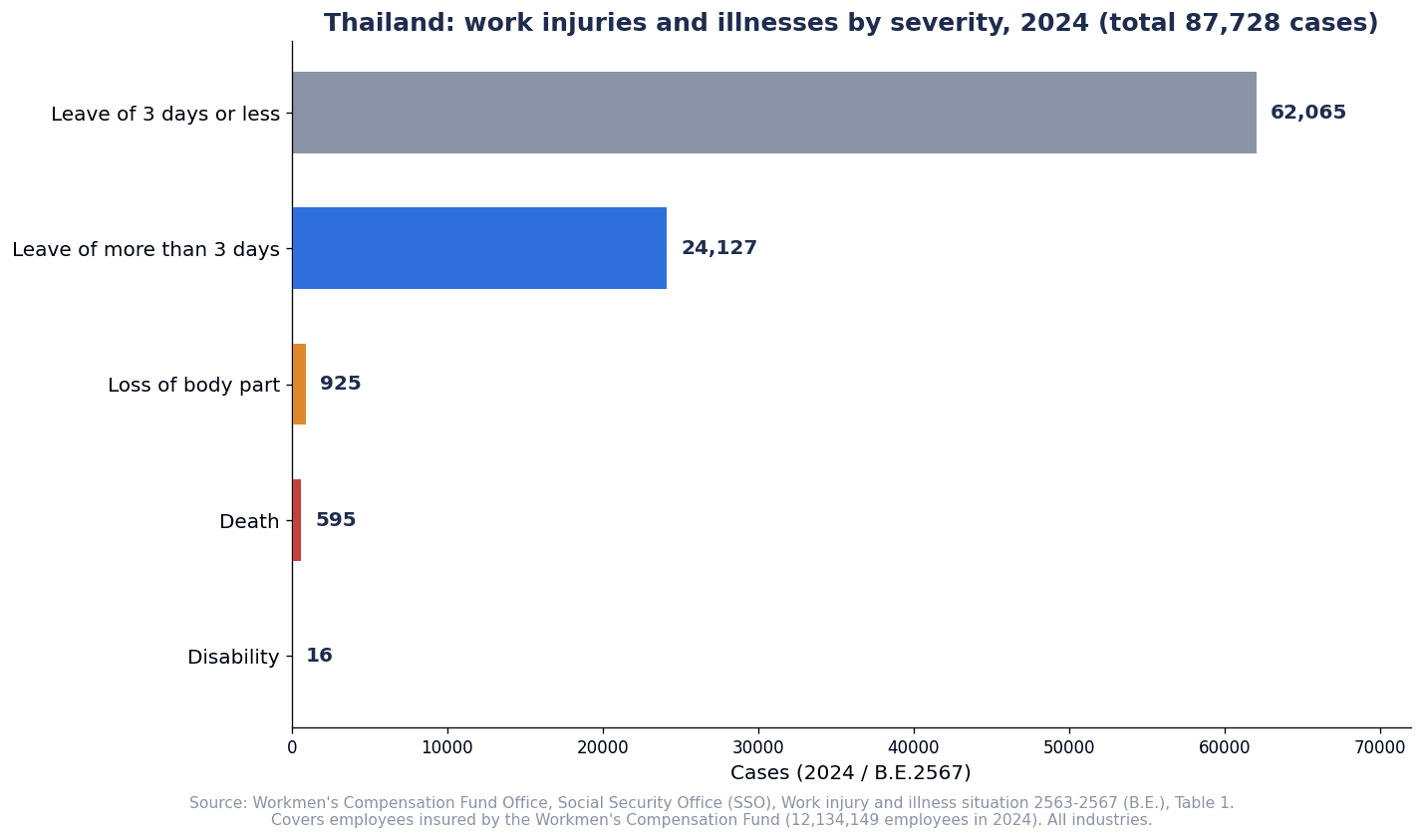
According to the same report, the incidence rate in B.E. 2567 was 7.23 cases per 1,000 covered workers, and there were 12,134,149 covered workers.
Handling Personal Data and KY Records
When KY is digitized and recorded as audio, workers’ names, face photos and voices may remain in the system. Regarding Thailand’s Personal Data Protection Act (PDPA, B.E.2562), according to secondary sources, Section 19 requires the data subject’s consent in principle, Section 24 sets out exceptions where consent is not required, such as legitimate interests, and Section 26 requires explicit consent or limited exceptions for sensitive data such as race, health and biometric data. It is said that even where consent is not required, the employer must notify workers before collection.
Whether photos and audio in KY records count as biometric data under Section 26 is said to depend on how they are used, such as whether they are used to identify individuals. In this survey, we did not find any official view that photos or audio automatically constitute biometric data. Because they may be treated as biometric data, this article considers that the following points should be decided before introduction.
- For what purpose names, photos and audio are recorded (as a record of participation, to confirm understanding, or for tracing after an accident)
- Whether consent will be obtained or notification will be considered sufficient, and on what basis
- Whether audio will be deleted after transcription, and how long it will be kept
- Who can view the records
Because KY input can include worker names and details of accidents, the information that may be entered into generative AI needs to be set out in a policy. Points that are easy to overlook in a generative AI usage policy for a Thai site are summarized in “Generative AI Usage Policy 2026: Four Gaps the Head Office Version Leaves at a Thai Site“.
Items to Include in the RFP
When outsourcing KY support AI, we recommend including the following items in the RFP (request for proposal). They translate the three points of division of roles, evidence and verification into the language of specifications.
| Item | What to write in the RFP |
|---|---|
| Target tasks and sites | Target lines, processes and tasks (routine, or non-routine such as changeovers, cleaning and maintenance), and the scale of the number of users |
| Input methods | Whether input is by text, voice or photo. Whether one-handed operation or operation while wearing gloves is needed |
| Reference data and version control | The scope of work procedures, SDS, equipment information, accident reports, near-misses and past KY to be referred to, update frequency, and a mechanism that prevents old versions from being referred to |
| Source display | For each hazard candidate and countermeasure option, display the name, version and relevant section of the document referred to. Display candidates with no reference so they can be distinguished |
| Languages and glossary | Display and read-aloud languages (Japanese, Thai, Myanmar, etc.), and who creates and updates the glossary |
| Screens and logs for human checks and approval | Screens where people do the 2R narrowing down and the 4R decision, recording of candidates adopted, rejected and added with reasons, and logs of the supervisor’s finalizing action |
| Records, search and retention period | Search by task, date and equipment, retention period, and the ability to retrieve that day’s KY after an accident |
| Offline use and noise | Operation in places with unstable connectivity or loud noise. In the Tokyu Construction PoC as well, recognition accuracy in high noise and connectivity limits were raised as issues |
| Personal data | Handling of names, photos and audio, storage location, access rights, and cooperation in designing consent and notification under the PDPA |
| Evaluation metrics and acceptance tests | Test methods that record the three metrics of missed hazards, wrong countermeasures and language separately, how test cases are built, and that the pass threshold is decided by the client |
| Cost breakdown | Separate costs for initial build, preparing reference data, creating the glossary, usage fees, maintenance and additional languages |
We consider that “screens and logs for human checks and approval” and “source display” in particular should be mandatory requirements, not options.
Designing the PoC and Acceptance Tests
We recommend designing the PoC (proof of concept) and acceptance tests for KY support AI not around “impressions after trying it” but as a way of counting the three metrics from Core Point 3.
Choosing test cases: if you center the tests on tasks where accidents or near-misses have occurred in the past, you can check “whether the AI raised that hazard as a candidate”. Also include non-routine work and tasks where equipment has changed.
Building the answer list: safety officers and experienced supervisors first create, for each test case, a list of the hazards that should be raised and the correct countermeasures. If the list is created after seeing the AI output, there is a risk of being pulled along by the candidates.
Recording the three metrics: compare the AI candidates with the answer list to record missed hazards, and judge each countermeasure option to record wrong countermeasures. For language, read aloud to workers, ask them to restate in their own words, confirm their understanding and record it. Also check whether the source display is correct (whether the relevant section of the cited document really contains that content).
Decide the pass threshold yourselves: before testing, the client decides and records the types of hazards that must not be missed, whether even a single wrong countermeasure means failure, and how understanding of language will be confirmed.
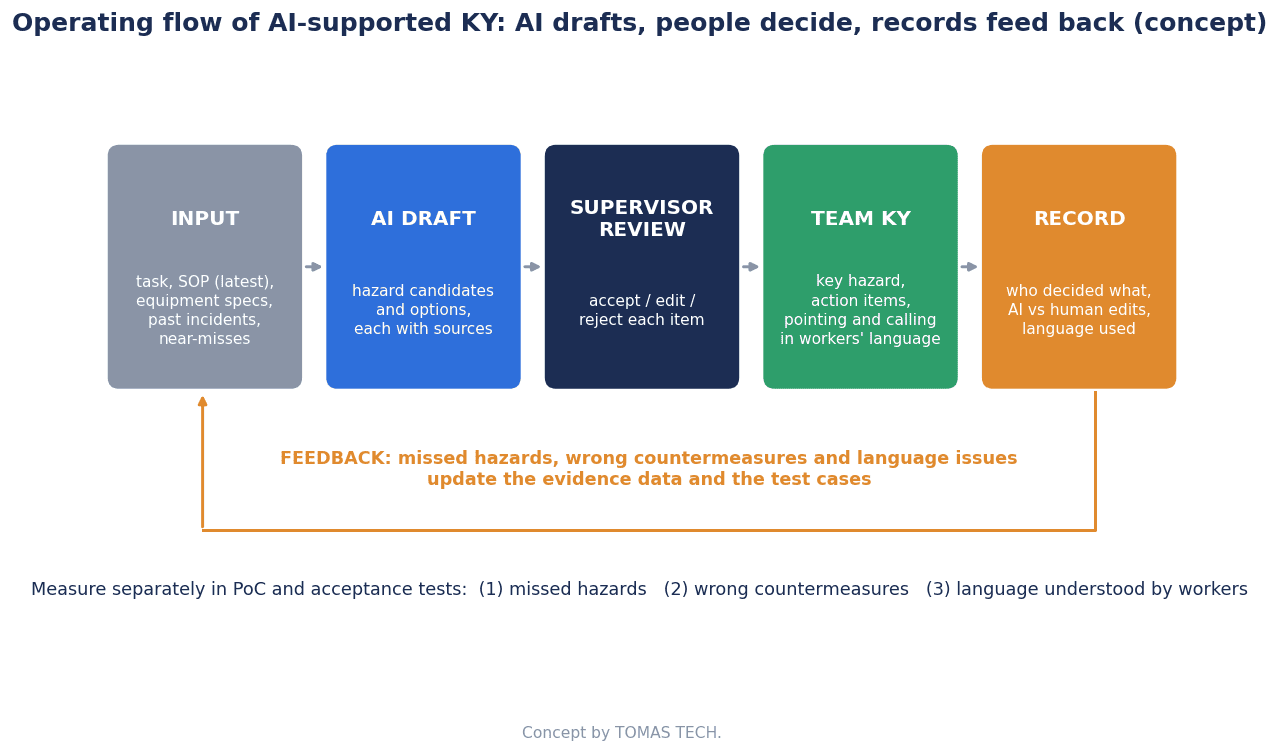
Review after going live: the OSHA guide states that JHAs should be reviewed periodically, reviewed especially when an accident occurs, and that everyone affected should be trained when they are revised. We consider that KY support AI, too, should have a flow that feeds candidates rejected by supervisors and hazards they added back into improving the reference data and glossary.
The next figure shows the operational flow considered in this article. Based on the input, the AI creates a draft with sources, the supervisor decides whether to accept, edit or reject, the team carries out KY including pointing and calling and records it, and the results feed back into improving the data.
Where to end a PoC and move to production, and how to design acceptance and operational handover, are covered in “AI PoC Exit Criteria for Production, Acceptance and Handover“.
Frequently Asked Questions
Can hazard prediction be left to AI?
We consider that hazard prediction itself should not be left to AI. What AI takes on is drafting candidates, listing countermeasure options, translation and recording; narrowing down and deciding are done by the supervisor and the team. In Japan’s MHLW guidelines and enforcement notice as well, what supervisors and others take on is up to “consideration” of risk reduction measures, while “the decision on and implementation” is the employer’s responsibility.
Is AI useful even if we only digitize KY sheets?
Digitizing alone lets you search records by task, date and equipment and makes it easier to trace that day’s KY after an accident. We consider that it also prepares you for using AI, because the accumulated records become material the AI can refer to as evidence when drafting candidates for the next KY.
Can AI translation be used for KY in Thai and Myanmar?
It can be used on the premise that it is combined with a glossary and human checks. Have the AI use the factory’s glossary, have the supervisor check in their own language, and read aloud to workers and ask them to restate in their own words. In acceptance tests, record “language” as a separate metric.
How can plausible errors by generative AI be prevented?
Design on the premise that they cannot be completely prevented. NIST describes confabulation as a natural result of the way generative models are designed and recommends reviewing and verifying sources and citations. Have the system display the name, version and relevant section of the referenced document for each candidate, allow the supervisor to reject candidates whose evidence is outdated or missing, and keep work procedures at their latest versions.
How should the cost of introducing KY activity AI be estimated?
Because the amount varies with the number of target tasks, the number of languages and the state of the reference data, this article does not give figures. We recommend asking vendors to quote separately for initial build, preparing reference data, creating the glossary, usage fees, maintenance and additional languages. We consider that preparing reference data is the central work for reducing missed hazards, and that internal person-hours should also be budgeted for it.
Summary
- We consider that when bringing AI into KY activity, what you decide first is not the name of a tool but three things: (1) division of roles, (2) evidence, and (3) verification.
- Division of roles: AI handles drafting candidates in 1R, listing countermeasure options in 3R, translation and recording, while narrowing down in 2R and deciding in 4R are done by the supervisor and the team (this framework is our own inference). Japan’s guidelines and enforcement notice also position supervisors and others as handling “consideration” and the employer as handling “the decision on and implementation”.
- Evidence: have the AI refer to work procedures, SDS, accident cases and near-misses, and past KY records, and make it show the source for each candidate.
- Verification: in the RFP, PoC and acceptance tests, count and record missed hazards, wrong countermeasures and language separately. Decide the pass threshold yourselves.
- We consider that AI should be positioned not as something that replaces KY activity but as a tool that supports its quality.
You are welcome to consult TOMAS TECH even at the stage of taking stock of how far your KY sheets, work procedures and near-miss reports have been digitized, or of considering how to prepare the data for the AI to refer to. Please get in touch here.
References
- MHLW Workplace Safety Site, “Safety and Health Keyword: KYT (Hazard Prediction Training)” (Japanese) https://anzeninfo.mhlw.go.jp/yougo/yougo40_1.html
- MHLW, “Guidelines on Investigation of Dangers or Harmful Effects” and enforcement notice (reference PDF, Japanese) https://www.mhlw.go.jp/bunya/roudoukijun/anzeneisei14/dl/080201g_0001.pdf
- MHLW, “Safety and Health Management of Foreign Workers” (Japanese) https://www.mhlw.go.jp/stf/seisakunitsuite/bunya/0000186714.html
- OSHA, “Job Hazard Analysis” Publication 3071 (2002 revised edition, PDF) https://www.osha.gov/sites/default/files/publications/osha3071.pdf
- Presencis, “ISO 45001 Article 5.4” https://cdn.presencis.com/regulations/iso-45001/article-5.4/
- Prince of Songkla University, “Occupational Safety, Health and Environment Act B.E.2554” English translation (unofficial translation, PDF) https://scit-services.surat.psu.ac.th/she/assets/RESEARCH/KM_FILE_6725f41322d3e.pdf
- Chulalongkorn University SHE, “กฎกระทรวง การจัดให้มีเจ้าหน้าที่ความปลอดภัยในการทำงาน 2565” (Ministerial Regulation on Safety Officers B.E.2565, Royal Gazette PDF, Thai) https://www.shecu.chula.ac.th/data/boards/748/%E0%B8%81%E0%B8%8E%E0%B8%81%E0%B8%A3%E0%B8%B0%E0%B8%97%E0%B8%A3%E0%B8%A7%E0%B8%87%20%E0%B8%81%E0%B8%B2%E0%B8%A3%E0%B8%88%E0%B8%B1%E0%B8%94%E0%B9%83%E0%B8%AB%E0%B9%89%E0%B8%A1%E0%B8%B5%E0%B9%80%E0%B8%88%E0%B9%89%E0%B8%B2%E0%B8%AB%E0%B8%99%E0%B9%89%E0%B8%B2%E0%B8%97%E0%B8%B5%E0%B9%88%E0%B8%84%E0%B8%A7%E0%B8%B2%E0%B8%A1%E0%B8%9B%E0%B8%A5%E0%B8%AD%E0%B8%94%E0%B8%A0%E0%B8%B1%E0%B8%A2%E0%B9%83%E0%B8%99%E0%B8%81%E0%B8%B2%E0%B8%A3%E0%B8%97%E0%B8%B3%E0%B8%87%E0%B8%B2%E0%B8%99%202565.PDF
- Chulalongkorn University SHE, “Ministerial Regulation on Confined-Space Work B.E.2562” (Thai) https://www.shecu.chula.ac.th/home/content1.asp?Cnt=558
- Social Security Office, Workmen’s Compensation Fund Office, “Situation of Work-Related Injuries and Illnesses 2563-2567” (PDF, Thai) https://www.sso.go.th/wpr/assets/upload/files_storage/sso_th/65e64958a0565ddc98ebc2ee6cc1fbf4.pdf
- MWG/HRDF, “Submission to the UN Working Group on Business and Human Rights: Labour Migration” (PDF) https://www.ohchr.org/sites/default/files/documents/issues/business/workinggroupbusiness/cfis/labour-migration/subm-labour-migration-business-cso-migrant-wg.pdf
- Securiti, “Employee Data Protection in Thailand” https://securiti.ai/blog/employee-data-thailand
- Lex Mundi, “Data Privacy Guide: Thailand” https://www.lexmundi.com/guides/data-privacy-guide/jurisdictions/asia-pacific/thailand/
- Chaudhary, Uddin et al., “How Reliable Are Large Language Models? Zero-Shot Detection of Construction Hazards”, ISARC 2025 (PDF) https://www.iaarc.org/publications/fulltext/085_How_Reliable_Are_Large_Language_Models__Zero-Shot_Detection_of_Construction_Hazards.pdf
- Lawani et al., “Reliability of Human Point of Work Risk Assessment vs Artificial Intelligence Risk Assessment”, CIB Conferences 2026 https://docs.lib.purdue.edu/cib-conferences/vol2/iss1/24
- Sammour et al., “Responsible AI in Construction Safety”, arXiv 2411.08320 https://arxiv.org/abs/2411.08320
- NIST, “AI 600-1 Artificial Intelligence Risk Management Framework: Generative Artificial Intelligence Profile”, July 2024 (PDF) https://nvlpubs.nist.gov/nistpubs/ai/NIST.AI.600-1.pdf
- EUR-Lex, “Regulation (EU) 2024/1689 (AI Act)” https://eur-lex.europa.eu/eli/reg/2024/1689/oj/eng
- IT Leaders (Impress), report on Tokyu Construction’s PoC of recording KY activity with voice AI (Japanese) https://it.impress.co.jp/articles/-/29733
- PR TIMES, NITACO “KY-AI” release, July 23, 2026 (Japanese) https://prtimes.jp/main/html/rd/p/000000074.000058841.html
- Rodo Shimbun, report on Maeda Corporation’s “SpectA KY-Tool”, March 28, 2023 (Japanese) https://www.rodo.co.jp/news/147165/
- AISmiley, report on Mitsubishi Electric Building Solutions’ “KY-Support” (Japanese) https://aismiley.co.jp/ai_news/mitsubishi-building-kysupport/


