


A factory AI camera can flag a worker who may be missing a hard hat, safety glasses, gloves or a high-visibility vest. That sounds straightforward until the plant must decide which task requires which equipment, whether a camera can see it, and who confirms an alert. This guide helps EHS, production, IT and procurement teams at factories in Thailand turn PPE detection into a defined, testable project. It focuses on camera scenes, PPE classes, occlusion, human review, privacy, RFP terms and FAT/SAT acceptance.
Start with the operating decision, not a camera accuracy claim
PPE detection combines a visible person and item with a site rule for a specific area, task and time. “No helmet visible in the frame” is not necessarily “no helmet worn.” A shelf may hide the head; backlight may erase its outline; a person may simply cross the edge of a monitored zone. Treat the output as a candidate for confirmation, not a final finding against a worker. State who reviews it, how quickly, and what happens when an image cannot support a decision.
Detection does not replace PPE, a hazard assessment, training or engineering controls. The NIOSH hierarchy of controls prioritises eliminating hazards, substitution and engineering measures before administrative controls and PPE; NIOSH also cautions against relying on PPE alone when more effective controls are available. An ordinary camera is a supplementary observation and improvement tool. If it is proposed as a machine stop or access-permission safety function, qualified specialists must design and validate the entire safety function separately. A computer-vision confidence score is not a safety circuit.
Our earlier overview of AI safety management explains detection, triage and correction across hazards. The factory AI camera RFP guide covers several scenarios. Here we narrow the question to PPE: what must be visible, which cases must be labelled “undecidable,” and which proof the buyer should demand at acceptance.
Choose one PPE scene before covering the whole plant
The first pilot should have a clear link between a hazard and a required item, a controlled crossing point and a reliable view. Examples include checking safety glasses at a machining-area entry, a hard hat at an area with overhead handling, or a high-visibility vest at a defined logistics crossing. Ask whether the rule applies to every person passing through or only to someone performing a task. Define contractors, maintenance staff and visitors before turning alerts on.
Trying to monitor every item everywhere in the first pilot makes results hard to interpret. One line may require glasses while the neighbouring corridor does not. Thin assembly gloves and cut-resistant gloves can look similar but provide different protection. A wide overview image may not contain enough detail to judge whether a small glove is present, let alone whether it is suitable. The statement “AI detects gloves” must never be equated with “the person has selected gloves appropriate for this hazard.”
Create one scene sheet with ten fields: hazard; existing controls; task; exact required PPE; zone; authorised exceptions; observation point; immediate response; later corrective action; and prohibited uses of the data. EHS and worker representatives should review it together. A specific prohibition on unrelated productivity scoring or disciplinary reuse, if that is the site’s decision, belongs in the specification and access design.
Define PPE classes and the limits of image evidence
An image label is not a certificate of protection. A camera might see a helmet without confirming its specification, fit, damage or correct fastening. Clear safety lenses can disappear against a background, and ordinary glasses may look similar. Gloves are often hidden by tools. A mask-like object on a face does not prove respirator suitability, seal, filter condition or service life. Vest colour, dirt and an overgarment can change visibility.
Avoid a simple yes/no output. At minimum distinguish: confirmed visible item under the agreed rule; possible missing item with adequate visibility; undecidable because of occlusion or insufficient image quality; and out of scope. Counting undecidable cases as violations inflates false alerts; counting them as compliant hides exposure. Confirm which PPE can be judged at which pose and distance from actual site images. The US OSHA PPE general requirements discuss hazard assessment, selection, fit and training. They are US rules, not a statement of Thai legal obligations, but they illustrate why a camera classification alone does not constitute a PPE programme.
Specify the camera scene: angle, light, occlusion and movement
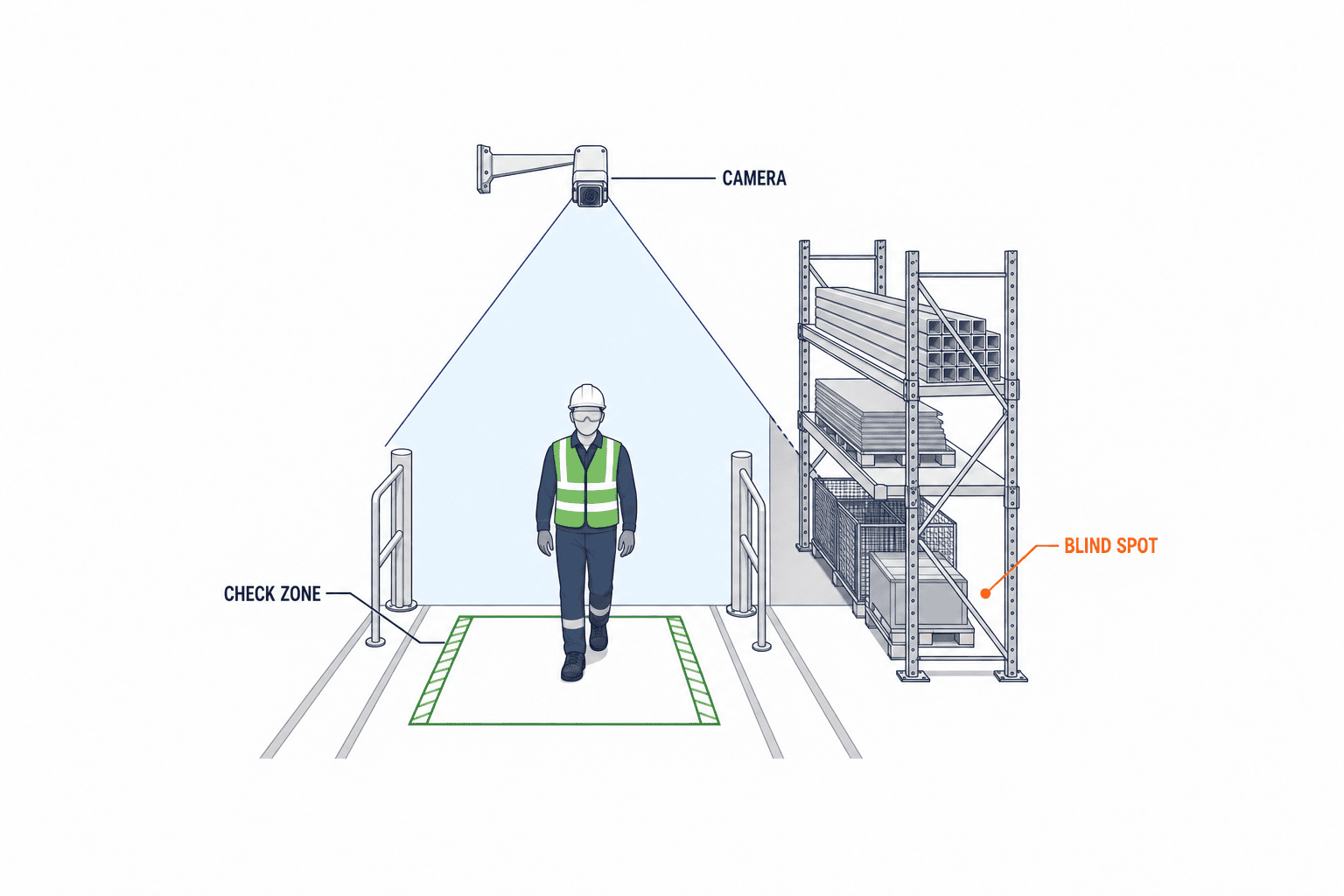
Model choice matters less than whether the relevant item is visible at usable size and angle for long enough. A high ceiling camera covers a large area but often sees the top of the head instead of eyewear. An entrance camera facing the person may see the face but not hands behind a carried box. Walk the route and record doors, racks, conveyors, pipework, carts, other people, reflections and likely body poses that block the view.
Axis Communications’ image-quality guide explains that analytics have use-case-specific requirements for pixel density, mounting location and field of view, and must be tested in the intended environment. Do not copy a general surveillance pixel-density figure into a PPE contract. Ask the vendor to state the smallest observable PPE size and usable distance for each camera, and verify them on site. Catalogue resolution alone is not an acceptance test.
Check morning and evening backlight, open loading doors, night shifts, reflective metal, strong welding light, lens dust, oil film and condensation. Motion blur can hide a small item even when a worker fills the frame. Axis’ analytics performance guidance identifies installation, light and cleaning as relevant to image usability. Use it to create site tests, rather than as a promise that any particular product will detect PPE.
Record a scene sheet for each camera: ID, height and orientation, distance to the decision point, PPE type, shift, backlight, obstructions, cleaning, power and network, and other personal information captured. A camera installed for general recording may be poorly framed for PPE. Define measurable pass/fail criteria from vendor requirements and site trials, not a generic online benchmark.
Report “cannot see” as a first-class outcome
A hidden helmet, face outside the frame, chest obscured by a box or whiteout from backlight should be logged as visibility conditions. If the system silently reports no alert in these cases, a high detection figure for clear images says little about the live operation. Measure the undecidable rate by zone and shift, with reason codes. Decide whether another camera, a lighting change, a different crossing point or a smaller pilot scope is appropriate. Do not automatically turn every unobservable frame into an accusation against a worker.
Write the rule engine before tuning the model
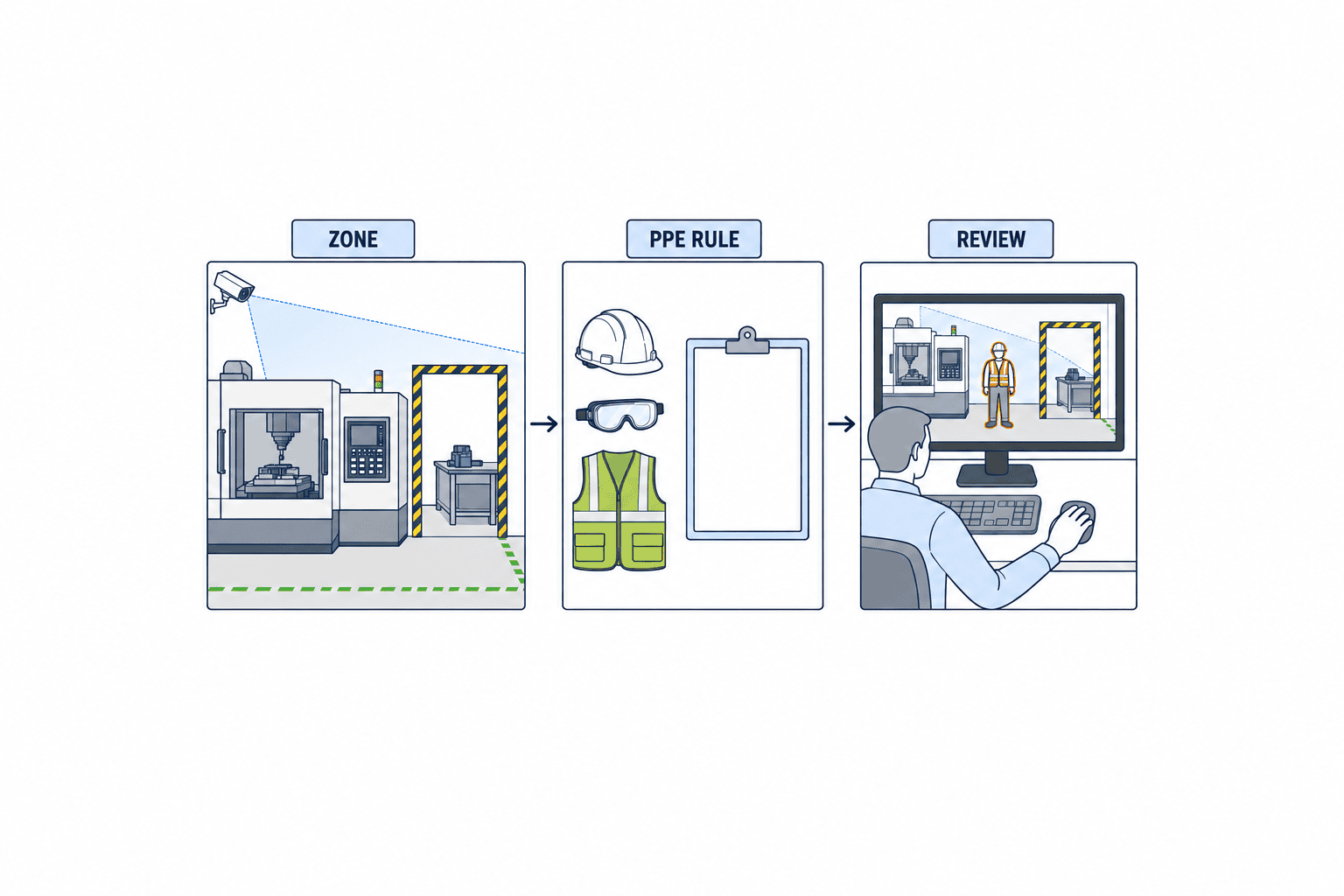
The same person may cross several zones and need different PPE for each task. Keep an EHS-approved rule register separate from the model: rule ID and version, zone boundary, task state, role, required item, exception and expiry, effective date, approver, and evidence that the rule was communicated. Do not assume that a stopped machine is harmless or that a maintenance visitor is exempt. If permit-to-work or equipment state determines the rule, specify the response to missing signals and mismatched timestamps.
An arbitrary rectangle in the video is not enough to define a zone. Consider whether a person only crosses it briefly, stops there, or starts hazardous work nearby. Use a decision window and dwell logic that fit the task. An instant verdict can misread donning or momentary occlusion; too long a delay may make the alert useless. Agree the window from recorded passages and EHS review in the pilot. Exception approval should include the reason, validity period and alternative control, rather than a verbal instruction with no record. Even a rule change that needs no model retraining requires approval, versioning, test and communication to affected workers.
Measure misses, false alerts and reviewer workload separately
One vendor “accuracy” number cannot support a purchase. On a held-out test set from the plant, measure how many observable missing-PPE passages were flagged, how many properly equipped passages generated false alerts, and how many passages could not be judged. Include shifts, lighting, clothing, PPE colours, body sizes, directions of travel, multiple people and maintenance exceptions. Keep training and evaluation samples separate. Use event-level definitions: decide whether the denominator is people or passages and how consecutive frames are combined into one event.
Report results by scene and risk, with the numerator, denominator and exclusions. A severe missed case must not disappear in an average over easy cases. Equally, count the number of false alerts per zone per shift, time spent on first review, and events left unreviewed. Lowering a threshold may reduce misses but overwhelm the reviewer. The NIST AI Risk Management Framework discussion of trustworthiness calls for monitoring deployed validity and reliability and, where needed, human intervention. Use that principle to set an ongoing measurement plan.
Classify false-alert causes before changing the model: wrong site rule, occlusion, exposure, incorrect time, unusual pose or model error each calls for a different fix. Retest the same scene after a camera or threshold change. Misses require independent human checking and planned test cases because the software emits no event for them. Stage missing-PPE test cases away from live hazards under an EHS-approved procedure; never ask someone to do dangerous work unprotected for an acceptance test.
Define the response after an alert
The first reviewer needs the short clip, timestamp, camera and rule version. They classify each candidate as confirmed missing PPE, undecidable, out of scope/valid exception, or false alert. If immediate intervention is required, follow the site’s established EHS procedure. Specify a backup reviewer, undelivered notifications, network loss and camera failure. No notification must never mean “the area has been confirmed safe.”
When a real missing-item event is confirmed, do more than speak to the individual. Check whether PPE was available at the entry, fogged up, interfered with another item, or prevented a task from being done with the existing jig. Correct the supply point, select better-suited equipment, modify a fixture, separate a hazard or revise a procedure as appropriate. Use repeat patterns by zone to find structural causes. A dashboard built only around named-worker rankings misses this opportunity. Track reason codes, open actions, completion dates and post-change review.
Put comparable evidence into the RFP
Give each vendor the same scene map and rule register, then request the same evidence:
| Requirement | Buyer defines | Vendor demonstrates |
|---|---|---|
| Scope | Zone, task, shift, roles, required PPE | Scene list and exclusions |
| Rules | ID, exception, approval, version | Rule register and change procedure |
| Imaging | Position, distance, backlight, occlusion | Field-of-view and blind-zone drawing |
| Outputs | Missing candidate, visible item, undecidable, out of scope | Label definitions and example evidence |
| Evaluation | Misses, false alerts, undecidable cases, latency | Results with denominators by scene |
| Alerts | Primary, backup and failed delivery | Delivery and review logs |
| Failure | Camera, network, inference device | Fault display, recovery and replay tests |
| Data | Purpose, viewers, location, retention, deletion | Data flow, access matrix, deletion test |
| Maintenance | Cleaning, recalibration, updates | Procedure, rollback and training records |
Break the price into cameras and installation, power and network, edge or server inference, model and rule configuration, integration, storage, site tests, training and ongoing service. Reusing CCTV hardware may save purchase cost but can create framing or data-use issues. Include the reviewer’s time and a quoted process for retesting after a new uniform, PPE type, light or camera position changes. Demand a camera map, rule register, model version, evaluation definition, operations manual, access matrix, incident procedure and recovery plan as deliverables.
Questions worth asking include: How does the system label clear glasses partly hidden by a face shield? How are PPE and a person associated when two workers overlap? How is a dirty lens reported? Who may change effective dates for exceptions? Can the site retain event metadata without storing continuous video? Ask for a demonstration or test record rather than accepting “supported” as an answer.
FAT and SAT: decide pass/fail before the demonstration
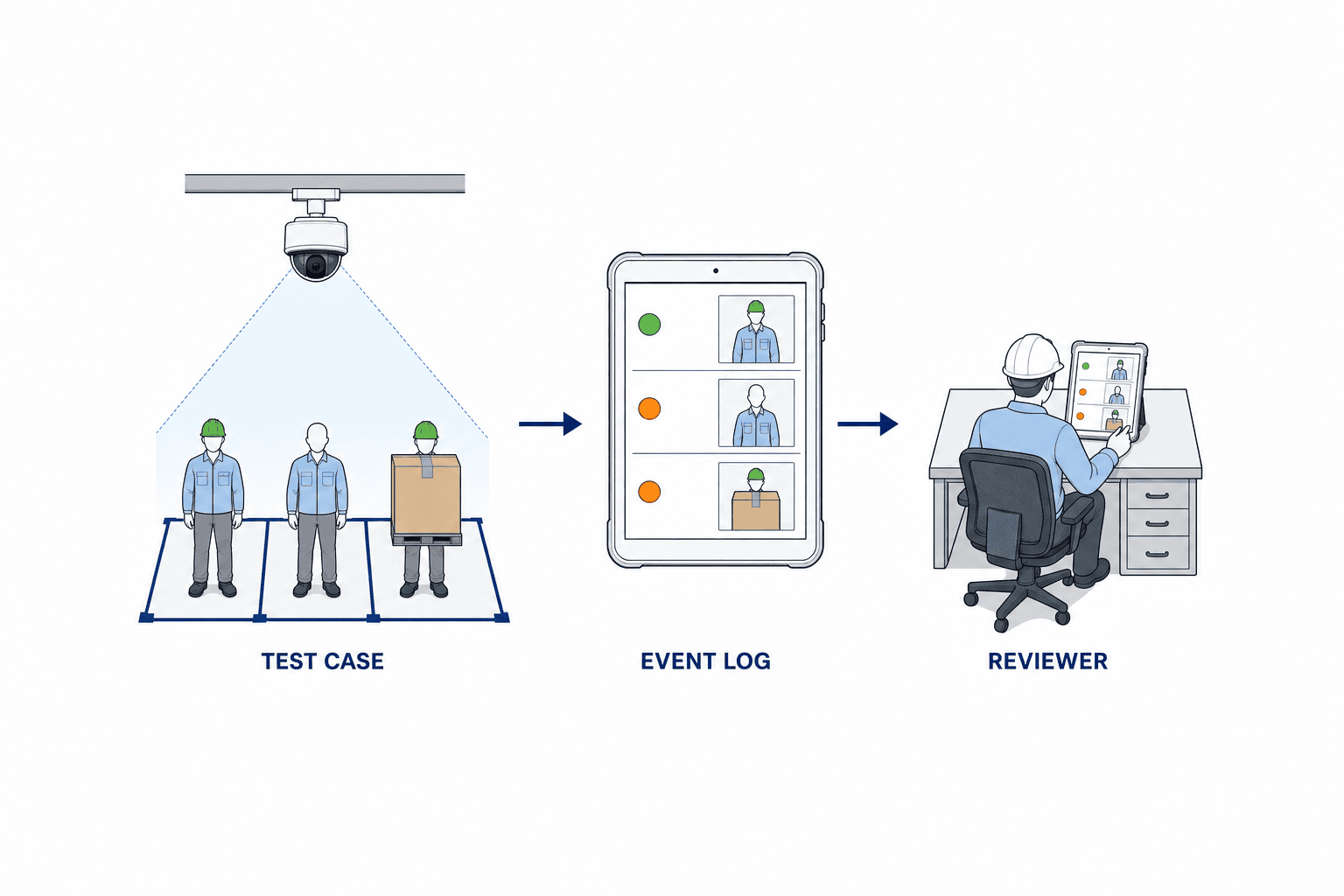
Factory Acceptance Testing (FAT) can test software, rule versions and alert routing before installation. Site Acceptance Testing (SAT) must test real angles, lighting, people, obstructions and the live network. Every case should have input conditions, expected output, actual result, reviewer and retest condition. A working demonstration is not equivalent to acceptance.
For FAT, include the same PPE in a mandatory zone and an out-of-scope zone, an approved exception and its expiry, a rule change awaiting approval, correct PPE, missing PPE, undecidable footage, a different PPE type, two overlapping people, missing video, absent reviewer, network interruption and duplicate events after recovery. Stage footage safely and handle any personal data under the agreed policy.
For SAT, match the camera view to the drawing and repeat cases during relevant shifts, loading-door positions, setup changes, cleaning and crowded passages. Record weather-dependent or night conditions that cannot be tested immediately and contract a later retest. Follow an alert all the way to the production notification endpoint and actual human acknowledgement. A temporary Wi-Fi demo does not prove the production route. Agree acceptance thresholds for each scene based on hazard severity and operational load. Avoid an unsupported universal “99% accuracy” criterion. Publish denominators and exclusion reasons; verify failure display, recovery and deletion as well as detection.
Privacy and retention: design for the smallest useful dataset
PPE detection records people. Define purpose, camera area, data elements, viewers, vendor access, storage location, retention, deletion and contact point before deployment. Explain the arrangement in languages workers understand. Decide whether continuous video is actually needed or whether a short event clip and aggregate counts are enough. If face recognition or individual productivity scoring is unnecessary, omit it from the initial design.
Thai PDPA questions should be reviewed with local counsel or the site’s data-protection lead for the actual configuration. This article does not state a universal Thai legal rule. The UK ICO’s worker-monitoring guidance is a useful design reference for retention schedules and deletion, not Thai law. Draw the path from camera to inference device, notification, primary storage, backups and maintenance provider. Control who can view and export raw footage, log access, and test deletion at SAT. “Until the disk is full” is not a retention policy.
Roll out one scene, then expand on evidence
Begin with EHS hazard assessment and a review of higher-level controls. Select one clear crossing point, ask operators about occlusion and exceptions, complete privacy and network reviews, then issue a scenario-based RFP. Keep the pilot’s simulated cases separate from normal operation. After SAT, monitor false alerts, undecidable cases and completed corrective actions by shift. Expand only when review load is manageable, rule changes are controlled, image-quality failure is visible, retention works and repeated events produce changes to work conditions.
Our forklift and pedestrian AI-camera article covers a different hazard and camera geometry. Even if both applications share a dashboard, their rules, response owners and boundaries with engineered safety controls should remain explicit.
Frequently asked questions
Can a factory AI camera verify the exact PPE class?
It can infer visible shape and colour within tested conditions. It cannot by itself certify a protective standard, fit, damage, respirator seal or suitability for a hazard. Specify the classes it may classify and the cases it must mark undecidable.
Should we simply raise the threshold when PPE false alerts increase?
Classify the root cause first. A rule mistake, hidden item, backlight and model limitation require different changes. A threshold adjustment may increase misses, so retest the scene and measure reviewer workload.
What drives PPE camera deployment cost?
Camera placement, the number of zones and PPE classes, site-specific tuning, alert integration, data storage, FAT/SAT and ongoing retesting drive cost. Compare itemised proposals including human review time, not camera price alone.
Do we need face recognition or names?
Not necessarily for zone-level safety improvement. Define the minimum data needed to confirm and correct an event, then separately justify any identity feature.
Can an AI “compliant” output authorise hazardous work?
An image output alone should not serve as work permission or proof that equipment is safe. Keep the hazard assessment, PPE programme, permits, engineered protections and supervision. A proposed automatic stop or access gate requires dedicated safety engineering and validation.
Conclusion
Factory AI camera PPE detection is useful when a plant defines the hazard and rule, proves the item is visible, separates false alerts from misses, and gives a human a workable confirmation path. The RFP and FAT/SAT should require evidence for image quality, undecidable cases, response, failure recovery and privacy. Repeated events should drive changes to equipment, work methods and PPE availability, not merely generate more warnings.
If your Thailand plant is still selecting a single PPE scene or drafting acceptance criteria, contact TOMAS TECH. We can help map the camera view and review workflow against the safety controls already in place.
Sources
- NIOSH: Hierarchy of Controls.
- OSHA: PPE General Requirements (US-specific reference).
- Axis: Image Quality.
- Axis: Optimizing Video for Analytics Performance.
- NIST: AI Risks and Trustworthiness.
- UK ICO: Monitoring Workers Guidance (UK reference, not Thai law).


