


Enterprise translation automation succeeds through operating design, not a model leaderboard. This guide shows Japanese manufacturers with Thai and ASEAN sites how to control source text, terminology, confidential data, human review, RFP evidence and an illustrative 30-day PoC.
Five design pillars for enterprise translation automation
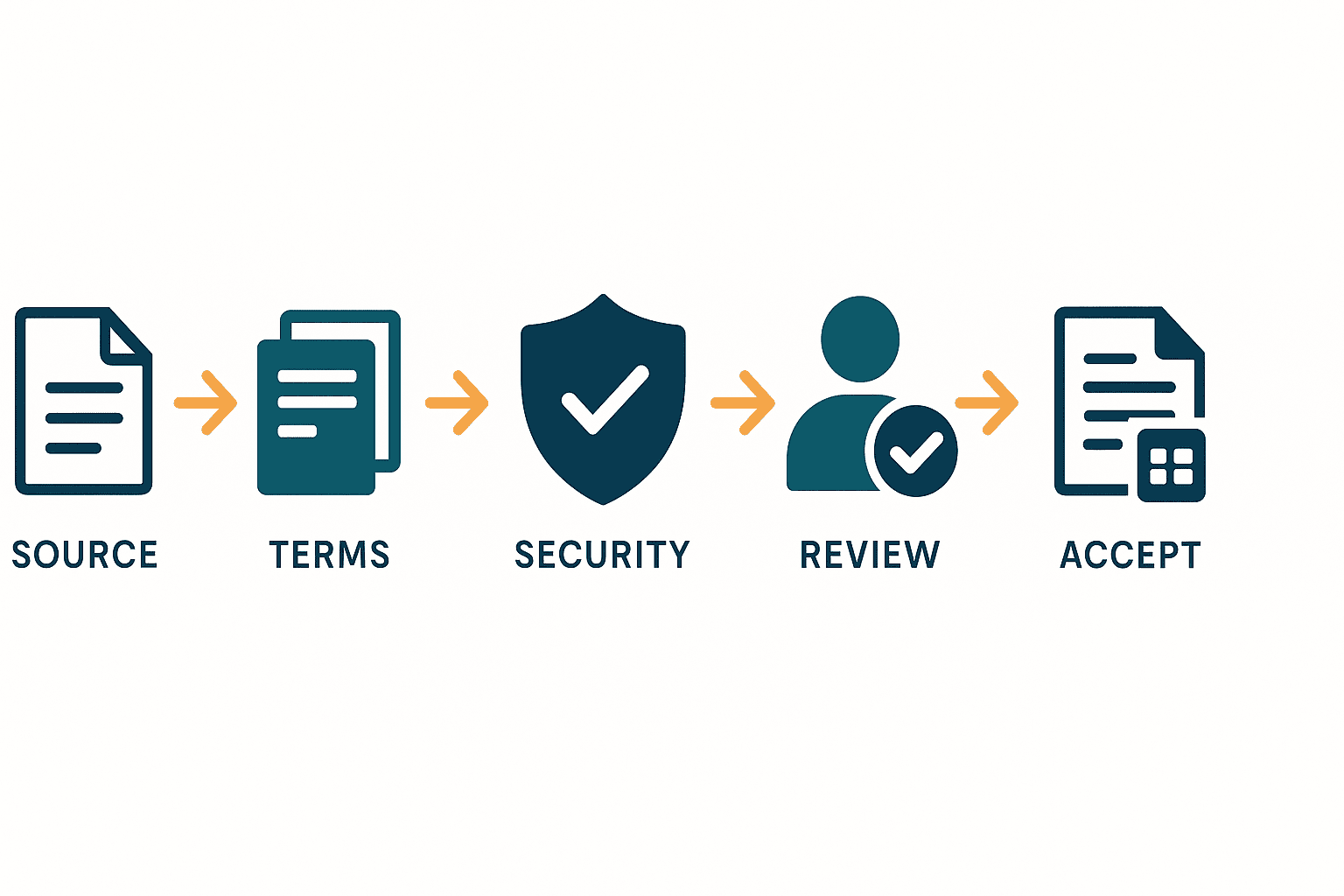
Treat translation automation as one system with five connected pillars:
- Source preparation: write short, unambiguous instructions, identify versions and use structures that can be reused.
- Glossaries and translation memory: govern product names, process terms, safety language and approved bilingual segments as assets.
- Confidentiality and transmission routes: decide which document may go to which service, endpoint, region and contract under what retention conditions.
- Risk-based human review: assign reviewers and approvers according to the consequence of an error in safety, quality, contractual or customer-facing content.
- Acceptance and continuous evaluation: test mandatory terms, numbers, negation, units, versions and layouts with both automated checks and people.
A comparison that asks only which AI sounds most natural can look impressive in a demonstration and still collapse in production. Corporate translation is not a one-time exercise in producing elegant prose. It repeatedly handles revisions, differences, approval, audit, reuse and withdrawal. A model is one component in that process; it is not the accountable owner of the process.
Why a model benchmark cannot govern multilingual document translation
Manufacturing language is unusually context-dependent. “Line” may refer to a production line, pipe, cable or product series. Japanese shop-floor terms such as *nige*, *atari* and *dandori* can carry a plant-specific meaning. A natural Thai sentence may omit a subject, yet a work instruction must identify who performs and who approves an action. Long Japanese modifiers can make it unclear in English, Thai or Vietnamese which condition governs which step.
Documents also contain non-linguistic constraints. A part number must not be translated. Units must not change. Figure references must match. Warning levels must be preserved. Revision history must remain available and obsolete versions must not be distributed. A fluent output is unacceptable if one character of a part number changes or if “must not” becomes a positive instruction.
The PoC scope must therefore include more than target sentences: extraction, source preparation, translation, terminology application, post-processing, review, approval, re-export, distribution and logs all require evaluation.
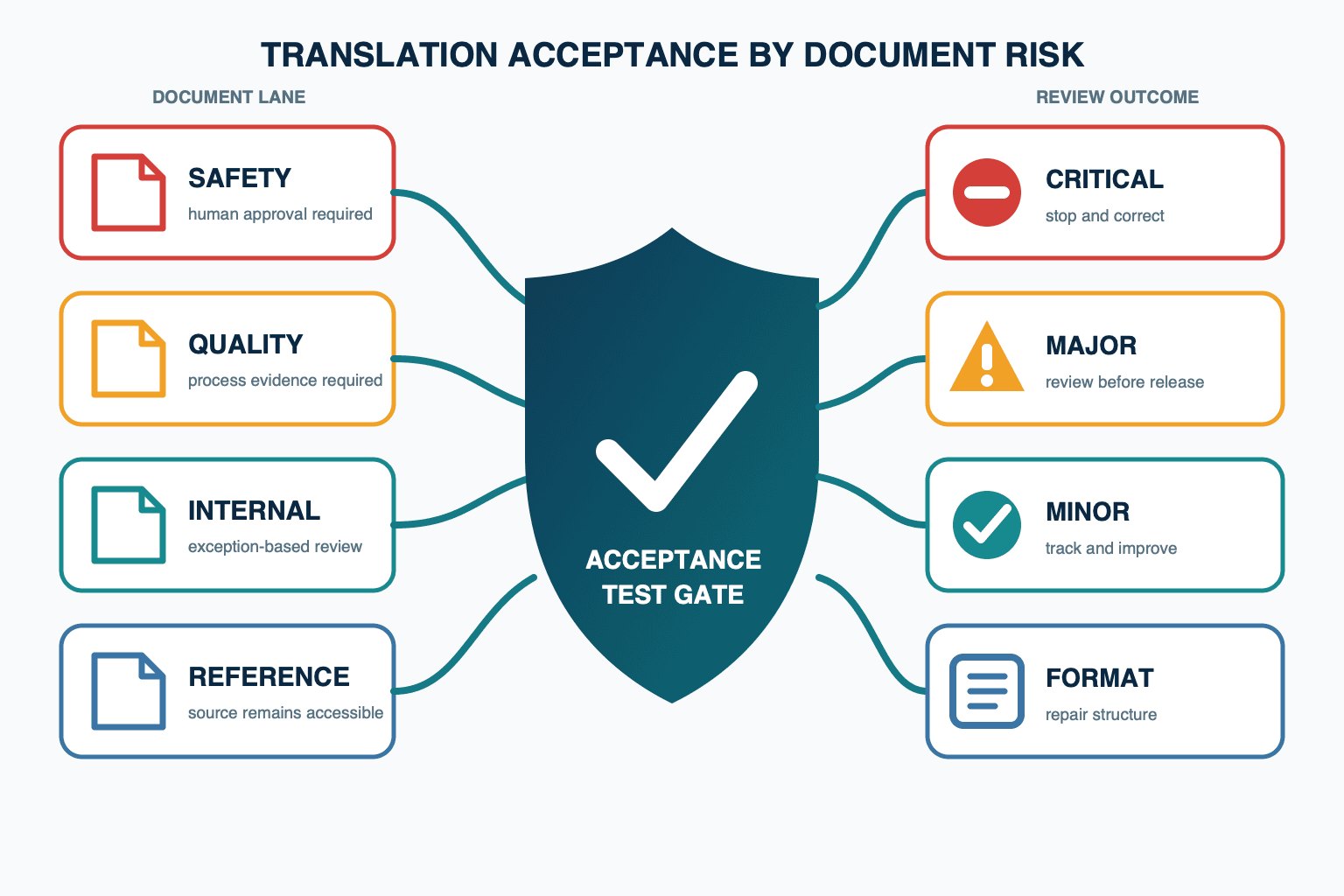
Select an operating lane by document risk, volume and update frequency
One service does not have to process every document. Separate lanes by purpose and consequence.
| Document class | Examples | Automation policy | Human review |
|---|---|---|---|
| A: safety, legal, contract | safety procedures, chemical data, customer contracts, warranty terms | AI supports drafting and terminology checks | mandatory final approval by the accountable function |
| B: quality and process | inspection standards, abnormal-response procedures, control plans, FMEA-related text | glossary-controlled translation plus differential review | normally mandatory; prioritize changed segments |
| C: internal operations | daily reports, training aids, kaizen ideas, internal FAQs | expand automation inside approved risk limits | sampling or exception review |
| D: discovery and reference | technical research, incoming-email comprehension | suitable for broader automated use | preserve access to the source |
This is a starting point. Customer requirements, personal data, export controls, intellectual property, labor rules and regulated sectors must be added. Two files called “manual” may need different lanes: a training overview is not equivalent to a lockout/tagout instruction.
Declare which documents will not be fully autonomous
Do not allow safety instructions, quality decisions, contractual obligations or regulatory/customer submissions to be released by AI alone. Retaining human approval is a proportional control, not a failed automation program. Automate retyping, retrieval of prior translations, terminology and number checks, change extraction, review routing and evidence creation. Reserve expert time for meaning and accountability.
Source preparation sets the quality ceiling for AI translation in business
Prepare source material as translatable information before calling an API. A powerful model cannot remove ambiguity that the source owner has not resolved.
One sentence, one action and explicit conditions
“After confirming there is no abnormality, start operation and report any problem to the leader” leaves the checker, definition of abnormality and stop behavior unclear. Rewrite it as:
- The operator confirms that the guard is closed.
- The operator confirms that the emergency stop is released.
- The operator must not start the machine if either condition is not met.
- The operator reports the alarm code to the shift leader.
This form makes actor, sequence, condition and negation testable by machines and reviewers.
Identify non-translatable elements
Separate part numbers, product names, equipment tags, screen labels, PLC addresses, standard numbers, variables, code and URLs. Attributes such as KEEP, LOCKED TERM and TRANSLATE make unintended conversion detectable. Define extraction rules for Word, Excel, HTML, XML, PDF and CAD-derived content.
Bind every job to a document ID and revision
At minimum record document ID, revision, source language, target language, owning department, approver, confidentiality and effective date. File names alone allow current and obsolete versions to mix. Every output must trace back to the exact source revision.
Do not confuse a glossary with translation memory
A glossary governs terms and short phrases; translation memory stores approved sentence or segment pairs. Their purposes differ, so an enterprise workflow needs both.
Minimum fields in an enterprise glossary
| Field | Purpose |
|---|---|
| term_id | immutable identifier |
| source_term | source spelling and capitalization |
| target_term | approved translation by language |
| definition | process or product meaning |
| do_not_use | prohibited translation, old name or confusing alternative |
| example | approved usage example |
| scope | corporate, business, plant, customer or product scope |
| owner | accountable subject-matter owner |
| status | draft, approved or deprecated |
| effective_from | date from which the term applies |
Microsoft’s Azure Translator Document Translation documentation says its glossary currently supports a one-to-one source-to-target language direction and can control context-specific terms, do-not-translate names and ambiguous words. It recommends TSV and notes that matching is case-sensitive by default. Google Cloud Translation supports unidirectional glossaries and multilingual equivalent term sets; because glossary resources do not provide version control, its documentation recommends retaining source files for rollback. AWS custom terminology can influence a selected translation but explicitly does not guarantee that the target term will be used in every translation because context is considered.
“Glossary support” is therefore not a uniform capability. Test file formats, directionality, case, morphology, compounds, enforcement, versioning, region and permissions for each candidate.
Promote only approved content into translation memory
Automatically feeding every AI output into translation memory reproduces errors. Require reviewer approval, a fixed source revision, language and plant scope, and a withdrawal mechanism. Distinguish exact from fuzzy matches and show the difference for every fuzzy match. Mark obsolete equipment names and procedures as deprecated and warn on reuse.
Test Japanese, Thai and Vietnamese in real sentences
Japanese has no ordinary spaces between words, and Thai typically has no word spaces either. A literal matching engine can miss a term when particles, prefixes, compounds or line breaks change. Vietnamese words may contain multiple space-separated syllables, making naive token matching unsafe. Measure correct application and false application in actual documents, not in an isolated word list.
Language rules for Thai–Japanese AI translation
Thai sites need both Japanese-to-Thai instructions and Thai-to-Japanese incident or production reports. Do not assume one direction’s settings work in reverse.
Preserve actors and accountability
Thai can naturally omit a subject, but controlled work instructions should retain roles such as Operator, Line Leader and QA. Replace a standalone “checked” with a structured performer and approver. Japanese source owners should likewise replace an unspecified “confirm” with an explicit role.
Prefer operational precision over politeness
The natural tone for internal communication and the precision required by a safety instruction are separate dimensions. A style guide should distinguish command, prohibition, permission and recommendation. Lock approved warning terms, and never rely on color or an icon alone to carry meaning.
Set the source language for short text
DeepL’s documentation recommends specifying the source language when possible. It also explains that automatic detection is less reliable for a single word or very short sentence. Require a source language on alarms, button labels, abbreviations and item names. For longer documents, detect accidental file mixing but still set a known language explicitly.
Design security around the transmission route, not the word “AI”
Security cannot be decided from a product name alone. Draw the path from input to deletion:
- Receive a job from an authorized device or repository.
- Classify it with DLP or documented rules.
- Mask names, customer identifiers or drawing numbers when required.
- Send it only through an approved API, region, network route and contract.
- Store the result in an encrypted, access-controlled location.
- Record human review and approval.
- Delete source, target, logs and caches according to the retention schedule.
Do not treat an API and a consumer interface as the same service
Contracts, data use, retention and controls vary by delivery mode. OpenAI’s API data-control documentation states that API data is not used to train or improve models unless the customer explicitly opts in. It separately states that default abuse-monitoring logs may be retained for up to 30 days unless law or service-protection needs require longer retention. Application state and Zero Data Retention eligibility differ by endpoint. “Not used for training” therefore does not mean “never stored.” Review the exact endpoint, store setting, files, caches and third-party services in the proposed architecture.
The 30-day value is not a universal rule for translation vendors. It is the default OpenAI API condition described in the source at the time of review and can vary with endpoints, controls, contracts and legal obligations. Reconfirm it in the RFP response and contract.
For a deeper control design, see our guide to preventing generative-AI data leakage in Thai manufacturing.
Map confidentiality to approved lanes
| Classification | Example | Illustrative approved lane |
|---|---|---|
| Public | published catalog or web content | approved cloud translation |
| Internal | ordinary internal procedure or training | enterprise API, access controls and logs |
| Confidential | customer drawing, cost or unannounced product | masking, restricted environment and explicit approval |
| Restricted | export-controlled data, highly sensitive personal data or strict NDA | no transmission by default, or dedicated environment with legal approval |
Use the organization’s own labels. The important control is technical enforcement of prohibited lanes, not a checkbox saying the user read a policy. Record requester, reason, expiry and approver for every exception.
Design human review by document risk and error type
Reviewing every word twice prevents the expected efficiency; removing all review creates unmanaged risk. Use layers.
Level 1: automated checks
Check mandatory and prohibited terms, numbers, units, dates, part numbers, tags, URLs, negation, warnings, untranslated strings, unexpected additions, table dimensions and figure references. Normalize full-width characters, decimal separators and local digits before comparing.
Level 2: language review
Verify meaning, grammar, readability and local vocabulary. The key question is not only whether the text sounds natural, but whether obligations, conditions, prohibition and uncertainty remain unchanged. Thai and Vietnamese native reviewers should confirm that shop-floor users can act without ambiguity.
Level 3: accountable subject-matter approval
Safety, QA, legal, engineering or account owners approve business correctness and release. Do not make a linguist solely accountable for engineering, or an engineer solely accountable for linguistic quality. Record the separate decision and evidence for each role.
Build the exception queue before expanding automation
Route low confidence, glossary conflict, poor OCR, unknown revision, broken tables, handwriting, mixed languages and unknown confidentiality to an exception queue. An HTTP 200 response is not a successful translation job.
Acceptance testing must prioritize consequential errors over fluency
Create a gold dataset from representative production documents. A PoC composed only of easy and public examples hides the failure modes that matter.
Freeze the test set
- formats: Word, Excel, PDF, HTML, email and OCR documents;
- directions: JA→TH, TH→JA, JA→EN and JA→VI;
- difficulty: short and long text, tables, lists, mixed languages, abbreviations and imperfect source text;
- risk: safety, quality, contract, internal operation and reference;
- lifecycle: new, minor revision, major revision and obsolete withdrawal.
Give every sample a document ID and version. Separate a development set used for tuning from a holdout set used only for final acceptance.
Define pass/fail by weighted error classes
An average score can hide a dangerous lost negation. Count at least:
- Critical: reversed prohibition or permission, dangerous number or unit, false legal duty, wrong component instruction;
- Major: term that changes a process, missing actor, condition or sequence, error affecting quality disposition;
- Minor: style or punctuation that does not change meaning;
- Format: damage to a table, figure number, link or layout.
For safety, quality and contract classes, the document can fail on a single Critical error. Set gates from the company risk assessment; do not copy a vendor’s generic threshold.
Test repeatability, upgrades and differences
Record variation when the same input is run with the same model, settings and glossary. Run regression tests when a model or API changes. Link source changes, target changes, glossary changes and configuration changes so reviewers can focus on what actually moved.
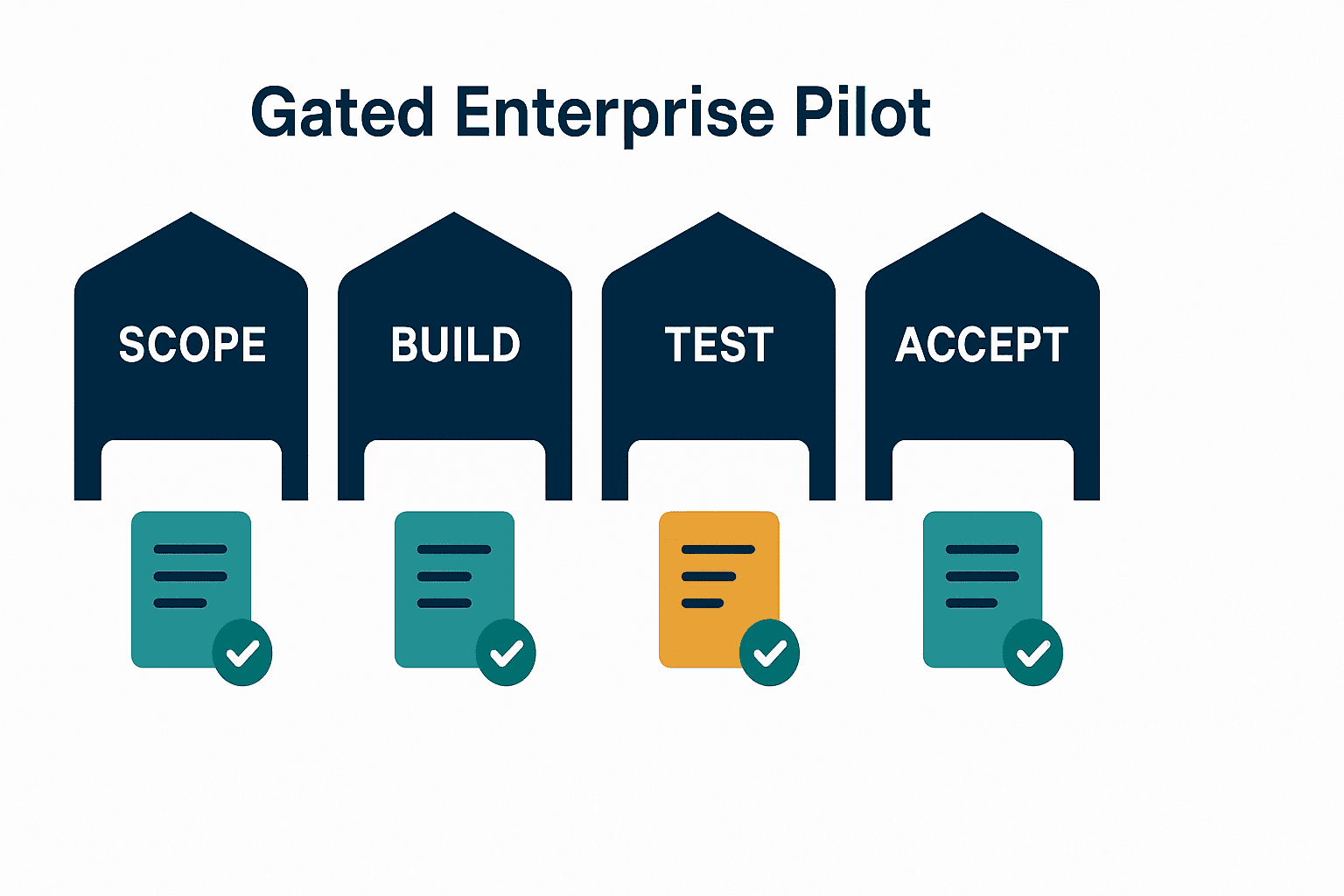
An illustrative 30-day PoC
Thirty days is a planning example, not an official statistic or a promise. Adjust it for document volume, access review and legal approval.
Week 1: scope, risk and gold data
- agree on included and excluded workflows;
- inventory document classes, confidentiality, directions and formats;
- collect existing glossaries, translation memory and style guides;
- approve the fixed test set and pass/fail criteria;
- name owners in information security, legal, IT/OT, quality and operations.
Week 2: minimum pipeline and terminology control
- ingest with document ID, revision, language and class;
- detect non-translatable content and customer or personal identifiers;
- apply a glossary to candidate services;
- log result, configuration, model, glossary version, duration and error;
- connect the exception queue and review interface.
Week 3: representative documents and fault tests
- process hard samples in the same proportions as ordinary samples;
- inject glossary misses, language misdetection, OCR omissions, API failures and timeouts;
- record review time and correction categories;
- trace consequential errors to source, terminology, configuration, model or post-processing controls.
DeepL’s production checklist recommends exponential-backoff retries for 429 and 500 errors, never putting authentication keys in query parameters, providing broader context and caching translation responses to avoid duplicate work. These are vendor-specific instructions, but they illustrate why retry behavior, secret handling, context and idempotency belong in enterprise tests.
Week 4: holdout acceptance and operating decision
- run the unused holdout set;
- approve results and residual risk by document class;
- define production, remediation and prohibited lanes;
- hand over operations, monitoring, incident response, rollback and training;
- schedule the next regression test and assign its owner.
Questions and evidence for the RFP
| Area | Question | Evidence required |
|---|---|---|
| language and format | How are JA/TH/EN/VI, mixed language, Word, Excel, PDF and OCR handled? | results from representative files |
| terminology | What are the direction, format, case, morphology, versioning and enforcement rules? | correct and false application tests in context |
| memory | Can approved translations be reused, scoped, withdrawn and shown as fuzzy differences? | history and rollback demonstration |
| data | What are training, log, state, retention, deletion and subprocessors? | contract terms, settings and data-flow diagram |
| identity | How are SSO, MFA, RBAC, service accounts and secrets managed? | access matrix, audit logs and key rotation |
| resilience | What happens on 429/5xx, timeout, duplicate submission or reordered completion? | fault-injection and recovery logs |
| quality | How are consequential errors, numbers, negation, terms and omissions measured? | results on the agreed fixed set |
| change | How are model, API and glossary updates notified and validated? | change notice and regression procedure |
| review | How do assignment, differences, comments, approval and rejection work? | end-to-end workflow demonstration |
| exit | Can data be exported, transferred and deleted at contract end? | standard-format export and deletion evidence |
Run the same corporate dataset for all candidates. Compare total work—source preparation, retranslation, review, exceptions, audit and terminology maintenance—not only a per-character price. This article intentionally provides no invented market price or savings percentage. Measure the current process and compare it with the same process after the PoC.
Keep the production architecture replaceable
Decouple intake, terminology, translation, checking, review, approval and distribution. Normalize vendor responses into a common job record rather than storing raw API output as the business record.
Recommended job metadata
- job_id, document_id and source_version;
- source_language, target_language and locale;
- document_class and confidentiality;
- glossary_version, translation_memory_version and style_version;
- provider, model, endpoint and request_setting;
- source_hash and output_hash;
- reviewer, approver, decision and timestamp;
- error_code, retry_count and fallback_reason.
This preserves lineage when a provider changes. Never embed API keys in client devices or spreadsheet macros; call services from server-side secret management. Separate operational metadata from text-bearing logs and avoid retaining the body when monitoring does not need it.
Cache with version and confidentiality context
Reuse reduces processing time, but it must not leak one customer’s translation to another or revive an obsolete term. Include language, glossary version, style version, model settings and scope in addition to a source hash. Invalidate dependent entries when a term or document revision is withdrawn.
Measure quality, time, exceptions and reuse
Volume alone encourages users to avoid hard documents or ignore errors. Combine:
- Critical, Major and Minor errors by document class;
- mandatory-term application and false-application rates;
- consistency of numbers, units and part numbers;
- lead time from intake to approval;
- review minutes and correction categories;
- no-change, minor-change and full-rewrite approval shares;
- translation-memory and cache reuse;
- exception, retry and failure reasons;
- obsolete distribution, misdelivery and missed approval events.
Set baselines from the company’s current process. Compare providers and upgrades on the same holdout set. Our article on evaluating Thai-language generative AI adds guidance on datasets and reviewers. If external implementation support is under consideration, see outsourcing AI development in Thailand.
Turn Thailand’s AI-governance direction into operating controls
Thailand’s ETDA describes its 2026 direction as “Driving Trust AI Governance,” combining guidelines and toolkits, practical adoption, domestic and international cooperation, and capability building. This announcement does not certify an individual corporate implementation, but it is consistent with treating trustworthy translation automation as governance, implementation and training—not model selection alone.
Maintain an AI-use register, document classes, data flows, risk assessments, approvers, test results, incidents and change history. Legal specialists should confirm Thai personal-data, employment, customer-contract and sector requirements for the actual use case.
Frequently asked questions
Which documents should an enterprise automate first?
Start with repeated, high-volume documents whose source owner and approver are clear and whose error consequence can be limited. Internal FAQs or structured reports may fit. Still include future quality and safety samples in the PoC to discover limits, while prohibiting autonomous release.
Is a glossary enough to stabilize AI translation for business?
No. Source ambiguity, revision, translation memory, style, settings, post-processing and review also matter. Each service applies terminology differently, so test both correct and false application in real sentences.
How should translation memory work with generative AI?
Prefer approved exact matches, present fuzzy matches with their differences, and draft unmatched segments with AI. Promote an AI output only after approval and retain its scope, version, owner and withdrawal state.
Can Thai–Japanese AI translation detect the source automatically?
Many services can, but alarms, item names, abbreviations and mixed text are difficult. Set the source when known and route uncertain or mixed detection to exceptions.
May confidential documents be sent to cloud AI?
There is no universal answer. Evaluate classification, contract, training use, retention, region, subprocessors, encryption, access, law and customer terms. Choose masking, dedicated environments or a prohibited route as required.
When can human review be reduced?
Only after production-like evidence shows consequential errors are controlled, automated checks and exceptions work, regressions and rollback are tested, and the accountable function accepts residual risk. Keep human approval for safety, quality and contract content.
What is the most useful evidence in a multilingual-document RFP?
Results from the buyer’s fixed dataset, processed with the real glossary, file formats, confidentiality controls and review steps. A demonstration sentence or vendor average cannot prove terminology, table preservation, version control or recovery for your operation.
Will a PoC finish in 30 days?
Thirty days is an illustrative design. Scope, document volume, security review, contracting and expert availability can change it. The essential outcome is agreement on holdout acceptance, residual risk, owners and prohibited lanes.
Conclusion: translation automation is an operating system, not a model purchase
Enterprise translation automation must unite source preparation, glossary and translation memory, secure transmission, risk-based human review, and acceptance plus continuous evaluation. Model comparison matters, but it should not dominate the decision.
Never make safety, quality or contract documents completely autonomous. During an illustrative 30-day PoC, test not only ordinary translation but terminology conflicts, language misdetection, OCR damage, API failures and revision mixing. Use the evidence to define production, review and prohibited lanes.
TOMAS TECH helps manufacturers across Thailand and ASEAN inventory multilingual documents, govern Japanese–Thai–English–Vietnamese terminology, build secure pipelines, run PoC evaluation and implement approval workflows. You can contact us before selecting a product or issuing an RFP. A practical first step is to list the target documents and the consequence of a wrong translation.
Official references
- OpenAI — Data controls in the OpenAI platform
- Microsoft Azure Translator — Use glossaries with Document translation
- DeepL — Language detection
- DeepL — Pre-production checklist
- Google Cloud Translation — Creating and using glossaries
- Amazon Translate — Custom terminology
- ETDA — Driving Trust AI Governance 2026
- Thailand BOI — 2026 H1 investment promotion context


