


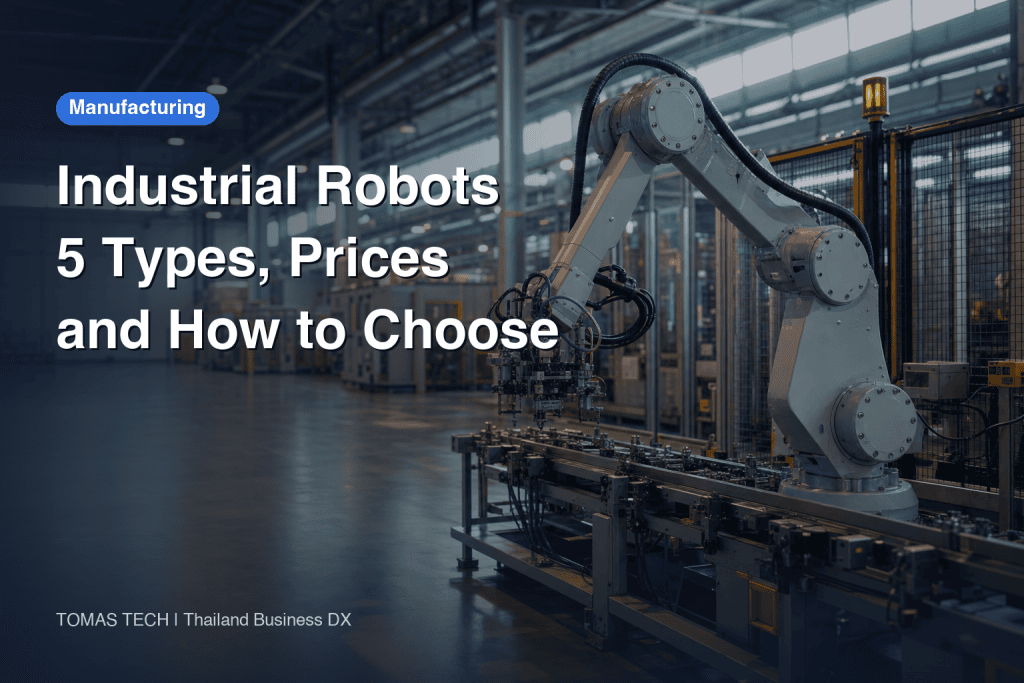
“Which robot actually fits our process?” That is where most plants stall the moment they start evaluating an industrial robot. Vertical articulated, SCARA, parallel-link, collaborative, Cartesian — change the type and you change the price band, the payload band and the processes it is genuinely good at. Choose wrong and the cycle time never arrives, or you pay for capability you never needed. This article lines the five types up by price and payload, shows which one to shortlist process by process, and sets out the conditions that shift the answer inside a Japanese-owned plant in Thailand.
Industrial Robot Implementation Starts With the Type, Not the Maker
When a plant comes to us about robots, the first question is almost always “which manufacturer should we go with?” That question is one step early. What has to be settled before the maker is the type, and once the type is settled the maker shortlist narrows on its own. For some processes, only a handful of manufacturers hold a model that genuinely fits.
Global Demand Doubled in Ten Years
According to the IFR (International Federation of Robotics) World Robotics 2025 report, 542,000 industrial robots were newly installed worldwide in 2024, bringing the operational stock to 4,664,000 units. That is the fourth consecutive year above 500,000 new installations. By region, Asia took 74%, Europe 16% and the Americas 9%. By country, China alone accounted for 295,000 units, or 54% of the world total, followed by Japan at 44,500, the United States at 34,200, South Korea at 30,600 and Germany at 26,982.
The same report puts numbers on density. The 2024 world average was 132 robots per 10,000 manufacturing employees: 267 in Western Europe, 204 in North America, 131 in Asia. By country, South Korea reached 1,220, Singapore 818, Germany 449, Japan 446 and China 166.
The figure worth pausing on is Asia’s 131. That average is propped up by the leaders — South Korea at 1,220, Singapore at 818, Japan at 446, China at 166 — so it is reasonable to assume that Southeast Asian countries outside that group sit well below the line. The IFR’s published material does not break out a standalone density figure for Thailand, so this cannot be stated as fact. But our reading is that you are not in a situation where “everyone around us has already finished, we have to rush.” There is still plenty of room to spend time on getting the type right.
The Wrong Type Changes Whether the Process Works At All, Not Just What It Costs
The common misunderstanding in robot selection is treating the difference between types as a difference in price. It is not. The difference between types first decides whether the process is feasible at all; price follows afterwards.
Take small pouches arriving on a conveyor at 60 units per minute and being arranged into trays. Build that with a single vertical articulated robot and the cycle time simply does not arrive. Add units and it does, but the moment you add them the cost structure changes and the footprint doubles. Conversely, a process that inserts a cast part into a lathe chuck at an angle cannot be built with a SCARA at all, because a SCARA’s structure cannot tilt the wrist.
Choosing a robot type is not price optimisation. It is constraint satisfaction. Only once more than one type still satisfies every constraint does comparing price start to mean anything.

Industrial Robot Types and Price Ranges — Five Types Compared
Start with the whole picture on one page. The prices below are for the robot body only (arm plus controller), based on market information published for the Japanese domestic market. They exclude peripheral equipment, engineering and installation. Exchange rates move, so read these figures as a relative comparison between types rather than as a quotation.
| Type | Axes | Payload range | Body price band (Japan domestic market) | Strong at | Weak at |
|---|---|---|---|---|---|
| Vertical articulated (6-axis) | 4–7 axes | 3 kg to several hundred kg (up to the 2,300 kg class) | approx. JPY 1,500,000 to over JPY 10,000,000 | Welding, painting, assembly, machine tending, palletizing | High-speed picking at tens of units per minute, extremely tight footprints |
| SCARA (horizontal articulated) | 4 axes | 1–20 kg (up to the 50 kg class) | approx. JPY 600,000–3,000,000 | Board and component insertion, screw fastening, pick and place in a horizontal plane | Work needing a tilted wrist, heavy loads, three-dimensional obstacle avoidance |
| Parallel-link (delta) | 3–6 axes | a few hundred grams to a few kg | approx. JPY 6,000,000–12,000,000 | High-speed pick and place over a conveyor, primary packaging, sorting | Heavy loads, insertion deep into a container, wide work envelopes |
| Collaborative (cobot) | 6–7 axes | 3–35 kg | approx. JPY 1,500,000–4,000,000 (up to the 12 kg payload class) | High-mix low-volume assembly, boxing, machine tending, processes running beside people | Fast cycle times, heavy loads, long reach |
| Cartesian (combined single axes) | 2–3 axes | a few kg to several hundred kg | Set by axis count and stroke length | Linear transfer, dispensing, inspection feed axes, long strokes | Work needing orientation change, complex paths |
The collaborative price band applies to general-purpose machines up to the 12 kg payload class; high-payload cobots of 15 kg and above sit above that range. Cartesian systems are not bought as a finished robot but assembled from single-axis actuators, so no single market price can be quoted and no figure is given. The table is there to give you the outline of each type. Below, each one is examined in terms of the processes where it becomes the first candidate.
Vertical Articulated Robots — The Default Starting Point
Structurally close to a human arm, with 4 to 7 axes giving free control of both position and orientation at the tool point. This is the shape most people picture when they hear “industrial robot,” and it is in fact the type with the largest share of global shipments.
Its strength is versatility. Model ranges run from 3 kg payload compacts up to 2,300 kg class giants, with reach from around 500 mm to over 3,500 mm. Welding, painting, assembly, transfer, palletizing, machine tending — the breadth of processes it can cover is far wider than any other type. If you change processes later, the odds of redeploying the same robot elsewhere are high.
It has three weaknesses. First, being free to change orientation means motion paths get complex, which makes teaching more labour-intensive than for other types. Second, coordinated motion across all six axes is structurally slow, so it is not suited to high-speed picking at tens of units per minute. Third, because the work envelope expands spherically, the area that has to be fenced is large, and footprint plus safety equipment cost stack up.
Market information published in Japan puts the compact class under 5 kg payload at roughly JPY 1,500,000–3,000,000, the mid class around 15 kg payload at roughly JPY 3,000,000–5,000,000, and the large class above 50 kg payload at roughly JPY 5,000,000 to over JPY 10,000,000.
SCARA Robots — A Structure Narrowed Down to the Horizontal Plane
SCARA (Selective Compliance Assembly Robot Arm) is a four-axis robot built mainly around horizontal rotary axes, with a single vertical axis for up-and-down travel. It moves compliantly within the horizontal plane while staying rigid in the vertical direction. That “compliant horizontally, stiff vertically” characteristic is exactly why it suits part insertion, press fitting and screw fastening.
Because the structure is narrowed down, the same motion runs faster than on a vertical articulated robot and positioning accuracy is easier to hold. For inserting electronic components onto a board, mating connectors, or horizontal pick and place of small parts, a SCARA is the more natural fit.
Its weakness is unambiguous: it cannot tilt the wrist. Inserting a workpiece at an angle, flipping it over, approaching from the side — none of these is possible in principle. Payload also tops out in practice around 1–20 kg, so heavy work is out of reach.
Body prices run approximately JPY 600,000–3,000,000 in the Japanese market, with typical models at JPY 1,000,000–2,000,000. But on SCARA projects the money usually inflates not on the robot but on the peripheral equipment. The narrow work envelope means you need transfer equipment and a parts feeder to bring the workpiece within reach, and design and fabrication cost land there. Including vision and parts feeders, a complete system is reported to range from the JPY 1,500,000 bracket up to over JPY 10,000,000.
Parallel-Link (Delta) Robots — Everything Committed to Speed
Three arms (four to six on some models) are suspended from an overhead frame and joined at their ends by a single plate. Because every motor sits at the base, the moving mass is light and the speed is an order of magnitude beyond other types.
Its territory is picking workpieces off a moving conveyor at anywhere from tens to around 100 units per minute. Primary packaging of confectionery and pharmaceuticals, tray filling of food products, extraction and sorting of moulded plastic parts. The typical build combines vision with conveyor tracking so that items are picked while still moving.
Its weaknesses are payload and work envelope. Payload centres on a few hundred grams to a few kilograms, so heavy items are out. The work envelope is limited to a cone, and reaching into the bottom of a deep box is not its strength. On top of that, choosing parallel-link effectively means choosing a vision-based build, which brings sensitivity to lighting conditions and workpiece surface variation onto the project’s risk register. How to manage that sensitivity is covered in detail in robot vision implementation cost and payback.
The body price band is reported at approximately JPY 6,000,000–12,000,000, the highest cost per kilogram of payload of any type. It still gets chosen because achieving the same cycle time with vertical articulated robots would take four or five units, losing on both total cost and floor area.
Collaborative Robots — Safety Built From Speed and Force, Not Fencing
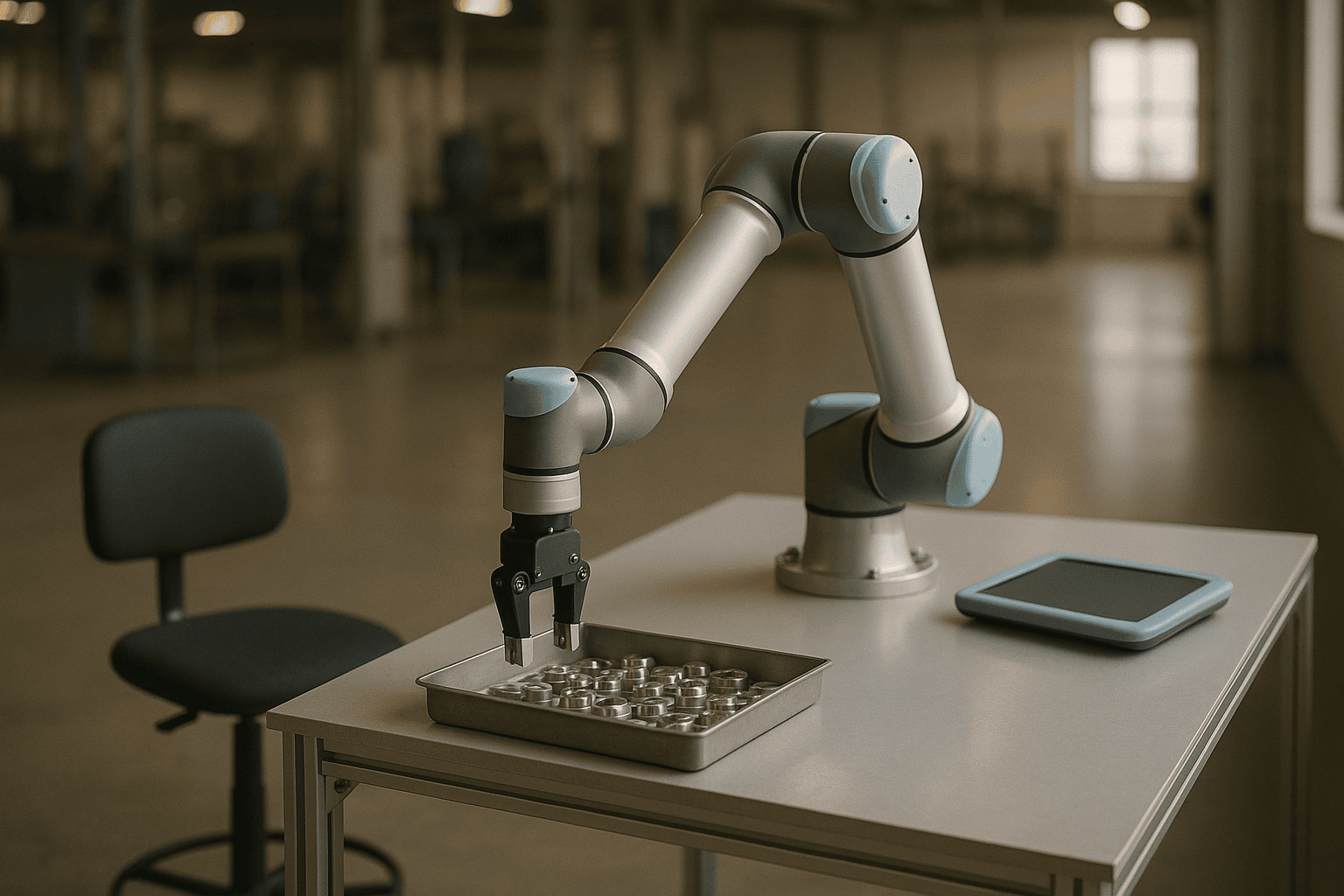
A 6 or 7 axis robot designed on the assumption that it will operate in the same space as people. It detects contact and stops, limits operating speed and force, and has rounded external surfaces.
Its biggest advantage is installation flexibility. Because fencing may become unnecessary (subject to the outcome of the risk assessment), the footprint is small and it retrofits easily into spare space on an existing line. Most models support direct teaching, where you move the arm by hand to teach positions, so no specialist programmer is required. On high-mix low-volume processes with frequent changeovers, that ease of teaching pays.
Its weaknesses are equally clear: it is slow, and its payload is limited. Limiting contact force with a person necessarily caps operating speed, and cycle time drops visibly against the same motion performed by a fenced vertical articulated robot. Practical payload runs 3–35 kg.
There is one more point that gets misread on cost. Not needing a fence does not make the safety budget zero. Measurement and evaluation of contact forces and pressures, configuration of speed and force limits, and design of operator movement paths all become process-side work. It is closer to the truth to say that hardware cost is replaced by process cost. The cost structure and implementation sequence for cobots is set out in collaborative robot implementation costs and approach.
Body prices are reported at roughly JPY 1,500,000–2,500,000 for the 3–5 kg payload class and JPY 2,200,000–4,000,000 for the general-purpose 5–12 kg class. The 15–25 kg payload class rises to around JPY 4,200,000–7,000,000, so the sense that “cobots are cheap” should be understood as applying up to the 12 kg class only. Japanese guidance suggests budgeting associated costs (integrator fees, end effector, installation and tuning) at 50–100% of the robot body, giving a total implementation cost for a single-robot system of roughly JPY 4,000,000–7,000,000 for a simple application, or JPY 7,000,000–12,000,000 for a configuration that includes vision.
Cartesian Robots — You Do Not Buy a Robot, You Build Axes
Single-axis actuators combined along the orthogonal X, Y and Z directions. Strictly speaking this is less “selecting a robot” than “designing and assembling axes.”
The advantages are that you take only the stroke you need in the direction you need it, and that the configuration is simple and easy to understand. For transfer requiring long strokes, dispenser application paths, or camera feed axes on inspection equipment, this is often more straightforward and cheaper than an articulated machine. Cost builds up from axis count and stroke length, so it cannot be expressed as a body price band the way other types can.
Its weaknesses are that it cannot change orientation and that path freedom is low. Reaching around an obstacle is not something it does well.
The type is unglamorous, but it matters as the reference point when you ask whether a robot is really needed at all. If someone has proposed a vertical articulated robot for simple linear transfer, it is worth checking once whether a Cartesian build or an even simpler dedicated machine would do the job.
Industrial Robot Price — The Body Is Only 20–30% of the Total
We have lined up body prices by type, but in a real quotation the body accounts for only 20–30%. Without understanding that structure first, you will compare body prices and decide wrong.
The table below shows the line-item breakdown, as a share of total, for the single vertical articulated configuration in our own estimate presented later in this article (Chonburi province, boxing process).
| Line item | Amount (THB) | Share |
|---|---|---|
| Robot and controller | 1,100,000 | 21.8% |
| Gripper (EOAT) design and fabrication | 380,000 | 7.5% |
| Feeding, alignment and discharge equipment | 900,000 | 17.8% |
| Safety equipment and risk assessment | 620,000 | 12.3% |
| Control panel design/build and electrical work | 480,000 | 9.5% |
| Upstream integration (production data capture) | 350,000 | 6.9% |
| Engineering (design, teaching, witnessed testing, documentation) | 900,000 | 17.8% |
| Installation, commissioning and training | 320,000 | 6.3% |
| Initial total | 5,050,000 | 100% |
Shares do not sum to exactly 100% because of rounding. What to take from this table is that the robot body (21.8%) and engineering (17.8%) are almost the same size. The body is a catalogue item, so the price difference between suppliers is limited. What moves the total is how many person-months of design, fabrication and tuning are stacked around it, and that is set by the difficulty of the process and the type you chose.
Japanese commentary variously puts the robot body at 20–30% of the total or at around 30–40%. The ratio itself moves with process difficulty, so the spread is itself realistic. What all versions agree on is that the remaining 60–80% is peripheral equipment and integration. The practical insight is that changing the type can move peripheral cost more than it moves body price. The earlier example holds exactly here: choose SCARA and the body is cheap, but transfer equipment and feeders are added.
The gripper (EOAT) is required regardless of type, and it is a line item that scales with the number of part types. How to approach the selection is set out in robot hand and gripper selection.
Robot Arm Implementation by Process — Which Type to Shortlist First
This is where the practical work begins: mapping the characteristics of each type onto the process.
| Process | First candidate | Alternative | The deciding factor |
|---|---|---|---|
| Arc welding | Vertical articulated (6-axis) | Collaborative (thin sheet, low volume) | Torch orientation freedom is required, so articulated is the baseline |
| Spot welding | Vertical articulated (payload above 100 kg) | None | The welding gun alone weighs tens of kg, so payload decides the type |
| Assembly, screw fastening, insertion | SCARA | Vertical articulated / collaborative | SCARA if it closes within a horizontal plane, articulated if orientation changes |
| Palletizing and boxing | Vertical articulated (including 4-axis dedicated palletizers) | Collaborative (low stacks) | Stack height and the weight of a single unit |
| High-speed picking (primary packaging) | Parallel-link | SCARA | Whether units per minute exceed the SCARA limit |
| Bin picking | Vertical articulated plus 3D vision | Collaborative plus vision | Freedom in extraction orientation favours articulated |
| Machine tending | Collaborative | Vertical articulated | Collaborative if changeovers are frequent, articulated if cycle time rules |
| Inspection transfer and positioning | Cartesian / SCARA | Vertical articulated | Whether the orientation of the inspected item has to change |
The processes where cost moves the most are covered below.
Welding — Orientation Freedom Decides the Type
Arc welding requires the torch to be held at a constant angle and distance relative to the workpiece throughout. The moment that “maintain the orientation” requirement appears, SCARA, parallel-link and Cartesian all drop out. A 6-axis vertical articulated robot becomes the premise, sometimes in a 7-plus axis configuration combined with a positioner. Spot welding is even simpler: the welding gun itself weighs tens of kilograms, so nothing below a large articulated machine above 100 kg payload is an option.
On cost, it is not unusual for the fixturing — the positioner that holds the workpiece plus dedicated jigs — to exceed the robot body. That block scales directly with part-type count, which makes it the part of the specification to treat most carefully at the early definition stage. The cost structure and the order in which to work through it are covered in welding robot implementation.
Assembly — SCARA Versus Collaborative Comes Down to Changeover Frequency
Assembly is the process with the widest range of viable types. Insertion and screw fastening that closes in a horizontal plane goes to SCARA, which is fast and cheap. If orientation has to change, vertical articulated. If part types are many and changeovers frequent, collaborative.
The judgement axis that works best in practice is how many times a day the setup changes. If changeovers are rare, it pays to run fast on a SCARA or an articulated machine even if teaching is more work. If the part type changes several times a day, a cobot the floor can adjust by direct teaching can win on overall utilisation. How to break the process down is set out in assembly automation robot implementation.
Palletizing — The Placing Side Is the Real Machine
Palletizing is almost entirely decided by payload and stack height. If a carton exceeds 10 kg and the stack goes above 1,500 mm on the pallet, you are into a vertical articulated robot of 50 kg payload or more (or a dedicated 4-axis palletizer). Light cartons and low stacks can work on a cobot.
What gets overlooked on this process is not the robot but the surrounding automation: pallet supply, slip sheet insertion and discharge of full pallets. Leave those to people and the robot runs while an operator stays permanently attached to it. For how the cost distributes, see palletizing robot pricing and selection.
Picking — “Speed Type” and “Bin Type” Are Entirely Different Conversations
In practice the word “picking” refers to two completely different processes. Confusing them leads to the wrong type.
Speed type is picking aligned workpieces at high rate as they flow past on a conveyor. This is parallel-link territory, and what you need is speed and conveyor tracking.
Bin type is extracting parts thrown loosely into a container. What you need is not speed but 3D vision for orientation recognition and path generation that avoids collisions on the way in. The type is vertical articulated. A parallel-link robot cannot reach inside a box.
The two differ completely in required technology, cost structure and difficulty. When someone says “we are looking at a picking robot,” the first thing to establish is which of the two they mean. The two cases are treated separately in picking robot implementation.

Six Questions That Narrow the Robot Type Down
Once the process is fixed, fill in the following six items with numbers. With all six filled in, the type narrows itself to one or two.
- Payload — not just the workpiece weight, but the weight of the gripper (EOAT) and the offset of its centre of gravity. If the gripper weighs 3 kg, the workpiece a 10 kg machine can handle is not 7 kg, and depending on the centre of gravity it can be considerably less
- Reach — the distance from the robot reference point to the furthest work point. Do both the pick position and the place position fall inside the envelope
- Cycle time — seconds per cycle. This is the strongest constraint in type selection
- Repeatability — insertion or mating work calls for the 0.02 mm class, whereas simple transfer can sometimes live with 0.5 mm. Demanding accuracy you do not need makes the price jump
- Part-type count and future additions — the current part list, plus what you expect to add within three years. This determines the number of grippers and the teaching effort
- Available floor area and ceiling height — occupied area including fencing. Does it fit the spare space on the existing line, and can an overhead-mounted build be used
The Estimating Error Made Most Often on Payload
Of the six, payload is the one most frequently got wrong in practice. The catalogue payload assumes a load applied at a specified centre-of-gravity position from the wrist flange (typically specified in tens of millimetres, model by model) and within a specified moment of inertia. In reality a gripper is attached and a workpiece sits beyond it, so the centre of gravity tends to fall further out than the catalogue assumes. The larger that offset, the smaller the weight you can actually handle.
Select on the logic that “the catalogue says 10 kg payload, so an 8 kg workpiece is fine” and you can exceed the allowable moment at, say, a 2 kg gripper plus a 200 mm offset — leaving you no choice but to reduce operating speed. Reduce speed and the cycle time does not arrive. Check payload only after provisionally fixing the gripper weight and its centre-of-gravity position.
Cycle Time Is the Only Variable That Reorders the Types
Of the six items, cycle time deserves special treatment. The other five are pass-or-fail judgements, but changing the cycle time changes which type is advantageous in the first place. The estimate in the next section demonstrates this concretely.
Our Own Estimate — Five-Year TCO for the Same Boxing Process Built Three Ways
The section below shows how the difference between types turns into money. Everything here is TOMAS TECH’s own estimate, not actual results from any real company. The figures are standard levels we have seen across multiple projects, offered as a frame you can rebuild with your own numbers.
Assumptions
| Item | Value used | Note |
|---|---|---|
| Location | Industrial estate in Chonburi province | Repacking and boxing process at a Japanese-owned manufacturer |
| Target work | Boxing small pouches from trays into cartons | 24 pouches per carton, about 0.3 kg per pouch |
| Throughput | 12 units per minute (5 seconds per unit) | Set at a level all three types can achieve |
| Operation | Two shifts, 16 hours/day, 250 days/year | 4,000 hours per year |
| Part types | Three current types | Two additional types assumed in year three |
| Operator labour cost | 216,000 THB per person per year | Based on 400 THB/day including overtime, statutory benefits and overhead |
| In-house engineer rate | 120,000 THB per person-month | Assumed internal transfer rate for production engineering and maintenance staff |
| Opportunity cost of line stoppage | 3,500 THB per hour | Assumed gross margin contribution per hour for the line concerned |
| Evaluation period | 5 years | Initial cost plus five years of running cost |
All figures are in THB. Because exchange rates move, avoid comparing in yen — decide in THB.
Three Configurations
- Configuration X: one 6-axis vertical articulated robot — 20 kg payload class, fenced. One set of vacuum grippers covering three part types
- Configuration Y: two SCARA robots — 10 kg payload class, fenced. Transfer equipment and a feeder added to compensate for the narrow work envelope
- Configuration Z: two collaborative robots — 10 kg payload class, no fencing. Contact force and pressure measurement and evaluation carried out
Parallel-link and Cartesian robots were never shortlisted for this process. The task requires reaching to the bottom of a carton to arrange small pouches, which is beyond the reach of a parallel-link robot’s cone-shaped work envelope, and a Cartesian robot cannot handle the orientation changes that boxing requires. The same reasoning holds in the higher-throughput case discussed later.
Initial Cost Comparison
| Line item (THB) | X One articulated | Y Two SCARA | Z Two collaborative |
|---|---|---|---|
| Robot and controller | 1,100,000 | 900,000 | 1,450,000 |
| Gripper (EOAT) design and fabrication | 380,000 | 460,000 | 520,000 |
| Feeding, alignment and discharge equipment | 900,000 | 1,250,000 | 900,000 |
| Safety equipment and risk assessment | 620,000 | 560,000 | 430,000 |
| Control panel design/build and electrical work | 480,000 | 520,000 | 400,000 |
| Upstream integration (production data capture) | 350,000 | 350,000 | 350,000 |
| Engineering | 900,000 | 1,050,000 | 980,000 |
| Installation, commissioning and training | 320,000 | 340,000 | 300,000 |
| Initial total | 5,050,000 | 5,430,000 | 5,330,000 |
The spread across the three configurations is at most 380,000 THB, or 7.5%. There is a factor of 1.6 between the cheapest and dearest robot bodies, and yet the system totals barely separate. Configuration Y has the cheapest bodies but spends 1,250,000 THB on the transfer equipment and feeder needed to compensate for the SCARA work envelope, ending up the most expensive overall. Configuration Z has the dearest bodies but spends 190,000 THB less on safety equipment because no fencing is needed, which partially offsets the higher body cost — though Z’s total still ends up the second-highest of the three, not the lowest.
Five-Year Running Costs
| Line item (THB, 5-year cumulative) | X One articulated | Y Two SCARA | Z Two collaborative |
|---|---|---|---|
| Scheduled maintenance and consumables | 520,000 | 420,000 | 480,000 |
| Spare parts inventory | 180,000 | 150,000 | 200,000 |
| Year-three part-type addition (2 types) | 260,000 | 420,000 | 180,000 |
| Re-run risk assessment on part-type addition | — | — | 150,000 |
| Opportunity cost of downtime | 210,000 | 280,000 | 105,000 |
| Training and handover | 120,000 | 120,000 | 180,000 |
| Running total (5 years) | 1,290,000 | 1,390,000 | 1,295,000 |
Downtime opportunity cost is modelled at 12 hours per year for X, 16 for Y and 6 for Z. Z is lowest on the assumption that direct teaching lets your own maintenance staff make teaching changes. Conversely, Z carries 150,000 THB for re-run risk assessment, which arises because every time a part type changes the grip geometry and the motion envelope, contact force and pressure have to be evaluated again. A collaborative robot removes the cost of the fence but adds this evaluation cost, which keeps recurring on the operations side.
The Five-Year TCO Result
| Category | X One articulated | Y Two SCARA | Z Two collaborative |
|---|---|---|---|
| Initial cost | 5,050,000 | 5,430,000 | 5,330,000 |
| 5-year running cost | 1,290,000 | 1,390,000 | 1,295,000 |
| 5-year TCO | 6,340,000 | 6,820,000 | 6,625,000 |
| Gap vs X | — | +480,000 | +285,000 |
The widest five-year TCO gap is 480,000 THB, or 7.6%. That is essentially the same magnitude as the initial cost gap of 7.5%, and after five years the ranking has not changed.
The conclusion to draw is slightly counter-intuitive. On a boxing process running at 12 units per minute, the five-year total barely moves whichever type you choose. Which means that under these conditions, type selection is not a question of which is cheapest. What decides it is not money but the non-monetary factors: responsiveness to part-type additions (favours Z), fit into the existing line (favours Z), and the possibility of redeploying to another process later (favours X).
Change the Cycle Time and the Ranking Flips
Now change one assumption only — throughput — from 12 units per minute to 40 units per minute (1.5 seconds per unit). Everything else is held.
Note that if throughput rises by a factor of 3.3, every configuration needs its feeding, alignment and discharge equipment and its control panel to run correspondingly faster. Charging that only to X while leaving Y untouched would exaggerate the gap. So in what follows, the speed-up costs common to both configurations (400,000 THB for faster transfer equipment, higher maintenance and consumables, more downtime) are booked against both. Only the increases specific to each type remain as the difference.
Configuration X (vertical articulated) — one unit cannot hold the six-axis speed required, so two are needed. Robot 1,100,000, gripper 380,000, control panel 150,000, fence extension 120,000, engineering 450,000 and transfer speed-up 400,000 give an increase of 2,600,000 THB, taking initial cost to 7,650,000 THB. Running cost picks up 260,000 for maintenance and consumables, 90,000 for spares, 130,000 for the part-type addition and 100,000 for added downtime, reaching 1,870,000 THB. Five-year TCO is 9,520,000 THB.
Configuration Y (SCARA) — the structure is narrowed to pick and place in a horizontal plane, and at this throughput it can absorb the increase by switching to high-speed models rather than adding units. A body price difference of 180,000, transfer speed-up of 400,000, control panel 80,000 and engineering of 200,000 to tighten the cycle give an increase of 860,000 THB, taking initial cost to 6,290,000 THB. Running cost picks up 180,000 for maintenance and consumables, 60,000 for spares and 140,000 for added downtime, reaching 1,770,000 THB. Five-year TCO is 8,060,000 THB.
Configuration Z (collaborative) — with operating speed capped by the premise of human contact, two units cannot reach this throughput. Either you erect fencing and run in high-speed mode, or you double the unit count. Choose the former and the reason for selecting a cobot in the first place — no fencing — disappears, along with the point of the type. Choose the latter and the high unit price of the bodies hits directly. Either way the type drops out under these conditions, so no cost estimate is presented for Z. The ranking discussion below covers X and Y only.
In other words, raising throughput by a factor of 3.3 alone flips the five-year TCO ranking from X-favourable to Y-favourable, and widens the gap to 1,460,000 THB, about 18% measured against Y. The gap that was 7.6% in X’s favour in the previous section becomes 18% in the other direction.
The deciding variable in type selection is not price. It is cycle time. Fix the required cycle time for the target process, in seconds, before you collect quotations. Leave it vague and approach three suppliers, and you will get three quotations each built on a different assumed cycle time.
Note that this estimate gives no payback period. There is no defensible basis for the numerator. Assume the removal of two operators and you get 432,000 THB per year — but in practice people remain for monitoring, changeover and exception handling, so how many positions actually disappear depends on the process. When the denominator (TCO) can be set but the numerator cannot, the honest thing is not to publish a payback figure.
Four Conditions That Change When You Implement an Industrial Robot in Thailand
Everything above about types applies equally in Japan, Thailand or Vietnam. Four factors are specific to Thailand, and each of them feeds directly into type selection and cost.
BOI Incentives — Check Scope and the Local-Content Condition First
Thailand’s Board of Investment (BOI) offers incentives for automation investment. Notification No. 4/2569, published in the Royal Gazette on 31 March 2026, sets out — for general automotive manufacturing (activity category 3.6) and HEV/PHEV manufacturing (activity category 3.8) — a three-year corporate income tax exemption for investment in automation and robotics systems, capped at 50% of the investment amount excluding land and working capital, plus import duty exemption on machinery.
The condition that matters is the uplift. If 30% or more of the value of the automation and robotics machinery installed is linked to Thailand’s domestic automation machinery industry, the exemption cap rises to 100% of the investment amount. The minimum investment is 1,000,000 THB (excluding land and working capital, and including equipment, software, IT systems and data centre services), with applications accepted until the end of 2027. Projects already receiving incentives may apply after their current incentives expire.
Three cautions. First, this measure targets automotive activity categories and does not apply automatically across all industries. Confirm which activity category your business falls under before anything else. Second, because there is a 30% local-content requirement, which type you choose and where the machinery is built feed straight into the incentive amount. Importing a complete turnkey line from overseas, versus having a local integrator fabricate the peripheral equipment, can produce different outcomes. Third, conditions vary case by case, so always confirm your own situation directly with the BOI or a specialist.
Either way, confirm your BOI eligibility before you request quotations, because the incentive requirements affect how you decide to configure the build.
Under a 400 THB Minimum Wage, “Labour Saving Only” Is a Weak Numerator
Thailand’s minimum wage was revised to 400 THB per day across all industries in Bangkok on 1 July 2025 (previously 372 THB, affecting roughly 700,000 workers). Some sectors, hotels among them, apply 400 THB nationwide. Chonburi and Rayong provinces had already reached 400 THB in the earlier revision of January 2025. That is why the estimate in this article, set in Chonburi province, uses 400 THB per day.
How should that be read? Labour cost remains considerably lower than in Japan. Which means a payback calculation whose only numerator is labour cost reduction is harder to make work in Thailand than in Japan: the lower the annual cost per person, the smaller the saving.
So automation in Thailand needs a numerator beyond headcount reduction. Specifically:
- Reduced quality variation (defect rate, customer complaints, sorting labour)
- Reduced staffing risk (recruitment difficulty, turnover, peak-season temporary labour)
- The possibility of 24-hour operation (operating hours you cannot reach by adding people)
- Removing people from hazardous work (injury risk, insurance premiums, audit exposure)
- Standing in customer audits (in some sectors, automation level is a condition of award)
Most of these are hard to convert into money. Which is exactly why producing a payback period using only the convertible items yields a number worse than reality. Conversely, be wary of material that monetises unsupported benefits to shorten the payback figure.
It is also worth noting that Thailand’s labour market has entered a phase of shrinking working-age population, with shortages reported in skilled roles — engineers, maintenance and production engineering, the middle layer. The level of wages and the availability of people are separate problems. The judgement that “labour is cheap, so we do not need automation” is unlikely to hold five years out.
Assume the SI Talent Squeeze and Build In-House Capability
Thailand’s system integration sector is growing, but on the talent side it is still early. Shortages in mechatronics, robotics and industrial automation skills are cited as one of the bottlenecks facing Thai manufacturing. The largest shortfall sits in the middle layer — engineers, maintenance and production engineering — which is precisely the role that keeps a robot cell running day to day. Going with a Japanese-affiliated integrator does not mean people are plentiful either.
There are two practical implications. First, plan your order timing to avoid peak periods. Second, make the deliverables package thicker so that you can do more yourself. Teaching programs, gripper 3D drawings and bills of material, electrical drawings, the controller administrator password. Whether those are named on the deliverables list completely changes your freedom of action from year three onward.
From a type-selection standpoint, this talent picture raises the relative standing of collaborative robots, because a build where your own maintenance staff can change the teaching by direct teaching reduces how often you have to call the integrator. But that requires actually putting your maintenance staff in a position to touch the machine. Include teaching authority and training in the specification, and require the training to be delivered in Thai. The practicalities of teaching are covered in robot teaching and programming.
On selecting the integrator itself, the structure behind a two-to-threefold spread in quotations is set out in how to select a robot system integrator, which is worth reading at the ordering stage once the type is settled.
ISO 10218 Was Revised in 2025 — The Thinking on Safety Has Changed
Industrial robot safety is built around ISO 10218. The standard was substantially revised in February 2025, with ISO 10218-1:2025 (safety design of the robot itself) and ISO 10218-2:2025 (robot applications and robot cells — integration, installation, operation and maintenance) both published. It is the first full revision since the 2011 edition.
Three changes matter for type selection.
First, many of the requirements for collaborative operation from ISO/TS 15066:2016 have been taken into ISO 10218-2:2025. The point being made is that collaboration is a property of the application, not of the robot alone. The practical consequence is unambiguous: “we bought a collaborative robot, therefore it is safe” is not a valid argument. Whether you can run without fencing is decided by an application-level assessment of what the robot handles, at what speed, and within which movement paths.
Second, the classification of robots and the corresponding functional safety requirements have been reorganised, subdividing what used to be a single broad “industrial robot” category.
Third, requirements covering safety-related cybersecurity have been added, reflecting how normal it has become to connect robots to upstream production systems and networks.
For Japanese-owned plants in Thailand there is an additional angle: customer audits. As an automotive tier 1 or tier 2 supplier, your customer’s process audit may ask to see the safety assessment records for the robot cell. At that point “the fence is up” is not an answer — you need a signed assessment document. Whether fencing is required and what the standards demand is covered in detail in robot safety fence standards and design under ISO 10218.
How to Proceed — From Type Decision to Go-Live
Finally, the order in which to move once you actually start.
Narrow to One Process Before Discussing Types
“We want to automate the whole factory” cannot enter a type-selection discussion, because the type is decided per process. Narrow to one target process first.
The classic first-project failure is going straight at the most labour-intensive process. Labour-intensive processes are usually complex, with the highest part-type counts and the widest workpiece variation. What you should pick for the first robot is a process with few part types, stable workpiece geometry, and feeding and discharge already in place. The measured benefit may be modest, but what you keep is the asset of having operated a robot. For plants without a dedicated production engineering department, the sequencing is set out in robot implementation for smaller manufacturers.
Fill In the Six Items With Numbers Before You Talk to Anyone
Once the target process is fixed, fill in the six items above — payload, reach, cycle time, repeatability, part-type count and future additions, available floor area and ceiling height — with numbers. Approach integrators without them and you get quotations built on different assumptions that cannot be compared.
Cycle time in particular, as the estimate showed, is the variable that reorders the types. Write “how many seconds per unit,” not “faster than today.”
Narrow to Two Types and Compare Them on Identical Terms
With the six items filled in, the type should already be down to one or two. If two remain, have both quoted at the same throughput, the same part-type conditions and the same deliverables conditions. Comparing quotations for different types on price alone is meaningless; what to compare is five-year TCO plus the items that do not show up in money — responsiveness to part-type additions, fit into the existing line, and how much you can touch yourself.
Decide the Post-Go-Live Organisation in Advance
Whatever the type, settle the operating organisation before go-live. Who makes teaching changes, where spares are held, how response time is defined. Near Bangkok a supplier may arrive same-day or next-day; for Rayong, Ayutthaya or Khon Kaen, travel time becomes downtime directly.
The person who touches the teaching should ideally be Thai. Concentrate the knowledge in a Japanese expatriate manager and it leaves with them at the end of their posting. Build it up in a Thai maintenance technician who can pass it on to a successor in Thai. How to structure the maintenance arrangement is set out in choosing robot maintenance and support.
FAQ
What is an articulated robot?
It is the general term for an industrial robot with multiple joints (axes) that can freely control both the position and the orientation of its tool point, much like a human arm. In practice the term splits into the vertical articulated robot, with 4 to 7 axes moving freely in the vertical direction as well, and the horizontal articulated robot or SCARA, with 4 axes specialised for motion within a horizontal plane. Used on its own, “articulated robot” normally means the vertical type. Model ranges run from the 3 kg payload class to the 2,300 kg class, and it covers the widest span of processes of any type — welding, painting, assembly, transfer, palletizing. The practical order is to check first whether a vertical articulated robot can do the job, and only look at other types if it can but is disadvantaged on cycle time or footprint.
What is the typical price of an industrial robot?
Body prices (arm plus controller) vary sharply by type. Market information published in Japan puts vertical articulated at roughly JPY 1,500,000 to over JPY 10,000,000, SCARA at roughly JPY 600,000–3,000,000, parallel-link at roughly JPY 6,000,000–12,000,000, and collaborative at roughly JPY 1,500,000–4,000,000 up to the 12 kg payload class, with the 15–25 kg class at JPY 4,200,000–7,000,000. But the body is only 20–30% of the system total. The rest is the gripper, feeding and discharge equipment, safety, control panel, electrical work, engineering and installation. In our own estimate in this article (Chonburi province, boxing process, 12 units per minute), initial cost landed within 5,050,000–5,430,000 THB regardless of type. Rather than asking for a market rate, insist on a quotation broken out by line item. A quotation that says only “robot system, one lot” cannot be compared with anything.
Should we choose a SCARA robot or a vertical articulated robot?
There are three judgement axes. First, does the orientation have to change? If the work involves tilting, flipping or approaching from the side, a SCARA cannot do it in principle and you are on vertical articulated. Second, payload. SCARA runs to roughly 1–20 kg in practice; above that, vertical articulated. Third, cycle time. For motion that closes within a horizontal plane, a SCARA is faster because its structure is narrowed down. Note also that although the SCARA body is the cheaper of the two, its narrow work envelope means transfer equipment and a parts feeder are needed to bring the workpiece within reach, and the system total can exceed that of a vertical articulated build. Compare on system total, not on body price.
Does a collaborative robot really remove the need for safety fencing?
Not simply by selecting the model. ISO 10218-2:2025, published in February 2025, absorbed many of the collaborative operation requirements from ISO/TS 15066:2016 and made clear that collaboration is a property of the application, not of the robot alone. Whether you can run without fencing is decided by an application-level risk assessment of what the robot handles, at what speed, and within which movement paths. In practice the hardware cost of fencing and light curtains falls, but process work rises in its place: measuring and evaluating contact forces and pressures, configuring speed and force limits, and designing operator movement paths. Safety cost does not disappear; it moves from hardware to process. And because a change of part type that alters the grip geometry or the motion envelope requires re-evaluation each time, that cost keeps recurring on the operations side.
What processes suit a parallel-link robot?
Processes that pick light workpieces off a moving conveyor at anywhere from tens to around 100 units per minute. Primary packaging of confectionery and pharmaceuticals, tray filling of food products, and the extraction and sorting of moulded plastic parts are typical. Because every motor sits at the base, the moving mass is light and the speed is an order of magnitude beyond other types. On the other hand, payload centres on a few hundred grams to a few kilograms so heavy items are out, and the work envelope is limited to a cone, which makes reaching into the bottom of a deep box difficult. Choosing this type also effectively means choosing a build that includes vision and conveyor tracking, which brings sensitivity to lighting conditions and workpiece surface variation onto the project’s risk register. The body unit price is among the highest of any type, but achieving the same cycle time with vertical articulated robots would take four or five units, so it usually wins on total cost and floor area.
Can Thailand’s BOI incentives be used for industrial robot implementation?
Scope and conditions have to be confirmed case by case. BOI Notification No. 4/2569, published on 31 March 2026, sets out — for general automotive manufacturing (activity category 3.6) and HEV/PHEV manufacturing (activity category 3.8) — a three-year corporate income tax exemption for automation and robotics investment capped at 50% of the investment amount, plus import duty exemption on machinery, and the cap rises to 100% of the investment amount where 30% or more of the value of the installed machinery is linked to Thailand’s domestic automation machinery industry. The minimum investment is 1,000,000 THB and the application deadline is the end of 2027. But this measure targets automotive activity categories and does not apply automatically across all industries. Which activity category your business falls under, and whether you can put together a build that meets the 30% local-content requirement, should be confirmed with the BOI or a specialist before you request quotations, because the incentive requirements affect where the machinery gets built.
Where should we start with robot arm implementation?
Narrow to one target process and fill in the six items with numbers. The six are payload (including gripper weight and centre-of-gravity offset), reach, cycle time (seconds per unit), repeatability, part-type count plus expected additions within three years, and available floor area and ceiling height. With those filled in, the type narrows to one or two and the conversation with integrators becomes concrete. Leave them vague and approach several firms, and you get quotations built on different assumptions that cannot be compared. For the first robot, we recommend choosing not the most labour-intensive process but one with few part types, stable workpiece geometry, and feeding and discharge already in place. The measured benefit may be modest, but you keep the asset of operating experience, and that changes the precision of everything you do from robot number two onward.
Summary
The first thing to decide in industrial robot implementation is not the maker but the type. And type selection is not price optimisation — it is constraint satisfaction.
- Vertical articulated — from 3 kg to the 2,300 kg class, the widest process coverage and the default answer. For welding and bin picking, where orientation freedom is required, it is effectively the only option
- SCARA — strong on horizontal pick and place, insertion and screw fastening. The body is cheap, but the transfer equipment needed to compensate for the work envelope can push the total up
- Parallel-link — dedicated to high-speed picking at tens to around 100 units per minute. Payload runs to a few kilograms
- Collaborative — installation flexibility and ease of teaching are the strengths. Cycle time and payload are capped, and above 15 kg payload the price advantage disappears too. Safety cost moves from hardware to process
- Cartesian — for linear transfer and long strokes, often more straightforward and cheaper than an articulated machine
In our own estimate, building the same 12 units per minute boxing process three ways left a five-year TCO spread of at most 480,000 THB, or 7.6%. Change throughput to 40 units per minute, however, and vertical articulated and SCARA swap places, with the gap widening to 1,460,000 THB, about 18%. The collaborative configuration drops out as a viable type under those conditions. The deciding variable in type selection is not price. It is cycle time.
The Thailand-specific conditions are the BOI automation incentives aimed at automotive activity categories with their 30% local-content requirement, the difficulty of building a payback case under a 400 THB minimum wage, the shortage of skilled staff and the squeeze on SI talent, and safety assessment under the ISO 10218 revision of February 2025. Every one of them reaches the total through how you configure the build.
What you should write before requesting quotations is not a specification document. It is the six numbers for one target process. Once those are filled in, the type narrows itself.
If you are still at the stage of working out which process to start with, or how to fill in the six items, that is a perfectly good place to begin — no commitment required. TOMAS TECH is based in Bangkok and builds FA systems, control panels and production management systems for Japanese manufacturers operating in Thailand, and we are happy to talk from the concept stage onward. If you would like to compare notes before deciding whether to proceed at all, get in touch through our contact page.
References
- IFR World Robotics 2025 press release on industrial robots
- IFR robot density statistics — Robot Density Surges in Europe, Asia, and Americas
- IFR explainer on collaborative robots — How Robots Work alongside Humans
- ISO 10218-1:2025 Robotics — Safety requirements — Part 1: Industrial robots
- ISO 10218-2:2025 Robotics — Safety requirements — Part 2: Industrial robot applications and robot cells
- ISO 10218:2025 Explained (There’s A Robot For That)
- Thailand unveils new incentives for automotive and HEV/PHEV manufacturing, Notification No. 4/2569 (Tilleke and Gibbins)
- Bangkok minimum wage raised to 400 baht per day (JETRO Business Brief)
- Industrial robot types — classification, characteristics and applications of six categories (OptiMax)
- Vertical articulated robots — structure, applications and pricing (Factory DX Center)
- SCARA robot pricing and robot system cost (Zumen Bank)
- Collaborative robot pricing and initial cost breakdown guide 2026 (Physical AI Hojokin Navi)
- Types of industrial robots — vertical articulated, SCARA, Cartesian and parallel-link (Instant Engineering)
- Why Thailand’s manufacturing sector is facing a talent bottleneck (aplus career)


