


If your plant in Thailand ships parts to Japan, ASEAN and China, applying for Form D and for certificates of origin (COs) under the Japan-Thailand EPA is routine monthly work. Behind those applications, however, many plants still run origin determination on Excel calculation sheets and the memory of the person in charge. If you are weighing whether to introduce an origin determination system, you are probably worried about two things: “Every time a unit price is revised, a supplier changes or a design changes, has an origin determination that passed before gone out of date?” and “If the importing country sends a verification request, can we produce the BOM and supplier declarations within the deadline?”
This article makes one argument. Origin determination is not paperwork that is finished once it passes. It is data management whose result changes every time the BOM, purchase prices, exchange rates, supplier declarations or the HS version move.
- Formulas, retention periods and HS versions differ by agreement. RCEP and ATIGA have two formulas, the build-down method and the build-up method, while the Japan-Thailand agreement and the ASEAN-Japan agreement have one formula, the build-down method. Record retention is a minimum of 3 years under RCEP as an agreement requirement, 5 years under the Japan-Thailand agreement, and 5 years for Japanese importers under Japanese domestic law. The HS used for product-specific rules (PSR) is HS2022 for RCEP and HS2017 for the Japan-Thailand agreement. A single Excel formula cannot keep all of this under control
- Fluctuations in exchange rates, material prices and FOB can push RVC below the threshold (a document of Japan’s Ministry of Economy, Trade and Industry, METI, states this explicitly). Under RCEP, materials of unknown origin are treated as non-originating materials (Article 3.5(4)), so a single missing supplier declaration can cause a determination to fail
- Verification comes with response deadlines. Under RCEP, a written request carries a response period of not less than 30 days and not more than 90 days. Under the Japan-Thailand agreement, the exporting country’s authority responds within 3 months of receiving the request. Under ATIGA, the amended Operational Certification Procedures (OCP) that entered into force in 2020 set a response to a retroactive check within 90 days and the whole process within 180 days. Unless records are kept in a “medium that allows prompt retrieval” (RCEP Article 3.27(2)), you will not make it in time
- Thailand is also moving toward digitalization and self-certification. Examples are the suite of electronic systems of the Department of Foreign Trade (DFT) of Thailand’s Ministry of Commerce, the public consultation on draft principles for self-certification under the Thailand-EFTA agreement, and the declaration on early application of the upgraded ATIGA
That is why it matters to build a mechanism on the production management or ERP side that “keeps the data behind each determination with version information,” to make it a requirement in your RFP (request for proposal), and to simulate a verification in acceptance testing.
Below, for people in charge of export control, purchasing, production management and accounting at Japanese-affiliated automotive parts, electrical and electronics, plastic molding and metalworking plants in Thailand (Chonburi, Rayong, Ayutthaya, Samut Prakan, Pathum Thani and elsewhere), we go through, in order: the basics of origin determination, the differences between agreements, the calculation of RVC and the change in tariff classification criterion, the variables that move a determination, the system data flow, connecting to ERP, supplier declarations, records and verification, developments on the Thai side, 8 implementation steps, the RFP, acceptance testing, and costs and benefits.
Note that non-preferential origin (substantial transformation), which is at issue for transshipment to the United States, is a separate system from the rules of origin used to claim FTA preferential tariffs. We covered that in “Transshipment Risk 2026 – How Thai Plants Prove Origin“, so this article focuses on how to build origin determination (RVC and CTC) for FTA preferential tariffs, together with evidence retention and verification response, from the BOM, purchasing and item master. For the write-off of BOI raw material duty exemptions, see “BOI Raw Material Inventory in Thailand – RMTS Write-Off and Max Stock by Design“.
This article is not tax, customs or legal advice. Originating status, product classification (HS codes) and the application of tariff rates should be confirmed for each individual shipment, by checking with the importing country’s customs, the DFT, Japan’s designated issuing bodies and others, or through an advance ruling. The model calculations in the second half use hypothetical figures made up for this article and are not quotations.
What FTA origin determination is: three types of originating goods and three criteria
Three types of originating goods
FTA preferential rates can be used only for goods recognized as “originating goods” under the agreement. Article 3.2 of the RCEP Agreement defines originating goods as any of the following three.
- Wholly obtained goods (products grown, mined and so on in that country)
- Goods produced exclusively from originating materials
- Goods that satisfy the product-specific rules (Annex 3A)
For industrial products, the issue is almost always the third. When you make parts in Thailand using imported resin or metal fittings, you check from the BOM and prices whether the part satisfies the product-specific rules (PSR). Even if the product-specific rules are not satisfied, a good is recognized as originating if it satisfies the provisions on cumulation or de minimis non-originating materials.
A point to watch: even if the product-specific rules are satisfied, a good does not become originating if the operations performed on the non-originating materials are only “minimal operations or processes” (Article 3.6: preservation, packaging, simple processing such as sifting, sorting or cutting, marking, simple mixing, simple painting or polishing, and so on).
Also, according to an explanation by Japan Customs, RCEP takes the same “originating good of a Party” approach as the ASEAN-Japan agreement. For example, a refrigerator produced in Australia and recognized as originating becomes an “Australian originating good under the RCEP Agreement.” This differs from the CPTPP approach of “originating goods of the Agreement.”
Three criteria used in determination
The criteria found in product-specific rules fall broadly into three.
| Criterion | What it means | Data needed for determination |
|---|---|---|
| Value-added criterion (RVC) | Whether the share of value created in the region, out of the value of the good, is at or above the threshold | FOB value, value of non-originating and originating materials, labor cost, overheads, profit |
| Change in tariff classification criterion (CTC) | Whether the HS number of the finished good differs from the HS numbers of the non-originating materials at the prescribed digit level. CC = change of chapter (2 digits), CTH = change of heading (4 digits), CTSH = change of subheading (6 digits) | HS numbers of the finished good and all materials, originating or non-originating status of each material |
| Process criterion | Whether a specific manufacturing or processing operation set out in the product-specific rules was performed. Japan Customs’ RCEP guide gives the example of “process criterion (chemical reaction) (CR)” for chemicals | Manufacturing process flow chart, production orders |
The names differ by agreement. The value-added criterion is called “regional value content (RVC)” under RCEP, ATIGA and the ASEAN-Japan agreement, but “qualifying value content (QVC)” under the Japan-Thailand agreement. ATIGA also writes it as “ASEAN Value Content.” In this article, we write RVC in general explanations that do not refer to a specific agreement, and QVC when discussing the Japan-Thailand agreement.
Types of proof
There are also several ways to show originating status: “third-party certification” by a certificate of origin (CO) issued by an issuing body, the “approved exporter” scheme in which an exporter approved by the authority declares origin itself (under ATIGA, the certified exporter), and “self-declaration” prepared by the exporter, producer or importer. Which methods can be used depends on the agreement and on the combination of exporting and importing countries. We return to this concretely later.
What differs by agreement: RCEP, ATIGA, the Japan-Thailand agreement and the ASEAN-Japan agreement compared
Here are the items relevant to origin determination and system design for the four agreements most often used by Japanese-affiliated plants in Thailand. The values are what we could confirm from the Japanese texts of the agreements published by Japan Customs, the English text of ATIGA from the ASEAN Secretariat, the 2020 amended OCP (AWSC Guidebook), and METI documents. Cells we could not confirm are marked “not confirmed in this article.”
| Item | RCEP | ATIGA (Form D) | Japan-Thailand agreement (JTEPA) | ASEAN-Japan agreement (AJCEP) |
|---|---|---|---|---|
| Name and threshold of the value-added criterion | RVC. Value set in the product-specific rules (e.g. heading 87.08 is CTH or RVC40) | RVC (ASEAN Value Content). The general rule is RVC of not less than 40% or CTH (Article 28(1), exporter chooses) | QVC. Value set in the product-specific rules (e.g. headings 87.05 to 87.08 are CTH or QVC40) | RVC. The general rule is RVC of not less than 40% with the last process performed in that Party, or CTH (Article 26(1), exporter chooses) |
| Formulas | Two formulas, build-down and build-up (Article 3.5) | Two formulas, direct and indirect. Originating materials in the direct method are valued at CIF. Each member state decides on one method (Article 29) | Build-down method only (Article 28(4)) | Build-down method only (Article 27(1)) |
| Cumulation | Originating materials of another Party are deemed originating materials of the Party (Article 3.4). Cumulation of processes is at the stage of being considered in a review | Cumulation available. If a material’s RVC is not less than 20% and less than 40%, partial cumulation in proportion (Article 30) | Bilateral cumulation (Article 29) | Cumulation provisions in Article 29 |
| De minimis | Non-originating materials not satisfying CTC of not more than 10% of FOB (not more than 10% by weight for Chapters 50 to 63) (Article 3.7) | Non-originating materials not satisfying CTC of not more than 10% of FOB (Article 33) | Chapters 19 to 24 at 7% by value, Chapters 28 to 49 and Chapters 64 to 97 at 10% by value, Chapters 50 to 63 at 10% by weight (Article 30 and Annex 2) | Chapters 16, 19, 20, 22 and 23, Chapters 28 to 49, and Chapters 64 to 97 at not more than 10% of FOB, Chapters 50 to 63 at not more than 10% by weight (Article 28) |
| HS version of the product-specific rules | HS2022 (from January 1, 2023) | Not confirmed in this article | HS2017 (Annex 2 from January 1, 2022) | HS2022 version scheduled to apply from February 15, 2027. The HS version of the current rules is not confirmed in this article |
| Validity of proof of origin | 1 year from the date of issuance or completion (Article 3.16(6)) | Form D is 12 months from the date of issuance | CO is 12 months from the date of issuance (Article 40) | Not confirmed in this article |
| Record retention period (under the agreement) | Exporters, producers and issuing bodies at least 3 years from the date of issuance of the proof of origin; importers at least 3 years from the date of importation (Article 3.27) | Producers and exporters that applied for Form D, not less than 3 years from the date of issuance of Form D (Annex 8, Rule 17) | Exporters to whom a CO was issued, and producers under Article 40(7)(b), 5 years from the date of issuance of the CO (Article 42(b)) | Agreement text not confirmed in this article (METI documents organize it as 3 years for Japanese applicants for issuance and others) |
| Verification deadlines | Response period for a written request is not less than 30 days and not more than 90 days from the date of receipt; consent or refusal of a visit request within 30 days (Article 3.24) | Response to a retroactive check within 90 days of receiving the request, whole process within 180 days (2009 original OCP and 2020 amended OCP) | Exporting country’s authority provides information within 3 months of receiving the request, additional information within 2 months (Article 43) | Not confirmed in this article |
What this table shows is that a plant shipping the same part under several agreements has to keep separate determination logic and retention periods for each agreement. For example, the same automotive part (heading 87.08) is “CTH or RVC40” under the HS2022 version of the rules in RCEP, and “CTH or QVC40” under the HS2017 version of the rules in the Japan-Thailand agreement. As for formulas, the build-up method can be chosen under RCEP, but only the build-down method is available under the Japan-Thailand agreement.
In the ATIGA column, the Form D validity, record retention and retroactive check deadlines are values we confirmed to be the same in Annex 8 as signed in 2009 and in the amended OCP that entered into force on September 20, 2020. We have not checked for changes made by the Second Protocol to Amend (the upgraded ATIGA) signed in 2025.
Calculating RVC: the build-down and build-up methods
The two RCEP formulas
Article 3.5 of RCEP provides that regional value content is calculated by either of the following.
- Build-down method (indirect method): RVC = (FOB − VNM) ÷ FOB × 100
- Build-up method (direct method): RVC = (VOM + direct labor cost + direct overhead cost + profit + other costs) ÷ FOB × 100
VNM is the value of non-originating materials used in production. VOM is the value of originating materials and parts acquired or self-produced by the producer and used in production.
What matters in system design is less the formula itself than how values are determined. Under Article 3.5, the value of non-originating materials is the CIF value at the time of importation for imported materials, and the earliest ascertainable price paid or payable for materials obtained domestically (Article 3.5(3)). And materials of unknown origin are treated as non-originating materials (Article 3.5(4)). From the value of non-originating materials and materials of unknown origin, you may deduct freight, insurance and packing costs to the producer, customs duties, internal taxes and customs brokerage fees, waste and spoilage, and so on, but if the costs are unknown and there is no evidence, they cannot be deducted (Article 3.5(5)). The portion of duties and the like that was exempted or refunded cannot be deducted.
Furthermore, all costs are to be recorded and maintained in accordance with the generally accepted accounting principles of the country of production (Article 3.5(2)). The premise is that the material values used in determination remain in a form that can be reconciled with the accounting records.
The ATIGA formulas and the “decide on one method” provision
Article 29 of ATIGA also sets out two formulas, direct and indirect, but the wording differs. The ASEAN Material Cost added up in the direct method is the CIF value of originating materials and the like. Direct overhead cost includes factory rent, depreciation and repairs, equipment leases and interest, utilities, research and development and design, dies, jigs and tools and their amortization, royalties, inspection, in-plant storage, and port and customs clearance charges and duties on imported parts.
It also provides that each member state shall decide on one RVC calculation method and adhere to it, and any change must be notified to the AFTA Council at least 6 months before adoption, and that the importing country’s verification is done using the method used by the exporting country (Article 29(3)). We have not been able to confirm in this article which method Thailand uses. When determining origin under ATIGA, confirm which formula your company calculates with, and check with the DFT whether it matches DFT practice.
In addition, materials procured from a domestic licensed manufacturer that complies with the rules of origin are deemed to satisfy the origin requirements, and other domestically procured goods are subject to verification (Article 29(5)).
The Japan-Thailand and ASEAN-Japan agreements use only the build-down method
Article 28(4) of the Japan-Thailand agreement defines qualifying value content with a single formula: QVC = (FOB − VNM) ÷ FOB × 100. FOB is the free-on-board value regardless of the mode of transport, excluding internal taxes reduced, exempted or refunded on exportation. The value of non-originating materials is the value under the Customs Valuation Agreement, including freight, insurance and packing costs to the port of importation (Article 28(6)). The ASEAN-Japan agreement likewise has a single formula in Article 27(1): RVC = (FOB − VNM) ÷ FOB × 100%.
In other words, even when calculating from the same BOM, the formulas available differ by agreement. It is important for the system to hold “the formulas available for each agreement” and “the definition of the values counted in each formula” as master data, rather than hard-coding them into the calculation logic.
Calculation A: an RVC example (hypothetical figures)
From here on, the figures are hypothetical and made up for this article. They do not represent a real product. Assume the FOB of one part made at a plant in Thailand is 1,000 baht.
| Category | Breakdown | Value (baht) |
|---|---|---|
| Non-originating materials (VNM) | Resin imported from Japan CIF 300, metal fittings imported from China CIF 150, domestically procured material with no documents showing its origin 50 (treated as non-originating) | 500 |
| Originating materials (VOM) | Materials with a declaration from a Thai supplier | 200 |
| Direct labor cost | 120 | |
| Direct overhead cost | 100 | |
| Profit | 50 | |
| Other costs | 30 | |
| Total (= FOB) | 500 + 200 + 120 + 100 + 50 + 30 | 1,000 |
- Build-down method: (1,000 − 500) ÷ 1,000 = 50%
- Build-up method: (200 + 120 + 100 + 50 + 30) ÷ 1,000 = 500 ÷ 1,000 = 50%
Both formulas give 50%, which satisfies the RVC 40% criterion. The margin above the threshold is 10 points.
The point to note here is that the domestically procured material of 50 is treated as non-originating. Even material bought within Thailand, if there are no documents and its originating status cannot be confirmed (material of unknown origin), is treated as non-originating material under RCEP and goes into VNM (Article 3.5(4)). If this example is calculated with the ATIGA build-up method, the originating materials of 200 need to be recounted at CIF value. Under the Japan-Thailand and ASEAN-Japan agreements, only the build-down result of 50% is used.
The change in tariff classification criterion (CTC) and how deep material HS must be identified
CC, CTH and CTSH
The change in tariff classification criterion requires that the classification change at the prescribed digit level from the HS numbers of the non-originating materials to the HS number of the finished good. A change of chapter (2 digits) is CC, a change of heading (4 digits) is CTH, and a change of subheading (6 digits) is CTSH.
In the RCEP product-specific rules (HS2022 version), heading 87.08 (parts and accessories of motor vehicles) is “CTH or RVC40,” heading 87.06 (chassis fitted with engines) is “RVC40,” and subheading 8714.10 (parts of motorcycles) is “CC or RVC40.” In the Japan-Thailand agreement product-specific rules (HS2017 version), headings 87.05 to 87.08 are “CTH or QVC40,” headings 87.02 to 87.04 are “QVC40,” and heading 87.01 is “CTH or QVC40.”
For items with options, such as “CTH or RVC40,” when RVC cannot be satisfied you can consider whether CTC can be satisfied instead. The ATIGA general rule also lets the exporter choose between RVC of not less than 40% and CTH (Article 28(1)).
Material HS does not always need to go to 6 digits
When every material in the BOM has to carry an HS number, the workload becomes a concern. Japan Customs explains that, when showing that CTC is satisfied, the HS of materials does not necessarily need to be identified to 6 digits, and identifying it to the chapter (2 digits) or heading (4 digits) may be enough. The example given is the RCEP rule for subheading 2905.32, “CTSH or RVC40”: if the material is outside Chapter 29, 2 digits are needed; if it is in Chapter 29 but outside heading 29.05, 4 digits; and if it is in heading 29.05, identification to 6 digits is needed.
It also notes that treating all materials as non-originating and showing compliance with the product-specific rules may be a lighter burden of proof than showing the good as “produced exclusively from originating materials” (the example of pickled vegetables from Thailand, subheading 2001.90, rule CC).
As a system, one possible design is to hold “to how many digits the material HS was identified” as a field and check whether it is deep enough for what the product-specific rule requires. However, the required depth depends on the product and the rule.
De minimis non-originating materials
The de minimis provision is the relief for cases where a small amount of material that does not satisfy CTC is mixed in. Under RCEP, a good is originating if the value of non-originating materials that do not satisfy CTC is not more than 10% of FOB (Article 3.7; not more than 10% by weight for textiles in Chapters 50 to 63). However, the value of these non-originating materials is included in VNM in the RVC calculation (Article 3.7(2)). It is relief for CTC and does not lighten the RVC calculation. The Japan-Thailand agreement uses 7% and 10% depending on the chapter, so the system should hold the de minimis values shown in the comparison table separately for each agreement.
Mismatched HS versions
Another thing that is easy to overlook is the HS version. The RCEP product-specific rules are the HS2022 version (from January 1, 2023), and the Japan-Thailand agreement product-specific rules are the version following “the Harmonized System as amended on January 1, 2017” (from January 1, 2022). For the ASEAN-Japan agreement, the HS2022 version of the product-specific rules is scheduled to apply from February 15, 2027.
The HS in Japan’s applied tariff schedule and on COs is HS2022, so under the Japan-Thailand agreement you need to map “the HS you declare (2022 version)” to “the HS you use to look up the product-specific rules (2017 version).” In the Q&A from its RCEP follow-up seminar (as of March 12, 2026), Japan Customs answered that if the HS on the CO differs from the HS in the import declaration, the CO is in principle invalid, but after hearing the reasons, it will be accepted as valid in cases such as where the difference is due to a different HS version. This Q&A itself states that it has no legal force and does not replace an advance ruling.
The next HS amendment is HS2028, scheduled to enter into force on January 1, 2028. In January 2026, the World Customs Organization (WCO) announced that the HS2028 amendments had been accepted. There are 299 sets of amendments; compared with HS2022, 6 headings are created and 5 deleted, and 428 subheadings are created and 172 deleted. RCEP Article 3.34 sets out the procedure for replacing the product-specific rules (Annex 3A) in line with HS amendments. If the system holds “the version of the product-specific rules” and “the effective date,” and can run determinations under both the old and new versions when the HS version changes, you will not have to scramble at the changeover.
Four variables that move a determination: exchange rates, material prices, FOB and supplier declarations
METI’s “Basic Approach to Determining Originating Status and Examples of Records to Be Kept” (Japanese, revised June 2025) states, for cases where the same originating-status determination under the value-added criterion is used repeatedly, that “because the qualifying value content may fall below the threshold due to fluctuations in exchange rates, FOB value, material prices and the like, it is necessary to confirm that the qualifying value content is met each time an application for issuance is made.” The document notes that it is intended for those exporting from Japan (Japanese applicants for issuance) and does not presume that the authorities of the Parties will take the same view during verification, but it provides official support for why the BOM and unit prices need to be managed on an ongoing basis.
Split into four, the variables that move a determination are as follows.
- Exchange rates: the CIF value of imported materials moves with the exchange rate when converted into baht
- Material prices: price increases by suppliers, or switching to a cheaper supplier
- FOB: if FOB falls because of a price reduction to the customer, RVC falls even if VNM stays the same
- Supplier declarations: if a declaration can no longer be obtained for a material counted as originating, that material becomes non-originating
Here is the calculation for the part in Calculation A when the exchange rate and supplier declarations move.
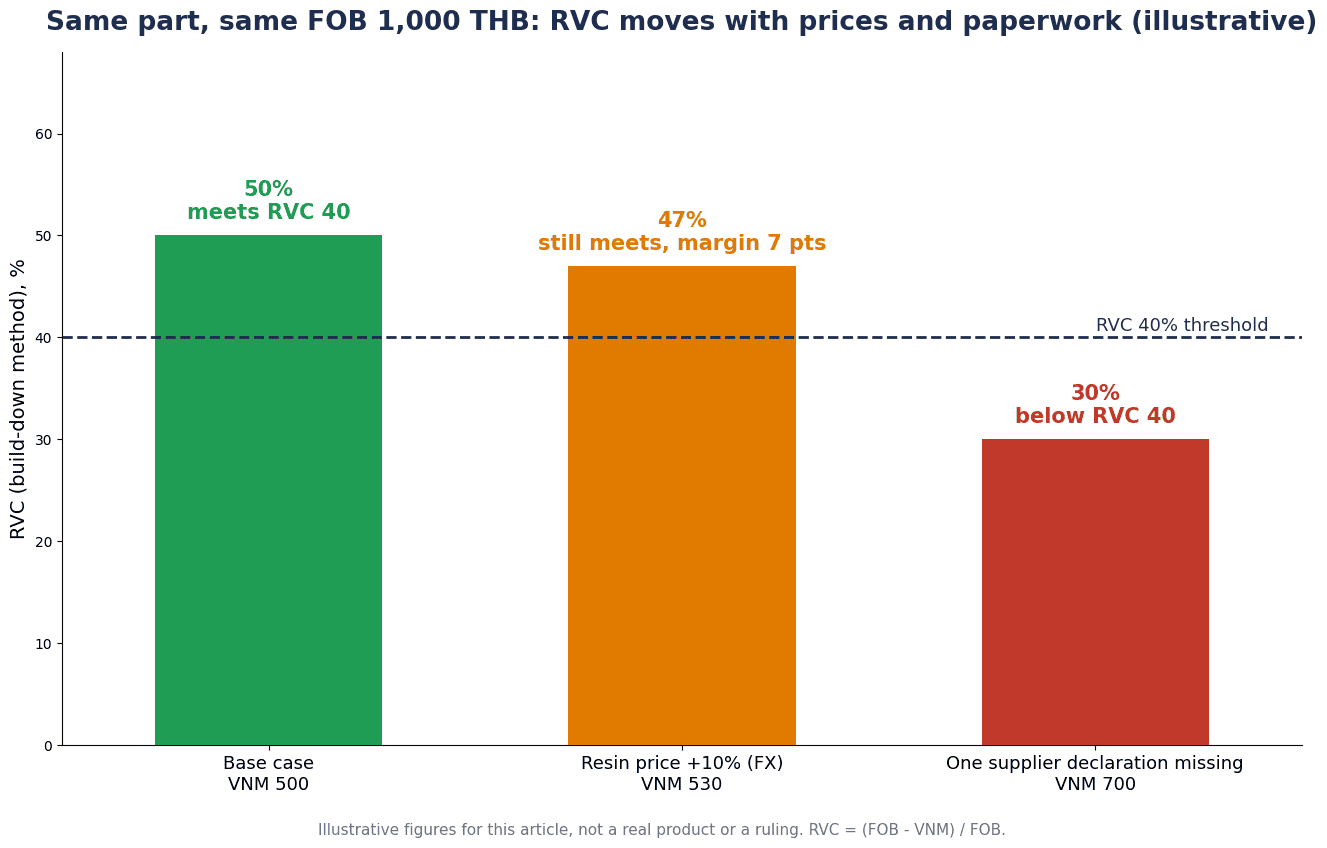
| Case | VNM (baht) | Build-down RVC | Relation to RVC 40% |
|---|---|---|---|
| Base (Calculation A) | 500 | (1,000 − 500) ÷ 1,000 = 50% | Satisfied. Margin of 10 points |
| Sensitivity 1: resin rises 10% in baht terms (CIF 300 → 330), FOB unchanged | 530 | (1,000 − 530) ÷ 1,000 = 47% | Still satisfied, but the margin is 7 points |
| Sensitivity 2: the supplier declaration for domestically procured material of 200 cannot be obtained, so it is treated as non-originating | 700 | (1,000 − 700) ÷ 1,000 = 30% | Not satisfied |
In Sensitivity 1, FOB is held unchanged, so the added 30 baht is absorbed in the calculation as a reduction in profit and the like. A single exchange-rate move reduced the margin from 10 points to 7 points.
Sensitivity 2 is much steeper. Just because a supplier declaration could not be obtained for 200 baht of material that had been counted as originating, RVC drops from 50% to 30% and falls below the threshold. In this case, if the product-specific rule offers a CTC option, the next step is to consider whether CTC can be satisfied instead.
A determination is the numbers on the day it passed. If unit prices, exchange rates or supplier declarations change, the result changes too. The METI document also recommends focusing management on high-priced materials and building up a buffer above the threshold. It also mentions the approach of confirming materials whose originating status is easy to judge first, building up to the threshold, and treating the rest as non-originating, as well as the basis for the value when counting in-house produced items as originating materials (such as the price at which the item is sold on its own to third parties).
Data flow of an origin determination system
Here are the points so far, organized as a system flow.
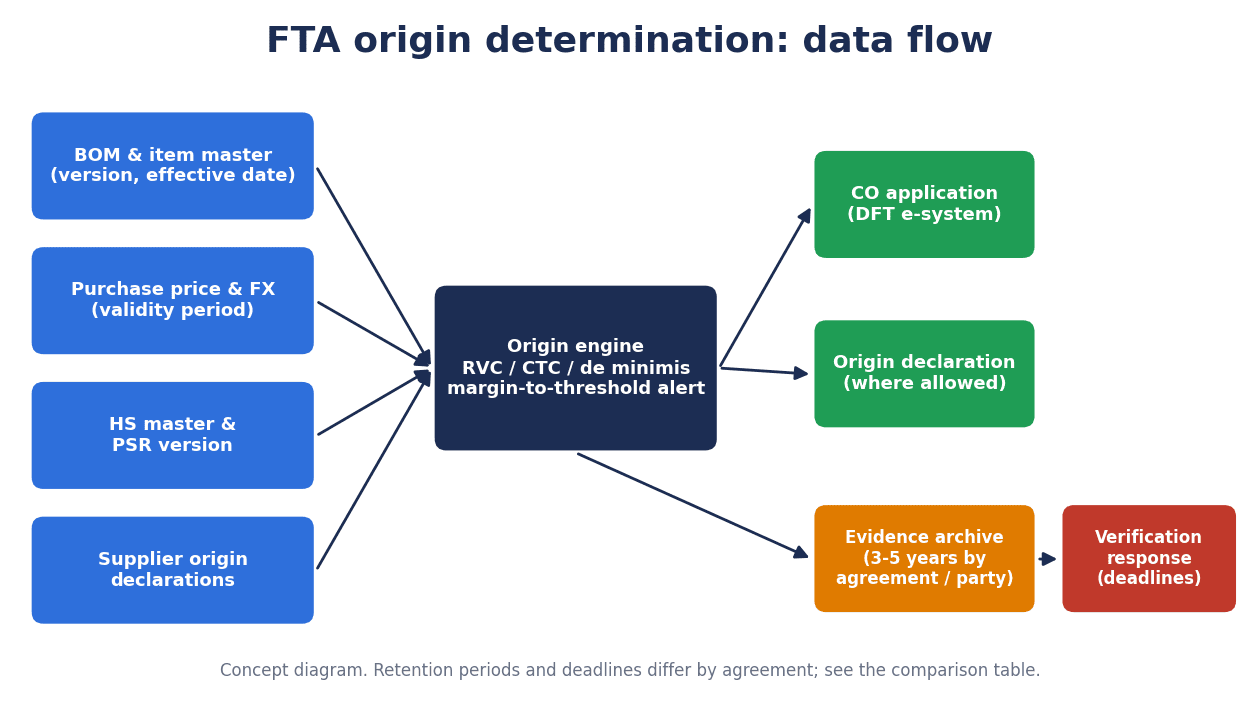
| Stage | Data going in | Key point |
|---|---|---|
| 1. BOM and item master | Finished good part number, BOM version and effective date, HS number for each material (with the number of digits identified) | Link the BOM version to the determination result |
| 2. Purchase prices and exchange rates | Unit price and validity period for each material, CIF value of imported materials, conversion rate | Keep a record of which date and which rate were used for conversion |
| 3. HS master and PSR version | Product-specific rules for each agreement, HS version, effective date | The Japan-Thailand agreement uses the HS2017 version, RCEP uses the HS2022 version |
| 4. Supplier declarations | Origin declarations from each supplier, validity, basis of the declaration | Treat materials without a declaration as non-originating |
| 5. Determination engine | Calculate RVC, CTC and de minimis with each agreement’s formulas | Show the margin to the threshold and warn on items with a small margin |
| 6. CO application and origin declaration | Pass determination results to CO applications in the DFT electronic systems, or to self-declaration documents | Link the application number to the determination version |
| 7. Evidence archive | Snapshot of the BOM, unit prices, exchange rates, declarations and calculation results at the time of determination | Manage retention periods by agreement and by party |
| 8. Verification response | Retrieve the full set of supporting evidence from the CO number | Searchability that allows responses within the deadline |
On the CO application in stage 6, the DFT website lists the following origin-related electronic systems: “DFT SMART C/O,” which issues COs; “ROVERs PLUS,” a paperless origin examination system; “Self-Origin-Certification-SOC” for self-certification; the legacy CO issuance system; and “DFT SMART-I” for user registration. According to press reports, the DFT began issuing e-Form D through DFT SMART C/O from April 28, 2025, and explained that after approval the Form D data is sent electronically to the destination country through the National Single Window (NSW) and the ASEAN Single Window (ASW), so there is no need to print a paper Form D. Over the three years from 2022 to 2024, e-Form D ranked first in the number of applications, averaging about 346,250 per year.
Under the Japan-Thailand agreement too, data exchange in which e-COs issued by the Thai issuing body are received in Japan’s NACCS has been in full operation since June 2, 2025, after a pilot from March 31 to June 1, 2025. Since then, only the e-CO is submitted in Japanese import declarations, and a copy of the e-CO is not required. The Thai issuing body continues to issue paper COs as well.
When COs go electronic, the application itself becomes faster. However, the plant still has to hold the basis for the determination that supports the application. The role of an origin determination system lies in the “determination” before anything is entered on the application screen, and in “retaining and retrieving the evidence” after the application. How to pass data between the production management system and ERP is covered in “ERP–Production Management Integration: Data Contracts, RFP and 90-Day PoC“.
Design points when connecting to production management and ERP
Even if you introduce an origin determination system on its own, if the data fed into it is old, the determinations will be old too. The following points need to be settled first on the production management or ERP side.
BOM version and effective date
Keep each determination linked to “which BOM version it was calculated with.” This prevents a situation where materials changed through a design change but the determination is still based on the old BOM. As a prerequisite for managing BOM versions and effective dates, the item, BOM and routing masters must be in order. How to go about master data cleanup is covered in “Manufacturing Master Data Management: A 90-Day Plan for Items, BOMs and Routings“.
Engineering changes
You need a mechanism that raises a recalculation of the origin determination when materials or suppliers change through an engineering change. For how to connect revision numbers and effective dates of engineering changes between PLM and ERP, see “Implementing Engineering Change PLM–ERP Integration: Revisions, Effectivity and Work in Progress“.
Alternate parts
When there are several alternate parts for the same BOM position, the determination changes depending on which alternate part was used. If parts from a supplier of originating materials and imported alternate parts are mixed, decide whether to run the determination on the least favorable combination or to pull actual usage for each lot. Approval of alternate parts and management of actual usage are covered in “Alternate Part Approval Control: BOM, MRP and Lot Traceability“.
ATIGA Article 37 provides that identical and interchangeable materials (fungible materials) are determined by physical segregation or by an inventory management method recognized in the generally accepted accounting principles of the exporting country, and that an inventory management method once chosen is used throughout the fiscal year. If you handle fungible materials with an inventory management method, your operation must not change that method in the middle of the year.
Unit price validity periods and supplier codes
Hold purchase prices with validity periods, so that the unit price valid on the calculation date of the determination can be retrieved. The supplier code is the key that links to supplier declarations. When the same material is bought from several suppliers, originating or non-originating status may differ by supplier, so manage declarations by the combination of item and supplier. Price management on the purchasing side and the related RFP points are covered in “Purchasing Management System: Thailand RFP Guide“.
How to take the exchange rate
Decide which rate, on which date, is used to convert the CIF value of imported materials into baht, and record it for each determination. Depending on whether you use an internal standard rate or the rate at the time of importation, RVC moves, as in Sensitivity 1 of Calculation A. Which one is appropriate should be decided after checking the agreement and the authority’s practice.
Consistency with costing
The direct labor cost, direct overhead cost and profit used in the RVC calculation must be consistent with manufacturing cost figures. This is because RCEP Article 3.5(2) requires that all costs be recorded and maintained in accordance with generally accepted accounting principles. Costing systems are covered in “Manufacturing Cost Management System 2026: Turn Month-End Cost into Daily Decisions with a 90-Day PoC“.
Functions of commercial trade management systems [vendor claims]
Some commercial ERP and trade management systems include origin determination functions. For example, according to vendor-side materials (SAP PRESS Blog, SAP Learning), Preference Management in SAP Global Trade Services (GTS) transfers a product’s BOM to GTS to perform preference determination, creates draft requests for supplier declarations from purchase orders and goods receipts and sends reminders, and creates declarations for customers from invoices. It presupposes the procurement indicator, prices and preference data in the product master, and the agreement rules (entered manually or uploaded from a data provider).
However, the SAP course material explains these supplier declarations as being based on the wording of Commission Implementing Regulation (EU) 2015/2447. This does not mean RCEP, ATIGA or the Japan-Thailand agreement have a system using the same format. Whether it supports Thai FTAs or DFT applications has also not been confirmed in this article. This is not a recommendation of any specific product; when considering introduction, use the RFP to confirm whether it supports the agreements your company uses and DFT applications.
How to collect supplier declarations (suppliers’ declarations of origin)
Items to have suppliers state
As Sensitivity 2 of Calculation A shows, supplier declarations can decide a determination. The METI document lists the items to be stated in a supplier declaration as: date of preparation, recipient, manufacturer, agreement name, product name (in English), model number and the like, HS code, origin criterion, and place of production. It also mentions setting up a communication arrangement so that information is provided immediately when there is a design or supplier change, and that in verification, the basis of the supplier declaration (comparison tables, calculation worksheets) may also be requested.
What the system should hold is not only whether a declaration exists. Hold as fields which agreement, which item and model number, and which origin criterion the declaration was issued for, and record where the supporting documents are. If you also keep the date the declaration was prepared and the date you were notified of a design or supplier change on the supplier’s side, it becomes easier to explain in verification “whether the declaration was valid at that time.”
Sourcing mix of Japanese-affiliated manufacturers in Thailand
How many counterparties do you need to collect declarations from? According to JETRO’s “FY2025 Survey on Business Conditions of Japanese Companies Overseas (Asia and Oceania)” (Japanese, conducted August to September 2025), the breakdown of sources of raw materials and parts for Japanese-affiliated manufacturers in Thailand (284 valid responses) was local 59.4%, Japan 26.3%, ASEAN 3.4% and China 7.4% (in FY2024: 58.4%, 27.7%, 4.6% and 5.7%). In Thailand, among local sources, Japanese-affiliated companies operating locally outnumber local firms. Across the survey as a whole, the procurement rate from “China” rose in all countries and regions.
Because more than half of procurement is local, whether you can collect origin declarations from suppliers within Thailand greatly affects whether determinations succeed. As in Calculation A, even material bought domestically is treated as non-originating under RCEP if there are no documents.
Collection mechanism
With many suppliers, re-collecting declarations by email and paper becomes a burden every time. If you have a portal that connects ordering and delivery responses with suppliers, requests, collection and deadline management for declarations can be handled through the same window. Portal design is covered in “Implementing a Supplier Portal for Thai Factories: PO Acknowledgment and Delivery Commitments“.
Also keep in mind that ATIGA Article 29(5) provides that materials procured from a domestic licensed manufacturer that complies with the rules of origin are deemed to satisfy the origin requirements. If whether a supplier falls into this category is held as a field in the supplier master, it can be used in determinations.
Preparing for record retention and verification
Retention period quick reference
Record retention periods differ by agreement, by party and by starting date.
| Agreement or scheme | Who | Starting date and period |
|---|---|---|
| RCEP (Agreement Article 3.27) | Exporters, producers, issuing bodies, competent authorities | At least 3 years from the date of issuance of the proof of origin |
| RCEP (Agreement Article 3.27) | Importers | At least 3 years from the date of importation |
| Japan’s RCEP self-declaration (Japan Customs guide) | Japanese exporters and producers that prepared the declaration of origin | 3 years from the date of preparation |
| ATIGA (2009 original OCP and 2020 amended OCP) | Producers and exporters that applied for Form D | Not less than 3 years from the date of issuance of Form D |
| ATIGA AWSC (2020 amended OCP) | Certified exporters (CE) | At least 3 years from the date the origin declaration was made |
| Japan-Thailand agreement (Agreement Article 40(10) and Article 42(b)) | Issuing body (CO records), exporters to whom a CO was issued, and producers under Article 40(7)(b) | 5 years from the date of issuance of the CO |
| Japanese importers (domestic law) | Japanese importers | 5 years from the day after the date of import permission |
| Thailand-EFTA agreement (DFT draft principles) | Exporters making self-certification | Not less than 3 years from the date each declaration was made |
RCEP’s “at least 3 years” is the lower limit under the agreement, and each country’s domestic law may set a longer period. We could not confirm the period under Thai domestic rules in this article, so check with the DFT. The 5 years for Japanese importers is as stated on Japan Customs’ verification page.
In the system, it is safest to give each determination record “which agreement, from whose position, and which starting date,” and retain it for the longest applicable period. For an item shipped under both the Japan-Thailand agreement and RCEP, that means aligning to 5 years.
Verification methods and deadlines
According to RCEP Article 3.24, the competent authority of the importing country may make written requests for additional information to the importer, written requests to the exporter or producer, requests to the issuing body of the exporting country, verification visits to the premises of the exporter or producer (observation of facilities and production processes, and examination of records relating to origin, including accounting records), and so on. A written request must be given a response period of not less than 30 days and not more than 90 days from the date of receipt, and a visit request allows consent or refusal within 30 days from the date of receipt. Preferential treatment may be suspended until the verification result is available, and release may be permitted subject to a security (Article 3.24(6)).
In cases of insufficient information, no response to a written request, or refusal of a visit, the authority may determine that the good is not originating and deny preferential treatment (Article 3.25(3)). On the other hand, minor discrepancies or errors such as typing errors or text extending outside a field are not to be taken into account as long as they do not create doubt about originating status (Article 3.26).
Under the Japan-Thailand agreement, in response to a request from the importing country’s customs, the exporting country’s authority provides information within 3 months of receiving the request, and responds to a request for additional information within 2 months of receipt (Article 43). Under ATIGA, the 2009 original OCP and the 2020 amended OCP provide that the issuing authority examines the producer’s or exporter’s cost statements, responds within 90 days of receiving the request, and completes the whole retroactive check process within 180 days.
According to Japan Customs’ explanation, if originating status cannot be confirmed in verification, application of the preferential rate is denied and, depending on the case, the importer may also be subject to additional tax for underpayment and the like. Where preferential treatment was received through importer self-declaration, the importing country’s customs in principle cannot make requests to or visit the exporter or producer under the agreement, so preferential treatment is denied if the importer cannot prove originating status. In its RCEP Q&A, Japan Customs answered that it conducts verification even for third-party certification, because “there are also cases where certificates of origin are issued for goods without originating status without sufficient examination by the issuing body of the partner country.” The fact that a CO was issued is no reason not to keep the supporting evidence.
What to be ready to produce
Japan Customs’ RCEP self-declaration guide (Japanese, June 2025) gives, as examples of related documents that establish originating status, “a comprehensive parts list or list of materials (including HS numbers), a manufacturing process flow chart, production orders” for CTC, and “manufacturing cost statements, purchase ledgers, vouchers, invoices, payment records, purchase invoices, price lists” for RVC. Examples of documents exporters and producers should retain include a copy of the declaration of origin, a comprehensive parts list that shows compliance with the product-specific rules, a manufacturing process flow chart, and manufacturing cost statements. This explains procedures for importing into Japan, but it gives a guide to the materials requested in verification.
These documents are scattered across the BOM, purchasing and accounting systems. RCEP Article 3.27(2) allows records to be kept in “a medium that allows prompt retrieval,” including digital, electronic, optical, magnetic and written forms. Within a response period of 30 to 90 days, finding a BOM version from years ago, the unit prices and exchange rates at that time, and the supplier declarations is likely to be difficult with paper and personal folders. Taking a snapshot at the time of determination and making it retrievable in one batch from the CO number is a major purpose of systematization.
In addition, if you obtain an answer that the goods are originating through a Japan Customs advance ruling, you can omit submitting the documents that establish origin by stating the ruling number, and the ruling is respected in the examination at the time of import declaration for 3 years after it is issued (for imports into Japan).
Developments on the Thai side: DFT digitalization, stricter examination and self-certification
The spread of DFT SMART C/O
According to press reports, the DFT has issued COs through DFT SMART C/O since December 15, 2023, and as of April 2025 it supported 10 types (Form RCEP, ASEAN-Hong Kong, ASEAN-Japan (AJ), Thailand-Peru, ASEAN-China (Form E), ASEAN-Korea, general C/O, AANZ, Thailand-Japan and Thailand-Australia). Its features are said to include Self-Printing, in which the company prints approved COs itself (forms purchased from the DFT’s sales site), electronic payment, and collection with a single ID card. In a September 2025 report, the DFT Director-General said COs had been issued for 12 types from December 15, 2023 to August 2025, and that AI and OCR would be introduced with full operation planned for September 2025. Whether full operation was achieved has not been confirmed in this article.
In an October 2025 report, the DFT Director-General named responding to the new US rules of origin and preventing origin fraud as urgent priorities for fiscal year 2026 (starting October 1, 2025), and mentioned introducing AI-based examination and accelerating data linkage between government agencies.
Stricter examination of exports to the US is a separate system
On April 22, 2025, an emergency meeting convened by the Thai Prime Minister decided, among other things, to centralize issuance of general (non-preferential) C/Os for monitored goods bound for the US at the DFT, and to carry out detailed factory inspections and strict examination of export documents for high-risk goods. On May 6, 2025, the DFT Director-General said the monitored goods had become 65 items (224 HS codes), with 16 items added to the existing 49, and that C/Os would not be issued if the origin did not meet the requirements or circumvention was found.
This concerns non-preferential C/Os for the US and is a separate system from FTA preferential COs. Still, the direction of reconciling a plant’s actual operations with its documents is shared. A commentary by the law firm Tilleke & Gibbins (not a primary source) also writes that consistency between HS codes, BOM, cost structure and actual processes is needed. The BOM and cost data prepared for preferential origin determination also become a foundation when explaining non-preferential origin.
ATIGA self-certification (AWSC)
In ASEAN, two self-certification pilots (which Thailand joined on October 28, 2011 and May 1, 2015 respectively) were integrated, and with the entry into force of the First Protocol to Amend ATIGA on September 20, 2020, the ASEAN-wide Self-Certification scheme (AWSC) began. Certified exporters (CE) can make an origin declaration on commercial documents instead of Form D. The obligations of a CE include allowing the competent authority access to records and premises, keeping records and books that can confirm originating status for at least 3 years from the date the origin declaration was made, making declarations only for goods for which it holds all appropriate documents proving originating status at the time of making them, and being responsible for all declarations. Under self-certification, the responsibility for holding the basis of determinations in-house becomes even heavier.
The upgraded ATIGA
The Second Protocol to Amend ATIGA (the upgraded ATIGA) was signed in 2025 and is scheduled to enter into force on June 1, 2027. On September 19, 2026, the governments of the 10 ASEAN countries issued a declaration that member states may, voluntarily and on a reciprocal basis, provisionally apply the Second Protocol among themselves pending its entry into force on June 1, 2027 (press reports). Provisional application starts between the countries that have notified the ASEAN Secretary-General, from the date specified in the notification. Whether Thailand has notified has not been confirmed in this article. The reports say that under the upgraded agreement it will become easier to meet the administrative requirements for self-declaration of origin, and that implementation of electronic certificates of origin and acceptance of electronic documents will advance.
On the substance of the upgrade, a JETRO report (Japanese, written in November 2025) lists relaxation of product-specific rules, relaxation of Form D requirements, and the introduction of a post-importation duty refund system, among others. However, the report explicitly states that, because the official full text has not been published, it is based on information sources and analysis. Treat these as settled only after confirming the official full text and DFT notifications. The DFT’s legislation page lists a DFT notification (2026) on CO issuance under ATIGA as in force, but we could not confirm the text of the notification in this article.
Self-certification under the Thailand-EFTA agreement (under public consultation)
The DFT is seeking comments from October 9 to November 7, 2026 on draft principles for self-certification of origin under the Thailand-EFTA Free Trade Agreement. The main points of the document are as follows.
- The Thailand-EFTA agreement (Iceland, Liechtenstein, Norway and Switzerland) was signed on January 23, 2025, and Thailand is targeting entry into force on January 1, 2027 (planned)
- The agreement requires exporters using preferences to self-certify
- There are two types of exporters: approved exporters and general exporters. From January 1, 2027 to December 31, 2036, general exporters are limited to exporting goods with a value of not more than 6,000 euros, and from January 1, 2037 onward the value limit is removed
- Origin declarations are made on invoices or commercial documents (invoices, delivery orders, packing lists and the like)
- Approved exporters must hold an approval number registered with the DFT, and hold evidence of an origin qualification examination received through the DFT electronic system that is within its validity period
- Supporting documents are retained for not less than 3 years from the date each declaration was made
This is still at the draft principles stage, and no notification has been issued. Still, it can be read that the further things move toward self-certification, the more plants will be required to have “a mechanism that can produce the basis for determinations.”
The scale of FTA use and negotiations
On September 3, 2026, the DFT Director-General announced that the value of exports using FTA preferences in January to June 2026 was USD 48,069.03 million (about 1.57 trillion baht), up 7.33% year on year, with a utilization rate of 80.83% of exports eligible for preferences (press reports). By agreement, ATIGA was USD 15,937.55 million (utilization rate 67.50%) and the Japan-Thailand agreement (JTEPA) was USD 3,819.69 million (utilization rate 85.86%), among others. These are statistics on exports from Thailand and are not figures limited to Japanese-affiliated companies. The ATIGA utilization rate is lower than that of the Japan-Thailand agreement, but the announcement does not explain why.
On the negotiation side, the 10th round of Thailand-EU FTA negotiations (September 28 to October 6, 2026, Phuket) made progress on rules of origin and other areas, and the two sides are reported to be aiming to conclude by the end of 2026. In RCEP, it was reported that the 5th Ministerial Meeting in September 2026 decided to set up a working group for the accession procedures of Chile, Bangladesh, Hong Kong and Sri Lanka. The more agreements and partner countries become available, the more you will need to hold determinations under multiple agreements for each item.
8 steps for implementation
Proceeding with the introduction of an origin determination system in the following 8 steps reduces rework.
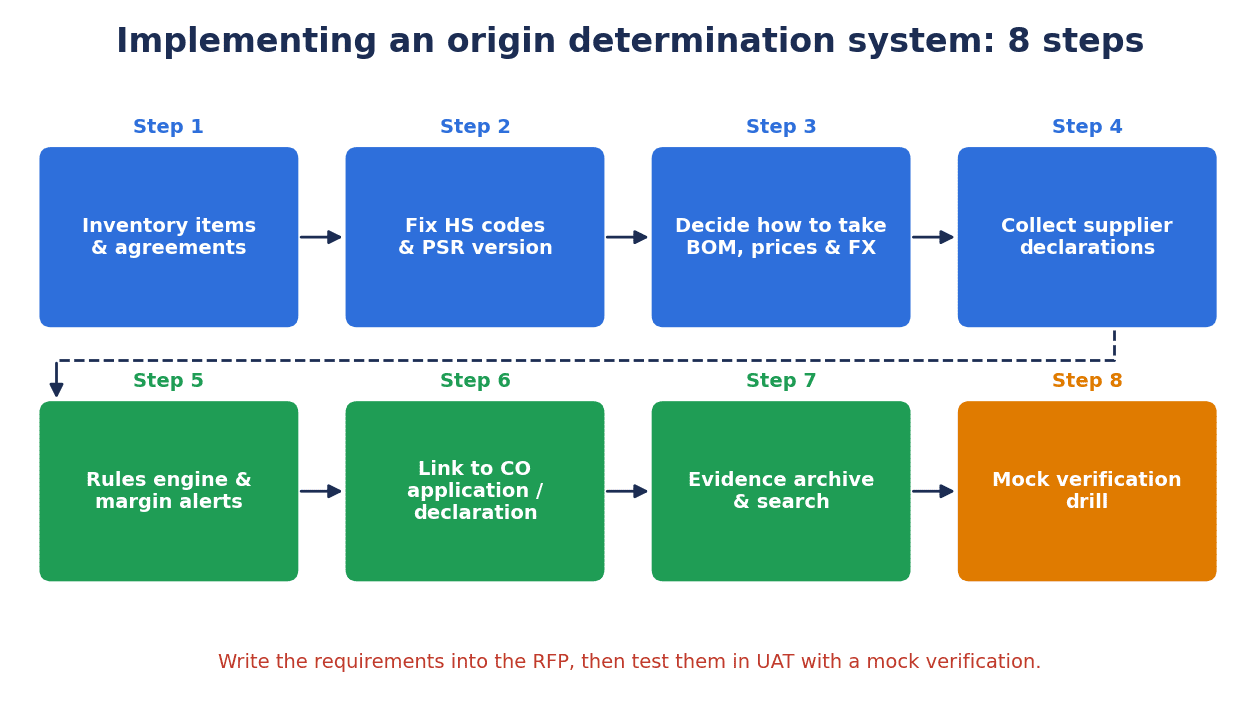
- Inventory target items and agreements: list which part numbers are shipped to which countries under which agreements. Also check whether there are agreements that could be used for items not currently using preferences
- Fix the HS of each item and the version of the product-specific rules: fix the HS of the finished good and look up the product-specific rules and their HS version for each agreement. For items where the HS classification is uncertain, fix it through an advance ruling or similar
- Decide how BOM, unit prices and exchange rates are taken: make it a rule which BOM version, which date’s unit price and which rate are used for calculation
- Collect supplier declarations: collect declarations from suppliers for materials counted as originating. On the premise that materials without a declaration are treated as non-originating, look first at how the determination would change
- Determination logic and threshold-margin alerts: calculate with each agreement’s formulas and warn on items with a small margin to the threshold
- Link with CO applications and self-declarations: link determination results to the application numbers and CO numbers in the DFT electronic systems
- Evidence archive and search: keep the snapshot at the time of determination for the retention periods of each agreement and party, and make it retrievable from the CO number
- Verification drills: randomly select past COs and test whether the full set of supporting evidence can be produced within the deadline
There is no need to cover all items from the start. Starting with items with large preference amounts, items with a small margin to the threshold, and items with many suppliers makes the benefits easier to see.
12 items to include in the RFP
Here are the points so far, summarized as 12 items for the system request for proposal (RFP).
| No. | Item | What to have vendors describe |
|---|---|---|
| 1 | Target agreements and formulas | Whether the usable formulas (build-down and build-up) can be switched for each target agreement, such as RCEP, ATIGA, the Japan-Thailand agreement and the ASEAN-Japan agreement |
| 2 | Value definitions | Whether value definitions for each agreement, such as the CIF value of imported materials, the first price paid for domestic materials, and the CIF value of originating materials under ATIGA, can be held as master data |
| 3 | Product-specific rules and HS version | Product-specific rules for each agreement, HS version and effective date, parallel determination under old and new versions |
| 4 | Depth of material HS | Whether the number of digits to which HS was identified can be held for each material and checked against the depth the rule requires |
| 5 | BOM version and alternate parts | BOM version and effective date, handling of alternate-part combinations, raising re-determination on engineering changes |
| 6 | Unit prices and exchange rates | Unit price validity periods, types and dates of conversion rates, recording of the values used in determination |
| 7 | Supplier declarations | Declaration fields (agreement name, product name, model number, HS, origin criterion, place of production and the like), requests, collection and deadline management, attachment of supporting documents |
| 8 | Determination engine | Calculation of RVC, CTC and de minimis, display of and alerts on margin to the threshold, output of the calculation process |
| 9 | Link with CO applications and self-declarations | How application data is output to the DFT electronic systems, import of CO numbers and application numbers |
| 10 | Evidence archive | Snapshots at the time of determination, management of retention periods by agreement and party, tamper prevention and change history |
| 11 | Search and output | Search by CO number, part number and period, batch output of the full set of evidence for verification |
| 12 | Connection to existing systems and cost breakdown | Which data from production management, ERP, purchasing and costing is linked and how, and a cost breakdown split into licenses, integration development, master data cleanup and maintenance |
Compare prices only after the assumptions in these 12 items are aligned. Costs vary greatly with the number of target items, the number of agreements and the scope of integration with ERP.
Acceptance testing (UAT) checklist
Before accepting the system, check the following items with real data. The last item in particular, “verification simulation,” is the test that confirms the value of the system.
| Item | What to check | Pass criterion (decided internally) |
|---|---|---|
| Reproducing formulas | Whether build-down and build-up results match manual calculation for a known example such as Calculation A | All match |
| Switching agreements | Whether, when determining the same part number under RCEP and the Japan-Thailand agreement, the formula and the version of the product-specific rules switch correctly | Correct formula and version for each agreement |
| Exchange-rate sensitivity | Whether RVC is recalculated and a margin warning appears when the conversion rate is changed | Warning when the margin falls below the set level |
| Missing supplier declaration | Whether, when a declaration’s validity is removed, that material switches to non-originating and the determination is updated | Automatically treated as non-originating |
| Engineering change | Whether raising the BOM version raises recalculation of the related determinations | Raised without omission |
| HS version | Whether, when the version of the product-specific rules is switched, determinations under the old and new versions can be viewed side by side | Both displayed |
| Link with CO | Whether the determination version, BOM, unit prices, exchange rates and declarations can be retrieved from the CO number | All retrievable |
| Retention period | Whether retention deadlines are calculated for each agreement and party, and records are not deleted before the deadline | As per deadline |
| Change history | Whether, when the master is corrected after a determination, the values at the time of determination remain without being overwritten | Values at the time of determination remain |
| Verification simulation | Whether the full set of determination evidence can be produced within the specified time for randomly selected COs | Output within the time decided internally |
If the verification simulation is repeated about once a year after introduction as well, you will notice missing data earlier. Considering that the response period for an RCEP written request is not less than 30 days and not more than 90 days, the internal target will be set much shorter than that.
Model calculation of costs and benefits (hypothetical figures)
From here on, the figures are hypothetical and made up for this article, and are not quotations. They are intended to show how to think about benefits.
Calculation B: the duty difference when preferences can be used
In Japan’s applied tariff schedule (version of August 8, 2026), looking at statistical code 029 (other) under subheading 3926.90 “Other articles of plastics,” the WTO rate is 3.9% and the Japan-Thailand agreement rate is free. In the same schedule, the columns for the ASEAN-Japan agreement and RCEP (ASEAN/Australia/NZ) are also free, and the columns for RCEP (China) and RCEP (Korea) are 1.8%.
- If the dutiable value of a single import is 10 million yen, the duty at the WTO rate is 10 million yen × 3.9% = 390,000 yen. If the Japan-Thailand agreement preference can be used, it is 0 yen
- If annual imports of the same item are 100 million yen (assumed), 100 million yen × 3.9% = 3.9 million yen per year is a rough indication of the duty you would not have to pay if preferences can be used
Consumption tax and the like are separate, and whether your product falls under this statistical code is an individual judgment. This calculation looks only at duties on the Japanese import side. Also, according to Japan Customs’ explanation, if originating status cannot be confirmed in verification, application of the preferential rate is denied and, depending on the case, the importer may also be subject to additional tax for underpayment and the like. The difference is gained only when determinations keep passing with supporting evidence.
Calculation C: man-hours for recalculating determinations
Suppose unit prices and exchange rates are reviewed every quarter and determinations are rerun each time.
- 200 target part numbers, re-determination 4 times a year
- Manual work (re-collecting Excel and paper declarations): 1.5 hours per part number → 200 × 4 × 1.5 = 1,200 hours per year
- After systematization (BOM, unit prices and declarations pulled automatically, only differences checked): 0.25 hours per part number → 200 × 4 × 0.25 = 200 hours per year
- Reduction: 1,200 − 200 = 1,000 hours per year. If labor cost per hour is 400 baht (assumed), 1,000 × 400 = 400,000 baht per year
Man-hours are not the main benefit
The man-hour reduction in Calculation C is an easy figure to grasp, but it is a secondary benefit. The larger benefits are being able to detect a “threshold breach” such as Sensitivity 2 of Calculation A before the application, and being able to answer verification requests within the deadline. The main benefits are the duties in Calculation B and reducing the risk of denial.
Put the other way, for a plant with small preference amounts, few items and almost no BOM changes, a large-scale system may not be needed. Even in that case, keeping snapshots of determinations and making them retrievable from the CO number can be started with Excel and a shared folder.
Frequently asked questions
The answers below are a general overview and not tax, customs or legal advice. Confirm individual shipments with the authorities or through advance rulings.
What is origin determination?
It is checking whether goods qualify as “originating goods” under an agreement in order to use FTA preferential rates. Under RCEP Article 3.2, originating goods are any of wholly obtained goods, goods produced exclusively from originating materials, and goods that satisfy the product-specific rules. For industrial products, you check from the BOM and prices whether the goods satisfy one of the criteria in the product-specific rules: the value-added criterion (RVC), the change in tariff classification criterion (CTC), or the process criterion. Final judgments should be confirmed for each individual shipment by checking with the authorities or through an advance ruling.
How is RVC calculated? (build-down and build-up methods)
Under RCEP, you use either the build-down method, RVC = (FOB − VNM) ÷ FOB × 100, or the build-up method, RVC = (VOM + direct labor cost + direct overhead cost + profit + other costs) ÷ FOB × 100. ATIGA also has two formulas, but originating materials in the build-up method are counted at CIF value, and each member state decides on one method. The Japan-Thailand agreement and the ASEAN-Japan agreement have only the build-down method. Check the formula for each agreement.
What is the change in tariff classification criterion (CTC)?
It is a criterion requiring that the classification change at the prescribed digit level from the HS numbers of non-originating materials to the HS number of the finished good. A change of chapter (2 digits) is CC, of heading (4 digits) CTH, and of subheading (6 digits) CTSH. According to Japan Customs’ explanation, the HS of materials does not necessarily need to be identified to 6 digits, and depending on the rule, 2 or 4 digits may be enough.
What documents are needed to apply for Form D?
We have not been able to confirm in this article an official list of required documents set by the DFT. The DFT electronic systems include DFT SMART-I for user registration, and COs are issued through DFT SMART C/O. For reference, Japan Customs’ RCEP self-declaration guide gives, as examples of related documents that establish originating status, a list of materials (including HS numbers) and a manufacturing process flow chart for CTC, and manufacturing cost statements, purchase invoices and price lists for RVC. The METI document sets out the items to be stated in supplier declarations. Both are Japanese-side documents, so confirm the actual application documents with the DFT.
Is self-declaration acceptable for RCEP proof of origin?
As of March 2026, for RCEP imports from Thailand into Japan, self-declaration by Thai exporters and producers cannot be used. Japan Customs’ Q&A (as of March 12, 2026) states that self-declaration by exporters and producers can currently be used only for imports from Australia, NZ and Korea. For imports from Thailand, what can be used is third-party certification (a CO from the Thai issuing body), an origin declaration by an approved exporter, and self-declaration by the Japanese importer. With importer self-declaration, preferential treatment is denied if the importer cannot prove originating status.
How many years must origin records be kept?
It differs by agreement and position. Under the RCEP Agreement, exporters and producers keep records for at least 3 years from the date of issuance of the proof of origin, and importers for at least 3 years from the date of importation. Under ATIGA, producers and exporters that applied for Form D keep them for not less than 3 years from the date of issuance of Form D (2020 amended OCP). Under the Japan-Thailand agreement, exporters to whom a CO was issued and producers under Article 40(7)(b) keep them for 5 years from the date of issuance of the CO. Japanese importers keep them for 5 years from the day after the date of import permission under domestic law. For items shipped under multiple agreements, aligning to the longest period is the safe approach.
How much does an origin determination system cost?
In this research, we could not confirm any published prices. Costs vary greatly with the number of target items, the number of agreements, the scope of integration with production management, ERP, purchasing and costing, and the amount of master data cleanup. Align the assumptions with the 12 RFP items and have vendors provide a breakdown split into licenses, integration development, master data cleanup and maintenance.
Summary
- Origin determination is not “finished once it passes.” It is data management whose result changes every time the BOM, unit prices, exchange rates, supplier declarations or the HS version move
- Formulas differ by agreement. RCEP and ATIGA have two formulas; the Japan-Thailand agreement and the ASEAN-Japan agreement have only the build-down method. The ATIGA build-up method counts originating materials at CIF value, and each member state decides on one method
- The HS of the product-specific rules is HS2022 for RCEP and HS2017 for the Japan-Thailand agreement. The ASEAN-Japan agreement is scheduled to apply the HS2022 version from February 15, 2027, and the next HS amendment is HS2028 (scheduled to enter into force on January 1, 2028)
- In the hypothetical calculation, a part with RVC of 50% falls to 47% (still satisfied) with an exchange-rate move, and to 30% (below the 40% threshold) with a missing supplier declaration. Under RCEP, materials of unknown origin are treated as non-originating
- Retention periods are a minimum of 3 years under the RCEP Agreement, 5 years under the Japan-Thailand agreement, and 5 years for Japanese importers. The starting date also differs by agreement and position
- Verification has deadlines. An RCEP written request is not less than 30 days and not more than 90 days, the Japan-Thailand agreement is within 3 months, and ATIGA under the 2020 amended OCP is a response within 90 days and the whole process within 180 days
- On the Thai side, digitalization is advancing with DFT SMART C/O, e-Form D and the Japan-Thailand e-CO; the draft principles for self-certification under the Thailand-EFTA agreement are open for comments until November 7, 2026; and the upgraded ATIGA is scheduled to enter into force on June 1, 2027
- Align the assumptions with the 12 RFP items, and in acceptance testing, simulate whether the full set of evidence for randomly selected COs can be produced within the deadline
- This article is not tax, customs or legal advice. Originating status, HS classification and tariff rates should be confirmed for each individual shipment by checking with the authorities or through an advance ruling
TOMAS TECH supports Japanese-affiliated plants in Thailand with data preparation and system integration for production management, ERP and purchasing. You are welcome to consult us when you are considering how to connect an origin determination mechanism to your BOM and purchasing data, or when you are just starting to draft an RFP. Note that customs and tax judgments themselves, such as originating status, HS classification and tariff rates, should be confirmed with the authorities or specialists. Please contact us here.
References
- Japan Customs, For First-Time Users of the RCEP Agreement (Imports) (Japanese): https://www.customs.go.jp/roo/origin/rcep.html
- Japan Customs, Condition 2: Goods Produced in RCEP Parties Must Be Recognized as Originating Goods under the RCEP Agreement (Japanese): https://www.customs.go.jp/roo/origin/rcep2.html
- Japan Customs, RCEP Agreement (Japanese): https://www.customs.go.jp/roo/information/rcep.htm
- RCEP Agreement, Chapter 3 Rules of Origin (Japanese text, published by Japan Customs): https://www.customs.go.jp/roo/information/rcep/rcep2.pdf
- RCEP Agreement, Annex 3A Product-Specific Rules (HS2022, published by Japan Customs): https://www.customs.go.jp/roo/information/rcep/PSR.pdf
- Japan Customs, RCEP Agreement: Proof of Origin Procedures for Imports into Japan (Japanese): https://www.customs.go.jp/roo/information/rcep/syoumei_tetsuzuki.pdf
- Customs and Tariff Bureau, Ministry of Finance and Japan Customs, Guide to Using the Self-Declaration System: RCEP Agreement (Japanese, June 2025): https://www.customs.go.jp/roo/procedure/riyou_rcep.pdf
- Japan Customs, RCEP Agreement Follow-up Seminar Q&A (Japanese, as of March 12, 2026): https://www.customs.go.jp/kyotsu/kokusai/news/rcep/260128_siryou_info_rcep3.pdf
- Japan Customs, Verification (Japanese): https://www.customs.go.jp/roo/verification/index.htm
- Japan Customs, Data Exchange of Certificates of Origin (Japanese): https://www.customs.go.jp/roo/procedure/data/news.html
- Japan Customs, Change of Format of Certificates of Origin under the Japan-Thailand Agreement (Japanese): https://www.customs.go.jp/roo/procedure/kisai/thailandco.html
- Japan Customs, Japan-Thailand Economic Partnership Agreement (Japanese): https://www.customs.go.jp/roo/information/thailand.htm
- Japan-Thailand Economic Partnership Agreement, main text (excerpt, published by Japan Customs): https://www.customs.go.jp/roo/text/thailand2.pdf
- Japan-Thailand Economic Partnership Agreement, Annex 2 Product-Specific Rules (from January 1, 2022, published by Japan Customs): https://www.customs.go.jp/roo/text/thailand3-2.pdf
- ASEAN-Japan Comprehensive Economic Partnership Agreement, main text (excerpt, published by Japan Customs): https://www.customs.go.jp/roo/text/asean2.pdf
- ASEAN-Japan Comprehensive Economic Partnership Agreement, Annex 2 Product-Specific Rules (from February 15, 2027, published by Japan Customs): https://www.customs.go.jp/roo/text/asean3-2.pdf
- Japan Customs, List of Agreement Texts (Japanese): https://www.customs.go.jp/roo/text/index.htm
- Japan Customs, Statistical Schedule for Imports (Applied Tariff Schedule), Chapter 39 (version of August 8, 2026): https://www.customs.go.jp/tariff/2026_08_08/data/j_39.htm
- METI, Basic Approach to Determining Originating Status and Examples of Records to Be Kept (Japanese, revised June 2025): https://www.meti.go.jp/policy/external_economy/trade_control/boekikanri/download/gensanchi/roo_guideline_preservation.pdf
- ASEAN Secretariat, ASEAN Trade in Goods Agreement: https://asean.org/wp-content/uploads/2021/08/ASEAN-Trade-in-Goods-Agreement.pdf
- ASEAN Secretariat, ASEAN-wide Self-Certification (AWSC) Guidebook: https://asean.org/wp-content/uploads/2021/09/ASEAN-wide-Self-Certification-Guidebook-web.pdf
- Centre for International Law, NUS, 2025 Second Protocol to Amend the ASEAN Trade in Goods Agreement (Unofficial Text): https://cil.nus.edu.sg/wp-content/uploads/2026/04/2025-2nd-Protocol-to-Amend-ATIGA.pdf
- JETRO, Modernizing the ASEAN Trade Framework: Upgraded ATIGA Signed (Japanese): https://www.jetro.go.jp/ext_images/world/asia/asean/basic_01/pdf/1_rpATIGA202510.pdf
- The Star, Asean adopts voluntary early application of upgraded Atiga (September 20, 2026): https://www.thestar.com.my/aseanplus/aseanplus-news/2026/09/20/asean-adopts-voluntary-early-application-of-upgraded-atiga
- Bernama (provisional application of the upgraded ATIGA): https://bernama.com/en/world/news.php?id=2609375
- WCO, HS 2028 Amendments – Adapting the Harmonized System to Global Priorities and Trade Evolution: https://www.wcoomd.org/en/media/newsroom/2026/january/hs-2028-amendments-adapting-the-harmonized-system-to-global-priorities-and-trade-evolution.aspx
- DFT (Department of Foreign Trade, Ministry of Commerce of Thailand): https://www.dft.go.th/
- DFT ROVERs PLUS: https://roversplus.dft.go.th/public/
- DFT, Public Consultation on the Principles of Self-Certification of Origin under the Thailand-EFTA FTA (Thai): https://www.dft.go.th/th-th/กฎหมาย/ขอเชิญร่วมแสดงความคิดเห็นต่อหลักการรับรองถิ่นกำเนิดสินค้าด้วยตนเอง
- Daily News (DFT SMART C/O and e-Form D, April 17, 2025): https://www.dailynews.co.th/news/4614939/
- Thansettakij (DFT SMART C/O, September 5, 2025): https://www.thansettakij.com/economy/trade-agriculture/638071
- Thansettakij (four measures on exports to the US, April 22, 2025): https://www.thansettakij.com/economy/trade-agriculture/625688
- InfoQuest (65 monitored items, May 6, 2025): https://www.infoquest.co.th/?p=492528
- Daily News (DFT priorities for FY2026, October 5, 2025): https://www.dailynews.co.th/news/5175220/
- Bangkok Biz News (FTA use in January to June 2026): https://www.bangkokbiznews.com/news/news-update/1250389
- Thansettakij (FTA use in January to June 2026): https://www.thansettakij.com/economy/trade-agriculture/668070
- Naewna (FTA use in January to June 2026): https://www.naewna.com/n/?p=41424
- JETRO, FY2025 Survey on Business Conditions of Japanese Companies Overseas, Asia and Oceania (Japanese): https://www.jetro.go.jp/ext_images/_Reports/01/231fa237934b5b0c/20250026rev1.pdf
- Pattaya Mail, Thailand and EU aim to finish free trade talks by end of 2026: https://www.pattayamail.com/thailandnews/thailand-and-eu-aim-to-finish-free-trade-talks-by-end-of-2026-567615
- China Daily HK, HK welcomes creation of working group for RCEP accession: https://www.chinadailyhk.com/article/639967
- SAP PRESS Blog, Trade Preference Reporting in SAP GTS (vendor-side material): https://blog.sap-press.com/trade-preference-reporting-in-sap-gts
- SAP Learning, Setting Up Supplier’s Declaration Management (vendor-side material): https://learning.sap.com/courses/configuring-the-essential-functions-of-sap-global-trade-services/setting-up-supplier-s-declaration-management_ce881303-d03e-4566-bf85-52d4566dd81e
- Tilleke & Gibbins, Thailand’s US and EU Export Outlook for 2026 (law firm commentary): https://www.tilleke.com/insights/thailands-us-and-eu-export-outlook-for-2026-transshipment-origin-risks-and-enforcement/


