


The hardest part of manufacturing master data management is not deleting old item codes. It is deciding which system is authoritative for each attribute, who may request a change, who approves it, and when an approved version is distributed to ERP, MES and other consuming systems. If those decisions remain unclear, a data-cleansing exercise only creates a short-lived snapshot. Differences soon return in spreadsheets, shop-floor terminals, ERP and MES.
This guide focuses a manufacturing MDM implementation on five controls: system of record, data ownership, change workflow, distribution and acceptance. It explains how to bring one product family and one production line into governed operation in 90 days. The scope is deliberately narrower than a general system migration or MOM selection project; the subject is the trusted data flow needed to execute manufacturing safely.
What manufacturing master data management actually governs
Master data is relatively stable reference data used by many transactions and execution records. In a factory, a production order becomes executable only when item definitions, product structure, operation sequence, work location, equipment capability and supplier conditions work together. Master Data Management is therefore not synonymous with building one giant database. It is the business capability for managing meaning, accountability, lifecycle and exchange across systems.
Start by separating five domains.
| Domain | Typical attributes | Main uses | Common inconsistency |
|---|---|---|---|
| Item master | item ID, description, unit, lot policy, revision, status | purchasing, inventory, planning, production, quality | duplicate IDs, incompatible units, obsolete items still selectable |
| BOM master | parent, component, quantity, substitute, effectivity, revision | MRP, issue, assembly, costing | EBOM and MBOM confused, conflicting effectivity |
| Routing master | operation sequence, standard time, work center, inspection point, version | capacity planning, work instruction, reporting | skipped operations, old version, invalid resource |
| Asset/work-center master | plant, line, work center, equipment, capacity, status | scheduling, MES execution, maintenance | code does not match physical asset, retired equipment remains available |
| Supplier master | legal entity, site, purchasing organization, payment, approval status | sourcing, receiving, quality, traceability | legal entity and site duplicated, orders sent to an unapproved source |
These domains are inseparable at execution time. Changing an item’s base unit can affect BOM quantities, purchasing conversion, MES consumption and label content. Changing a routing work center changes both capacity planning and the work queue shown on a terminal. Item master management must therefore treat dependencies as part of the change, rather than stopping at a departmental spreadsheet.
Decide the system of record by domain and attribute
A System of Record (SoR) is the source regarded as authoritative when records conflict. A frequent mistake is to declare in one sentence that “ERP owns everything.” ERP may be authoritative for items and purchasing suppliers while PLM owns engineering revisions, MES or EAM owns the current asset state, and MES owns work in process.
SAP’s manufacturing integration guidance provides a concrete example: SAP S/4HANA or ERP is the system of record for master data, SAP Digital Manufacturing is the system of record for WIP, and materials, BOMs, routings and work centers can be transferred from ERP to manufacturing execution. This is useful evidence for one integration pattern, not a universal rule. Build an attribute-level decision table for your own landscape.
| Data or attribute | Authoring system | System of Record | Consumers | Conflict rule | Owner |
|---|---|---|---|---|---|
| Item ID and base unit | ERP | ERP | MES, WMS, QMS | approved ERP version | production planning |
| Engineering BOM and revision | PLM | PLM | ERP | effective PLM version | engineering |
| Manufacturing BOM and substitute | ERP | ERP | MES | effective ERP version | manufacturing engineering |
| Routing and standard time | ERP or PLM | one agreed source | MES, planning | version plus effectivity | manufacturing engineering |
| Equipment execution state | MES/EAM | MES/EAM | planning, analytics | latest governed shop-floor state | production/maintenance |
| Supplier approval status | QMS or ERP | one agreed source | ERP, procurement | approval workflow outcome | quality/procurement |
Distinguish the authoring system from the system of record. A request can start in an MDM portal while the activated record lives in ERP. Conversely, being able to view an attribute in ERP does not mean users may edit it there. Document four locations separately: entry point, pre-approval staging, activated authoritative record and distribution target.
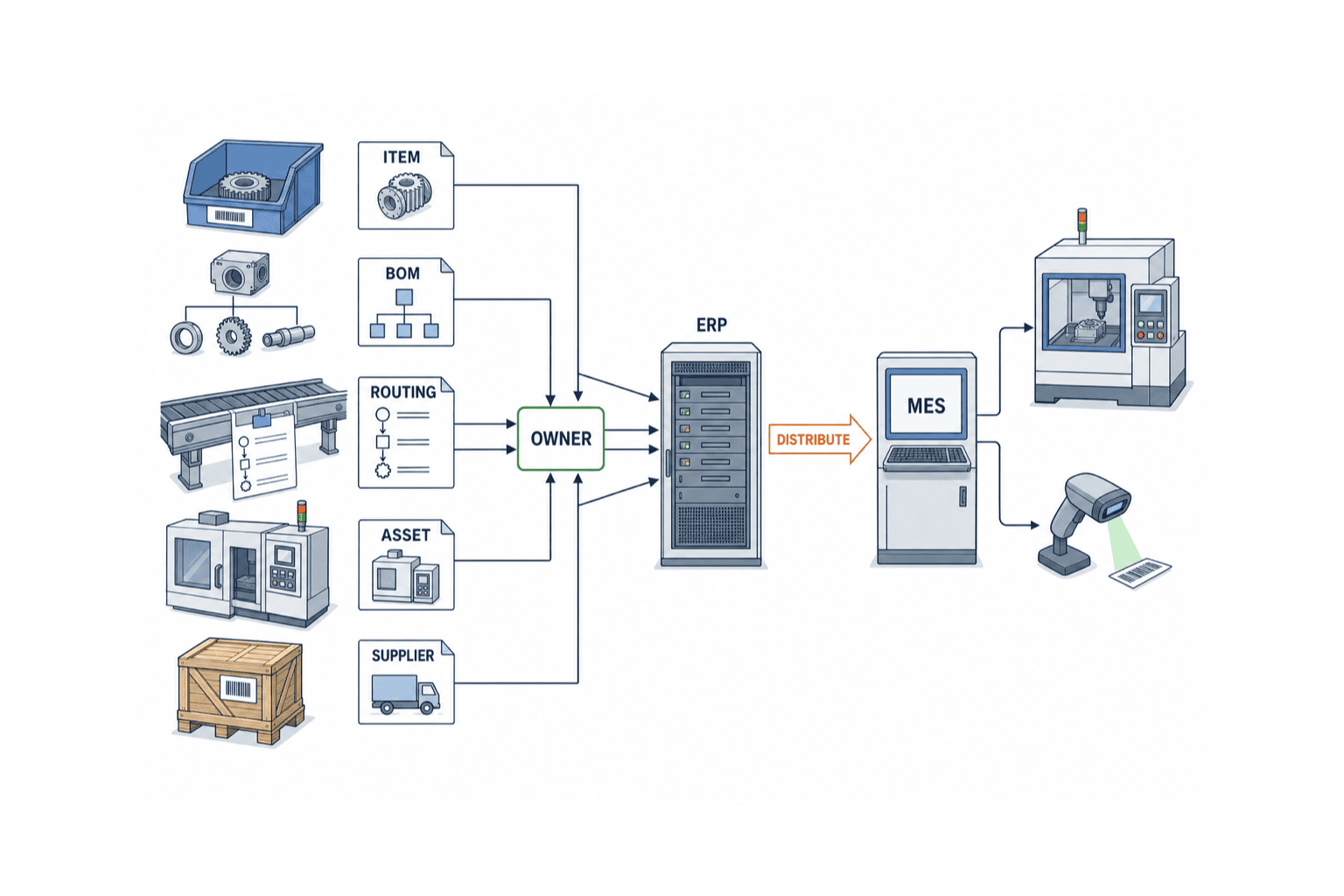
ISA-95 offers a common model for information exchange between enterprise/logistics activities and manufacturing control. Part 2 addresses interface content between Level 3 manufacturing systems and Level 4 business systems. Part 7 addresses mappings of equivalent identifiers, or aliases, and their context across domains. If ERP work center WC-100 and MES resource LINE-A01 identify the same physical unit, the practical answer may be a governed alias with plant and effective dates rather than forcing every system to use one string. Ownership and namespace lifecycle still have to be governed by the enterprise.
Manage the item lifecycle before redesigning the code
Replacing every item code at once can break references in history, drawings, supplier labels, inventory and service parts. First define what makes two records the same item and what lifecycle transitions are allowed.
Useful business states include Draft, Review, Active, Phase-out, Blocked and Obsolete. Do not delete an active item immediately. Separate the permissions to purchase, manufacture, consume existing stock and support installed products. Also decide which attributes may be revised and which changes require a new item. A material or dimension change that destroys interchangeability may require a new identity.
Duplicate prevention should search more than exact descriptions:
- normalized manufacturer part number;
- base unit and conversion factors;
- defining specifications such as material, dimension, rating and grade;
- known supplier item numbers;
- legacy IDs, aliases and plant-local codes.
When candidates are found, a steward should determine equivalence and preserve the reasoning and reference redirects. Manufacturing contains many parts that appear similar but are not safely interchangeable.
The GS1 Global Data Model defines a consistent set of foundational product attributes across listing, ordering, moving, storing, selling and discontinuing a product. It is a useful reference for product information exchanged with trading partners. It does not, by itself, define every manufacturing BOM or routing attribute. Apply common vocabulary to the exchange scope while keeping internal manufacturing semantics explicit.
BOM master management must state the BOM type and effectivity
The risk in BOM management is checking only whether every component appears in a list. Engineering BOMs, manufacturing BOMs, service BOMs and order-specific BOMs serve different purposes. Combining them without transformation rules and owners can produce a structure that is correct for design but impossible to build.
A BOM header should identify the parent item, plant, usage, alternative, revision, status and effective-from/to dates. Lines should identify the component, quantity, unit, yield or scrap condition, substitute group, supply type and operation assignment. Automate at least these checks:
- Parent and components are effective for the intended plant and usage.
- Component units are convertible using an approved conversion.
- There is no circular reference and required lower-level BOMs are effective.
- No two versions conflict for the same plant, usage and period.
- Every assigned operation exists in the applicable routing.
SAP’s official integration guidance says a BOM in ERP or S/4HANA can be transferred to SAP Digital Manufacturing to create or update the corresponding record. It also exposes sequence dependencies, including the need for materials to exist before dependent structures are transferred. The broader lesson is to distribute a dependency graph, not copy isolated files. Publish item, BOM, routing and work-center records in an order the receiving application can accept.
Routing master data includes execution conditions
A routing is more than an ordered list of operation numbers. It defines where work can run, which instruction version applies, which inspection gates are required and which actuals must be collected.
| Element | What to verify | Consequence of bad data |
|---|---|---|
| Sequence and branches | normal, parallel, rework and subcontract paths | blocked flow or skipped operation |
| Work center and alternatives | qualified resource, capability and authorization | dispatch to a nonexistent or unqualified asset |
| Standard time | setup, run, queue and move definitions | distorted capacity and cost |
| BOM allocation | component consumption by operation | wrong material issue or missing traceability |
| Inspection point | characteristic, limit, decision and reaction | defect passed downstream |
| Work instruction | document ID, revision, language and effectivity | old or wrong-language instruction shown |
Multi-site organizations must balance a global standard routing with plant variation. Copying a full routing for every plant isolates later improvements. One universal record, however, may ignore equipment and regulatory differences. A practical design uses a global template, controlled local attributes and an approved exception layer.
Connect the physical asset hierarchy to system aliases
The equipment domain is not a copy of the fixed-asset ledger. Manufacturing execution needs a hierarchy of plant, area, line, work center, equipment and tool, along with capability, status, eligible items and maintenance constraints. The same physical object may be called a work center in ERP, a resource in MES, equipment in EAM and a tag in a controller, so alias mapping is essential.
SAP’s work-center integration documentation describes updates flowing from ERP/S/4HANA to Digital Manufacturing and warns that downstream additions that do not exist in the upstream system can be deleted by a later update. A direct shop-floor fix may therefore disappear at the next synchronization. The operating procedure must say where a correction belongs and how a temporary emergency difference is reconciled into the authoritative source.
Define equipment states such as Commissioning, Available, Restricted, Maintenance and Retired, along with who can change them and how planning, MES and maintenance receive the state. Retired assets should remain referentially available to historical records while being blocked from new assignment.
Separate supplier legal entity, site, capability and approval
Supplier duplication is not merely inconsistent spelling. A legal entity may operate several plants, payment locations, ship-from points and quality approvals. Model legal entity, site, purchasing relationship, payee and manufacturer as separate but related entities.
Route financial attributes such as bank and payment terms, quality attributes such as approval scope, and sourcing attributes such as lead time through different approvers. One approver for every attribute weakens segregation of duties and expertise. Sending every small change to a large committee creates delay. Classify attribute groups by risk: streamline low-risk corrections and require stronger approval for high-risk changes.
Do not confuse owner, steward and system administrator
“IT owns the master” is too vague. IT can operate access, integration and recovery, but it cannot alone judge whether a material, substitute, standard time or supplier certification is correct.
| Role | Main accountability | What the role should not do |
|---|---|---|
| Data Owner | definition, quality objective, approval authority, exception decision | key every record personally |
| Data Steward | daily review, duplicate assessment, quality monitoring, user support | change business policy unilaterally |
| Custodian/IT | access, storage, integration, monitoring, recovery | decide final business meaning |
| Requester | submit a justified create/change request | use unapproved data in production |
| Approver | assess risk and evidence, approve or reject | self-approve as the requester |
| Consumer Owner | downstream acceptance and impact confirmation | silently repair distribution failures downstream |
Extend the RACI to important attribute groups. Production planning may own a description, EHS a hazardous-material classification and Quality an inspection specification. Approval routing should follow data risk, not simply the organization chart.
Control change through REQUEST, CHECK, APPROVE and PUBLISH
SAP S/4HANA MDG Classic Mode provides change-request processing with integrated workflow, staging, approval, activation and distribution. Across vendor platforms, the same control can be expressed as four stages: REQUEST → CHECK → APPROVE → PUBLISH.
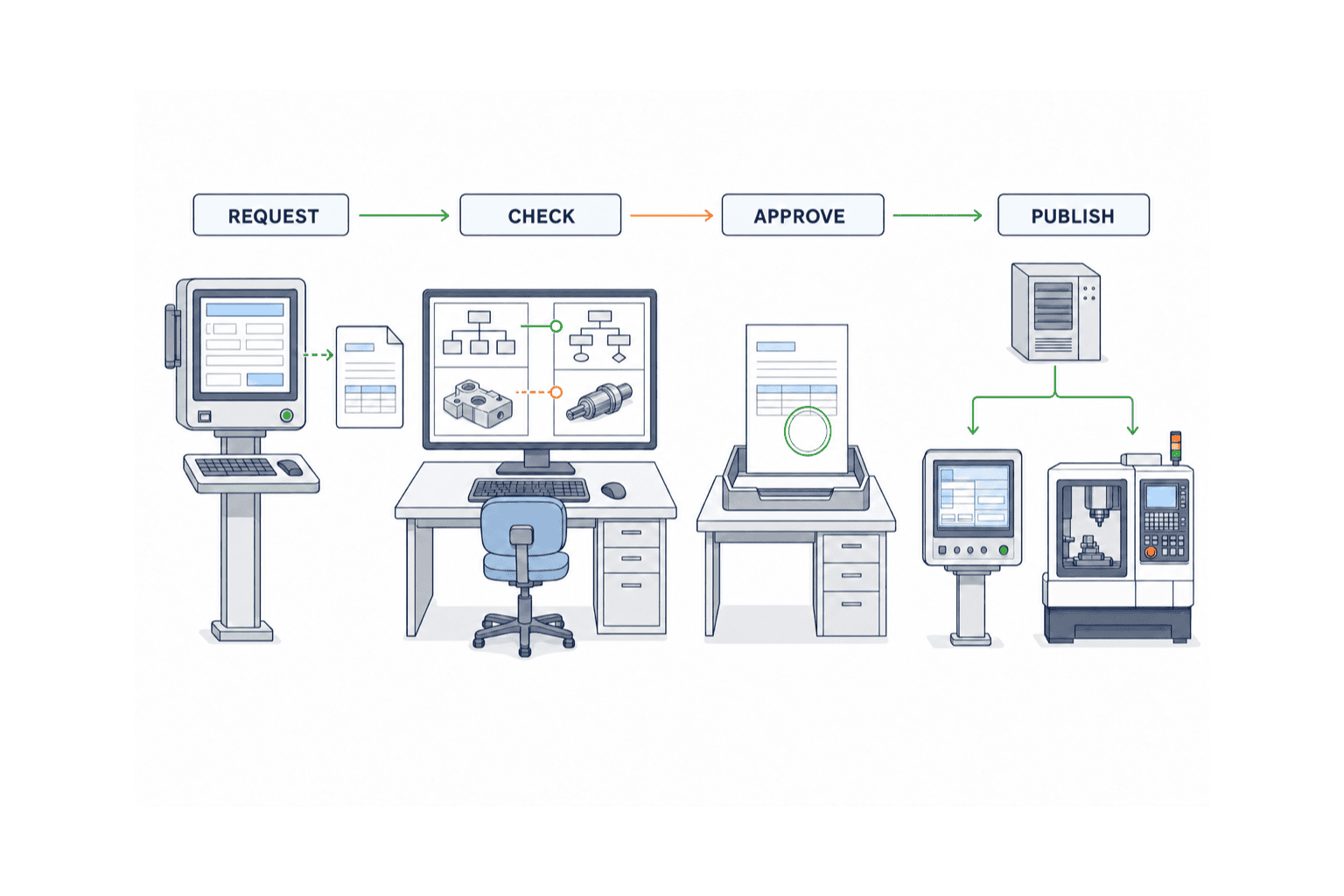
REQUEST: include reason and impact
Capture old and new values, reason, plants, desired effectivity, related drawing or specification, affected BOM/routing/inventory and urgency. Do not accept an email body as the permanent record; issue a request ID. Emergency change needs a shorter governed path, not an undocumented bypass.
CHECK: separate machine and business validation
Machine checks cover required fields, formats, code lists, duplicate candidates, referential integrity, cycles and overlapping effectivity. Business checks cover interchangeability, inventory disposition, quality approval, safety, cost and customer authorization. Distinguish an error that prevents release from a warning that may proceed with recorded justification.
APPROVE: route by attribute risk
A spelling correction should not follow the same path as a base-unit or BOM-quantity change. Attributes affecting money, quality, safety, compliance or traceability require the right cross-functional decisions. Preserve delegation, deadline, escalation and rejection reasons as audit evidence.
PUBLISH: record activation and distribution separately
Activate the approved version in the authoritative source, then distribute it. Successful activation does not mean every consumer received the record. Store message ID, data version, sent and received time, retry count and receiver result. Failed messages belong in a governed retry or quarantine queue, not an invisible manual override.
Define distribution as a data contract
An integration specification needs more than an API endpoint. Define:
- business meaning, type, unit and code list for each object and attribute;
- key, alias and context such as plant and organization;
- revision, effectivity, time zone and representation of disablement;
- snapshot versus delta, sequence, retry and idempotency;
- acknowledgement, error classes, reprocessing and quarantine;
- compatibility, schema-change notice and transition period;
- authorization for personal, financial or export-controlled attributes.
A nightly CSV requires the same discipline: filename, encoding, delimiter, header, null, cancellation, due time and resend method. Replacing a file with a real-time API does not fix uncertain meaning or ownership.
Sequence dependencies matter. If a new product’s component items and work centers do not yet exist in MES, sending only its BOM and routing will fail. Treat a release as a bundle, distribute in dependency order and do not mark it executable until all required acknowledgements arrive.
Make data quality measurable
ISO 8000-8:2015 describes fundamental concepts of information and data quality and prerequisites for measurement in quality-management processes. ISO reports that the standard was reviewed and confirmed in 2022. Its public overview does not prescribe a universal pass percentage for factory masters. Each organization must agree the use case, population, timing, denominator and threshold.
| Acceptance metric | Formula | Control note |
|---|---|---|
| Required-attribute completeness | records with all required attributes ÷ in-scope records × 100 | define “required” by use case |
| Uniqueness | unique records after candidate review ÷ in-scope records × 100 | preserve steward decisions |
| Referential integrity | child records with a valid parent ÷ in-scope child records × 100 | apply to BOM, routing and assets |
| First-pass distribution success | messages acknowledged without retry ÷ all messages × 100 | separate business and transport error |
| Change lead time | publish timestamp − request receipt timestamp | report normal and emergency separately |
| On-time decision rate | requests approved or rejected within SLA ÷ due requests × 100 | include both approval and rejection |
| Physical match rate | samples matching the physical observation ÷ inspected samples × 100 | fix the sampling protocol |
When the denominator is zero, report N/A rather than 0%. Zero means every case failed, whereas N/A means there was no applicable population. Keep drill-down from the aggregate to each discrepancy.
GS1 presents its Data Quality Framework as a collaborative best-practice guide containing a data-quality management system, self-assessment tools and a procedure for physical validation of product attributes. The manufacturing lesson is to compare records not only with another screen, but also with sampled part labels, pack quantities, equipment capability and the actual work location.
A 90-day manufacturing MDM implementation
The 90-day plan is not a promise to finish every plant and item. It is a prescriptive pilot for one product family, one plant and one line, built to prove an operational pattern.
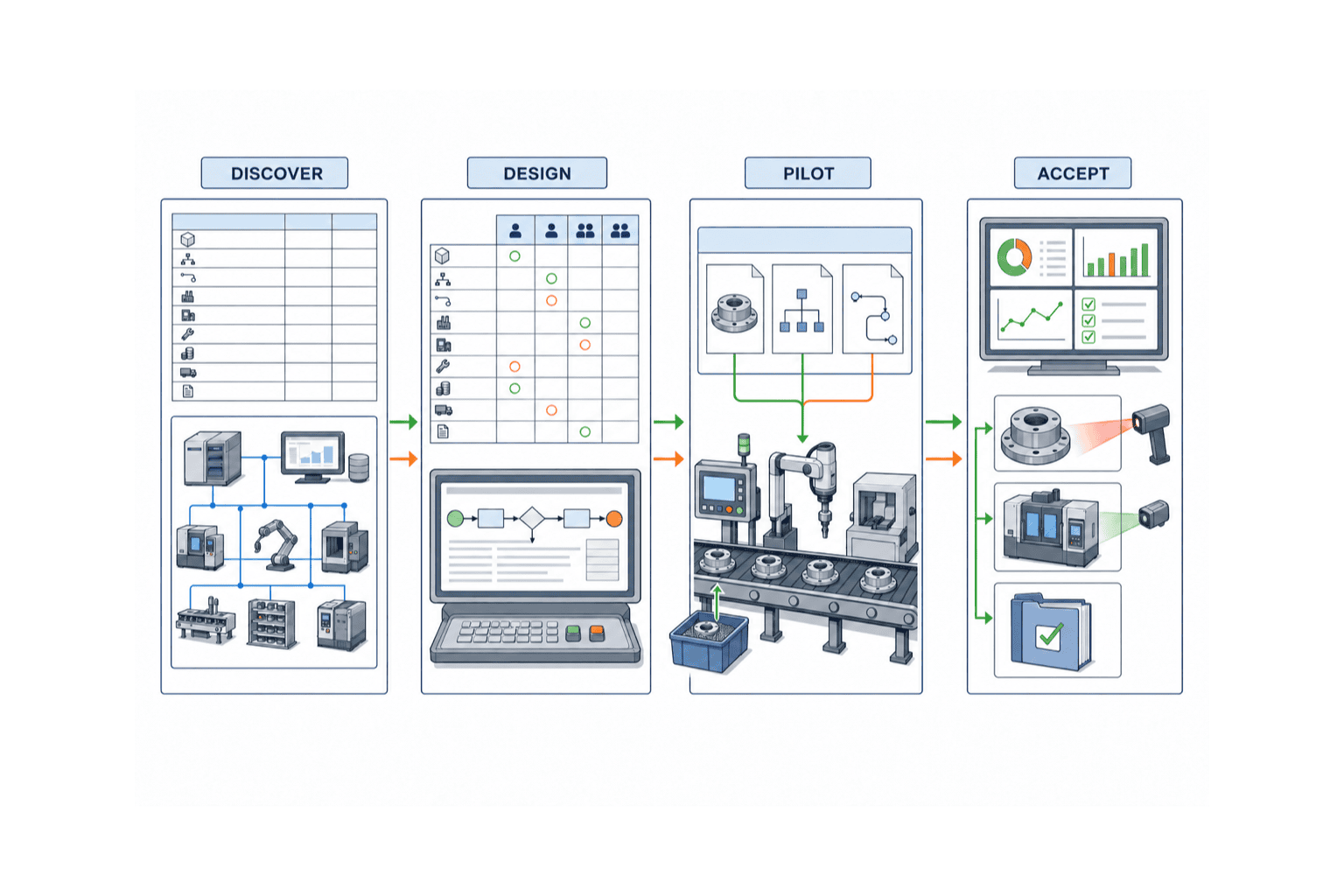
Days 1–15 — DISCOVER
Select the product family and extract related items, BOMs, routings, work centers, equipment and suppliers. Identify every place where those attributes are created or repaired: ERP, PLM, MES, spreadsheet and paper. Collect examples in which the same attribute differs.
Deliver a domain inventory, attribute dictionary, system map, SoR decision table, owner candidates and quality baseline. Do not start mass correction yet. First stop the paths that recreate the defect.
Days 16–30 — DESIGN
Define naming, units, code lists, lifecycle states, revision, effectivity, duplicate decision and retirement. Design the REQUEST–CHECK–APPROVE–PUBLISH screens, roles and evidence, including separate normal and emergency routes.
Deliver governance rules, RACI, data contracts, validations, approval matrix, exception process, rollback and acceptance tests. Name the Data Owner and delegate, rather than listing only a department.
Days 31–60 — PILOT
Load the target population into staging and resolve duplicates, units, references and versions. Distribute in dependency order from items through BOMs, routings and work centers. Test duplicate requests, rejection, stale versions, connection loss, retry and partial failure as well as the happy path.
At the line, verify instruction, component, resource and inspection point against reality. When a mismatch appears, return it through the request and republish from the source. Avoid a downstream direct edit becoming the permanent workaround.
Days 61–90 — ACCEPT
Measure agreed completeness, uniqueness, referential integrity, first-pass delivery, lead time and physical match. Classify every gap as data correction, rule issue, system defect or training need, then assign owner and due date.
For go-live, specify change freeze, final delta, distribution order, rollback conditions and support contact. In the first operating weeks, review approval queues, direct edits, quarantined messages and exception use frequently. The Day-90 exit is not “perfect data.” It is the demonstrated ability to detect a quality problem, route it to an owner, correct the authoritative record and redistribute it.
What to ask in a manufacturing MDM RFP
Do not evaluate only a feature matrix. Ask each product or implementation partner to demonstrate a complete change using representative data.
| Evaluation area | Evidence to request |
|---|---|
| Data model | item, multiple BOM purposes, routing, asset, supplier and effectivity examples |
| Governance | attribute ownership, staging, difference view, delegation and audit trail |
| Quality | duplicate, unit, reference, cycle, code-list and physical-validation operation |
| Distribution | dependency order, acknowledgement, retry, idempotency and quarantine from ERP to MES |
| Multi-site | global template, plant variation, language, time zone and local regulation |
| Security | least privilege, segregation, sensitive attributes, logging and recovery |
| Operations | SLA, monitoring, data-quality forum, training and rule-change procedure |
Use scenarios such as a BOM quantity change, replacement routing resource and supplier-approval suspension. Evaluate impact analysis, approval, future effectivity, distribution, receiver error and rollback—not just successful entry.
In a case published by SAP on 14 September 2026, Damen Shipyards had approximately 80% of its worldwide operations running on one SAP platform and was building AI use on that standardized digital foundation. Its stated sequence is “Reuse before Buy before Build.” This is one customer story, so 80% is not a universal target and supplies no general ROI. The useful principle is the order: establish reliable process and data, check standard capability, and only then buy or build an extension.
Common failure modes after implementation
Cleansing remains a one-time event
The create/change path is unchanged. Bring creation into the workflow, expose exceptions and put quality metrics into routine operations.
Users repair the consuming system directly
An emergency repair may be necessary, but it can disappear at the next sync. Require an emergency change ID, expiry, deadline for source reconciliation and confirmation of redistribution.
The Data Owner exists only as a title
Register owner, steward, delegate and SLA by attribute group. Make transfer of this responsibility part of personnel changes.
The KPI looks good without quality improving
Reducing required fields raises completeness; narrowing duplicate rules raises uniqueness. Store denominator, scope, rule version and exclusions and compare like with like.
Enterprise-wide scope prevents delivery
Do not begin with every plant, product and application. Choose a product family with meaningful value and risk, prove the vertical flow on one line, then reuse the pattern.
Connect MDM with migration, MOM and the factory roadmap
MDM can appear separate from an ERP or production-management migration, yet it determines whether the new platform starts with governed data. See our production management system migration guide for cutover, data conversion and acceptance considerations.
For the boundary between enterprise planning and shop-floor execution, read the Manufacturing Operations Management implementation guide. MDM is not MOM, but a MOM platform fed the wrong item, BOM, routing and asset definitions will execute the wrong instruction faster.
If you are still ordering the enterprise portfolio, use the Thailand factory DX roadmap to position MDM as a foundation rather than an isolated data-cleaning project.
Conclusion: build a trusted change flow in 90 days
The first deliverable in manufacturing master data management is not a giant repository. It is one complete control loop for items, BOMs, routings, work centers/assets and suppliers: source, owner, request, approval, activation, distribution, acknowledgement and measurement.
Limit the first scope to one product family and line. Discover during Days 1–15, design during Days 16–30, pilot from Days 31–60 and accept during Days 61–90. Once that loop works, the organization has a reusable pattern for the next product family and plant.
TOMAS TECH can support current-state diagnosis, System-of-Record and ownership design, ERP–MES data distribution and acceptance design for a 90-day pilot. You can speak with us while the project is still at the scoping stage through our contact page.
Frequently asked questions
How is manufacturing master data management different from ERP implementation?
ERP processes planning and transactions. MDM governs the meaning, authoritative source, owner, change, quality and distribution of reference data used by ERP and other systems. MDM can be implemented during ERP deployment, but software alone does not assign business ownership or approval rules.
Which data should a master data management implementation start with?
Choose one product family with meaningful revenue or disruption risk and govern the items, BOM, routing and work centers needed to build it. Include relevant suppliers. This vertical slice proves an executable production instruction, unlike cleaning an isolated item table.
Should item master management replace the entire coding scheme?
Not necessarily. Meaningful codes often break when products and organizations change. An organization can preserve old references, separate a stable unique identifier from classification attributes, and govern aliases. Evaluate impact before wholesale renumbering.
Should BOM master management merge EBOM and MBOM?
They serve different purposes. More important than forcing one table is tracing the relationship, transformation owner, revision and effectivity from engineering to manufacturing and routing.
Who owns the routing master: planning or manufacturing engineering?
There is no universal department. Operation design, standard time, capacity and shop-floor instruction may have different accountable owners. Assign the final decision and daily steward by attribute group.
Will a manufacturing MDM product automatically improve data quality?
It can support matching, workflow, audit and distribution, but it cannot replace definitions, accountable owners, decision rules and exception handling. Prove the full request-to-line acceptance flow with representative data before scaling.
Sources
- SAP Nederland, Damen Shipyards ERP and AI case, 14 Sep 2026: https://news.sap.com/netherlands/2026/09/damen-shipyards-zet-volgende-stap-met-sap-ai-binnen-wereldwijd-erp-landschap/
- SAP Help Portal, Manufacturing Master Data Management: https://help.sap.com/docs/sap-digital-manufacturing/execution/manufacturing-master-data-management
- SAP Help Portal, Business Integration with SAP S/4HANA or SAP ERP: https://help.sap.com/docs/sap-digital-manufacturing/integration-guide/business-integration-with-sap-s-4hana-or-sap-erp
- SAP Help Portal, Master Data Governance (Classic Mode): https://help.sap.com/docs/SAP_S4HANA_ON-PREMISE/6d52de87aa0d4fb6a90924720a5b0549/56a57357f2b1aa6be10000000a4450e5.html
- ISA, ISA-95 Series of Standards: https://www.isa.org/standards-and-publications/isa-standards/isa-95-standard
- ISO, ISO 8000-8:2015: https://www.iso.org/standard/60805.html
- GS1, Global Data Model Attribute Implementation Guideline: https://www.gs1.org/standards/gs1-global-data-model-attribute-implementation-guideline/111
- GS1, GDSN standards and Data Quality Framework: https://www.gs1.org/standards/gdsn


