


What to Sort Out First When Introducing a Retort Sterilization Record System
In plants making canned tuna, retort pouch foods and wet pet food, sterilization records are sometimes still kept on paper charts and handwritten record sheets, which quality control (QC) staff then transcribe into Excel. This article is a practical guide for QA, production engineering staff and plant managers who are considering a record system for retort sterilization, and for those who order equipment and record systems.
On sites that rely on paper charts and Excel transcription, the following tends to happen.
- For every audit or customer inquiry, someone has to dig the paper chart for that retort and that day out of the storage room.
- People inside the company cannot agree on whether “the F0 value” means the number shown on the recorder screen or the value at the product’s cold spot.
- Disposition and recording of lots affected by a deviation depend on the experience and memory of a particular person.
In this article we do not consider a retort sterilization record system to be a matter of “digitizing temperature graphs”. In this article we consider it something that designs the following four elements as one.
- A record for each sterilization cycle (temperature, pressure, time, venting, critical factors, F0 value) tied to the retort, basket, product code and lot
- Automatic detection of deviations, and a deviation record kept separate from the routine records
- Review within 1 working day, connected to the release decision
- Links to calibration and validation records
This approach is based mainly on US rules. In the US, 21 CFR 113.100 sets out the record items, review within 1 working day after the actual process, the retention period and the conditions for electronic records. 21 CFR 113.89 requires deviations to be recorded in a separate file and requires either reprocessing or evaluation. 21 CFR 113.40 sets requirements for recorders and data loggers. In Thailand, Ministry of Public Health Notification No. 469, which took effect in May 2026, maintained the sterilization requirements for low-acid foods. In Japan, according to a Ministry of Health, Labour and Welfare (MHLW) document, foods packed in containers and packaging and sterilized under pressure and heat must be heated at 120°C for 4 minutes at the center, or by an equivalent or more effective method.
Traceability design for the plant as a whole is covered in Food Factory Traceability System: RFP and 90-Day Deployment. This article focuses on records of the sterilization process. It covers still and rotary batch retorts. It does not cover the technical details of continuous sterilizers, UHT, aseptic filling or can seam inspection.
This article does not recommend or rank any specific product. The cost and benefit calculation later in the article uses hypothetical numbers for this article. Also, the sterilization conditions themselves (the scheduled process) are, under the US rule, established by a qualified person (21 CFR 113.83), and under Thai Notification No. 469 they are determined by heat distribution and heat penetration tests at the manufacturing site concerned. This article does not deal with how those conditions are set, but with the record mechanism that shows the product was processed according to them.
Why Now Is the Time to Review Retort Sterilization Records in Thai Food Plants
Thai Ministry of Public Health Notification No. 469 (2026)
The Thai Ministry of Public Health issued Notification No. 469 (B.E. 2569) on foods in hermetically sealed containers (อาหารในภาชนะบรรจุที่ปิดสนิท). The notification is dated 17 April 2026. It was published in the Royal Gazette on 18 May 2026 and took effect on 19 May 2026, the day after publication. It repealed Notification No. 355 dated 26 June 2013.
According to the amendment comparison table published by the Thai Food and Drug Administration (Thai FDA), the former No. 355 took effect 180 days after publication in the Royal Gazette, whereas No. 469 was changed to take effect immediately. On the other hand, Clause 8, which sets the sterilization requirements for the low-acid type, is marked “unchanged (คงเดิม)” in the comparison table. In other words, the underlying approach to sterilization has been maintained.
Clause 13 states that this notification does not apply to foods in hermetically sealed containers manufactured for export. Clause 14 states that manufacturers and importers who received food registration numbers under No. 355 may continue to use those numbers.
In this article we consider that the value of using this notification as an occasion to review record mechanisms lies less in the regulatory change itself and more in being able to explain, once again, the relationship between the sterilization requirements and the records. Because export products fall outside the scope of No. 469, records will be explained against the rules of the destination country. For the US, the 21 CFR 113 discussed below is the reference.
The scale of exports
As background, here is a brief look at market figures. According to Krungsri Research (August 2025), Thailand’s canned tuna exports in 2024 were 548,700 tonnes by volume (up 32.0% year on year) and USD 2.3 billion by value. According to the same report, Thailand’s share of the global export volume of canned and prepared tuna products in 2023 was 28.2%, ranking first in the world.
For pet food, The Nation Thailand (3 August 2026) reported the following, citing data from the Trade Policy and Strategy Office (TPSO) of Thailand’s Ministry of Commerce. Thailand’s pet food exports for full-year 2025 were USD 3.28 billion, up 8.15% year on year. Its share of the global export market for full-year 2025 was 10.2%, ranking second after Germany at 12.1%. For the first five months of 2026 (January to May, cumulative), exports were USD 1.43 billion, up 5.15% on the same period of the previous year. Of this five-month cumulative total, the US accounted for 30.22%.
These are national figures. They do not indicate the production volume or export ratio of any individual plant. Even so, in this article we consider that situations in which sterilization records must be explained against the rules of export destinations, starting with the US, will continue.
What to Record for Retort Sterilization (Sorting Out the Record Items)
The starting point for designing a record system is the list of “what to record”. Here we organize 21 CFR 113.100(a) in the US, which lists the items specifically. These are items of a US rule that apply to plants exporting to the US. Even so, in this article we consider that they are a useful reference when taking stock of record items for products sold in Thailand or exported to Japan.
113.100(a) requires processing and production information to be entered on record forms by the retort operator or another designated person at the time it is observed.
| Category | Items listed in 21 CFR 113.100(a) | Example of how a record system captures it (our view in this article) |
|---|---|---|
| Common | Product, code number, date | Pulled automatically from the product master and production order |
| Common | Retort or processing system number | Assigned automatically from each retort’s control panel |
| Common | Container size, approximate number of containers per coding interval | Taken from the production order and basket loading records |
| Common | Initial temperature | Measured value entered, with the person and time of measurement kept |
| Common | Actual processing time | Calculated automatically from process signals on the control panel |
| Common | Indicating thermometer and recorder readings | Indicating thermometer reading entered by the operator, recorder value captured automatically, and both kept side by side |
| Still | Time steam on, time processing temperature reached, time steam off, venting time and temperature reached by venting | Process stage boundaries recorded automatically from control panel signals |
| Rotary | Functioning of condensate bleeders, retort speed, and, where specified in the scheduled process, headspace, consistency, maximum drained weight, minimum net weight and percent solids | Retort speed captured automatically, the rest pulled from entries and inspection records |
| Critical factors | Critical factors specified in the scheduled process, such as closing machine vacuum and maximum fill-in or drained weight | An entry field and acceptable range for each critical factor, with out-of-range values treated as deviations |
At the international level, Section 8.1 of the Codex CAC/RCP 23-1979 (Code of Hygienic Practice for Low and Acidified Low Acid Canned Foods, adopted 1979, revised 1989 and 1993, editorial corrections 2011) recommends (should) that record forms include the product name, code lot number, identification of the retort and recorder chart, container size, minimum initial temperature, scheduled and actual processing time and temperature, and indicating thermometer and recorder readings, among other items.
This table shows that most record items are identifiers, times and entered values rather than temperature graphs. In this article we consider that the real payoff of a record system lies less in digitizing the graphs and more in bringing these items together into one record for each sterilization cycle.
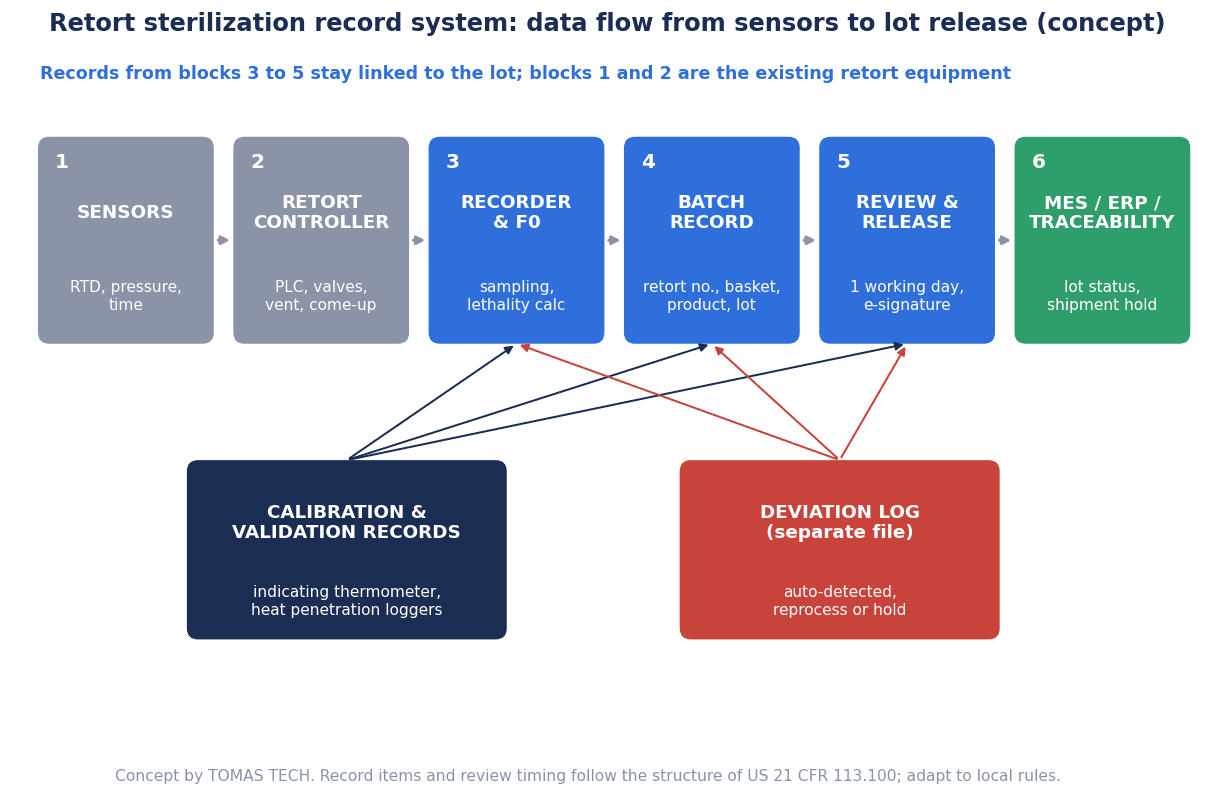
Figure 1 Structure of the record system. Data flows in this order: 1 SENSORS (RTD, pressure, time), 2 RETORT CONTROLLER (PLC), 3 RECORDER & F0 (sampling, lethality), 4 BATCH RECORD (retort no., basket, product, lot), 5 REVIEW & RELEASE (1 working day, e-signature), 6 MES / ERP / TRACEABILITY. CALIBRATION & VALIDATION RECORDS and the DEVIATION LOG (separate file) on the lower row connect to blocks 3 to 5.
What Is the F0 Value? Recording Recorder F0 Separately from Product Cold-Spot F0
How Notification No. 469 positions it
In Thai Notification No. 469, the F0 value appears as “ค่า F0 (Sterilizing value)”, that is, the sterilizing value (also referred to as lethality in this article and in Figure 1). In this article we explain the F0 value qualitatively, as “the time during which the product’s cold spot stayed in the lethal temperature range, converted into equivalent minutes at a specified reference temperature and accumulated”. The reference temperature and conversion factor are part of the method used to calculate F0. In a record system, what matters is to have the specification state explicitly which values the calculation uses.
Clause 8 of Notification No. 469 requires manufacturers of low-acid type foods in hermetically sealed containers to do one of the following.
- Heat-sterilize at the specified temperature and time (Scheduled process) to achieve an F0 value of at least 3 minutes. The notification positions this as a value sufficient to destroy Clostridium botulinum spores. The specified temperature and time must be determined at the manufacturing site concerned by carrying out a heat distribution test inside the sterilizer and a heat penetration test, following the criteria and methods set by the Thai FDA.
- Add acid to adjust the pH of the food to 4.6 or below.
The low-acid type referred to here is defined in Clause 6 of the notification as having a pH above 4.6 and a water activity above 0.85.
Do not confuse the two F0 values
In this article we consider that, in many cases, the reason people inside a company cannot agree on F0 is that two values of different nature are both called “F0”.
- Recorder F0: a value calculated from the temperature inside the retort (the temperature at the measuring point). It can be recorded for every sterilization cycle and is used for routine records and review.
- Product cold-spot F0: a value measured in a heat penetration test with a logger probe inserted at the product’s cold spot. It is the basis for setting the scheduled process.
Routine records use the former, and the basis for sterilization conditions is the latter. We recommend displaying these two under different names on the record system’s screens and reports. Distinguishing them, for example as “calculated from retort temperature” and “heat penetration test value”, makes them easier to explain in audits.
The manufacturers describe the wireless temperature data loggers used for heat penetration tests as follows (in alphabetical order).
- Ellab, on its TrackSense page (published in February 2026), describes it as a wireless data logger that captures data in real time without cables. The measuring range is -80°C to +400°C depending on the type of sensor and logger, and the page lists Steam Sterilization as an application.
- MadgeTech, in its HiTemp140-FP and HiTemp140-FPST data sheet (stated as the January 2026 edition), gives the probe measuring range as -200°C to +260°C and states that the logger body cannot exceed 140°C. The company describes it as suitable for steam sterilization processes and lists lethality (F0, PU) calculation formulas as a software function.
- Thermo Fisher Scientific (Australia), in a dataTaker DT80 case study (2010), describes inserting thermocouple probes into the center of pouches and placing those pouches at appropriate positions throughout the load inside the retort. In this setup, a partial F0 is calculated for each probe at regular intervals, the accumulated F0 is shown on screen, and after sterilization ends the data is exported as a CSV file and stored. The number of probes and the recording interval here are the settings used in that case study.
The approach in Japan
In Japan, according to an MHLW document, foods packed in containers and packaging and sterilized under pressure and heat must be sterilized by heating at 120°C for 4 minutes at the center, or by a method with equivalent or greater effect. As the words “at the center” indicate, the reference here is again the temperature inside the product. Note that the term “low-acid foods packed in containers and packaging”, as defined in a Japanese notice, uses the thresholds of pH above 4.6 and water activity above 0.94. Because this differs from the water activity of 0.85 in Thai Notification No. 469, it is important not to mix documents from different destination countries.
Sterilization conditions are set for each product, under the US rule by a qualified person and under the Thai notification through tests at the manufacturing site concerned. The role of the record system is to show that those conditions were met every time, not to decide the target F0 value.
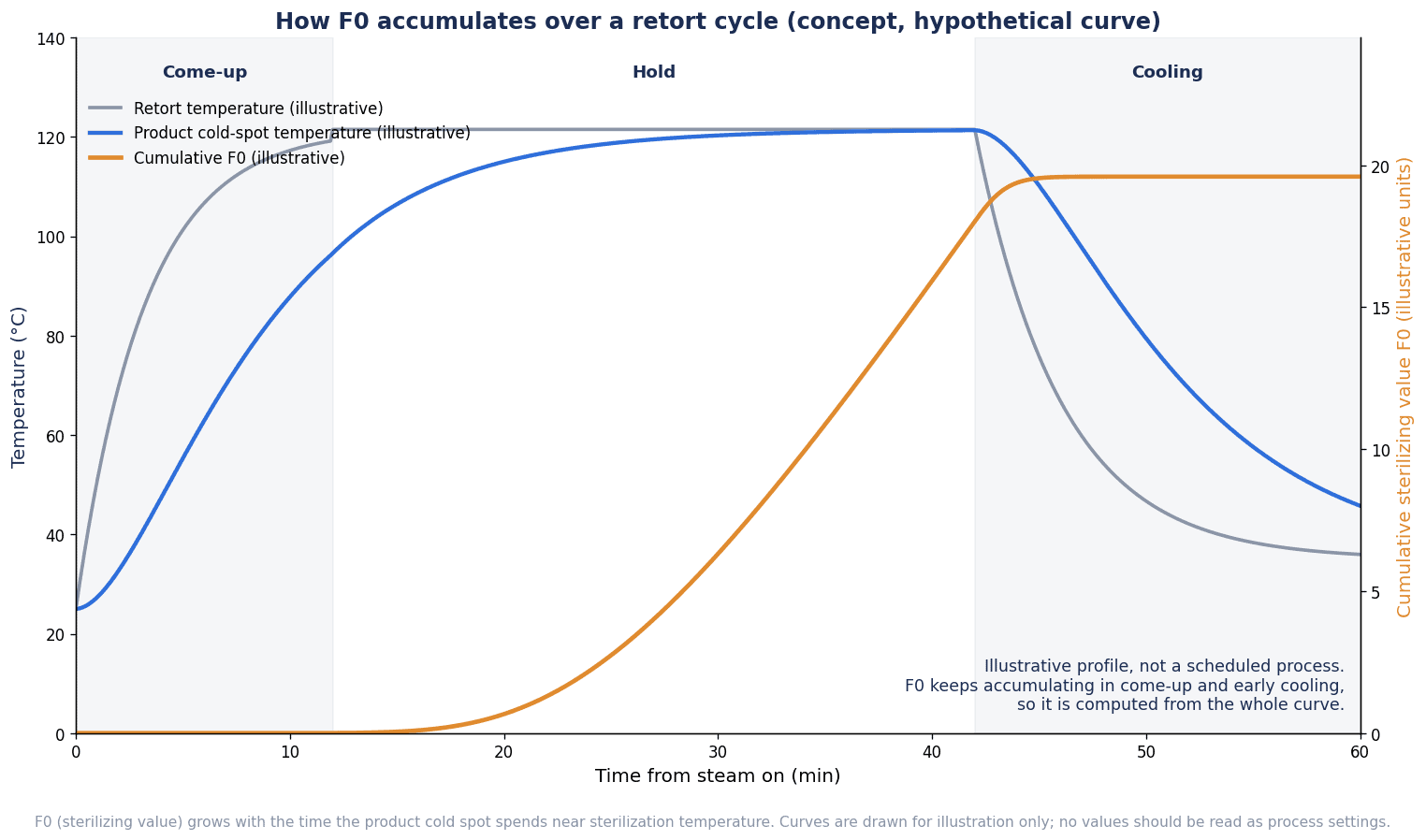
Figure 2 Conceptual diagram of a hypothetical temperature profile and the accumulated lethality. This is a conceptual diagram, so please do not read numerical values from it. Because lethality accumulates during the come-up, hold and cooling phases, the F0 value is calculated from the whole curve, not only from the hold time.
From Paper Charts to Electronic Records: Requirements for Recorders and Data Loggers
When digitizing sterilization records, plants exporting to the US need to check the equipment requirements in 21 CFR 113.40. The following is the content of 113.40(a), which covers the case of still retort pressure processing in steam. 113.40(b), which covers pressure processing in water, contains wording with the same numbers.
| Item | Content of 21 CFR 113.40(a) | Strength of requirement |
|---|---|---|
| Indicating thermometer accuracy | 1°F (0.5°C) | shall (mandatory) |
| Indicating thermometer calibration | Against a reference traceable to a national metrology institute such as NIST, at installation and at least once a year thereafter, or more often if necessary | shall (mandatory) |
| Reference instrument | The reference for the processing temperature is the indicating thermometer, not the recorder | shall (mandatory) |
| Recorder chart graduations | Within the range of 10°F (5°C) above and below the processing temperature, graduations not exceeding 2°F (1°C) | shall (mandatory) |
| Digital records such as data loggers | May be used. Record at intervals that ensure the process time and process temperature parameters have been met | shall (mandatory) |
| Recorder adjustment | During processing, agree as closely as possible with the indicating thermometer and not read higher than it. Provide a means to prevent unauthorized adjustment | shall (mandatory) |
| Pressure gauge accuracy | 2 psi (13.8 kPa) or better | should (recommended) |
| Recording of critical factors | Measure and record in the processing record often enough | shall (mandatory) |
| Recording interval for critical factors | Intervals not exceeding 15 minutes | should (recommended) |
The key point here is that, for the recording interval of data loggers, 113.40 does not set a specific number of seconds but requires recording “at intervals that will assure that the parameters of the process time and process temperature have been met”. The plant itself will decide the recording interval on a justified basis, taking into account the scheduled process and how fast the process changes.
For the electronic records themselves, 21 CFR 113.100(h) allows records to be kept electronically if they comply with Part 11. 21 CFR 11.10 lists requirements such as the following as controls for closed systems.
- Validation of the system (accuracy, reliability, consistent intended performance, and the ability to discern invalid or altered records)
- Protection of records to enable their accurate and ready retrieval throughout the retention period
- Limiting system access to authorized individuals
- A secure, computer-generated, time-stamped audit trail that independently records the date and time of operations that create, modify or delete records. Record changes must not obscure previously recorded information, and the audit trail is to be retained for at least as long as the subject electronic records
As a product example, Thermo Fisher Scientific (Australia), in the 2010 dataTaker case study, lists as features of the DT80 a built-in web server and FTP server, and connection to SCADA through Modbus slave and master functions.
Yokogawa, on a case study page about S&B Sankyo (which makes retort pouch and canned curry and other products in Yaizu, Shizuoka Prefecture) with no date given, explains that the temperature and pressure of the sterilization process are monitored with a GX20 paperless recorder. The company says that, after sterilization ends, the recorded data is automatically sent over the network by FTP to a hard disk. On the same page, the user says that it previously used chart recorders, that the volume of paper was enormous, and that old paper deteriorated and became hard to read.
Sensor types (Pt100, thermocouples) and how to choose thermowells are covered in Industrial Temperature Sensor Selection: Thermocouple vs Pt100, Thermowells and Calibration. On the record system side, the starting point is to define, for each retort, which sensor’s value is treated as “the recorder value”.
How to Link Retorts, Baskets, Products and Lots (Traceability Across the Sterilization Process)
The core of traceability in the sterilization process is the design of identifiers. 21 CFR 113.100(b) requires recorder records to be identified by date, retort number and similar, so that they can be correlated with the records of the lots processed. 113.87(e) also requires the time on the recorder record to correspond to the time on the processing record.
In this article we consider a design in which each sterilization cycle carries at least the following identifiers.
| Identifier | Role | Example of how to assign it (our view in this article) |
|---|---|---|
| Sterilization batch ID | Uniquely represents one sterilization cycle | Numbered automatically from the retort number and start time |
| Retort number | Which equipment processed it | Fixed for each control panel |
| Basket (car) number | Which group of containers was inside | Scan the basket label |
| Product code | What was processed | Pulled from the production order |
| Production lot | Unit of shipment and product recall | Carried over from the filling process lot |
| Filling line | Link to the upstream process | Pulled from filling records |
| Pre- and post-sterilization status | Prevents unsterilized product from mixing in | Basket status switched on completion of sterilization |
The last item, “pre- and post-sterilization status”, relates to 21 CFR 113.87(b). This provision requires a system for controlling product flow in the retort room so that unprocessed product does not bypass the retort process. Baskets and cars containing processed product are to be clearly marked by an effective method such as heat-sensitive indicators and checked visually. In this article we consider that even when basket status is managed in the record system, heat-sensitive indicators and visual checks on the floor should remain. The electronic status display does not replace physical marking; it is a means of cross-checking.
Once the identifiers are in place, queries work in both directions: “which lots were in this cycle on this retort number?” and “on which retort and at what time was this lot processed?”. The query procedure and acceptance criteria for a recall scenario are organized in Mock Recall Testing for Factory Traceability: SOP and Acceptance Criteria. For how to hold lot numbers and best-before dates on the production management side, see Food Factory Production Management System Guide.
How to Detect and Record Retort Deviations (Managing Deviations)
As the reference for managing retort deviations, US 21 CFR 113.89 provides the following. When a process falls short of the scheduled process, or when a critical factor is out of control, the commercial processor does one of the following.
- Fully reprocess the affected portion and keep complete records of the reprocessing conditions.
- Isolate the affected portion and send it for evaluation by a competent processing authority. Record the evaluation procedures and results.
In addition, every deviation that does not meet the minimum requirements of the scheduled process is to be recorded and compiled in a separate file (or a log identifying the relevant data) detailing the deviation and the action taken. Section 7.8.1 of Codex CAC/RCP 23-1979 also recommends that, after isolation, the product either be reprocessed or that a competent processing expert evaluate the records, with the evaluation procedures, results and action on the product recorded.
The FDA inspection guide (accessed 16 October 2026) states that all deviations must be detected and properly handled by the processor. It also says that, although processing authorities often advise on “whether this should be evaluated as a deviation”, it is ultimately the processor that is responsible for handling deviations appropriately.
In this article we draw the line here. Deciding whether something is a deviation and how to handle the product is the responsibility of the processing authority and the plant’s responsible managers. What the record system does is detect deviations without missing them, reliably put the affected lots on hold, and keep the decision and action as a separate record.
Examples of events the record system should detect include the following.
- The processing temperature fell below the value in the scheduled process
- The processing time was shorter than planned
- The venting procedure (time and temperature reached) did not go as planned
- A critical factor (initial temperature, fill weight and so on) went outside the acceptable range
- Records were missing, or there was a power failure or communication loss
When a deviation is detected, the system automatically puts the lots linked to that sterilization batch ID “on hold” and opens a deviation record. The deviation record keeps the event detected, the time, the affected lots, the person who made the decision, the basis for the decision and the action (the reprocessing conditions or the evaluation result). It is managed in a list separate from the routine sterilization records, with links between the two.
Methods for correcting processing conditions on the spot during a deviation have also been studied. The method described in US Patent 6,472,008 builds a time and temperature profile from the actual retort temperature, predicts the lethality that the scheduled heating time will deliver during a temperature deviation, and resets the processing time or temperature to meet the target lethality. In this article we consider that, even when such a function is used, the precondition is that the correction result is kept in the deviation record and becomes subject to evaluation by the processing authority.
Review and Release: Check Within 1 Working Day and Before Shipment
21 CFR 113.100(b) sets out the review as follows.
- The operator or designated person signs or initials each record form.
- Within 1 working day after the actual process, and before shipment or release for distribution, a representative of plant management with appropriate training or experience reviews all processing and production records. The purpose is to confirm that the records are complete and that the product received the scheduled process.
- The reviewer signs or initials and dates all records, including recorder records.
A record system can turn this review into an on-screen workflow. When sterilization ends, the record enters a “pending review” list, and the reviewer checks for missing items and deviations and applies an electronic signature. Plants exporting to the US that use electronic signatures need to meet the access control and audit trail requirements of 21 CFR 11.10. In this article we consider that, even for products sold in Thailand or exported to Japan, writing the same level into the specification makes things easier to explain in audits.
In this article we recommend supporting the following two points with the system.
- Visible deadlines: show the deadline of 1 working day after the actual process for each sterilization batch, and highlight those close to the deadline.
- Link to the release decision: keep lots whose review is not complete, and lots whose deviation record is not complete, in a state where they cannot be shipped in the MES or shipping system.
When records are corrected during review, a mechanism is needed that keeps the original value, the corrected value, the reason, the person who corrected it and the approver. Designing the correction and approval history is covered in detail in Production Actuals Correction and Approval System: A Guide for Thai Factories. The same approach can be used for sterilization records.
Connecting Calibration and Validation Records to Daily Sterilization Records
Whether daily sterilization records can be trusted depends on instrument calibration and on the records of the tests that set the sterilization conditions.
21 CFR 113.40(a), in the case of still retort pressure processing in steam, requires the indicating thermometer to be calibrated against a reference traceable to a national metrology institute at installation and at least once a year thereafter (shall). It also requires the recorder to be adjusted so that it does not read higher than the indicating thermometer. Clause 8 of Thai Notification No. 469 requires the specified temperature and time to be determined by heat distribution and heat penetration tests at the manufacturing site concerned.
In this article we consider a design that links sterilization records to these records as follows.
- Keep in the sterilization record the instrument IDs of the indicating thermometer and recorder in use at that time.
- Make it possible to trace from the instrument ID to the latest calibration date, the next due date and the calibration result.
- Issue a warning if someone tries to start sterilization on a retort fitted with an instrument past its calibration due date.
- For each combination of product code and retort number, link the heat distribution and heat penetration test records that form the basis (test date, tester, logger model used).
Manufacturers describe the measuring range of wireless data loggers used for heat penetration tests for each model. As with Ellab and MadgeTech mentioned in the previous section, the range varies with the type of sensor and logger. Keeping the model and range in the test record makes it easier to trace the basis later.
Calibration due-date management and the record mechanism itself are covered in Calibration Management System | Thailand Factory Guide. On the sterilization record system side, making a link to the calibration management system by instrument ID a requirement avoids creating a second register.
Integration with Record Servers, Historians and MES (Retort MES Integration)
Sterilization record data is handled, for example, in the following flow.
- The PLC or control panel of each retort outputs temperature, pressure and process stage boundaries (steam on, processing temperature reached, steam off, venting).
- The record server (historian) collects the time-series data at set intervals and calculates the F0 value.
- The sterilization batch record brings together the time-series data, identifiers, entered values, deviations and review.
- The MES or ERP receives the lot status (on hold, reviewed, released for shipment).
Mechanisms for collecting time-series data and storing it long term are compared in Industrial Historian Selection: RFP and FAT/SAT in Thailand. In this article we consider that, for sterilization records, a design is needed that, separately from the raw data in the historian, locks the record of each sterilization cycle as the final version and keeps any later changes in the audit trail.
Two points need particular attention when integrating retorts with MES: time and missing data.
Time: 21 CFR 113.87(e) requires the time on the recorder record to correspond to the time on the processing record. If the clocks of the control panel, record server, MES and operator entry terminals drift apart, it becomes hard to explain which record belongs to the processing of which lot. Time synchronization methods and acceptance tests within the plant are covered in Factory Time Synchronization: PTP vs NTP and Acceptance Tests in Thailand.
Missing data: if records are interrupted by a communication loss or power failure, it is no longer possible to show that the processing temperature was maintained during that interval. You need both a mechanism that buffers data on the control panel side and sends it to the server after recovery, and a rule that treats any remaining gap as a deviation. Designing detection and backfilling of missing data is organized in detail in Factory Sensor Data Loss Prevention: RFP, FAT and SAT Acceptance Criteria.
Retention of Sterilization Records and Audit Readiness
Retention period under the US rule
21 CFR 113.100(g) sets out record retention as follows.
- Keep records at the processing plant for at least 1 year from the date of manufacture.
- Keep them for a further 2 years after that, at the processing plant or another reasonably accessible location.
So under the US rule, retention totals 3 years, but the first year must be at the plant. When records are kept electronically, compliance with Part 11 is a condition under 113.100(h). 21 CFR 11.10(e) requires the audit trail to be retained for at least as long as the subject electronic records. Once records are digitized, the retention period of the audit trail, not only of the records themselves, has to be included in the design.
Treatment in Thailand and Japan
In the text of Thai Notification No. 469 and its amendment comparison table, provisions setting record retention periods or record items were not confirmed in this article. Clause 11 requires manufacturers and importers for sale to follow the Ministry of Public Health notifications on production methods, production equipment and storage of food. Record requirements may be set in the notifications referred to by this general reference, but their content was not confirmed in this article. The retention period in Japan was also not confirmed in this article.
For this reason, in this article we recommend setting the retention period for products sold in Thailand and products exported to Japan only after checking the relevant notifications and customer requirements individually. On the record system side, being able to set retention periods by product and destination makes it easier to cope when requirements differ.
In an audit, the goal is to be able to answer a request such as “please show us the sterilization records for this lot” by producing, in one continuous chain from the lot number, the sterilization batch record, the deviation record, the review signatures and the instrument calibration records.
Common Pitfalls in Thai Plants
From here, we summarize points to watch when considering a record system, as our view in this article.
Lingering Excel transcription: even after a record system is introduced, report formats sometimes stay the same, and the practice of re-transcribing into Excel remains. Before introduction, you need to decide which reports will be replaced by system output.
Storing paper charts: paper charts created before digitization remain until their retention period ends. Building an index for the transition period, so that old and new records can be queried by lot number, avoids trouble in audits.
Mixed F0 definitions: the F0 shown on the recorder screen, the F0 calculated in the historian and the F0 from heat penetration tests sometimes appear under the same name on different reports. We recommend fixing a single calculation method and measuring point in the system specification and separating the display names.
Power failures and communication loss: you need provisions so that records are not interrupted even when a power failure or voltage dip occurs. It is important to check the power supply and buffers of the control panel and recording unit so that no gaps in the records remain.
Staff changes: if the procedure for deciding on deviations lives in someone’s head, judgments shift every time the person changes. Writing into the system workflow, for each type of deviation, who checks what and makes the decision makes handover easier.
Multilingual record forms: in plants where operators use Thai, QA uses English and head office uses Japanese, the same item is called by different names in each language. A design with common item IDs, switching only the screen and report display language, makes queries and audits easier.
Confusion with records other than sterilization: food plants have other process records too, such as CIP cleaning records and cooling water or cold storage temperature records. Because their requirements differ from those of sterilization records, we consider it easier to first define retort records as an independent set of system requirements and link them to other records by identifiers. The approach to CIP conductivity monitoring is covered in CIP Conductivity Monitoring in Thai Food Factories: Implementation Guide.
Requirements to Write into the RFP (RFP for Sterilization Records)
The table below summarizes, as our view in this article, the requirements to write into an RFP when ordering a sterilization record system. Judging compliance with the rules is the buyer’s responsibility. Ask vendors to answer specifically how they will meet each requirement.
| Requirement area | Example of what to write in the RFP |
|---|---|
| Record items | All items in the table in the section “What to Record for Retort Sterilization” can be captured, separately for still and rotary retorts. The distinction between automatic capture and manual entry is stated explicitly |
| Sampling interval | The recording interval can be set for each retort, with the setting and its change history kept. The buyer provides the basis for the interval from the scheduled process |
| F0 calculation method | The specification explicitly states the F0 formula, reference temperature, z-value, measuring points used, and conditions for starting and ending the calculation. Recorder F0 and heat penetration test F0 are displayed under different names |
| Identifiers | Sterilization batch ID, retort number, basket number, product code, production lot, filling line and pre- and post-sterilization status are linked for each sterilization cycle |
| Deviation detection and separate record | Deviation conditions can be configured, and on detection the lot is automatically put on hold and a deviation record separate from routine records is opened |
| Review and signature | Display of the 1 working day deadline, electronic signature by the reviewer, and blocking of shipment for unreviewed lots |
| Audit trail | Explain how the requirements of 21 CFR 11.10 (access control, time-stamped audit trail, changes that do not erase previous values) are met |
| Retention | Retention periods can be set by product and destination. For the US, the system can meet at least 1 year at the plant from the date of manufacture plus a further 2 years |
| Calibration and validation | Calibration records are linked by instrument ID, and warnings are issued for expired calibration. Heat distribution and heat penetration test records can be linked to product and retort combinations |
| MES and ERP integration | Show the interface method and fields for passing lot status (on hold, reviewed, released for shipment) |
| Missing data and power failures | Show the buffer capacity on the control panel side, the resend method after recovery, and how remaining gaps are treated as deviations |
| Time | Show the time synchronization method for control panels, servers and terminals |
| Multilingual UI | Screens and reports support Thai, English and Japanese, with common item IDs |
| Data export | Sterilization batch records, deviation records and audit trails can be exported in bulk in a readable format |
What matters most in the RFP is not settling the F0 calculation method with “per the vendor’s standard”. If the reference temperature, z-value and measuring points are not stated explicitly, the calculation cannot be checked at FAT.
FAT/SAT Acceptance Criteria (FAT and SAT for Sterilization Records)
In this article we consider that acceptance of a record system should be based on “receiving the records” and “recalculating them”. The check is not whether the screens run smoothly, but whether the records required by the rules and internal procedures end up in your hands in the required form.
FAT (factory acceptance test)
| Test item | What to confirm |
|---|---|
| Coverage of record items | In a simulated run, all record items listed in the RFP come together in one sterilization batch record |
| Sampling interval | Data is recorded at the set interval with no gaps |
| F0 calculation check | The value calculated by hand by the buyer from the output temperature data, using the formula in the specification, matches the system’s value |
| Separate deviation record | Temperature drop, short time and insufficient venting are induced deliberately, the lot goes on hold and a separate deviation record is opened |
| Operation log for review and approval | Review, signature and correction operations are kept in the audit trail with date, time and operator |
| Permissions | Users without permission cannot change records or settings |
SAT (site acceptance test)
| Test item | What to confirm |
|---|---|
| Cross-check with the indicating thermometer | On the actual retort, the recorder value does not read higher than the indicating thermometer |
| Recovery from power failure and communication loss | Communication is cut and power is turned off during operation, and after recovery either the records are complete with no gaps, or the gap is treated as a deviation |
| Lot query | From the retort number, the sterilization batch, lot and shipment destination can be traced within the set time |
| Time consistency | The clocks of the control panel, server and terminals stay within the set tolerance |
| Retention and export | Finalized records and audit trails are exported in bulk and can be read in a separate environment |
We recommend that the buyer carry out the FAT calculation check themselves. A vendor-prepared report saying “the values matched” alone leaves no understanding of the calculation method inside the company. In this article we consider that being able to recalculate the records you receive yourselves is the precondition for being able to explain them in an audit.
Cost and Benefit Model Calculation (Hypothetical Numbers for This Article)
To show how to think about the costs and benefits of a record system, here we run a calculation with hypothetical numbers for this article. These are not figures from an actual plant.
Assumed plant: a Japanese-affiliated food plant in Thailand with 6 still retorts. Sterilization records are paper charts and handwritten records, which QC transcribes into Excel and checks before shipment. Decisions on deviations (temperature drops, insufficient venting, power failures) are made only after staff have collected the records, so holds drag on. Assume this plant introduces an electronic record system with automatic recording of temperature, pressure and F0 for each retort, identifier linking, automatic deviation detection, a review and approval workflow, and MES integration.
Only the following two cost items related to sterilization records are counted. Quality costs in general and equipment replacement are not counted.
Current state (annual)
- A Labor for transcribing and checking records: 2 people × 1.5 hours/day × 300 days/year = 900 person-hours/year. At a labor rate of 150 THB per person-hour (hypothetical), 900 × 150 = 135,000 THB/year.
- B Cost of handling deviations: 12 times/year × 60,000 THB per occurrence (total of warehousing while on hold, reprocessing or disposal, investigation and re-inspection, hypothetical) = 720,000 THB/year.
- The current total is 135,000 + 720,000 = 855,000 THB/year.
Initial cost
The initial cost is assumed to total 1,200,000 THB, broken down as follows.
- Additional sensors, recording units and wiring for 6 retorts: 480,000 THB
- Record server and software, identifier and workflow configuration: 420,000 THB
- MES integration, validation support, FAT/SAT: 300,000 THB
Base case and sensitivity case
| Item | Current | After, base case | After, sensitivity case |
|---|---|---|---|
| A Transcription and checking (person-hours/year) | 900 | 300 | 300 |
| A Transcription and checking (THB/year) | 135,000 | 45,000 | 45,000 |
| B Number of deviations (times/year) | 12 | 4 | 8 |
| B Cost per occurrence (THB) | 60,000 | 30,000 | 30,000 |
| B Deviation handling (THB/year) | 720,000 | 120,000 | 240,000 |
| Total annual cost (THB/year) | 855,000 | 165,000 | 285,000 |
| Annual savings (THB/year) | – | 690,000 | 570,000 |
| Payback period | – | about 1.74 years (about 1 year 9 months) | about 2.11 years (about 2 years 1 month) |
Base case: for A, transcription disappears and only checking remains, at 300 person-hours/year. 300 × 150 = 45,000 THB/year, a saving of 90,000 THB. For B, assume that early detection reduces deviations that affect whole lots, so the number counted as deviation handling falls to 4 per year. Assume also that complete records bring the cost per occurrence down to 30,000 THB. 4 × 30,000 = 120,000 THB/year, a saving of 600,000 THB. The total after the measures is 165,000 THB/year, and the savings are 855,000 − 165,000 = 690,000 THB/year. The payback period is 1,200,000 ÷ 690,000 ≈ 1.74 years (about 1 year 9 months).
Sensitivity case: consider the case where deviations fall only to 8 per year. The cost per occurrence stays at 30,000 THB. B = 8 × 30,000 = 240,000 THB/year, a saving of 480,000 THB. The A saving of 90,000 THB is the same. The total after the measures is 285,000 THB/year, and the savings are 855,000 − 285,000 = 570,000 THB/year. The payback period is 1,200,000 ÷ 570,000 ≈ 2.11 years (about 2 years 1 month).
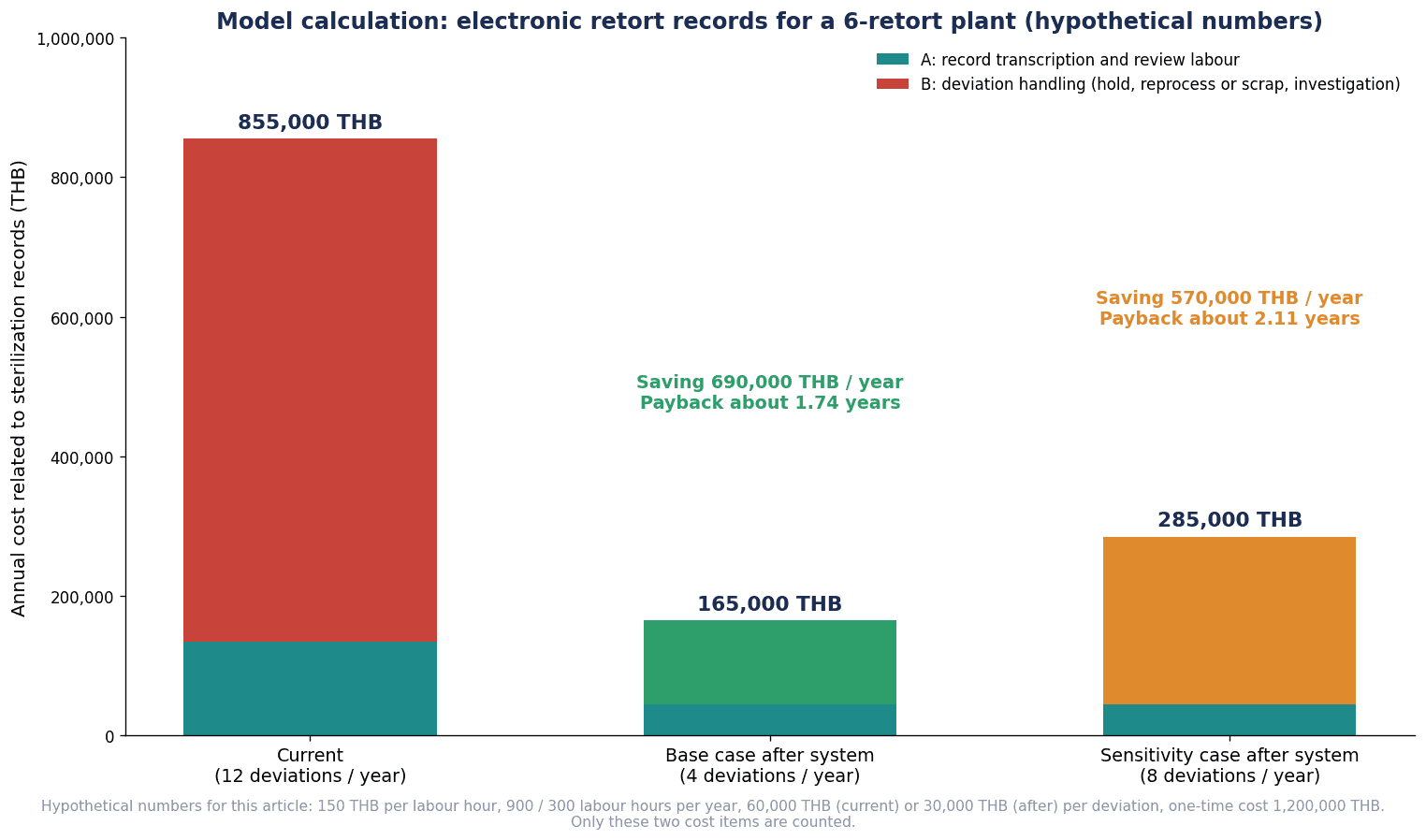
Figure 3 Annual costs for the current state, after the base case and after the sensitivity case, stacked by A (transcription and checking) and B (deviation handling). All numbers are hypothetical numbers for this article.
How to read the calculation
In this calculation, the payback period changes greatly with “how far the number of deviations falls” and “the cost per deviation”. It is about 1.74 years in the base case, where deviation handling falls to 4 times per year, and about 2.11 years in the sensitivity case, where it stays at 8 times per year. Most of the savings come from B, deviation handling; the saving from A, transcription labor, is only 90,000 THB.
The cost per deviation varies greatly from plant to plant depending on product unit price, the size of the lots put on hold, and whether product can be reprocessed or must be disposed of. For this reason, in this article we recommend recording, before considering introduction, the number of deviations over the most recent year, the days on hold and cost per deviation, and the person-hours spent on transcription and checking. With these, you can run the same calculation with your own figures.
Also, digitizing records does not in itself reduce the causes of deviations (equipment, steam, operation). What it helps with is earlier detection of deviations and faster decisions. To reduce the number of deviations themselves, action is needed on the equipment and operation side against the causes the records reveal.
Frequently Asked Questions
What should be kept in retort sterilization records?
For plants exporting to the US, the items in 21 CFR 113.100(a) are the reference: product, code number, date, retort number, container size, initial temperature, actual processing time, indicating thermometer and recorder readings, for still retorts the times of steam on, processing temperature reached and steam off, venting time and temperature, and critical factors. In this article we consider that this list is a useful reference for taking stock even for products sold in Thailand or exported to Japan.
How should the F0 value be recorded?
We recommend recording separately the recorder F0 (the value calculated from the temperature inside the retort) and the product cold-spot F0 measured in heat penetration tests. Keep the former in routine sterilization records, with the calculation method, reference temperature, z-value and measuring points stated explicitly in the specification. Keep the latter in test records for each product and retort combination, as the basis for the scheduled process. For the low-acid type, Thai Notification No. 469 requires an F0 value (sterilizing value) of at least 3 minutes to be achieved at the specified temperature and time, with those conditions determined by heat distribution and heat penetration tests at the manufacturing site concerned.
Does digitizing sterilization records make paper charts unnecessary?
US 21 CFR 113.40 allows the use of digital records such as data loggers, for example in the case of still retort pressure processing in steam. 113.100(h) also allows records to be kept electronically if they comply with Part 11. Whether paper charts can be replaced by electronic records in Thailand and Japan was not confirmed in this article. Please decide after checking the relevant notifications and customer requirements. Paper charts created before digitization need to be kept until their retention period ends.
How are retort deviations managed?
Under US 21 CFR 113.89, when a process falls short of the scheduled process or a critical factor deviates, the processor either fully reprocesses the product and records the conditions, or isolates it, sends it for evaluation by a processing authority and records the evaluation procedures and results. Deviations are compiled in a separate file or log. In this article we recommend a division of roles in which the record system handles automatic deviation detection, automatic lot holds and opening deviation records, while decisions are made by the processing authority and the plant’s responsible managers.
How many years should sterilization records be kept?
Under US 21 CFR 113.100(g), records are kept at the processing plant for at least 1 year from the date of manufacture, and then for a further 2 years at the plant or a reasonably accessible location. For electronic records, the audit trail must also be kept for at least the same period. The retention periods under Thai Notification No. 469 and in Japan were not confirmed in this article.
What are the benefits of integrating retort sterilization records with MES?
The sterilization records can pass lot status (on hold, reviewed, released for shipment) to the MES. Lots whose review is not complete, and lots whose deviation decision is not finished, can be kept in a state where they cannot be shipped, which helps prevent human oversights. In addition, because you can query in one continuous chain from retort number to lot and shipment destination, you can cut the time spent looking for records in audits and recalls.
What is the minimum to check in the RFP and FAT/SAT for a sterilization record system?
In the RFP, require coverage of record items, explicit statement of the F0 calculation method (reference temperature, z-value, measuring points), identifier linking, a separate deviation record, review and electronic signatures, an audit trail, retention periods, and behavior when data is missing. At FAT, confirm that records come together in a simulated run, check F0 by hand calculation, and confirm that deliberately induced deviations are kept in a separate record. At SAT, confirm that the recorder does not read higher than the indicating thermometer, recovery from power failure and communication loss, and the time taken for lot queries.
Summary
- In this article we consider a retort sterilization record system to be something that designs four elements as one: a record for each sterilization cycle, a separate deviation record, review within 1 working day connected to the release decision, and calibration and validation records.
- Thai Ministry of Public Health Notification No. 469 was published in the Royal Gazette on 18 May 2026 and took effect the next day, 19 May. The sterilization requirements for the low-acid type (F0 value of at least 3 minutes, heat distribution and heat penetration tests at the manufacturing site concerned) were left unchanged. The notification does not apply to export products.
- For plants exporting to the US, 21 CFR 113.40, 113.87, 113.89, 113.100 and Part 11 form the basis of record system requirements. Check the difference between shall and should and reflect it in the specification.
- Record the recorder F0 and the product cold-spot F0 separately, and state the calculation method explicitly in the specification.
- Linking identifiers (sterilization batch ID, retort number, basket number, product code, lot) to each sterilization cycle speeds up lot queries and recall response.
- Decisions on deviations rest with the processing authority and the plant’s responsible managers, and the system ensures detection, isolation and recording.
- In the RFP, have the F0 calculation method stated explicitly, and at FAT/SAT, receive the records and recalculate them yourselves.
- Costs and benefits vary greatly with the number of deviations and the cost per deviation. We recommend collecting your own deviation records before introduction.
TOMAS TECH welcomes consultations from early stages such as taking stock of your current record forms, organizing identifiers and deviation rules, and sorting out RFP requirements. If you are considering a review of your retort sterilization records, please feel free to contact us.
References
- Notification of the Ministry of Public Health (No. 469) B.E. 2569 on Foods in Hermetically Sealed Containers (Thai Ministry of Public Health Notification No. 469, published in the Royal Gazette 18 May 2026, effective 19 May 2026)
- Thai FDA Food Division, amendment comparison table from No. 355 to No. 469 (2026)
- Thai FDA press release on the enforcement of Notification No. 469 (19 May 2026)
- 21 CFR §113.40 Equipment and procedures (eCFR, Cornell LII, accessed 16 October 2026)
- 21 CFR §113.100 Processing and production records (eCFR, Cornell LII, accessed 16 October 2026)
- 21 CFR §113.89 Deviations in processing, venting, or control of critical factors (eCFR, Cornell LII, accessed 16 October 2026)
- 21 CFR §113.87 Operations in the thermal processing room (eCFR, Cornell LII, accessed 16 October 2026)
- 21 CFR §113.83 Establishing scheduled processes (eCFR, Cornell LII, accessed 16 October 2026)
- 21 CFR §11.10 Controls for closed systems (eCFR, Cornell LII, accessed 16 October 2026)
- Japan Ministry of Health, Labour and Welfare, Technical Study Group on Food Hygiene Management (4th meeting), Document 8, Hygiene management of heat-sterilized foods in containers (summary of materials submitted by the Japan Canners Association)
- Japan Consumer Affairs Agency and Ministry of Health, Labour and Welfare notice, Measures against botulism food poisoning from low-acid foods packed in containers and packaging (30 January 2023)
- Codex Alimentarius, CAC/RCP 23-1979 Code of Hygienic Practice for Low and Acidified Low Acid Canned Foods (Adopted 1979, Revisions 1989 and 1993, Editorial corrections 2011)
- FDA, Guide to Inspections of Low Acid Canned Food, Process Deviations (accessed 16 October 2026)
- FDA, Guide to Inspections of Low Acid Canned Food, Retort Systems (accessed 16 October 2026)
- Krungsri Research, Industry Outlook 2025-2027: Canned Seafood Industry (8 August 2025)
- The Nation Thailand, Thailand holds No. 2 spot in global pet food exports (TPSO data, 3 August 2026)
- USDA FAS GAIN Report TH2025-0029, Thailand’s Pet Food Market 2025 (3 December 2025)
- Ellab, TrackSense Wireless Data Loggers (published February 2026, updated October 2026)
- MadgeTech, HiTemp140-FP/FPST Data Sheet (DOC-1296009-00 REV 18, stated as 14 January 2026)
- Thermo Fisher Scientific Australia, dataTaker Case Study CS-0014-B0, Rice Miller Sterilisation Monitoring (2010)
- Yokogawa, Monitoring Sterilization Tank Temperature and Pressure in a Food Processing Plant (S&B Sankyo case study, GX20, no date given)
- US Patent 6,472,008 B2, Method for administering and providing on-line correction of a batch sterilization process (Google Patents)


