



Two model numbers sit side by side on the quotation. One has the faster processing speed; the other is the one more people in your plant can already program. Either choice will keep the line running next year. The point where PLC selection genuinely divides opinion is not anywhere on that comparison sheet. It is a single question: will you still be able to repair that panel eight years from now? And 2026 happens to be a year in which the end dates are moving at three of the four major makers at once. End of production, transition to made-to-order, last order acceptance, end of repair service. Those are four separate dates, and which one you happen to be looking at can shift your estimate of the remaining life by several years.
What PLC selection really decides is how many more years you can repair it
New line or replacement, the discussion about which model to adopt tends to run in the same order every time. Processing speed, I/O count, price, how easy the ladder is to write, what the plant already runs. Lay those out in a comparison table and you can usually narrow the field to two candidates. That part is done in 30 minutes.
The problem is what comes next. Whichever of the two you pick, next year’s production will start up. The difference shows up between year five and year ten, which is to say at a point when the person who pushed the capital request through may no longer be at that plant. And what matters then is not the processing speed you wrote at the top of the comparison table.
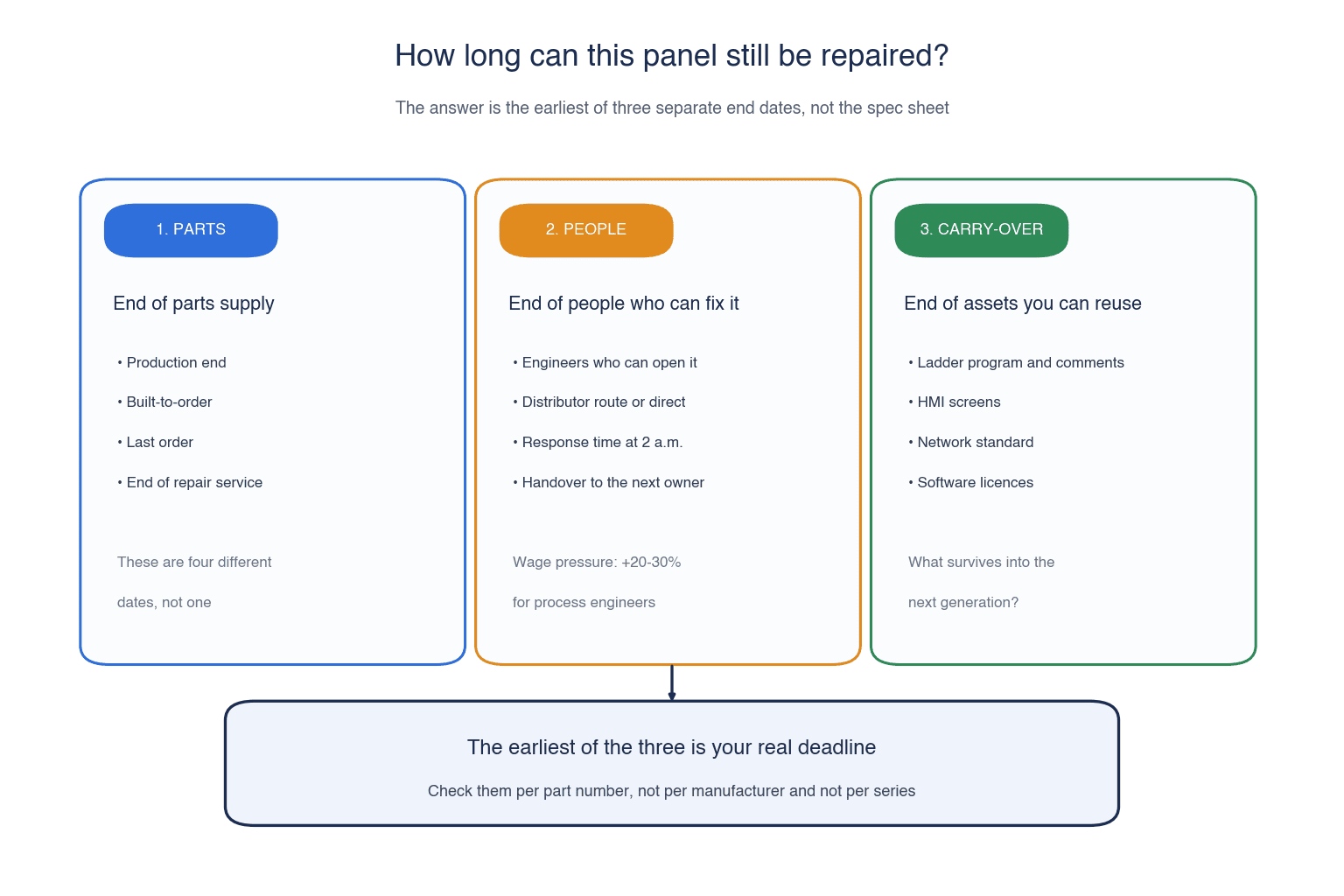
What matters is whether the panel can be repaired at that moment. More precisely, whether the three resources you need in order to repair it are still obtainable.
- Parts. Can a replacement for the failed CPU or module still be sourced through an authorised channel?
- People. Can you get an engineer who can work on that model to the site, inside Thailand, within the time you have?
- Internals. Do the program, the screens and the communication settings still exist in a form that can be carried over to the next generation?
Each of the three has its own end date. In this article we call them the end date for parts supply, the end date for people who can repair it, and the end date for the assets you can carry over. Boiled down, PLC selection is the work of putting those three dates side by side and judging how they mesh with your own equipment plan.
Why a spec comparison table cannot produce the answer
A spec comparison table has no time axis. Processing speed, I/O count and price are all values for “now.” The control panel that PLC sits in, meanwhile, will be in service for 10 to 15 years, sometimes longer. You are selecting an asset that has a time axis using a table that does not. That mismatch is the root of the problem.
On top of that, the situations where a spec difference actually shows up in daily operation are limited. Even if scan time is halved, it feeds straight through to machine cycle time only in certain processes, typically high-speed positioning or work that has to stay in step with image processing. On most conveying, assembly and inspection lines, the number of steps in a changeover and how easy it is to isolate a fault will move annual output more than scan time does.
None of which means specs should be ignored. Use specs to screen candidates out, not to make the final call. That is the practical division of labour. Take the spec table as far as narrowing the field to two or three models that meet the performance you need, then decide from there on end dates. Reverse that order and you end up with a panel that cannot be replaced five years from now.
“Deal with it when it breaks” is becoming harder to sustain
Ten years ago, even a model whose supply had ended could be kept alive reasonably well through the second-hand market or a repair house. Those options still exist, but the terms have got worse. The reason is simple: the number of plants worldwide hunting for the same model number went up at the same time. Once a discontinuation is announced, the second-hand price and the difficulty of sourcing that model typically start moving from the announcement onward.
In other words, “deal with it when it breaks” has effectively turned into “compete to buy it faster and at a higher price than the next plant when it breaks.” The plants that win that race are the ones holding stock in-house or connected directly to a supply source. If you are neither, the only remaining option is to look at the dates before anything breaks.
In 2026, end dates are moving at three of the four major makers (the premise for any PLC manufacturer comparison)
First, the facts. The following is information published as of August 2026 by the makers themselves and by their distributors. Dates are revised from time to time, so for an actual decision please confirm the current status in each manufacturer’s official notices. Note also that the model numbers and product names cited here are the respective manufacturers’ products, not ours.
| Item | Published date and content | Which of the four stages | Source |
|---|---|---|---|
| Mitsubishi Electric MELSEC-Q UD-type CPUs (Q03UD / Q04UDH / Q06UDH / Q13UDEH / Q26UDEH, etc.) | Production scheduled to end 30 October 2026. Under Mitsubishi Electric’s general policy, repair service runs for 7 years after production ends, so around 2033 is the working figure | End of production (plus indicative end of repair service) | artitech FA equipment discontinuation quick-reference list / Mitsubishi Electric FA discontinued products page |
| Mitsubishi Electric MELSECNET/H modules (QJ71LP21G / QJ71BR11, etc.) | Moving to made-to-order production on 31 March 2026, with orders closing 28 February 2029. The stated reason is that some of the components used are difficult to obtain | Transition to made-to-order, then last order | Narasaki Denki discontinuation notices |
| Omron CS series | Discontinuation announced March 2024; last orders for part of the range March 2025 | End of production, then last order | Takashima Denki maker notices / Omron control equipment discontinued products page |
| Omron CJ2H-CPU6*-EIP | End of March 2025 extended to end of March 2027 | Deadline extended | As above |
| Omron CJ2M-CPU3* | End of March 2026 extended to end of March 2028 | Deadline extended | As above |
| Omron CS1D-CPU6*H / P | Discontinuation withdrawn | Withdrawn | As above |
| Siemens SIMATIC S7-300 / ET 200M | Product Phase-Out effective 1 October 2023; standard delivery ended 1 October 2025. After that, spare parts only for roughly 10 years (around 2033). No firmware updates are provided | End of production, then spare parts only | Classic Automation / Automation Trader |
| Keyence KV-8000 | Current model. Marketed as delivering roughly 10 times the processing speed of the previous generation (manufacturer’s claim). Support is available in which the maker performs program conversion when replacing a PLC from another maker. Sold direct, without distributors | Current | Keyence official product page / case studies |
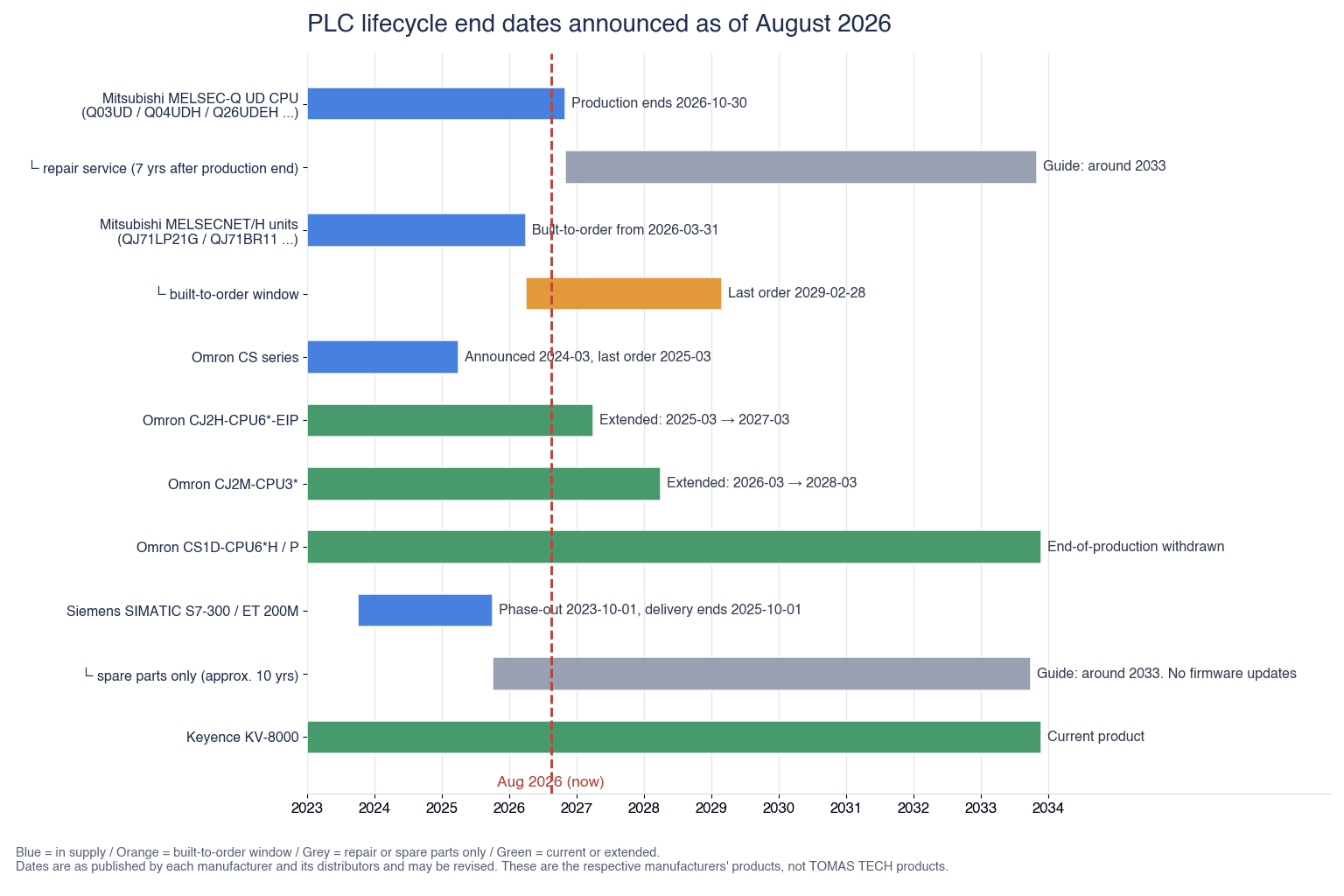
Plot that table onto a single calendar and you can see how densely the dates cluster between 2025 and 2029. You can also see that Mitsubishi Electric’s UD-type CPUs and Siemens’ S7-300 line up almost exactly, in that the indicative end of repair service for both falls around 2033. Which means a panel you judge in 2026 to be fine because it is still running may hit the same problem all at once, seven years from now.
“End of production,” “made-to-order,” “last order” and “end of repair service” are four different dates
The most common misunderstanding on the shop floor is to treat those four as a single date. Taking them in turn:
End of production (discontinuation). The day the volume production line stops. It does not mean stock goes to zero at that point. If there is inventory at the distributor or the maker, you can keep buying for a while afterwards. Conversely, popular models sometimes see stock disappear immediately after the announcement, so the period in which a part is genuinely obtainable varies model by model.
Transition to made-to-order production. Volume production stops, but the maker will build a batch if orders come in. Mitsubishi Electric’s MELSECNET/H modules are in this stage: they move to made-to-order production on 31 March 2026, with orders closing on 28 February 2029 as published. At this stage the price and the lead time are not necessarily the same as during volume production. The reason is stated openly as well: some of the components used are difficult to obtain. In other words, what sets the end date is not only the maker’s own plans but the semiconductor and electronic component supply chain behind it.
Last order. The final day on which orders are accepted. Past that point, new units through authorised channels are finished. Any decision about whether to stock spares is worked backwards from this date.
End of repair service. The day from which sending a failed unit in no longer gets it repaired. Mitsubishi Electric’s general policy is 7 years after production ends, which puts the working figure for the UD-type CPUs at around 2033. For Siemens’ S7-300, the position published is spare parts only for roughly 10 years after standard delivery ends.
Once you accept that these are four different dates, the answer to “how many more years can we use it” changes for one and the same model. Look at the last order date and you have three years left; look at the end of repair service and you have seven. It is entirely possible for two estimates several years apart to be circulating inside the company about the same panel. When the question “how many more years can we run this” comes up in a capital request, agree first on which date everybody is referring to. Argue without settling that, and the discussion spins before it ever reaches the money.
How to read extensions and withdrawals
Omron’s CJ2H-CPU6*-EIP has moved from end of March 2025 to end of March 2027, and the CJ2M-CPU3* from end of March 2026 to end of March 2028, each with its discontinuation timing extended. In the case of the CS1D-CPU6*H / P, the discontinuation itself has been withdrawn. Continued production has been indicated for the CJ2 series.
For existing users this is unambiguously good news. At the same time, it carries a second meaning for anyone in the middle of a selection exercise. It is evidence that end dates move. They can be brought forward, they can be pushed back, and they can be withdrawn.
So the way to handle them during selection follows from that. A published date is the maker’s plan as of that moment, not a contractual guarantee. If you are going to build a 10-year plan on top of a date, it is worth confirming that the plan survives the date moving by a year either way. Put the other way round: a plan that collapses because a date shifted by six months was short of margin to begin with.
There is one more mistake that tends to follow the news of an extension. Concluding that “it has been pushed back, so we will skip it this time” and then doing nothing in the following fiscal year. The two years you gained are two years in which to prepare for the update, not two years in which to do nothing. Use them to pin down the current state of the drawings and the program and the cost of the next update will come down measurably.
Selection axis 1. Parts supply: how to read the dates that start a PLC retrofit or migration
Of the three end dates, parts supply is the easiest to research, because the information is published. And yet many plants do not have it. The reason is that they are researching at the wrong unit of granularity.
The unit to research is not the maker, nor the series, but the model number
“We are a Mitsubishi plant, we will be fine.” “It is Omron, so no worries.” Those lines come up often in selection meetings. At that level of granularity, no judgement is possible. Within the same series from the same maker, it genuinely happens that the CPU and the network module progress through the supply stages on separate tracks. In the Mitsubishi Electric example above, the planned end of production for the UD-type CPUs and the move to made-to-order for the MELSECNET/H modules are running on different dates.
What has to be done is straightforward: write out the model number of every module inside the panel and check the current status of each one. For a set of eight panels, that means CPUs, power supplies, digital I/O, analogue, positioning, communications and the HMI. Count them and it comes to 5 to 10 items per panel, so 40 to 80 items across eight. At a few minutes each, that is half a day to a day of work. The reality is that a great many plants have not spent that half day even once in five years.
Column layout for the model-number inventory sheet
When you actually sit down to do it, build a sheet with the following columns. If columns are missing, the sheet will not support a decision when you read it back later.
| Column | What goes in it | Why it is needed |
|---|---|---|
| Panel number / machine name | Which panel, which item | To define the unit of the update |
| Model number (type designation) | Exactly as printed on the nameplate | Suffix variants can carry different end dates |
| Quantity | Total units of the same model | The basis for how many spares to hold |
| Current stage | Current / made-to-order / last order placed / repair only | State explicitly which of the four stages applies |
| Published date | Year, month, day | The starting point for working backwards |
| Source and date checked | Where it was confirmed | So you can take a difference when you re-check in six months |
| Fallback if it fails | Spare on hand / second-hand / swap to successor | Decide in advance what you will do at 2 a.m. |
| Successor available | Model number, and the work involved in swapping over | The base layer for the update quotation |
With this sheet in hand, the reverse calculation described next follows directly. Without it, you research the same things from scratch every time.
Working back from the last order date must include the approval cycle
For models with a published last order date, work backwards to find when you need to move. Where capital expenditure requires approval from the Japanese head office, the period between the site recognising the need and a purchase order being issued runs longer than most people expect.
The elements to include in the reverse calculation are as follows. Put your own historical figures into the numbers.
- Current-state survey and requirement freeze (model-number inventory, extracting the current program, reconciling the I/O list)
- Obtaining and comparing quotations (with multiple vendors, there is back-and-forth to bring the specifications into line)
- Internal approval (local sign-off, then head office engineering, then finance and purchasing)
- Lead time from order to delivery
- Build, program migration and factory acceptance testing
- Where in the annual calendar the shutdown window for site installation and commissioning actually sits
That last item, number 6, is the one that bites hardest in practice. On a line running 24 hours, there are only a handful of days a year on which you can stop for an update. Even if the parts arrive on time, the update cannot go ahead without a shutdown window. So work backwards from the date of the shutdown window, not from the order date.
Stock spares, or bring the update forward
For a model whose last order date is approaching, there are three options available.
Option 1: stock spares. Buy the CPU and the main modules before the last order date and put them on the shelf. What this buys you is the ability to choose when the update happens. Instead of scrambling the moment something fails, you can hold out until a convenient shutdown window. The drawbacks are that the stock you laid down may never be used before the update comes round anyway, and that products containing batteries or electrolytic capacitors age even while stored. It is worth powering stored units up once a year to check them, or, if you are not going to, at least making sure it is visible that this has never been done.
Option 2: bring the update forward. We deal with this in the model calculation later, but carrying out the update as a planned project converts downtime into planned downtime. Planned downtime can be pushed onto non-operating days in the annual calendar, which compresses the opportunity cost substantially.
Option 3: extend the life partially through a PLC retrofit. Keep the enclosure, the power circuits and the field wiring, and swap only the CPU and the communication modules for successor units. The amount of work is small and the downtime is short. It applies where the successor maintains the same wiring and the same terminal block layout, or where a conversion adapter is available. Program compatibility, however, is a separate matter: some instructions can turn out to be unsupported. There is no way to settle that other than checking on the actual hardware.
Which of the three you pick comes down to two things. How much an hour of downtime costs you, and whether there is anyone locally who can carry out the repair. The second of those is the next section.
For the wider question of how to handle an ageing asset base as a whole, we set out a separate framework in When to decide on replacing legacy equipment. If you want to sequence a group of machines rather than deal with a PLC in isolation, that piece is worth reading alongside this one.
Selection axis 2. Can it be repaired in Thailand: the technician pool and time to arrival
This is the part that selection articles written in Japan tend not to cover. When you select a PLC for a plant in Thailand, three conditions differ from Japan.
Do not judge “can we get someone out” from a weekday afternoon
When support arrangements from the maker or the trading company are checked, the conversation almost always assumes weekday business hours. But control panels do not only stop on weekday afternoons. If anything, many maintenance staff will say that failures cluster in the night shift and at weekends.
So the table below is the one to fill in during selection. Put in values you have actually tested and confirmed yourself, not the maker’s published figures. We deliberately avoid printing a general “X hours” here, because the answer varies enormously with the industrial estate you are in and the contract you hold.
| Route | Weekday 08:00-17:00 | Weekday 22:00-06:00 (overnight) | Weekends and public holidays |
|---|---|---|---|
| In-house maintenance (on site) | |||
| Machine builder (Japan / local subsidiary) | |||
| PLC maker’s help desk or distributor | |||
| Local system integrator |
The value to enter is not “does the phone get answered” but the time until first-line fault isolation begins. A route where the phone is answered but an engineer is only dispatched the next business day is effectively unusable at night. Filling this table in once before a new line starts up gives you a persuasive piece of evidence when the capital request comes round.
The distributor route and direct sales deliver support differently
Products from Mitsubishi Electric, Omron and Siemens are generally understood to reach the market in Thailand mainly through trading companies and distributors. Keyence sells direct. This is not a matter of one being better than the other; the structure of how support reaches you is simply different. Which route applies in your case is best confirmed from your existing purchasing records.
Where a distributor is involved, that company’s stock and technical depth become, directly, your recovery time. Land a good distributor and it is not unusual for them to be faster than going to the maker’s help desk in Japan. Land one whose staff are sales-only with no engineers behind them, and you stall at the fault isolation stage. In other words, on the distributor route, choosing the distributor carries the same weight as choosing the model. Settling the maker during selection and leaving the distributor to be decided later is a risky order in which to take those decisions.
With direct sales, there is a single point of contact, so less gets lost in relay. Support in which the maker performs program conversion when replacing a PLC from another maker also lowers the barrier to switching. On the other hand, it can sit awkwardly with a purchasing policy that wants several makers consolidated into a single trading company order. This is something to square with the purchasing department up front.
Reduced to one line, the criterion looks like this. If you want the shortest recovery route, direct sales has the advantage; if you want procurement consolidated so that price and credit can be managed centrally, the distributor route has the advantage. Which of those takes priority depends on how the plant is run, and there is no single correct answer.
The situation around PLC programming talent in Thailand is changing
There is one further change that cannot be ignored. Chinese EV-related companies moving into Thailand have reportedly pushed pay levels for manufacturing engineers up by 20 to 30%, with staff moving away from Japanese-owned automotive parts manufacturers. In addition, from January 2026 a phased increase in the ceiling on the earnings base used to calculate social security contributions begins (Tokyo Consulting Group, Thai labour trends 2026).
The path by which this reaches your selection decision runs as follows. Even when someone in-house grows into the role of working on PLCs, the probability that the same person is still with you five years later is lower than it used to be. Which means that a selection that depends on the tacit knowledge of one particular individual carries more risk than it once did.
There are three concrete counter-measures. First, narrow the range of models. A plant standardised on one maker will get a newly hired engineer up to full contribution faster than a plant running three. Second, keep program comments and change history in the file rather than in the head of the person responsible. Third, line up at least one external party you can call on, in normal times rather than in a crisis. A company you contact for the first time in an emergency does not know the inside of the machine, so it has to start from fault isolation.
How to structure the contract and the working arrangement when programming is outsourced is covered in How to design PLC program development outsourcing. For how to make sure knowledge stays in-house when a new line is commissioned, see equipment start-up support.
Selection axis 3. Assets you can carry over: ladder programs, sequence control, communication standards, HMI screens and licences
The third end date belongs to the assets you already hold. It is the one most often overlooked, because hardware dates get published while nobody tells you the condition of your own assets.
What you can carry over at the next update makes a large difference to what that update costs. Here is a way of organising the stock-take.
| Asset | Updating within the same maker | Migrating to a different maker | Work generated when it cannot be carried over |
|---|---|---|---|
| Ladder program | Much of it can be migrated with conversion tools, though special instructions and some applied instructions need checking | Some makers offer conversion support, but operational verification is still required | Re-reading the logic and rewriting it, plus operational checks on every I/O point |
| Sequence control design philosophy (interlocks, approach to emergency stop) | Carries over almost entirely | Carries over almost entirely, though the way it is expressed changes | Redesigning the safety concept. Miss this and it leads to accidents |
| I/O list and electrical drawings | Carries over if it matches the physical installation | Same as the row above | On-site physical verification. The single most time-consuming task |
| HMI screens | Even within one maker, a generation change can force a rebuild | Rebuild in almost all cases | Rebuilding screen layouts and the alarm list |
| Communication standards and network topology | A generation change calls for a review | The connection method to upper-level systems has to be reconsidered | Modifications on the upper-level system side follow on |
| Development environment licences | Usually remains usable | New purchase | Cost, plus the process of deploying it to in-house PCs |
| Change history and record of on-site modifications | Carries over if it still exists | Same as the row above | Re-investigating “why is this circuit here” |
In practice, the single biggest consumer of time in that table is the gap between the drawings and the physical installation. Any control panel that has been in service for a few years will, almost without exception, have had modifications made on site. An added sensor, a temporary jumper, a contact wired in during an emergency. Where those have not been reflected in the drawings, every one of them has to be chased down on site at update time.
The one concrete action to take from this is simple. Even with no update planned, build the job of closing the gap between drawings and physical installation once a year into your maintenance routine. The next update quotation between plants that do this and plants that do not is plainly visible. Closing the gap can be distributed across normal daily work; leave it all until the update and it eats into your shutdown window.
Your choice of communication standard sets how much freedom you have at the next update
Among the assets you can carry over, the decision taken at selection time whose consequences run longest is the communication standard. The PLC itself will be replaced within 10 years, but the network topology is part of the skeleton of the plant, and once fixed it becomes hard to change.
As a reference point, the annual survey by HMS Networks (published in 2025) puts the share of new industrial network nodes at 18% for PROFINET, 18% for EtherNet/IP and 12% for EtherCAT. That figure needs to be read with care, however. It is the distribution of new nodes globally, which is not the same as the distribution across the population of Japanese-owned plants in Thailand. CC-Link IE is strong in Japan, China and Asia, and its base depends on Mitsubishi Electric FA’s customer base. In other words, your actual set of options is determined not by that global share but by the distribution of your own machine builders and your own maintenance organisation.
Narrowed down, there are three points to decide during selection.
First, where to place the interface with upper-level systems. Do you push data straight out of the PLC, or put a gateway in between? Settle this and a change of PLC model no longer forces modifications on the upper-level side. The design of that connection method is covered in detail in How to design data collection from PLCs.
Second, whether to insert a maker-independent layer such as OPC UA. Inserting one adds a component to the architecture, but it increases your freedom to change PLC maker at the next update. Leaving it out gives you a simpler and faster architecture, at the cost of tying the upper-level system to the PLC model. Base this decision on how likely you are to change maker at the next update. If that likelihood is close to zero, leaving it out is the more reasonable choice.
Third, whether the wiring inside the panel changes when you migrate an existing industrial network to a newer standard. Moving from an architecture that uses optical fibre or coaxial cable, as Mitsubishi Electric’s MELSECNET/H does, to an Ethernet-based one brings a replacement of the cabling and the network hardware with it. That lands directly on the price of the update project. As noted above, the MELSECNET/H modules move to made-to-order production on 31 March 2026, with orders closing on 28 February 2029 as published. Plants with that architecture in place will want to plan for this cabling replacement as part of the work.
Our own model calculation: where does the 10-year total for eight control panels split?
What follows is our own model calculation. All the assumptions are disclosed, so read it with your own numbers substituted in. The amounts below are assumed values we have set for modelling purposes; they are neither any manufacturer’s published prices nor the going rate on any particular project.
Assumptions of the calculation
- Scope: one line made up of eight control panels
- Operation: 24 hours x 300 days a year (= 7,200 hours a year)
- Period: 10 years
- Currency: THB (no yen conversions mixed in)
- Opportunity cost per hour of line stoppage: 15,000 THB. Substitute your own figure for this number. A sensitivity analysis across different rates appears later
- The existing control panels are assumed to be old enough that their book value is treated as zero
- Assumed unit prices: current generation CPU 90,000 / module 20,000 / HMI 40,000. Replacement generation CPU 130,000 / module 24,000 / HMI 60,000
The two scenarios being compared are as follows.
- Scenario A (life extension): keep using the existing models, whose supply end is approaching, for the full 10 years. Secure a batch of spares before the last order date, then run on ad hoc parts sourcing and emergency response. No planned update is carried out in the 10 years.
- Scenario B (one planned update in year 5): run the existing models in years 1 to 5, then carry out one planned update in year 5. The enclosure, power circuits and field wiring are reused; the CPUs, modules and HMIs are replaced and the program is migrated.
The rule that keeps the counterfactuals apart: we do not measure the benefit of A or B as “savings against the other.” Each scenario’s 10-year total is calculated on the same definition, and only at the end is the difference taken. In addition, the portion of the update assets B acquires in year 5 that is still remaining at the end of year 10 is deducted, so that the two are matched to the same period. Without that deduction, the update obligation waiting for A in year 11 stays hidden and the comparison does not hold together.
Breakdown of downtime
| Item | Scenario A | Scenario B |
|---|---|---|
| Unplanned stoppages, years 1-5 | 3 per year x 2.0 hours x 5 years = 30 hours | 3 per year x 2.0 hours x 5 years = 30 hours |
| Unplanned stoppages, years 6-10 | 4 per year x 3.5 hours x 5 years = 70 hours | 2 per year x 1.0 hours x 5 years = 10 hours |
| Planned stoppage (update work) | 0 hours | 48 hours |
| Total downtime | 100 hours | 88 hours |
| Of which hours charged as loss | 100 hours | 56 hours |
| Downtime loss (at 15,000 THB per hour) | 1,500,000 THB | 840,000 THB |
The reason recovery time per incident lengthens for A in years 6 to 10 is that, once repair service has ended, like-for-like replacement is no longer possible, so every failure now includes a search for a substitute part and an interim fix. It is not only the number of incidents but the time per incident that grows, and that is the defining characteristic of this stretch.
Of B’s 48 hours of planned stoppage, 32 hours are treated as falling on non-operating days in the annual calendar (at 7,200 operating hours a year, 1,560 hours a year are non-operating), and no loss is charged against them. The remaining 16 hours are charged on the assumption that they stop an operating day. Planned downtime is downtime whose date you can buy; unplanned downtime is downtime you cannot. That distinction is the single most influential factor in the whole calculation.
Breakdown of direct spend
| Cost item | Scenario A | Scenario B | Assumption |
|---|---|---|---|
| 1. Advance purchase of spares (before last order) | 920,000 | 420,000 | A: 4 CPUs x 90,000 + 20 modules x 20,000 + 4 HMIs x 40,000 / B: 2 CPUs x 90,000 + 8 modules x 20,000 + 2 HMIs x 40,000 |
| 2. Ad hoc maintenance parts, years 1-5 | 250,000 | 250,000 | 50,000 a year x 5 years in both scenarios |
| 3. Ad hoc maintenance parts, years 6-10 | 825,000 | 200,000 | A: 165,000 a year x 5 years (second-hand and substitute sourcing after repair service ends) / B: 40,000 a year x 5 years (authorised sourcing on the new generation) |
| 4. Update project, all in (year 5) | 0 | 3,990,000 | Broken down in the next table |
| 5. External maintenance support (10-year total) | 600,000 | 450,000 | A: 60,000 a year x 10 years / B: years 1-5 at 60,000 a year = 300,000, years 6-10 at 30,000 a year = 150,000 |
| Total direct spend | 2,595,000 | 5,310,000 |
The update project breaks down as follows.
| Item | Quantity | Unit price | Amount |
|---|---|---|---|
| CPUs | 8 units | 130,000 | 1,040,000 |
| I/O and communication modules | 40 items | 24,000 | 960,000 |
| HMIs | 8 units | 60,000 | 480,000 |
| Equipment subtotal | 2,480,000 | ||
| Program migration and verification | 8 panels | 85,000 | 680,000 |
| Panel modification, reuse of existing wiring | 8 panels | 60,000 | 480,000 |
| Commissioning and site trials | Lump sum | 350,000 | 350,000 |
| Update project total | 3,990,000 |
The 10-year total: the conclusion reverses depending on which view you take
First, line up only the money that actually leaves the business during the period.
| View 1: 10-year total on a cash-out basis | Scenario A | Scenario B |
|---|---|---|
| Direct spend | 2,595,000 | 5,310,000 |
| Downtime loss | 1,500,000 | 840,000 |
| 10-year total | 4,095,000 | 6,150,000 |
| Difference (B – A) | +2,055,000 (A is cheaper) |
Look only at this table and the conclusion is that extending the life is more than 2 million THB cheaper. Put this table in front of an approval meeting and the update gets rejected.
But the comparison does not hold. At the end of year 10, A and B are in completely different states. A’s control panels are ten years further into their life, repair service has ended, and an update project worth the equivalent of 3,990,000 THB is waiting in its entirety in year 11. B’s panels are five years past their update, with half their life still ahead. Ignoring that difference in state and comparing only the totals is exactly the counterfactual mix-up we set out to avoid.
So we set the expected service life of the updated control panels at 10 years and apportion on a straight line to match the period. Of the 3,990,000 THB B invested in year 5, the portion consumed by the end of year 10 is five years’ worth, or 1,995,000 THB, and the remaining 1,995,000 THB is an asset carried into year 11 and beyond. That remaining amount is deducted from B. A has acquired no update asset, so it has neither consumption nor a remaining balance.
| View 2: 10-year total matched to the period | Scenario A | Scenario B |
|---|---|---|
| Direct spend | 2,595,000 | 5,310,000 |
| Remaining value of update assets (end of year 10, deducted) | 0 | -1,995,000 |
| Direct spend after period matching | 2,595,000 | 3,315,000 |
| Downtime loss | 1,500,000 | 840,000 |
| 10-year total | 4,095,000 | 4,155,000 |
| Difference (B – A) | +60,000 (A is cheaper) |
The difference is 60,000 THB. On a 10-year comparison of the order of 4 million THB, a gap of 60,000. In practical terms, the conclusion is effectively a dead heat.

What a difference of 60,000 THB means
Ask how many hours that 60,000 THB represents and, divided by 15,000 THB, it is 4 hours. Which is to say that the moment Scenario A’s unplanned downtime comes to 104 hours over 10 years instead of 100, the two scenarios cost the same. Four hours against an estimate of 100 hours is 4%. Nobody can predict failure hours a decade out to an accuracy of 4%. So what this calculation supports is neither “updating is cheaper” nor “extending the life is cheaper,” but that money alone does not decide it.
A one-line formula for deciding with your own numbers
From the two tables above, the difference can be written as a single expression. Here p is the opportunity cost per hour of stoppage, in THB.
Difference (B – A) = 720,000 – 44 x p
720,000 is the difference in direct spend after period matching (3,315,000 – 2,595,000), and 44 is the difference in hours charged as loss (100 hours – 56 hours). A positive difference means A is cheaper; a negative one means B is cheaper.
The break-even point is 720,000 / 44 = approximately 16,364 THB per hour. At plants where an hour of stoppage costs less than that, life extension is cheaper; where it costs more, the planned update is cheaper. The sensitivity looks like this.
| Opportunity cost per hour of stoppage | A: 10-year total | B: 10-year total | Difference (B – A) | Favoured |
|---|---|---|---|---|
| 8,000 THB | 3,395,000 | 3,763,000 | +368,000 | A (life extension) |
| 15,000 THB | 4,095,000 | 4,155,000 | +60,000 | A (but only just) |
| Approx. 16,364 THB | Approx. 4,231,000 | Approx. 4,231,000 | 0 | Break-even |
| 25,000 THB | 5,095,000 | 4,715,000 | -380,000 | B (planned update) |
| 40,000 THB | 6,595,000 | 5,555,000 | -1,040,000 | B (planned update) |
The concrete thing you can use tomorrow is that formula. Settle on one figure for what an hour of stoppage costs your plant and substitute it in. That alone tells you whether you are a plant that leans towards life extension or towards updating. High-mix low-volume plants with inventory buffers sit on the left; dedicated lines shipping direct to a customer sit on the right.
What this calculation does not claim
Three things, stated explicitly. First, this is not a quotation for any particular project. It is a model built on assumed unit prices and incident counts. Second, no payback period is given. In this comparison both scenarios are expenditure and the investment-to-return relationship cannot be defined uniquely, so we have avoided producing a year figure with no defensible denominator. Third, it does not enter into the question of which model to select. What this calculation deals with is not the relative merits of makers but the timing of the update and how controllable your downtime is.
The issues that arise at the point of ordering the control panels themselves are set out separately in our guide to ordering control panel design and manufacture.
Is mixing makers a bad thing? Draw the line at three layers
“Standardise on a single maker” is a sound policy from a maintenance point of view. In a real plant, though, it cannot be held, because machine builders deliver equipment with their own standard PLC inside. Policy and reality collide at that point, and it is usually the policy that ends up hollowed out.
The workable answer is to stop treating standardisation as a binary. Split the plant into three layers and hold a different rule in each.
| Layer | Scope | Who sets the standard | Mixing allowed? | Reasoning |
|---|---|---|---|---|
| Layer 1: plant infrastructure | Utility monitoring, aggregation to upper-level systems, energy metering, common alarm systems | Head office engineering plus local maintenance | Not allowed | Stays in place longest and has the longest replacement cycle. Mix here and maintenance training doubles |
| Layer 2: line control | Material handling, conveyors, line-wide interlocks, the supervisory HMI | Local production engineering | Consolidate on one maker in principle | The layer where first-line maintenance response happens. This is what gets touched at night |
| Layer 3: in-machine control | Control built in by the machine builder to its own standard | The machine builder | Mixing accepted | Break the machine builder’s standard and you compromise warranty cover and start-up quality |
The practical effect of drawing the line this way is that by explicitly conceding layer 3, you can hold layers 1 and 2 intact. Set out an unworkable policy of “Mitsubishi across the whole company” and exceptions pile up through negotiations with machine builders until, in the end, there is no policy at all. Decide from the outset that layer 3 is permitted, and the negotiating capital you free up there can be concentrated on layers 1 and 2.
Where layer 3 is permitted, there are three items to settle in the contract with the machine builder without fail.
- The scope of program provision. Will the source be handed over, or will it be password-protected? If protected, how far can maintenance staff go?
- The output interface to the upper level. Whatever the PLC inside the machine is, the format of the signals and data sent to the line side is to follow your own specification. Align this and swapping out a machine will not ripple upwards.
- The supply period for maintenance parts, and who to contact on failure. Is it via the machine builder, or direct to the PLC maker? Get it in writing at handover: who to call at night.
Put these three into the specification at the enquiry stage for the machine. Negotiate them after delivery and there is a cost attached.
The same structure of decision applies to selecting a drive method, incidentally. On how to choose a control method, see choosing between servo control and inverter control.
A 10-point checklist to complete before ordering or submitting the capital request
Complete the following ten items before selection and approval. Any item you cannot fill in is a hole in this particular decision.
- Has every model number in the target panels been inventoried (panel number, model number, quantity, current stage, source and date checked)?
- Is there internal agreement on which of the four dates is being discussed (end of production / made-to-order / last order / end of repair service)?
- Has the “date we must move” derived from the last order date been worked back from the shutdown-window calendar?
- Has a single agreed figure been set for the opportunity cost per hour of stoppage (the value to substitute into the formula in this article)?
- Has the time to first-line fault isolation at night and at weekends been measured or confirmed for each route?
- If a distributor is used, has whether that distributor has engineers, and their scope of support, been confirmed?
- Have the gaps between drawings and physical installation (on-site modifications, temporary jumpers, added sensors not yet drawn) been identified?
- Have assets to be carried over and assets to be rebuilt been sorted (ladder / HMI screens / network architecture / licences)?
- Is the interface with upper-level systems positioned where a change of PLC model will not affect it?
- Is it stated explicitly in the capital request whether the discussion concerns layer 1, layer 2 or layer 3?
Of these, items 3, 4 and 7 take time to complete, and without them the quotation will not be accurate. Which also means that once those three are in place, quotations from several vendors can be compared on the same footing.
Frequently asked questions
What should be decided first in PLC selection?
The opportunity cost per hour of stoppage. Once that single figure is settled, whether to stock spares or commit to a planned update, whether to prioritise the direct-sales route or the distributor route, and how far to invest in redundancy can all be judged against the same yardstick. Without it, the discussion turns into an exchange of vague impressions about things being expensive or cheap. The calculation in this article uses 15,000 THB per hour, but this is a number for you to set. Agree internally beforehand how much of revenue, gross margin, additional overtime and logistics cost, and impact on the customer you intend to include.
What is the difference between a Mitsubishi PLC and a Keyence PLC?
It is not a matter of one being better; the advantage shifts with the conditions. Mitsubishi Electric products are widely used in Japanese-owned plants in Thailand and, as far as we see on site, the pool of engineers who can work on them is correspondingly large, so people tend to be easier to secure. Against that, end dates move at a fine-grained model-by-model level, so the inventory work takes effort. The planned end of production for the UD-type CPUs (30 October 2026) and the move of the MELSECNET/H modules to made-to-order production, both covered above, are examples of that. Keyence’s KV-8000 is a current model marketed with a high-speed engine delivering 10 times the previous generation; because it is sold direct there is a single point of contact, and support is available in which the maker performs program conversion when replacing a PLC from another maker. If a short recovery route is the priority, direct sales has the advantage; if the purchasing policy is to consolidate procurement and manage price and credit centrally, the distributor route has the advantage. Note that these are the respective manufacturers’ products, not ours.
Which is cheaper, a PLC retrofit or a full update?
Looked at purely as short-term spend, a PLC retrofit (swapping only the CPU and communication modules for successor units) is cheaper, because there is less work involved and the downtime is shorter. In the calculation in this article, a retrofit is treated as one of the options within life extension, that is, within Scenario A. On that basis, what the figures show is that over 10 years the totals for life extension and for a planned update can come out effectively level. The break-even point is around 16,364 THB per hour of stoppage; below that, life extension is cheaper, and above it, the planned update is (our own calculation, on the assumptions set out in the text). There is one further precondition if you choose the retrofit route: that the successor maintains the same wiring and terminal block layout or that a conversion route exists, and that instruction-level program compatibility has been confirmed on the actual hardware. A retrofit undertaken without that confirmation carries the risk of not finishing inside the shutdown window.
Can PLC programming be outsourced in Thailand?
It can. But as with selection, look at your prospective partner’s own “end dates.” Specifically, four things: whether they hold the development environment for the maker in question, how far their coverage extends at night and at weekends, whether the program source and change history will be delivered to you, and whether they have an arrangement for handover if the assigned engineer leaves. The third of those in particular is worth confirming in writing before contracting. Let a few years pass without the source in your hands and the next update starts with analysis from scratch. How to set up the working arrangement in detail is covered in outsourcing PLC program development.
When are Omron PLCs being discontinued?
It varies by model number, and the dates themselves are moving. The CS series had a discontinuation notice issued in March 2024, with last orders for part of the range in March 2025. Meanwhile the CJ2H-CPU6*-EIP has been extended from end of March 2025 to end of March 2027, and the CJ2M-CPU3* from end of March 2026 to end of March 2028. For the CS1D-CPU6*H / P the discontinuation itself has been withdrawn, and continued production has been indicated for the CJ2 series. Write out the model numbers in your own panels exactly as printed on the nameplate and check them one at a time against the official discontinued products page. At the granularity of “it is Omron so we are fine” or “it is Omron so we are exposed,” no judgement is possible.
Summary
The final fork in PLC selection is not processing speed and not how easy the ladder is to write. It is how many more years that panel can be repaired. And that is set by three end dates: the end date for parts supply, the end date for people in Thailand who can repair it, and the end date for the assets you can carry over.
On parts supply, hold on to the fact that end of production, transition to made-to-order, last order and end of repair service are four different dates, and inventory every model number inside the panel one item at a time. Judgement is not possible at the level of the maker or the series. In 2026 the dates at Mitsubishi Electric, Omron and Siemens are all moving at once, with extensions and withdrawals happening too. Assume dates will be revised, and build a plan that does not break if one moves by a year.
On people who can repair it, evaluate each route by the time to first-line fault isolation at night and at weekends, not on a weekday afternoon. On the distributor route, choosing the distributor carries the same weight as choosing the model. And with engineer mobility rising, an architecture that depends on one individual’s tacit knowledge is riskier than it used to be.
On the assets you can carry over, building the annual job of closing the gap between drawings and the physical installation into maintenance work is what does most to improve the accuracy of the next update quotation. Where you place the communication standard and the interface with upper-level systems is a decision that outlasts the PLC itself.
And on money. In the model calculation for eight control panels over 10 years, life extension and a single planned update in year 5 came out, once matched to the period, effectively level on the 10-year total (a difference of 60,000 THB, equivalent to 4 hours of downtime). Substitute your own cost per hour of stoppage into the expression Difference (B – A) = 720,000 – 44 x p and you can see which side your plant falls on. The break-even point is around 16,364 THB per hour. Precisely because the totals do not settle it, what decides the matter is whether you can schedule your own downtime, and what state the panel is in at the end of year 10.
Equipment updates in Thailand throw up situations where the criteria used in Japan cannot simply be transplanted. The route the parts travel, who can be called out at 2 a.m., and what documentation you can leave for the next person. If you would like to work through which of your own model numbers sits at which stage, or to re-run this calculation using your own downtime cost, please get in touch through our contact form. We are happy to talk through how to run the inventory and how to set the assumptions for the calculation.
Sources referenced in this article: artitech FA equipment discontinuation quick-reference list / Mitsubishi Electric FA discontinued products page / Narasaki Denki discontinuation notices / Classic Automation / Automation Trader / Takashima Denki maker notices / Omron control equipment discontinued products page / Keyence official product page and case studies / HMS Networks annual industrial network survey (published 2025) / Tokyo Consulting Group, Thai labour trends 2026. The dates and figures given reflect what was published as of August 2026. The calculation section is a model based on assumptions we have set for illustration and is not a quotation for any specific project. All product names and model numbers in the text are the respective manufacturers’ products, not ours.


