


“Should this axis be on servo control, or is inverter control enough?” When a plant in Thailand puts a retrofit out to quotation, that question almost always collapses into a price comparison. But price is not what causes the wrong choice on the shop floor. The wrong choice happens because nobody has checked, in numbers, whether the axis is being asked for a position or only for a speed, and how its load torque changes with rotational speed. This article walks through a model case built on a Japanese-owned metalworking plant in Rayong and opens up the four boundaries that decide the answer, formulas included.
Servo control versus inverter control is decided by what you demand of the axis, not by the motor
The difference is often explained as “servos are more accurate” or “inverters are cheaper”. Neither statement helps you decide anything. What actually separates the two is what you command the drive to do.
What you give an inverter is a frequency, which is to say a speed. Run at 50 Hz, drop to 30 Hz. The motor turns at the commanded speed and keeps turning. Where it stops is not the inverter’s concern. After a deceleration stop, the position where the shaft actually came to rest is decided by the inertia and friction present at that moment.
What you give a servo amplifier is a position. Move to the point 120.00 mm from the home position. The encoder reads the actual position back, and the amplifier keeps producing torque until the difference against the command reaches zero. Even after the target is reached, if an external force pushes the axis, the servo pushes back. Whether or not this read-back-and-close-the-error loop exists is the structural difference between the two.

So the first thing to decide is not a motor model number. It is the type of demand you are placing on that axis. This article uses four kinds of rotating equipment as a model case. Picture a Japanese-owned metalworking plant in Rayong, Thailand, running press and machining lines, considering a control retrofit of existing equipment. Annual operating hours are 6,000 h for all equipment, which corresponds to two shifts plus overtime.
| Equipment | Rating | Quantity | Load torque characteristic | Positioning |
|---|---|---|---|---|
| Dust collector fan | 22 kW | 2 units | Variable torque | Not required |
| Cooling water pump | 15 kW | 2 units | Variable torque | Not required |
| Belt conveyor | 3.7 kW | 6 units | Constant torque | Not required |
| Positioning table | 2.0 kW | 4 axes | — | Required |
Reading this table as “servo only on the axes that need positioning, inverters on everything else” is half right and half wrong. The positioning column alone does settle whether a servo is needed. But whether an inverter belongs on the remaining three, and whether that investment will ever pay back, cannot be judged without reading the load torque column. That column is the centre of this article.
Two misconceptions that end the discussion too early
“Inverters, because they are cheap.” An inverter unit does cost less than a servo amplifier, but the cost of a retrofit is not set by the hardware price. In the model case below, out of the 374,000 baht required to put inverters on two dust collector fans, the inverters themselves are 120,000 baht, roughly one third. The rest is panel modification, noise countermeasures, changes to the command logic on the PLC side, and commissioning. A project ordered on a hardware price comparison, that then doubles because there was not enough free space in the existing panel and a new panel had to be added, is a familiar story in Thailand as well. The thinking behind control panel design and fabrication is covered separately in our guide to outsourcing control panel design and manufacturing.
“Servos, because we need accuracy.” What “accuracy” refers to here is usually never shared. Stop position accuracy, uniformity of rotational speed, and scatter when the same motion is repeated are three different requirements, and they call for different hardware. If only speed uniformity is required, a sensorless vector inverter is often enough. If repeatable positioning accuracy is required, you need a servo. Take the word “accuracy” to quotation unchanged, and you will pay for performance nobody asked for.
The order of the decision is as follows. First, does the axis have a stop position requirement? Second, how does load torque change with rotational speed? Third, which tier of control method carries the response you actually need? Fourth, under which incentive measure do you file the investment? The rest of this article takes those four boundaries in turn.
Boundary 1 — Does the axis need to stop at a defined position, or only to stop
The first boundary is simple. Can you write the stop accuracy into the specification as a number? If you cannot, that axis does not need a servo.
An axis described as “roughly around here is fine” or “the operator lines it up by eye” is an axis you cannot write. Dust collector fans, cooling water pumps, belt conveyors, agitators and hydraulic pumps all fall into that group. What is demanded of them is that the required air volume, flow rate or transfer speed is delivered, not where they come to rest.
An axis you can write has its requirement stated numerically. For a positioning table, “repeatable positioning accuracy within ±0.05 mm”. For a rotary index, “indexing angle error ±0.02°”. For a feeder, “±0.1 mm against a feed length of 120.0 mm”. On top of that, settling time, the interval between reaching the commanded position and the vibration dying out, feeds straight into cycle time and therefore has to be quantified too.
Note also that the word “stop” carries three meanings that get mixed together on site. The first is a deceleration stop, which only brings the speed to zero. The second is position holding, where the axis maintains its position after stopping even if an external force is applied. The third is behaviour on emergency stop, which is the question of whether the axis may coast freely when power is removed or has to be held where it is. If a vertical axis needs position holding, you design around an electromagnetic brake even when a servo is fitted. Hand over “it just has to stop” without separating these three, and you will be delivered a design that drops the workpiece on emergency stop.
An axis positioned by a mechanical stopper is an axis somebody touches at every changeover
Equipment that could be written numerically but has no servo on it is not unusual. The classic case is an axis driven by a general purpose motor that is positioned by running it into a mechanical stopper. During production, accuracy is guaranteed by the stopper, so quality is fine. The problem appears at product changeover.
Assume the four positioning table axes in the model case are in exactly this state. At every changeover, an operator adjusts the stopper position, runs a trial piece, measures the dimension, and readjusts if needed. That takes 18 minutes each time, and there are 6 changeovers per day. Convert the axes to servo so the coordinates can be called from the program, and the work reduces to calling a product number and checking the first piece, which takes 3 minutes.
The time saved is 18 minutes minus 3 minutes, so 15 minutes, multiplied by 6 changeovers a day and 250 working days a year. 15 min x 6 x 250 days = 22,500 minutes, which is 375 hours per year. At a machine hour rate of 850 baht/h for this line, 375 h x 850 baht = 318,750 baht per year.
The investment for four axes breaks down as follows.
| Item | Amount (baht) |
|---|---|
| Servo amplifier and servo motor, 2.0 kW class, 78,000 x 4 axes | 312,000 |
| Mechanical rework including ball screws and couplings | 240,000 |
| Positioning unit and PLC modification | 130,000 |
| Teaching and commissioning | 95,000 |
| Total | 777,000 |
Payback is 777,000 / 318,750 = 2.4 years. What deserves attention here is that out of the 777,000 baht, the servo amplifiers and motors account for 312,000 baht, only about 40 percent. Mechanical rework on ball screws and couplings takes 240,000 baht. A mechanism that used to run on a general purpose motor and a stopper usually has backlash and stiffness that will not survive servo response, and unless the mechanical side is rebuilt, the servo will not deliver its performance. Submit a capital request built on the assumption that buying a servo amplifier is what converts the axis to servo, and the mechanical cost appears after approval and stalls the plan.
And here is the most important point. This investment does not reduce your electricity bill. If anything it raises it slightly. While servo-on, the drive keeps current flowing to hold position, which produces holding loss. Compared with a general purpose motor that consumes nothing while stopped, power consumption moves marginally upward. The benefit of going servo shows up in changeover time and stop accuracy, not on the electricity bill. Get this single point backwards and you will also pick the wrong incentive measure later.
Boundary 2 — Load torque characteristic, or which equipment inverter control actually saves money on
The second boundary is the part of this article we most want to emphasise. Inverter control lowers the electricity bill on variable torque loads only. Fit one to a constant torque load and almost nothing happens. And the load torque characteristic is precisely what nobody checks on site.
A variable torque load is one where the required torque changes in proportion to the square of the rotational speed, as with fans and pumps. Because torque follows the square of speed, shaft power (torque x speed) follows the cube of speed. Drop the speed to 50 percent and shaft power goes to 0.5³ = 0.125, in theory down to 12.5 percent. Efficiency losses and static pressure mean you never quite reach the theoretical figure in practice, but the reduction is still large.
A constant torque load is one where the required torque stays roughly the same regardless of speed, as with conveyors, extruders, crane hoists and positive displacement pumps. Shaft power is merely proportional to speed, so dropping the speed to 50 percent only takes power down to 50 percent. Worse, dropping a conveyor’s speed means dropping its throughput, so you cannot drop it while you are producing. The only time you can drop is the idle running time when no material is on the belt. That double constraint is why inverters do not pay back on constant torque loads.
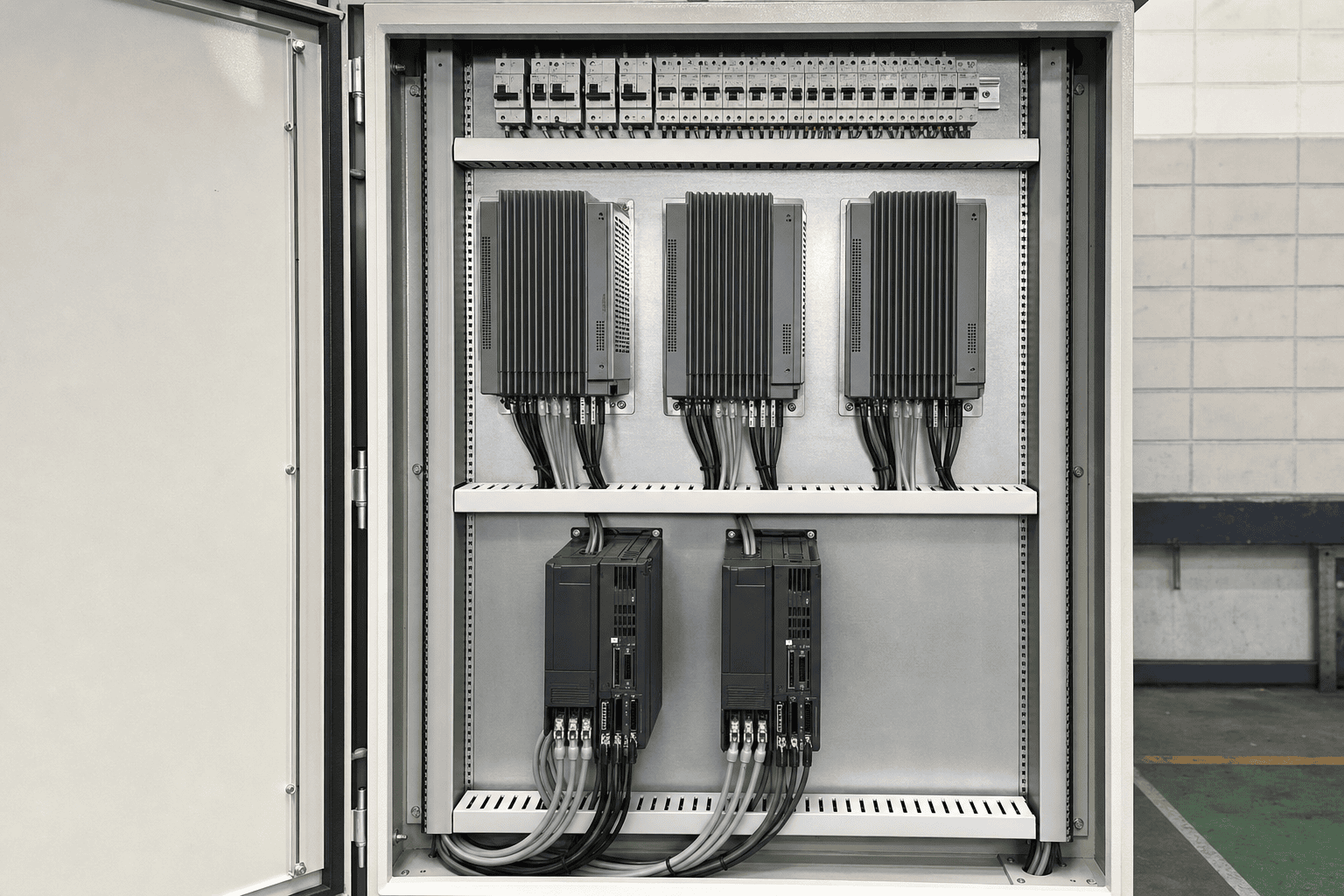
One more thing matters, which is how the flow is currently being throttled. Fan air volume can be controlled either by throttling the flow path with a damper or by reducing the speed itself. Damper throttling leaves the motor turning at rated speed and adds resistance to the flow path, so throttling barely reduces power draw. Turn that around, and it means that the more hours a machine spends running against a throttled damper, the more room an inverter retrofit has to save. A machine already running wide open with no need to throttle has no room at all.
Case A — Inverter retrofit on the dust collector fans
For reference points we use the worked example published by The Japan Electric Association of Engineers. That example is a calculation for a pump with valve throttling, assuming a static head of 30 percent and a shut-off pressure of 140 percent. In it, throttling the flow to 50 percent leaves shaft power at 0.65 Pn with the valve and 0.238 Pn with speed control, where Pn is rated shaft power. Damper throttling on a fan works on the same principle, keeping the motor at rated speed and adding resistance to the flow path, so we borrow those two points as conservative reference values. A fan has no component corresponding to static head, which means the real saving tends to come out larger than this. The same commentary also reports a fan case in which variable speed drive delivered a little over 50 percent energy saving against inlet damper control.
One caveat is worth stating. Because 0.238 is a pump model value that includes static head, it sits higher than the 0.5³ = 0.125 of the pure cube law mentioned in the previous section. At 100 percent flow both are 1.00 Pn. For 75 percent flow the source gives no value at that point, so we take the throttling side as a straight-line interpolation between the two points, 0.825 Pn, and speed control from the cube law, 0.75³ = 0.422 Pn. The 50 percent point and the 75 percent point therefore mix two models, which works in the direction of making the saving look slightly larger. That is exactly why Case A prime below always sets the case where the premise breaks alongside it.
Assume this plant’s dust collector fans need different air volumes depending on what is being machined, running at 100 percent flow for 20 percent of the time, 75 percent flow for 30 percent, and 50 percent flow for 50 percent. Multiplying the saving in each flow band by its time share and adding them up gives the annual average reduction rate.
| Flow | Time share | Throttling (damper or valve) | Speed control | Difference | Weighted contribution |
|---|---|---|---|---|---|
| 100% | 20% | 1.000 Pn | 1.000 Pn | 0.000 | 0.000 |
| 75% | 30% | 0.825 Pn | 0.422 Pn | 0.403 | 0.121 |
| 50% | 50% | 0.650 Pn | 0.238 Pn | 0.412 | 0.206 |
| Total | 100% | — | — | — | 0.327 |
The weighted average reduction rate is 0.327. In other words, the equivalent of 32.7 percent of rated shaft power can be saved across the year. Annual saving per unit is 22 kW x 0.327 x 6,000 h = 43,164 kWh. For two units that is 86,328 kWh, and at an electricity price of 3.95 baht/kWh, 86,328 kWh x 3.95 baht = 340,996 baht per year.
A note on that 3.95 baht/kWh. It is the average power tariff approved by Thailand’s ERC for the May to August 2026 period, excluding VAT. The fuel adjustment charge (Ft) for that period is set at 16.23 satang/kWh. Actual industrial TOU rates vary by supply voltage category and time band, so please treat the calculations in this article as estimates based on an average unit price. To substitute your own actual rate, multiply the kWh figures above by your own price.
The investment for two units builds up as follows.
| Item | Amount (baht) |
|---|---|
| Inverter units, 22 kW class, 60,000 x 2 units | 120,000 |
| Panel modification, power and control wiring, terminal blocks, 45,000 x 2 units | 90,000 |
| Noise countermeasures, input reactor, EMC filter, shielded cable, 22,000 x 2 units | 44,000 |
| Air volume command and interlock changes on the PLC side | 65,000 |
| Commissioning, on-site adjustment and operator handover | 55,000 |
| Total | 374,000 |
Payback is 374,000 / 340,996 = 1.1 years. At that level, the capital request is not hard to argue. The 44,000 baht carried for noise countermeasures is easy to overlook, but an inverter becomes a noise source through high speed switching, so the cost of protecting existing instrumentation signals and encoder cabling belongs in the budget from the start. There are real cases where this item was cut from the budget and the readings on the weighing machine next door started jumping.
Case A prime — In a plant that never throttles, it does not pay back, it costs more
That figure of 1.1 years depends entirely on the operating pattern being 20 percent at full flow, 30 percent at 75 percent and 50 percent at half flow. Here is what happens when the premise breaks, recalculated with the same work and the same hardware.
Suppose the pattern were instead 70 percent of the time at 100 percent flow, 20 percent at 75 percent flow and 10 percent at 50 percent flow. That is a plant running wide open for most of its hours. The weighted difference becomes 0.20 x 0.403 + 0.10 x 0.412 = 0.122 Pn, which is under 40 percent of the 0.327 in the standard case.
The annual saving is 22 kW x 0.122 x 6,000 h x 2 units = 32,208 kWh, and in money 32,208 kWh x 3.95 baht = 127,222 baht per year. Payback becomes 374,000 / 127,222 = 2.9 years. Same hardware, same work, same capital outlay, and payback has moved from 1.1 years to 2.9 years. What moved it was not equipment performance. It was the operating pattern.
There is a worse premise still. Fit an inverter to equipment that never throttles its damper and runs wide open at all times, and the saving is zero while the inverter’s own conversion loss adds roughly 3 percent on top. 22 kW x 2 units x 6,000 h x 3% = 7,920 kWh, which in money is an increase of 31,284 baht per year. A project approved as an energy saving investment ends up raising the electricity bill.
So what you should be measuring before an inverter retrofit is not the nameplate rating. It is the share of hours spent throttled. Record damper opening, or the time distribution of actual power draw, for at least one representative week. Why actual measurement is needed and how to do it is covered in our article on factory power monitoring systems. That said, installing a monitoring system does not cut your bill by a single baht. It falls only after you have measured, obtained the distribution, and screened the candidates by load characteristic. The procedure for extracting real data from older existing machines is set out in our article on IoT retrofit for legacy equipment.
Case B — On conveyors it is still 5.4 years
Now the same plant’s six belt conveyors, with inverters fitted. Being a constant torque load, shaft power is merely proportional to speed. And because reducing speed reduces throughput, you cannot reduce it during production. The only time available is idle running with no material flowing.
Assume you add presence detection sensors and drop to 50 percent speed whenever idle running is detected. If idle running is 25 percent of total time, the saving per unit is 3.7 kW x 0.5 x 6,000 h x 25% = 2,775 kWh. For six units that is 16,650 kWh, and in money 16,650 kWh x 3.95 baht = 65,768 baht per year.
That calculation is optimistic, because it assumes the conveyor still draws its full rated 3.7 kW while running empty. In reality the load torque of a belt carrying nothing falls to something like 20 to 40 percent of rated, so the absolute saving is smaller than this. Which means the payback below is, in practice, longer still.
The investment for six units is as follows.
| Item | Amount (baht) |
|---|---|
| Inverter units, 3.7 kW class, 18,000 x 6 units | 108,000 |
| Panel modification and wiring, 20,000 x 6 units | 120,000 |
| Presence detection sensors and PLC modification | 85,000 |
| Commissioning and on-site adjustment | 40,000 |
| Total | 353,000 |
Payback is 353,000 / 65,768 = 5.4 years, roughly five times longer than the 1.1 years on the dust collector fans. The scope of work is almost identical. You buy inverters, build them into a panel, and command them from the PLC. The only thing that differs is the load torque characteristic.
Look at the breakdown too, and against 108,000 baht of hardware there is 120,000 baht of panel modification and wiring, so the installation costs more than the equipment. When individual ratings are small but the unit count is high, hardware cost falls while installation cost stacks up in proportion to the number of units. Small-rating, high-count equipment is structurally the hardest place to make an inverter retrofit pay.
The same job of fitting an inverter comes out at 1.1 years or 5.4 years depending on one thing, the load torque characteristic. If a quotation lands on your desk proposing inverters uniformly across an equipment list without that fact having been checked, ask for a load characteristic column to be added. That alone separates what you should invest in from what can wait.
Boundary 3 — The staircase of control methods, or the three tiers between V/f and servo
The third boundary is the observation that the gap between inverter and servo is a staircase, not a cliff. Many evaluations jump straight from “an inverter probably will not do it” to “so, a servo”, when there are at least three steps in between.
| Control method | Speed feedback | Where it fits | Weakness | Skill required to maintain it |
|---|---|---|---|---|
| V/f control | None | Air volume and flow adjustment on fans and pumps, driving several motors from one drive | Torque tends to fall short at low speed, and speed shifts with load variation | Basic electrical work plus the ability to follow the setting procedure in the manual |
| Sensorless vector control | None (estimated) | Conveyors, agitators and other axes that must hold speed as load changes | Estimation gets unstable at very low speed and near standstill, and position cannot be held | Able to run motor constant auto-tuning and judge whether the result is plausible |
| PG vector control | Encoder | Winding and tension control, zero-speed torque, axes needing high speed response | Encoder wiring and noise countermeasures increase, and tuning hours rise | Able to adjust gains and isolate encoder faults |
| Servo control | Encoder | Positioning, repeatability, short settling time | Mechanical stiffness and backlash have to be engineered out | Able to manage positioning parameters and teaching, and to inspect the mechanical side |
With every step up the staircase, it is not only cost that rises but the skill level required of whoever maintains it. In Thailand that constraint bites harder than it does in Japan. A local electrical contractor can change V/f settings, but PG vector gain tuning or servo parameter management narrows the field of available engineers considerably. When the machine stops during night shift, who can touch it? Install equipment at a tier where you cannot answer that question, and every fault turns into a long line stoppage.
The technical ceiling has moved as well. Recent inverters reach a speed response frequency of 250 Hz using PG vector control with a permanent magnet (PM) motor and an encoder, which puts them in the response territory of early AC servos. Which means the judgment “not enough response, so a servo” is worth re-examining. If positioning itself is required, you need a servo. But if the requirement is speed response or tension holding, an upper tier of inverter may well be enough.
As a decision sequence, go back to Boundary 1 first and confirm whether positioning is required. If it is, the answer is a servo. If it is not, and the issue is only speed response or low speed torque, climb the staircase from V/f and take the lowest tier that meets the requirement. Buying a servo without examining how far you can get short of one means entering at the most expensive step. Cost, maintenance skill requirements and mechanical rework are all maximised there.
Boundary 4 — Which incentive measure you file under, or how the same job moves the CIT exemption cap by 363,500 baht
The fourth boundary is not technical, it is an application question. Thailand’s BOI offers efficiency improvement measures for existing projects, and a control retrofit can potentially be filed under them. File under the wrong measure, though, and the exemption cap is halved.
| Measure | Scope | Incentive |
|---|---|---|
| 1.1 | Efficiency improvement through machine replacement and automation | Import duty exemption on machinery plus 3-year CIT exemption, capped at 50% of the investment |
| 1.4 | Energy saving, alternative energy and reduction of environmental impact | Import duty exemption on machinery plus 3-year CIT exemption, capped at 100% of the investment |
These measures carry a minimum investment of 1 million baht, excluding land and working capital. Total investment in this model case is 374,000 + 353,000 + 777,000 = 1,504,000 baht, so the minimum is satisfied. This is where the fork appears.
Take the case of filing separately. The inverter work on the dust collector fans and conveyors comes to 374,000 + 353,000 = 727,000 baht, and since that investment targets energy saving it falls under measure 1.4, giving a cap of 727,000 baht at the 100 percent limit. The 777,000 baht of servo work is automation rather than energy saving, so it falls under measure 1.1, giving 777,000 x 50% = 388,500 baht. Added together, the cap is 1,115,500 baht.
Filing everything together under measure 1.1 gives 1,504,000 x 50% = 752,000 baht. The difference is 1,115,500 – 752,000 = 363,500 baht. Same job, same investment, and the cap moves that far purely on how the application is divided.
There is an exception within measure 1.1, though. For automation and robotics systems where linkage with Thailand’s domestic automation industry accounts for 30 percent or more of the value of the machinery being upgraded, measure 1.1 is also treated as capped at 100 percent of the investment. Whether you place the servo work with a system integrator based in Thailand therefore feeds directly into the size of the cap. It is worth confirming whether your own project meets that condition before you decide who to order from.
This is where the conclusion from Boundary 1 earns its keep. Converting to servo is not an energy saving investment. As the servo calculation in Boundary 1 showed, the electricity bill actually creeps up, so filing under measure 1.4 on energy saving grounds leaves you unable to evidence the effect. Conversely, rolling the inverter work into measure 1.1 as automation pushes an investment that could use the 100 percent cap into the 50 percent cap. The difference in technical nature maps directly onto the difference in application category.
Note that BOI measure content and eligibility conditions are revised over time. The figures in this article are an organised reading of the published guide, and actual eligibility is determined case by case. What you must submit as the basis for calculating energy savings, and how far the replacement of existing equipment is covered, are judged differently from project to project, so treat prior confirmation with the Board of Investment or a specialist familiar with the filing practice as a prerequisite. The calculation process shown in Case A, based on load characteristic and operating pattern, can be used as supporting material in exactly that prior confirmation.
Seven items to settle before you order servo motors or outsource the electrical design
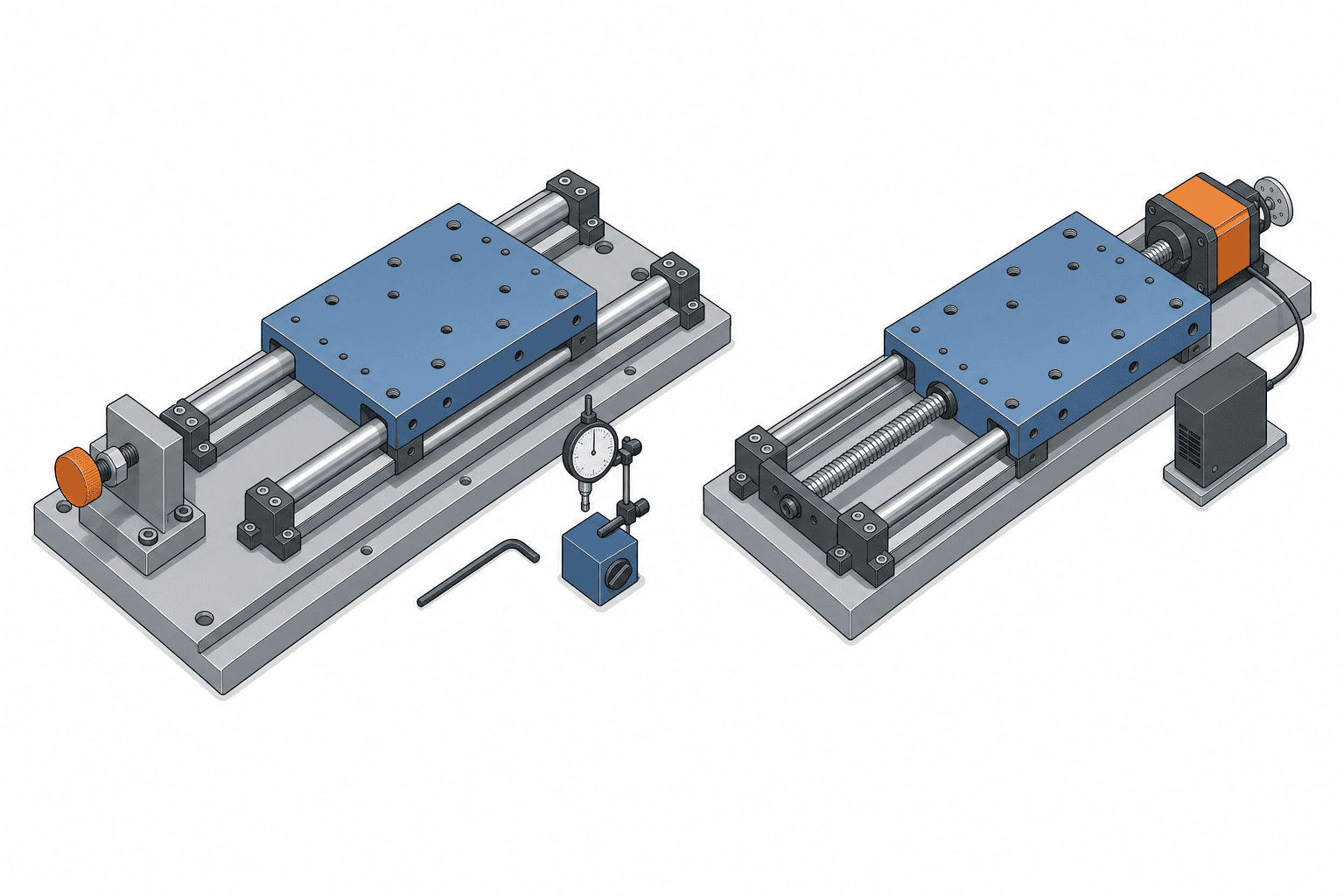
Once you have passed the four boundaries and the hardware direction is set, the next step is ordering. When electrical design is outsourced, anything absent from the specification either becomes a variation cost later or arrives with nobody having owned it. Here are seven items to settle in-house before you order.
| Item | What to decide | What happens if you do not |
|---|---|---|
| Command interface | Pulse train or network (industrial Ethernet or similar). Free slots on the existing PLC and whether it supports the option | The PLC turns out not to support it after wiring is done on site, and you end up having to add a CPU module |
| Homing method | Dog type or absolute. Whether homing is required after a power failure | A homing routine stays in the morning start-up, eroding the changeover saving |
| Behaviour on emergency stop | Free run, dynamic brake, or held by electromagnetic brake. Drop protection on vertical axes | The workpiece or tool falls on emergency stop and the safety review sends you back |
| Repeatability requirement | Repeatable positioning accuracy and settling time stated as numbers | You get an abstract complaint that accuracy is poor, with no way to settle responsibility |
| Local stock of spare parts | Whether amplifiers, motors and encoder cables can be sourced locally, and lead times | A failure means waiting on air freight from Japan and a line down for a week |
| Ownership of parameters | Who backs up the settings and where, and the approval flow for changes | The day the contractor moves on, nobody knows the settings and hardware cannot be swapped |
| HMI language | Thai, Japanese or English on screen, and whether alarm messages are included | Operators cannot read the alarms, so they press reset without checking what they say |
Of these, the bottom three cause the most trouble locally. Local stock of spare parts can be avoided at selection stage by confirming that the maker has a distributor and a service base inside Thailand. Ownership of parameters turns into a black box the moment it is left entirely to the contractor. Make it a contract condition that a parameter list is handed over on paper and as data at delivery, and that your own maintenance department keeps it.
HMI language ties directly to quality problems in Thai plants. Delivering a Japanese-only screen and having Thai operators press reset without reading the alarm content, so that a real fault went undetected, is far from a rare case. Specify multilingual coverage down to alarm messages at the quotation stage.
Where to draw the line between what you outsource and what you keep in-house is organised by contractor type in our article on outsourcing PLC program development. What this article covers is one step earlier, namely deciding in-house what you demand of the axis. Outsource without settling that, and the contractor has no choice but to design against a guess, with the rework cost when the guess is wrong falling on the ordering side.
The order to follow when running a control retrofit in a Thai plant
Here is everything above rearranged into an execution sequence. Keeping the order matters because each stage consumes the output of the one before it.
First, measure. Capture actual power consumption and operating pattern for the target equipment over at least one representative week. Not the nameplate value, but what percentage of load it actually runs at and for how many hours. For equipment throttled by dampers or valves, record the distribution of opening as well. Any machine found at this stage to spend virtually no time throttled drops out of scope right there. As Case A prime showed, investing there raises the electricity bill.
Second, sort. Split the measured data by load torque characteristic into variable torque and constant torque. For variable torque equipment, calculate the reduction rate using the method in Case A. For constant torque equipment, confirm first what share of the hours can actually be reduced. Skip this sorting and take the equipment list to quotation as it stands, and a 1.1-year project and a 5.4-year project sit in the same table, forcing a decision on the average. Decide on the average, and projects that would have passed on their own merits get rejected.
Third, split the application. Organise the energy-saving inverter work and the automation servo work as separate investments. In the model case, that separation alone moved the CIT exemption cap by 363,500 baht. The measured data from stage one and the saving calculations from stage two go straight into the application documents. Which also means that a project run without measuring will have to rebuild its supporting evidence at filing time.
Fourth, order. Put the seven items from the previous section into the specification, fix the command interface and the emergency stop behaviour, and then request quotations. The window during which existing equipment can be stopped, meaning the shutdown slot available for installation and commissioning, should also be presented by the plant at this point. For what happens during start-up after installation, and who owns what, see our article on equipment start-up support. A control retrofit is complete not when the hardware is delivered, but when it has settled into the existing line operation.
Of these four stages, the ones most often skipped are the first and the second. Projects that jump straight to stage four because the equipment is old and the electricity bill is high are the most common, and the least likely to pay back.
Frequently Asked Questions
What is the difference between servo control and inverter control?
The type of command and the presence of feedback. What you give an inverter is a speed (frequency) command, and where the axis stops is not controlled. What you give a servo is a position command, the encoder reads the actual position back, and torque is produced until the error against the command reaches zero. So the selection criterion is not “do we need accuracy”, it is “can we write a stop position requirement for this axis as a number”. If you can, it is servo territory. If you cannot, it is inverter territory.
Does inverter control always save energy?
No. It saves energy only on variable torque loads such as fans and pumps, and only where the equipment is currently run throttled by a damper or valve. On a constant torque load such as a conveyor, shaft power is merely proportional to speed, and reducing speed reduces output, so the hours available for reduction are limited. In the model case in this article, payback on the dust collector fans was 1.1 years and on the conveyors 5.4 years. Fitted to equipment that runs wide open at all times, the inverter’s own conversion loss of roughly 3 percent produces an increase of 31,284 baht per year.
What should be decided first when selecting a servo motor?
Not the rating, but the numbers in the requirement. Repeatable positioning accuracy, settling time, maximum travel distance against cycle time, payload mass, and what you want that axis to do on emergency stop. Once those five are set, the required torque and inertia ratio can be calculated, and the rating follows from there. Do it the other way round, selecting a servo to match the rating of the existing motor, and the inertia ratio will not match, settling time stretches, and you never reach the accuracy you expected. On top of that, if the ball screws and couplings on the mechanical side lack stiffness, no amplifier performance will produce accuracy.
How much of the electrical design can be outsourced?
Circuit design, panel fabrication, wiring, PLC programming and commissioning can all be outsourced. What cannot be handed over is the definition of what you demand of the axis. Stop accuracy requirements, behaviour on emergency stop, homing method and ownership of parameters can only be decided by the side that operates the equipment. Order with those left blank and the contractor designs to a generic specification, and when that premise does not match your operation, the rework cost sits with you. Whether numbers appear in the specification is what separates a successful outsourcing from a failed one.
Can BOI incentives be used for a servo or inverter retrofit in Thailand?
It may qualify under the efficiency improvement measures for existing projects. Machine replacement and automation fall under measure 1.1 with CIT exemption capped at 50 percent of the investment, while energy saving, alternative energy and reduction of environmental impact fall under measure 1.4 with a 100 percent cap. The minimum investment is 1 million baht, excluding land and working capital. The key point is that converting to servo does not lower the electricity bill, so it cannot be filed under the energy saving measure, while rolling the inverter work in as automation loses you the 100 percent cap. Note that measure 1.1 also carries a 100 percent cap where linkage with Thailand’s domestic automation industry accounts for 30 percent or more of the value of the machinery being upgraded. That said, measure content is revised and eligibility is determined case by case, so prior confirmation with the Board of Investment or a specialist familiar with the filing practice is necessary.
Summary
Choosing between servo control and inverter control is not an exercise in comparing motor catalogues. It is a definitional question of whether you are demanding a position from the axis or only a speed. And the damage from a wrong choice is largest when nobody checks the second boundary, the load torque characteristic.
The same job of fitting an inverter pays back in 1.1 years on a variable torque load, takes 5.4 years on a constant torque load, and costs an extra 31,284 baht a year on equipment that runs wide open at all times. What produces that spread is not equipment performance but operating pattern and load characteristic. Converting to servo does not lower the electricity bill, and its benefit lands on changeover time. In the model case that was 375 hours a year, worth 318,750 baht, for a payback of 2.4 years. This difference in nature maps directly onto the BOI application category, where filing separately or not moved the CIT exemption cap by 363,500 baht.
The order to follow is four stages. Measure, sort by load characteristic, split the application, then order. The projects that skip the first two are the ones that never pay back.
If you are working through a control retrofit and need help separating your equipment by load characteristic, or organising requirements before they go into an order specification, please get in touch with TOMAS TECH. We are happy to start from the stage where the target equipment has not been identified yet and no measured data exists. We serve plants across Thailand, from on-site measurement through specification writing to post-installation start-up. Enquiries are welcome via our contact form.
References
- What is the difference between an inverter and a servo — Yaskawa Electric
- Basics of inverter control methods and how to select them — Yaskawa Electric
- Energy saving in practice through speed control of pumps and fans — The Japan Electric Association of Engineers
- ERC sets power tariff at 3.95 baht per unit for May-August — Nation Thailand, April 1, 2026
- Measure for Industrial Upgrades towards Smart and Sustainable Industry — Thailand Board of Investment
- What is a servo motor and what is positioning control — Softech Co., Ltd.


