


Every time product variants are added, changeovers stop the line for longer. Change parts come off, new ones go on, positions are adjusted, a trial run is made, and only then does the next variant flow. For such assembly and packaging lines, a linear transport system is increasingly proposed by machine builders and system integrators, with the claim that “changeovers become a software task, and you can change the pitch freely.” But reading the proposal does not tell you whether it will really pay off in your own process, which type to choose, which specifications to set, or what to test at acceptance. This article is a practical guide for production engineering and capital investment staff at Japanese-affiliated plants in Thailand (and ASEAN) making electronic components, batteries, medical devices, household goods, food packaging and automotive parts, who need to assemble the facts for an internal decision on linear transport system selection.
This article makes one argument. Linear transport is not “a faster conveyor.” It is “transport in which each carrier can move differently.” It pays off only in processes where you can state in numbers at least one of the following: (1) product changeovers are frequent, (2) the time or stopping precision required differs from station to station, or (3) you want to machine, inspect or synchronize work on the transport itself. That is why the work should proceed in this order. (1) Measure what is going wrong with fixed-pitch transport, in terms of changeover time, waiting time and precision. (2) First see how far changeover improvement on the existing equipment (simpler change parts) can cut that. (3) Convert to linear transport only the “high-value section” where that is still not enough, and connect the sections before and after it with conventional conveyors. (4) Because payload, speed, acceleration and precision are determined as a set, check the published figures against the weight of your own workpiece and fixture. (5) Include safety (stopping per carrier) and software maintenance (who modifies recipes and motion profiles) in the scope of the order.
The sections below follow this order. All product specifications are figures published by the manufacturers, not values verified by third parties. The products are listed as examples; the list is not exhaustive and does not recommend any particular manufacturer. The case studies were published by vendors, and none of them are cases from Thai plants. The cost calculation uses placeholder figures set for this article.
Why linear transport system selection is a live question for Thai plants now
First, let us look at how Thai manufacturing is moving in 2026.
According to Reuters (published in The Star), the Manufacturing Production Index (MPI) for August 2026 announced by Thailand’s Ministry of Industry rose 4.44% year on year, above the Reuters poll forecast (a 1.0% rise). Higher output of electronic components, government stimulus measures and a weaker baht were cited as the drivers. According to Trading Economics, telecommunications equipment rose 24.41% year on year in the same month of August, with demand related to AI and data centers given as the background. The MPI for July rose 3.97% year on year. The Ministry of Industry has raised its outlook for 2026 factory output growth from the previous 0.0-0.5% to 2.75-3.55% (a forecast). Note that the ministry has revised the MPI calculation method by “adding new electronic products and changing the weights to reflect the new economic structure,” and these are figures on the revised basis. They cannot simply be compared with the series before the revision.
Business sentiment, on the other hand, is not strong. The Thai Business Sentiment Index (an index linked to the Bank of Thailand) reported by Trading Economics was 48.1 in September 2026 (49.8 in August), below 50 for 9 consecutive months. For the automotive sector, the report notes that rising EV imports are reducing demand for parts from domestic production.
On the investment side, according to a BOI (Thailand Board of Investment) press release (No. 117/2569, July 23, 2026), investment applications in the first half of 2026 rose 37% year on year to USD 43.6 billion (about THB 1.47 trillion) across 1,299 projects (Thailand as a whole, application basis). By sector, electrical and electronics accounted for USD 3.56 billion (about THB 120.2 billion) and 179 projects, and machinery, automation and robotics for USD 387.4 million (about THB 13.1 billion) and 82 projects. Applications under the BOI’s “Smart and Sustainable Industry” measures numbered 132 projects worth USD 507.6 million (about THB 17.2 billion), with the uses described as machinery upgrades, adoption of digital technology, and integrating automation and robots into production and services. Applications from Japan were USD 970.1 million (about THB 32.8 billion) across 123 projects. In BOI figures reported by the New Straits Times, investment applications in semiconductors and advanced electronics over the 3 years from 2023 to mid-2026 totaled 880 projects and USD 26.8 billion, of which PCBs (printed circuit boards) were the largest at 224 projects and USD 9.85 billion (article of August 4, 2026).
A word on incentives as well. BOI Announcement No. 4/2569 (published in the Royal Gazette on March 31, 2026) sets out measures such as a 50% corporate income tax (CIT) exemption for 3 years on investment in automation and robotics, but it covers only 2 categories: “general automotive manufacturing (category 3.6)” and “PHEV and HEV manufacturing (category 3.8).” Electronics, food, medical device and other plants are outside the scope of this announcement. For general manufacturing, the candidate is the Smart and Sustainable Industry “measure for improving the efficiency of existing projects.” The BOI investment promotion guide (2023 edition) provides, for efficiency improvement through upgrading machinery and automation, an exemption from import duties on machinery and a 3-year CIT exemption (capped at 50% of the investment, excluding land and working capital), and raises the cap to 100% if at least 30% of the value of the upgraded machinery is linked to Thailand’s domestic automation industry. However, the source is the 2023 guide, so please check the latest conditions as of 2026 in the BOI’s original documents.
From these figures, one can read a picture in which production and investment are growing, centered on electronic components, and investment applications are also being filed for machinery upgrades and automation on existing lines. On such lines, frequent changeovers and differences in time and precision between stations tend to surface as weaknesses of fixed-pitch transport, and a linear transport system can be expected to come up as a candidate more often. However, this is inference. In this research we could not confirm, from primary sources, any case of linear transport being introduced in a plant in Thailand (or ASEAN). The cases introduced later are all from Europe and the United States.
Here is one market estimate as well. According to a QYResearch estimate (published November 5, 2025), the global market for “linear motor driven transfer systems” will grow from USD 533 million in 2024 to USD 959 million in 2031, at an average annual rate of 8.9% (2025-2031). By region, Asia-Pacific accounts for about 39%, and by application, automotive assembly lines are the largest, followed by medical and life sciences assembly. This is one company’s estimate for the global market, and the definition of the market differs between research firms.
What is a linear transport system: independent cart technology and magnetic levitation planar transport
Let us align the terms first.
A linear transport system, as explained by Schneider Electric Japan, is “a system that transports workpieces using carriers fitted with magnets,” providing high-precision transport through magnetic force and precise control. In a typical configuration, linear motor modules are lined up in the track (the fixed side), and the magnet-equipped carriers (also called movers, shuttles or sliders) are moved separately, one at a time.
Independent cart technology is a name that emphasizes this ability to move each carrier separately. A 2018 Rockwell Automation blog post (aimed at medical devices) states that each carrier moves independently and is “fully configurable and programmable,” so it can handle different processes, assemblies and sizes; that it can go back to a previous station if the same process is needed more than once; that it has far fewer moving parts, reducing machine complexity and maintenance; and that high-precision track-and-trace records make validation and compliance more efficient. All of these are vendor claims.
Magnetic levitation planar transport does not run on a rail. Instead, movers float over tiles (motor modules) laid out like a floor. A 2018 trade magazine article introducing Beckhoff’s XPlanar says that passive movers levitate above the tiles and move with 6 degrees of freedom, and that because there is no contact, wear and contamination from friction-generated particles can be avoided. The intended applications listed include packaging, assembly, sorting, picking, micro-assembly, semiconductors, cleanrooms, pharmaceuticals and food, and vacuum.
How to decide on planar motor transport itself (selection, PoC and investment evaluation) is covered in detail in a separate article, Planar Motor Transport Selection: A Practical Adoption Guide for Thailand Factories. This article focuses on rail-based independent cart transport and treats magnetic levitation planar transport as a point of comparison.
How this differs from conventional transport is summarized in a 2017 MachineDesign article (by Reid Schook). Chain, belt and roller conveyors usually run at a fixed speed and fixed pitch, with the entire transport system always powered and moving at the same speed. They cannot accelerate, decelerate or precisely position just one particular carrier, and the pitch cannot easily be changed for a different model. The article says they may have “hundreds of wear parts” such as chains, belts, rollers and gears. The same article says that, on the independent cart side, acceleration, deceleration, speed and position are programmable, the system is “pitchless” and handles many product types, and the footprint is small. The article also says it is “30% faster” than conventional friction-based transport, but this is a general claim in a 2017 trade magazine article, and the conditions of the comparison are not given. The Rockwell blog mentioned above also says machine builders have reported “a reduced footprint and/or throughput increases of 50% or more,” but this too is a vendor claim with no conditions given.
The following 3 points are often cited as features of linear transport.
- Software-based changeover: For XTS, Beckhoff advertises “software-based format changes without downtime” and “elimination of manual format changes,” citing independent control of each mover and individual motion profiles (vendor claims).
- Pitchless: The spacing between carriers can be changed in software for each product and each process. On fixed-pitch conveyors and index tables, changing the pitch often means modifying the machine.
- Electromagnetic diverters (diverging and merging): A 2017 announcement article claims that the B&R ACOPOStrak diverter is “100% electromagnetic and wear-free,” and can diverge and merge at full speed, enabling “product changeovers with zero downtime” (vendor claims).
However, “changeover is a software task” applies to the transport part. If the fixtures or nests mounted on the carriers differ by product, they still have to be changed. The cost calculation also assumes this.
Comparing transport methods: conveyor transport system, rotary index table and linear motor conveyor
When considering linear transport, the starting point is to set it beside the conventional methods and confirm what your own process needs. The table below summarizes the character of each method qualitatively. For numbers it uses only examples of the manufacturer figures given in later sections; everything else is written as a general tendency. Because these vary with the product and configuration, please read the table not as a ranking but as a list of points to check.
| Aspect | Belt or chain conveyor | Pallet circulation (free flow) | Rotary index table | Linear transport (independent cart) | Planar maglev transport | Linear for heavy loads |
|---|---|---|---|---|---|---|
| Pitch freedom | Fixed pitch and fixed speed as a rule | Stop positions set by stoppers can be changed, but speed is the same across the whole system | Indexing angle is set mechanically | Speed, position and spacing set in software for each carrier | Free 2D movement over the tiles, plus rotation and tilt | Controlled per carrier |
| Changeover | Mainly swapping guides and change parts | Mainly swapping fixtures | Swapping fixtures and reviewing the indexing | Transport motion switches by recipe; fixture changes remain | Motion switches by recipe; changing fixtures on the mover remains | Motion switches by recipe |
| Machining or inspection on the transport | Work done while stopped, as a rule | Stopped by stoppers for work | Work done while stopped after indexing | Work with the carrier stopped or synchronized is possible (some products restrict work on curves) | Work that changes position and attitude while levitating is possible | Varies by product |
| Payload guide | Depends on type and design | Depends on type and design | Depends on table diameter and drive | One example of published figures is 200 g-10 kg per mover (one product page also says more than 10 kg can be carried), with an example of up to 50 kg | One example of published figures is 4.2 kg for a single mover, more than 20 kg when coupled, and up to 40 kg depending on XBot size | One example of published figures is “several thousand kg” |
| Layout | Combines straights, curves and merges | Circulating loop | Stations arranged around the circumference | Circulates via straights, curves and diverters; some products circulate vertically | Shape of the surface formed by the tiles | Straight or circulating |
| Nature of maintenance | Replacing wear parts such as belts, chains and rollers | Maintaining pallets, stoppers and conveyor belts | Maintaining the indexing mechanism | Few mechanical wear parts; software and parameter maintenance is needed instead | Non-contact; software and parameter maintenance plus surface cleaning | Software and parameter maintenance |
What this table shows is that the strength of linear transport is not “speed” but “the ability to vary motion carrier by carrier.” For processes where all carriers can flow at the same speed and pitch, a belt or chain conveyor transport system is often enough. If the stations fit around a circle and the cycles are uniform, a rotary index table is a candidate. How to choose an index table is covered in Rotary Indexing Table Selection in Thailand: RFP and FAT/SAT, and how to design conveyor merges and accumulation in Conveyor System Design for Thailand Factories. This article focuses on how to identify the processes where those are not enough.
Processes where linear transport pays off, and where it does not
From here on, we set out the order of judgment as this article’s own way of thinking. In this research we could not find a source that can be used as a general statement on the cost-effectiveness of linear transport. So please read what follows not as the claim of any particular source, but as a way to structure a capital investment decision.
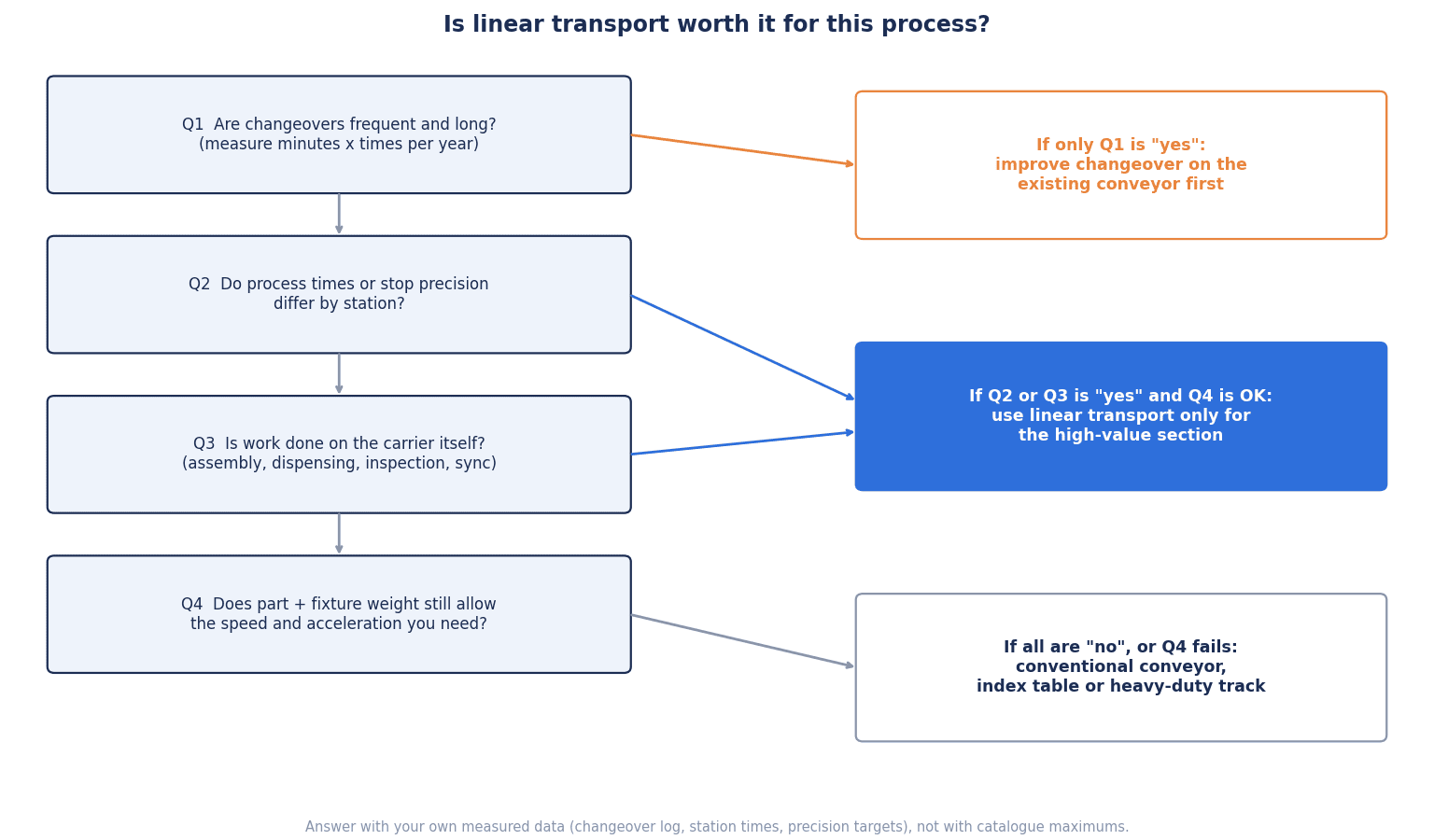
The judgment proceeds through 4 questions.
Question 1: Are product changeovers frequent? Check the number of changeovers and the time each takes, from records. Not “it feels like a lot,” but from the daily production reports of the last few months, pick up the number per day and per week, and the time from the start of the stop until good parts start flowing. If changeovers are few and each one is short, one of the main benefits of linear transport does not apply.
Question 2: Do the time or stopping precision required differ from station to station? With fixed-pitch transport, every station moves at the pace of the slowest one. Station A finishes in 2 seconds, but station B takes 6 seconds. Only station C needs high stopping precision. The larger such differences are, the more it means to be able to vary speed and stopping position per carrier. Conversely, if station times are uniform, this benefit is small.
Question 3: Do you want to machine, inspect or synchronize work on the transport? Do you want to dispense, drive screws, inspect or print with the workpiece still on the carrier, either stopped or moving? If you can reduce hand-offs in which the workpiece is taken off the transport, worked on in another machine and put back, it may help both precision and time.
Question 4: Can the required speed be reached with the combined weight of workpiece and fixture? With some linear transport products, speed or acceleration drops as the payload gets heavier (we look at this in detail in the next section). Check against published figures whether the required cycle can be reached with the weight including fixtures and nests, not the workpiece alone.
The conclusions from these 4 questions fall roughly into 3 patterns.
- You can say “yes” in numbers to Question 2 or Question 3, and Question 4 is also satisfied → convert only the high-value section to linear transport (conventional transport before and after). If Question 1 is also “yes,” you have even more material for the decision.
- Changeovers are frequent, but Questions 2 and 3 are weak → first improve changeover on the existing conveyor (simpler, one-touch change parts). Measure the effect, then judge the additional benefit of linear transport.
- All are weak, or speed is not enough for the weight → a conventional conveyor or index table is the better fit.
The important point here is the second conclusion. If shorter changeover time is the only reason, changeover improvement on the existing equipment can sometimes remove a large part of it. The overall picture of an equipment concept that reduces changeover losses on high-mix lines is also covered in High-Mix Variable-Volume Automation: 90-Day Thailand Guide. Linear transport is worth considering when, after seeing that improvement, some section is still not good enough.
Reading manufacturer figures: payload, speed, acceleration and precision come as a set
When comparing linear motor conveyors, it is tempting to line up the catalog’s “maximum speed,” “maximum acceleration,” “maximum payload” and “repeatability” side by side. But these cannot necessarily all be achieved at the same time. Let us look at examples given in the sources.
- Speed changes with payload: The Yamaha Motor LCMR200 has a maximum speed of 2,500 mm/sec, but the maximum speed is said to drop when the transported mass exceeds 10 kg (manufacturer figure).
- Acceleration depends on mass: For the Rockwell Automation MagneMotion QuickStick HT, acceleration is given as “up to 6 G, depending on mass” (manufacturer figure).
- On the same product, acceleration differs by a factor of 4 depending on payload: The ATS SuperTrak VERTICAL10 is given as “1G at 10 kg / 4G at 1 kg” (manufacturer figure).
- Work is not possible in some places: The same SuperTrak VERTICAL10 is listed as “No process on curve,” with a maximum of 4 kg per shuttle on the vertical curve (manufacturer figure).
In other words, even if it says “maximum speed 4 m/s, maximum payload 10 kg,” that does not necessarily mean it can run at 4 m/s with 10 kg on board. The basic approach in an RFP is to state the maximum mass and center-of-gravity position of your workpiece and fixture combined, and ask for the speed, acceleration and stopping precision under that condition.
Next, the different terms for precision.
- Repeatability: The variation when stopping at the same position many times with the same command.
- Absolute accuracy (positioning accuracy): How far the actual position deviates from the commanded position.
- Synchronization accuracy: The deviation when another axis (such as a dispenser or robot) is matched to the moving transport.
On a page dated December 17, 2024, Beckhoff gives XTS a repeatability of up to 10 µm and a synchronization accuracy of up to 50 µm. On the other hand, the XTS product page gives the EcoLine module an absolute accuracy of 0.70 mm and a repeatability of 0.075 mm (all manufacturer figures). 10 µm and 0.075 mm differ by an order of magnitude. Rather than one of them being wrong, this is thought to be because the series, modules or definitions of precision differ. Even for the same product name from the same manufacturer, the published figures can differ greatly by configuration, so for the precision you ask to be quoted, you need to specify the configuration and the definition (repeatability, absolute or synchronization) and have both written down together.
Furthermore, precision also depends on the fixture on the carrier. However good the published transport figures are, if the locating pins of the nest have play or the way the workpiece is placed varies widely, the precision the process needs will not be achieved. In practice it is useful to split precision requirements into “transport,” “fixture” and “workpiece.”
Main linear motor conveyor products (comparison of manufacturer figures)
The table below lists examples of products whose details we could confirm in this research. It is not exhaustive and not a recommendation. All values are examples of manufacturer figures (or values in articles reporting vendor announcements) and change with the series, module and configuration. Because the conditions are not aligned between products, they cannot be lined up side by side and ranked.
| Product (manufacturer) | Type | Example of published figures | Notes |
|---|---|---|---|
| XTS (Beckhoff) | Linear transport (independent cart) | Up to 4 m/s, maximum acceleration 20 G, mover payload 200 g-10 kg, repeatability up to 10 µm, synchronization accuracy up to 50 µm (page of December 17, 2024). EcoLine module absolute accuracy 0.70 mm, repeatability 0.075 mm, minimum product spacing 54 mm | The product page says “masses of more than 10 kg per mover can also be transported.” Curve radius 250 mm |
| XTS Hygienic (Beckhoff) | Linear transport (hygienic design) | IP69K, electropolished stainless steel 1.4404 (AISI 316L), surface roughness under 0.8 µm, VMQ silicone seals | Said to withstand high-pressure washdown |
| XPlanar (Beckhoff) | Planar maglev | Up to 3 m/s, typical repeatability ≤±5 µm (x, y, z), single mover up to 4.2 kg and more than 20 kg when coupled, lift up to 5 mm, tilt up to 5°, 360° rotation about the Z axis | Values from the current product page. Movers come in 7 sizes |
| ACOPOStrak (B&R) | Linear transport (independent cart) | In a 2017 announcement article: 5g acceleration, top speed “over 4 m/s,” minimum shuttle spacing 50 mm, track length over 100 m and over 250 shuttles controlled by 1 PC, electromagnetic diverters | In 2023 an IP69K version (rated for high-pressure washdown up to 80°C) and a new low-wear shuttle were announced |
| ACOPOS 6D Hybrid (B&R) | Coordination of planar maglev and conventional transport | Announced at Interpack 2026 (article of May 2026) | No figures are covered in this article (they could not be confirmed in the source text) |
| iTRAK 5750 (Rockwell Automation) | Linear transport (independent cart) | Up to 5 m/s, up to 128 movers and 64 logical sections, IP66 (with infield cover), STO and SS1 (SIL 3, PLe) | No payload figure on the product page. Announced July 3, 2024 |
| QuickStick HT (Rockwell Automation) | Linear for heavy loads | Up to 5 m/s, acceleration up to 6 G (depending on mass), transport of heavy loads of “several thousand kg,” repeatability ±1 mm | Said to be able to operate in cleanrooms, glove boxes and underwater |
| ctrlX FLOWHS (Bosch Rexroth) | Linear transport (high speed) | Acceleration up to 10G, up to 5 m/s, payload 2.5 kg (5 kg as a group), product spacing 40 mm | U-shaped design |
| ctrlX FLOW6D (Bosch Rexroth) | Planar maglev | Levitation height up to 20 mm, tilt 10°, operates on horizontal, vertical and ceiling surfaces | Payload, speed and acceleration not stated on the product page |
| Multi-Carrier-System (Festo / Siemens) | Linear transport (independent cart) | Transported mass up to 50 kg (article of May 20, 2019) | Festo supplies the linear motors and Siemens the control. Speed and acceleration not stated in that article |
| 4-Series (Planar Motor) | Planar maglev | Up to 3 m/s, maximum acceleration 20 m/s², repeatability typically 10 µm, levitation height 0.5-6 mm, payload 1.8-40 kg (depending on XBot size) | Canadian manufacturer. Values from technical documentation |
| LCMR200 (Yamaha Motor) | Linear transport (independent sliders) | Up to 2,500 mm/sec, repeatability ±5 μm, up to 64 sliders | Maximum speed is said to drop above 10 kg |
| Lexium MC12 (Schneider Electric) | Linear transport (independent cart) | Up to 4 m/sec on straights, up to 3 m/sec on curves, positioning accuracy ±0.02 mm, payload 2.2 kg and 10 kg, maximum thrust 120 N | Values from the Japan page |
| SuperTrak VERTICAL10 (ATS) | Linear transport (vertical circulation) | 4 m/s, 10+ kg per shuttle (up to 4 kg on the vertical curve), 1G (10 kg) / 4G (1 kg), repeatability ±0.01 mm (straight sections) | Said to allow no process on curves |
| Linear Track System (Mitsubishi Electric) | Linear transport (individual carriers) | Won the 67th Nikkan Kogyo Shimbun Ten Best New Products Award (2024). No changeover through individual carrier control, horizontal and vertical circulation | No numerical specifications in the web page text, so not covered in this article |
Here are 3 points to watch when reading the table.
First, the dates and sources of the published figures are not aligned. The B&R ACOPOStrak values come from a 2017 announcement article, not from the current product page. The Festo / Siemens MCS values also come from a 2019 article. At the quotation stage, please check them against the latest data sheets.
Second, an item that is not listed does not mean “not available.” The payload of the iTRAK 5750 and the speed of the ctrlX FLOW6D were simply not stated as numbers on the product pages we checked. Items you need should be raised as questions in the RFP.
Third, check hygienic design and environmental figures against your own washdown conditions. There are products designed for washdown, such as the IP69K XTS Hygienic and the IP69K version of ACOPOStrak (rated for high-pressure washdown up to 80°C). On food, pharmaceutical and cosmetics lines, state your own washdown method, chemicals, temperature and frequency, and confirm suitability.
Hybrid layouts: do not make everything linear
When considering linear transport, there is no need to make the whole line linear. At Interpack 2026, B&R announced ACOPOS 6D Hybrid and presented a concept in which shuttles of the maglev ACOPOS 6D are used for high-value processes, less critical processes are left to conventional transport such as conveyors and robots, and the two are coordinated in a single control architecture (article of May 8, 2026, vendor claim). The fact that a manufacturer itself is putting forward a design that “does not make everything linear” is a useful reference for how to think about selection.
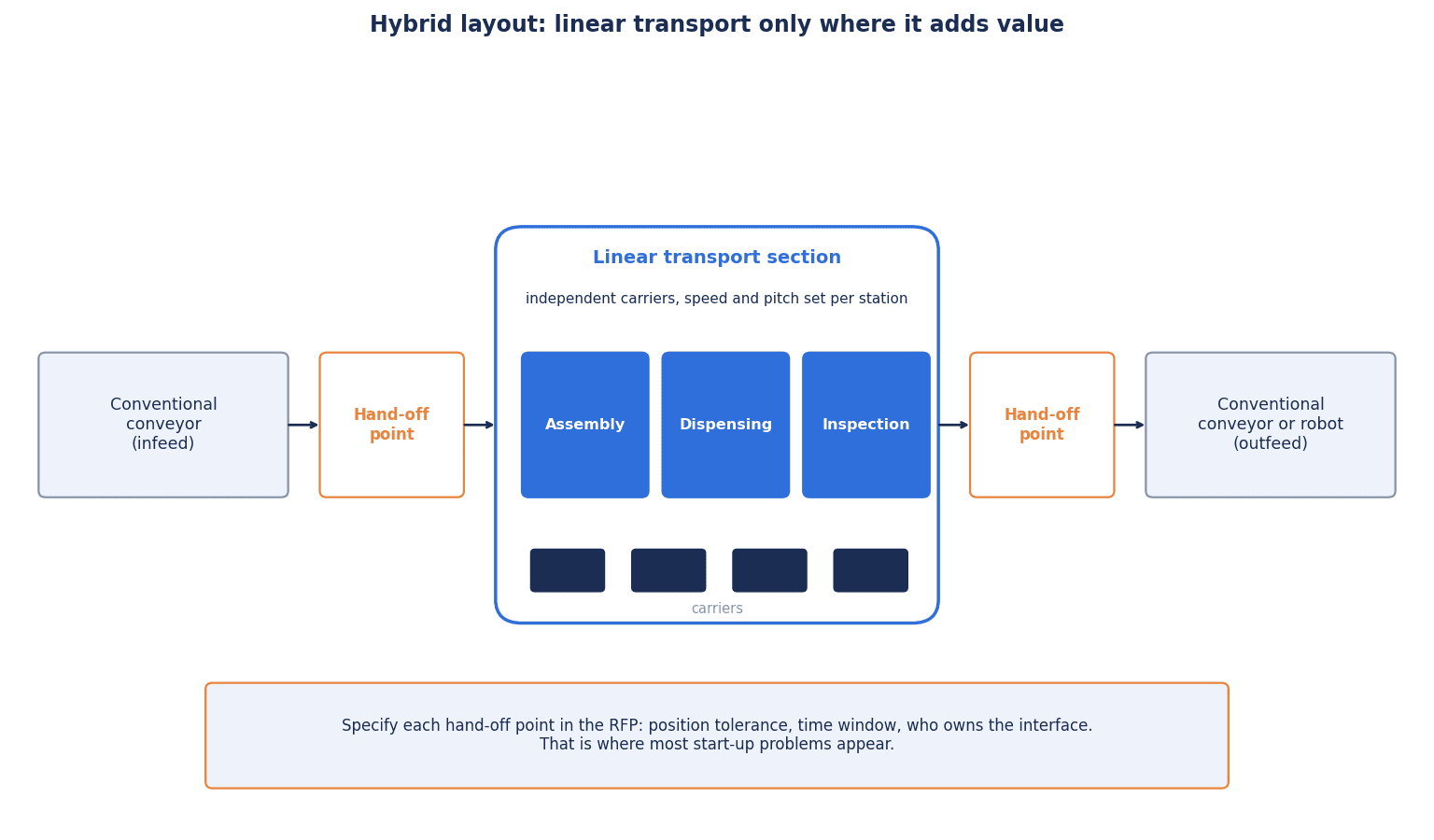
In a hybrid layout, the workpiece is handed over from the conventional conveyor of the upstream process to the linear transport section, assembly, dispensing and inspection are done per carrier within the section, and the workpiece is handed over again to a conventional conveyor or robot. Where problems tend to appear is at the hand-off points.
- Position: How closely do the position and attitude of the workpiece need to be aligned at the hand-off point? How much of the variation on the upstream conveyor can the linear transport section absorb?
- Time: How are the takt of the conventional conveyor and the arrival of carriers in the linear transport section synchronized? When one of them stops, where does the other wait?
- Scope of responsibility: Who is responsible for the mechanism and control at the hand-off point, the linear transport vendor or the supplier of the conventional equipment?
When a robot is used for the hand-off, parallel-link robots are often considered for high-speed picking of light workpieces. How to choose one is covered in Delta Robot Selection: Parallel-Link Pick-and-Place RFP and FAT/SAT for Thai Plants. If a camera captures moving workpieces for picking, 3D Vision Conveyor Tracking in Thailand: RFP and FAT/SAT Guide is also a useful reference. Writing the position and time at the hand-off points as numerical requirements in both the RFP and the acceptance tests is the key to making a hybrid layout succeed.
What the case studies show: assembly automation and changeover
Here we introduce 4 cases announced by vendors. All of them were published on the vendors’ own websites and have not been verified by third parties. None of them are Thai cases; they are from the Netherlands, Italy and the United States. The figures are values for each plant, machine and set of conditions.
Beverage bottle packaging (Netherlands, 1 plant, announced by Beckhoff, published April 28, 2026): The Italian machine builder Clevertech used Beckhoff’s XTS to build an end-of-line packaging machine for a traditional Dutch distillery. Capacity is said to have gone from 110 to 225 bottles per minute, and changeover from 30 minutes to 7 minutes. The XTS has 24 motor modules (AT2002-0250). There are 24 bottle types and 42 box types, and changeovers are said to occur up to 10 times a day. There is also a statement of “up to 23,000 more bottles per shift.” This can be read as an example where an effect appeared in a process with many product combinations and frequent changeovers, but the article does not allow us to separate out whether all of the capacity gain came from the transport method.
EV battery cell assembly (Italy, IMA EV-Tech, announced by Beckhoff, published November 3, 2025): XTS was adopted for an assembly line for cylindrical cells (prismatic cells also under development), using 5 enclosed XTS systems with a total length of about 43.5 m. The XTS positioning accuracy is given as ±0.25 mm. Throughput, the number of movers and the cycle time are not stated. It is a reference for precision and for configurations with long tracks, but the productivity effect is not known.
Hygienic pouch packaging (United States, Bartelt Packaging, announced by Beckhoff, published April 28, 2026): In this case, XTS Hygienic (stainless steel, IP69K) was adopted for the MAG series of horizontal form-fill-seal (HFFS) machines, reportedly achieving push-button changeover. The MAG-L is said to run at up to 150 pouches per minute. It is an example of using hygienic linear transport on a packaging line that requires washdown.
Assembly, dispensing and packaging (United States, DT Engineering, announced by Rockwell Automation, published February 4, 2020): The customer is an undisclosed Fortune 500 company. A machine using iTRAK is said to have achieved an OEE (overall equipment effectiveness) of 97% (against a target of 85%), with a dispensing synchronization accuracy of “7/1000 of an inch,” and the ability to run 2 SKUs at the same time. It is an example of dispensing on the transport and simultaneous production of multiple products.
In addition, the Beckhoff XPlanar product page lists applications such as pharmacy dispensing, cosmetics filling, inspection of I/O terminals (about 10,000 units per shift), handling of medical bags, food slicing, optical inspection (3-second cycle) and plasma treatment (vendor claims; detailed conditions are unknown).
What the 4 cases have in common is that the effect is not tied to “faster transport,” but to at least one of frequent changeovers, work on the transport, precision and hygiene. They are easier to use as a reference if you read them against where your own process falls in this article’s decision flow.
Safety: stopping per carrier, and standards
With linear transport, many carriers move independently, so “where to stop, in what unit, and how” becomes a design issue.
First, let us check the terms for drive safety functions. Beckhoff’s TwinSAFE (safe drive technology) page explains that STO (Safe Torque Off) corresponds to stop category 0 of EN 60204 and immediately cuts off the energy that generates torque, and that SS1 (Safe Stop 1) corresponds to stop category 1, decelerating to a stop and then activating STO after a set delay. SS2 corresponds to stop category 2 and keeps the drive under control after stopping. Others listed include SOS, SLS, SSM, SDI and SLP, and STO and SS1 are given as SIL 3 / Cat. 4, PL e on the AMP8000 and other drives. However, this page describes servo drives in general and makes no direct reference to XTS.
On the linear transport product side, Rockwell Automation’s product page for the iTRAK 5750 explicitly states that it has STO and SS1 at SIL 3, PLe (manufacturer figure). Which safety functions a product has, and in what unit (the whole system, a section or a carrier), should differ from product to product, so check this in the RFP.
For plants and machine builders that build machines for export to Europe, an important item is the EU Machinery Regulation (EU) 2023/1230. Its full title is “Regulation of the European Parliament and of the Council of 14 June 2023 on machinery and repealing Directive 2006/42/EC.” It was published in the Official Journal on June 29, 2023 and entered into force on July 19, 2023. Machinery placed on the EU market from January 20, 2027 onward must comply with this regulation. The recitals of the regulation state that software performing a safety function and placed on the market on its own is to be regarded as a safety component (recital 19), that new digital technologies such as AI, IoT and robotics are taken into account (recital 12), and that systems with self-evolving behavior that perform safety functions require third-party conformity assessment (recital 54). Linear transport is equipment in which much of the carriers’ motion is determined by software. Thai plants and machine builders that export machines to Europe will likely need to check early how to approach compliance, including how software performing safety functions is handled.
In Thailand, the Ministry of Labour’s “Ministerial Regulation on Standards for the Administration, Management and Operation of Occupational Safety, Health and Environment Concerning Machinery, Cranes and Boilers B.E.2564 (2021)” was published in the Royal Gazette on August 6, 2021 and came into force 90 days after publication (repealing the previous regulation of 2009). Its legal basis is the Occupational Safety, Health and Environment Act B.E.2554 (2011). It covers machinery (presses, welding machines, forklifts, lifts, hoists and pulleys), cranes, boilers and pressure vessels, among others, and requires inspection before use, maintenance of protective devices, hazard assessment and protective equipment for machines with a cutting hazard, operation only by trained persons, and the preparation of work procedures, among other things. This regulation contains no provision that names linear transport. The absence of such a mention does not mean that linear transport needs no safety measures. The safe course is to check case by case which category of this regulation your own equipment falls under, and then put protective measures and work procedures in place.
Standards such as ISO 13849-1 are generally used to evaluate functional safety. Please check the edition of the standard and the details of its application in the text of the standard and against the requirements of the regulations in the export destination. How to validate safety functions using a safety PLC is covered in Safety PLC Implementation: RFP, Validation and FAT/SAT Evidence, and how to choose safety light curtains used for protective measures around the track in Safety Light Curtain Selection for Thai Factories: Procurement and Acceptance.
Here are points worth checking when designing the safety of linear transport.
- When a protective cover is opened, is the whole system stopped, or only that section?
- After a carrier stops, can it be moved by hand (to remove workpieces or fixtures)?
- On restart after a stop, how is the position of each carrier re-confirmed?
- Is collision avoidance between carriers treated as a safety function or as a normal control function?
Model cost calculation for a linear transport system (placeholder figures)
Finally, we show how to think about cost-effectiveness using placeholder figures. The investment amounts in this calculation are placeholder figures set for this article, not market prices or typical quotation levels. The sources we researched did not state any prices for linear transport systems. In practice, replace every figure with your own changeover records, measured process times and vendor quotations.
Model assumptions
Assume 1 high-mix assembly and packaging line. Changeover means swapping change parts and takes 45 minutes each time. The contribution margin lost when the line stops for 1 hour is set, as a placeholder, at 12,000 THB (assuming there is demand and whatever is made can be sold). This 12,000 THB is a placeholder figure unrelated to wages. There are 2 options to compare.
| Item | Current | Option A: changeover improvement on the existing conveyor (simpler, one-touch change parts) | Option B: replace the high-value section with linear transport (existing conveyors before and after) |
|---|---|---|---|
| Time per changeover | 45 min | 21 min | 9 min |
| Initial investment (one-time, THB) | — | 1,200,000 | 9,000,000 |
| Annual maintenance and software support (THB) | — | — | 200,000 |
Even with Option B, changeover does not become zero. It is set at 9 minutes per changeover, on the assumption that changing fixtures and nests on the carriers and checking recipes still remain.
The calculation (Scenario 1: 250 changeovers a year)
Assume 5 times a week × 50 weeks, or 250 times a year.
- Current stoppage: 250 × 45 minutes = 11,250 minutes = 187.5 hours. 187.5 hours × 12,000 THB = 2,250,000 THB a year (for reference).
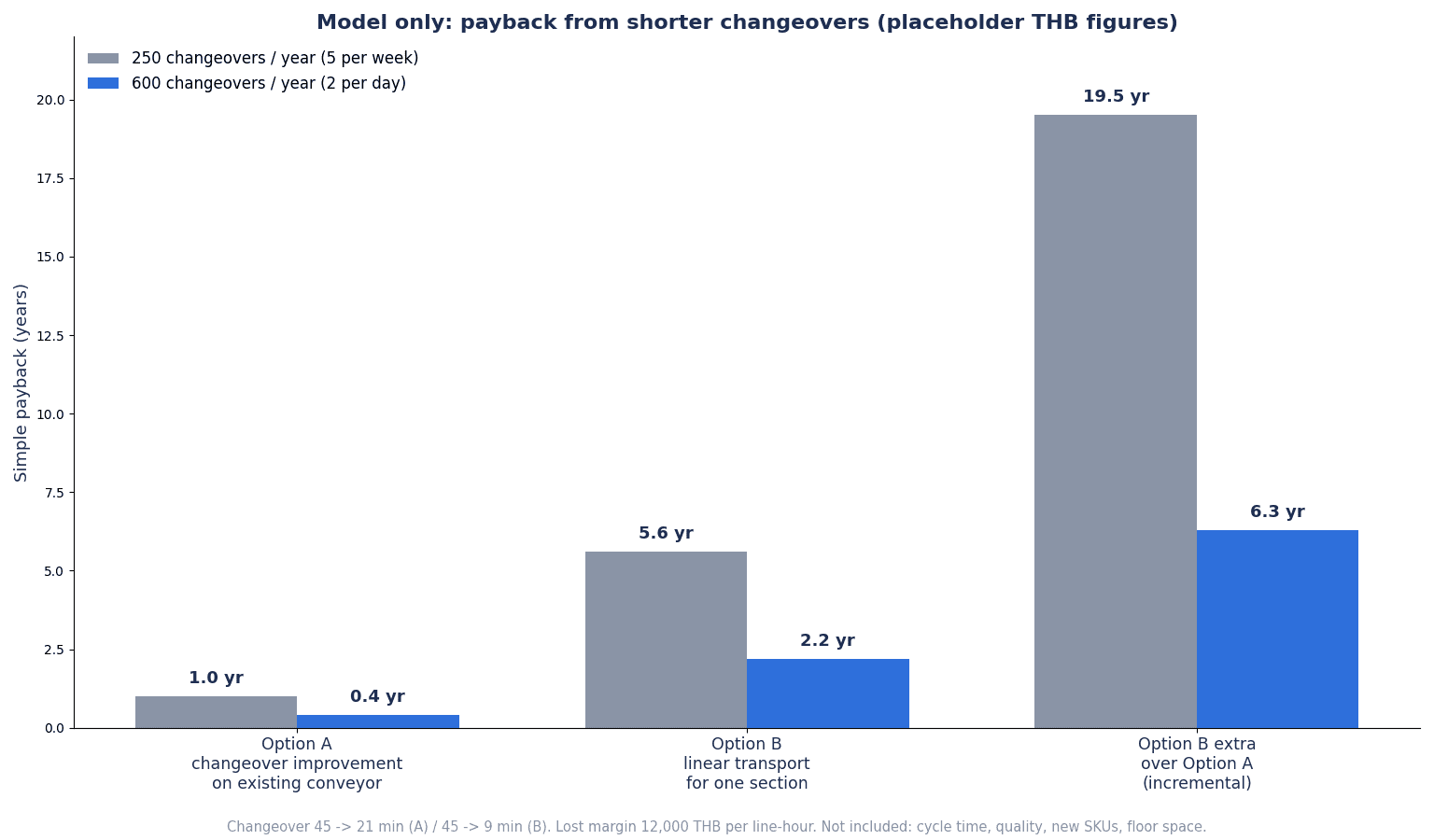
- Option A: 24 minutes saved per changeover. 24 minutes × 250 = 6,000 minutes = 100 hours. The effect is 1,200,000 THB a year. Payback is 1,200,000 ÷ 1,200,000 = 1.0 year.
- Option B: 36 minutes saved per changeover. 36 minutes × 250 = 9,000 minutes = 150 hours. Subtracting the maintenance and software support cost of 200,000 THB from the 1,800,000 THB for 150 hours, the effect is 1,600,000 THB a year. Payback is 9,000,000 ÷ 1,600,000 ≈ 5.6 years.
The calculation (Scenario 2: 600 changeovers a year)
Assume 2 times a day × 300 days, or 600 times a year.
- Current stoppage: 600 × 45 minutes = 27,000 minutes = 450 hours. 450 hours × 12,000 THB = 5,400,000 THB a year (for reference).
- Option A: 24 minutes × 600 = 14,400 minutes = 240 hours. The effect is 2,880,000 THB a year. Payback is 1,200,000 ÷ 2,880,000 ≈ 0.4 years.
- Option B: 36 minutes × 600 = 21,600 minutes = 360 hours. Subtracting 200,000 THB from 4,320,000 THB, the effect is 4,120,000 THB a year. Payback is 9,000,000 ÷ 4,120,000 ≈ 2.2 years.
Looking only at the linear transport increment
Now look at the “increment” of Option B over Option A. The additional investment is 9,000,000 − 1,200,000 = 7,800,000 THB in both scenarios.
| Scenario | Additional effect (Option B − Option A, THB/year) | Payback on the increment |
|---|---|---|
| Scenario 1 (250 a year) | 1,600,000 − 1,200,000 = 400,000 | 7,800,000 ÷ 400,000 = 19.5 years |
| Scenario 2 (600 a year) | 4,120,000 − 2,880,000 = 1,240,000 | 7,800,000 ÷ 1,240,000 ≈ 6.3 years |
How to read the calculation
When evaluated on changeover time alone, most of the effect comes from changeover improvement on the existing equipment (Option A). Payback on the linear transport increment is about 19.5 years with changeovers 5 times a week and about 6.3 years with changeovers 2 times a day, so the conclusion changes greatly with changeover frequency. Looked at on its own, Option B appears to pay back in 5.6 years or 2.2 years, but much of that effect is something Option A could also deliver. That is exactly why the order matters: consider Option A first, see its effect, and then judge the increment.
And shorter stoppage only becomes profit if what is made in the freed-up time can be sold. If there is no demand and nothing to make in the freed-up time, this effect is zero.
What this calculation leaves out
The real basis for choosing linear transport is likely to lie elsewhere than changeover time in many cases. Examples are shorter cycles from being able to vary speed by station, fewer hand-offs from machining and inspection on the transport, fewer defects from higher precision, and differences in modification costs when products are added. These are not included in this calculation. To avoid overestimation and double counting, we do not add numbers for them here. Put a number on each one separately for your own process, and decide whether to add it to the difference between Option A and Option B. The calculation also does not include losses from installation and commissioning while the line is stopped, training, spare parts, or the effect of tax incentives.
What to write in the RFP (request for proposal)
To make quotations for linear transport systems comparable, the conditions need to be aligned in the RFP. Use the following 12 items as a guide.
| No. | Item | Example of what to write | What to check in the quotation |
|---|---|---|---|
| 1 | Mass and center of gravity of workpiece and fixture | Maximum mass per product (workpiece + fixture + nest), center-of-gravity position, outline dimensions | Speed and acceleration achievable under that condition |
| 2 | Required cycle and pitch | Cycle time per product, carrier spacing, number of carriers on the track at once | Basis for the number of carriers and the track length |
| 3 | Stopping precision | For each station, which of repeatability, absolute or synchronization accuracy is needed, and how much | Expected precision split into transport, fixture and workpiece |
| 4 | Number of products, changeover frequency and recipes | Current and future number of products, number of changeovers, how recipes are held | Work and cost needed when a product is added |
| 5 | Track length and layout | Whether straights, curves, diverters or vertical circulation are needed, and whether processes are done on curves | Whether work on curves is possible, installation space |
| 6 | Operating environment | Temperature, humidity, dust, washdown method and chemicals, required IP rating | The manufacturer’s operating environment conditions, and how deviations are handled |
| 7 | Safety functions | Whether stopping per carrier or per section is needed, functions such as STO and SS1, protective measures | Unit of the safety functions and documents supporting their performance |
| 8 | Higher-level integration | MES, traceability (linking carrier and workpiece), communication protocol | Items recorded and how they are stored |
| 9 | Software ownership, source code and licenses | Scope of application source code provided, type and number of licenses | Extent to which your company or a third party can modify it |
| 10 | Spare parts and local stock | Number of spare carriers, modules and drives, whether stock is held in Thailand | Days needed for replacement on failure |
| 11 | Training and maintenance setup | Training in Thai, English and Japanese, scope of the maintenance contract, remote support | Setup of engineers who can respond locally |
| 12 | FAT/SAT acceptance criteria | The test items in the next section and their numerical pass values | Test procedures and record formats |
Item 9, software ownership, deserves particular attention. With linear transport, most of the motion is determined by software. When products are added, who modifies the motion profiles and recipes? Do you ask the machine builder every time, or do you make it possible for your own engineers to do it? If you place the order without deciding this, what should have been “changeover is a software task” can turn into “every software change costs outsourcing fees and waiting time.” How to divide the scope of orders for servo and motion control is covered in Servo Control Procurement and FAT/SAT Guide for Thailand Plants in 2026, and how to handle quotations and acceptance for a whole special-purpose machine in Special-Purpose Machine Manufacturing: Evidence-Gated Procurement.
Acceptance testing (FAT/SAT) and the first 90 days
Tests that deliberately provoke problems
In acceptance testing, in addition to confirming that things flow normally, deliberately create conditions where problems tend to occur and check them. We recommend testing the following items in the FAT (Factory Acceptance Test) before shipment and the SAT (Site Acceptance Test) on site.
- Maximum speed with the heaviest workpiece: Load the workpiece and fixture of the heaviest product and check whether the stopping precision is achieved at the specified speed and acceleration.
- Consecutive product changeovers: Switch recipes consecutively from product A to B, B to C and C to A, and record the time each changeover takes and the precision right after it.
- Stopping or removing 1 carrier: When 1 carrier is stopped or removed from the track, how do the other carriers behave? After it is put back, can the system return to normal?
- Collision avoidance: Create conditions where carriers approach each other and check whether the collision avoidance function works.
- Recovery from power loss and emergency stop: Trigger an emergency stop or power cut during operation, and record the restart procedure and the time needed to re-confirm the position of each carrier.
- Communication loss: Cut communication with the higher-level PLC or MES and check how the transport behaves and whether any records are lost.
- Restart after washdown (for hygienic designs): After washing with the actual washdown procedure, check whether it restarts normally.
- Checking trace records: Check whether the links between carriers and workpieces, and the records for each station, match the actual flow.
Set the acceptance criteria as numbers at the RFP stage. Do not write “precision must be achieved”; write something like “repeatability at station X within ±XX mm with a maximum mass of XX kg.”
Running the first 90 days
The 90 days after installation are the period for checking whether the assumptions of the calculation really hold.
- Days 1-30: Record every day the number of changeovers and the time each takes, the cycle time, and the number and causes of stops. It is important to collect them with the same definitions as the records from before the introduction.
- Days 31-60: Compare the records with the calculation. Has changeover time become as short as expected? Are fixture changes or recipe checks taking longer than expected? What are the top causes of stops?
- Days 61-90: For items where gaps appeared, decide on causes and countermeasures. If software changes are needed, confirm who will make them, and widen the range of changes your own engineers can handle. Also check whether additional production was actually achieved in the freed-up time.
Issues specific to Thailand and ASEAN
Heat, humidity, and temperature in the cabinet and on the track
Thai plants have areas without air conditioning and areas where humidity is high in some seasons. Linear transport is equipment in which the track coils, drives and control cabinet generate heat. In this research we did not check the operating temperature and humidity conditions of each product. Provide measured temperature and humidity values for the installation location, and check with the manufacturer the operating environment conditions and how deviations from them are handled.
Power outages and momentary interruptions
When a power outage or momentary interruption occurs, how the positions of many carriers are handled directly affects recovery time. In addition to testing recovery from a power cut in the acceptance tests, consider at the design stage whether an uninterruptible power supply is needed.
Washdown and water
On food, pharmaceutical and cosmetics lines, the washdown method and frequency affect the life of the equipment. There are hygienic products such as XTS Hygienic and the IP69K version of ACOPOStrak, and Planar Motor has also been reported to address the food and medical fields with SUS316L covers (MONOist, October 14, 2025). All of these are manufacturer announcements, and suitability under your own washdown conditions needs to be checked individually.
Local stock of maintenance parts
Whether spare parts such as carriers, track modules and drives are held in Thailand affects downtime on failure. In the RFP, check the recommended number of spare parts, whether they are stocked in Thailand, and the number of days needed if they are ordered from overseas. Some manufacturers have started technical support in Japan (MONOist article on Planar Motor, August 7, 2025), but the support setup in Thailand needs to be checked separately.
People who can modify the software
Maintaining linear transport calls less for mechanical parts replacement and more for the ability to understand the PLC and motion control software and modify parameters and motion profiles. How much should local Thai staff be able to modify on their own? We recommend deciding at the time of ordering the language of training (Thai, English or Japanese), the training materials and the scope of remote support.
Checking eligibility for BOI incentives
As mentioned above, BOI Announcement No. 4/2569 covers only automotive (categories 3.6 and 3.8). For electronics, food, medical device and other plants, the Smart and Sustainable Industry efficiency improvement measure is a candidate, but the conditions are those described in the 2023 guide, so please check the latest details in the BOI’s original documents.
Regulatory compliance for machines exported to Europe
When machines are built in Thailand and exported to Europe, machinery placed on the market from January 20, 2027 onward must comply with the EU Machinery Regulation 2023/1230. For machines that incorporate linear transport, it is thought to be important to check from the early stages of design how to approach compliance, including how software performing safety functions is handled.
Frequently asked questions
What is a linear transport system?
It is a system that transports workpieces by moving magnet-equipped carriers independently, one at a time, with linear motors on the track side. Because the speed, position and spacing of each carrier can be set in software, unlike a fixed-pitch conveyor, the motion can be changed to suit the product or process. There are independent cart systems that run on rails and maglev systems that levitate and move over tiles.
How does a linear motor conveyor differ from a conventional conveyor?
Conventional belt and chain conveyors basically move the whole system at the same speed and pitch. A linear motor conveyor can accelerate, decelerate, stop and position each carrier, and is said to have few mechanical wear parts (vendor claims). On the other hand, with some products speed and acceleration drop as the payload gets heavier, and software maintenance is needed. For processes where all carriers can move the same way, a conveyor is often enough.
How do you choose between independent cart technology and magnetic levitation planar transport?
If you run many carriers in a circulating loop along a rail or on a long track, independent cart technology is a candidate. If you have requirements such as changing position or attitude in 2 dimensions on the carrier, rotating, tilting or lifting, or minimizing particle generation through non-contact operation, maglev planar transport is a candidate. However, the payload of maglev transport is limited depending on the product; one example of published figures is a maximum of 4.2 kg for a single mover (XPlanar). Check the weight of the workpiece and fixture first.
How much does linear transport cost?
The sources we researched did not state prices. This article’s model calculation uses placeholder figures, and the result is that, when evaluated on changeover time alone, most of the effect comes from changeover improvement on the existing equipment, and payback on the linear transport increment varies greatly with changeover frequency, at about 19.5 years for 250 changeovers a year and about 6.3 years for 600 a year. Please confirm actual costs by asking vendors for quotations based on an RFP that sets out your own conditions.
Does changeover really become zero?
It is safer to plan on the assumption that it does not. Even if the transport motion (speed, pitch, stop positions) can be changed by switching recipes, fixtures and nests on the carriers must be changed if they differ by product. Recipe checks and quality checks right after the changeover also remain. This article’s calculation also assumes that a changeover takes 9 minutes each time under the linear transport option.
Can it handle heavy workpieces?
It depends on the product. As examples of published figures, the Festo / Siemens Multi-Carrier-System has a transported mass of up to 50 kg (2019 article), and Rockwell Automation’s QuickStick HT advertises transport of heavy loads of “several thousand kg.” However, note that motion changes as loads get heavier; for example, the acceleration of the QuickStick HT is said to depend on mass. Check whether the required cycle can be reached with the weight of your own workpiece and fixture.
Can maintenance be done in Thailand?
It differs by product and vendor. Check at the RFP stage whether spare parts are stocked in Thailand, whether engineers can respond locally, whether training is available in Thai, English and Japanese, and the scope of remote support. Because maintaining linear transport involves a lot of software modification, we also recommend deciding at the same time how much your own engineers should be able to modify.
Summary
A linear transport system is not “a faster conveyor”; it is transport in which each carrier can move differently. It pays off in processes where you can state in numbers that product changeovers are frequent, that the time or precision required differs by station, or that you want to machine, inspect or synchronize work on the transport. So the first step is not to compare products, but to measure what is going wrong with fixed-pitch transport in terms of changeover time, waiting time and precision.
In the model calculation (placeholder figures), looking at changeover time alone, most of the effect came from changeover improvement on the existing equipment, and payback on the linear transport increment varied greatly with frequency, at about 19.5 years with changeovers 5 times a week and about 6.3 years with changeovers 2 times a day. In many cases, the reason to choose linear transport lies in effects other than changeover time. Put numbers on those for your own process, convert only the high-value section that falls short to linear transport, and connect the sections before and after it with conventional transport. Check payload, speed, acceleration and precision as a set, and include safety and software maintenance in the scope of the order. Following this order lets you decide based on your own numbers rather than the wording of a proposal.
TOMAS TECH helps plants in Thailand evaluate transport methods and introduce equipment to suit their processes and layouts. You can consult us even before the method or product has been decided, for example at the stage of taking stock of current changeover and process times, or of assessing how far improvement is possible while keeping fixed-pitch transport. Please contact us through this form.
References
- The Star (Reuters): Thai August factory output rises 4.44% y/y, beats forecast (September 30, 2026)
- Trading Economics: Thailand Industrial Output Growth Beats Forecasts (September 30, 2026)
- Trading Economics: Thailand Business Confidence Remains Subdued (October 2, 2026)
- Thailand Board of Investment (BOI): Investment applications in the first half of 2026, Press Release No. 117/2569 (July 23, 2026)
- New Straits Times: Thailand attracts USD 26.8 billion in chip and electronics investment applications (August 4, 2026)
- Tilleke & Gibbins: New investment incentives for automotive and HEV/PHEV manufacturing (April 21, 2026)
- Thailand Board of Investment (BOI): Smart and Sustainable Industry efficiency improvement measures (investment promotion guide, 2023 edition)
- Schneider Electric Japan: What is a linear transport system (Lexium MC12)
- Rockwell Automation: On the move to flexible medical device production (July 16, 2018)
- Machine Design: Why Independent Cart Conveying Is One Smart Move (June 12, 2017)
- Beckhoff: XTS linear product transport product page (accessed October 9, 2026)
- Drives & Controls: B&R ACOPOStrak announcement article (December 8, 2017)
- Drives & Controls: Levitating transport systems could be a motion revolution (December 19, 2018)
- Industrial Automation India: Machine automation innovations at Interpack 2026 (May 8, 2026)
- Beckhoff: XPlanar planar motor system product page (accessed October 9, 2026)
- Yamaha Motor: Linear Conveyor Module LCMR200 Specifications (accessed October 9, 2026)
- Rockwell Automation: QuickStick HT product page (accessed October 9, 2026)
- ATS SuperTrak CONVEYANCE: SuperTrak GEN3 Specs, Components, Configurations (accessed October 9, 2026)
- Beckhoff: The perfectly synchronized XTS (December 17, 2024)
- Packaging South Asia: New track and shuttle – B&R (June 30, 2023)
- Rockwell Automation: iTRAK 5750 product page (accessed October 9, 2026)
- PR Newswire (Rockwell Automation): Announcement of the iTRAK 5750 Intelligent Track System (July 3, 2024)
- Bosch Rexroth: ctrlX AUTOMATION transfer systems (ctrlX FLOW6D / FLOWHS) (accessed October 9, 2026)
- Robotics & Automation News: Festo and Siemens integrate Multi-Carrier-System into Bosch Rexroth transfer system (May 20, 2019)
- Planar Motor: 4 Series technical documentation (accessed October 9, 2026)
- MONOist: Maintenance-free maglev linear transport, with technical support also starting in Japan (August 7, 2025)
- MONOist: Canadian maglev linear transport adds high-temperature support and a vacuum model (October 14, 2025)
- Mitsubishi Electric FA: Linear Track System (Ten Best New Products Award)
- Beckhoff: Doubled throughput in bottle packaging (April 28, 2026)
- Beckhoff: Efficient production of vehicle battery cells (November 3, 2025)
- Beckhoff: Flexible implementation of hygienic pouch packaging (April 28, 2026)
- Rockwell Automation: iTRAK System Achieves Extraordinary OEE (February 4, 2020)
- Beckhoff: TwinSAFE safe drive technology (accessed October 9, 2026)
- EUR-Lex (Official Journal of the EU): Regulation (EU) 2023/1230 on machinery (adopted June 14, 2023)
- Knowby: EU Machinery Legislation 2023/1230 (July 29, 2026)
- Enviliance ASIA: Thailand renews safety standard for machine, crane and boiler (2021)
- Data Resource (QYResearch): Global linear motor driven transfer systems market (November 5, 2025)


