


The training ran. The instructor scored well. Yet three months later, only two or three people out of twenty are actually using generative AI in their daily work. Manufacturers across Thailand and the wider ASEAN region report this same pattern again and again. The cause is rarely the instructor’s ability or the quality of the materials. It is the sheer number of minutes given to practice. This article narrows in on one design decision — building generative AI hands-on training around exercises rather than lectures — and works through the time allocation, the exercise design, the operating constraints of a Thai site, and the follow-up mechanism that keeps people using what they learned.
Why lecture-heavy generative AI training fails to stick
One hundred slides and a twenty-minute demo
A Japanese-language analysis of why generative AI training programmes fail describes a manufacturing case with more than one hundred slides and only twenty minutes of live prompt demonstration. Everything else was lecture. Participants heard about how generative AI works, what the risks are, and what the internal rules say — and the next morning had no idea what to actually type into the tool for their own job.
The lesson here is not that the lecture content was wrong. It was comprehensive, and once you include audit readiness and information-handling guidance, one hundred slides is not an unreasonable volume. The problem is that the training ended without participants ever going through the one loop that matters — writing a prompt themselves, getting back an output that misses the mark, and fixing it.
You do not learn a tool like this by listening to someone describe it. Knowing which part of an instruction to rewrite when the output drifts is a judgement built from failure. A lecture can convey what is possible. It cannot convey how to repair what went wrong.
The under-30-percent threshold
The same analysis notes that programmes devoting less than 30 percent of total time to exercises tend to show markedly poor retention at the three-month mark. One important caveat travels with that number. It is not drawn from an official statistical survey. It is an estimate the training company calculated from its own client engagements and presented as an illustrative case. Treat it as a directional guide, not a precise threshold. On that basis, the same source recommends a hands-on ratio of at least 50 percent.
The 30 percent mark matches practical experience closely. In a four-hour session, 30 percent is 72 minutes. Seventy-two minutes of exercise sounds generous, until you account for what sits inside it — logging into the tool, walking through the interface, reading the exercise brief, and fielding questions. In the sessions we have supported, the time participants genuinely spend writing and testing prompts shrinks to somewhere around 30 minutes. Thirty minutes is barely enough to run two cycles of write, look at the output, revise, run again on a single exercise.
At 50 percent you have 120 minutes. That is enough for three stages — one easy exercise to build confidence, a second closer to the participant’s actual job, and a third pass where they compare notes with the person next to them and rewrite. That third stage, looking at someone else’s prompt and revising your own, is what determines whether people can reproduce the skill after the session ends.
The gap between “I understood it” and “I can do it”
Post-session surveys often look good even for lecture-heavy programmes. Generative AI is an interesting subject, the examples are easy to follow, and participants genuinely report that they understood the material. Then you check usage three months later and login counts have not moved. The discrepancy comes from what the survey measures — comprehension, not the ability to reproduce the work on the job.
For the broader structural reasons generative AI training fails to take hold, including the organisational factors, see why generative AI training does not stick in manufacturing. This article stays with the one part the programme designer controls directly — how the hours of the day itself are spent.
Designing the ratio — a 20/50/30 starting point
20 percent input, 50 percent hands-on, 30 percent sharing and reflection
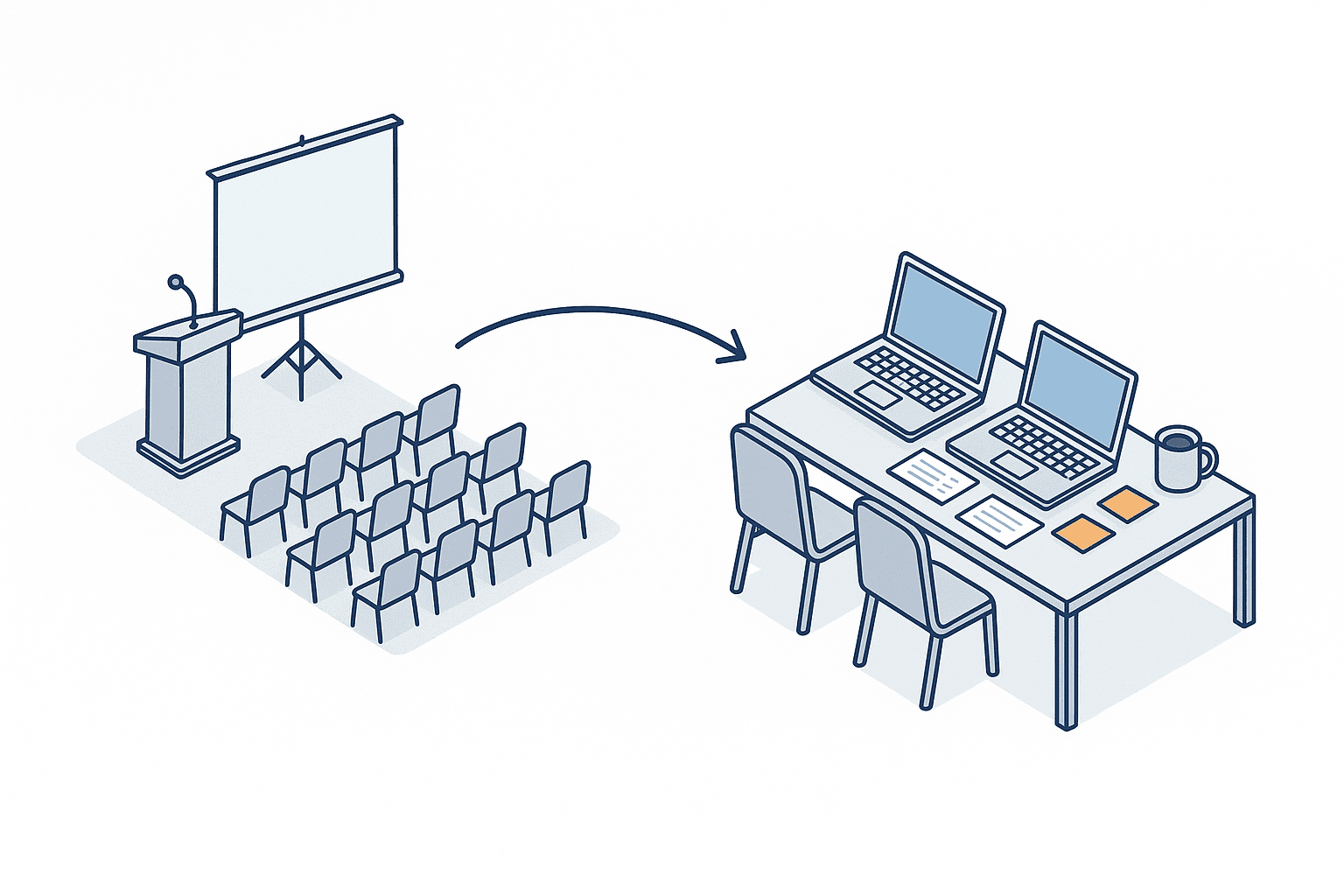
Recommending a hands-on ratio of at least 50 percent only gets you halfway to a timetable. You still have to decide what the other 50 percent does. So this article proposes a three-way split as a starting point for design — 20 percent knowledge input, 50 percent hands-on exercise, 30 percent sharing and reflection.
To be clear about where 20/50/30 comes from. It is not a published standard from the source. What the source publishes is the recommendation to keep hands-on time at a minimum of 50 percent; it says nothing about how the remaining half should be divided. The 20/50/30 split is our own working guideline, built by taking that recommendation as the anchor and distributing the rest between lecture and sharing. Treat it as a number to be adjusted to your own circumstances, not a standard to be carried around.
The part that usually surprises people is that input gets only 20 percent. In a four-hour session that is 48 minutes for how generative AI works, the internal usage policy, and information-handling cautions combined. It feels tight. That tightness is the point. It forces a decision — anything that will not fit into 48 minutes should not be delivered verbally on the day at all. It belongs in a pre-read pack or in documentation people can consult afterwards.
Foundational knowledge and internal rules are the kind of information you can absorb by reading. Reading it aloud in a room is an expensive use of scarce training time. Judging how to fix a prompt, by contrast, can only be practised with an instructor present and a colleague sitting next to you. The principle behind 20/50/30 is to spend the day on the things that can only happen on the day.
Why sharing and reflection deserves 30 percent
Of the three blocks, sharing and reflection is the one most likely to be cut when a programme is designed internally. “We’re short on exercise time, so let’s do a ten-minute wrap-up at the end” is the usual compromise, and it undercuts the exercises themselves.
During an exercise, each participant sees only their own screen. They know whether their prompt worked. They have no way of knowing whether it was well written, whether it could have been half as long, or whether someone in another department took a completely different approach. Sharing time exists to widen that field of view.
In practice, sharing time produces four concrete effects.
- Seeing several solutions to the same exercise broadens each person’s range of prompt-writing styles
- Reviewing the attempts that did not work turns failure patterns into shared organisational knowledge
- Hearing about other departments’ problems triggers ideas for applications back in one’s own team
- Questions the instructor was answering one-to-one get answered for everyone, cutting duplicate handling
The fourth point hits operating cost directly. Cut the sharing block and individual questions during exercises multiply until a single instructor cannot keep up. The perverse result is that effective exercise time goes down.
A checklist for when hands-on time falls below 50 percent
If your draft programme comes out at 40 percent exercise time, the places to trim are fairly predictable. Working through the following in order usually pushes you past 50 percent.
- Move the technical explanation of how generative AI works into the pre-read pack
- Split the read-through of internal usage rules into e-learning or a separate meeting
- Narrow the case studies to a single industry and reduce how many you cover
- Cut the number of instructor demonstrations and do one of them properly
- Fold the dedicated Q&A slot into the sharing block rather than keeping it separate
What you must not trim is the time spent explaining the exercise itself. If people start an exercise without understanding the brief, the first ten minutes evaporate into questions about what they are supposed to do. The safe approach is to treat the briefing as part of the exercise block and place it at the front of that block.
The higher-level question of which curriculum goes to which layer of the organisation, and in what sequence, is covered in designing an AI training curriculum. The ratio design in this article sits one level below that — how you build the interior of each individual session.
A time allocation template for a four-hour session
The published template, as published
The analysis cited above sets out a concrete four-hour timetable. The breakdown is as follows.
| Block | Duration | Main content |
|---|---|---|
| Introduction and foundations | 60 min | Objectives, generative AI basics, internal rules |
| Live demonstration | 30 min | Instructor demonstrates prompt writing |
| Individual exercise | 60 min | Participants write and test their own prompts |
| Group sharing | 30 min | Compare prompts and results across the room |
| Applied exercise | 45 min | Work on a task close to one’s own job |
| Wrap-up | 15 min | Reflection and agreement on next actions |
| Total | 240 min | — |
In this allocation, the individual exercise (60 min), group sharing (30 min) and applied exercise (45 min) add up to 135 minutes of “exercise plus sharing”, which is 56 percent of 240 minutes. The source presents that 56 percent figure as a worked example of a design that clears the recommended 50 percent hands-on threshold.
Reading the template against 20/50/30
One thing to watch is that the four-hour template and the 20/50/30 guideline proposed earlier are not counted on the same basis.
Map the template blocks mechanically onto the three categories and, if you count the 60-minute foundations block and the 30-minute demonstration as “input”, input becomes 90 minutes, or 37.5 percent. Pure exercise is the 60-minute individual block plus the 45-minute applied block, 105 minutes or 43.75 percent. Group sharing plus wrap-up is 45 minutes, or 18.75 percent. In other words the distribution differs from 20/50/30.
This does not mean the source template is wrong. It means there is a difference between counting “exercise plus sharing” as one bucket at 56 percent and counting three separate categories. When you design your own programme, what matters is deciding which counting method you use before you start. Say “half our training is hands-on” without fixing the method, and the conversation falls apart the moment another department verifies it using a different one.
The practical recommendation is to publish both of the following numbers.
- Time participants spend with their own hands on the tool (exercise time, narrow definition)
- Exercise plus sharing combined (hands-on time, broad definition)
For the four-hour template you would write 105 minutes narrow and 135 minutes broad. Line up those two figures and you have a consistent yardstick for comparing training vendors’ proposals.
This turns out to be a common blind spot. Comparison articles on choosing a generative AI training provider tend to list criteria such as whether the courses match employees’ AI literacy levels, whether the vendor will propose a customisation plan fitted to your objectives, whether pricing is transparent and delivers value, whether post-training follow-up is well supported, and whether the vendor has a track record in your industry and company size.
Every one of those is a reasonable criterion. But the time allocation itself — how many minutes go to exercises — rarely appears as a front-line comparison axis. Which means that when you lay several proposals side by side, the exercise ratio is only visible if the buyer deliberately checks for it. Reducing each vendor’s timetable to the narrow and broad figures is work the buyer has to add. That small extra step draws a sharp line between lecture-centred proposals and exercise-centred ones.

Stretching and compressing to three or six hours
Site realities frequently mean four hours is unavailable, or conversely that a full day can be secured. In either case, scaling every block proportionally is a poor move. Some blocks still work when shortened; others stop functioning below a certain size.
| Block | Compressed to 3 hours | Extended to 6 hours |
|---|---|---|
| Introduction and foundations | 30 min (moved to pre-read) | 60 min (unchanged) |
| Live demonstration | 20 min (single demo only) | 30 min (unchanged) |
| Individual exercise | 50 min (one exercise) | 75 min (two exercises) |
| Group sharing | 25 min (lower limit) | 45 min (cross-department groups) |
| Applied exercise | 40 min (lower limit) | 105 min (using own work data) |
| Wrap-up | 15 min (unchanged) | 45 min (build a 30-day action plan) |
| Total | 180 min | 360 min |
On the compression side, the first cuts come from the introduction and the demonstration. Both can be absorbed through pre-distribution and fewer demos. Push group sharing below 25 minutes, however, and there is no longer enough airtime per person; push the applied exercise below 40 minutes and people run out of time just as they finish reading the brief. Three hours is the practical floor precisely because those two minimums add up to it.
On the extension side, the principle is to give the extra time to the applied exercise and the wrap-up rather than to new lecture content. Stretching the applied exercise to 105 minutes in a six-hour design lets participants bring real data from their own department and leave with one finished, usable prompt. Give the wrap-up 45 minutes and you can have them write down when, in which task, and how many times per week they will use it. Whether that action plan exists is what moves the needle on usage at day 30.
Designing the content of the exercises
Whether you can use your own real data changes the outcome
Securing 50 percent exercise time achieves little if every exercise is generic — “summarise the minutes of a meeting at a fictional company”. Participants leave saying it was interesting but unrelated to their job. Exercise quality is determined almost entirely by how close the task is to the participant’s actual work.
Ideally, the raw material is documents people handle every day — defect reports, daily production logs, supplier emails, standard operating procedures. Bringing real data into a classroom, though, requires that the organisation has already drawn a line about which information may be entered into which tool. Plan a real-data exercise before that line exists and you will typically get stopped by the information security team a week before the session and have to swap in dummy data at short notice.
The workable compromise is to prepare anonymised “near-real” data in advance. Replace only part numbers, customer names, monetary amounts and individual names, and leave the document structure and writing style exactly as they are. That alone closes most of the felt gap against a generic exercise.
Build three steps of difficulty
Prepare only one exercise and you guarantee two outcomes — some people get left behind, and others finish early and sit idle. Generative AI training makes this spread especially visible because the range of PC skill among participants is wider than in most other courses.
The recommendation is three exercises of differing difficulty on the same business theme, worked through in order.
- Step one, paste the supplied instruction as-is and observe the output. Everyone gets a guaranteed success
- Step two, rewrite the supplied instruction to match your own working conditions. You feel the output change
- Step three, write the instruction from a blank page. This is where people get stuck and the instructor earns their keep
It is fine if some participants never reach step three. What matters is that everyone clears steps one and two and takes home the experience of having changed an instruction and seen the output change with it. That experience is the fork in the road between trying it again alone afterwards and never opening the tool.
Tailoring exercises to the individual
An overview of corporate training trends published internationally presents adaptive learning — delivering different content depending on data about a learner’s comprehension and progress — as one of the major currents in corporate training. The same piece notes that microlearning, breaking material into short units, compares favourably with long conventional modules for knowledge retention.
Both observations describe corporate training in general and are not quantified measurements specific to generative AI training, which is worth keeping in mind. Directionally, though, they say the same thing as the three-step exercise design above. The further you move from giving everyone the same task in the same time toward varying the task by role and comprehension, and the smaller the chunks you deliver at once, the better retention gets.
Even a small in-house programme can borrow the adaptive idea. Split participants by department in advance and swap out only the subject matter of the exercises for each group. Keep the lecture content common and prepare manufacturing, quality assurance and administration variants of the exercise briefs alone, and you narrow the distance to real work while keeping material development cost contained.
Backing the investment case with retention and ROI data
Do not conflate employee retention with knowledge retention
Getting a generative AI training budget approved requires numbers that demonstrate effect. This is where a specific trap sits — the word “retention” is used for two entirely different things.
A report compiling international corporate training statistics states that organisations running AI-focused training saw employee retention improve by 29 percent, and that ROI on AI training investment averaged 250 percent within 18 months. Retention there means the rate at which employees stay with the company. In the training context, however, the word is very often used to mean the rate at which learned material stays with the learner — knowledge retention. One word, two completely different subjects.
The two can be causally connected, but as metrics they are distinct. Put employee retention and knowledge retention under a single “retention” heading in a budget request and the reader will assume they are the same kind of number. Stating clearly what each figure measures and which study it came from, and keeping them apart, makes approval considerably easier.
| Item | What it indicates | Where it comes from |
|---|---|---|
| Under 30 percent exercise time correlates with weak three-month retention | Estimate based on one training company’s client work (illustrative case) | Japanese-language analysis of generative AI training |
| Hands-on ratio of at least 50 percent recommended | Design recommendation | Same source |
| Employee retention up 29 percent | Workforce retention | International AI corporate training statistics report |
| ROI averaging 250 percent within 18 months | Investment payback | Same source |
| Adaptive learning and microlearning favour retention | Learning design trend (no quantitative figure given) | International corporate training trends article |
Keeping a table like this ready to attach to the budget request removes the rework that follows the inevitable question about where a number came from. Presenting the figures separately by source, rather than rounding them into a single headline, ends up being the fastest route.
How to read 250 percent within 18 months
When reading an ROI figure of 250 percent, start by asking what sits in the numerator. The source does not publish its ROI formula, so this number alone cannot tell you whether 2.5 times the investment came back, or whether profit after deducting the investment was 2.5 times. On top of that, it is an average from an international study mixing every industry, company size and training type together. It is not a number you can apply directly to a single generative AI training session at one factory in Thailand.
If you want to use it internally, the defensible use is as grounding for the time horizon — look at payback over 18 months rather than over one quarter. The benefit of generative AI training appears not immediately afterwards but several months later, once participants have embedded it into their own work. Measure at three months, declare no effect, and you cut the budget just before the steepest part of the curve. The 18-month framing is material for preventing that premature shutdown.
Concrete cost figures, and the break-even point between running training internally and outsourcing it, are broken down in the cost of generative AI training in Thailand. Raising the hands-on ratio forces the participant-to-instructor ratio down, so the cost structure differs from a lecture-centred programme too.
What the 70-20-10 model actually says
The 70-20-10 model, long referenced in talent development, holds that of what people learn at work, 70 percent comes from on-the-job experience, 20 percent from interaction with others, and 10 percent from formal training.
Reading that as an argument against training is a mistake. It should be read as a directive — design the 10 percent so that it connects to the other 90 percent. The same applies to hands-on training. The exercises on the day are not themselves on-the-job experience, but they are a device for taking the first step toward working with the tool in a place where failure is safe.
The 20 percent, interaction with others, corresponds to group sharing during the session and prompt sharing afterwards. Allocating 30 percent to sharing in the 20/50/30 split can be read as building that 20 percent into the training itself, ahead of schedule.
Design considerations for hands-on training at a factory in Thailand
Running exercises across mixed languages
The first decision to make for a Thai site is which language participants write their prompts in. Leave it vague and you end up with expatriate staff writing in one language and Thai staff writing in a mix of Thai and English, and nobody able to read anyone else’s prompt when group sharing starts.
A workable arrangement looks like this.
- Individual exercises are written in whatever language each person actually uses at work. Do not force uniformity
- Group sharing presentations explain the intent of the prompt in a common language. The original text is shown as written
- Model prompts distributed by the instructor are prepared in both Thai and the head office language
- Only the evaluation criteria for outputs are common across all languages — readability, factual accuracy, and whether the output is usable as-is
Producing model prompts in multiple languages has to be budgeted into material preparation up front. How to structure language coverage across materials and instructors is covered in detail in generative AI training for Thai staff.
PCs, networks and accounts on site
The leading causes of a hands-on session falling apart on the day are not the materials or the instructor. They are environmental. The link saturating the moment twenty laptops connect in a factory meeting room, a shared PC with a browser too old to render the AI interface correctly, accounts not issued in time the day before — none of these are unusual.
Designing for 50 percent or more exercise time also means making more than half the session dependent on the environment. A lecture can continue when the connection drops. A hands-on session stops. At minimum, close out the following in advance.
- Measure the meeting room’s concurrent connection capacity and effective bandwidth at the expected headcount
- Issue accounts for every participant at least three business days ahead and have each person test their login
- Where shared PCs are used, verify browser versions and any extension restrictions
- Confirm that access to the generative AI service is not blocked at the network layer
- Prepare a fallback for a connection failure
That last item is routinely dismissed and is mandatory for hands-on training. Mobile tethering, or one exercise that can be switched to an offline paper-based format, keeps the session moving.
Where to draw the line on bringing real work data in
As noted, exercise quality depends on proximity to real data. For a site in Thailand, three constraints overlap — the head office information management policy, Thailand’s personal data protection law, and confidentiality obligations toward customers.
Confirming the following in order while preparing exercise data avoids rework. First, verify that the generative AI service in use is under a contractual arrangement in which input data is not used for training. Second, strip information from the exercise documents that could identify individuals or customers. Third, decide up front whether the processed data will be deleted after the session or retained as internal training material.
Because this confirmation requires sign-off from the information management function, it needs to start three to four weeks before the training date. Build that approval window into the schedule when planning exercise development.
Shift patterns, line stoppages and scheduling
At a factory, the schedule itself is a design variable. When participants come off a three-shift line, a continuous four-hour block may be impossible. The obvious response is to split four hours into two sessions of two hours, but splitting shortens exercise time per session and squeezes out the applied exercise entirely.
If you must split, the recommendation is not to divide evenly. Put the introduction and the individual exercise into the first session, and the sharing and applied exercise into the second. Keep the gap between the two to a week or less. A longer gap means the prompts written in session one have faded from memory, and the start of session two is consumed by revision.
There is also a decision about whether to put executives and managers in the same room as floor staff. Doing so makes it harder for staff to fail freely, so in exercise-centred training, separating the layers works better. The thinking behind layered design is set out in structuring DX talent development by organisational layer.
Building the mechanism that keeps people using it
Set checkpoints at 30 and 90 days
Hands-on training must not be designed as something that concludes on the day. The scope of the training extends until the one prompt built in the room is being used repeatedly in real work.
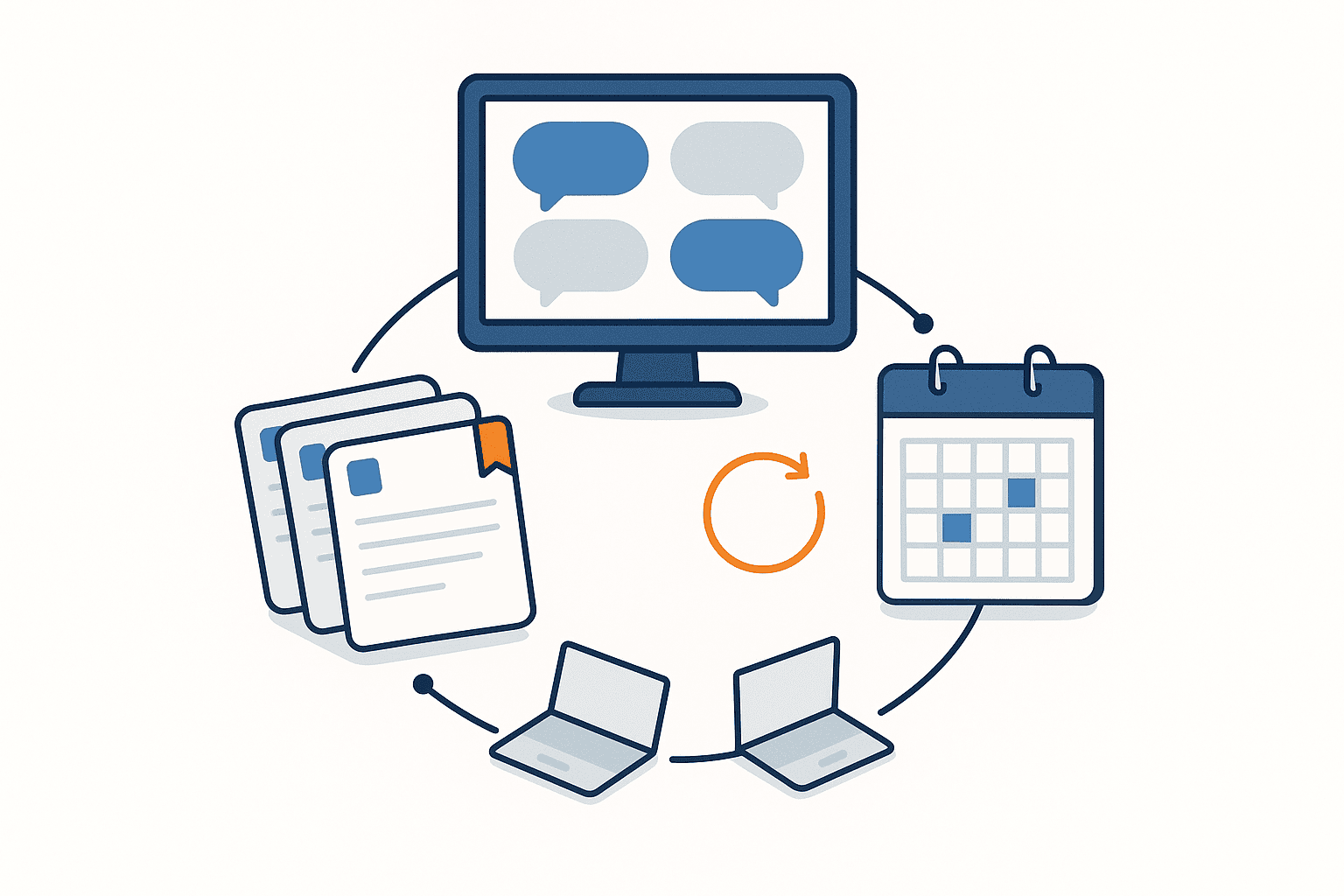
In practice, two checkpoints after the session are easy to manage. At 30 days, ask each participant to self-report how many times they actually used the prompt they built. If a lot of people report zero, the cause lies not in the training but on the work side. Separate the cases — the occasion to use it has not arisen, versus they tried and were blocked by permissions or account issues.
At 90 days, look at whether people have started applying generative AI to work the training never covered. If that spread is happening, the learning has taken hold. If it is not, the conclusion is that additional practice opportunities or a follow-up session are needed.
Decide where prompts will live before the session
Prompts created on the day disappear into personal notes if left alone. Decide during the planning stage where finished prompts will be stored, and build registering them there into the final fifteen minutes of the session.
The requirements for that location are simple. Every participant can open it quickly during work, it is searchable, and someone can overwrite it with an improved version. No elaborate system is needed. Waiting for a dedicated tool to be procured, leaving the location undecided while the training goes ahead anyway, costs far more than the tool would.
The methodology for organising prompts as an organisational asset is also discussed in prompt engineering training in Thailand. The period right after a hands-on session is when participants feel the most ownership over prompts they wrote themselves, which makes it the best moment to build early momentum in sharing.
What to measure
The important thing about measuring the effect of generative AI training is not to stop at survey satisfaction. Satisfaction scores come out high for lecture-centred programmes too, so the investment in hands-on design does not show up in the numbers.
Metrics that suit hands-on training and work in practice include the following.
- Generative AI usage count per participant over the 30 days after training
- Number of prompts registered in the shared location, and how often others reuse them
- Change in processing time for the tasks covered in the training
- Number of people who have begun applying it to tasks the training did not cover
The second of these, reuse count, is useful as an indicator of whether the effect is spreading beyond the room. If one person’s prompt is being used by five people, the benefit is reaching employees who never attended.
How TOMAS TECH can help
Drawing on our experience delivering production management and energy management systems to manufacturers in Thailand, we support the application of generative AI to real work and the design of internal training programmes. On hands-on training specifically, the following are the most common forms of support.
- Designing a timetable that holds exercise time at 50 percent or more, and diagnosing the ratio in an existing programme
- Building exercises from your own documents, including preparing anonymised data
- Preparing exercise materials and model prompts in both Thai and Japanese
- Connectivity testing in factory meeting rooms and on-the-day environment troubleshooting
- Follow-up at 30 and 90 days, and setting up a shared location for prompts
- Layered programme design for executives, managers and floor staff
A common sequence is to start with a short executive seminar and then roll out hands-on training on the floor. How to structure a corporate seminar is set out in designing corporate generative AI seminars.
Frequently asked questions
How long should generative AI hands-on training be
Because the condition is that exercise plus sharing accounts for at least 50 percent of the total, four hours is the most manageable standard. The published time allocation template also shows a four-hour design in which individual exercise (60 min), group sharing (30 min) and applied exercise (45 min) total 135 minutes, or 56 percent, devoted to exercise and sharing. Compressing to three hours is possible, but once group sharing drops below 25 minutes and the applied exercise below 40 minutes, those blocks stop working. Conversely, if you want to include an applied exercise using your own department’s real data, a six-hour design fits better.
How should we choose a generative AI training provider
Comparison articles on generative AI training list criteria such as whether the course matches employees’ AI literacy, whether it can be customised to your objectives, whether pricing is transparent, whether post-training follow-up is provided, and whether the vendor has a track record in your industry and company size. The exercise ratio rarely appears as a front-line comparison axis, so the buyer has to check for it deliberately. When comparing proposals, reduce each vendor’s timetable to two numbers — the time participants spend operating the tool themselves, and exercise plus sharing combined. Line those up and lecture-heavy proposals separate clearly from exercise-centred ones. Also confirm whether your own documents can be used in the exercises, how many participants there are per instructor, and whether follow-up is included.
Can AI training be customised for our company
Replacing the subject matter of exercises with your own working documents has the largest effect on outcomes and a comparatively small effect on cost. Partial customisation — keeping the lecture generic and swapping only the exercise briefs by department — is a realistic option. Corporate training trends also point toward adaptive learning, which varies content according to a learner’s comprehension, so this direction of customisation is consistent with where the field is heading.
What is the maximum class size for an exercise-centred session
There is no published standard figure, but because the instructor needs to look over individual participants’ work during exercises, in our experience the practical ceiling is roughly 12 to 16 participants per instructor. Above that, either assign an assistant instructor or split the session into two runs — either is more efficient in the end. Packing in more people and degrading exercise quality defeats the purpose of raising the hands-on ratio.
Where should the lecture content go instead
The technical explanation of how generative AI works, internal usage rules, and case study introductions are all information people can absorb by reading. Move them into a pre-read pack, e-learning, or internal documentation available for reference at any time after the session. Keep the day itself focused on what requires an instructor and colleagues to be physically present — practising writing and repairing prompts, and seeing how other people write.
Summary
Whether generative AI hands-on training takes hold depends far less on the instructor’s delivery or the polish of the materials than on one plain number — how many minutes went to exercises. An estimate based on one training company’s client engagements holds that programmes with under 30 percent exercise time show markedly poor retention at three months, and recommends a hands-on ratio of at least 50 percent. For a four-hour session, a published worked example combines 60 minutes of individual exercise, 30 minutes of group sharing and 45 minutes of applied exercise so that exercise and sharing together reach 56 percent.
Once the ratio is secured, three things determine the result — how close the exercises sit to your actual work, whether there is a difficulty ladder, and whether a mechanism exists to keep people using it afterwards. At a factory in Thailand, four further constraints apply on top — running exercises across multiple languages, the plant network and account environment, information governance when bringing real work data in, and scheduling around shift patterns. None of these are settled on the day. They are settled three to four weeks earlier, in preparation.
As material for the investment decision, international reporting states that organisations running AI-focused training saw employee retention improve by 29 percent and that ROI on AI training investment averaged 250 percent within 18 months. That 29 percent refers to workforce retention and is a different metric from the knowledge retention rate the training field usually means by the word. The design guideline from the Japanese-language source and the figures from the international study cover different subjects and different metrics, so present them separately with sources and scope stated when the budget request goes forward. As the 70-20-10 model indicates, training is the 10 percent of total learning. Whether you have designed that 10 percent to connect to the remaining 90 percent — on-the-job experience and interaction with others — is the real evaluation axis for hands-on training.
Working out where your current programme sits on the hands-on ratio, or how much extra effort it takes to swap exercises over to your own documents, is hard to judge without looking at an actual timetable. We are happy to help simply with organising information at the exploratory stage, or with diagnosing the ratio in an existing programme, so tell us where things stand today. Enquiries are welcome through our contact page.
References
- Diagnosing why generative AI training programmes fail (published 20 March 2026, updated 23 August 2026) – Uravation — the relationship between under 30 percent exercise time and three-month retention (an estimate based on the company’s own client engagements, presented as an illustrative case), the recommendation of a hands-on ratio of at least 50 percent, the four-hour time allocation template with 135 minutes of exercise plus sharing equal to 56 percent, and the manufacturing training failure case
- Comparison guide to generative AI training providers – YOUSEFUL — the five criteria commonly cited when selecting training (literacy fit, customisation, pricing transparency, follow-up support, industry track record)
- Statistics report on AI corporate training – CareerTrainer — employee retention up 29 percent at organisations running AI-focused training, and ROI on AI training investment averaging 250 percent within 18 months
- Corporate training trends – Flipsnack Blog — currents in corporate training including adaptive learning and microlearning
- Explanation of the 70-20-10 model – Whatfix — the talent development framework of 70 percent on-the-job experience, 20 percent social learning and 10 percent formal training