



Corporate Generative AI Seminars: A 30-Day ASEAN Adoption Design
When an ASEAN regional headquarters searches for a corporate generative AI seminar, it does not need another 90-minute product show. It needs teams in sales, procurement, quality, operations and corporate functions to know what they may enter, how to verify an output, who approves it and whether the practice still creates value after 30 days. Unlike our articles on training cost, management alignment and implementation economics, this guide focuses on acceptance design: role-based work, evidence, manager review and measurable transfer into operations.
A seminar is not the same as a capability
A participant can enjoy a demonstration, write a polished prompt and give the trainer a high score without being ready to use AI safely at work. Adoption normally stalls at operational questions: Can a quotation be placed in this environment? Who approves a translated customer response? Which source proves a number? How will saved time and rework be recorded? If these questions remain open, cautious employees avoid the tool while enthusiastic employees may cross a boundary.
The World Economic Forum’s Future of Jobs Report 2025, based on more than 1,000 companies, says 63% of employers identify skill gaps as a main barrier to transformation, 77% plan to upskill workers in response to AI, and nearly 40% of skills required on the job are expected to change by 2030. This is not an ASEAN-only sample. It does show why distributing a tool without changing work and skills is inadequate.
Microsoft’s 2026 Work Trend Index surveyed 20,000 knowledge workers who use AI across 10 markets. In this self-reported survey, 66% said AI allowed them to spend more time on high-value work and 58% said they were producing work they could not have produced a year earlier. Only 19% were classified in the “Frontier” zone, where both individual and organizational readiness were high. In Microsoft’s model of self-reported AI impact, organizational factors had 67% of normalized importance versus 32% for individual factors. These are associations, not causal effects, and the study is not an ASEAN estimate. The practical lesson is still useful: culture, manager support, governance and talent practices belong inside the training design.
Separate satisfaction from 30-day outcomes
Satisfaction can indicate whether a trainer communicated clearly. It cannot stand in for work performance. Use four distinct levels.
| Evaluation level | Question | Evidence | Timing |
|---|---|---|---|
| Attendance | Did the intended people learn? | attendance, recording completion, knowledge check | day 0 |
| Practice | Can they operate within boundaries? | role exercise, input decision, verification record | day 0–7 |
| Adoption | Did they repeat the practice? | evidence packs, reviewed outputs, usage record | day 14–30 |
| Outcome | Did time, quality or risk change? | baseline comparison, rework, elapsed time, incidents | day 30+ |
When selecting a provider, ask who submits what, who accepts it and what is measured after 30 days—not only how many people attend.
Five acceptance conditions to define before the seminar
1. Choose decision-bearing tasks, not broad departments
“Sales training” is too broad. Account research, meeting-note structuring, proposal outlining, quotation explanation and customer email drafting have different inputs and approvers. In quality, defect classification, 8D drafting, audit-question translation and specification checks carry different consequences.
Each participant should select two frequent tasks that have a measurable current duration and can be repeated within 30 days. Do not begin by delegating contract decisions, final quality release, safety decisions or employee evaluation. Start with drafting, comparison, retrieval and summarization, with a named human retaining authority.
2. Turn prohibited-input rules into decisions people can practice
ETDA’s 2024 Generative AI Governance Guideline for Organizations identifies risks including confabulation, sensitive or unethical content, bias and discrimination, personal-data leakage, intellectual-property infringement and information security. It also describes human review and acceptance or rejection of generated content. The guideline is a practical reference, not a statement that any partial non-adoption automatically violates Thai law. Every organization must translate it into contracts, privacy duties, information classification and approved environments.
“Do not enter confidential information” is too vague. Use concrete cards and classify them as permitted, permitted after transformation, permitted only in an approved environment, or prohibited.
| Data example | Starting position | What the exercise must test |
|---|---|---|
| Published product catalogue | normally permitted | version and publication status |
| Synthetic defect record | suitable for practice | no real identifiers mixed in |
| Customer quotation and contract | do not paste as-is | contract, access, retention and approved environment |
| Employee health or appraisal data | highly restricted | HR, legal and privacy approval |
| Unreleased drawing or source code | normally restricted | IP ownership, customer terms and vendor controls |
This is an instructional example, not legal advice or a final policy. A durable rule combines information type, purpose, environment and approver, so it survives a change in tool name.
3. Verify independently; do not ask the same AI if it is correct
The NIST AI Risk Management Framework is a voluntary reference for integrating trustworthiness into AI design, development, use and evaluation. Its Generative AI Profile, NIST AI 600-1, organizes suggested actions through Govern, Map, Measure and Manage. It recommends measuring in conditions similar to deployment and reviewing sources and citations.
In a seminar, this becomes an acceptance routine: split claims into atomic statements; open primary sources; record publisher, date, definition and denominator; recalculate numbers; check whether a citation supports the exact claim; and record the human approver. Asking the same model “Are you sure?” is not independent verification.
4. Define human approval by role and acceptance criteria
“A human checks it” is necessary but not operational. A Thai customer email may require the local sales owner; a maintenance instruction may require engineering and safety; contract language may require legal or delegated authority. Break acceptance into fact, number, confidentiality, tone, legal language and executability.
Reviewing every item can become a bottleneck. A program may start with 100% review and move to risk-tiered sampling after stable performance. Define the threshold for that transition and the conditions that return the process to full review.
5. Define the 30-day evidence before training starts
“Productivity” is too broad. For each task, capture baseline elapsed time, completion criteria, rework, serious errors, prohibited-input events and frequency. Measure speed together with quality and risk.
Role-based exercises should not use one prompt for everyone
Regional leaders: compare assumptions before choosing an answer
An executive exercise should structure assumptions, counter-evidence, unknowns and information required for a decision on markets, investment, capacity or hiring. The deliverable is not a persuasive AI report. It is a claim-to-source table, an uncertainty register and decision-owner comments.
Our related article on management AI training for Thailand addresses leadership alignment in more depth. In this program, regional leaders join the final cross-functional review so that operating boundaries have an owner.
Sales and procurement: separate evidence from external commitments
Sales teams can use public sources to develop account hypotheses, structure meeting notes and outline proposals. Customer names, unpublished prices and contract conditions must stay out of unapproved tools. Company facts should be traced to official company pages, public authorities or formal releases, with the date checked.
Procurement teams can draft comparison tables, but units, currencies, lead times, Incoterms and warranties must be checked against source documents. A clean table can conceal AI-filled gaps; blank and unknown are legitimate outputs.
Quality, production and maintenance: retain safety and release authority
Suitable practice includes classifying synthetic defect narratives, standardizing inspection notes, organizing troubleshooting hypotheses and simplifying work instructions. Final safety, quality-release and equipment-operation decisions remain with authorized people and existing controls. Begin with synthetic or properly de-identified records; move to real data only after environment and logging approval.
HR and corporate functions: make privacy and fairness central
Job-description and training-announcement drafts may be practical starting points. Appraisal, selection, health, compensation and disciplinary decisions are higher risk. Do not enter employee or candidate data without authority, and do not accept inferences that create unfair treatment. AI literacy includes the ability to refuse a use case and escalate it.

Choose online or in-person training by purpose
Online generative AI training is attractive for a regional organization with multiple plants and travel constraints. Yet a fully remote format may be weak for negotiating sensitive boundaries and cross-functional responsibility. Choose format according to the learning objective.
| Objective | Online advantage | In-person advantage | Practical pattern |
|---|---|---|---|
| Fundamentals | scalable, recordable, repeatable | individual support for low digital confidence | pre-learning plus live Q&A |
| Tool operation | screen sharing and guided practice | hands-on device support | small online lab |
| Input boundaries | repeated polls and cases | richer legal/IT/operations debate | online preparation plus in-person decision |
| Workflow redesign | brings countries together | observes work and assigns handoffs | facilitated workshop |
| 30-day follow-up | short frequent touchpoints | on-site observation | weekly remote clinic plus targeted site visit |
Design a learning sequence, not a single event
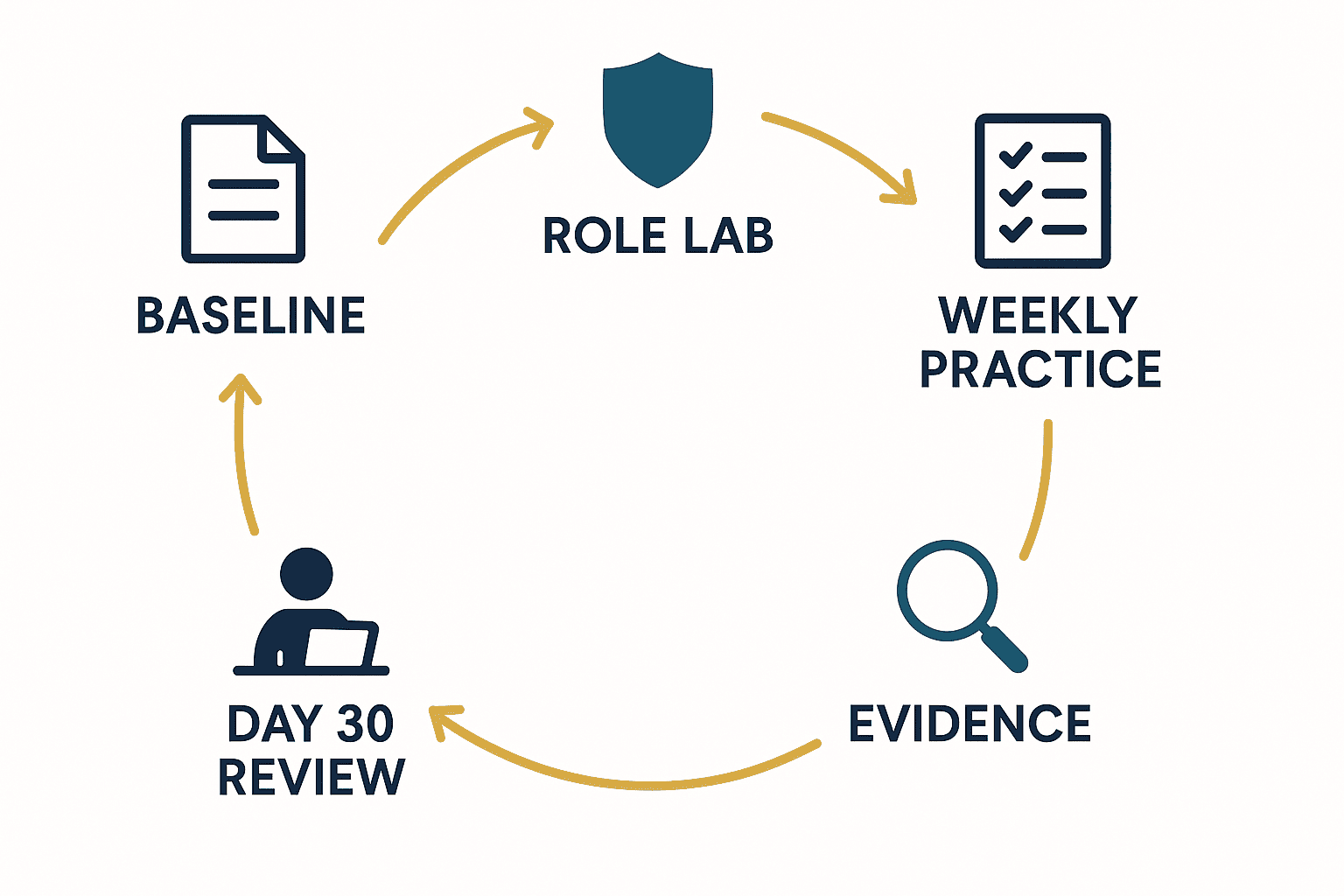
A strong regional pattern is diagnosis, a 90–180-minute live lab, role assignments, weekly clinics and a day-30 review. Use online delivery for knowledge and frequent support, and in-person time for boundary decisions and workflow redesign. Account for shifts, language and device restrictions rather than forcing a long, identical session on every site.
For multilingual cohorts, translation is not enough. Maintain a controlled glossary and bilingual output templates. Operational words such as “review,” “approve,” “reference” and “prohibited” must align with the organization’s actual policies.

What an AI literacy curriculum must contain
Module 1: capability and limits
Participants experience probabilistic output, variation and the gap between fluent language and factual accuracy. For writing, summarization, translation, classification and code, distinguish useful assistance from decisions that retain human authority.
Module 2: information classification and approved environments
Use company information classes to judge personal data, customer secrets, unpublished prices, drawings, code and operating conditions. IT should explain the approved environment, retention, model-training settings, administrator controls and access rights.
Module 3: instruction design
Do not teach prompts as magic phrases. Specify purpose, reader, reference material, constraints, output format and validation. Make the system ask for missing information rather than invent it, prohibit unsupported numbers and tie citations to primary sources.
Module 4: verification and escalation
Check primary sources, calculations, translation, names, dates and legal wording. If an error pattern repeats, change the template, reference base or approval step. Suspected leakage or harmful external communication follows the incident route, not an informal trainer Q&A.
Module 5: transfer into work
Each learner maps input, AI processing, human judgment, output and record. They also state where AI is not used. Official resources such as OpenAI Academy can support continuing learning, but viewing content does not demonstrate competence in a company’s workflow. Evidence from local cases is still required.
A practical 30-day program for an ASEAN HQ
Days 0–3: establish baseline and rules
For an illustrative cohort of 24 people, each selects two tasks and records three recent samples of elapsed time, rework and quality criteria. IT, HR, legal/compliance and process owners confirm approved tools, prohibited-input examples and escalation routes.
Day 4: conduct role-based live practice
The common section covers limits, boundaries and verification. Role groups then complete one output using synthetic data. The facilitator observes pre-input decisions, source checks and approval records—not prompt elegance. Each person commits to two tasks and evidence dates.
Days 5–27: remove obstacles in weekly clinics
Use 30–45-minute online clinics to discuss failed attempts as well as successes. “My manager will not approve,” “de-identification takes too long,” and “Thai output is inconsistent” are design signals. Improve templates, glossaries, approval routes and tool settings instead of blaming individual motivation.
Day 30: decide continue, change or stop
Twenty-four participants × two tasks × four weeks equals a maximum of 192 trials if every person completes every trial. This is a TOMAS TECH planning model, not a promised outcome. If 18 people submit at least one evidence pack, participant adoption is 18 ÷ 24 = 75%. If 126 of 168 submissions pass source, policy and reviewer checks, verified-use rate is 126 ÷ 168 = 75%.
If those 126 accepted uses each save 12 minutes, the arithmetic is 1,512 minutes, or 25.2 hours. This illustrates measurement; it is not a productivity guarantee. Review rework, serious errors and boundary violations at the same time. A faster but lower-quality use case should not continue.
| Day-30 measure | Formula | Example | Guardrail |
|---|---|---|---|
| Evidence submitter rate | people with ≥1 pack ÷ cohort | 18 ÷ 24 = 75% | not the same as login rate |
| Verified-use rate | accepted packs ÷ submitted packs | 126 ÷ 168 = 75% | fix criteria in advance |
| Time delta | baseline − AI-assisted time | 12 min/use | use a consistent method |
| Quality delta | before/after rework or error | by task | avoid conclusions from tiny samples |
| Boundary event | prohibited input or unapproved use | target zero | encourage reporting, not concealment |
Compare program cost by deliverable, not seminar hours
Price depends on diagnosis, localization, multilingual facilitation, role cases, security review, management alignment, follow-up and measurement. See our generative AI training cost guide for a fuller cost structure.
The following is a TOMAS TECH planning example for 24 people at one site, not a market benchmark or list price.
| Design component | Illustrative amount (THB) | Deliverable |
|---|---|---|
| Diagnostic and task selection | 40,000 | task list, baseline, risk class |
| Live workshop | 90,000 | common and role labs, evidence |
| Four weekly clinics | 80,000 | obstacle log and improved templates |
| Day-30 review | 30,000 | measures and continue/change/stop decision |
| Total | 240,000 | equivalent to 10,000 THB/person for 24 |
Travel, interpretation, multi-site delivery, custom materials, approved-environment implementation and licenses may be separate. AI platform and operating costs should be assessed separately; our generative AI implementation cost guide covers that distinction.
How to select a recommended generative AI training provider
Ask each provider the same questions:
- How will you select tasks and capture a baseline?
- How will materials and terminology align with our regional policies?
- How will learners practice boundaries for customer, employee, drawing and code data?
- What evidence proves that sources, numbers and translations were checked?
- How do exercises differ for sales, quality, operations and HR?
- Why is each module online or in person?
- What are the day-30 denominator and acceptance criteria?
- How do you teach refusal and stop decisions?
- Which templates and governance assets remain after the trainer leaves?
- How do suspected leaks or severe errors enter our incident process?
If a proposal focuses on the “best AI” but omits data boundaries, approvers and day-30 evidence, add those acceptance conditions before comparing prices.
Governance across ASEAN operations
ETDA describes its AI Governance Practice Center initiative as connecting principles with practical tools, policy, capability building and regional networks. A Thailand operation should translate global policy into local work, language, contracts, privacy duties and IT controls.
EU AI Act Article 4 requires providers and deployers within the Act’s scope to take measures supporting staff AI literacy, considering knowledge, experience, education, training and use context. It applied from 2 February 2025, with later 2026 amendments described by the European Commission. It is not a general domestic obligation for every business in Thailand, Vietnam or the wider ASEAN region. Organizations with EU entities, EU-facing activities or potentially in-scope systems should confirm applicability with qualified legal counsel.
FAQ
How long should a corporate generative AI seminar be?
Ninety minutes can introduce concepts. Operational transfer usually needs diagnosis, a two- to three-hour role lab, follow-up clinics and a day-30 review. Evidence and acceptance criteria matter more than stage time.
Can corporate generative AI training be fully online?
Fundamentals, screen practice and follow-up work well online. Sensitive boundary decisions, cross-functional ownership and workplace observation may benefit from in-person facilitation. A hybrid sequence is often the practical choice for multiple ASEAN sites.
What makes a generative AI training provider recommendable?
Look for task diagnosis, prohibited-input practice, role cases, verification, multilingual delivery and 30-day measurement. Ask what operational assets remain with managers after the program.
Is prompt training enough for AI literacy?
No. AI literacy includes capability and limits, information classification, approved environments, source and number verification, human approval, record keeping and escalation.
How should training impact be measured?
Separate attendance and satisfaction from verified workplace use. Fix the baseline, denominator and pass criteria before the program, then track evidence, time, rework, serious errors and boundary events for 30 days.
Should live company data be used in training?
Begin with synthetic or properly de-identified data. Before using live data, confirm contracts, privacy, classification, retention, model-training settings, access and approval. De-identification is not sufficient if people or customers can be re-identified.
Conclusion: turn a seminar into a 30-day operating design
The value of a corporate generative AI seminar is not surprise on day one. It is repeated, safe and explainable use on day 30. Combine role tasks, prohibited-input boundaries, primary-source verification, named approvers, baselines and outcome measures. Use online delivery for scalable knowledge and frequent support; use in-person work for sensitive agreements and workflow redesign. The goal is an organization that learns—including when it should not use AI.
TOMAS TECH can help an ASEAN regional HQ define target tasks, multilingual exercises, information boundaries and a 30-day evidence model before tools or participant groups are final. Discuss your training design with TOMAS TECH.
Sources
- ETDA: Generative AI Governance Guideline for Organizations
- ETDA: AI Governance Practice Center
- NIST AI Risk Management Framework
- NIST AI 600-1: Generative AI Profile
- European Commission: AI talent, skills and literacy
- World Economic Forum: Future of Jobs Report 2025
- Microsoft: 2026 Work Trend Index
- OpenAI Academy


