


When a company starts looking into generative AI training for its employees, the first real obstacle is not which vendor to hire. It is which employees should sit in the room. DX talent development training splits into two very different things, literacy education aimed at the entire workforce and hands-on practice aimed at a small group of internal champions, and the two differ completely in cost, in duration and in the thinking behind their design. This article deliberately leaves the curriculum aside. Instead it looks at the investment decision, how you cut the audience into tiers, how much you put into each, how you use the available subsidy, and where you place the people once they are trained.
Who Sits in the Room Decides What DX Talent Development Training Produces
When companies ask us about training, the opening question is almost always some version of how much generative AI training costs. But price is not the first thing that has to be settled. The audience is. A quotation written without a defined audience cannot be compared with another quotation, and lining up three quotations you cannot compare will not get you to a decision.
The Talent Shortage Shows Up Long Before Training Begins
JETRO’s 2023 survey on the business conditions of Japanese companies operating overseas, Asia and Oceania edition, found that 56.7% of respondents in Thailand rated the shortage of IT talent such as programmers as either very serious or somewhat serious. Across the Asia and Oceania region as a whole the figure was 58.2%. That survey was conducted between August and September 2023, and the numbers therefore describe conditions at the time of the 2023 survey. They should not be quoted as current 2026 figures.
Even so, it is a matter of record that as of the 2023 survey, more than half of the Japanese-affiliated companies with sites in Thailand regarded their IT talent shortage as serious or somewhat serious. There is little to suggest that a gap of that size closed quickly. If you accept that hiring alone will not fill it, the remaining options are developing the people you already employ, outsourcing to an external partner, or some combination of the two.
The Gap Between Companies Working on DX and Companies Getting Results
The picture inside Japan’s own manufacturing sector is similar. Among companies that are not using digital technology, 47.6% cite a shortage of people who can introduce and operate it as the reason. The 2025 White Paper on Manufacturing Industries goes further, reporting that while roughly 80% of manufacturers are working on DX, only around 20% say their corporate reform efforts are producing results.
A spread between roughly 80% engagement and roughly 20% realized results is better read not as a failure rate for tools but as evidence that nobody inside the company has been given the job of running what was introduced. What separates the two groups is not whether training took place, but what share of a trained person’s working hours is actually allocated to the new role afterwards.
Training Is Part of Staffing, Not a Standalone Event
One practical conclusion follows from this. As long as DX talent development training is treated as a one-off line item inside the education budget, it will struggle to produce results. It starts working as an investment only when it is treated as part of a staffing plan.
In practice, that means deciding, at the moment you place the training order, what the trainee will spend their time on during the three months after the course ends and how many hours that will be. Run the training with that box still blank and the attendee returns to their previous workload, and what they learned fades within six months. That is not a problem with the quality of the training. It is a problem with the landing place.
Using Digital Skill Standards ver.2.0 to Segment Who You Develop
Internal discussions about who should attend stall quickly when there is no shared vocabulary. Cutting the audience by job title or by department does not work either, because those lines do not map onto the skills actually required. This is where the Digital Skill Standards published by Japan’s Ministry of Economy, Trade and Industry (METI) become useful.
Version 2.0 Was Released on April 16, 2026
METI released Digital Skill Standards ver.2.0 on April 16, 2026. The revision added talent categories related to data management, among other changes, reflecting the importance of preparing, governing and actually using data as the precondition for applying AI.
The direction of that revision is instructive when you are drawing up a development plan. Companies ask for people who can make skillful use of generative AI, and the standards answer that before you get there, you need people who can put your data in order, manage it and make it usable. Translated to a factory, ordering large volumes of training on how to operate generative AI achieves little if equipment data and quality data cannot be extracted in a usable form. The attendees will not be able to find an occasion to apply what they learned.
A Two-Tier Structure Built From Literacy Standards and Promotion Skill Standards
The Digital Skill Standards come in two parts. The DX Literacy Standards set out the foundational knowledge every business professional needs. The DX Promotion Skill Standards address the specialists who drive DX forward.
That two-tier structure can be carried straight over into the tiering of your training. What belongs in front of the whole workforce and what belongs in front of a selected group of champions are genuinely different products. Try to satisfy both with a single course and you land on the worst possible middle ground, too difficult for the general workforce and too thin for the champions. This is one of the classic reasons training ends with the verdict that it was easy to follow but is not being used at work.
The Five Talent Categories in the DX Promotion Skill Standards
The DX Promotion Skill Standards sort the people who drive DX into five categories.

| Category | Role |
|---|---|
| Business architect | Setting DX objectives and coordinating stakeholders |
| Designer | Defining product and service direction and designing the development process |
| Data scientist | Designing, building and operating the mechanisms for using data |
| Software engineer | Designing, building and operating systems and software |
| Cybersecurity | Countermeasures against security risk |
Looking at those five, the one that most Japanese manufacturers first notice missing at their overseas sites is the business architect. Data scientists and software engineers can be brought in from outside. The role that decides what the effort is for and then moves other departments into line cannot be outsourced. When a company tells us that generative AI training was pushed out to every employee and the shop floor still has not moved, what is usually absent is not people who have learned the technology but people who set the objective.
You Do Not Need All Five Categories at a Thailand Site
That said, trying to install all five categories at a local subsidiary as five separate full-time jobs runs into a headcount problem immediately. At a manufacturing site of 100 to 300 employees, very few companies can dedicate one person to each of the five.
The realistic design is to sort the five into three buckets, roles the site must hold itself, roles it shares with the parent company in Japan, and roles it contracts out. Objective setting and stakeholder coordination will not function unless the site holds them. Building the mechanisms for using data and implementing systems can be divided with the head office IT department or an external partner. Security is largely governed by global policy, so the site’s contribution is mostly compliance in day-to-day operation.
Doing that sorting first naturally narrows the scope of what you need to order, because you only have to buy heavy training for the roles you decided to hold locally. The same way of thinking about which layers you keep and which you hand over is set out in AI Insourcing Support – Deciding Where Each Layer Lives Rather Than Insource Versus Outsource, and it transfers directly to this question.
Which Tier Receives Generative AI Employee Training | A Three-Tier Investment Design
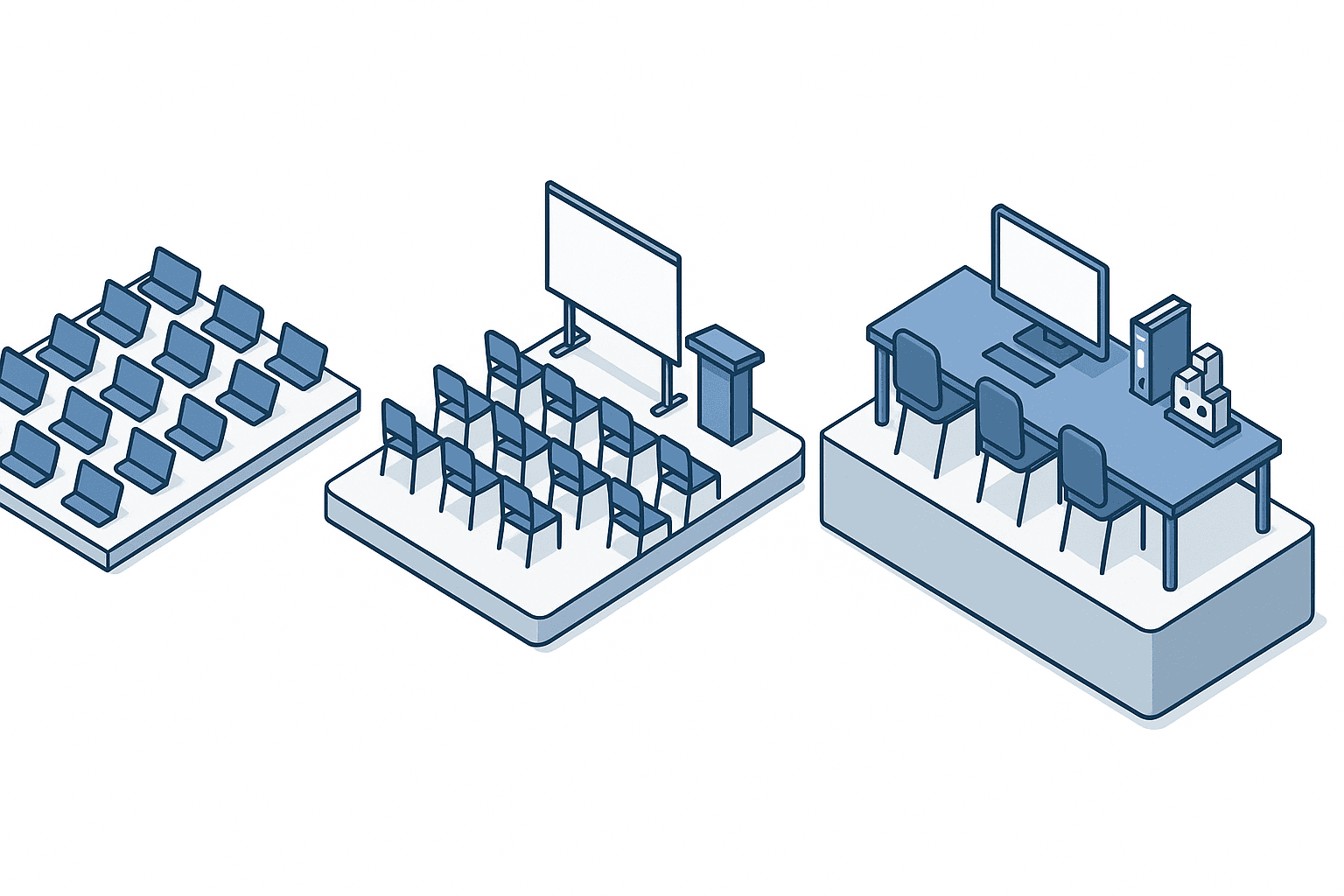
Once the audience is segmented, the next questions are format and price. Generative AI employee training falls into three broad formats, and the unit price and the assumed headcount differ completely between them.
Cost Benchmarks Differ by an Order of Magnitude Between Formats
As of June 2026, the cost benchmarks for generative AI training break down as follows.
| Training format | Indicative cost | Assumed headcount |
|---|---|---|
| E-learning | JPY 50,000 to 100,000 per person | Suited to company-wide rollout |
| Instructor-led group training (half-day fundamentals seminar) | JPY 300,000 to 500,000 per session | 10 to 50 attendees |
| Instructor-led group training (full-day practical workshop) | JPY 800,000 to 1,500,000 per session | 10 to 50 attendees |
| Business-specific customized training | JPY 1,000,000 to over 3,000,000 in total (roughly JPY 200,000 to 400,000 per person) | 3 to 20 attendees |
Instructor-led group training as a whole sits in a band of JPY 300,000 to 1,500,000 per session, split between JPY 300,000 to 500,000 for a half-day fundamentals seminar and JPY 800,000 to 1,500,000 for a full-day practical workshop.
The number worth studying in that table is the spread in per-person cost. E-learning runs JPY 50,000 to 100,000 per head, while business-specific customized training runs JPY 200,000 to 400,000 per head, a gap of roughly four times. Group training compounds this, because it is quoted as a total per session. The same half-day fundamentals seminar at JPY 300,000 to 500,000 costs JPY 6,000 to 10,000 per person with 50 attendees and JPY 30,000 to 50,000 per person with 10, so headcount alone moves the unit price several fold. In other words, if you collect quotations under the single heading of generative AI employee training without having fixed the headcount and the format, the figures are not comparable.
Tier 1 – Literacy Training for the Whole Workforce
Tier 1 is everyone. What you are teaching here is not how to operate a tool. It is where the line falls between acceptable and unacceptable use, and the habit of not swallowing the output whole. This is the territory the DX Literacy Standards address.
E-learning is the rational format for this tier on cost grounds. JPY 50,000 to 100,000 per person is by no means cheap, but it is an order of magnitude below pushing group training out to the entire workforce. At a Thailand site, the question that surfaces here is whether Japanese-language material can be reused without modification. At sites where local staff form the majority, rolling out e-learning contracted by the parent company in Japan without adapting it tends to produce participation rates that never rise.
Tier 2 – Group Training and Seminars for Departmental Champions
Tier 2 consists of the champions nominated by each department. A typical configuration is one person each from production engineering, quality assurance, production control and purchasing, which puts the group at somewhere between 10 and 30 people.
Instructor-led group training suits this tier. At JPY 300,000 to 500,000 for a half-day fundamentals seminar and JPY 800,000 to 1,500,000 for a full-day workshop, a group of 20 taking the full-day workshop works out at roughly JPY 40,000 to 75,000 per person. That is close to the per-person cost of company-wide e-learning, but the difference is that the exercises let attendees pull the content toward the work their own department actually does.
If you are commissioning a corporate generative AI seminar from an outside provider, Tier 2 is also the audience where an order tends to deliver the best return. It sits exactly in the middle, too expensive to give to everyone and too thin for your core people.
Tier 3 – Business-Specific Customized Training for Core Staff
Tier 3 is the handful of people who will actually design and operate the mechanisms inside the company. This is where business-specific customized training belongs, at JPY 1,000,000 to over 3,000,000 in total, roughly JPY 200,000 to 400,000 per person, for a group of 3 to 20.
The common failure at this tier is letting the size of the invoice push you into widening the audience so that as many people as possible get the benefit. The value of customized training lies in being able to use your own operational data and your own process flows as the material. The more attendees you add, the more the material drifts toward the lowest common denominator and back into generalities. Narrowing to three to five people and designing the course around real internal data leaves you with something different for the same money.
What to teach at this tier and how to inspect the output, in other words the curriculum-side design, is covered in detail in AI Training Curriculum 2026 – The Difference Comes From Inspection and Templates, Not Content. This article stays with the allocation question of who the training is pointed at.
How to Think About Splitting the Budget
There is no need to split the budget evenly across the three tiers. In practice, weighting the first year toward Tier 2 works better. Tier 1 literacy training rarely changes anyone’s daily work immediately afterwards, and Tier 3 spending goes to waste if the receiving role has not yet been defined. If your departmental champions in Tier 2 find the uses inside their own departments first, and you then select the people to promote into Tier 3 from among them, you have an evidence base for next year’s allocation.
An In-House Generative AI Study Group Is Not a Substitute for Training
Cost pressure often leads to the suggestion that an in-house study group could replace external training. The short answer is that an in-house generative AI study group is not a substitute for external training, and that it works when it is designed as a complement.
What a Study Group Can and Cannot Carry
What in-house study groups are good at is sharing usage patterns grounded in your own operations and accumulating a record of what went wrong. Their value as a place to learn what other departments are doing with the same tool is considerable, and no external instructor can manufacture that.
What they are bad at is systematic coverage. The ceiling is the understanding of the best-informed person in the room, and mistaken understanding can settle in and stay. Study groups also tend to get scheduled outside working hours or over lunch, which fixes the attendance list and turns the session into a gathering of people who were already interested. The structural weakness is that the sessions never reach the people with low interest.
The Minimum Setup for Launching One
If you are starting a generative AI study group internally, four elements are enough.
- Fix the frequency at once a month and block out a full year of dates in advance
- Use a rotating format in which one person spends ten minutes on something they tried in their own work
- Reserve a slot in every session for at least one example that did not work
- Hold sessions during working hours and make attendance subject to line manager approval
Anything more elaborate will not survive past the first session. The fourth point matters most. Make it a voluntary gathering outside working hours and in six months the organizer will be the only one left.
A Study Group Protects the Training Investment Rather Than Reducing It
It is worth being explicit about how this sits as an investment decision. An in-house study group is not an alternative that reduces your training spend. It is the insurance that stops the training spend you already committed from being wasted. The phenomenon where a tool is used right after training and everything reverts within a few months does not come from the quality of the training. It comes from the fault line between the training and the daily work. The structure of those fault lines and how to deal with them is covered in AI Adoption Enablement 2026 – The Three Fault Lines That Stop Use After Training, so this article stops at the decision to launch. In budget terms, what a study group needs is not additional spending but internal provisions, a slot inside working hours and line manager approval.
How to Judge Providers When Commissioning a Corporate Generative AI Seminar
At the point where you are considering an external order, here is how to frame the selection criteria.
The Dividing Line Between a Generic Seminar and Customized Training
The decision turns on one question. Does the course need to handle, during the session, the actual operational data the attendees will use the following day? If it does not, a generic seminar is sufficient. If it does, the order should go to a customized format.
Generic seminars are enough when the audience is Tier 1 or the entry point of Tier 2. If the purpose is to install shared knowledge, what generative AI is, how far you can delegate to it, how information should be handled, then there is no need to bring your own data into the room. Conversely, if the purpose is to land the capability on specific tasks such as summarizing daily reports, classifying defect reports or drafting work instructions, a generic seminar leaves nothing behind except homework, the instruction to go away and try it yourselves.
Additional Checks When Ordering Training for a Thailand Site
Running training at a Thailand site does not proceed on the same terms as in Japan. These are the points worth confirming in advance.
- Which language the training will be delivered in, since whether you cover only Japanese expatriates or also include local staff changes both the material and the instructor
- If local staff are included, whether you will work through an interpreter or find an instructor who can deliver in Thai or English
- Whether a training program already contracted by the parent company in Japan can be reused, since licenses are sometimes limited to the Japanese legal entity
- Whether the company has decided which generative AI services employees are permitted to use, because running the training ahead of that decision leaves attendees with no approved tool afterwards
- Whether local information management rules define the scope of operational data that may be entered into external services
The last two points are separate from choosing a training provider, but if they are unresolved when the training runs, attendees cannot carry what they learned into their work. The internal policy work needs to advance in parallel with the training order.
Building the Investment Plan Around the Subsidy
For employees based in Japan, the effective net cost of training changes substantially once the subsidy is applied.
Japan’s Training Subsidy Is in Its Final Program Year in FY2026
The Investment in People Promotion Course (advanced digital talent training and related categories) of Japan’s Ministry of Health, Labour and Welfare Human Resources Development Subsidy is designated as being in its final program year in FY2026, which corresponds to Reiwa 8. For small and medium-sized enterprises, expense support covers up to 75% and wage support is JPY 1,000 per person per hour.
One worked example puts the effective cost at roughly JPY 62,000 per person for a case where five people take a 20-hour course priced at JPY 330,000 per person. A move from JPY 330,000 to JPY 62,000 is the kind of difference that determines whether Tier 3 customized training can be ordered at all.
The important caveat is that any extension beyond April 2027 is undecided. Before deciding to defer training to the following fiscal year, confirm the program deadline and the application cut-off directly with the competent Labour Bureau or with the program’s own primary sources.
It Does Not Apply Directly to Staff at Overseas Sites
The point to watch is that this subsidy is built around establishments covered by Japan’s employment insurance system and the insured employees at those establishments. Local staff employed directly by a Thai subsidiary cannot be assumed to qualify.
The realistic design is therefore to budget separately for employees taking the training on the Japan side and staff taking it at the local subsidiary. Build the heavier, subsidy-backed program in Japan, and have the people developed there act as the vehicle for rolling it out to the overseas site. That sequence lets you address both sides within a limited budget. It is also worth examining whether the training for Japanese expatriates can be brought forward to before their posting begins.
Where to Place the People You Develop and How to Spread It Internally
When the training ends, only half the investment is complete. The other half is placement.

Fix the Three-Month Post-Training Assignment Before You Order
As noted earlier, deciding how the trainee’s time will be allocated for the three months after the course, and deciding it at the point the order is placed, is the single most effective step. Three things need to be settled.
- How many hours per week go to DX promotion work
- Which parts of their existing workload transfer to whom during those hours
- Who they report to and who checks their progress
Leave the third out and you end up with time reserved and nothing moving. The manager does not need to understand the technical content, but whether a monthly reporting line exists at all changes the rate of progress.
Choose the First Use Case From Work Whose Hours You Can Count
The standard rule for the first assignment given to a newly trained person is to choose work whose hours you can count, not work with the largest potential effect. Compiling daily reports, drafting routine reports and producing multilingual work instructions are all tasks where you can count how many hours a month they consume before you start. Where you can count the before, you can count the after.
Themes such as demand forecasting or defect root-cause analysis go the other way. The potential effect is large, but neither the hours before nor the improvement after are easy to measure, which makes them poor candidates for a first project. The sequence to avoid is handing a difficult theme to a newly trained person, seeing no visible result, and losing the budget line for the following year.
Internal Rollout Accelerates When Trained Staff Move to the Teaching Side
A useful next step is to move the people developed in Tiers 2 and 3 onto the instructor side of the following year’s Tier 1 training. They hold internal examples no external instructor can produce, and standing in front of a room consolidates their own understanding. The in-house study group described earlier also works well as the place where that transition happens without friction.
The thing to be careful about here is not expecting internal instructors to match the systematic coverage of external training. What internal instructors provide is concrete examples of how the tool is used inside your own company. Systematic knowledge stays with the external program. Keep that division of labor clear and the burden on your internal instructors will not grow every time you roll out to another group.
Frequently Asked Questions
How much does DX talent development training cost?
Per-person cost varies several fold by format. On June 2026 benchmarks, e-learning runs JPY 50,000 to 100,000 per person, instructor-led group training runs JPY 300,000 to 1,500,000 per session (JPY 300,000 to 500,000 for a half-day fundamentals seminar and JPY 800,000 to 1,500,000 for a full-day practical workshop, for 10 to 50 attendees), and business-specific customized training runs JPY 1,000,000 to over 3,000,000 in total (JPY 200,000 to 400,000 per person, for 3 to 20 attendees). Where the trainees are employees based in Japan, using the Human Resources Development Subsidy lowers the effective cost. Small and medium-sized enterprises can claim expense support of up to 75% and wage support of JPY 1,000 per person per hour, and one worked example shows five people taking a 20-hour course priced at JPY 330,000 per person coming down to roughly JPY 62,000 per person in effective cost.
Should every employee receive generative AI training?
The practical approach is to separate the tier that receives the company-wide rollout from the tier you select and invest in heavily. It follows the same logic that underlies METI’s Digital Skill Standards, which are built from two parts, the DX Literacy Standards and the DX Promotion Skill Standards. Give the whole workforce literacy training that conveys the permitted scope and the cautions, give departmental champions group training that includes exercises, and give core staff customized training built on your own data. Push the same course out to everyone and it will be too difficult for the majority and too thin for the champions, and nothing will stay with either group.
How do we start an in-house generative AI study group?
Start by fixing the frequency at once a month and blocking out a full year of dates in advance. Use a rotating format in which one person spends ten minutes sharing something they tried in their own work, and reserve a slot for at least one example that did not work. Holding the sessions during working hours and making attendance subject to line manager approval is the condition for the group surviving. Make it a voluntary gathering outside working hours and within six months the organizer will be the only one left. Bear in mind that a study group is poor at installing systematic knowledge, so position it not as a replacement for external training but as the complement that stops usage from fading after the course.
What criteria should we use when commissioning a corporate generative AI seminar?
The dividing line is whether the course needs to handle, during the session, the operational data attendees will use the following day. If the purpose is to install shared knowledge, a generic seminar is sufficient. If the purpose is to land the capability on specific tasks, choose a customized format that can use your own data and process flows as the material, otherwise all that remains is homework to take away. In parallel with placing the order, confirm whether the company has decided which generative AI services are approved for use, and whether your information management rules define the scope of operational data that may be entered into external services. If those are unresolved, attendees will finish the course with no tool they are allowed to use.
How long can the subsidy be used?
The Investment in People Promotion Course (advanced digital talent training and related categories) of Japan’s Human Resources Development Subsidy is designated as being in its final program year in FY2026, which is Reiwa 8. Any extension beyond April 2027 is undecided. Before deciding to defer training to the next fiscal year, confirm the program deadline and application cut-off with the competent Labour Bureau or the program’s primary sources. Note also that the subsidy is built around establishments covered by Japan’s employment insurance system and their insured employees, so staff employed directly by a Thai subsidiary cannot be assumed to qualify. Plan on the basis that the Japan-side and local-side budgets are drawn up separately.
Should local staff at a Thailand site receive the same training?
There is nothing wrong with delivering the same content, but the delivery conditions cannot be identical to those in Japan. You need to confirm in advance which language the training will run in, whether you will use an interpreter or find an instructor who can deliver in Thai or English, and whether the license on a program already contracted by the parent company in Japan permits reuse at an overseas site. In JETRO’s 2023 survey on the business conditions of Japanese companies operating overseas, 56.7% of respondents in Thailand rated the IT talent shortage as very serious or somewhat serious. It is safer to assume you are in an environment where hiring alone will not close the gap. Developing local staff is also an investment in the sense that it leaves capability at the site that does not depend on expatriate posting cycles.
Summary
Here are the points to hold on to if DX talent development training is going to work as an investment.
- Training is part of staffing rather than a standalone event, and the three-month post-training time allocation and reporting line need to be settled at the point the order is placed
- METI released Digital Skill Standards ver.2.0 on April 16, 2026, adding talent categories related to data management and reflecting the importance of preparing, governing and using data as the precondition for applying AI
- The Digital Skill Standards are built from two parts, the DX Literacy Standards for all business professionals and the DX Promotion Skill Standards for DX specialists, and that structure transfers directly into the tiering of your training
- Of the five categories in the DX Promotion Skill Standards, the business architect who sets objectives and coordinates stakeholders cannot be outsourced and has to be held at the site
- Generative AI training costs as of June 2026 differ by an order of magnitude between formats, with e-learning at JPY 50,000 to 100,000 per person, instructor-led group training at JPY 300,000 to 1,500,000 per session and business-specific customized training at JPY 1,000,000 to over 3,000,000 in total, which means quotations are not comparable until headcount and format are fixed
- Weighting the first year toward Tier 2, the departmental champions, and selecting the Tier 3 candidates from among them is the practical sequence
- An in-house study group complements external training rather than replacing it, and the minimum viable setup is monthly, inside working hours, on a rotating format
- The Investment in People Promotion Course of Japan’s Human Resources Development Subsidy is in its final program year in FY2026, with expense support of up to 75% and wage support of JPY 1,000 per person per hour for small and medium-sized enterprises, and any extension beyond April 2027 is undecided
- In JETRO’s 2023 survey, 56.7% of respondents in Thailand and 58.2% across Asia and Oceania rated the IT talent shortage as very serious or somewhat serious, so development should be planned on the assumption that hiring alone will not close the gap
- Among companies not using digital technology, 47.6% cite a talent shortage as the reason, and while roughly 80% of manufacturers are working on DX, only around 20% report that results are coming through
The first thing to do is not to compare training providers. It is to write down, on paper and in advance, which of the five categories you have decided to hold at your own site, who you are placing in that role, and how many hours a week that person will spend on it. Once those three are filled in, the format and the price of the training you need narrow down on their own.
TOMAS TECH supports shop-floor DX for Japanese manufacturers operating in Thailand, including the PEGASUS production management system. On the talent side, we are happy to work through the questions that come before you place a training order, such as which tier to start with and how to divide the roles your site holds from the roles that belong with head office or an external partner. Information gathering ahead of budgeting is perfectly fine as a starting point, so please get in touch through our contact page.
References
- METI – Digital Skill Standards ver.2.0 Compiled and Released (April 16, 2026)
- METI – Digital Skill Standards (DX Literacy Standards and DX Promotion Skill Standards)
- ALL DIFFERENT – The Five Talent Categories and Their Roles in the DX Promotion Skill Standards
- JETRO – IT Talent Shortages in the 2023 Survey on Business Conditions of Japanese Companies Operating Overseas (Asia and Oceania)
- dotpro – AI Training Cost Benchmarks and Unit Prices by Training Format
- Trustep – Subsidy Rates and Worked Examples for the Human Resources Development Subsidy (Investment in People Promotion Course)
- TRISE – The Talent Shortage and the Results Gap in Manufacturing DX


