


What Changes with an Electronic Batch Record (EBR) Implementation
A paper batch manufacturing record (BMR) can run to dozens of pages for a single batch. Production assembles the record and hands it to QA, and QA checks every page before moving on to batch release. If missing entries or transcription errors turn up along the way, the record goes back to production for rechecking and re-signing. Sometimes it is only at the review stage that anyone notices a weighed quantity or an in-process control (IPC) value was outside its limit. During inspections, you are asked to explain who wrote each entry and when, and who corrected it and when.
This article is for readers considering an electronic batch record (EBR) implementation at a GMP plant in Thailand. It sets out a design approach, an RFP, and acceptance criteria for FAT/SAT. The scope is batch manufacturing of pharmaceuticals and active pharmaceutical ingredients, cosmetics, health foods and supplements, specialty chemicals, and food.
Here is the conclusion first. In this article, we take the view that implementing an electronic batch record (EBR) is not a matter of replacing paper records with tablets or PDFs. We see it as designing the following five elements as one system.
- Generate the execution record for each batch from an approved master batch record (MBR)
- Capture weighed quantities and IPC values directly from instruments and run limit checks on the spot
- Automatically flag exceptions such as out-of-limit values, out-of-sequence steps and delays, and link them to deviation records
- Use electronic signatures and audit trails to preserve who did what, when, and why
- Have QA review with a focus on exceptions, make the batch release decision, and reflect the result in the lot status in the ERP and LIMS
A few caveats up front. This article is not a recommendation or ranking of any particular product. The cost estimate later in the article uses hypothetical figures prepared for this article. Also, an EBR is not a regulatory obligation. Paper records can also meet the requirements of the regulations. If you go electronic, additional requirements apply to the records as electronic records.
Requirements definition for a production management system across a whole batch plant is covered in Chemical Production Management System: A 90-Day Playbook. This article focuses on the batch record part.
Why GMP Plants in Thailand Are Considering Digitizing Batch Records Now
A short summary of the background. All figures are given with the year and basis used in their sources. They are not figures that apply directly to the reader’s plant.
According to Krungsri Research’s “Industry Outlook 2026-2028: Pharmaceuticals” (published June 26, 2026), around 88.4% of the pharmaceuticals produced domestically in Thailand in 2024 were consumed domestically, and 11.6% were exported (compiled by OIE and Krungsri Research). The same report cites, among other sources, a statement by the Government Pharmaceutical Organization (GPO) in April 2026 (as reported by Bangkok Biz News) that Thailand has about 144 GMP-certified pharmaceutical plants, of which 9 companies are able to manufacture active pharmaceutical ingredients (APIs).
The report lists, as challenges for private manufacturers, compliance with PIC/S GMP standards following Thailand’s accession to PIC/S, and the resulting rise in operating costs. It also mentions the adoption of digital manufacturing systems such as MES, e-Batch Records, and pharmaceutical traceability. On investment, it states that in January to September 2025 the BOI approved 14 projects in the pharmaceutical value chain worth a total of THB 2.68 bn, up 43.4% from THB 1.87 bn in the same period of 2024.
There are regulatory developments as well. According to the PIC/S list of members, Thailand (Thai FDA) joined in August 2016. The revised PIC/S GMP Guide, PE 009-18, entered into force on September 24, 2026. However, this is a PIC/S guide. We have not confirmed in this article how it will be reflected in Thai domestic law.
In the EU, draft revisions of GMP Chapter 4 and Annex 11 were published on July 7, 2025, and the consultation closed on October 7, 2025. As of the time of writing, the revised versions have not entered into force. The 2011 version of Annex 11 is the one currently in force.
As a case in Thailand, according to a Körber press release (May 12, 2022), GPO was the first in Thailand to implement the company’s PAS-X MES in 2015, and migrated to version 3 in 2022.
What Is an Electronic Batch Record (EBR)? How It Differs from MBR, BMR, Electronic Forms and MES
Let us look at what an electronic batch record (EBR) is by starting from how the records relate to each other.
The US rule 21 CFR 211.186 requires master production and control records to be prepared for each product and each batch size. The record is prepared and signed by one person and independently checked and signed by a second person. In this article we call this the master batch record (MBR).
21 CFR 211.188, in turn, requires batch production and control records to be prepared for each batch. Its paragraph (a) is an accurate reproduction of the appropriate master record, checked for accuracy, dated and signed. Paragraph (b) is the record of execution layered on top. In other words, a batch manufacturing record (BMR) consists of two layers: a reproduction of the approved MBR, and the results of what was actually done. An EBR is a system that handles these two layers electronically.
Note that 21 CFR Part 11 and Part 211 are US regulations. They concern plants that ship products to the US, and plants that use US regulations as their internal standard. They need to be read as separate rules from EU GMP, the PIC/S guides, and Thai notifications.
For batch control, there is the ISA-88 standard, published internationally as IEC 61512-1. According to the IEC webstore, this standard defines models and terminology that treat recipe procedural elements and equipment procedural elements separately. The second edition, IEC 61512-1:2026, was published on February 20, 2026, replacing the first edition of 1997. The items to be kept in a batch record are set out by 21 CFR 211.188 and EU GMP Chapter 4, as described above, and their role differs from that of ISA-88.
Electronic Forms vs EBR
An electronic forms system replaces paper forms with screens. It can make fields mandatory and restrict choices. An EBR, by contrast, controls the execution of the procedure itself and makes it one with the record. For example, you cannot move to the next step until the previous step is complete, and an out-of-limit value is treated as an exception when entered. For the general case of digitizing forms, see Electronic Forms System Guide 2026: Paperless ASEAN Factories.
EBR vs MES
An EBR may be offered as one function of an MES, or as a stand-alone product. Neither is inherently better. The choice depends on whether you already have an MES, how roles are divided with the ERP, and the scope of the target processes. The MES selection process is covered in Thailand MES 2026: RFP, 90-Day PoC and Acceptance Guide.
Part 11 Terminology
21 CFR 11.3 defines an electronic record as information represented in digital form that is created, modified, maintained, archived, retrieved, or distributed by a computer system. An electronic signature is a combination of symbols executed, adopted, or authorized by an individual that is the legally binding equivalent of a handwritten signature. A closed system is an environment in which system access is controlled by the persons responsible for the content of the records. An EBR inside a plant is in many cases designed as such a closed system.
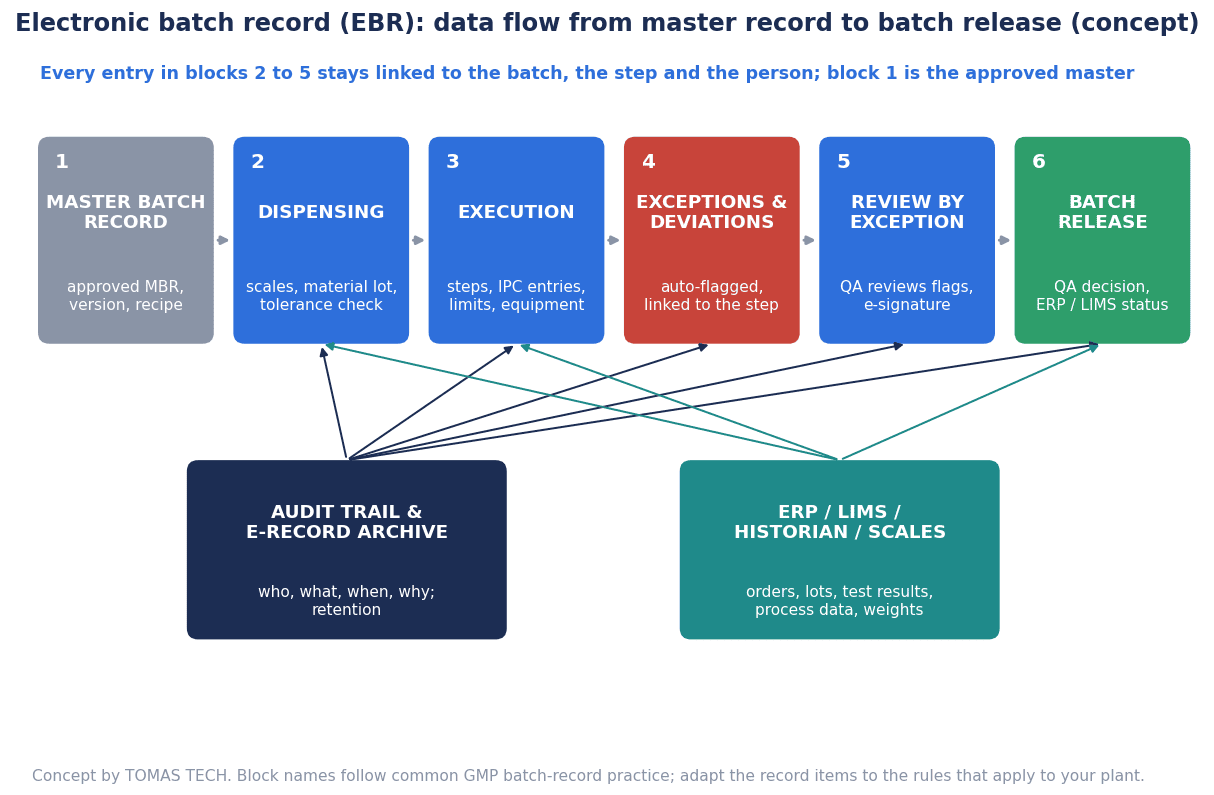
Figure 1 EBR architecture. The flow runs in this order: 1 MASTER BATCH RECORD (approved MBR, version, recipe), 2 DISPENSING (scales, material lot, tolerance check), 3 EXECUTION (steps, IPC entries, limits, equipment), 4 EXCEPTIONS & DEVIATIONS (auto-flagged, linked to the step), 5 REVIEW BY EXCEPTION (QA reviews flags, e-signature), 6 BATCH RELEASE (QA decision, ERP / LIMS status). In the lower row, AUDIT TRAIL & E-RECORD ARCHIVE connects to 1 to 5, and ERP / LIMS / HISTORIAN / SCALES connects to 1, 2 and 5.
What Goes into a Batch Record: Items Required by US and EU Rules
The items of a batch record are set out specifically in the US rule 21 CFR 211.188 and in 4.20 Batch Processing Record of EU GMP Chapter 4. Both are items under US and EU rules, but they are a useful reference for record design even at plants supplying the Thai domestic market or Japan.
| Record content | US 21 CFR 211.188 | EU GMP Chapter 4, 4.20 |
|---|---|---|
| Underlying instructions | (a) Accurate reproduction of the master record (checked, dated, signed) | Based on the current approved manufacturing formula and processing instructions |
| Product and batch identification | (b)(3) Identification of each batch of components and in-process materials | a) Name and batch number of the product |
| Dates and times | (b)(1) Dates | b) Dates and times of start, significant intermediate stages and completion |
| Equipment | (b)(2) Identity of major equipment and lines used | e) Processing operations and major equipment |
| Weighing | (b)(4) Weights and measures of components used in the course of processing | d) Quantity of each starting material actually weighed (including the batch number and amount of any recovered or reprocessed material) |
| In-process controls | (b)(5) In-process and laboratory control results | f) Record of in-process controls, the person performing them, and the results |
| Yield | (b)(7) Actual yield and percentage of theoretical yield | g) Yield at each stage |
| Performer and checker | (b)(11) Identification of the persons performing and directly supervising or checking each significant step (for automated equipment, the person checking) | c) Persons performing each significant step and, where appropriate, the checker |
| Deviations | (b)(12) Investigations under 211.192 | h) Notes on special problems and signed authorization of deviations |
| Other | (b)(8) Labeling control records, (b)(10) sampling, and so on | i) Approval by the person responsible for processing operations |
EU 4.20 carries a Note. In substance, it says that for a process that is validated and continuously monitored and controlled, automatically generated reports may be limited to compliance summaries and exception/OOS data reports. This limitation presupposes both “validated” and “continuously monitored and controlled.” It does not apply to every process.
In the same Chapter 4, 4.8 requires records to be made at the time each action is taken. 4.9 requires any alteration to an entry to be signed and dated, to leave the original information readable, and, where appropriate, to record the reason. The principle is the same for paper and electronic records.
4.20 of PIC/S PE 009-18 Part I has the same wording as 4.20 of EU Chapter 4. Regarding pharmaceutical GMP in Thailand, the Thai FDA had indicated a policy of revising its notification to comply with PIC/S GMP in line with its PIC/S accession. In this article, we have not been able to confirm the provisions of the current notification.
Designing and Version-Controlling the Master Batch Record (MBR)
In this article, we take the view that the quality of an EBR is determined by the quality of its MBR. If the MBR is ambiguous, neither limit checks nor exception flagging are possible.
21 CFR 211.186(b) lists the items to be included in the MBR. These include a complete list of components, the weight or measure of each component, a statement of theoretical weight at each stage of processing, complete manufacturing and control instructions, and sampling and testing procedures. For theoretical yield, the MBR also states the maximum and minimum percentages. When the yield falls outside that range, an investigation under 211.192 is required.
In EU GMP Chapter 4, this corresponds to 4.17 Manufacturing Formula and 4.18 Processing Instructions. Item i) of 4.18 requires the details of in-process controls to be stated, including instructions for sampling and acceptance limits.
In an EBR, these are held as structured data rather than as text. Product code, steps, parameters, limits, materials to be used, and the roles of required signatories are defined as fields. This lets the system compare values against limits at execution time.
Q6 of the FDA data integrity Q&A (December 2018) recommends that blank forms (such as electronic worksheets and master production and control records) be controlled by the quality unit or another responsible unit, issued with numbers, and reconciled. In an EBR, the system is set up so that batch records are issued only from approved versions, and the issue history is retained.
When switching versions, decide first how batches in progress will be handled. Define in procedures whether a batch started on the old version is completed on the old version, and which process steps prohibit a mid-batch switch. For how to draw change boundaries, see also 4M Change Management System: Evidence-Based Release Control.
As product examples, Körber states on its MBR support page that it supports the transition from paper batch records to electronic execution in PAS-X MES. Rockwell Automation states on its FactoryTalk PharmaSuite product page that “Master recipes follow ISA S88/95 standards.”
Capturing Weighing and Dispensing: Directly from the Scale, with Limit Checks on the Spot
Weighing is one of the steps in a batch record most prone to transcription errors. 21 CFR 211.188(b)(4) requires the weights and measures of components used in the course of processing to be recorded, and 4.20 d) of EU GMP Chapter 4 requires the quantity of each starting material actually weighed to be recorded.
In an EBR, the design captures scale values directly from the scale instead of having people copy them down. The captured value is judged on the spot against the target value and tolerance defined in the MBR. If it is outside the tolerance, the operator is alerted immediately and the event is recorded as an exception. At the same time, the system reads the material lot number and container and confirms that they match the instructions. Connection methods between scales and PLCs or higher-level systems are covered in Industrial Scale PLC Integration: RFP and FAT/SAT for Thai Factories.
For reference, here is an approach to analytical balances. According to the USP FAQ (<41> Balances and <1251> Weighing on an Analytical Balance), the minimum weight requirement does not include the weight of the tare container. The difference between the readings before and after the material is added must meet the minimum weight requirement. The FAQ also explains that the “smallest net weight” is a threshold set by the user and should be larger than the calculated “minimum weight.” This is an explanation in the context of analytical balances. It does not necessarily apply as-is to scales in a production dispensing room.
The descriptions from each vendor are listed below in alphabetical order. This is not a recommendation or comparison.
- Emerson states in its Syncade data sheet (March 2018) that it reads scale data, sends commands issued to the scale to the EBR for compliance review, and verifies dispensing containers
- Rockwell Automation states on its FactoryTalk PharmaSuite product page that it supports pre-weighing scenarios and can automate weighing and dispensing
- Siemens lists, on its Opcenter Execution Pharma page, scale management and calibration checks, tolerance calculation, and the receipt and issue of prepared materials as functions
- Tulip states that in its Electronic Batch Record App Suite, the Weigh & Dispense app guides operators through the weighing and dispensing steps
Correct calibration of scales is also a precondition for the record. One possible design is for the EBR to look up the calibration status of a scale and block weighing on scales whose calibration has expired. For managing calibration records, see Calibration Management System | Thailand Factory Guide.
Capturing In-Process Control (IPC) Values and Equipment Data
21 CFR 211.188(b)(5) requires in-process and laboratory control results to be kept, and 4.20 f) of EU GMP Chapter 4 requires the record of in-process controls, the person performing them, and the results to be kept.
Some IPC values are measured by operators with instruments and entered, and others can be taken automatically from equipment or sensors. For the former, capture directly from the instrument where possible. Where manual entry remains, compare the value against the MBR limit at the moment it is entered, and raise an exception on the spot if it is out of limit. With paper records, out-of-limit entries can go unnoticed until QA review. In this article, we take the view that judging values on the spot is at the heart of what an EBR delivers.
Continuous equipment data such as temperature, pressure, and agitation speed is often stored in a historian. There is no need to bring all of that data into the EBR. One possible division of roles is to bring in the values needed for the batch record (maximum and minimum per step, hold times, and so on) and the out-of-limit intervals, and to refer to the historian for the details. How to select a historian is covered in Industrial Historian Selection: RFP and FAT/SAT in Thailand.
Time consistency also matters. 21 CFR 11.10(e) requires computer-generated time stamps in audit trails, and 12.4 of EU GMP Annex 11 requires the operator identity and date and time to be recorded. If the clocks of the EBR, scales, equipment and historian drift apart, you can no longer explain the sequence of records. We recommend including a mechanism for synchronizing time across systems in the RFP requirements.
Also decide in advance how to handle data gaps caused by communication outages and similar events. Examples of procedures are keeping the missing interval as an exception, and, if the gap is filled by manual entry, recording the reason and the person who did it.
A Rockwell Automation blog post (March 24, 2017) describes, as an advantage of MES, being able to recognize deviations from critical quality attributes immediately at points such as IPC.
How to Flag and Record Exceptions (Deviations)
21 CFR 211.192 requires any unexplained discrepancy or failure to meet specifications to be thoroughly investigated. This includes cases where the theoretical yield falls outside the maximum or minimum set in the MBR. The investigation extends to other batches of the same product and to other products that may have been associated. The conclusions of the investigation and the follow-up are recorded in writing. 4.20 h) of EU GMP Chapter 4 likewise requires the signed authorization of deviations to be included in the batch record.
In an EBR, exceptions are classified in advance. Examples of categories are as follows.
- Out of limit: a weighed quantity or IPC value fell outside the MBR limit
- Out of sequence: a step was skipped, steps were done in the wrong order, or a material lot different from the instructions was scanned
- Time exceeded: a hold time or the time between steps exceeded the upper limit in the MBR
- Re-weighing or re-entry: a value was taken again, or an entry was corrected
- Equipment status: expired calibration, communication outage, missing data
Exceptions are recorded linked to the step where they occurred. Serious ones are linked to a deviation record. Deciding which exceptions are treated as deviations is QA’s role. The system’s role is to flag exceptions without omission and record them reliably. We recommend making this line clear at the requirements definition stage.
The Principle of EU GMP Annex 11 states that where a computerised system replaces a manual operation, there should be no resultant decrease in product quality, process control or quality assurance. When automating exception flagging, too, you need to confirm that nothing that the paper process used to catch is now missed.
Electronic Signatures and Audit Trails: Part 11 and Annex 11 Requirements
The GMP requirements for audit trails and electronic signatures are set out below, separated by regulation.
US 21 CFR Part 11
21 CFR 11.10 requires the following as controls for closed systems.
- (a) Validation to ensure accuracy, reliability, consistent intended performance, and the ability to discern invalid or altered records
- (d) Limiting system access to authorized individuals
- (e) Secure, computer-generated, time-stamped audit trails that independently record the date and time of operator entries and actions that create, modify, or delete electronic records. Record changes shall not obscure previously recorded information
- (f) Operational system checks to enforce permitted sequencing of steps and events
- (g) Authority checks to ensure that only authorized individuals can sign records, alter records, or perform operations
21 CFR 11.50 requires signed electronic records to show three things: the printed name of the signer, the date and time of signing, and the meaning of the signature (such as review, approval, responsibility, or authorship). These three items are also included in screen displays and printouts. 21 CFR 11.70 requires electronic signatures to be linked to their records so that they cannot be excised, copied, or otherwise transferred by ordinary means. Part 11 also contains further requirements, such as the uniqueness of signatures (11.100 onward).
EU GMP Annex 11 (2011 Version, Currently in Force)
The 2011 version of EU GMP Annex 11 is the version currently in force. 9 Audit Trails requires consideration, based on a risk assessment, of building into the system a record of all GMP-relevant changes and deletions (an audit trail). For changes or deletions of GMP-relevant data, the reason should be documented, audit trails need to be convertible into an intelligible form, and they should be regularly reviewed.
12.4 under 12 Security requires that the identity of operators entering, changing, confirming or deleting data, including date and time, can be recorded. 14 Electronic Signature requires electronic signatures to have the same impact as handwritten signatures within the company, to be permanently linked to their record, and to include the date and time of signing. 8.2 requires that, for records supporting batch release, it is possible to generate printouts indicating whether any data has been changed since the original entry.
FDA Data Integrity Q&A
The FDA Q&A (December 2018) describes an audit trail as a secure, computer-generated, time-stamped electronic record that allows the course of events relating to the creation, modification, or deletion of an electronic record to be reconstructed. Q7 states that personnel responsible for record review should review audit trails together with the rest of the record. As an example, it cites 211.192, under which all production and control records, including audit trails, must be reviewed and approved by the quality unit. Q8 states that where the regulations set a review frequency, that frequency is followed, and where they do not, the frequency is determined by process knowledge and risk assessment.
Direction of the Revision Draft (Not in Force)
The draft revision of Annex 11 published in 2025 has not entered into force as of the time of writing. For reference, here is a brief look at the direction the draft indicates. 12.2 lists keeping in the audit trail the user who made a change and their role, the old and new values, and the date and time, and having the system prompt for the reason for the change. 12.3 lists keeping the audit trail always enabled and locked, 12.6 review by persons not directly involved in the activity, 12.7 risk-based review targeted at specific items, and 12.8 review, in principle, before batch release. Under 13 Electronic Signatures, it lists re-authentication at signing (13.3), including name, username, role, meaning, and date and time in the signature display (13.6), and a permanent link to the record (13.8). These are the contents of a draft, not current requirements.
Thailand’s Electronic Transactions Act
Thailand’s Electronic Transactions Act (B.E. 2544, 2001) sets out the legal effect of electronic signatures as a general law. Section 9, as amended by the 2019 amending act (No. 3, B.E. 2562), provides that where a law requires a signature, a signature is deemed to have been made if a method is used that identifies the person and indicates that person’s approval of the content of the data message, and that method is reliable for the purpose, among other conditions. Section 26 sets out four requirements for a reliable electronic signature: the signature creation data is linked to the signer alone; at the time of signing, it was under the control of the signer alone; any alteration to the electronic signature after signing is detectable; and any alteration to the information after signing is detectable (where that is a purpose of the signature). ETDA has also published an electronic signature guideline, ขมธอ. 23-2563.
However, this concerns the legal effect of electronic signatures under a general law. The requirements for electronic signatures on GMP records need to be judged based on Part 11, Annex 11, the PIC/S guides and similar. In this article, we take the view that the two should be considered separately.
For how to keep the history of record corrections and approvals, see also Production Actuals Correction and Approval System: A Guide for Thai Factories.
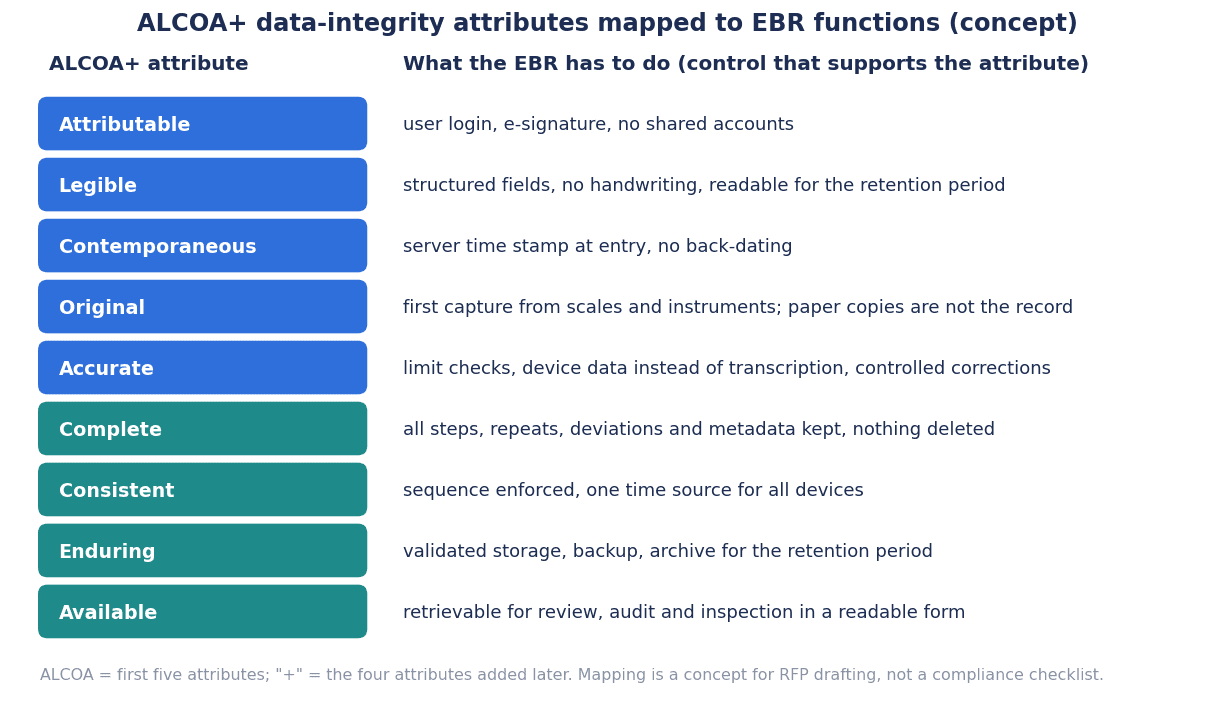
Figure 2 Mapping between the nine ALCOA+ attributes and EBR functions. This is a conceptual diagram for writing an RFP, not a compliance checklist.
Data Integrity: Translating ALCOA+ into EBR Functions
7.4 of PIC/S PI 041-1 (July 1, 2021) defines ALCOA as the initials of Attributable, Legible, Contemporaneous, Original and Accurate, and ALCOA+ as ALCOA with Complete, Consistent, Enduring and Available added. WHO TRS 1033 Annex 4 (2021) also explains ALCOA+ with the same attributes, and emphasizes that they must be met throughout the retention period of the record.
Translated into EBR functions, a possible mapping is as follows. Attributable maps to individual accounts and electronic signatures; Legible to structured input fields and display on screen and in print; Contemporaneous to entry at the time of work and time stamps; Original to direct capture from instruments; Accurate to limit checks; Complete to mandatory fields and recording of exceptions; Consistent to time synchronization and enforced step sequencing; and Enduring and Available to retention and archiving.
On audit trails, 9.6 of PI 041-1 states that audit trail functionality should always be enabled and locked so that it cannot be disabled, deleted or modified. Where an administrator is able to do so, that action should be automatically recorded in the audit trail. Critical audit trails are reviewed independently, together with the other records of the activity, before the activity is confirmed as complete (for example, before batch release). Non-critical audit trails can be checked at a predetermined frequency during system reviews.
WHO TRS 1033 Annex 4 describes the audit trail as metadata that allows the history of a record to be reconstructed, including who, what, when and why. It then lists enabling audit trails for all operations, restricting the authority to enable and disable them, and not permitting changes such as hard deletion.
A note on mixed paper and electronic (hybrid) operation as well. 9.10 of PI 041-1 states that because hybrid systems can be vulnerable to manipulation, their use is discouraged, and they should be replaced whenever possible. On the other hand, 4.1 of EU GMP Chapter 4 assumes that hybrid forms may exist and requires the relationships and control measures for master documents and records to be defined. If hybrid operation arises during the transition period of an implementation, its control measures need to be documented.
For plants that ship products to Japan, Japanese rules are also relevant. Japan’s GMP Ministerial Ordinance was amended by MHLW Ordinance No. 90 of 2021 (Reiwa 3) and took effect on August 1, 2021. For electromagnetic records and electronic signatures, there is the notification “Use of Electromagnetic Records and Electronic Signatures in Applications for Approval or Licensing of Drugs, etc.” (April 1, 2005, Heisei 17, PFSB Notification No. 0401022). In this article we limit ourselves to giving the names and dates.
Review by Exception and Batch Release
Review by exception is an approach in which QA, instead of looking at every page equally, focuses its review on the exceptions flagged by the system. Here we set out its regulatory position accurately.
First, the US rule 21 CFR 211.192 requires the quality control unit to review and approve all production and control records before batch release. Adopting review by exception does not remove this requirement. Its position is that the fact that the EBR verifies the correctness of the record step by step serves as a basis for the quality unit’s review.
As noted above, the Note to 4.20 of EU GMP Chapter 4 states that for a process that is validated and continuously monitored and controlled, automatically generated reports may be limited to compliance summaries and exception/OOS reports. 9.6 of PIC/S PI 041-1 lists “Review by exception – focusing on anomalous or unauthoried activities” as one of the focal points of audit trail review. In its glossary, it describes an exception report as a validated search tool that identifies and documents predetermined abnormal data or actions. Q7 of the FDA Q&A also states that audit trails should be reviewed as part of the record.
ISPE’s GAMP Good Practice Guide: Manufacturing Execution Systems (2010) contains a chapter, Appendix 8, dealing with the definition and justification of Review by Exception. A Rockwell Automation blog post (2017) explains that because an MES enforces controls during execution, review can be narrowed to exceptions rather than the whole record. MasterControl, Siemens and Tulip also refer to review by exception functionality in their respective product descriptions.
On batch release, 15 Batch release of EU GMP Annex 11 requires that, where a computerised system is used to record certification and batch release, the system should allow only Qualified Persons (QPs) to certify the release, should clearly identify and record the person releasing, and should do so using an electronic signature.
In this article, we see the preconditions for moving to review by exception as follows.
- Limits and tolerances are defined in the MBR
- The classification of exceptions and the criteria for judging their severity are set out in procedures
- Validation confirms that the exception report flags, without omission, everything it should flag
- For a set period, full review and review by exception are run in parallel, and the move is made only after confirming that the results match
The result of the batch release decision is reflected in the lot status in the ERP and LIMS. What matters is that the hold, approved and rejected statuses appear the same in the inventory and shipping systems. Managing holds and releases is covered in Quality Hold Management System for Manufacturing: Implementation Guide.
Integration with ERP, LIMS, Historians and Scales
An EBR does not stand on its own. We recommend mapping the data flow first and dividing responsibilities by interface. A typical flow is as follows.
- The ERP issues the production order (product, batch number, quantity)
- The EBR generates the execution record for that batch from the approved MBR
- Weighed quantities are captured from the scale and material lots are allocated
- The process is executed and IPC values and equipment data (historian) are captured
- Test results are received from the LIMS
- QA reviews exceptions and makes the batch release decision
- The result is reflected in the lot status in the ERP
For each interface, decide which system is the system of record, which side resends when a transmission fails, and how received values are verified. In material lot allocation, merges occur when several lots are charged into one batch, and splits occur when one batch is divided into several packaging lots. For how to trace these, see Chemical Lot Management 2026 – Traceability Breaks Where Batches Merge.
Record Retention and Inspection Readiness
Retention periods differ by regulation. They are summarized below to avoid confusion.
| Regulation | Retention period and storage requirements |
|---|---|
| US 21 CFR 211.180(a) | At least 1 year after the expiration date of the batch. For certain OTC drugs exempt from expiration dating, 3 years after distribution of the batch |
| US 21 CFR 211.180(c)(d) | Records that can be immediately retrieved electronically from another location are deemed to meet the storage requirement. Records may be retained as originals or as true copies |
| EU GMP Chapter 4, 4.11 | 1 year after the expiry date of the batch, or at least 5 years after certification by the QP, whichever is longer. For investigational medicinal products, at least 5 years after completion of the last clinical trial in which the batch was used |
| EU GMP Chapter 4, 4.10 | Controls ensuring the integrity of records throughout the retention period are put in place and validated where appropriate |
EU GMP Annex 11 requires the following for the retention of electronic records. 7 Data Storage requires data to be secured by both physical and electronic means, accessibility, readability and accuracy to be checked, and data to be backed up regularly, with the ability to restore checked during validation and monitored periodically. 17 Archiving requires archived data to be checked for accessibility, readability and integrity, and, when changes are made to the system, the ability to retrieve the data to be ensured and tested. 16 Business Continuity requires alternative arrangements for system failures to be made available, documented and tested.
With an EBR, electronic records are kept over long periods. In this article, we take the view that whether past batch records can still be retrieved after the software is replaced or upgraded is something to confirm at the RFP stage.
A note on Thai regulations too. For cosmetics, the facility guide (revised December 2020) for the Thai FDA notification on the manufacture and import of cosmetics (2018) refers to ASEAN Cosmetic GMP. It requires documentation of the master formula and manufacturing records. We have not been able to confirm in this article the provisions on record retention periods and similar matters in the food GMP notification or Thailand’s pharmaceutical GMP notification. We recommend checking the original text of the relevant notification.
Common Pitfalls at Plants in Thailand
From here, as the view of this article, we list pitfalls that commonly occur at plants in Thailand.
- Dual standards between head office and local law: if you go into requirements definition without settling whether to base the system on the standards of the Japanese head office (based on US, EU or Japanese rules) or on Thai notifications, rework follows later. First, list the destination markets of the target products and the regulations that apply
- Language of screens and records: decide which of Thai, English and Japanese to use for screens and which to use for records. If the language of the screens operators read differs from the language of the records presented at inspections, make sure you can explain how they correspond
- Shared accounts: if operators share one account, the record does not show who performed an operation. Design the number of terminals and shift operations on the premise of individual accounts
- Operator qualifications: one possible design is for the EBR to look up qualification status so that untrained operators cannot perform critical steps. For the approach, see Operator Qualification Expiry Control for Manufacturing: Implementation Guide
- Double recording during the hybrid period: while paper and the EBR run in parallel, decide for each product and step which one is the authoritative record
- Remote access for vendor maintenance: for maintenance connections from overseas, set up records of who did what and when, and an approval procedure for connections
- Power and communication outages: decide in advance, and test, how records are kept during power or communication outages, and the procedure for capturing and reconciling them after recovery
Requirements to Include in the RFP
The table below gives examples of requirements to include in an EBR RFP. These are examples based on the views of this article, and each plant will need to add and remove items.
| Requirement category | Example of what to write in the RFP |
|---|---|
| MBR structuring and version control | Steps, parameters, limits, materials and signatory roles can be defined as fields. Batch records are issued only from approved versions, and the issue history is retained. The handling of versions for batches in progress can be configured |
| Direct capture from scales and instruments | List the models, connection methods and values to be captured for the target scales and instruments. State clearly which items will still be entered manually |
| Limit checks and exception classification | Values are compared against limits at entry, and out of limit, out of sequence, time exceeded, re-entry and equipment status are classified and recorded as exceptions |
| Link to deviation records | Exceptions are linked to the step where they occurred, and a deviation record can be raised. The status of deviations is reflected in the batch release decision |
| Electronic signatures | The signer’s name, date and time, and meaning can be displayed and printed (21 CFR 11.50). Signatures are linked to records (21 CFR 11.70) |
| Audit trail and its review | The operator and date and time of creation, modification and deletion, the reason for change, and the old value are retained. The audit trail cannot be disabled. Audit trails can be extracted and reviewed per batch |
| Permissions and individual accounts | Role-based permission settings, records of granting and revoking permissions, no reliance on shared accounts |
| Time synchronization | The method for synchronizing time across the EBR, scales, equipment and historian, and how drift is detected |
| Retention periods and archiving | Retention periods can be set per regulation. Past records can be retrieved after version upgrades |
| ERP, LIMS and historian interfaces | Fields exchanged for orders, lots, test results and release decisions, which system is the system of record, and the resend method |
| Multilingual UI | Screen languages (Thai, English, Japanese, etc.) and the language kept in records |
| Behaviour during power and communication outages | Whether data is buffered on the terminal, capture and reconciliation after recovery, and recording of exceptions during the outage |
| Validation documents | Scope of delivery of IQ, OQ and PQ plans and reports, and the division of responsibilities between vendor and user |
| Data export | Batch records and audit trails can be output in both human-readable and electronic formats |
Even where a vendor describes its product as compliant with Part 11 or Annex 11, that is not certification by a regulator. You need to confirm through your own validation whether the requirements are met in the way you use the system.
FAT/SAT Acceptance Criteria
FAT is an acceptance test carried out in the vendor’s environment before shipment, and SAT is an acceptance test carried out on the actual equipment at the plant. In this article, we recommend receiving test results as records and recalculating the figures yourselves.
| Test | Example acceptance criterion |
|---|---|
| FAT | All steps of the MBR can be executed from start to finish in a simulated batch |
| FAT | Entering an out-of-limit value flags an exception, which is recorded linked to the step |
| FAT | The audit trail retains who changed what, when, and why |
| FAT | The name, date and time, and meaning appear on the electronic signature screen and printout |
| FAT | When a correction is made, the old value is retained and the reason for change is recorded |
| FAT | Scale values enter the record without transcription |
| SAT | The values displayed on the actual scales and instruments match the values recorded in the EBR |
| SAT | After inducing a power outage and a communication outage, records can be reconciled without gaps after recovery |
| SAT | Operations from review by exception through to batch release are kept in the operation log |
| SAT | The batch release result is reflected in the lot status in the ERP and LIMS |
| SAT | Batch records and audit trails can be retained, exported and read back |
Items that passed at FAT are verified again at SAT under real equipment conditions. In particular, matching of scale values and recovery from power and communication outages can only be confirmed on the actual equipment.
Cost and Benefit Model Estimate (Hypothetical Figures)
All figures from here on are hypothetical figures prepared for this article. They are not figures from an actual plant. Cost items are limited to the two items related to batch records; general quality costs, equipment replacement, and licence and maintenance costs are not counted.
The assumed plant is a Japanese-affiliated GMP plant in Thailand that carries out batch manufacturing of health foods and pharmaceuticals, producing 1,200 batches a year. Batch records are on paper, and QA reviews every page before the batch release decision.
Current State
| Cost item | Calculation | Annual cost |
|---|---|---|
| A Labour for creating, transcribing and reviewing records | Per batch: production 1.5 h + QA 3.0 h = 4.5 h × 1,200 batches = 5,400 person-hours. Rate 180 THB per person-hour | 972,000 THB |
| B Rechecking, correcting and re-signing records with defects | 240 cases a year (20% of batches) × 2,500 THB per case | 600,000 THB |
| Total | 1,572,000 THB |
Initial Cost
The initial cost is assumed to total 3,600,000 THB. The breakdown is EBR software and initial licences 1,500,000 THB, MBR structuring and configuration (for 40 products) 900,000 THB, integration with ERP, scales and LIMS 600,000 THB, and validation support (IQ, OQ, PQ), FAT/SAT and training 600,000 THB.
Base Case and Sensitivity Case
| Item | After, base case | After, sensitivity case |
|---|---|---|
| Labour for A | Production 0.5 h + QA 1.0 h = 1.5 h × 1,200 = 1,800 person-hours | Production 0.5 h + QA 2.0 h = 2.5 h × 1,200 = 3,000 person-hours |
| Cost of A | 1,800 × 180 = 324,000 THB (saving 648,000) | 3,000 × 180 = 540,000 THB (saving 432,000) |
| Cost of B | 60 cases × 1,500 = 90,000 THB (saving 510,000) | 120 cases × 1,500 = 180,000 THB (saving 420,000) |
| Total after measures | 414,000 THB | 720,000 THB |
| Annual saving | 1,572,000 − 414,000 = 1,158,000 THB | 1,572,000 − 720,000 = 852,000 THB |
| Payback period | 3,600,000 ÷ 1,158,000 ≈ 3.11 years (about 3 years 1 month) | 3,600,000 ÷ 852,000 ≈ 4.23 years (about 4 years 3 months) |
The base case assumes that limit checks and exception flagging reduce records with defects to 60 a year, and that because records are complete, the cost per case also falls to 1,500 THB. The sensitivity case covers a situation where the move to review by exception is only partial, QA review falls only to 2.0 hours per batch, and records with defects fall only to 120 a year. The cost per case is kept at 1,500 THB.
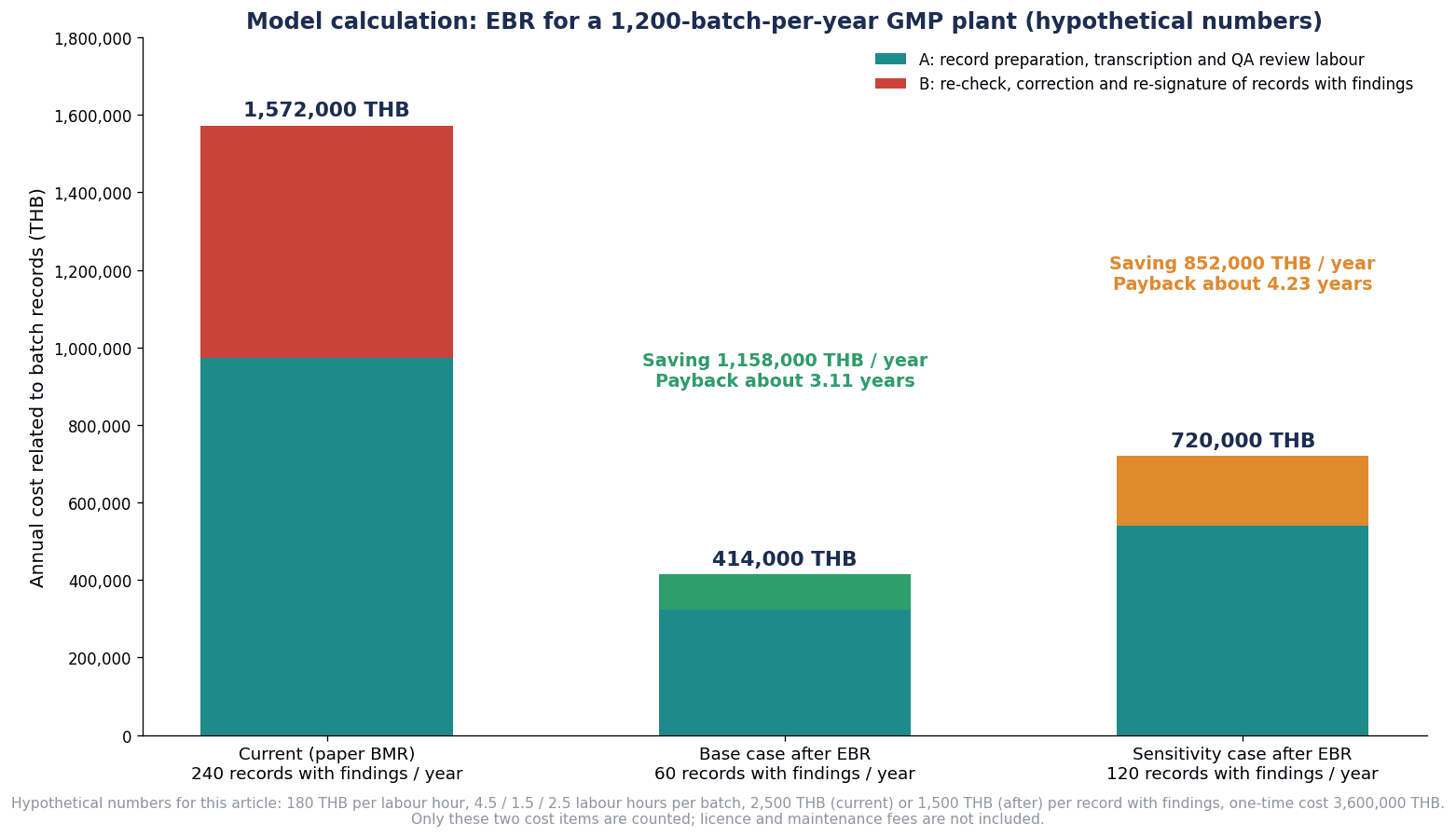
Figure 3 Annual cost (breakdown of A and B) for the current state, after the base case and after the sensitivity case, with the annual saving and payback period. All figures are hypothetical figures prepared for this article.
Here is how to read this estimate. The payback period varies greatly depending on how far QA review time falls (whether you can move to review by exception), and on the number of records with defects and the cost per case. Annual licence and maintenance costs need to be budgeted separately, and including them makes the payback even longer.
Before implementation, we recommend recording the number of batches in the most recent year, the person-hours per batch for record creation and review, and the number of records with defects and the time spent handling them. Also, implementing an EBR does not in itself reduce the causes of manufacturing deviations (equipment, materials, work). What it acts on is defects in records and delays in finding them.
Frequently Asked Questions
What is an electronic batch record (EBR)?
It is a system that generates the execution record for each batch from an approved master batch record (MBR) and electronically records weighing, in-process controls, exceptions, electronic signatures, and audit trails. In this article, we see it as something designed as one system, up to batch release and reflection in the ERP and LIMS.
What is the difference between an EBR and an MES?
An EBR handles the generation of batch records and execution control. An MES covers manufacturing execution broadly (orders, progress, equipment, quality and so on), and may include an EBR as one of its functions. A stand-alone EBR may also be implemented, and neither is inherently better.
Is digitizing batch manufacturing records a regulatory obligation?
No, it is not. 21 CFR 211.180(d) allows records to be retained as originals or as true copies, and the Principle of EU GMP Chapter 4 states that documentation may exist in paper, electronic, photographic or other forms. If you go electronic, you need to meet the requirements for electronic records, such as 21 CFR Part 11 and EU GMP Annex 11.
What is review by exception?
It is an approach in which QA focuses its review on the exceptions flagged by the system. 9.6 of PIC/S PI 041-1 lists it as one of the focal points of audit trail review. It does not remove the review and approval of all records by the quality control unit that US 21 CFR 211.192 requires.
Are electronic signatures legally valid in Thailand?
Thailand’s Electronic Transactions Act sets out the legal effect of electronic signatures as a general law, in Section 9 as amended in 2019 and in Section 26, which sets out the requirements for a reliable electronic signature. However, the requirements for electronic signatures on GMP records need to be judged separately, based on Part 11, Annex 11, the PIC/S guides and similar.
What should be reviewed in audit trails, and how often?
Q8 of the FDA Q&A (2018) states that where the regulations set a frequency for reviewing data, that frequency is followed. As examples, 211.188(b) requires review after each significant step, and 211.22 requires review before release. Where no frequency is set, it is determined by process knowledge and risk assessment. 9.6 of PI 041-1 states that critical audit trails are reviewed before batch release or a similar point, and non-critical ones can be checked at a predetermined frequency. The regulations do not set a uniform numeric frequency.
What is the minimum to confirm in an EBR RFP and FAT/SAT?
In the RFP, state clearly MBR structuring and version control, direct capture from scales and instruments, limit checks and exception classification, the display elements of electronic signatures, the audit trail and its review functions, and retention and export. In FAT/SAT, confirm that out-of-limit values are flagged as exceptions, that old values are retained on correction, that scale values match, that the system recovers from power and communication outages, and that batch release decisions are reflected in the ERP and LIMS.
Summary
- In this article, we take the view that implementing an electronic batch record (EBR) is not about replacing paper with tablets, but about designing the MBR, weighing and limit checks, exception flagging, electronic signatures and audit trails, and review by exception and batch release as one system
- An EBR is not a regulatory obligation. If you go electronic, the requirements for electronic records, such as Part 11 and Annex 11, apply in addition
- The 2011 version of EU GMP Annex 11 is currently in force. The revision draft published in 2025 has not entered into force as of the time of writing
- Adopting review by exception does not remove the review and approval by the quality control unit that 21 CFR 211.192 requires. The move is made after defining limits, classifying exceptions, validating the exception report, and running a parallel period
- Thailand’s Electronic Transactions Act sets out the legal effect of electronic signatures as a general law. GMP requirements are judged separately
- In the RFP and FAT/SAT, make matching of scale values, retention of old values on correction, recovery from power and communication outages, and reflection in the ERP and LIMS into concrete acceptance criteria
- Cost-effectiveness varies greatly depending on how far QA review time falls. We recommend recording your current person-hours and number of defective records before implementation
TOMAS TECH supports manufacturers in Thailand in building systems that connect shop-floor equipment with business systems. If you would like to discuss requirements for digitizing batch records, preparing an RFP, or integration with scales and equipment, please get in touch through our contact page.
References
- 21 CFR §211.186 Master production and control records (eCFR, Cornell LII, retrieved October 16, 2026)
- 21 CFR §211.188 Batch production and control records (eCFR, Cornell LII)
- 21 CFR §211.192 Production record review (eCFR, Cornell LII)
- 21 CFR §211.180 General requirements (eCFR, Cornell LII)
- 21 CFR §11.3 Definitions (eCFR, Cornell LII)
- 21 CFR §11.10 Controls for closed systems (eCFR, Cornell LII)
- 21 CFR §11.50 Signature manifestations (eCFR, Cornell LII)
- 21 CFR §11.70 Signature/record linking (eCFR, Cornell LII)
- FDA, Data Integrity and Compliance With Drug CGMP: Questions and Answers (December 2018)
- EudraLex Vol.4 Chapter 4: Documentation (2011)
- EudraLex Vol.4 Annex 11: Computerised Systems (2011)
- European Commission, EudraLex Volume 4 (retrieved October 16, 2026)
- European Commission, Stakeholders’ Consultation on EudraLex Volume 4 Chapter 4, Annex 11 and New Annex 22 (2025)
- PIC/S, Draft guidelines: Revised Annex 11 Computerised Systems (2025 draft)
- PIC/S PI 041-1 Good Practices for Data Management and Integrity in Regulated GMP/GDP Environments (2021)
- PIC/S GMP Guide PE 009-18 Introduction (2026)
- PIC/S GMP Guide PE 009-18 Part I (2026)
- PIC/S News (September 23, 2026)
- PIC/S Members
- Thai FDA, Status of Controls to Assure the Quality, Efficacy and Safety of Drugs (in Thai, describing the situation as of 2016)
- ETDA, Electronic Transactions Act B.E. 2544 (2001, English translation)
- ETDA, Electronic Transactions Act (No. 3) B.E. 2562 (2019, English translation)
- MDES, Electronic Transactions Act B.E. 2544 (2001, unofficial translation)
- ETDA Open Data, ขมธอ. 23-2563 Electronic Signature Guideline
- Thai FDA, Facility guide for cosmetics (revised December 2020)
- IEC 61512-1:2026 Batch control Part 1: Models and terminology (2026)
- IEC 61512-1:1997 (1997, withdrawn in 2026)
- ISA, ISA88: Batch Control
- WHO TRS 1033 Annex 4 Guideline on data integrity (2021)
- e-Gov Laws and Regulations, Ministerial Ordinance on Standards for Manufacturing Control and Quality Control of Drugs and Quasi-drugs (2004, amended 2021, in Japanese)
- Ministry of Health, Labour and Welfare, Administrative notice (July 1, 2014, in Japanese)
- Krungsri Research, Industry Outlook 2026-2028: Pharmaceuticals (2026)
- Körber, GPO Thailand migrates to PAS-X MES 3 (2022)
- Körber, MBR Consulting & Implementation (retrieved October 16, 2026)
- Rockwell Automation, FactoryTalk PharmaSuite Life Sciences (retrieved October 16, 2026)
- Rockwell Automation, Take Review by Exception to the Next Level (2017)
- Siemens, Opcenter Execution Pharma (retrieved October 16, 2026)
- Emerson, Product Data Sheet Syncade Behaviors (2018)
- MasterControl, Batch Production Records (retrieved October 16, 2026)
- Tulip Library, Electronic Batch Record App Suite
- ISPE, GAMP Good Practice Guide: Manufacturing Execution Systems (2010)
- USP, FAQs: Balances and Weighing on an Analytical Balance


