


A chemical production management system needs more than orders, schedules and finished-goods inventory. In batch manufacturing, it must connect formulation and recipe versions, genealogy from raw-material lot through charge, intermediate and finished product, QC hold and release, yield, by-products, rework, tank or silo inventory, and the effective SDS and label version. This guide turns those needs into practical boundaries for ERP, LIMS, MES and PLC/DCS, followed by an RFP, PoC and 90-day implementation playbook for plants in Thailand.
Why chemical plants need a batch-specific production management design
In discrete assembly, the relationship among bill of materials, production order, component issue and finished quantity is often relatively direct. Chemical production routinely branches. A charge can create an intermediate and a by-product; material changes state during reaction, ageing or transfer; an off-spec output may become an input to a later batch; and a tank heel may mix with the next production lot. Posting only a product code and completed quantity to ERP cannot reconstruct which material lots, equipment conditions, recipe version and laboratory decisions made a shipment releasable.
The objective is therefore not to replace paper with screens. It is to give planning, execution, quality, inventory and EHS a shared manufacturing fact. The operating model should answer:
- Which raw-material, intermediate and rework lots entered this finished lot?
- Which products, inventory and customer shipments are exposed to a suspect raw-material lot?
- What quantity, quality status and lot ownership are physically present in each tank?
- Which recipe version actually ran, who approved it and why was it changed?
- Who released material from QC hold, based on which specification and result?
- Is the yield gap explained by samples, evaporation, residue, waste, by-product or rework?
- Which SDS and label version was effective when the product was filled and shipped?
It is rarely necessary to force every item into one giant application. A more durable design assigns a system of record and an execution authority for each fact, then defines the event contract that crosses each boundary.
The 2026 compliance hook: keep three CLP timelines separate
For mixtures supplied to the EU, three nearby dates must not be collapsed into one generic “label regulation update.” They come from different legal changes and have different transition logic.
| Change set | Application point | Transition | Production-system implication |
|---|---|---|---|
| New hazard classes under Delegated Regulation (EU) 2023/707 | Mixtures from 1 May 2026 | Mixtures already placed on the EU market before that date and already in the supply chain may transition until 1 May 2028, subject to the stated conditions | Link market-placement date, formulation version, classification, SDS and label version |
| 22nd ATP, Delegated Regulation (EU) 2024/2564 | Applies from 1 May 2026 | Assess the affected substances and mixtures individually | Open a separate change record for harmonised classifications in Annex VI |
| Specified Article 61(7) provisions introduced by Regulation (EU) 2024/2865 | Specified classification, labelling and packaging provisions listed in Article 61(7) apply from 1 July 2026 | Qualifying stock already placed on the market and already in the supply chain may transition until 1 July 2028 | Store the EHS/legal applicability decision and execute its document-effective date |
ECHA’s new hazard classes page gives the mixture application date as 1 May 2026 and the qualifying transition for mixtures already on the market as 1 May 2028. ECHA’s 2024/2865 transitional-provisions page and the text of Regulation (EU) 2024/2865 distinguish the specified classification, labelling and packaging provisions listed in Article 61(7), applying from 1 July 2026, and the transition until 1 July 2028 for qualifying stock already placed on the market and already in the supply chain. ECHA’s CLP legislation page lists the 22nd ATP as applying from 1 May 2026. Similar calendar dates do not make these the same change.
The production management system does not make the legal classification. EHS, legal and product-stewardship personnel decide which rule, product, formulation, market and inventory population is affected. The system then prevents filling or shipping against the wrong approved SDS or label version. The RFP should therefore test future-effective versions, sales market, customer rules, date placed on market and formulation-change status—not merely whether the vendor stores PDF documents.
Formulation and recipe version management
ISA’s ISA-88 overview describes structured batch-control terminology and models, recipe management, equipment capabilities and batch production records. The practical lesson is to avoid treating a product formula and a PLC sequence as one undifferentiated “latest recipe.”
Separate product intent from equipment execution
A workable model distinguishes four levels:
- General recipe: the product or grade concept, basic formulation, process intent and quality objective.
- Site recipe: the formula adapted to the Thai site, local materials, utilities, equipment constraints and approved market scope.
- Master recipe: the approved unit allocation, operation order, parameter ranges, sampling points and exception rules.
- Control recipe: the version issued to one production batch, enriched with its order, equipment, actual parameters, deviations and records.
The project may use different labels, but it must preserve three questions: what product is intended, how this site and equipment will make it, and exactly what version this batch executed. Attempting to store temperatures, agitation ramps, sample calls and equipment capabilities only in an ERP BOM mixes approval responsibilities and drives operators back to spreadsheets or controller notes.
Effective scope matters as much as the version number
A recipe record should include version, status, approvers, effective start and end, reason for change, product, site, line, equipment class, allowed raw-material substitutions, market, QC specification and linked SDS/label versions. “Use the latest” is not a release rule. Decide whether the version freezes at order release, weighing start or batch start. Any change after that point should be a controlled deviation with an impact assessment.
Impact review should have separate quality, process, automation, EHS, inventory, label and customer-approval decisions. A supplier change may leave the PLC sequence untouched while requiring compositional, SDS and customer review. A change in agitation time may leave the SDS untouched while changing the controller parameter, cycle time, sampling plan and standard cost.

Genealogy from raw-material lot to finished product
The GS1 Global Traceability Standard uses Critical Tracking Events (CTEs), such as receiving, transformation and shipping, together with Key Data Elements (KDEs). For transformation events it calls for the relationship between inputs and outputs to be recorded. A chemical batch plant should model genealogy as a directed graph that allows splits, joins and loops, not as a single linear chain.
| Object | Typical identity | Required relationships |
|---|---|---|
| Material receipt | material, supplier lot, internal lot | supplier, receipt, CoA, quality status, location |
| Weighing/issue | issue ID, container ID | material lot, quantity, scale, operator, production order |
| Charge batch | batch ID, control-recipe version | input lots, equipment, times, actual conditions, deviations |
| Intermediate | intermediate lot, tank/container | parent batch, transfer, quality status, storage condition |
| Rework | rework lot, reason code | source batch, target batch, percentage limit, approval |
| By-product/waste | output lot, disposition ID | source batch, quantity, use or disposal, cost and EHS record |
| Filling/finished lot | product lot, packaging lot | bulk lot, packaging, line, inspection, label version |
| Shipment | shipment ID | product lot, customer, quantity, date/time, destination market |
A tank transfer must record more than a subtraction and addition. It needs the proportions of the logical lots moved, the heel that remained, and any allowed commingling rule. Partial transfer, split filling, combination from multiple tanks and return-material addition cannot break the parent-child link.
Make a recall drill part of the acceptance test
Use one representative lot to perform both backward and forward tracing. Backward tracing moves from finished product to materials, recipe, equipment and tests. Forward tracing moves from a material lot to exposed product, stock and customer shipments. Acceptance is not “the search page opens.” The quantities, hold population and customer distribution must reconcile. Store both local time and its UTC offset so that an event around midnight does not migrate to a different reporting day.
Treat QC hold and release as a controlled state transition
Quantity on hand does not mean that a chemical lot is available for use, filling or shipment. Define states such as untested, sampled, testing, held, conditionally approved, released, rejected and disposed. Specify permitted transitions, roles, evidence and reversal behaviour.
LIMS should own the sample, method and specification versions, result, OOS/retest process and laboratory approval. MES consumes that disposition and decides whether the lot can be weighed, charged or filled. ERP consumes an appropriate business status for planning, allocation, shipment and valuation. Instead of copying every instrument result into MES, pass the disposition, specification version, approval identity and time, plus a durable link to evidence.
A manual or conditional release path needs reason, expiry, allowed quantity, permitted product/use and dual approval. If a laboratory result is corrected after release, genealogy must identify batches and shipments that return to hold or require an impact assessment.

Close yield, by-product and rework in one mass balance
“Finished output divided by input” is insufficient when samples, equipment residue, evaporation, moisture, reaction consumption, recovered solvent, by-product, waste and rework exist. First freeze the basis: wet or dry mass, standard or measured density, process boundary and cut-off time.
Use a decomposed balance such as:
material difference = total input − (good output + carried WIP + by-product + recovered material + samples + approved waste + measured process loss)
unexplained difference rate = material difference / total input × 100
Hypothetical example: input is 10,000 kg; good output 9,250 kg; carried intermediate 200 kg; by-product 180 kg; recoverable material 120 kg; samples 20 kg; approved waste 80 kg; measured evaporation 100 kg. The unexplained difference is 50 kg, or 0.5%. This is an explanatory assumption, not an industry benchmark. The site must set its limits by product, reaction, measurement capability, equipment, costing rules and environmental permits.
Rework is a new input lot, not a convenient negative cost. Record its source lot, quality status, shelf life, allowed destination products, maximum ratio, point of addition and approver. The original lot remains in the genealogy of the resulting product. By-products likewise need a disposition—sale, reuse or disposal—and must not become a balancing plug.
Tank and silo inventory needs two coordinated ledgers
ERP’s owned and valued inventory and a level transmitter’s physical observation are different facts. Temperature, density, foam, dead stock, calibration, material in transfer and sampling can create a legitimate gap at the same moment.
Keep these layers distinct:
- Asset: tank ID, capacity, material of construction, zone, allowed products, cleaning and calibration state.
- Measurement: level, volume, mass, temperature, density, timestamp and sensor-quality flag.
- Lot ownership: the logical quantity of each raw-material or intermediate lot inside the vessel.
- Available quantity: usable stock after QC, reservation, minimum heel and transfer restrictions.
- Adjustment: measured variance, reason, approver and before/after balances, including the ERP posting.
The RFP should not demand that every second of sensor data be copied into ERP. Define the event that creates a confirmed transaction: transfer start/end, charge completion, inventory count or quality-state change. High-frequency values belong in the historian or SCADA; confirmed business events and evidence references move to MES and ERP.
Connect SDS and label versions to the manufacturing lot
Storing PDF files is not version control. Structure product/formulation identity, destination market, language, classification basis, effective date, placement-on-market rule, customer-specific statement and approval status. At filling and shipment, the system must resolve the approved version applicable to that transaction.
A robust CLP change workflow is: regulatory signal → affected-product assessment → classification decision → SDS/label authoring → review → approval → future-effective master → old-stock transition decision → shop-floor deployment → execution evidence. Create separate change records for the new hazard classes, 22nd ATP and specified Regulation 2024/2865 provisions. Depending on product risk, evidence may include the printed label’s version or image, printer, reprints and destroyed-label count.
The system is not a regulatory database or a substitute for a qualified classifier. It consumes approved decisions and ensures that production and logistics apply them consistently.
Convert Thailand DIW reporting into auditable quantity logic
DIW materials describe reporting for applicable factories that store or use at least one tonne per year per hazardous chemical. DIW’s chemical-reporting notice states the one-tonne-per-year-per-hazardous-chemical basis, while the DIW iSingle Form page links the electronic reporting system and guidance. Annual DIW materials point to a deadline in April of the following year. The exact factory scope, chemical scope, reporting year, form and current deadline must be checked against the current DIW notice and qualified local advice.
The system requirement is more than retaining SDSs. It needs a substance identity, CAS or other approved key, concentration by material/formulation version, purchases, opening and closing balance, production use, transfer and disposal. Purchased product quantity and reportable substance quantity are not interchangeable. The report total should drill down to original inventory transactions and batches.
Do not design the database to ignore quantities below one tonne. An annual threshold can only be monitored when all in-scope quantities accumulate. A site might configure alerts at 70%, 90% and 100%, but those percentages are an operational assumption, not DIW statutory thresholds.
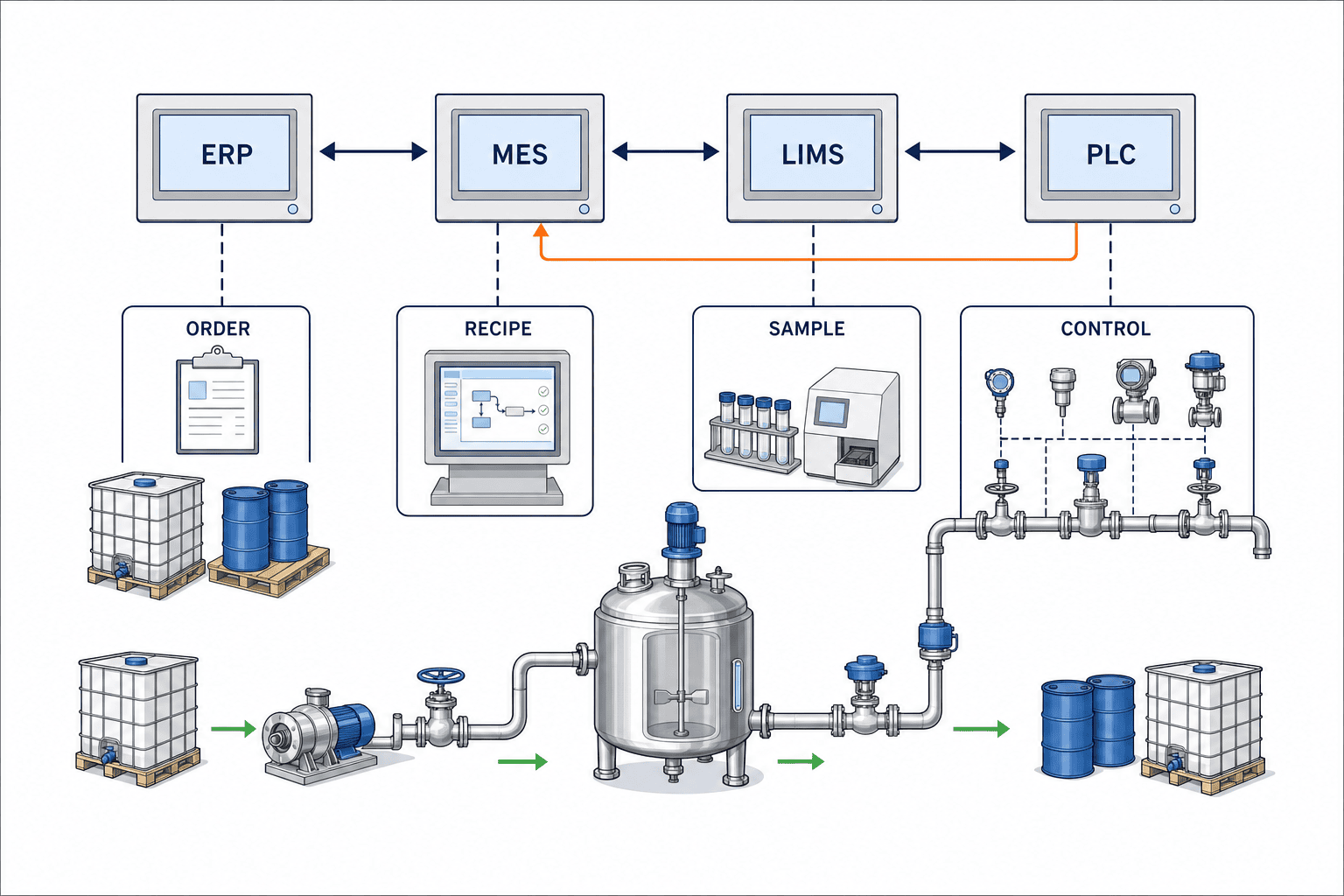
Define ERP, MES, LIMS and PLC/DCS ownership
Compare responsibilities, not feature checkboxes.
| Layer | Primary responsibility | Authoritative data | Avoid making it own |
|---|---|---|---|
| ERP | orders, purchasing, MRP, finance, standard cost, owned inventory, shipment | product/customer, production order, planned quantity, business status, cost postings | high-frequency tags, detailed control sequence |
| MES/production management | dispatch, recipe issue, genealogy, electronic batch record, WIP, actuals, exceptions | batch, input/output, person/equipment/version, quality usability, actual event time | all instrument raw data, PLC logic |
| LIMS | samples, methods, specifications, results, OOS and approval | sample, method/spec version, result, disposition, approver | production schedule, equipment sequence |
| PLC/DCS/SCADA | real-time control, interlock, collection and alarms | setpoint, actual, step, equipment state, historian reference | orders, cost, final regulatory-document ownership |
A common flow is ERP→MES production order; MES→control layer approved control recipe and execution context; control layer→MES steps, actuals and alarms; MES↔LIMS sample request and quality disposition; MES→ERP consumption, output, waste, time and status. Design communications loss, retry, duplicate message, reversed order, clock drift and manual operation as first-class scenarios.
For a broader foundation, see Production Management System Basics and Production Management System Comparison. Budget categories for identification, interfaces and data capture are discussed in Traceability System Build Cost.
Write the RFP around evidence and exceptions
A useful RFP asks for sample data, failure scenarios, ownership and acceptance evidence, not a yes/no response to “supports batch.”
Mandatory questions
- Which ISA-88 concepts are implemented, and how are recipe levels and batch production records represented?
- How are splits and joins across raw materials, charge, intermediates, rework, by-products and finished product modelled?
- How are tank heel, commingling, partial transfer, negative inventory and instrument correction controlled?
- How do LIMS hold, release and result reversal propagate to MES and ERP?
- How are future-effective SDS/label versions and qualifying existing-stock transitions controlled?
- How are controller communication loss, retry, duplicate event and manual operation audited?
- How are Thai, English and Japanese instructions and master-data responsibilities governed?
- What are hosting, data-location, backup, RTO/RPO and maintenance-access controls?
- How are additional users, equipment, interfaces, reports, validation and training priced?
- If the PoC does not proceed, how are configuration and data returned in a usable format?
Mandatory deliverables
| Deliverable | Acceptance focus |
|---|---|
| Fit-gap register | separate standard, configuration, customization, excluded and roadmap items |
| Data model | keys and relationships for batch, lot, tank, sample, recipe and document version |
| Interface contract | owner, trigger, payload, unit, timestamp, retry, error and monitoring |
| Security matrix | operator, approver, administrator, service account, audit and emergency access |
| Migration plan | master, stock, open batch, historical genealogy and document version |
| FAT/SAT scripts | normal, hold, outage, heel, rework and rollback cases |
| Operating model | shift support, training, master change, incident and KPI review |
| Commercial table | initial, subscription, interface, support, change and exit costs |
Run an end-to-end PoC on one product family
Choose a family that is representative enough to show value but bounded enough for diagnosis. Include receipt, QC hold, weighing, charge, equipment actuals, sample, quality release, intermediate transfer, filling, label, shipment and trace. Exercise rework or a by-product once, plus a tank heel and communications outage.
Acceptance should be evidence-based:
- Only an approved recipe version can be issued.
- A held lot cannot be charged, filled or shipped without a governed exception.
- Parent-child lots and quantities survive split and merge operations.
- Actuals and the mass difference can be explained.
- A duplicate controller event cannot post material consumption twice.
- The SDS/label version can be reconstructed for manufacturing and shipment time.
- Backward and forward trace drills complete within the site’s agreed time.
- Restore and rollback prove that the approved and running configurations match.
If the PoC needs numeric thresholds, state the denominator and measurement method. “At least 19 of 20 representative batches close genealogy without manual correction” could be a local hypothesis, but it is not an industry standard. Set the threshold according to product risk and baseline data quality.
A practical 90-day implementation roadmap
Days 1–30: freeze scope and data contracts
- Days 1–5: approve the product family, equipment, sales markets, KPIs and accountable owners.
- Days 6–10: map normal flow and exceptions across paper, spreadsheets and current systems.
- Days 11–15: approve identities for batch, lot, tank, sample, recipe and document.
- Days 16–20: approve ERP/LIMS/MES/control responsibility and event contracts.
- Days 21–25: prepare recipe, quality, document and genealogy master data.
- Days 26–30: freeze PoC scenarios, acceptance criteria and FAT data.
Do not overbuild the user interface during the first month. If IDs and states are unstable, every interface and report will be reworked.
Days 31–60: configure, integrate and test exceptions
- Issue approved recipes and collect actual process steps.
- Build genealogy for material issue, intermediate, rework, by-product and filling.
- Integrate LIMS sample request, hold, release and reversal.
- Test transfer, heel, measured variance and inventory adjustment.
- Control label selection, reprint and wrong-version prevention.
- Test outage, retry, duplicate event, clock drift and manual mode.
Run an end-to-end scenario every day. Waiting for each functional stream to finish before integration often produces a system where every screen works but no batch can close.
Days 61–90: FAT, plant trial, SAT and ownership transfer
- Days 61–70: execute FAT on frozen data; regression-test the impact of each fix.
- Days 71–78: train super users and verify local procedures, access and outage workarounds.
- Days 79–85: run representative batches under site conditions and reconcile material, quality and trace data.
- Days 86–88: perform SAT, backup/restore, rollback and formal risk acceptance of open items.
- Days 89–90: hand ownership to operations, support, KPI review and the master-change board.
Ninety days is not a promise to roll out an entire enterprise. It is an implementation unit to obtain production evidence for one product family and bounded equipment scope. High-hazard processes, regulated validation, poor legacy data or limited shutdown windows may require a longer plan.
Make cost and ROI assumptions visible
License price varies with users, assets, interfaces, validation, hosting and support, so a generic market number would be misleading. Compare five-year TCO with the same boundary. Initial cost should include software, design, configuration, integration, migration, testing, training and equipment changes. Operating cost should include subscription, infrastructure, support, master maintenance and revalidation.
Hypothetical calculation example:
- Initial cost: THB 6,000,000
- Annual operating cost: THB 1,200,000
- Annual benefits: THB 1,800,000 from reduced wrong charges/waste, THB 900,000 from reduced investigation effort and THB 600,000 from inventory-variance reduction; total THB 3,300,000
annual net benefit = 3,300,000 − 1,200,000 = THB 2,100,000
simple payback = 6,000,000 / 2,100,000 = approximately 2.86 years
five-year net benefit = 3,300,000 × 5 − (6,000,000 + 1,200,000 × 5) = THB 4,500,000
five-year ROI = 4,500,000 / 12,000,000 × 100 = 37.5%
Every figure is a hypothetical assumption for showing the method, not a TOMAS TECH or vendor quotation and not a guaranteed result. Prevent double counting. Define whether waste benefit includes only material or also disposal and remanufacture, and whether saved labour can actually be removed or redeployed. A 50%/100%/150% benefit sensitivity plus an implementation-delay case gives management a more reliable decision.
Use ISO 22400 as a KPI framework, not a magic scorecard
The official ISO 22400-1:2014 page describes an industry-neutral MOM KPI framework for batch, continuous and discrete manufacturing. ISO confirmed the edition in 2025, so it remains current. It does not make poor source data comparable.
For each KPI define purpose, formula, unit, product/equipment scope, period, exclusions, data owner and finalisation time. Useful early candidates include schedule adherence, batch cycle time, right-first-time, QC lead time, unexplained mass-difference rate, rework rate, tank inventory variance and trace-drill time. Stratify products and process families before aggregation.
Keep BOI eligibility separate from the MES business case
Section 6 of the Thailand BOI Investment Promotion Guide 2026 (July 2026) lists chemical and petrochemical activities and conditions. For the cited chemical activities, it states that a project with only mixing, dilution or phase transition shall not be promoted. This does not mean that every chemical producer is excluded, or that adding a production management system automatically makes a manufacturing project eligible.
Confirm the applied-for activity, actual manufacturing transformation, machinery, value added, environmental conditions and other current criteria with BOI and qualified advisers. If an Industry 4.0 or efficiency-upgrade measure is considered, assess it separately from the underlying manufacturing-activity eligibility. A vendor proposal should not promise “BOI approval.”
FAQ: selecting a chemical production management system
What functions are essential for chemical batch production?
Recipe versions, batch/lot genealogy, QC hold/release, mass balance, rework and by-product, tank inventory, SDS/label versions, ERP/LIMS/control integration and audit trail form the core. They need not come from one vendor, but each record and decision needs one owner.
Can ERP manage chemical batch production by itself?
ERP is well suited to planning, purchasing, finance and owned inventory. Detailed recipe execution, process steps, samples and complex genealogy often fit MES, LIMS and control systems better. Use a fit-gap exercise to avoid duplicating masters.
Does ISA-88 compliance complete regulatory compliance?
No. ISA-88 is a strong foundation for batch models, recipes and batch production records. It does not replace product classification, SDS/label duties, quality tests, electronic-record requirements, process safety or local law. Maintain a separate compliance matrix.
Should the level transmitter be the official tank balance?
Not by itself. Reconcile measured physical quantity—considering temperature, density, calibration and heel—with logical lot, quality and reserved stock through approved adjustments.
How large should the PoC be?
This article’s 90 days are a planning assumption. Start with one product family and one equipment boundary, but include holds, rework, heel, outage and tracing. Extend the schedule where validation, hazard control, shutdown windows or data cleansing demand it.
How should ROI be calculated?
Measure the current baseline for waste, wrong charges, investigation, inventory variance, downtime and document change. Compare it with five-year TCO, use cashable benefits where possible and do not count the same loss in two categories.
Conclusion: make one batch fact usable across every function
A chemical production management system succeeds when recipe version, raw/intermediate/finished genealogy, quality disposition, mass balance, tank inventory and SDS/label version meet at one governed batch identity. Freeze ERP, LIMS, MES and PLC/DCS responsibilities before selecting screens. Compare exception evidence in the RFP, then test one product family end to end in a 90-day implementation unit. Keep the 2026 CLP timelines, Thailand DIW reporting and BOI conditions as separate, expert-approved decisions that the system executes reliably.
If you are still defining the RFP or PoC boundary around your Thai plant’s tanks, laboratory and existing controllers, you can talk with TOMAS TECH before selecting a product. We can start with the data ownership and acceptance scenarios needed for a defensible implementation.
References
- ISA-88 Series of Standards — ISA
- ISO 22400-1:2014 — ISO
- New hazard classes 2023 — ECHA
- Regulation (EU) 2024/2865 transitional provisions — ECHA
- CLP legislation and ATPs — ECHA
- Regulation (EU) 2024/2865 — EUR-Lex
- DIW chemical reporting notice
- DIW iSingle Form
- Thailand BOI Investment Promotion Guide 2026 (July 2026)
- GS1 Global Traceability Standard
This article provides general production-management and systems guidance. It is not legal advice, chemical classification, a BOI eligibility opinion or a quality/safety guarantee. Verify current law, authority guidance, standards, customer obligations and product decisions with qualified personnel.