


People searching for AMR implementation case studies do not merely want proof that a robot can navigate. They need to know whether it can work in a brownfield factory with narrow aisles, temporary pallets, people and forklifts, legacy PLCs and several business systems—and whether the operation can recover safely after something changes or stops. This guide turns six reusable implementation patterns into practical requirements for SLAM map control, traffic, charging, WMS/MES/PLC integration, exception recovery, a 90-day PoC, RFP, FAT/SAT, TCO and handover evidence.
The conclusion: success is proven by controlled change and recovery
A demonstration looks successful when one AMR travels through a cleared aisle. Production is different. A temporary pallet changes the usable width, a machine move changes the SLAM environment, vehicles queue for a charger, and a WMS instruction may conflict with a PLC “not ready” state. After a safety-related stop, somebody must know who may intervene, how the load is verified and from which system state the mission may resume.
The procurement unit is therefore the complete operating system, not the vehicle alone: AMR, fleet manager, wireless network, charging, load transfer, WMS/MES/PLC interfaces, maps and configuration, work standards, safety validation, maintenance and backup. Acceptance cannot stop at “travelled from A to B.” It must test normal flow, congestion, network loss, localization loss, a full station, wrong load, low battery, safety stop, manual intervention and retry after recovery with a consistent evidence format.
The six cases below are composite requirement patterns, not claims of results at named customers. Use the existing general AGV implementation case overview as the introduction. This article goes deeper into brownfield AMR change control and acceptance. For a cost-layer comparison, also see the AGV/AMR TCO guide.
Do not decide the AGV–AMR difference by the label
AGVs are commonly described as following a defined route, while AMRs use sensors and maps to plan a path. That is a useful first explanation but an inadequate specification. One product may stop and wait for an obstacle; another may make a local detour. Route assignment may sit in the fleet manager or partly on the vehicle. Safety functions, load handling, restart conditions and map publishing also vary.
VDA’s official publication identifies VDA 5050 Version 3.0.0, dated 17 March 2026, as the current interface for exchanging order and status data between a central fleet control and mobile robots. Version 3.0 adds concepts including zones and path sharing for freely navigating robots. Compliance with an interface does not by itself prove plug-and-play operation, safety or a shared map. The project must accept the supported version, selected functions, proprietary extensions, error meanings, timeouts, reconnect behavior and ownership boundaries.
MassRobotics AMR Interoperability Standard 1.0 similarly addresses common information such as position, speed, direction and status for heterogeneous robots. It is not a safety standard, and it does not mandate common task management or one navigation map. Procurement teams should separate fleet communication, traffic orchestration and vehicle safety.
Ask suppliers to explain:
- what the vehicle decides locally and what the fleet manager controls;
- how it reacts to people, forklifts, other robots and manual carts;
- how safety-related stops differ from operational pauses in the event log;
- who may approve changes to maps, zones, speeds, no-go areas and right-of-way;
- what can recover automatically after localization, network, battery or load exceptions;
- how an incomplete mission is reconciled with WMS/MES after manual recovery.
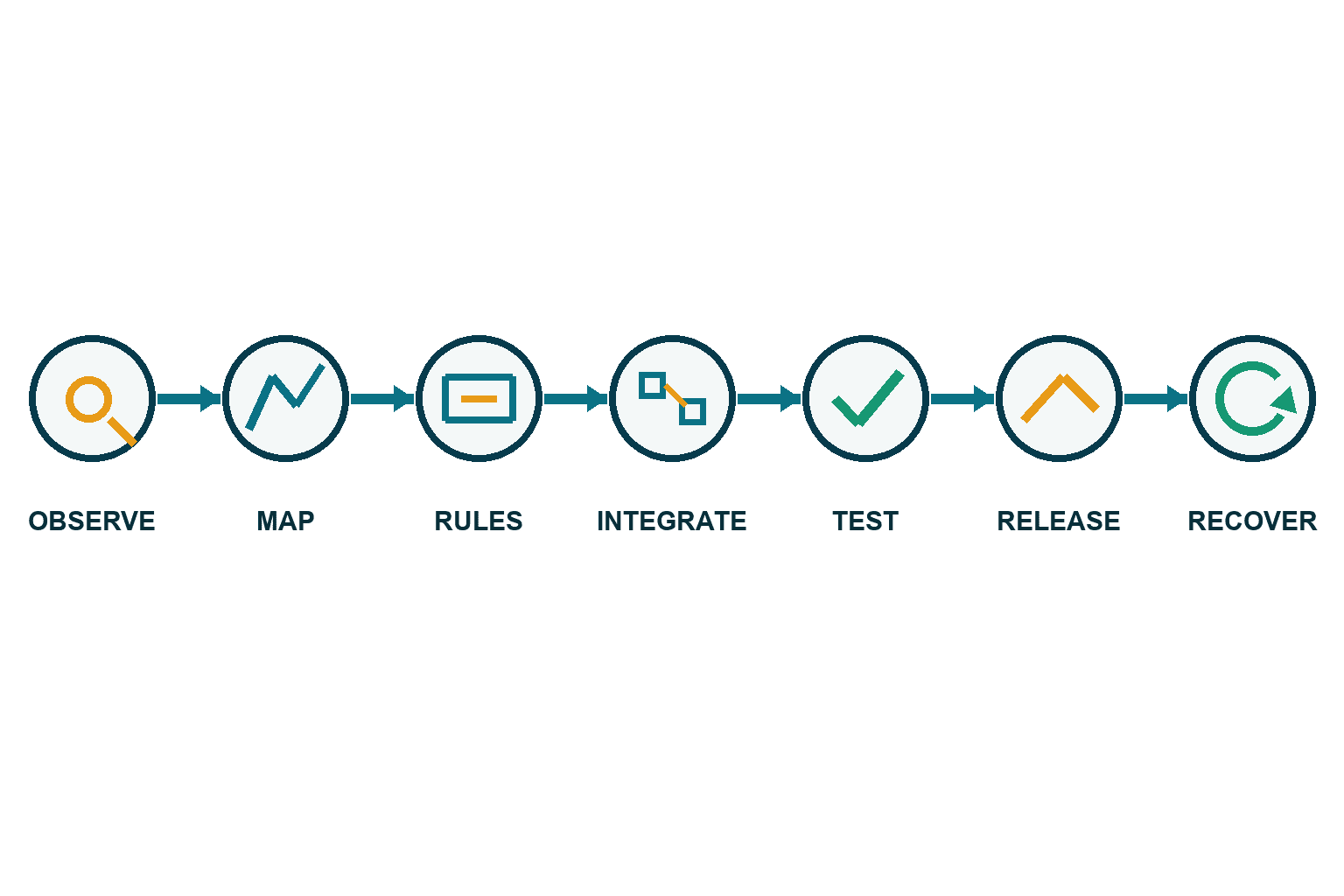
AMR implementation pattern 1: scheduled line-side replenishment
The first pattern moves standard containers from a parts supermarket to one assembly area on a schedule. Origins and destinations are clear, load units can be standardized, and current manual-cart movements can form a baseline. It is a strong first PoC, but a “simple shuttle” fails when priority replenishment, empty-container returns, production-plan changes and cancelled kanban requests are ignored.
Start with the mission trigger. Decide whether the source of truth is a timetable, e-kanban consumption, a MES release or an operator call. Give each business request an idempotency key so a resend cannot create a duplicate movement. Track container ID, part, quantity, origin, destination, requested time and priority. Separate “vehicle arrived,” “load transferred,” “receiving PLC confirmed” and “inventory movement posted.”
Do not test only the maximum daily count. Recreate the overlap of shift change, break recovery and urgent calls. As an editorial starting recommendation—not a standard—observe two weeks of traffic and requests so that day and shift differences appear. Classify normal, peak, equipment-stop and material-shortage periods separately.
AMR implementation pattern 2: empty-container return on the backhaul
The second pattern collects empty totes or pallets on the return trip. A business case based only on outbound delivery leaves empty running and floor congestion untouched. Yet accepting every return item creates unstable transfer when size, contamination, orientation, stack height and urgency vary.
Define the load unit first: dimensions, mass range, center of gravity, stack limit, base geometry, identification, permitted deformation and orientation. Towing, roller transfer and lift-under operation require different docking tolerance and safeguarding. Distinguish a return delay that is harmless from a full station that prevents the next material delivery.
Acceptance should deliberately introduce a wrong container, a skewed load, a full station, an unreadable identifier and a PLC disconnect during transfer. The AMR must not silently mark the task complete. It must enter a recovery workflow that makes physical and digital states agree.
AMR implementation pattern 3: multi-process call and fleet leveling
In the third pattern, several processes request transport on demand and the fleet assigns missions. First-in-first-out may delay a bottleneck process; strict priority may starve low-priority work. The dispatcher has to consider due time, vehicle location, load-handling capability, battery state and congestion.
Make dispatch rules visible in the RFP: nearest vehicle, earliest due time, bottleneck priority, grouped destinations and low-battery exclusion are examples. Record a rule version and replay historical requests before and after a change. Measure timestamps for request, acceptance, assignment, pickup, arrival, transfer and business completion. Classify delay as no vehicle, blocked route, load not ready, destination full, upstream wait or safety stop. The evidence then shows whether to add vehicles, change traffic rules or fix process readiness.
AMR implementation pattern 4: unattended finished-goods movement
The fourth pattern moves finished goods from inspection to storage during a night or low-staff shift. Fewer people may simplify traffic, but fewer responders make exceptions more serious. Lighting, shutters, cleaning, reflective floors, condensation and carts parked only at night must be observed under the actual shift conditions.
Define degraded mode before go-live. If one vehicle fails, decide whether the remaining fleet continues only critical missions, a manual tug takes over or goods divert to a buffer. Specify the escalation contact, expected response, towing permission, spare parts, logs to preserve and morning inventory reconciliation. An alarm alone is not a recovery design. Remote intervention, if allowed, needs explicit visibility and authorization conditions.
AMR implementation pattern 5: crossing the WMS–factory boundary
The fifth pattern starts with WMS picking, moves a load to production and lets MES record consumption. Its value is high, but inventory unit and movement unit diverge. WMS manages locations and pallets, MES manages production orders and lots, while the AMR carries a physical load carrier. Split, mixed, repacked and returned loads expose mismatched identifiers.
Assign a source of truth for each field: WMS for inventory, MES for manufacturing consumption, fleet control for mission and vehicle state, and PLC for station equipment state, for example. Messages need a correlation ID, request version, retry count, expiry and cancellation reason. After a timeout, a client should query and reuse the existing mission rather than create a new one blindly.
Treat the PLC handshake as state transitions such as REQUEST, READY, TRANSFER, COMPLETE, RESET and FAULT. A brief single-bit pulse is vulnerable to scan-cycle and communication loss. Define timeout, retry, operator action and safe reset for every state. The signal list and sequence diagram become controlled FAT/SAT evidence.
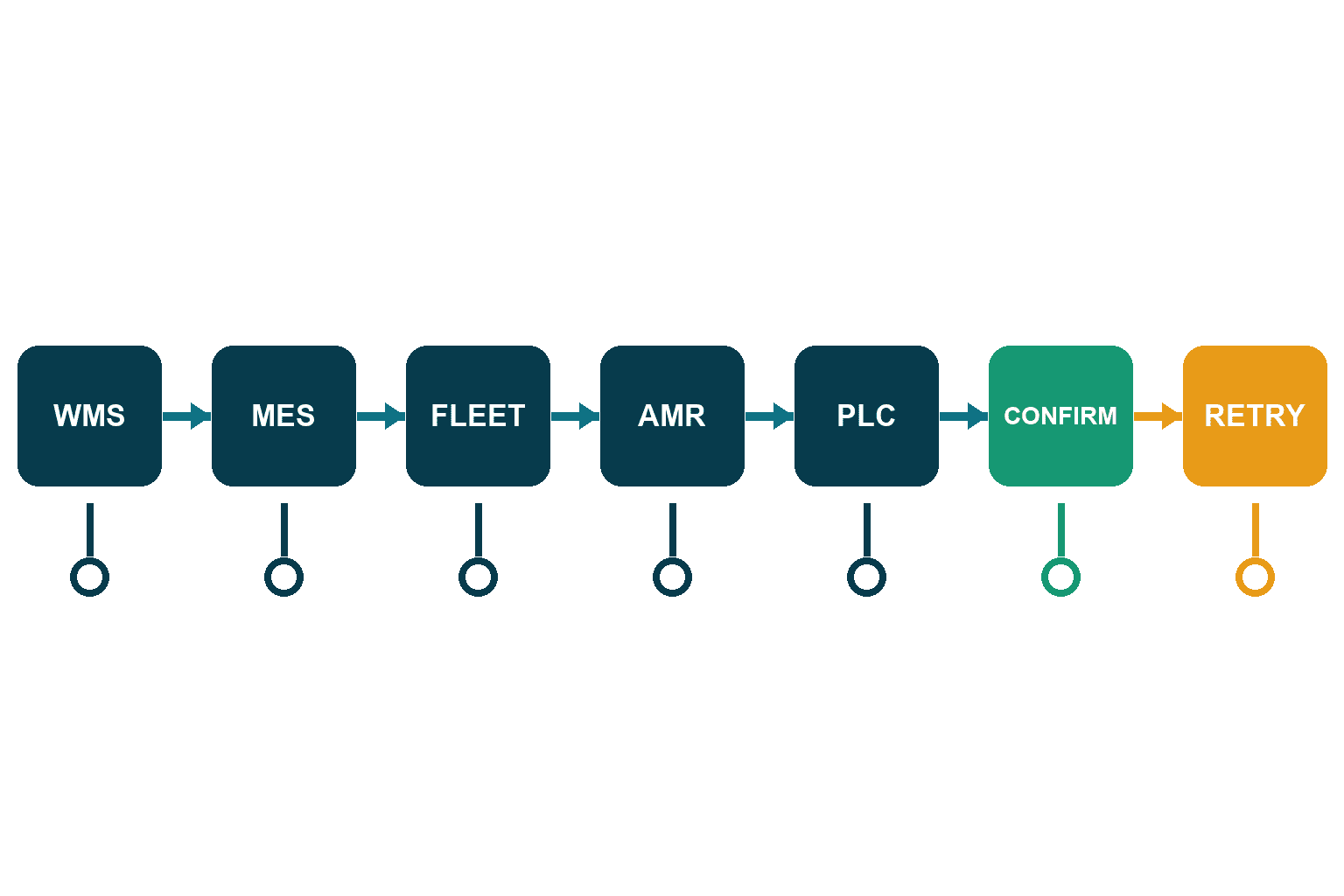
AMR implementation pattern 6: phased mixed-fleet introduction
The sixth pattern adds AMRs while existing AGVs remain. It reduces the shutdown and initial investment of a wholesale replacement but complicates intersections, narrow-aisle reservations, station sharing, charging and emergency-stop boundaries. Open interfaces widen the options without making every vendor function equivalent.
Decide what information is common and what control remains separate. A shared view of position and status may coexist with independent route planning, requiring a traffic orchestrator to grant intersection entry. A zone permission from central control must not replace safety control on the vehicle. Keep order communication, operational permission and safety-related stop in distinct layers.
Contract the retirement conditions for legacy equipment. Compare spare-part availability, software updates, wireless technology, batteries, map tooling and maintenance skills. Add the duration of duplicate masters, interfaces and training to TCO. “Keep it while it runs” can turn a temporary migration into a permanent double cost.
Manage SLAM maps like controlled equipment configuration
A brownfield map is never finished. Racks, machines, curtains, temporary stores, reflective surfaces, floor markings and signs change what sensors see. If an operator can overwrite a map without a release record, localization failures and route changes cannot be traced.
Manage maps, zones, stations, speed limits, no-go areas, one-way rules and stopping coordinates as configuration items. Link every release to a version ID, area, reason, requester, approver, authoring-tool version, vehicle-software version, test result and rollback copy. Review the difference and drive the affected routes before release. Save the map, station coordinates, fleet rules and interface configuration as one release bundle.
A recommended—not normative—change workflow is:
- Add an AMR impact field to every rack or machine relocation request.
- Isolate the area, change the map or zone and preserve the previous release.
- Verify localization, docking, detours, speeds, blind areas and wireless coverage at low speed.
- Replay missions with the standard load and an adverse allowed load.
- Obtain safety, operations and production approval against evidence.
- Roll back maps, settings and interface versions as a compatible bundle when needed.
Begin AGV layout design with traffic rules, not the shortest line
The shortest path does not guarantee the shortest completion time. Intersections, doors, narrow aisles, lifts, chargers, transfer stations, forklift crossings and pedestrian exits create queues. A slightly longer one-way loop and waiting zone can be more stable at peak demand.
Write right-of-way rules explicitly. Protecting people is non-negotiable; operational priorities among urgent parts, finished goods, empties, charging returns and maintenance vehicles must also be defined. Use reservations for intersections, single entry for narrow zones, door-ready interlocks and waiting positions that do not block evacuation routes.
Study distributions rather than averages. Record shift changes, breaks, forklift replenishment, cleaning, waste collection and truck arrivals. Build a traffic heat map from request timestamps and trajectories, then classify waits. After a route change, repeat safety validation and capacity validation as separate activities.
Size charging from mission energy, not catalogue runtime
A fixed “one charger per number of vehicles” rule is unsafe as an engineering assumption. Consumption changes with distance, load, acceleration, slope, waiting, wireless activity, temperature, battery age and load-handling equipment. Available charging time changes with break charging, opportunity charging, battery exchange and night charging.
Measure an energy budget for each representative mission and overlay the daily request profile. Define the threshold for excluding a low-state vehicle, travel reserve to a charger, maximum queue, treatment of critical missions and restart after an outage. This article intentionally gives no universal state-of-charge percentage; it must be validated with the real vehicle, load, temperature and the manufacturers’ battery policy.
Treat a charger as a controlled station. Log approach available, connected, charging started, charging, completed, fault and departed. Distinguish bad contact from an occupied charger. Review failure independence, maintenance access, electrical capacity, heat and facility/fire requirements. TCO includes battery replacement, charger maintenance, electrical work, outage measures and capacity loss through aging.
Design exception recovery in eight classes
An AMR system does not merely avoid obstacles; it returns exceptions to an operating team. A useful editorial starter taxonomy has eight classes: BLOCKED AISLE, LOCALIZATION LOSS, LOAD MISMATCH, STATION UNAVAILABLE, LOW BATTERY, NETWORK LOSS, MANUAL INTERVENTION and SAFETY STOP. This is not a standard-required classification.
For each class define detection, automatic retry limit, waiting position, notification, local inspection, manual permissions, incomplete-mission treatment, load location, business-system correction, restart condition and preserved logs. A Retry button is not enough. The operator must know whether a retry is safe, whether the load already transferred and whether another business transaction would be created.
Manual movement also requires reconciliation. Record who moved which load ID, from where to where, for what reason and which WMS/MES/fleet/PLC records were corrected. Include night shift and weekend maintenance in recovery drills.
Keep safety, fleet communication and OT cybersecurity separate
ISO currently lists ISO 3691-4:2023 Edition 2 as the published international standard for safety requirements and verification of driverless industrial trucks and their systems, including AGVs and AMRs. ISO marks it at stage 90.92, to be revised, and ISO/DIS 3691-4 is under development; its final content and edition are not yet settled. The 2023 edition remains the current published version; a DIS is not an adopted final requirement.
A3’s current listing separates Part 1, the 2020 edition reaffirmed R2026, Part 2 (2023), and ANSI/A3 R15.08-3-2026, Industrial Mobile Robots — Safety Requirements — Part 3: Use of IMR Applications. Part 3 provides safety requirements for users to maintain tolerable risk during day-to-day operation of an IMR application. Reaffirmation of Part 1 is not a technical revision, and the parts have different scopes. Responsibility for vehicle, integration and user application must be assigned rather than hidden behind one standard number.
Risk assessment should cover load overhang, braking, floor, gradient, doors, intersections, blind areas, worker behavior, maintenance, manual mode and foreseeable misuse—not only speed and scanner range. OSHA warehousing guidance can inform general hazard brainstorming but is US guidance, not Thai law or AMR certification. Applicable Thai law, site rules, insurance, electrical, fire and building requirements need local qualified review.
VDA 5050 is a communication interface, not a safety standard. NIST SP 800-82 Revision 3 provides OT-security guidance that accounts for performance, reliability and safety. Include fleet servers, wireless, remote support, APIs, map tools, terminals and logging platforms in the asset inventory. Apply segmentation, least privilege, appropriate multifactor authentication, certificate/key management, updates, monitoring and a risk-based safe response to cyber incidents.
Turn a 90-day PoC into evidence gates
Ninety days is an editorial governance example, not a standard duration. Adjust it to the production calendar, installation access and legal review. The value is in defining evidence for each gate.
| Period | Objective | Minimum evidence |
|---|---|---|
| Days 1–15 | baseline and scope | requests, traffic, loads, stops, wireless, floor and peak profile |
| Days 16–30 | safety, layout and interface design | zones, risk review, signal list, API contract, exception table, map release |
| Days 31–50 | controlled functional PoC | missions, docking, transfer, charging, logs and operator training |
| Days 51–65 | abnormal and peak tests | congestion, network and localization loss, full station, wrong load, low battery, safety stop |
| Days 66–80 | operational pilot | shift capacity, interventions, unfinished tasks, reconciliation and maintenance response |
| Days 81–90 | decision and handover planning | gap list, revised TCO, FAT/SAT plan, restore test and owners’ signatures |
Do not define success by one “navigation rate.” Separate the denominator, planned stops, upstream waits and site-not-ready time. Measure lead time from business request to business completion, manual intervention, traffic wait, retry, load error and charging queue. The customer should set thresholds from the baseline and production risk and distinguish contractual guarantees from improvement targets.
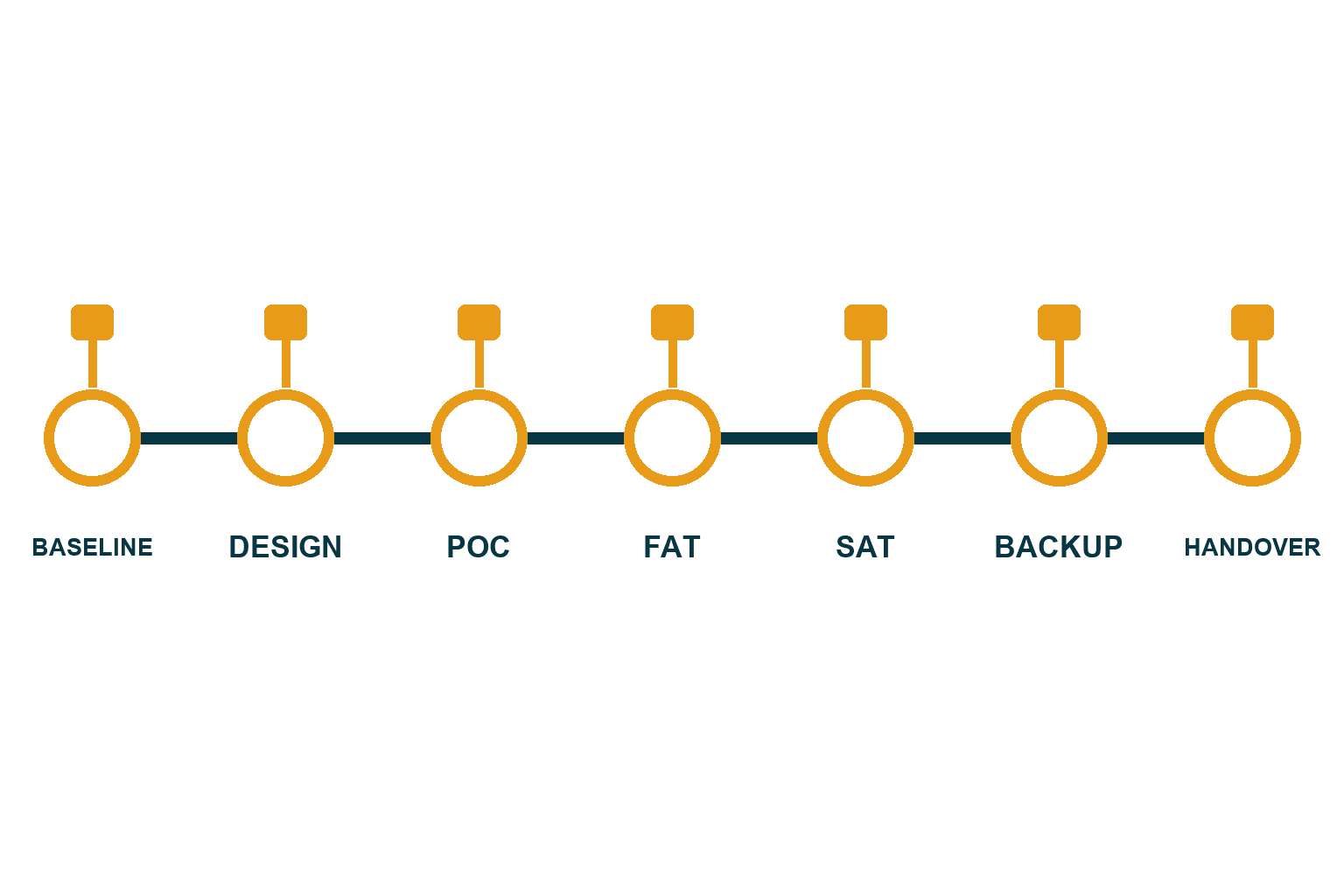
Twelve questions for the RFP
- What movements, loads, origins, destinations, peak requests, priorities and exclusions are in scope?
- What path planning, avoidance, localization, stop and recovery capability lies behind the AGV or AMR name?
- Which standards and laws apply, and who owns conformity and site validation?
- How are maps, zones, stations, speeds and traffic rules changed, approved and rolled back?
- How are dispatch, intersections, narrow aisles, doors, lifts and mixed vehicles controlled?
- How are charging, reserve, queues, aging and outages derived from real missions?
- What are the source of truth, IDs, states, timeouts, retries and cancellations for WMS/MES/PLC?
- How does each exception class recover automatically, escalate and reconcile business state?
- How are wireless, servers, endpoints, remote access, APIs, updates and logs secured?
- Which normal and abnormal FAT/SAT scenarios are replayed with what evidence?
- How does five-year TCO include software, support, batteries, map changes, spares and dual operation?
- Which source, settings, maps, certificates, backups, procedures and training records are handed over?
Make FAT/SAT a package of input, expectation, evidence and recovery
Allocate tests by risk and reproducibility, not only by the names “factory” and “site.” FAT can use simulators and real components for APIs, PLC handshakes, queues, retries, charging logic, alarms, permissions and log export. SAT must add the real floor, wireless, doors, loads, human/forklift movement, night conditions and support organization.
Every case needs precondition, input, steps, expected result, actual result, evidence ID, approver and software/configuration version. As an editorial recommendation, pass each critical scenario twice after reset to separate repeatable recovery from a lucky run; two is not a normative value. A failed test should record cause, containment, permanent action, affected scope and regression cases. Conditional acceptance needs an owner, deadline, fallback operation and stated residual risk.
Compare AGV running cost through five-year TCO
Vehicle price and an annual maintenance fee omit brownfield costs. Five years is an example horizon to adjust to the customer’s accounting policy.
| TCO layer | Include |
|---|---|
| Equipment | vehicles, load handling, chargers, server, wireless, stations, safety devices, spares |
| Integration/work | WMS/MES/PLC/API, floor, power, doors, displays, signs, network and relocation |
| Software | fleet license, connectors, analytics, remote support and upgrades |
| Operations | inspections, cleaning, wheels, sensors, batteries, repair, calibration and night response |
| Change/recovery | maps, zones, reassessment, training, backup, restore drills and cyber response |
| Residual operation | legacy AGVs, manual fallback, peak labor, duplicate masters, spare vehicles and removal |
Value should cover transport waiting, operator time away from machines, WIP, wrong delivery, product damage, night support, shortage stops, safety controls and traceability—not labor alone. Keep cashable benefit separate from operational risk reduction. Build base, upside and downside cases using PoC distributions rather than catalogue maxima, and show which assumption changes the Go/No-Go decision.
Backup and handover evidence determine operational control
NIST SP 1339, the final OT Backup Quick Start Guide published 17 June 2026, says effective OT backup management includes change-management integration, regular creation, testing and review during recovery exercises. Candidate AMR assets include the fleet database, maps, zones, stations, traffic rules, vehicle settings, PLC programs, API mappings, certificates, users/roles, alarm definitions, dashboards and software/firmware inventory.
A backup file is not proof of recovery. As an editorial recommendation, conduct at least one restore drill before SAT sign-off. Restore into an isolated environment or agreed maintenance window and verify compatibility across vehicles, stations and upstream systems. Find missing encryption keys, licenses and incompatible versions before production needs them.
The final evidence index should bundle as-built drawings, network design, asset list, versions, source/configuration, interfaces, signal list, map release, risk assessment, FAT/SAT records, open issues, spares, maintenance, training, backups, restore sequence, contacts and license expiries. Add owner, location, classification, recovery order and verification date. This preserves the factory’s ability to make the next layout change without recreating the project.
FAQ about AMR implementation cases
What is the practical difference between AGV and AMR?
AGV often describes defined-route guidance and AMR map-based autonomous planning, but names do not determine avoidance, safety, load handling or recovery. Compare functions and responsibility boundaries. VDA 5050 support describes an interface scope; it does not automatically prove safety or complete plug-and-play operation.
What should AGV layout design check first?
Check load, peak demand, people and forklift crossings, narrow aisles, doors, waiting, charging and evacuation before drawing a shortest route. Observe shift changes and breaks, then define right-of-way, one-way zones, reservations and safe waiting. Version traffic rules with the map and revalidate after change.
What belongs in AGV running cost?
Include batteries, wheels, sensors, software, connectivity, map changes, reassessment, training, night support, spares, dual operation, backup and restore drills—not only power and maintenance. A base/upside/downside TCO makes quotation-scope differences visible.
What should a 90-day AMR PoC accept?
Accept recovery from congestion, network and localization loss, wrong loads, full stations, low battery, safety stops and manual intervention, as well as normal travel. Preserve timestamps, retries, waits, charging and business reconciliation as reusable FAT/SAT evidence. Ninety days is an example, not a rule.
Which ISO 3691-4 edition applies?
As checked on 3 September 2026, ISO lists ISO 3691-4:2023 Edition 2 as Published. ISO/DIS 3691-4 is under development, and its final content and edition are not yet settled. State the contract edition explicitly and handle adoption of any future published edition through change control and local legal review.
Summary: turn case studies into your own acceptance evidence
An AMR implementation case is useful when it becomes your requirement for loads, traffic, map change, charging, WMS/MES/PLC, exceptions, safety, security, maintenance and recovery. In a brownfield plant, repeatable operation after a change or failure matters more than a clean demonstration.
TOMAS TECH can support current-state observation, AGV/AMR comparison, a 90-day PoC, RFP, WMS/MES/PLC integration, FAT/SAT and TCO even before the first target process is finalized. If you want to make brownfield constraints visible before procurement, contact us.
References
- VDA 5050 Version 3.0.0: https://www.vda.de/en/news/publications/publication/vda-5050
- VDA 5050 topic page: https://www.vda.de/en/topics/automotive-industry/vda-5050
- ISO 3691-4:2023: https://www.iso.org/standard/83545.html
- A3 Industrial Robot Standards: https://www.automate.org/store/categories/industrial-robot-standards
- NIST SP 800-82 Revision 3: https://csrc.nist.gov/pubs/sp/800/82/r3/final
- NIST SP 1339: https://csrc.nist.gov/pubs/sp/1339/final
- MassRobotics AMR Interoperability Standard publication: https://www.massrobotics.org/autonomous-mobile-robot-standards-published-by-massrobotics/
- MassRobotics AMR Interoperability working group: https://www.massrobotics.org/working-groups/
- OSHA Warehousing Hazards: https://www.osha.gov/warehousing/hazards-solutions


