


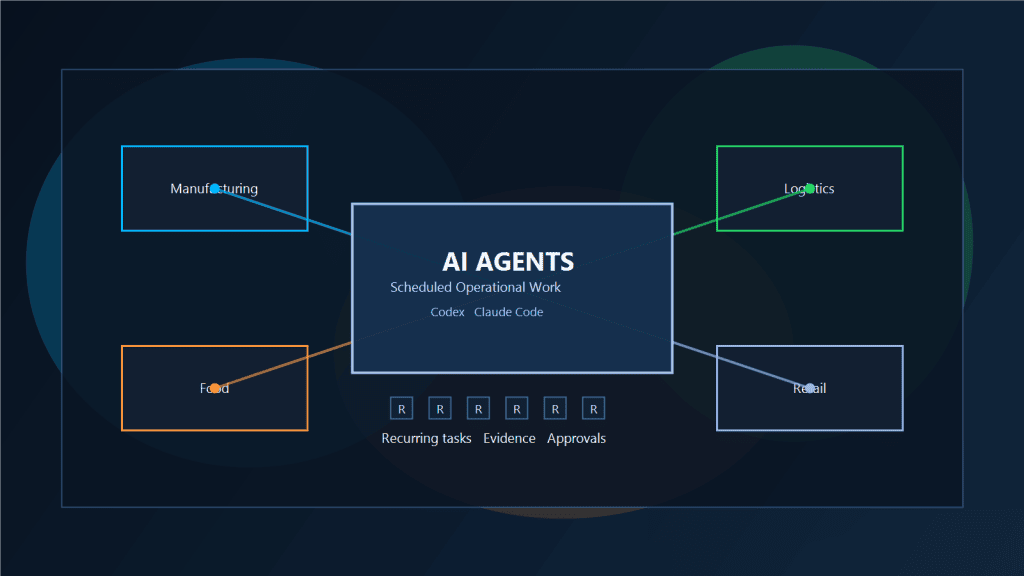
AI Agents Are Moving from Chat to Scheduled Work: Notes as of June 16, 2026
As of June 16, 2026, the most useful AI trend for business operators is not better prompting alone. It is the shift from one-off chat help to recurring work that runs on a schedule or event trigger. OpenAI introduced Codex on May 16, 2025 as a cloud software engineering agent that can work on many tasks in parallel, run in isolated environments, and return evidence such as terminal logs and test outputs. Anthropic followed on May 22, 2025 with Claude 4, broader agent capabilities, and general availability for Claude Code, including background tasks, IDE integrations, and stronger multi-step tool use.
That matters beyond engineering teams. Stanford HAI’s 2025 AI Index reports that 78% of organizations said they used AI in 2024, up from 55% the year before. At the same time, MIT’s 2025 AI Agent Index shows that 24 of 30 tracked agents launched or received major agentic updates in 2024-2025, while only 4 of 13 frontier-autonomy agents disclose any agent-specific safety evaluations. Adoption is speeding up. Governance is not catching up at the same rate.
The Main Business Question Has Changed
Until recently, many enterprise AI programs focused on summarizing meetings, translating text, drafting documents, or answering internal questions faster. Those uses still matter. But the new pattern is different: AI is being connected to tools, asked to take several steps, and expected to return traceable output on a recurring basis.
Codex is explicitly designed around independent task execution and verifiable evidence. Claude Code’s current documentation goes even further, describing recurring tasks, MCP integration, Slack routing, background agents, and multi-surface workflows across terminal, IDE, web, and desktop. The implication is straightforward. AI is becoming less of a conversation layer and more of an operating layer.
The practical question is no longer “Which model sounds smartest?” It is “Which recurring work should we delegate first, under what approvals, and with what evidence trail?”
In Manufacturing, Daily Cross-Reading of Records Is an Underrated First Win
Manufacturing AI discussions often jump immediately to visual inspection, predictive maintenance, and production planning. Those are real opportunities. But one of the most practical first uses is simpler: have an AI agent review existing operational records every day.
Maintenance logs, quality reports, defect records, inspection notes, shift handovers, and customer complaints often describe the same issue from different angles. An AI agent can cross-read those sources each morning and surface repeated conditions, likely missing checks, recurring failure patterns, and issues that deserve escalation.
That does not replace expert judgment. It standardizes preparation for expert judgment, which is often where time and consistency are lost.
In Logistics, Recurring Exception Review Is More Valuable Than Elegant Planning
Logistics looks like a natural AI target because it already runs on structured data. But operational value rarely comes from the plan alone. It comes from how quickly the team reacts when the plan breaks.
Shipment delays, failed loading, traffic, driver shortages, customer changes, and site constraints create constant exceptions. An AI agent that reviews those signals every hour or every morning can recommend who to contact first, which issue creates the largest downstream impact, and which workaround is most realistic based on prior cases.
That framing is more useful than promising full logistics autonomy. In real operations, recurring exception preparation often beats perfect theoretical optimization.
In Food Operations, Quiet Quality Workflows Are a Stronger Starting Point
Food businesses care about more than efficiency. Hygiene, traceability, shelf life, waste, and recall readiness are core operating issues.
Raw material lots, temperature logs, sanitation checks, production records, shipping history, and complaint files often sit across fragmented systems. A daily AI agent review can flag missing records, inconsistent entries, repeated weak points, and follow-ups that should happen before the next audit or incident.
That is why food-sector AI often works best first as a quiet quality layer rather than a flashy front-end experiment.
In Retail, Morning Hypothesis Generation Is a Practical Agent Use Case
Retail teams already use AI for demand forecasting, replenishment, pricing, and review analysis. But POS data usually explains what sold, not fully why it sold.
Weather, promotion timing, stockouts, shelf position, local events, competitor actions, and social signals all shape store outcomes. An AI agent can review those signals each morning and return structured hypotheses about unusual demand, weak promotions, probable missed sales, or stores that deserve immediate follow-up.
That role does not replace store managers or merchants. It gives them a faster first layer of analysis before the day gets busy.
Codex and Claude Code Point to the Same Operating Pattern
The deeper lesson from Codex and Claude Code is that enterprise AI is becoming asynchronous, evidence-based, and recurring.
Codex lets people hand off well-scoped tasks, continue other work, and review logs, outputs, and tests later. Claude 4 and Claude Code extend the same pattern with parallel tool use, stronger memory, background tasks, and broader workflow integration. Claude Code’s live documentation also emphasizes scheduled routines, MCP, Slack-triggered work, and multi-agent execution.
This is a meaningful shift. It means the center of gravity is moving away from “chat with AI when you remember” toward “let AI continuously prepare operational work in the background.”
The Right Rollout Order Is Small Recurring Tasks, Approval Gates, and Business KPIs
The AI Agent Index makes one point hard to ignore: capabilities are improving faster than disclosure and standardization. That is not a reason to stop. It is a reason to scope deployment properly.
The practical sequence is simple. Start with recurring tasks that are reversible, evidence-rich, and easy for current owners to review. Define where human approval is required before launch. Measure business outcomes such as faster investigation time, fewer missing records, lower stockout risk, or shorter response cycles instead of vanity metrics such as prompt volume.
Companies often learn more from one daily recurring agent workflow than from five disconnected pilots.
Conclusion
The clearest AI trend in mid-2026 is that agents are moving from chat interfaces into recurring operational routines. Codex and Claude Code are visible examples of that shift, but the same logic applies in manufacturing, logistics, food, and retail.
The useful question is not whether AI can do everything. It is where AI can gather context, surface exceptions, prepare hypotheses, and return traceable outputs every day or every week before a human makes the final call. Companies that answer that question clearly are more likely to turn generative AI into operating leverage instead of just another software experiment.
FAQ
How is an AI agent different from standard generative AI?
Standard generative AI mainly answers prompts. An AI agent can gather context, use tools, take multiple steps, and support or execute part of a recurring workflow.
Why is scheduled or recurring AI work becoming important now?
Because model quality alone does not create business value. Recurring operational workflows make speed, consistency, accountability, and ROI easier to measure.
What is a good first manufacturing use case?
Daily cross-reading of maintenance notes, defect records, inspections, and quality logs is a strong first use case because the data already exists and the value is easy to explain.
Where does AI help most in logistics?
Exception review and response prioritization are often more valuable than trying to automate all planning.
How do companies avoid getting stuck in AI pilots?
Start with a small recurring task, define approval points, and measure business KPIs rather than demo quality or prompt count.
References
- OpenAI, “Introducing Codex,” May 16, 2025
- Anthropic, “Introducing Claude 4,” May 22, 2025
- Anthropic, “Overview – Claude Code Docs”
- Stanford HAI, “The 2025 AI Index Report”
- MIT, “The 2025 AI Agent Index”
Related Articles
- AI Agent Rollouts Will Reach Supervised Recurring Operations Before Full Automation: Notes as of June 17, 2026
- AI Agents Are Moving Into Exception-Handling Workflows: Practical Notes for Operations Teams as of June 19, 2026
- AI Agents Need a Supervised Control Tower First: Practical Notes as of June 21, 2026
- Start AI Agents with a Verification Layer: Practical Notes as of June 22, 2026


