


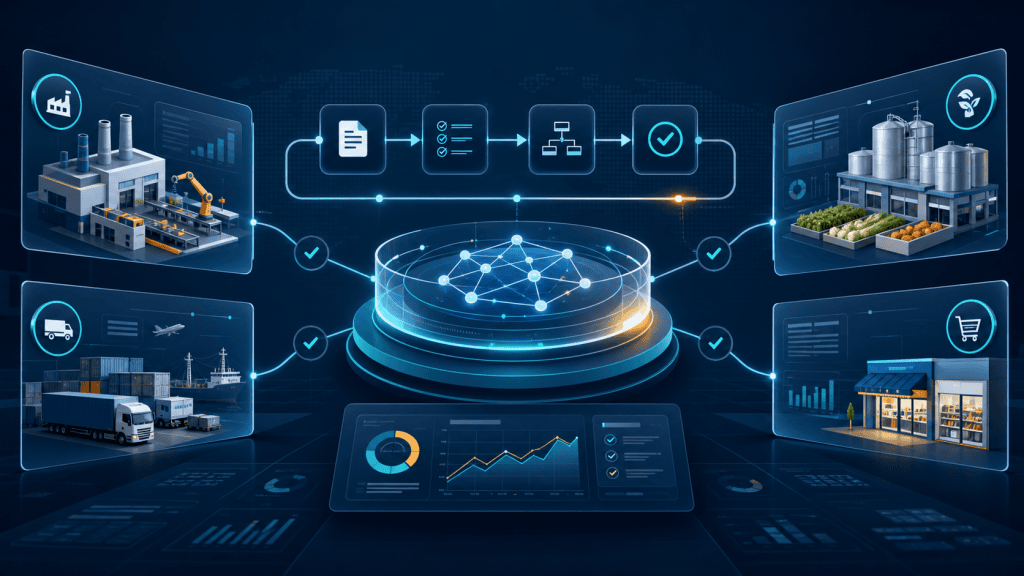
AI Agents Are Moving Into Exception-Handling Workflows: Practical Notes for Operations Teams as of June 19, 2026
The clearest AI trend for business operators as of June 19, 2026 is not full autonomy. It is the rise of AI agents as a supervised operating layer for exception handling.
That matters because most real operations are not constrained by the easy, repeatable cases. They are constrained by the late shipment, the missing document, the suspicious defect cluster, the temperature deviation, the unexpected stockout, and the customer issue that does not fit the standard script. These are exactly the places where an AI agent can create value before full automation is realistic.
The product direction from OpenAI and Anthropic supports that reading. OpenAI introduced Codex on May 16, 2025 as a cloud software engineering agent that can work on multiple tasks in parallel inside isolated environments and return verifiable evidence such as terminal logs and test outputs. Anthropic followed on May 22, 2025 with Claude 4 and the general availability of Claude Code, emphasizing background tasks, IDE integrations, and broader agent workflows. Both signals point in the same direction: AI tools are being designed not just to answer questions, but to perform bounded work, leave an evidence trail, and hand results back for review.
For manufacturing, logistics, food, and retail teams, that is the more relevant lesson. The first scalable use of AI agents is often not “let the model run the process.” It is “let the agent prepare the exception queue, explain the likely issue, and return the evidence before a person decides.”
The Core Decision Is Now Workflow Design, Not Model Selection Alone
Stanford HAI’s 2025 AI Index reports that 78% of organizations said they used AI in 2024, up from 55% the previous year. Adoption is no longer the difficult part. Operating design is.
The key question has shifted from “Which model is smartest?” to “Which recurring workflow should we delegate first, under which approvals, and with what proof?”
That shift matters because the easiest ROI usually does not come from trying to automate an entire function. It comes from shortening the time between signal and decision. AI agents are well suited to that middle layer: collecting context, cross-reading records, surfacing anomalies, drafting likely explanations, and returning structured next steps.
Codex and Claude Code Both Point to Evidence-Based Asynchronous Work
Codex makes its operating pattern explicit. A task runs in an isolated environment, can be handled in parallel with other tasks, and returns citations to what happened during execution. That is a software engineering example, but the principle is general: if an AI system is going to be trusted inside operations, people need to inspect what it saw, what it did, and what it could not confirm.
Claude Code points the same way. The Claude 4 launch highlighted background tasks through GitHub Actions and broader agent workflows, while the current Claude Code documentation emphasizes working across CLI, web, and desktop surfaces. The important pattern is not that one product is better than another. It is that frontier tools are competing on safe multi-step execution, not only on chat fluency.
That pattern translates directly into business operations.
In Manufacturing, Cross-Reading Existing Records Is a Strong First Win
Manufacturing AI conversations often jump straight to computer vision or predictive maintenance. Those are important, but the first reliable value often comes from a quieter layer.
Maintenance logs, defect records, inspection notes, shift handovers, and customer complaints usually describe overlapping issues from different viewpoints. An AI agent can review them every morning and surface repeated symptoms, unusual concentration around a line or machine, likely missing checks, and cases that deserve escalation.
That approach aligns with emerging smart manufacturing research. Hybrid agentic systems are being framed around prescriptive maintenance with human oversight, auditability, and interpretable recommendations. In practical terms, that means many manufacturers can start before full autonomy by using agents to turn fragmented records into a better-prepared morning decision brief.
In Logistics, Exception Queues Often Matter More Than Elegant Optimization
Logistics teams already understand routing, forecasting, and optimization. The harder daily burden is usually exceptions.
Delayed pickups, failed loading, documentation gaps, customer schedule changes, traffic disruptions, and site-specific delivery constraints all force replanning. A useful logistics agent does not need to fully automate the network to create value. It can review those signals every hour or every morning, cluster the issues, rank the likely impact, and suggest the first calls or checks to make.
That is consistent with recent supply chain research on document intelligence and multi-agent workflows. The point is not only automation efficiency, but governed, measurable improvement in document-heavy exception processes. For many operators, that is a faster path to ROI than promising end-to-end autonomous logistics.
In Food Operations, Traceability and Record Integrity Come Before Flashy AI
Food businesses operate under stricter quality, hygiene, shelf-life, and audit pressures than many industries. That makes back-end evidence work more valuable than front-end novelty.
Recent food manufacturing research highlights near-term AI potential across supply chain, formulation and processing, consumer insight, nutrition, and workforce development, while also stressing the gaps in interoperability and data standards. That is exactly why AI agents fit best first as a record integrity layer.
Raw material lots, sanitation checks, production records, temperature logs, shipment history, and complaint files are often spread across systems. A daily agent can flag missing records, conflicting entries, repeated weak points, and follow-ups that should happen before the next audit or incident. That is a practical operating layer, not a demo.
In Retail, the Next Useful Role Is Explaining Variance Faster
Retail already has strong momentum in generative AI. A large field experiment in online retail found that GenAI increased sales in many workflows, with effects ranging up to 16.3% depending on the baseline process. Another large-scale study in Alibaba’s after-sales service found that generative AI improved service speed and subjective quality, while also showing that the results were not uniform across worker groups.
That combination is important. It suggests that retail value does not come from simply “adding AI everywhere.” It comes from using AI where it improves the speed and quality of interpretation.
For store, e-commerce, and merchandising teams, a strong agent role is morning hypothesis generation: explain why a SKU underperformed, why a campaign response is weak, why stockouts rose in one region, or why service tickets are spiking for one product category. That gives humans a faster starting point before the day turns reactive.
Rollout Order Should Favor Small Reversible Work
The practical rollout sequence is straightforward.
- Start with a recurring task that is easy to reverse.
- Use inputs that already exist and are reasonably consistent.
- Keep the current process owner in the review loop.
- Measure business KPIs such as investigation time, missed issue rate, escalation speed, and cycle time.
This is a better path than starting with a broad autonomy story. Many firms will learn more from one daily agent that prepares an exception brief than from several disconnected pilots built for demo value.
Conclusion
The operational AI trend in mid-2026 is not instant replacement of operations teams. It is the emergence of AI agents as an evidence-based exception workflow layer.
Codex and Claude Code make that pattern visible in software work, but the lesson carries into manufacturing, logistics, food, and retail. The strongest early deployments are likely to be the ones that read scattered records, detect deviations, rank issues, draft hypotheses, and return traceable outputs on a reliable cadence while humans keep the final decision.
That is how generative AI starts becoming operational leverage instead of another pilot.
FAQ
How is an AI agent different from standard generative AI?
Standard generative AI mainly answers prompts. An AI agent can gather context, use tools, follow multiple steps, and support part of a recurring workflow.
Why are exception workflows a strong starting point?
Because exception cases are costly to miss, limited enough to review, and easier to connect to measurable ROI than full-process automation.
What is a practical first manufacturing use case?
Cross-reading maintenance notes, defect records, inspection logs, and shift handovers each morning is a strong first use case.
Where does AI help most in logistics first?
For many teams, AI creates value sooner by organizing exception queues and response priorities than by fully automating network planning.
How should retail teams measure value?
Measure business KPIs such as investigation time, stockout detection speed, service response time, and campaign diagnosis quality, not only top-line sales.
References
- OpenAI, “Introducing Codex,” May 16, 2025
- Anthropic, “Introducing Claude 4,” May 22, 2025
- Anthropic, “Overview – Claude Code Docs”
- Stanford HAI, “The 2025 AI Index Report”
- Farahani, Khan, Wuest, “Hybrid Agentic AI and Multi-Agent Systems in Smart Manufacturing,” Nov 23, 2025
- Gosmar, Pallotta, Zenezini, “Agentic AI Sustainability Assessment for Supply Chain Document Insights,” Nov 10, 2025
- Fang et al., “Generative AI and Sales Productivity: Field Experiments in Online Retail,” revised Jun 2, 2026
- Ni et al., “Generative AI in Action: Field Experimental Evidence from Alibaba’s Customer Service Operations,” Feb 8, 2026
- Zhou et al., “The Future of Food: How Artificial Intelligence is Transforming Food Manufacturing,” Nov 17, 2025
Related Articles
- AI Agents Need a Supervised Control Tower First: Practical Notes as of June 21, 2026
- Start AI Agents with a Verification Layer: Practical Notes as of June 22, 2026
- What Companies Should Do in the Age of AI Agents: Practical AI Use in Manufacturing, Logistics, Food, and Retail
- What It Takes to Put AI Agents Into Business Operations: Notes as of June 14, 2026


