



When a manufacturer evaluates an open purchase order balance management system, the first decision is the meaning of “open.” Suppose a plant orders 100 units, the supplier confirms two deliveries of 60 and 40, and the first 60 arrive. Inspection accepts 50 and holds ten; the second 40 have not arrived. Do purchasing, receiving, production planning and accounts payable see the same quantities for the same reasons? This guide explains how a Thai factory can connect outstanding procurement quantities to split deliveries, supplier commitments, goods receipt, quality decisions, invoices and MRP without losing the history behind the balance.
Define the buy-side balance before selecting software
Here, an open purchase order balance is the quantity on a purchase order sent to a supplier that has not completed the plant’s defined receipt process. It is different from the customer order backlog, which concerns orders the plant has received from its customers. Our customer order backlog guide deals with the sell side. This article starts from a procurement PO line and asks when the expected material may safely appear as supply in the production plan.
The arithmetic “ordered quantity minus received quantity minus cancelled quantity” is a useful starting point, but it does not say what “received” means. Goods may be physically at the dock, registered in the warehouse, under inspection, rejected, returned or formally received in ERP. A supplier may have shipped material that is still in transit. A date commitment may have changed while the quantity remained constant. Compressing these states into one editable spreadsheet cell can make MRP count unusable goods as supply or hide an overdue delivery. Design the balance as a calculation from identified events and states, not as a number someone overwrites.
Microsoft’s purchase order delivery schedule documentation illustrates how one PO line can be split into delivery lines with different quantities and dates. Its PO approval and cancellation documentation distinguishes quantities that remain cancellable from quantities already received or invoiced. These pages describe a particular product. They do not establish the rules of every ERP, but they make the required data granularity clear: PO line, delivery line, receipt and cancellation must be distinguishable.
Worked example: how an order for 100 units changes
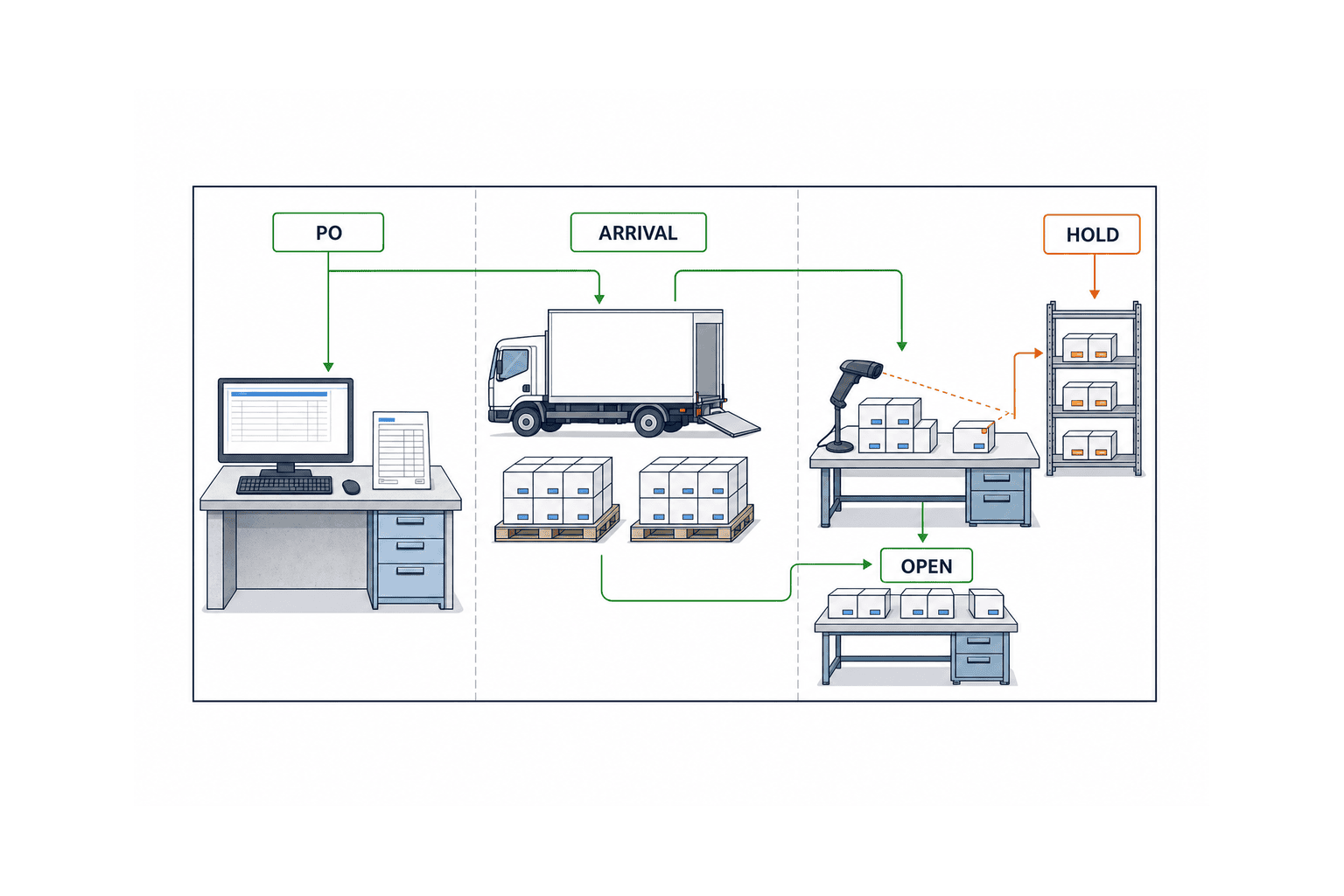
All quantities and dates in this example are illustrative, not actual supplier performance. A plant places an order for 100 units due on 20 October. The supplier confirms 60 for 20 October and 40 for 27 October. On 20 October, 60 arrive; inspection accepts 50 and holds ten. At that point, the physically undelivered quantity is 40, the quantity at the site pending a quality decision is ten, and 50 are available after inspection. Whether the ten held units still count as “open” for contractual receipt is a policy decision. The screen must not silently force purchasing, warehouse and quality to use a single definition.
If the buyer and supplier then agree to cancel five of the remaining 40, the valid undelivered balance becomes 35. Record the approval, reason, effective date and delivery line affected. If the ten held units are returned for replacement, decide whether the replacement belongs on the original PO line or a separate return or replacement document. Either method can work if the reference to the original receipt is kept and the units are not counted twice.
| Quantity or state | Illustrative units | Principal decision |
|---|---|---|
| Confirmed PO quantity | 100 | Purchasing controls the revision |
| Physically registered arrival | 60 | Receiving reconciles goods and delivery note |
| Accepted and available | 50 | Quality and inventory confirm release |
| On quality hold | 10 | Quality controls isolation and disposition |
| Undelivered before cancellation | 40 | Purchasing asks for a revised commitment |
| Agreed cancellation | 5 | Approval and change history are retained |
| Valid undelivered balance | 35 | Planning receives the expected supply |
A display that says only “open: 35” conceals the ten units under inspection. Show the undelivered balance and held stock side by side, and define separately what may enter available inventory or future supply. Do not assume that a held lot will pass inspection.
Build the data model around PO lines and events
The minimum identifier is PO number, revision and line ID, not the PO header alone. If one line has multiple promised dates, assign each delivery schedule line an ID. Receipts, returns and cancellations need their own event or document line IDs and a reference to the affected PO line. Store amendments, supplier replies, shipment notices, physical arrivals, inspection decisions and cancellations as traceable events. Recalculate a display balance from them. This makes a disputed balance explainable at month end.
| Data set | Typical fields | Ownership question |
|---|---|---|
| PO line | PO and revision, line, item, supplier item, ordered quantity, purchase unit, price, currency, requested date, site | Is ERP the system of record? |
| Supplier confirmation | Reply revision, promised quantity and receipt date, respondent, timestamp, reason for difference | Who approves an email reply? |
| Delivery schedule | Schedule line, quantity, date, parent PO line | How are old replies preserved? |
| Receiving and quality | Receipt line, physical quantity, formally received quantity, hold, reject, lot, document | When does “received” become final? |
| Cancellation and return | Affected line, quantity, reason, approver, original event | How does it affect supply and AP? |
| Planning feed | Item and warehouse, expected receipt date, usable date, MRP import version | Does unconfirmed supply enter MRP? |
Test unit conversion before accepting any balance report. A buyer may order boxes, receive pieces and obtain a supplier confirmation in pallets. Conversion rates and decimal precision affect the remainder. Microsoft’s troubleshooting note about a physical remaining quantity error gives an example in which a small remainder in the purchase unit rounds to zero in the inventory unit. This does not imply the same error occurs in another ERP, but it is a reason to include conversion and rounding in factory acceptance tests.
Decide which system owns each fact
A plant might keep approved PO revisions in ERP, supplier replies in a procurement application, physical movements in WMS, quality decisions in QMS and supply planning in MRP. Another plant may combine several of these in one system. Either arrangement needs an explicit data contract: which system confirms an event, which ID links it to the PO line, when downstream systems receive it, and how a correction reverses the original. Two screens should not both allow independent manual edits to the same receipt quantity.
If an interface fails and a buyer records a supplier’s telephone reply in a temporary sheet, that reply is not automatically a confirmed planning date. Give it a provisional status and specify who may approve it for MRP. Use an event ID to prevent a replayed receipt message from adding the same 60 units twice. For batch integrations, retain the run time, extracted period, prior successful version and replay rule. An integration that eventually succeeds but cannot explain when planning saw the change is difficult to operate.
Separate requested, confirmed and usable dates
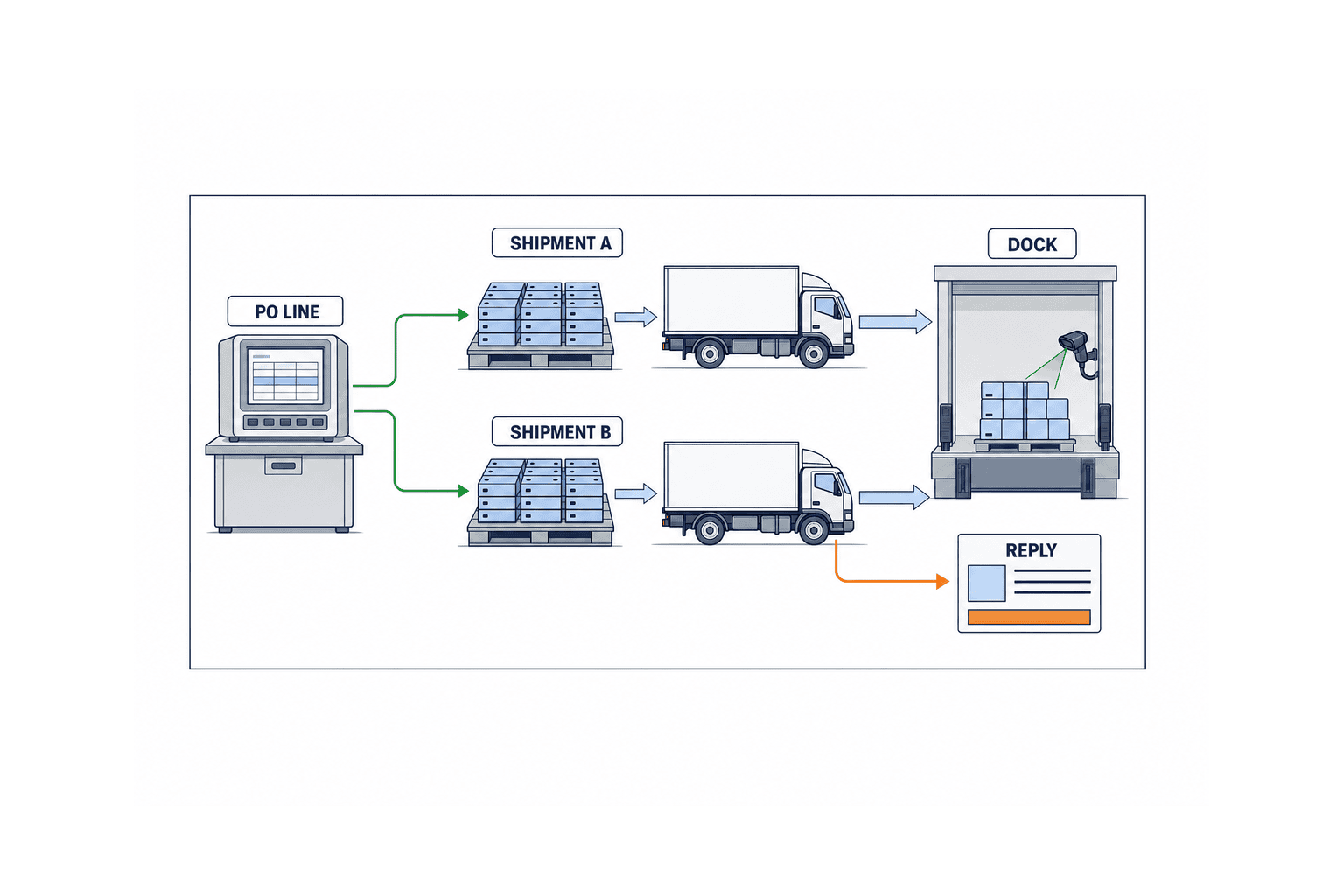
Production planning needs to know when material can be used, not merely when a PO was issued. Requested supplier ship date, requested plant receipt date, confirmed ship date, confirmed receipt date, actual departure, physical arrival and inspection release are different facts. Microsoft’s explanation of requested and confirmed PO dates makes the distinction explicit in its product model. The names and calculations in a new system should reflect the plant’s own contracts and transport terms.
For purchasing, “no supplier answer” is an exception, not the same as “on time.” Show unconfirmed lines, a reply deadline and the person responsible for follow-up. After a confirmation, record every changed date with its old value, reason and affected manufacturing orders. If a supplier promises “40 units Tuesday and the rest unknown,” retain both the known commitment and the unresolved quantity. Do not remove the unknown row to make a dashboard look complete.
Three dates for every split delivery
Ask for the supplier’s committed dispatch date, expected arrival at the plant and expected release for production. Imported parts can have a long interval between them, but even local parts encounter weekends, receiving slots and quality lead time. In Thailand, define the Asia/Bangkok time zone, the site calendar and the supplier calendar used to calculate “next working day.” Do not use a generic transport lead time for every supplier.
The delivery schedule example shows separate quantities and dates on one commercial PO line. In an RFP, go further: ask whether each delivery line can hold a supplier reply revision, receipt, cancellation and invoice association. A screen that supports two planned dates but loses their respective received quantities is not sufficient for balance management.
Distinguish arrival from inventory available for production
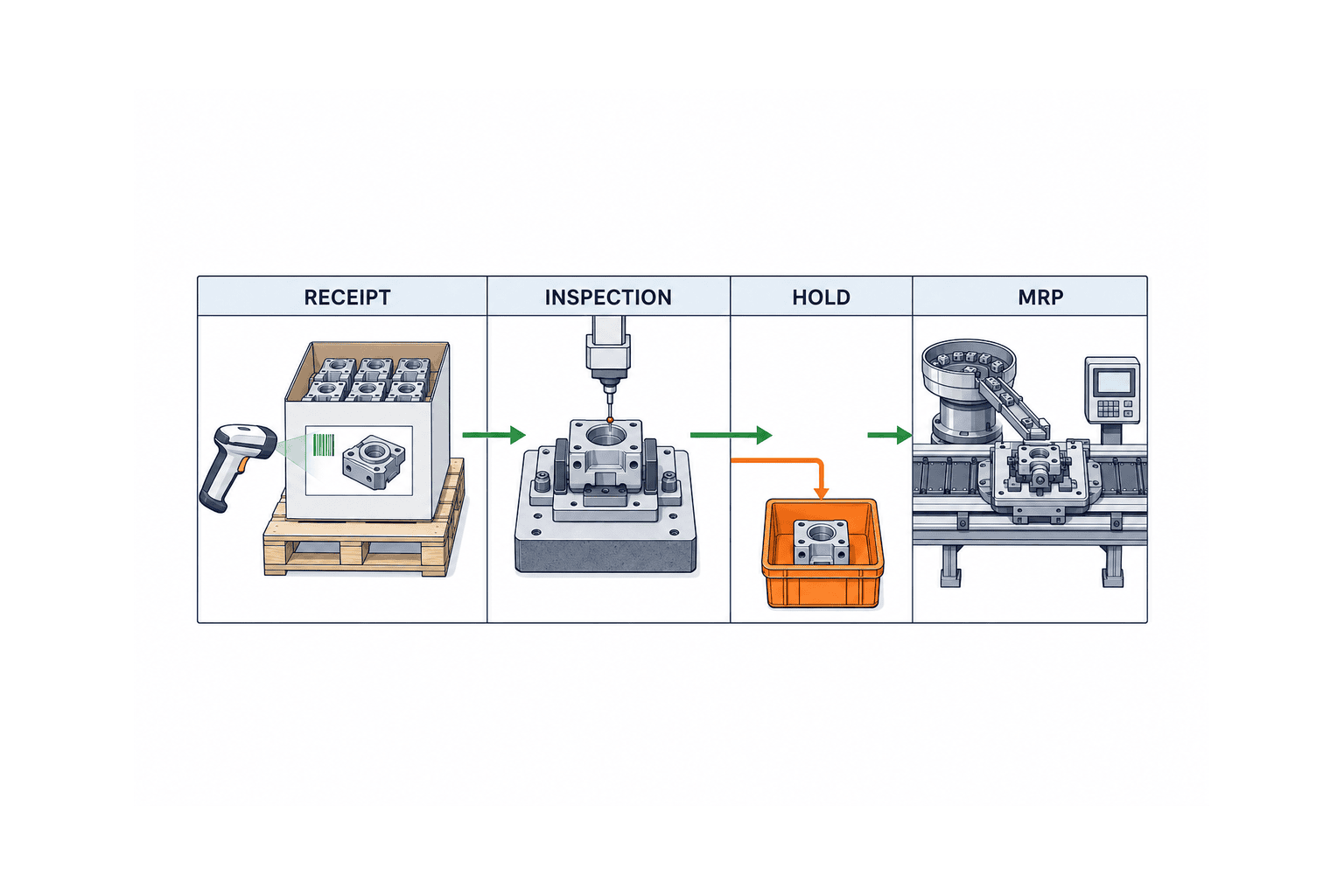
Unloading a truck, registering a receipt, accepting quality inspection and posting a product receipt in ERP may happen at different times. Microsoft’s product receipt guidance distinguishes pre-registration, registration, quality processing and product receipt. Use that as a design checklist, not as a universal accounting rule. Define precisely how an undelivered PO balance, goods under inspection and available inventory move between states at your site.
Link a receipt to the correct PO line. Item number and supplier alone may be ambiguous when several open orders exist. Provide a hold path for a missing PO reference, changed supplier item number, over-delivery or wrong item. A rejected quantity needs a disposition: scrap, accepted with concession, return, replacement or a new delivery. Keep links to the original receipt and PO so the same material does not appear once as stock and again as outstanding supply.
Planning should receive future undelivered supply with its confirmed or provisional date separately from stock already available. Goods on hold should not appear in both categories. This article is the operational step before the three-way matching and goods receipt guide, which examines payment-side controls in more detail. Here the question is how an actual receipt changes the open PO line.
Keep undelivered quantity apart from uninvoiced quantity
The quantity not yet delivered and the quantity delivered but not yet invoiced answer different questions. Microsoft’s accounts payable invoice matching overview describes matching PO, product receipt and supplier invoice quantities and prices. SAP’s quantity variance documentation likewise distinguishes received but uninvoiced quantity from invoice variance. These are product descriptions, not a universal statement about recognition, taxation or payment policy.
For an illustrative PO of 100 units with 60 formally received and only 50 invoiced, the undelivered PO balance is 40 and the received-but-uninvoiced balance is ten. If an invoice for 60 arrives before a receipt is posted, it must not reduce the undelivered PO balance by itself. The treatment of payment holds and exceptions depends on company policy and ERP configuration. Require line-level references across PO, receipt and invoice, including split shipments, partial invoices, returns, credits and over-deliveries.
Finance may also need a monetary view of outstanding purchase commitments, received-but-uninvoiced goods and invoiced-but-unpaid liabilities. Present them in distinct columns. Currency, price amendments, freight, tax, exchange rate and accounting rules affect the monetary values, so a universal journal entry or conversion formula is not asserted here. Agree with finance when an approved PO amendment changes the forecast and who can make a correction after close.
Pass credible supply to MRP, not merely a remainder
If MRP treats open POs as future receipts, overstatement conceals shortages and understatement can create duplicate procurement. Microsoft’s master planning performance documentation lists purchase orders among expected receipts considered in planning. Its master plans overview explains that time-fence settings change how supply covers demand. Accordingly, a planning feed needs item, site, warehouse, expected usable date, quantity, confirmation status and source version, not just an “open quantity” field.
Test three states in particular: a PO sent but not acknowledged; a confirmed delivery now later than the requested date; and a partially received PO with the remaining date unknown. A planner should be able to see these exceptions and decide whether to expedite, find an alternate supplier, reschedule production or use a buffer. Treating every open line as certain supply on its original date gives false confidence even if the arithmetic is perfect.
Specify when the new answer enters a new MRP plan. Does every supplier reply trigger a full run, an affected-item run or a nightly batch? Show the planning version that consumed the change so purchasing and planning can explain temporary differences. Match new purchase suggestions against existing open PO lines to prevent duplicate orders. Our order and purchasing management systems guide covers the broad boundary between purchasing and MRP; here that boundary becomes a PO event and a planning supply record.
Diagnose the current open order list before migration
Before comparing vendors, sample several months of open PO lines at a fixed extract time. For each line, trace ordered quantity, approved amendments, receipts, inspection, returns, cancellation and invoices to source documents. Classify differences by cause: missing entry, unanswered confirmation, unit conversion, delivery-line misallocation, cancellation not posted, return handling or late correction. Loading a balance that cannot be explained into new software only makes the old error more visible.
Prioritize parts by operational consequence rather than line count alone. A few unanswered lines for a part that can stop production matter more than many routine lines that close automatically. Investigate long lead-time items, single-source parts, imported material and parts often held by quality. Also ask the people maintaining spreadsheets which adjustments they make each morning; those actions reveal the business rules the new system must support.
When detailed old receipts are unavailable, agree on a signed opening balance at a specific cutover time and track subsequent events in the new system. Keep the evidence, approver and date for that opening balance. If an old document appears later, add an adjustment event instead of silently rewriting history. Compare old and new results by item, supplier and PO line at the same timestamp. A +10 error on one critical part and a −10 error on another do not cancel operationally, even when a grand total matches.
Put scenarios, not feature ticks, into the RFP
Ask vendors to run the same representative sequence and show the same expected outputs. Include split delivery, partial receipt, over-delivery, quality hold, return, partial cancellation, revised promise, invoice discrepancy, unit conversion and message replay. Check the buyer’s open balance, warehouse state, MRP expected supply and AP matching state after every step.
| Acceptance scenario | Input event | What the evaluator should observe |
|---|---|---|
| Split delivery and revised answer | Delay only the second schedule line | Old answer remains; affected plan is visible |
| Partial arrival and hold | Receive a portion and hold some for inspection | Undelivered and held stock appear separately |
| Cancellation and return | Cancel undelivered units and return received ones | Original PO and receipt remain traceable; no double reduction |
| Unit conversion | Order boxes, receive pieces with a remainder | Purchase and inventory units reconcile |
| Recovery | Replay the same receipt event | Received quantity is not doubled |
| Invoice difference | Invoice a quantity different from receipt | AP receives an exception; undelivered balance does not move |
Use FAT to test arithmetic, permissions, audit history and replay under controlled conditions. Use SAT to test actual terminals, network, labels, supplier part numbers, Thai and English screens and approver paths at the plant. A system that reads an email reply but passes it to MRP before approval has not met the operating requirement. Give the exception owner a practical screen and queue, not only an administrator log.
Compare total scope and cost
Compare quotes on equal scope: PO, receipt, quality, finance and MRP integrations; migration cleanup; supplier response channel; devices; reports; training; monitoring; support; and later sites. A supplier portal can collect confirmations but is not itself the open-balance calculation. See our supplier portal guide for the participation and collaboration side. Some smaller suppliers may still answer by email or structured file; every channel needs the same PO-line association and approval status.
Build the business case from measured local work rather than a generic software price. Record hours spent reconciling open lines, chasing dates, expediting freight, rebuilding plans and investigating invoice differences. Separate work likely to disappear from exceptions that still need people. A stable spreadsheet process for a small, simple group need not be replaced merely to make every plant use the same tool.
Thai factory implementation points
Purchasing, warehouse, quality, planning, finance, Japanese management and overseas suppliers may all inspect the same transaction. Human-readable item names can be multilingual, but item and supplier-item codes must identify one record. Store the original time zone of a foreign supplier’s response as well as the Asia/Bangkok display time. Retain the source email and any translation; a translated summary alone should not silently become the authoritative PO amendment.
For imports, keep dispatch, border or port progress and plant arrival separate. Customs terms, taxes, BOI treatment and accounting recognition depend on the product, commercial terms and company’s authorization, so do not assume a generic rule. Specify which events, currencies, lots and documents the system must track, then have the responsible local specialists confirm legal and tax requirements.
Separate the ability to record a supplier promise from the authority to change PO quantity or close the remainder. “Fully received,” “remaining quantity cancelled” and “PO closed” are different reasons for zero balance. Retain who closed a line and why, and prevent a routine supplier feed from reopening it without review. Define a delegate and an escalation rule so the queue does not stall when the named buyer is absent.
Implement in a narrow sequence and measure exceptions
First reconcile the current open lines and agree on the status model. Next pilot one part family, one site and a small supplier set through PO, split commitment, receipt, inspection and cancellation. Then connect MRP and AP and test planned supply and matching. Only after those boundaries hold should the plant add supplier groups, items and sites. Duration depends on source-data quality, integration and approvals; there is no defensible universal number of days.
After go-live, review unanswered PO lines, undelivered quantity past its confirmed date, quality holds, receipts that cannot be linked to a PO and manual balance overrides. Fix the denominator and timestamp for each measure. The purpose is to improve supply reliability, not to blame a buyer for an exception the supplier or integration caused. If the definition changes, record the change date instead of comparing incompatible periods.
Frequently asked questions
Is open PO balance management the same as purchasing management?
It is one part of purchasing management. The wider process also covers requisitions, quote comparison, approvals, contracts, supplier evaluation and payment terms. Open-balance management follows a confirmed PO line through promised dates, receipts, cancellation and the quantity still expected. The purchasing management selection guide discusses the wider scope.
Can the open balance simply be ordered minus delivered?
That approximation works only for a simple transaction under an agreed receipt definition. Cancellations, returns, over-deliveries, quality holds, split schedules and unit conversions require additional states. Preserve source events so the number can be recalculated and explained.
Why does the undelivered balance differ from the uninvoiced balance?
Goods and invoices arrive at different times. An order can be physically received while its invoice is outstanding, or an invoice can arrive before a product receipt. Keep PO, receipt and invoice quantities in separate records with line-level links. Follow company policy for recognition and payment.
Which promised date should MRP use if a supplier changes it repeatedly?
The latest approved confirmation is a reasonable candidate, accompanied by a status such as provisional, confirmed or delayed. Retain prior versions and display which plan run consumed each change. Let a planner review low-confidence supply and alternatives.
What determines implementation cost?
The number and difficulty of integrations, historical cleanup, line-level traceability, supplier channels, sites, permissions, training and support matter more than a headline user count. Compare vendors against identical scenarios, data scope and acceptance criteria.
Conclusion: agree on transitions before buying a dashboard
An open PO management system helps only when the plant can explain why a quantity is still expected and when it can become usable supply. Link PO lines to supplier commitments, split deliveries, physical receipts, quality, cancellation, invoice matching and MRP through stable IDs. Keep undelivered, on-hold, available and received-but-uninvoiced quantities distinct. Prove the exception paths with one part family before expanding.
If your Thai plant is reconciling open POs in spreadsheets or finding different balances in ERP and MRP, you can discuss the current process with TOMAS TECH. Sample PO lines, receipts and supplier replies are enough to start drafting a status model and comparable acceptance scenarios.
Sources
- Microsoft Learn — PO delivery schedules.
- Microsoft Learn — Approve and confirm purchase orders.
- Microsoft Learn — Product receipt against purchase orders.
- Microsoft Learn — Requested and confirmed PO dates.
- Microsoft Learn — Accounts payable invoice matching.
- SAP Help Portal — Quantity Variance.
- Microsoft Learn — Master planning performance.
- Microsoft Learn — Master plans overview.
- Microsoft Learn — Physical remaining quantity error.


