



Procurement searches for the purchase order, receiving confirms what arrived, and accounts payable compares a delivery note with an invoice. The purpose of goods receipt automation is not merely to read paper faster. It is to link the purchase order (PO), receipt evidence and supplier invoice at line level; advance cases that comply with policy; route variances and missing evidence to accountable people; and post an approved result to the ERP without duplication. This guide explains the operating model, AI-OCR, exceptions, controls and implementation evidence that a buyer should require.
Goods receipt automation is an evidence-and-decision system
“Receipt” can refer to several decisions. A warehouse records physical arrival. Quality may place the goods on hold. A requesting department accepts a service or milestone. Accounts payable determines whether there is sufficient evidence to recognize and pay the liability. A factory may also need item, lot, unit of measure, location, inspection, return and partial-delivery data.
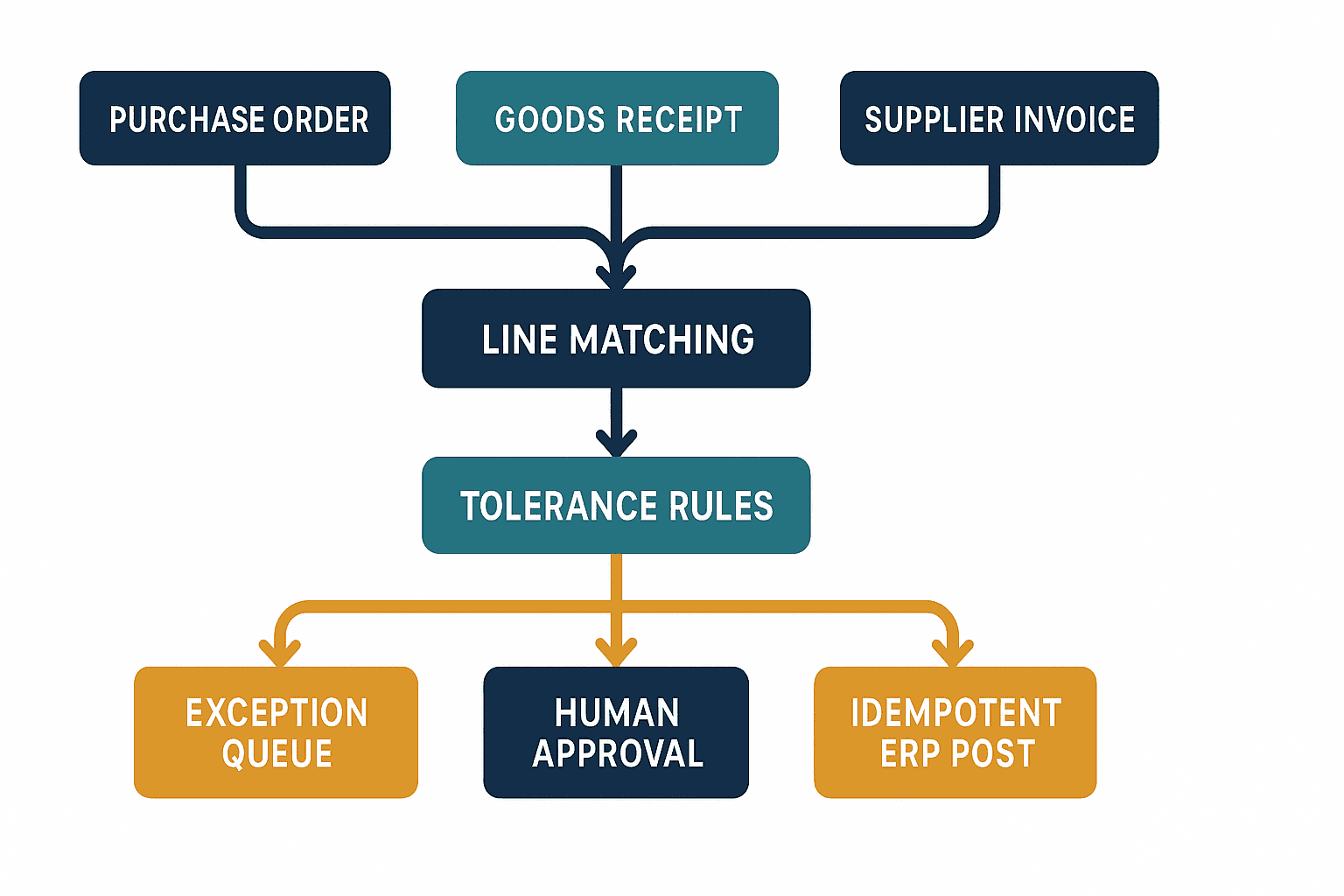
Installing a scanner and OCR does not connect those decisions. If the matching keys, policy owners and exception routes remain undefined, staff simply move manual checking from paper to a screen. Define the target as a closed loop:
- Receive POs, receipt events, delivery notes, invoices and credit notes.
- Classify the document and identify the supplier.
- Extract and normalize order, line, item, quantity, UOM, price, tax and currency fields.
- Match PO, receipt and invoice lines and apply approved tolerances.
- Route mismatches to a reason-specific exception queue.
- Have an authorized person approve, reject, hold or correct the case with evidence.
- Post the result idempotently to the ERP and retain the decision trail.
- Reconcile the posting and track reversals, returns and credit notes.
AI may read documents, rank candidates and flag uncertainty. It does not replace the person accountable for approval. The NIST AI RMF Core organizes AI-risk work around Govern, Map, Measure and Manage. It is voluntary guidance rather than local law, but it provides a useful reminder that model use requires ongoing ownership, measurement and response, not one acceptance score at launch. NIST AI RMF Core
What three-way matching means at line level
Three-way matching commonly compares the purchase order, goods receipt and supplier invoice. Microsoft Dynamics 365 documentation describes invoice matching as a comparison of invoice, PO and product-receipt information and shows configurable policies and tolerances. This is product documentation, not a claim that every ERP behaves alike, but it identifies practical design questions. Accounts payable invoice matching overview
Why header totals are not enough
An invoice total may equal a PO total while the line composition is wrong. A shortage on item A and an overcharge on item B can cancel out. One PO may also receive several partial deliveries and several invoices. Without line-level open quantity and previously invoiced quantity, the process struggles to distinguish a valid split from a duplicate or unbilled balance.
| Matching field | Evidence compared | Design consideration |
|---|---|---|
| Order reference | PO and PO-line number | Combine OCR with supplier identity and open-PO candidates |
| Item or service | Internal item, supplier item, description | Govern cross-reference masters and ambiguous descriptions |
| Quantity | Ordered, received, accepted and invoiced | Separate partial, excess, return and inspection-hold states |
| Unit of measure | EA, BOX, KG and others | Define conversion and rounding rules |
| Price and amount | Contract/PO price and invoice price | Handle effective dates, tiers, discounts and rounding |
| Tax and freight | Tax codes, tax amount and logistics charges | Separate ancillary charges and send applicability to specialists |
| Currency and FX | Order currency, invoice currency, rate date | Define the authoritative source and conversion date in the ERP |
| Receipt evidence | Receipt event, inspection, service acceptance | Preserve who accepted what and when |
OpenPeppol BIS Billing 3.0 specifies structured invoice business terms and validation rules. An invoice line can also carry an order-line reference. Structured exchange may remove the OCR step, but it does not guarantee that a supplier sends the reference, that the reference matches your master data, or that an exception is valid. Peppol BIS Billing 3.0 and order-line reference
Do not force non-PO invoices and services through a goods route
Rent, utilities, professional fees, subscriptions, travel and fixed maintenance may not have a material receipt. Service acceptance may rely on a milestone, completion report, contract term or requesting-manager approval. These need a legitimate non-PO or two-way route, not an unexplained “exception.”
Define the requester, budget, account, contract, service period, deliverable and delegated authority. Monitor whether non-PO use is becoming a way to bypass proper purchasing. A separate controlled route is stronger than pretending every payment can use the same three documents.
Delivery note digitization and purchase order OCR
AI-OCR can extract candidate fields from POs, delivery notes and invoices with varying layouts. Its performance depends on image quality, languages, fonts, tables, stamps, handwriting, page continuation and supplier variation. One headline “accuracy” figure is therefore not a production acceptance test.
Set confidence and impact by field
A one-character error in an invoice number may defeat duplicate detection. A wrong PO line may attach the invoice to another receipt. An incorrect tax amount may affect accounting. Punctuation in a note may have little decision impact. Define, for each field:
- whether it is mandatory;
- the impact of an error;
- conditions for machine confirmation;
- master-data or arithmetic validation;
- the confidence or inconsistency that triggers human review; and
- the retention of original, corrected value, reviewer and reason.
Even a high-confidence reading must stop if the PO is closed, quantity exceeds accepted receipt, arithmetic fails or the supplier/invoice combination already exists. A low-confidence field may be strengthened by a barcode, structured XML or portal value. See our practical guide to evaluating AI-OCR accuracy for a field-level test approach.
Reducing OCR is also automation
Where suppliers can provide XML, EDI, API or portal data, use the structured values and retain the PDF as evidence when appropriate. Thailand’s Revenue Department provides official e-Tax Invoice & e-Receipt information, and ETDA publishes a public FAQ. Applicability, format, signatures, transmission, retention and tax treatment must be confirmed against current official guidance and qualified advisers; this article is not tax advice. Revenue Department e-Tax and ETDA FAQ
The end-to-end invoice processing automation flow
1. Intake and source-record control
Record whether the document arrived by email, portal, scan, EDI or another approved channel. Use an intake ID and file hash so the same invoice received by paper and email does not create two cases. Retention, deletion, backup and access must follow the organization’s legal, tax and information-governance rules.
2. Classification and supplier resolution
Distinguish invoices, delivery notes, quotations and credit notes. Resolve the supplier using several signals such as tax identifier, address, approved email domain and master data. A bank-account change shown on an invoice should never update the vendor master automatically; route it through the established independent verification process.
3. Extraction, normalization and validation
Normalize date formats, character variants, separators, currency, UOM, tax notation and supplier item codes. Check subtotal/tax/total arithmetic, required fields, duplicate indicators, supplier status and open orders. Keeping OCR extraction separate from business validation makes failures explainable.
4. Line matching and tolerances
For every candidate PO line, compare ordered quantity, accepted receipt, previously invoiced amount and the current invoice. Apply company-approved quantity, price, amount, tax, freight and FX tolerances. A tolerance is a business policy—not an AI suggestion—and may vary by entity, site, supplier, category or delegated authority. Define precedence when policies overlap.
5. Exception queue and accountable approval
Attach a reason code and route the case to procurement, receiving, quality, requester or accounts payable. Do not display only “mismatch.” Put the source, extracted value, ERP value, difference, related history and possible next action in one view. The approver reviews evidence and records the approval, rejection, hold or correction reason.
6. Idempotent ERP posting
An API or robot may time out after the ERP has committed a posting. Retrying blindly can create a duplicate. Use an external processing ID plus a duplicate key such as company, supplier, invoice number and fiscal context. Separate pending, processing, posted, failed and reversed states. Retry with the same idempotency identity and query the ERP before creating another transaction.
7. Post-posting reconciliation
Return the ERP document number to the case. Reconcile daily counts, amounts, tax and currencies. Monitor received-but-not-posted cases, ERP postings without workflow results, and reversed postings with open tasks. Automation is not complete until both sides agree.
Microsoft also documents an automated vendor-invoice matching and workflow-submission pattern in Dynamics 365. It is an application pattern, not a promise of touchless processing or control effectiveness. Validate your own configuration, permissions, logs, error handling and change process. Automated vendor invoice matching
Exceptions determine whether automation works in production
Normal-path demos are easy. Operational time accumulates where evidence is incomplete, interpretations differ and ownership crosses departments.
| Exception | Machine evidence | Accountable human decision |
|---|---|---|
| Partial or split delivery | Open PO, receipt history, current quantity | Wait for balance or accept/invoice the received portion |
| Split invoice | Prior invoices and contract milestone | Whether payment conditions are met |
| Quantity variance | Count, weight, inspection and UOM conversion | Accept, hold or return the variance |
| Price variance | PO revision, contract and effective date | Whether the revision is authorized |
| Tax variance | Tax code, registration and line data | Correct treatment, confirmed by the relevant specialist |
| Freight or ancillary charge | PO terms, contract and logistics term | Supplier or buyer responsibility |
| Currency or FX | Order/invoice currency and approved rate source | Conversion date and difference treatment |
| Non-PO invoice | Contract, budget and requester approval | Legitimate route or purchasing bypass |
| Service | Completion report, deliverable and period | Whether the service has been accepted |
| Duplicate | Supplier, number, date, amount and lines | Duplicate, copy or legitimate reissue |
| Return or credit note | Return event and original reference | Offset, refund or future application |
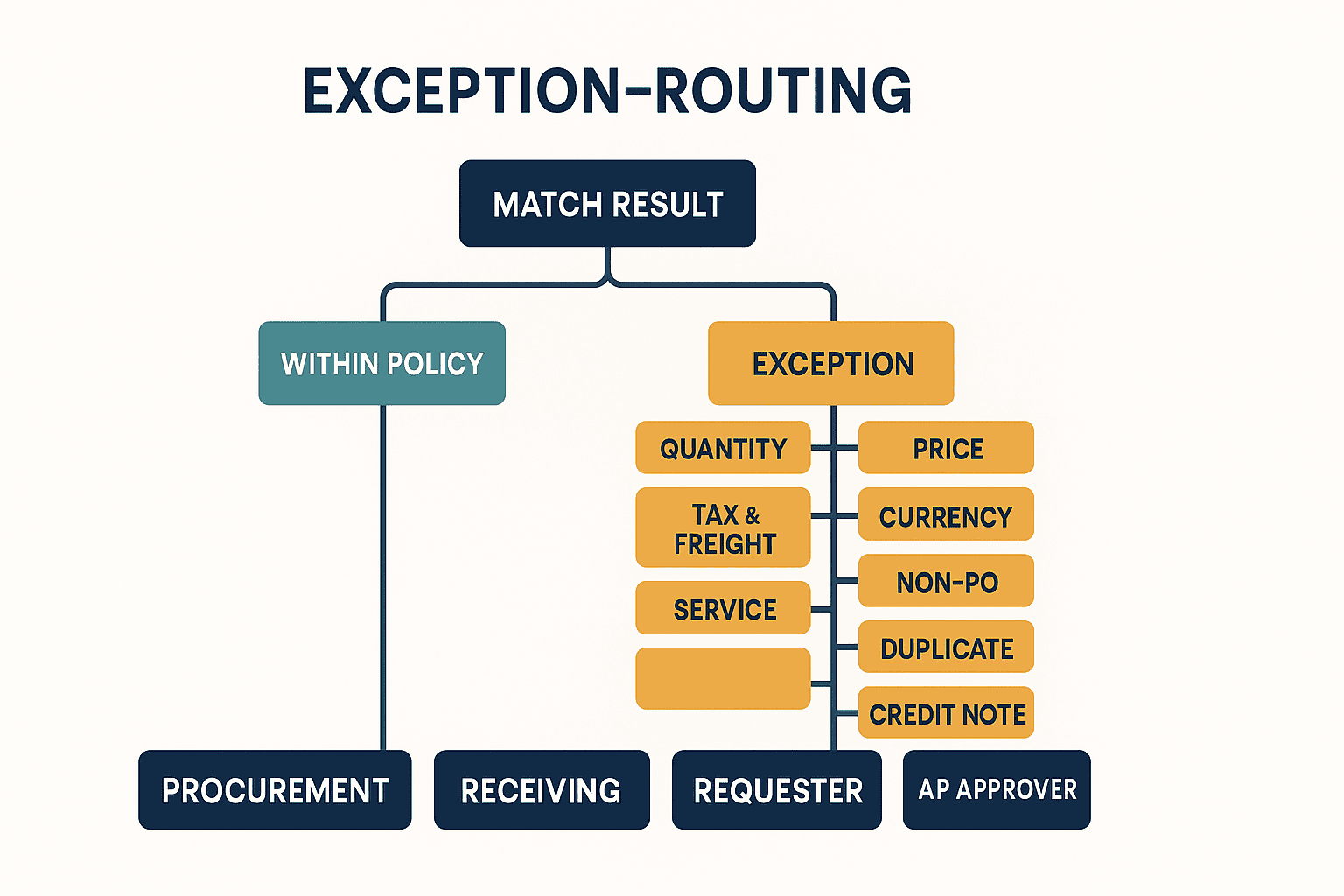
An exception queue should include case ID, reason, materiality, amount/currency, age, owner, next deadline, documents, variance, decisions, hold reason and resumption condition. It is a managed work queue with escalation, not another inbox.
Do not confuse model confidence with business tolerance. Confidence expresses extraction uncertainty. Tolerance expresses approved policy. A case may proceed only when evidence is present, both conditions are met and other controls—duplicate, supplier status, access and sanctions where applicable—do not require a stop.
OCR RPA integration: prefer stable interfaces and govern screen automation
When the ERP has a supported API or import service, it is normally easier to manage state, errors and idempotency. RPA can bridge a legacy application or a temporary gap, but screen fields, response times and dialogs can change.
Acceptance for OCR RPA integration should include:
- a dedicated bot identity with least privilege;
- no sharing of a person’s credential;
- correlation between case ID and ERP document number;
- monitoring and safe-stop rules for UI change;
- querying posting status before retry after timeout;
- no design dependent on bypassing CAPTCHA or MFA;
- a failed-work queue, authorized retry and manual fallback;
- regression testing before production change; and
- retirement criteria when a supported interface becomes available.
If standard ERP functions cannot cover the process, our guide to deciding on custom production-management system development provides additional questions on interface boundaries and long-term ownership.
Audit trail, segregation of duties and data controls
Segregation of duties
Avoid concentrating PO creation, receipt, invoice entry and payment approval in one authority. Where a small site cannot fully separate roles, define compensating controls such as higher-level review, change reports, monetary thresholds and after-the-fact reconciliation. Include AI and RPA service identities in the role matrix.
Traceable evidence
For each case, retain or reference the source file, receipt time, extraction model/version, extracted value and confidence, master lookup, matching rule/version, variance, correction history, reviewer, decision reason, ERP request and response. Put logs in a controlled store rather than an editable shared worksheet.
Change management
Regression-test changes to the model, prompt, OCR template, supplier mapping, tolerances, tax rules and ERP interface against a stable evaluation set. Contract for notice of model changes, reassessment, rollback, incident response and manual continuity.
GS1 EPCIS 2.0 provides a standard for visibility events that can describe what happened, when, where and why in a supply chain. This can support receipt evidence, but an event alone does not establish quality acceptance, title, contractual performance or liability. Those decisions remain separate. GS1 EPCIS 2.0
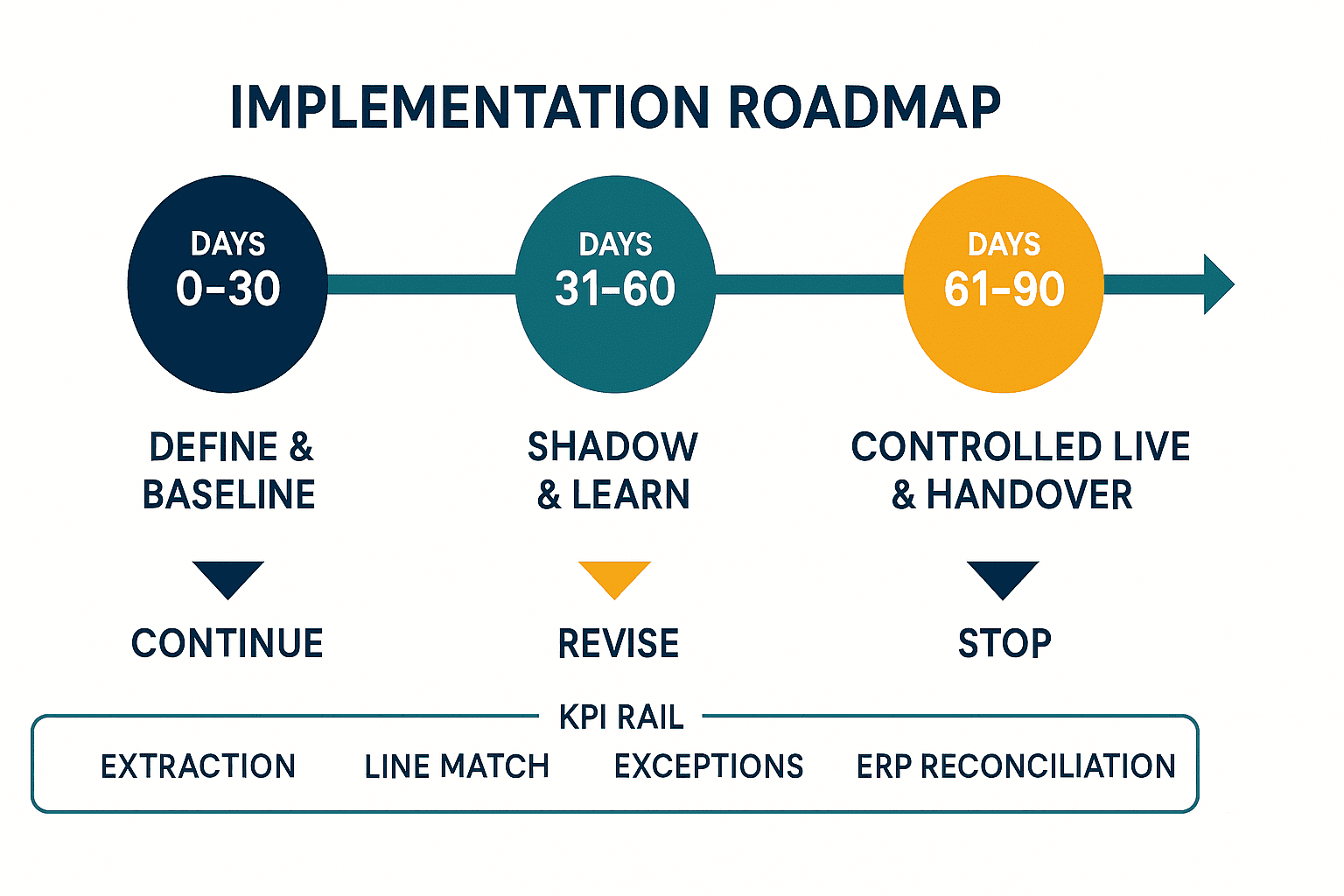
A 30/60/90-day proof of concept
A PoC should produce evidence for an operating decision, not just an attractive OCR demonstration.
Days 0–30: define and baseline
- Limit entity, site, suppliers, document types, languages and ERP scope.
- Observe the current path from intake to posting and measure wait/rework.
- Define PO, receipt, invoice and exception data dictionaries.
- Freeze a historical evaluation set with normal and exceptional cases.
- Agree critical fields, tolerances, authority and retention.
- Assess API, RPA, EDI and structured-invoice options.
- Define continue, revise, stop and expand gates.
Days 31–60: shadow and learn
Run a limited supplier or document population in shadow mode. Staff continue the authoritative process while the new flow proposes extraction and matching. Capture wrong extraction, wrong linkage, missed exceptions and unsafe straight-through candidates. Deliberately include partial delivery, UOM conversion, freight, tax and credit notes.
Days 61–90: controlled live and handover
Enable only the accepted scope. Operate exception queues, approvals, idempotent posting, daily reconciliation and manual fallback. Confirm that internal staff can manage first-line support and rerun regression tests. Day 90 is a decision gate—not an automatic end date—to continue, revise, stop or expand.
KPIs beyond OCR accuracy
Fix each numerator, denominator and exclusion. Segment by supplier, document, language, site and exception. Averages can hide rare critical errors.
| KPI | Example definition | Decision supported |
|---|---|---|
| Critical-field extraction | Correct, missing and wrong values by field | Where extraction needs control |
| Line-link success | Correct PO and receipt line association | End-to-end matching quality |
| Exception rate | Exception cases / eligible cases | Master and policy improvement |
| Unsafe straight-through | Cases that should have stopped but advanced | Critical control risk |
| Exception resolution time | Queue entry to resolution | Cross-functional delay |
| Rework rate | Cases requiring reread, correction or repost | Hidden operating effort |
| Duplicate control | True duplicates and false alerts | Payment risk and workload |
| ERP reconciliation variance | Count/amount difference between workflow and ERP | Missing or duplicate posting |
| Manual fallback | Uses and recovery time | Operational resilience |
Set targets from your baseline, risk appetite and sample size. Do not convert a vendor’s general benchmark into a guarantee for your documents.
What to put in the RFP
Specify entities, sites, volumes and variability, languages, pages, channels, suppliers, PO/non-PO, goods/services, partial delivery, currencies, tax context, ERP and approval structure. Describe sample availability and anonymization constraints.
Require extraction fields, line matching, tolerance hierarchy, exception reasons, queue/SLA, segregation, approval, duplicate prevention, idempotent posting, reversal, credit notes, logs, retention, search and audit export. “AI-OCR supported” is not comparable without these outcomes.
For non-functional requirements, address availability, performance, security, encryption, data location, subprocessors, backup, monitoring, incidents, recovery, change notice, model update, support and exit data return/deletion.
Break TCO into setup, document/page/field usage, AI consumption, integration, RPA and ERP licences, environments, monitoring, support, supplier onboarding, layout changes, retraining, audit, storage and internal operations. Our AI-OCR pricing comparison guide explains how to compare pricing units. This article does not invent a project price because scope and volume determine it.
Acceptance testing must emphasize exceptions and retry
Use real distribution plus critical low-frequency cases: skewed scans, low resolution, stamps, multipage tables, Japanese/Thai/English, handwritten corrections, similar items and UOM differences. Test that:
- the same invoice from two channels creates one case;
- a correct PO with a wrong line stops;
- partial delivery, split invoice, quantity and price differences get distinct reasons;
- non-PO and service invoices enter approved alternative routes;
- freight, tax, currency and FX are not guessed into compliance;
- low confidence, failed arithmetic and master mismatch reach people;
- role restrictions operate when one user created the PO or receipt;
- timeout after ERP commit does not create a duplicate;
- an ERP outage preserves order and supports controlled recovery;
- returns and credit notes link to the original receipt and invoice;
- model/rule/UI changes pass regression; and
- evidence from intake through decision and posting is exportable.
Acceptance should include a zero-tolerance gate for defined critical failures, exception resolution, segregation, retry, reconciliation and fallback. Averages alone are insufficient.
Pre-implementation checklist
- [ ] We separated physical receipt, quality acceptance and invoice matching decisions.
- [ ] We have keys that connect PO, receipt and invoice at line level.
- [ ] We defined legitimate routes for non-PO, services, partial delivery and split invoices.
- [ ] Owners are assigned for tax, freight, currency, FX and credit notes.
- [ ] AI confidence and business tolerance are governed separately.
- [ ] Low confidence and inconsistency go to people; AI does not replace the approver.
- [ ] Segregation of duties and compensating controls are documented in the role matrix.
- [ ] ERP posting has an idempotency key and post-posting reconciliation.
- [ ] RPA recovery and manual fallback are documented and tested.
- [ ] KPIs include unsafe straight-through, exception time, rework and ERP variance.
- [ ] The 90-day PoC has continue, revise, stop and expand gates.
- [ ] TCO includes internal operations and future change.
FAQ
Where should goods receipt automation start?
Start with one site and bounded document population. Observe the complete flow, identify line keys, baseline exceptions and define accountable approval. Freeze an evaluation set before comparing tools.
Is delivery note digitization enough for three-way matching?
No. A delivery note may not represent the actual accepted quantity, inspection hold, return or service completion. Connect it to the authoritative receipt, PO and invoice lines.
What purchase order OCR accuracy is sufficient?
There is no universal percentage. Evaluate critical fields separately and measure wrong line links and unsafe straight-through cases. Human routing for low confidence and inconsistency is part of acceptance.
Does invoice processing automation remove approvers?
No. A defined low-risk case may advance automatically within approved policy, but delegated authority and accountability remain with the organization. Exceptions and high-impact changes require appropriate review.
Is OCR RPA integration cheaper than an API?
It may appear to require less initial development, but compare total cost including UI changes, monitoring, failures, retries, licences and internal operations. A supported API commonly provides stronger state and idempotency controls.
Does Thai e-Tax remove every paper process?
That depends on applicability, trading-partner arrangements, format, signature, transmission, retention and internal policy. Confirm current Revenue Department and ETDA guidance and obtain professional advice. Electronic format and operational matching are separate questions.
Is an OCR demo sufficient for a PoC?
Not for a production decision. Test line matching, exception routing, permissions, duplicate prevention, post-posting reconciliation and continuity within the limited scope.
Conclusion: automate the closed loop, not just data entry
Goods receipt automation is complete only when PO, receipt and invoice lines are connected; company tolerances are applied; non-PO, service, partial delivery, quantity, price, tax, freight, currency, FX and credit-note exceptions reach accountable people; and approved results post idempotently to the ERP. AI-OCR proposes data and exposes uncertainty; it does not become the approver. Segregation of duties, audit evidence, reconciliation and change control allow speed and control to be improved together.
TOMAS TECH can help while document scope and integration choices are still being defined—from current-state mapping and three-way matching rules to an AI-OCR evaluation set, exception queue and 30/60/90-day PoC. To discuss a practical design for a Thailand or ASEAN operation, contact us.
References
- Thailand Revenue Department: e-Tax Invoice & e-Receipt
- ETDA: e-Tax Invoice & e-Receipt FAQ
- Microsoft Learn: Accounts payable invoice matching overview
- Microsoft Learn: Automated vendor invoice matching
- OpenPeppol: Peppol BIS Billing 3.0
- OpenPeppol: Invoice-line order-line reference
- NIST: AI RMF Core
- GS1: EPCIS 2.0
*This article provides general information for system and process planning. It is not legal, tax or accounting advice, a product-performance guarantee or an investment-return guarantee. Confirm applicability, retention, approvals and accounting treatment against current official guidance and qualified internal or external advisers.*


