


Factories in Thailand that are considering a returns management system for manufacturing tend to be in a very similar situation. Sales receives the customer’s return notice by email, the quality assurance staff member adds a line to the defect register in Excel, and the physical goods sit in a “returns corner” at the back of the warehouse. Accounting issues the credit note only after Sales tells them to. This is a familiar scene at Japanese-affiliated automotive parts, electronic components, plastic molding and metal processing plants around Ayutthaya, Chonburi, Rayong and the Bangkok area.
The biggest problem in this situation is that no one can see at a glance “how many returns we have this month and for how much, where each one is right now, and whose decision each one is waiting for.” Until someone opens the box in the returns corner, no one knows which customer and which shipment it came from. Even after the quality investigation is finished, it is unclear who decides whether to restock or scrap, so the box stays where it is for weeks. Meanwhile the customer keeps asking, “Where is our credit note?”
This article is a practical guide for plant managers, quality assurance managers, sales administration, warehouse, accounting and IT staff at those factories. It sets out, for building a returns management process, “what to record, in what order, in which system, how to compare options, and how to proceed.”
First, here is the argument of this article in brief.
The purpose of returns management is not “to clear returns quickly.” A return is an event in which money (the credit note), goods (inventory) and quality information (the defect record) all move at the same time. The purpose is to make it possible to follow that event to the end with a single number, namely the RMA number.
There are 3 typical reasons why returns processing gets tangled.
- (1) There is no RMA number, so the return is not linked to the original shipment, invoice and lot
- (2) For quarantined returns, there is no defined decision owner and no deadline for deciding the disposition (restock, rework, scrap, return to supplier, return to customer)
- (3) The credit note moves separately from the inventory, cost and quality records
In addition, the transit time from the customer to the factory can hardly be shortened. What can be shortened is the number of days inside the factory, that is, the days spent on receipt and identification, investigation, disposition decision and credit note issuance. This article is built around the idea of managing returns by “days.”
Note that this article does not recommend or rank any specific product. It is also not legal, tax or customs advice. The Thai tax and customs topics are presented as “points to check,” and the latest requirements should be confirmed with a tax accountant and a customs broker. All the case counts, amounts, hours and costs in the estimates are hypothetical figures made for this article.
Why manufacturers should review returns management
More shipments mean more returns
Recent figures for Thai manufacturing show that production and orders are growing. According to Reuters, the Manufacturing Production Index (MPI) of Thailand’s Ministry of Industry rose 4.44% year on year in August 2026, beating the market forecast of +1.0% in a Reuters poll. At the same time, however, the Ministry revised the MPI methodology, for example by adding new electronic products and changing the weights. Figures from August 2026 onward cannot simply be compared with the old series. The Ministry raised its 2026 MPI growth forecast to 2.75 to 3.55% (previously 0.0 to 0.5%).
The S&P Global Thailand Manufacturing PMI was 54.3 in September 2026 (53.8 in August), the highest level since December 2025. According to Trading Economics, output expanded at the fastest pace in 9 months and new orders were the strongest in 6 months.
Even if the return rate stays the same, more shipments mean more returns. A factory that could handle 10 returns a month with email and Excel will suddenly find it hard to track “which return is stuck where” once the number of cases, customers and part numbers grows. Growth in shipments is reason enough to review returns management.
Statistics on the size of returns, and their scope
Several figures on the size of returns are often quoted. However, each of them has a limited scope (country, industry, year, survey body).
- US retail returns: According to the “2025 Retail Returns Landscape” survey by the National Retail Federation (NRF) and Happy Returns (a UPS company), US retailers estimate that 15.8% of their annual sales in 2025, or USD 849.9 billion, will be returned. In 2024 the figures were 16.9% and USD 890 billion. This is an estimate for US consumer retail, and the survey covered 2,006 consumers who had returned items bought online in the past 12 months and 358 people at large US retailers with sales of more than USD 500 million.
- Warranty claims at US-listed manufacturers: According to Warranty Week’s “23rd Annual Product Warranty Report,” the average warranty claims rate (warranty claims paid divided by product sales) of US-based manufacturers in 2025 was 1.30%. The data covers companies listed in the US that disclose warranty expenses to the SEC. By industry, 2025 warranty accruals were reported as USD 2.09 billion for automotive parts (Tier 1, Tier 2, etc.) and USD 3.37 billion for semiconductors and PCBs.
These 2 figures differ in both scope and definition. 15.8% is an estimate of the value of returns in US retail, while 1.30% is the ratio of warranty claims paid at US-listed manufacturers. They cannot be added together or applied to the return rate of Thai manufacturers. Warranty expenses are also not the full cost of returns.
In reality, public statistics on return rates in B2B manufacturing with a clear scope (country, industry, year, sample) are scarce. That is exactly why it is worth being able to measure your own number of returns, their value and the days they take. Before comparing yourself with other companies’ averages, the starting point is to be able to answer whether your returns “have increased since last month, and where they are stuck.”
Look at returns by “time to disposition”
One returns metric discussed in recent commentary is “time to disposition.” In the logistics publication Logistics Viewpoints (Jim Frazer, September 16, 2026), the author argues that reverse logistics should be evaluated by time to disposition rather than by cost per return, and points out that returned items lose value as assets, so slow decisions leave inventory “economically frozen.” The metrics he suggests include disposition speed, recovery rate through resale, avoided markdowns, and the number of days items remain unusable.
This commentary is mainly in the context of US retail. Even so, the ideas that “returns lose value the longer they sit” and that “slow decisions are a cost in themselves” apply directly to factory returns as well. With parts, an item can become an old revision because of a design change while it sits, or can no longer be restocked because of humidity or rust. In this article too, the number of days from the customer’s notice to the issuance of the credit note is placed at the center of management, not just the number of cases or the amount.
Also in the returns field, it was reported in September 2026 that US-based ReturnPro acquired iF Returns, a Spanish returns technology company (DC Velocity, September 23, 2026). iF Returns provides a returns management system to more than 200 brands in Europe, and this is a development in the retail and e-commerce space. Because its premises differ from those of B2B returns in manufacturing, this article only mentions it as a trend.
What is returns management: the 6-stage returns process
The returns process
Returns management is a mechanism that makes it possible to track each product returned by a customer, case by case, from acceptance of the request through receipt of the goods, investigation, disposition decision, financial settlement, and records and recurrence prevention. The returns process is easier to organize when divided into the following 6 stages.
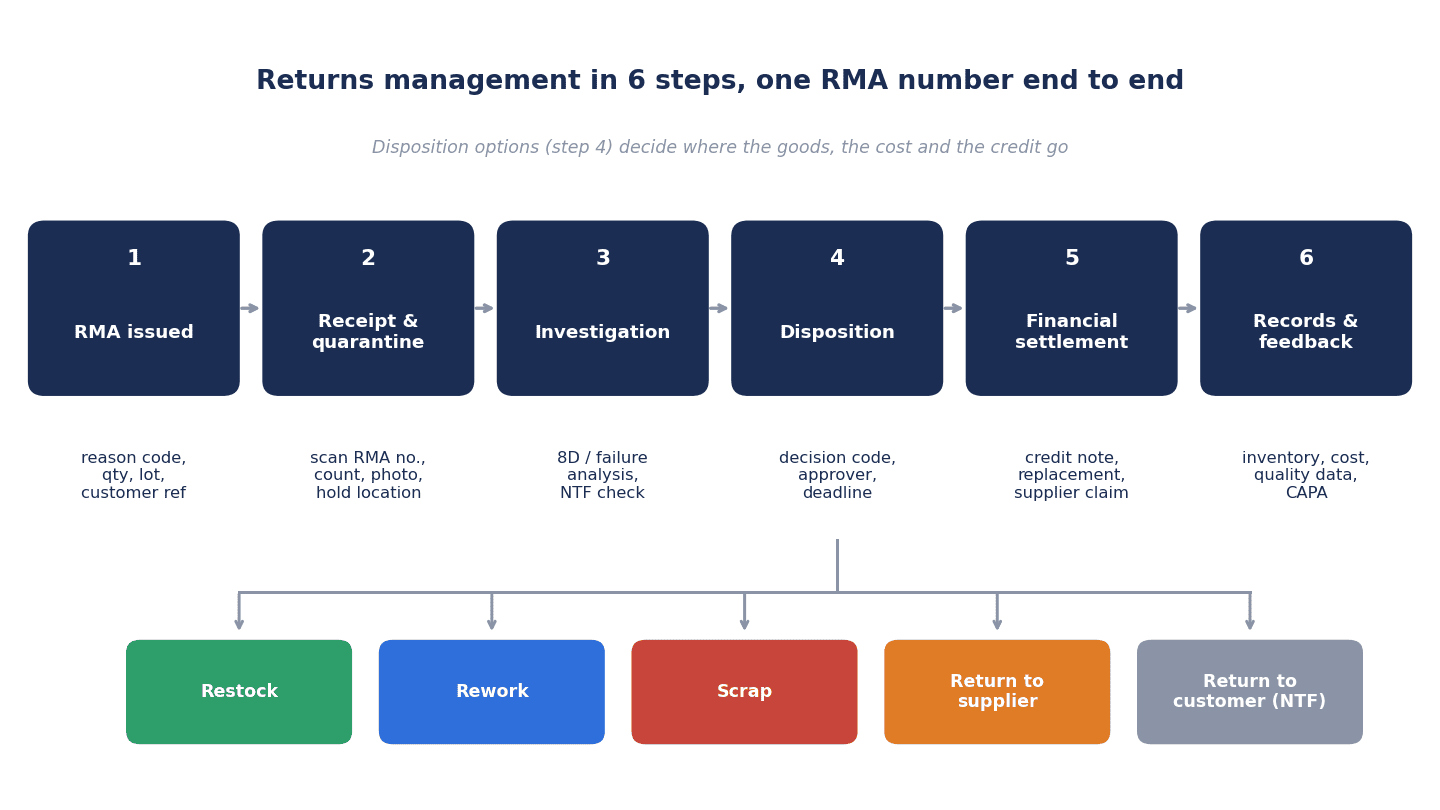
| Stage | Main tasks | Main owners | Records created |
|---|---|---|---|
| 1 RMA issued | Receive the customer’s return request, assign an RMA number, and register the original shipment, invoice, lot and return reason | Sales, Quality | RMA (return merchandise authorization), return reason code |
| 2 Receipt and quarantine | Check the goods against the RMA number, receive them and place them in a quarantine location | Warehouse | Receipt record, quarantined stock |
| 3 Investigation | Check appearance, dimensions and function, and investigate whether there is a defect and its cause | Quality | Investigation record, photos, 8D, etc. |
| 4 Disposition decision | Decide whether to restock, rework, scrap, return to supplier or return to customer | Quality, Production, Sales (decision owner) | Disposition code, decision maker, decision date |
| 5 Financial settlement | Issue the credit note, ship the replacement, claim against the supplier | Accounting, Sales, Purchasing | Credit note, replacement shipment, invoice to the supplier |
| 6 Records and feedback | Reflect the case in inventory, cost and quality records, and feed recurrence prevention back into the shipping release decision | Quality, Production, Accounting | Inventory and cost journal entries, quality record, corrective action |
The important point here is that all 6 stages are connected by the same RMA number. Without an RMA number, each stage is managed under a different number (the subject line of the Sales email, the row number in the quality defect register, the warehouse receipt number, the accounting credit note number), and at the end someone has to manually match “which return this credit note belongs to.”
Types of returns
There are several types of returns that come back to a factory, and each has a different disposition and a different flow of money.
| Type | Description | Typical disposition | Money flow |
|---|---|---|---|
| Defective return | A defect found in the customer’s receiving inspection or process | Rework, scrap or return to supplier after investigation | Credit note or replacement |
| Wrong delivery return | Wrong part number, wrong quantity or wrong delivery destination | Restock if good | Credit note, reshipment of the correct item |
| Over-delivery return | The portion delivered beyond the ordered quantity | Restock | Credit note |
| Warranty return | Return of items that failed in the field or in the end product | Disposition after investigation (failure analysis) | Depends on the contract (settlement of warranty costs, etc.) |
| NTF (no trouble found) | A return whose failure cannot be reproduced even after investigation | Return to customer, or a disposition based on agreement | Depends on the contract and agreement |
Defective returns and warranty returns are also important as quality records. Wrong delivery returns and over-delivery returns, on the other hand, are often problems with the shipping procedure or order management, so the recurrence prevention goes to a different place. If you distinguish the types with return reason codes, it later becomes clear “which department’s process needs to be fixed.”
Boundaries with other operations
Returns management sits next to other quality and logistics operations. Here is the scope of this article.
- How to build records so that you can act within 24 hours of receiving a customer complaint is covered in the article on faster complaint response. This article covers what comes after that, “from the moment the goods come back until the money and inventory are closed”
- What happens inside the “rework” disposition (from quarantine to re-inspection) is left to the article on rework control systems. This article covers only up to sorting returns into dispositions
- How to identify the cause of a defect is covered in the article on defect root cause identification systems. This article treats 8D and failure analysis as a “process step” within returns processing
3 reasons why returns processing gets tangled
Reason 1: No RMA number, so the return is not linked to the original shipment
Suppose a customer emails, “We are returning the parts delivered last week because they were defective.” If the goods arrive without an RMA number having been issued, the warehouse has to guess “which shipment this is” from the box label or the enclosed documents. If the same part number is shipped every week, it takes time to identify which lot it belongs to.
If the return is not linked to the original shipment and invoice, the following problems follow one after another.
- The original invoice number and the amount to put on the credit note cannot be determined
- You cannot check whether the returned quantity exceeds the originally shipped quantity
- Because the lot is unknown, you cannot trace whether other shipments from the same lot have the same defect
- You cannot decide at what cost to reverse the return (the cost at the time of shipment or the current standard cost)
Whether the lot can be identified depends on whether the lot was recorded at the time of shipment. The basics of lot management are organized in the guide to choosing a lot management system.
Reason 2: No defined decision owner or deadline for the disposition
Even after the quality investigation is finished, if no one has defined who decides “whether this return may be restocked,” “whether to scrap it” or “whether to return it to the supplier,” the return stays in the returns corner. Quality says “decide together with Sales,” Sales says “that is for Quality to decide,” and the warehouse says “no one has given us instructions.” As weeks pass this way, items that could have been restocked deteriorate or become unusable because of a design change.
A disposition involves inventory, cost, the customer relationship and claims against suppliers. That is exactly why it is necessary to define in advance, for each disposition, “who decides” and “within how many days.”
Reason 3: Money, goods and quality records move separately
A single return moves the following 4 records.
- Accounting: the credit note (reduction of sales and VAT)
- Warehouse: inventory (from quarantined stock to available stock, scrap or return to supplier)
- Cost: reversal of the cost of the returned items, scrap loss, rework cost
- Quality: the defect record, investigation results, corrective action
If these move in separate systems or Excel files at separate times, gaps appear at month end, such as “the credit note was issued but the stock has not been restored,” “the items were scrapped but no scrap loss was recorded,” or “the quality register says resolved, but the goods are still in the warehouse.” What a returns management system needs to do is to close these 4 as a single event, with the RMA number as the axis.
Designing the RMA number: linking to the original shipment, invoice and lot
What to attach to the RMA number
The RMA (Return Merchandise Authorization) number is the number used to follow a single return to the end. The items you want to link to the RMA number are as follows.
| Item | Content | Purpose |
|---|---|---|
| RMA number | Assigned automatically | Common key across all stages |
| Customer and the customer’s reference number | The customer’s defect notice number, etc. | Matching with the customer |
| Original shipment and invoice number | The original sales lines | Entry on the credit note, checking the quantity ceiling |
| Part number, lot and quantity | The items being returned | Cost reversal, tracing the same lot |
| Return reason code | Defect, wrong delivery, over-delivery, warranty, etc. | Analysis and routing of recurrence prevention |
| Return deadline | Deadline from RMA issuance to arrival of the goods | Tracking returns that do not arrive |
| Photos and the customer’s report | Attachments | Evidence for the investigation and for claims against the supplier |
| Status and owner | Current stage, the person whose decision is pending | Making delays visible |
Examples of standard ERP functions [Vendor claim]
Major ERPs have standard functions for accepting returns and referencing the original sales lines. All of the following are [Vendor claims] based on each company’s official documentation, and do not guarantee any effect.
- Microsoft Dynamics 365 Supply Chain Management: According to the official documentation (Microsoft Learn “Sales returns”), an RMA is registered as a return order (a sales order with the order type “Returned order”), and the header holds the RMA number (assigned from the RMA number sequence and serving as an alternate key throughout the return process), the return deadline (creation date plus the validity period) and the return reason code (user-defined, and can be grouped for analysis). It states that if you reference the original invoiced sales lines with “Find sales order,” the return is valued at the same cost as at the time of sale, and returns exceeding the sold quantity can be prevented. A “replacement order” for shipping a replacement can also be associated
- Microsoft Dynamics 365 Business Central: According to the official documentation, related documents such as a sales credit memo and a replacement sales order are issued from the Sales Return Order. It states that copying the lines of a posted document with “Get Posted Document Lines to Reverse” lets you reverse the cost accurately (exact cost reversing), and a Return Reason Code can be selected for each line
- Oracle NetSuite: According to the official help, when a customer return arrives, it is processed by matching it against the Return Authorization (RMA) number, and entering the receipt creates an item receipt record
- Odoo 18.0: According to the official documentation, the standard function creates a Reverse Transfer with the “Return” button on a validated delivery order and receives the return as an incoming receipt. Note that within the scope of the official documentation reviewed, a dedicated returns module that manages RMA numbers, disposition codes and quarantine inspection as one was not found
Whatever the product, whether it can create a return by referencing the original sales lines is the first point to check to prevent Reason 1.
Handling unannounced returns
In reality, customers sometimes send the goods without requesting an RMA. It is not unusual to hear that boxes of returns came back on the truck’s return trip. You need to decide in advance how to handle these “unannounced returns.”
According to the official documentation for Microsoft Dynamics 365 Supply Chain Management (“Receive unannounced sales returns”), unannounced returns can be received in the warehouse mobile app with 2 methods, “Blind return,” which receives the goods without an RMA, and “Return details,” which uses a return detail record created automatically at the time of shipment (return ID, original order, shipment ID, return deadline), and an RMA order is created automatically after the receipt is completed. It also states that a policy on whether returns are accepted can be set per item (always, never, or within N days after shipment). The documentation lists SCM version 10.0.39 or later as a requirement for this function (10.0.40 or later for label printing) [Vendor claim].
Regardless of whether the system has the function, the following points should be decided as operating rules.
- Give an unannounced return a provisional RMA number on the day it is received, and place it in the quarantine location
- Sales contacts the customer, confirms the original shipment and the return reason, and then turns it into a formal RMA
- Do not mix returns that cannot be confirmed into available stock
How to define return reason codes
If return reason codes are too detailed, the shop floor cannot choose among them; if they are too coarse, they cannot be used for analysis. Starting with around 10 codes is realistic. Here is an example.
| Code | Reason | Main destination for recurrence prevention |
|---|---|---|
| D01 | Appearance defect (scratches, dents, dirt) | Production process, packing |
| D02 | Dimensional defect | Production process, inspection |
| D03 | Functional defect | Design, production process |
| D04 | Defect in a purchased part | Supplier, receiving inspection |
| S01 | Wrong part number | Shipping procedure |
| S02 | Wrong quantity or over-delivery | Shipping procedure, order management |
| S03 | Wrong delivery destination | Shipping procedure |
| W01 | Warranty return | Quality, design |
| C01 | Customer reasons (order cancellation, etc.) | Sales, contract |
| N01 | NTF (reassigned after investigation) | Agreement with the customer |
Keeping D04 (defect in a purchased part) separate makes it easier to total the cases that can be claimed against suppliers. The receiving inspection records made when the supplier’s goods arrived also serve as evidence for returns to suppliers.
Receipt and quarantine: turn the returns corner into a location
Turn the “corner” into a “location”
If the returns corner is not a location in the system, returns become stock that exists outside the system. You cannot know the quantity, the value or which stage each return is in without going to the floor.
When receiving returns, make the following possible in the system.
- Check the RMA number against the label on the goods or the enclosed documents, and receive them
- Place received returns in a “quarantine location” and set the stock status to “on hold (not allocatable)”
- Attach a return label (RMA number, part number, lot, quantity, receipt date)
- Keep photos taken at receipt
The quarantine location should also be a physically separated area. If returns are placed at the end of a shelf of good stock, they may be picked and shipped by mistake. Returned goods getting mixed into good stock and shipped again is the accident you most want to avoid.
The ISO 9001 8.7 approach
For the control of nonconforming products, clause 8.7 of ISO 9001:2015 provides the basis of the approach. According to a public commentary by an auditor training organization, 8.7.1 requires one or more of the following ways of dealing with nonconforming outputs: correction, segregation, containment, return or suspension of provision of products, informing the customer, and obtaining authorization for acceptance under concession; and 8.7.2 requires retaining documented information that describes the nonconformity, the actions taken, any concessions obtained, and the authority deciding the action. Because the text of the standard is paid, it is introduced here only within the scope of the public commentary.
This approach maps directly onto the functions of a returns management system. The quarantine location and on-hold stock correspond to “segregation and containment,” and the record of the disposition code and the decision maker corresponds to the record of “the actions taken” and “the authority deciding the action.”
Examples of ERP quarantine functions [Vendor claim]
According to the official documentation for Microsoft Dynamics 365 Supply Chain Management, physical returns are processed in the following flow: (1) creating the return order, (2) arrival at the warehouse and inspection (supporting additional inspection and quality control by quarantining the return), (3) deciding the disposition, (4) confirming the disposition by generating the packing slip, and (5) generating the invoice (credit note). It states that a disposition code cannot be specified at arrival for lines sent to quarantine, and that the disposition code is entered as the inspection result of the quarantine order. The same documentation divides returns into 2 types, “Physical return” and “Credit only” (credit without goods).
For SAP, according to the S/4HANA 1610 documentation (SAP Help Portal “Advanced Returns Management”), Advanced Returns Management checks completeness and damage in the inspection of returns, and the logistical follow-up specifies the physical movement of the returned items (moving to scrap, shipping to the supplier, transferring to available stock, etc.). This is documentation from 2016, and it may not match the screens or function names of the latest release.
Investigation: 8D, failure analysis and handling NTF
Treat the investigation as a “process step”
Returns investigations are often carried out at the discretion of the quality assurance staff member, and it is hard to see from the outside how far they have progressed. In returns management, rather than the content of the investigation (how the cause is identified), treat the investigation as a “process step” and make it possible to record the following.
- Start date of the investigation and the person in charge
- Whether the failure was reproduced (defect or NTF)
- Cause category (own process, purchased part, transport, how the customer used it, unknown)
- Number of the report such as an 8D, and the date it was submitted to the customer
- Completion date of the investigation
The methods for identifying the cause itself are left to the article on defect root cause identification systems mentioned above.
What is 8D
8D (Eight Disciplines) is a problem-solving procedure widely used in the automotive industry. According to an explanation by production management researcher Christoph Roser (AllAboutLean.com), Ford’s “Team Oriented Problem Solving (TOPS)” manual was first published in 1987, the method developed into the current 8D in the 1990s, and the emergency response step D0 was added later. The steps are D0 preparation and emergency response, D1 forming the team, D2 describing the problem, D3 interim containment, D4 root cause and escape point, D5 developing permanent corrective actions, D6 implementing permanent corrective actions, D7 preventing recurrence, and D8 closure and recognizing contributors. The same article also notes that many versions with different wording exist depending on the source.
Requirements from automotive customers: IATF 16949 and the Ford example
At automotive parts factories, IATF 16949 has the clauses 10.2.3 Problem solving, 10.2.4 Error-proofing, 10.2.5 Warranty management systems, and 10.2.6 Customer complaints and field failure test analysis (the clause titles were checked in the Customer-Specific Requirements (CSR) for IATF 16949, January 2025 edition, published by Ford).
As an example of customer-specific requirements, Ford’s January 2025 CSR sets out the following. The following are Ford-specific requirements for Ford suppliers, not deadlines common to all automakers.
- On receiving a quality concern notification (counted from the time Ford sends the notification), respond within 24 hours, carry out containment at the Ford plant, supply certified stock, and submit an 8D covering D0 to D3
- Within 15 calendar days, submit an 8D (or 6 panel) that includes the interim or verified root cause and the plan for corrective and preventive actions
- Have a documented system for internal notification, analysis and communication covering all parts returned from Ford plants and warranty-returned parts, communicate the analysis results to the relevant departments, and include them in the 8D report. Include the results of returned-part testing in the monthly performance report for management review
Check in each customer’s CSR or quality agreement what deadlines and reports your main customers require. In a returns management system, setting deadlines per customer and being able to list returns whose 8D submission deadline is approaching helps prevent missed deadlines.
How to handle NTF (no trouble found)
Returns whose failure cannot be reproduced even after investigation, so-called NTF (No Trouble Found), are difficult to handle. Even if your company finds “no fault,” the customer is reporting a problem.
For the electronic components supply chain, the German Electrical and Electronic Manufacturers’ Association (ZVEI) has published a guideline (2015) that applies the “Field Failure Analysis” recommended by the German Association of the Automotive Industry (VDA). According to it, as a result of diagnosis, parts are divided into “I.O. (in order, no fault)” and “N.I.O. (not in order),” and when parts that remain I.O. even after standard tests and load tests reach a threshold agreed in advance (for example, when a certain percentage of the parts analyzed within a certain period are I.O.), the NTF process is triggered. The NTF team investigates in line with the NTF guideline and records the results in an NTF report.
This guideline dates from 2015, and later revisions on the VDA side could not be confirmed this time. What is worth borrowing here is the structure of “not treating NTF as an exception handled case by case, but agreeing with the customer in advance on the point at which a return becomes subject to special investigation.” In a returns management system, it becomes easier to handle if the following are prepared.
- Have a field in the investigation result that distinguishes “defect” from “NTF”
- Make it possible to route NTF returns to the disposition code “return to customer” or to another disposition based on agreement
- Make it possible to report the number and percentage of NTF cases by customer and by part number
Disposition decision: 5 dispositions, decision owners and deadlines
The 5 dispositions
Once the investigation is finished, decide the disposition of the return. The basic dispositions are the following 5.
| Disposition | Description | Main decision maker (example) | Decision deadline (example) | Impact on inventory and cost |
|---|---|---|---|---|
| Restock | Return to available stock as a good item | Quality assurance manager | 1 business day after the investigation is completed | Restore stock |
| Rework | Rework, re-inspect and return to stock | Quality assurance manager and production manager | 2 business days after the investigation is completed | Record the rework cost |
| Scrap | Scrap the items | Quality assurance manager; plant manager above a set amount | 2 business days after the investigation is completed | Record the scrap loss |
| Return to supplier | Return defective purchased parts to the supplier | Quality assurance manager and Purchasing | 2 business days after the investigation is completed | Claim against the supplier |
| Return to customer | Send back to the customer, for example in NTF cases | Quality assurance manager and Sales | 2 business days after the investigation is completed | Do not put into stock |
The decision makers and deadlines in the table are examples to show the approach. Decide them according to your factory’s organization and the scale of the amounts involved. What matters is that, for each disposition, “who” decides and “within how many days” are written down, and that a deputy is defined for when the decision maker is absent.
Define disposition codes
Register dispositions in the system as “disposition codes,” so that the movements of inventory and money can be determined automatically from the disposition code.
According to the official documentation for Microsoft Dynamics 365 Supply Chain Management, a disposition code is assigned to the return line when the arrival is registered and determines (1) the financial impact (whether to credit the customer or charge a fee), (2) the disposition of the returned item (return to stock, scrap, return to customer), and (3) logistics (whether to ship a replacement). There are 6 built-in disposition actions, Credit only, Credit, Replace and credit, Replace and scrap, Return to customer, and Scrap; for the scrap-type actions the scrap loss is posted to the general ledger, and Return to customer sends the item back to the customer after inspection (for example, in cases of intentional damage or a void warranty) [Vendor claim].
According to the SAP S/4HANA 1610 documentation, in Advanced Returns Management the refund amount is decided by an authorized person based on the return reason, the inspection result and business judgment, a credit memo can be created automatically as a follow-up document, and authorization control is available for each processing step [Vendor claim].
According to the Oracle NetSuite official help, if “Restock” is turned on when receiving a return, the inventory quantity and inventory value increase; if it is turned off, the items are written off as an expense and the revenue that could not be realized is recorded as a loss [Vendor claim].
How disposition codes are held differs by product, but what your company needs to decide is the same. Make a table of your 5 dispositions and the inventory, cost and money movements for each, and then map them onto the product’s disposition codes.
Make the days waiting for a decision visible
The most effective way to speed up the disposition decision is to make “the days waiting for a decision” visible. If you record, for each return, the date it entered and left each stage, you can see where it is stuck and for how many days.
The following figure compares, using hypothetical figures made for this article, the number of days from the customer’s notice to the issuance of the credit note, current versus target.
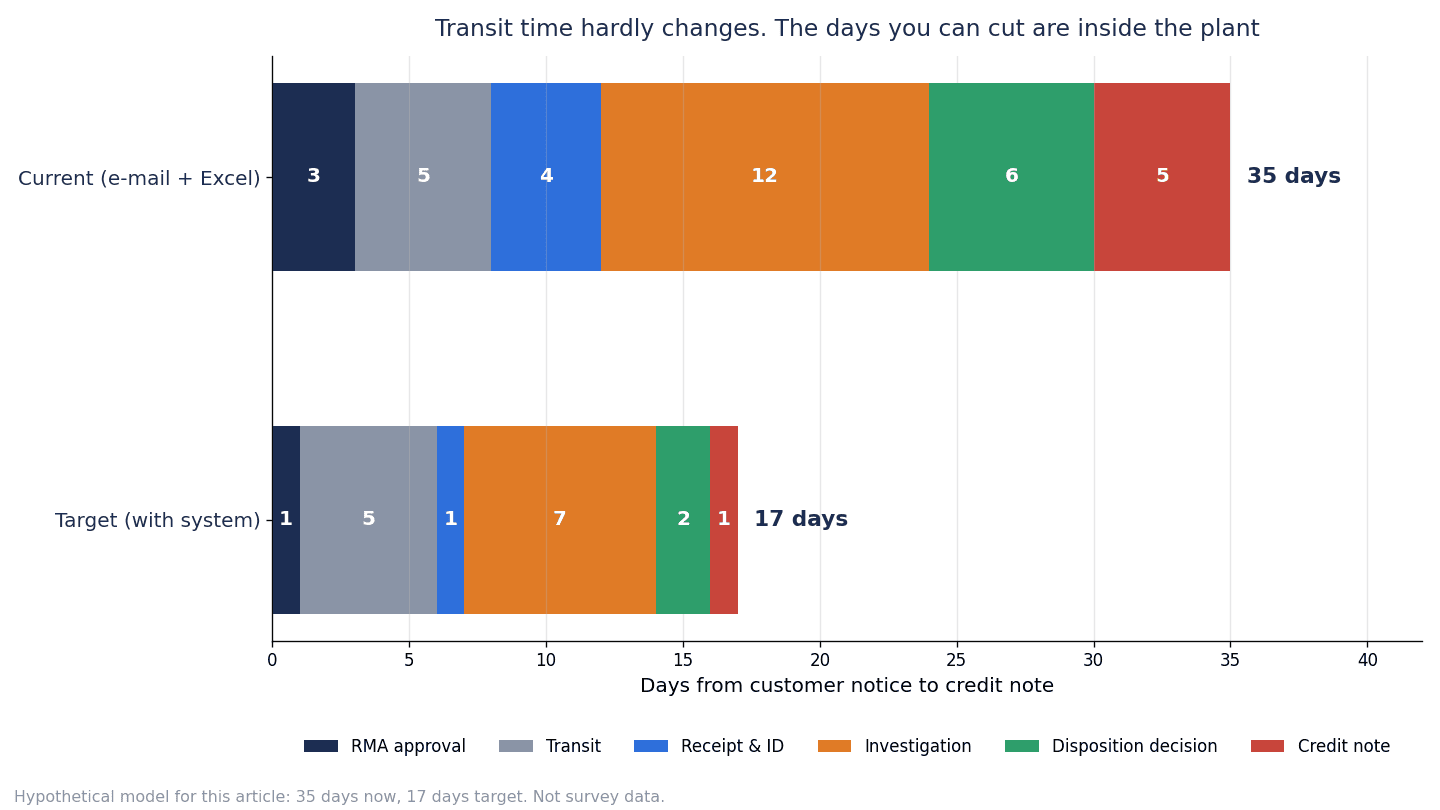
| Segment | Current (days) | Target (days) | Difference (days) |
|---|---|---|---|
| RMA approval | 3 | 1 | 2 |
| Transit | 5 | 5 | 0 |
| Receipt and identification | 4 | 1 | 3 |
| Investigation | 12 | 7 | 5 |
| Disposition decision | 6 | 2 | 4 |
| Credit note issuance | 5 | 1 | 4 |
| Total | 35 | 17 | 18 |
The current 35 days are 3 + 5 + 4 + 12 + 6 + 5 = 35 days. The target 17 days are 1 + 5 + 1 + 7 + 2 + 1 = 17 days.
What we want you to see in this figure is that the 5 days of transit do not change between current and target. Transit from the customer’s plant to your plant can hardly be shortened even if you change the returns management process. Of the 18 days that are cut, 16 days come from the 4 segments inside the factory (3 days in receipt and identification, 5 days in investigation, 4 days in disposition decision, and 4 days in credit note issuance), and the remaining 2 days come from RMA approval.
The reasons each segment shrinks are as follows.
- RMA approval (3 days to 1 day): If the original shipment and invoice can be searched in the system, Sales spends less time asking Quality and the warehouse
- Receipt and identification (4 days to 1 day): Checking against the RMA number eliminates the work of opening the box and guessing which shipment it came from
- Investigation (12 days to 7 days): The start date and the person in charge of the investigation are fixed, and the list of returns waiting for investigation becomes visible. Because the investigation time itself depends on the item, the reduction is smaller than in the other segments
- Disposition decision (6 days to 2 days): The decision maker and deadline are fixed, and returns past their deadline appear in a list
- Credit note issuance (5 days to 1 day): When the disposition code is confirmed, Accounting is notified and can prepare the credit note with the original invoice number and amount already filled in
These are hypothetical figures, but the structure is the same at many factories. If you pick a few of your own returns and actually measure the days in each segment, you will start to see where they get stuck.
Closing the money: Thai requirements for credit notes (ใบลดหนี้)
This chapter organizes points to check regarding Thai taxation. It is not legal or tax advice. Confirm the latest requirements with a tax accountant and a customs broker. The following is based on what could be confirmed on the public pages of the Thai Revenue Department as of October 10, 2026. It has not been possible to confirm every subsequent amendment to laws or orders.
What is a credit note
The document issued to reduce sales and VAT when a return is accepted is the credit note (ใบลดหนี้ in Thai, meaning “debt reduction note”). It is close to what is called akaden in Japan, a red-ink reversal slip that cancels a sale, but in Thailand it is a statutory document based on the Revenue Code, and its required contents are prescribed. Below, this article simply calls it a “credit note.”
Conditions and grounds for issuance
According to Revenue Department Order ป.80/2542 (dated January 21, 1999, practical guidelines on issuing debit notes under Section 86/9 and credit notes under Section 86/10 of the Revenue Code), a credit note can be issued when a VAT-registered operator has already issued a tax invoice with the required particulars for a sale, and an event subsequently occurs that reduces all or part of the output VAT.
Among the grounds for such a reduction, the Order lists the following ones related to returns.
- Price reductions due to goods not matching the agreed specifications, damage, short quantity, price calculation errors, etc.
- Acceptance of returns of goods sold because of defects, nonconformity with samples, nonconformity with descriptions, etc.
- Returns or exchanges based on a commercial agreement between registered operators
- Returns or exchanges based on a commercial agreement between a registered operator and a purchaser (limited to those made within a reasonable period)
Required particulars
Paragraph 3 of the same Order lists the following as the minimum particulars of a credit note.
| No. | Particular |
|---|---|
| 1 | The words “ใบลดหนี้” (credit note) in a prominent position |
| 2 | Name, address and taxpayer identification number of the issuer (and of the agent too, if an agent issues it) |
| 3 | Name and address of the purchaser |
| 4 | Date of issue |
| 5 | Number of the original tax invoice (and the book number, if any), the original amount, the correct amount, the difference, and the VAT on the difference |
| 6 | A brief explanation of the reason for issuance |
According to the same Order, the reason field shows only the reason and the items of goods or services in which the error occurred. It also states that a single credit note may reference several original tax invoices, and the details for each original invoice may be shown in an attachment.
Furthermore, according to the Revenue Department’s notification (VAT No. 201, dated December 26, 2013), when issuing a credit note that references a tax invoice prepared on or after January 1, 2015, you state the taxpayer identification number of the purchaser (a registered operator) and the establishment type of both the issuer and the recipient (head office or branch; for the head office, “สำนักงานใหญ่” (head office), HO, HQ, five zeros “00000,” etc., and for a branch, “สาขาที่” (branch no.) with the branch number, Branch No., a 5-digit number, etc.).
Watch the wording of the heading
The wording of the document heading is an easy point to overlook. In a 1999 Revenue Department ruling (กค 0811/พ.10090), a credit note issued for a return or a pricing error whose heading was printed as “ใบหักหนี้” (debt deduction note) instead of “ใบลดหนี้” was considered to have incomplete material particulars, and the issuer was considered subject to penalties (the registered operator who received it was considered able to deduct it from input tax).
ERP credit note forms are in many cases based on the English “Credit Note” or the format of the head office’s country. Be sure to check at implementation that the Thai form template correctly shows the heading, the original invoice number, the difference and VAT, the reason, the taxpayer identification numbers, and the head office or branch designation.
Timing of issuance
On the timing of issuance, the wording of Order ป.80/2542 of 1999 states that, in principle, a credit note is issued in the tax month in which the event occurred, and if it unavoidably cannot be issued in time, it is issued in the tax month following the month in which the event occurred. The issuer reduces output tax in the tax month in which it issued the note, and the recipient reduces input tax in the tax month in which it received the note.
However, this is the wording of the 1999 Order. Because this article has not been able to confirm every subsequent amendment, it cannot state the issuance deadline definitively. In addition, which point in time should be regarded as “the event occurring” in the case of a return (the customer’s notice, receipt of the goods, confirmation of the disposition, etc.) is a point on which judgments may differ depending on the nature of the transaction. Confirm with your tax accountant which point in time your company should use as the basis in its operations.
What can be said from a returns management perspective is that, as seen in the previous chapter, when it takes 35 days from the customer’s notice to the issuance of the credit note, the occurrence of the event and the issuance of the credit note are likely to fall in different months. Shortening the days also makes the tax check easier.
Scope of e-Tax Invoice
The Thai Revenue Department’s overview of e-Tax Invoice & e-Receipt (revised November 2025) defines an e-Tax Invoice as a tax invoice (Section 86/4), abbreviated tax invoice (Section 86/6), debit note (Section 86/9) or credit note (Section 86/10) created as electronic data and electronically signed with a digital certificate. It gives PDF, PDF/A-3 and XML as examples of formats.
In other words, at factories that use or are about to use e-Tax Invoice, credit notes for returns are also subject to digitization. When creating credit notes from a returns management system, how to connect it to the e-Tax Invoice setup is also a point to check.
When shipping a replacement
As the disposition of a return, you may ship a replacement instead of issuing a credit note. Even in this case, it is important to record the receipt of the return, the replacement shipment and the relationship with the original invoice under the same RMA number. As mentioned above, the official documentation for Dynamics 365 Supply Chain Management and Business Central describes functions for associating a replacement order with a return order [Vendor claim]. The tax treatment (whether a credit note is needed, how to issue a new tax invoice) may vary with the form of the transaction, so confirm it with your tax accountant.
When exported goods come back
When an overseas customer sends returns back, customs duty and VAT treatment come into play. One reference case is a 2002 Revenue Department ruling (กค 0811/2024). In a case where exported goods for which a tax refund had been received at export, and for which no re-import permit had been prepared at export, were sent back, the ruling states that the company could apply for an exemption from the permit and receive an exemption from import duty and VAT, and that in that case it had to return the refund received at export to the Customs Department.
However, this is an individual ruling from 2002, and the regulations it was based on have since been amended (the Customs Act became a new law in 2017). This article limits itself to introducing the structure that “there is a mechanism for receiving an exemption from customs duty and VAT when re-importing returned exported goods, and in that case the refund received at export comes into play.” Confirm the specific procedures and requirements with a customs broker.
From a returns management perspective, linking the original export declaration number and refund information to the RMA for returns of exported goods makes it easier to consult the customs broker and prepare the procedures.
Reflecting returns in inventory, cost and quality records
When to put restocked items back into allocatable stock
A return whose disposition is decided as “restock” becomes allocatable to orders only after it is moved from the quarantine location to a normal location and its stock status is changed from “on hold” to “available.” It is important to make this switch possible only after the quality decision has been recorded.
If returns are counted as available stock at the moment they are received, items still under investigation may be allocated to orders and shipped. Allocation rules are covered in detail in the article on inventory allocation systems.
How to reverse cost and process scrap
The cost at which returns are reversed needs to be decided with Accounting in advance. Some products can reverse returns at the cost at the time of sale if the return is created by referencing the original sales lines (the original sales line reference in Dynamics 365 Supply Chain Management and exact cost reversing in Business Central, mentioned above) [Vendor claim].
Returns decided as scrap are recorded as scrap loss. For rework, decide where the rework cost is recorded (as a returns cost or as a manufacturing cost). If these are linked to the RMA number, you can later total “how much each return cost.”
Evidence for returns to suppliers and chargebacks
Returns caused by defective purchased parts may be returned to the supplier or the cost may be claimed (a chargeback). However, whether a claim is accepted depends on the contract and the quality agreement with the supplier. To make a claim, you need at least the following evidence.
- The RMA number of the return and the customer’s defect report
- The lot of the defective purchased part and its receiving record
- Investigation records and photos
- Analysis results showing the causal link between the defect and the purchased part
According to the Business Central official documentation, “Create Return-Related Documents” on the sales return order can automatically create a purchase return order to the supplier (return of supplier warranty items), a purchase order to the supplier, and a replacement sales order. The SAP S/4HANA 1610 documentation also states that Advanced Returns Management covers returns to suppliers in addition to customer returns [Vendor claim].
Feed recurrence prevention back into the shipping release decision
The last stage of returns management is recurrence prevention. If the cause of a return lies in your own process, take corrective action and feed it back into the mechanism that stops the same defect before shipment. A return is also the result of “a defect slipping through the shipping release decision,” so it is an opportunity to review the release criteria and the inspection items. How to stop defects before shipment is organized in 3 layers, the shipping release decision, physical quarantine and reverse lot lookup, in the article on defect outflow prevention.
If you produce the number and value of returns by return reason code, by customer and by part number every month and make it a habit to review them in the quality meeting, returns management changes from “cleanup” into “an entry point for improvement.”
How to choose a returns management system: combining ERP, WMS, QMS and dedicated tools
4 types
Returns management functions are not necessarily completed within a single system. Consider the combination according to the factory’s existing systems.
| Type | Main scope in returns management | Suitable situation | Points to note |
|---|---|---|---|
| Standard ERP returns functions | RMA, reference to original sales lines, disposition, credit note, cost | Sales and inventory are already managed in an ERP | Available functions differ by version and configuration. Check the Thai forms separately |
| WMS (warehouse management system) | Receipt of returns, quarantine locations, labels, checks with handheld terminals | Heavy warehouse workload and detailed location management | Money and quality records are on the ERP or QMS side |
| QMS (quality management system) | Investigation, 8D, NTF, corrective action, reports to customers | Strict customer reporting requirements, as in automotive | Inventory and money movements are on the ERP side. Linking by RMA number is required |
| Dedicated returns management tools | Return requests on a customer portal, RMA issuance, status notifications | Many returns and many interactions with customers | Many products are for retail and e-commerce. Check whether they fit B2B manufacturing operations |
Whatever the combination, it is a prerequisite that the RMA number is the common key across all systems. If the number changes each time a return crosses systems, the “moving separately” problem of Reason 3 reappears between the systems.
Returns functions of major products (within the scope of official documentation) [Vendor claim]
The following summarizes, with the product and version stated, what could be confirmed in the official documentation referenced for this article. Prices are not included because publicly available information could not be confirmed. Also, this is a check of whether functions exist, not a comparison of which is better.
| Product (version and documentation referenced) | Returns functions confirmed in the official documentation |
|---|---|
| Microsoft Dynamics 365 Supply Chain Management (Microsoft Learn, viewed in 2026) | Return orders (RMA number, return deadline, return reason code), reference to original sales lines, quarantine orders, disposition codes (6 built-in types), replacement orders, receipt of unannounced returns (10.0.39 or later) |
| Microsoft Dynamics 365 Business Central (Microsoft Learn) | Sales return orders, return reason codes, exact cost reversing, automatic creation of purchase return orders to suppliers and replacement sales orders, posting of restocking charges |
| SAP S/4HANA Advanced Returns Management (S/4HANA 1610 documentation) | Returns documents, inspection and logistical follow-up, automatic creation of follow-up documents, refund determination, authorization control of processing steps, tracking through a returns overview, returns to suppliers |
| Oracle NetSuite (Help Center) | Return authorization (RMA) and receipt, inventory and loss processing depending on Restock, credit memos for authorized returns |
| Odoo 18.0 (official documentation) | Receipt of returns through reverse transfers from delivery orders, Credit Note from the invoice. A dedicated module that manages RMA numbers, disposition codes and quarantine inspection as one was not found in the official documentation |
As for product developments, on the SAP learning site (SAP Learning), “flexible plant determination through cloud BAdI in customer returns” is listed among the topics of the briefing sessions for the sales area of SAP S/4HANA Cloud Public Edition 2608 [Vendor claim]. Microsoft has also announced that it will not publish Dynamics 365 release plans from September 2026 onward, and will publish new features in the “AI at Work roadmap.” If you check a product’s future functions in an RFP, note that the source to refer to has changed.
Before deciding the combination
Before comparing products, we recommend writing out your returns flow in 6 stages and deciding, for each stage, “who enters what into which system.” For example, if you already manage sales and inventory in an ERP, one possible order is to first check how much of the 6 stages the ERP’s standard returns functions can cover, and then fill the gaps (handheld checks in the warehouse, quality 8D, etc.) with other systems.
Cost and benefit model estimate (hypothetical figures)
This section estimates the benefits and costs of introducing a returns management system. All of the case counts, amounts, hours, rates and costs below are hypothetical figures made for this article. For actual decisions, replace them with your own figures.
Model assumptions
- A make-to-order factory for automotive parts and electronic components
- Customer returns: 40 per month (480 per year)
- Value of returns: 6,000,000 THB per year (average 12,500 THB per case; 6,000,000 / 480 = 12,500)
- Currently managed with email and Excel
- Currency is the Thai baht (THB)
Benefit 1: Administrative time
- Total administrative time across Sales, Quality, Warehouse and Accounting per return: currently 6 hours, 3 hours after introduction (a reduction of 3 hours)
- Hours saved: 40 cases x 3 hours = 120 hours per month
- Assuming an administrative hourly rate of 250 THB, 120 hours x 12 months x 250 THB = 360,000 THB per year
Benefit 2: Earlier disposition
- Assume that the loss from returns that could have been restocked but sat waiting for a decision, deteriorated and ended up scrapped is 15% of the value of returns: 6,000,000 x 15% = 900,000 THB per year
- Speed up the disposition decision and halve this loss: 900,000 / 2 = 450,000 THB per year
Benefit 3: Claims against suppliers
- Assume that returns caused by defective purchased parts are 25% of the value of returns: 6,000,000 x 25% = 1,500,000 THB per year
- Currently, because evidence (lot, investigation records, photos) is incomplete, only 20% of that is claimed from suppliers: 1,500,000 x 20% = 300,000 THB
- Gather the evidence and raise this to 60%: 1,500,000 x 60% = 900,000 THB
- Difference: 900,000 – 300,000 = 600,000 THB per year
- This benefit is realized only where claims are accepted under the contract with the supplier
Total benefit and payback period
| Item | Calculation | Annual benefit |
|---|---|---|
| (1) Administrative time | 120 hours x 12 x 250 THB | 360,000 THB |
| (2) Earlier disposition | 900,000 x 50% | 450,000 THB |
| (3) Claims against suppliers | 900,000 – 300,000 | 600,000 THB |
| Total | 360,000 + 450,000 + 600,000 | 1,410,000 THB |
Costs are assumed as follows.
- Initial cost: 2,000,000 THB (configuration of the ERP or WMS returns functions, the credit note form, handheld terminals and labels, integration with quality records, master data preparation, training)
- Annual cost: 400,000 THB (subscription, maintenance)
The calculation is as follows.
- Annual net benefit: 1,410,000 – 400,000 = 1,010,000 THB per year
- Payback period: 2,000,000 / 1,010,000 ≈ 1.98, so about 2.0 years

The figure above lays out the breakdown of benefits, the annual cost and the net benefit, and compares the payback period with and without Benefit 3.
Sensitivity: when claims against suppliers are not possible
Benefit 3 appears only when claims are accepted under the contract with the supplier and the practice of gathering evidence is actually working. If claims are not accepted, Benefit 3 becomes zero.
- Benefit: 360,000 + 450,000 = 810,000 THB per year
- Annual net benefit: 810,000 – 400,000 = 410,000 THB per year
- Payback period: 2,000,000 / 410,000 ≈ 4.88, so about 4.9 years
How to read this estimate
In this model, administrative efficiency alone takes nearly 5 years to pay back. What determines payback is protecting the value of returned items by speeding up disposition (Benefit 2) and gathering the evidence to pass costs back to the party that caused them (Benefit 3).
In other words, if you introduce a returns management system only as “a tool to make paperwork easier,” payback on the investment will be slow. Defining the decision owners and deadlines for dispositions, linking the lots and receiving records of purchased parts to returns, and confirming the conditions for claims in the quality agreement with suppliers: these 3 need to be carried out at the same time as the system is introduced.
What this estimate does not include
- Customer satisfaction and continued business (credit for handling returns quickly)
- A reduction in the number of returns itself through quality improvement
- Risks from errors in tax processing (deficiencies in credit note particulars, etc.)
Items to check in RFPs and demos for a returns management system
Have the vendor run one of your returns all the way through
If you ask “Can you manage returns?” in an RFP (request for proposal), almost every product will answer “Yes.” The difference shows when one of your actual returns is run from RMA issuance through to the credit note and quality records, in how much manual work and Excel remains.
We therefore recommend giving vendors 2 to 3 of your typical returns as scenarios (for example, a defective return caused by a purchased part, a wrong delivery return, and a return that turned out to be NTF) and having them run these through all 6 stages in the demo. How to write the RFP as a whole is organized, together with the reasons why quotes diverge widely, in the article on production management system RFPs.
Items to check
| No. | Item | What to verify in the demo and acceptance test |
|---|---|---|
| 1 | RMA and original sales lines | Can an RMA be created by searching the original shipment and invoice? Is the returned quantity prevented from exceeding the shipped quantity? Can cost be reversed at the value at the time of sale? |
| 2 | Return reason codes | Can your own code structure be registered and totaled by reason? Can names be held in Thai, English and Japanese? |
| 3 | Unannounced returns | Can returns without an RMA be received and later linked to a formal RMA? |
| 4 | Receipt and quarantine | Can goods be received by checking against the RMA number and put into a quarantine location and on-hold stock? Can labels be printed? |
| 5 | Investigation records | Can the investigation start date, person in charge, result (defect or NTF), photos and 8D number be recorded? |
| 6 | Disposition codes and authority | Can your 5 dispositions be registered, with inventory and cost movements determined per disposition? Can decision authority and deputies be set? |
| 7 | Deadlines and list of delays | Are the days per stage recorded, and can returns past their deadline be listed by person in charge? |
| 8 | Returns to suppliers and replacements | Can documents for returns to suppliers and replacement shipments be created from the RMA? |
| 9 | Credit note form | Are the heading “ใบลดหนี้,” the original invoice number, original amount, correct amount, difference, VAT, reason, taxpayer identification numbers and head office or branch designation shown correctly? |
| 10 | e-Tax Invoice | How is the credit note passed to the e-Tax Invoice setup? |
| 11 | Integration with quality records | Can investigation results and 8Ds be connected with the quality system by RMA number? Can reporting deadlines per customer be managed? |
| 12 | Inventory allocation | Are returns prevented from being allocated to orders until the disposition is confirmed? |
| 13 | Reporting | Can counts, amounts and days be produced by customer, part number, reason and disposition? |
| 14 | Future product functions | In which materials can the future plans for returns and quality functions be checked? |
| 15 | Support structure | Support desk in Thailand, supported languages, and how the cost of form changes is determined |
In the acceptance test, run not only normal returns but also deliberately difficult ones. For example, a return that arrived unannounced, a return larger than the originally shipped quantity, a return where only part is restocked and the rest is scrapped, and a return whose disposition was decided after month end. How these returns are handled makes a big difference to the operating workload.
How to proceed with a returns management system: 90 days from defining reason and disposition codes to a pilot with 1 customer and 1 product group
This is a guide to what to do in the 90 days before rolling out company-wide. The period varies with the size of the factory.
Days 1 to 30: Measure current returns and define codes
- List the returns of the past 3 to 6 months and organize the number of cases, amounts, customers, part numbers and reasons
- For a few returns, actually measure the days from the customer’s notice to credit note issuance, segment by segment
- Define the return reason codes (around 10) and the disposition codes (5)
- Define the decision maker, deputy and deadline for each disposition, and obtain the plant manager’s approval
- Agree with Accounting on how to reverse cost and how to record scrap loss
- Confirm with a tax accountant the required particulars of credit notes and how to think about the timing of issuance
Days 31 to 60: Pilot with 1 customer and 1 product group
- Choose 1 customer with many returns and 1 product group
- Run RMA issuance, receipt into the quarantine location, investigation, disposition decision and credit note issuance in the system (or with existing ERP functions)
- Actually try the procedure for when an unannounced return arrives
- Record the days per stage and check weekly where returns get stuck
Days 61 to 90: Close the money and quality records
- For the piloted returns, reconcile at month end whether the credit notes, inventory, cost and quality records match
- For returns caused by purchased parts, check whether the evidence needed to claim from the supplier is complete
- Review the totals by reason and by disposition in the quality meeting, and decide where recurrence prevention should go
- Based on the results, finalize the plan for rollout to all customers and the RFP requirements
What to look at in the pilot is not the number of functions. It is whether each return could be followed to the end with a single RMA number, and whether the disposition decision deadlines were met.
Points to check especially at Thai factories
Languages of forms and screens
Thai factories often need forms and screens in 3 languages. The credit note needs the Thai heading “ใบลดหนี้,” and overseas customers may ask for English alongside it. Reports to the head office in Japan are in Japanese. Check whether return reason codes and disposition codes can hold names in Thai, English and Japanese. It is also important that warehouse workers on the floor can perform receipt and quarantine on Thai-language screens.
Division of roles among Sales, Quality, Warehouse and Accounting
Returns management is an operation that spans 4 departments. At Japanese-affiliated factories, a Japanese expatriate may handle both Sales and Quality decisions, and when that person is away, returns stop. Before introducing a system, we recommend documenting the following points.
- Who receives the customer’s return request and issues the RMA
- Who is contacted first when an unannounced return arrives
- Who is the decision maker for each disposition, and who is the deputy
- What triggers the request to Accounting to issue the credit note (confirmation of the disposition code or a request from Sales)
Returns sent back by overseas customers
When customers in export destinations send returns back, transit takes longer than for domestic returns and customs procedures are added. As seen in the earlier chapter, the treatment of customs duty and VAT can involve the refund received at export, so link the original export declaration information to the RMA and make it possible to consult the customs broker early.
Relationship with e-Tax Invoice
At factories that already use e-Tax Invoice, credit notes for returns are also subject to digitization. Decide before implementation how the credit note data created in the returns management system will be passed to the e-Tax Invoice setup.
Return notifications via customer portals and EDI
In automotive parts and similar sectors, customers sometimes notify defects and returns through their own supplier portals or EDI. In that case, being able to import the customer’s notice number into the RMA reduces matching work. Also check before implementation in what format return notifications can be received from the customer’s portal or EDI.
Frequently asked questions
What is returns management?
It is a mechanism that makes it possible to track each product returned by a customer, case by case, from acceptance of the request through receipt of the goods, investigation, disposition decision, financial settlement such as the credit note, and reflection in inventory and quality records. Because money, goods and quality information move at the same time in a return, the purpose is to make it possible to follow it to the end with a single RMA number.
What is an RMA?
It stands for Return Merchandise Authorization, and refers to the number and procedure issued when a return is accepted. If the original shipment and invoice, the part number and lot, the quantity and the return reason are linked to the RMA number, the stages of receipt, investigation, disposition and credit note can be connected by the same number.
What is the returns process?
In this article, it is divided into 6 stages: (1) RMA issuance, (2) receipt and quarantine, (3) investigation, (4) disposition decision, (5) financial settlement (credit note, replacement, claim against the supplier), and (6) records and feedback (reflection in inventory, cost and quality records, and recurrence prevention). In this article’s hypothetical figures, the time from the customer’s notice to credit note issuance is 35 days currently and 17 days as the target, and of the 18 days cut, 16 days are in segments inside the factory.
How should the disposition of defective returns be decided?
The basic approach is to choose, based on the investigation results, from 5 options: restock, rework, scrap, return to supplier and return to customer. What matters is defining in advance, for each disposition, the decision maker, the deadline and a deputy for when the decision maker is absent. According to public commentary, ISO 9001 8.7 also requires records of the actions taken and of the authority deciding the action.
When should a credit note for a return be issued?
The wording of the Thai Revenue Department’s 1999 Order ป.80/2542 states that, in principle, it is issued in the tax month in which the event occurred, and if unavoidable, in the following tax month. However, whether there have been subsequent amendments, and which point in a return is regarded as the occurrence of the event, need to be confirmed. This is not legal or tax advice, so confirm the latest requirements with a tax accountant.
Is Excel not good enough?
It is not that Excel is unusable. If the number of returns is small and few people are involved, Excel or a shared sheet may be enough. The problem arises when the number of cases grows, the 4 departments of Sales, Quality, Warehouse and Accounting manage separate files, and the credit notes, inventory and quality records begin to diverge. In this article’s hypothetical estimate, 40 returns a month at 6 hours each was assumed to take 240 hours of administrative work per month. When you can no longer answer right away where a return is now and whose decision it is waiting for, that is a sign to consider a system.
How long does it take to introduce a returns management system?
It varies greatly with the product and scope, so a single period cannot be given. This article presented a guide for progressing, in the 90 days before company-wide rollout, from defining return reason and disposition codes, through a pilot with 1 customer and 1 product group, to reconciling the money and quality records. More important than the length of the period is confirming in the pilot that a return could be followed to the end with a single RMA number.
Summary
- The purpose of returns management is not to clear returns quickly, but to make it possible to follow a return, in which money, goods and quality information move at the same time, to the end with a single RMA number
- The typical reasons returns processing gets tangled are 3: (1) the RMA number is not linked to the original shipment, invoice and lot, (2) there is no defined decision owner or deadline for the disposition, and (3) the credit note moves separately from the inventory, cost and quality records
- Statistics on returns have a limited scope (the 15.8% for US retail is an estimate for 2025, and the 1.30% warranty claims rate for US-listed manufacturers is for 2025). Public statistics on B2B return rates in manufacturing are scarce, and the starting point is measuring your own number of cases, amounts and days
- Look at returns by “time to disposition.” In the hypothetical figures, the time from the customer’s notice to the credit note goes from 35 days to 17 days. The 5 days of transit do not shrink, and of the 18 days cut, 16 days are in segments inside the factory
- There are 5 dispositions: restock, rework, scrap, return to supplier and return to customer. Define the decision maker, deputy and deadline for each, and determine inventory and cost movements through disposition codes
- Thai credit notes (ใบลดหนี้) have prescribed particulars such as the heading, the original invoice number, the difference and VAT, and the reason. On timing, the wording of the 1999 Order states that in principle they are issued in the month the event occurred (the following month if unavoidable). Confirm the latest requirements with a tax accountant and a customs broker
- In the hypothetical estimate, total benefits of 1,410,000 THB per year and an annual cost of 400,000 THB give a net benefit of 1,010,000 THB per year and a payback of about 2.0 years. Without claims against suppliers, the net benefit is 410,000 THB per year and the payback is about 4.9 years. Payback is determined by the speed of disposition and the evidence to pass costs back to the party that caused them
- In the RFP, have vendors run 2 to 3 of your returns from RMA issuance through to the credit note and quality records, and compare them by how much manual work and Excel remains
At TOMAS TECH, we help factories in Thailand design the flow of returns and quality records, integrate ERP and WMS with quality records, and select shop floor terminals and labels. You can also consult us at the stage before choosing a product, for example when taking stock of your current returns flow, organizing return reason and disposition codes, or drafting RFP requirements. Please contact us through this form.
References
- The Star (Reuters): Thai August factory output rises 4.44% y/y, beats forecast (September 30, 2026)
- Trading Economics: Thailand Industrial Production (September 30, 2026)
- Trading Economics: Thailand Manufacturing PMI (October 1, 2026)
- Thai Revenue Department: คำสั่งกรมสรรพากร ที่ ป. 80/2542 (January 21, 1999)
- Thai Revenue Department: ประกาศอธิบดีกรมสรรพากร เกี่ยวกับภาษีมูลค่าเพิ่ม (ฉบับที่ 201) (December 26, 2013)
- Thai Revenue Department: Ruling กค 0811/พ.10090 (October 29, 1999)
- Thai Revenue Department: e-Tax Invoice & e-Receipt Overview (revised November 2025)
- Thai Revenue Department: Ruling กค 0811/2024 (March 7, 2002)
- Ford Motor Company: Customer-Specific Requirements for IATF 16949:2016 (January 2025 edition)
- Auditor Training Online: ISO 9001 Clause 8.7 Control of Nonconforming Outputs (May 12, 2023)
- AllAboutLean.com (Christoph Roser): The History of the Eight Disciplines Problem Solving (8D) (August 21, 2025)
- ZVEI: Field Failure Analysis in the Electronics Supply Chain (September 2015)
- Microsoft Learn: Sales returns (Dynamics 365 Supply Chain Management)
- Microsoft Learn: Receive unannounced sales returns (Dynamics 365 Supply Chain Management)
- Microsoft Learn: Process sales return orders (Business Central)
- SAP Help Portal: Advanced Returns Management (LO-ARM) (S/4HANA 1610 documentation)
- Oracle NetSuite Help Center: Receiving a Customer Return
- Oracle NetSuite Help Center: Crediting an Authorized Customer Return
- Odoo: Returns and refunds (18.0 Documentation)
- NRF: Consumers expected to return nearly $850 billion in merchandise in 2025 (October 15, 2025)
- Warranty Week: 23rd Annual Product Warranty Report (April 16, 2026)
- DC Velocity: ReturnPro acquires Spanish reverse logistics platform provider iF Returns (September 23, 2026)
- Logistics Viewpoints: The $850 Billion Returns Problem: Why Reverse Logistics Is Becoming a Margin Engine (September 16, 2026)
- SAP Learning: Sales – 2608 Early Release Series
- Microsoft Learn: Microsoft Dynamics 365 2025 release wave 2 plan


