


“We do time studies with a stopwatch and video, but analysis can’t keep up, so we only cover a few processes a year. Our line balance stays broken.” Production engineering managers and IE staff at Japanese-owned assembly and electronics plants in Thailand often raise this, which is where AI motion analysis implementation comes in.
Here is the conclusion first. The value of AI motion analysis is not “fewer analysis hours.” It is “more processes you can analyze, and the ability to turn the variation you find into improvement.” If you try to justify the investment on analysis labor savings alone, payback becomes difficult (in the model calculation later in this article, labor savings alone do not pay back). There are five things to decide when implementing: (1) what to measure, (2) how to film, (3) how to create the “correct answer” for judgment, (4) how to handle people and data, and (5) the mechanism for turning findings into improvement. If you decide them in this order, your product selection, RFP, and acceptance tests are less likely to drift.
Note that all line counts, headcounts, hours, amounts, and payback periods for the factory in this article are original estimates and assumed values (placeholder values) for this article, based on the model factory described later. They are neither industry averages nor survey figures. No primary information on vendor prices or effects has been used either. Please read them as a “calculation template” to be replaced with your own actual results and quotations.
Why AI Motion Analysis Implementation Is Now a Question for Thai Factories
Stopwatch time studies cannot keep up with analysis
The ideas of work study itself (method study, work measurement, and time study) have been around for a long time, and there are foundational texts such as the 4th edition of *Introduction to Work Study* (edited by George Kanawaty), published by the ILO (International Labour Organization) in 1992. At Japanese-owned factories in Thailand, too, it is still common for IE staff to stand at the line with a stopwatch, or to film on video and later step through it frame by frame to break the work into elements.
The problem is that analysis takes longer than filming. You watch the video looking for the breaks between work elements, write down the time of each cycle one by one, and compare veterans with newcomers. This takes far longer than the time spent filming. On its product page for work analysis software, Mitsubishi Electric states that analysis “is said to require 10 times the actual working time.” In a 2021 announcement, Fujitsu wrote that dividing a 20-minute work video into work elements had taken more than an hour.
As a result, it is common to be able to analyze only a few processes a year, and only those where problems have occurred. Even when line balance breaks down because the number of part numbers increases or operators change, there is no time to re-measure. You end up discussing improvement without knowing in numbers what the bottleneck process’s cycle time really is, or how much veterans and newcomers differ.
Work-video AI services continue to launch in 2026
Announcements of products and services that analyze work video with AI have continued over the past few years. On July 6, 2026, BrainPad began offering “COROKO Analytics,” a service in which an AI agent analyzes work video from manufacturing sites. The company says it provides “standard work analysis,” which defines and measures standard work time, and “productivity analysis,” which identifies wasteful work and bottlenecks and visualizes the gap between veterans and newcomers. Visualizing issues in as little as 1 to 2 weeks using existing video is the shortest figure published by the company. The company has set a goal of deployment at several dozen companies by the end of 2027.
However, this is one company’s announcement. It does not allow us to say that “the market is expanding rapidly.” What we can read from this announcement is that a form is emerging in which work-video analysis is offered not as a product you buy and are done with, but as a service used continuously in step with the pace of improvement.
Labor cost assumptions are also moving
For Thailand’s minimum wage, the latest revision we could confirm took effect on July 1, 2025, and is a multi-tier, province-by-province system of THB 337 to 400 per day. THB 400 applies to 5 provinces and 1 district including Bangkok, and to 2 business categories nationwide (hotels and entertainment venues). Samut Prakan and other areas where manufacturing is concentrated are at THB 372, while Chonburi and Rayong fall on the THB 400 side. It is not a uniform national rate. In addition, the wage ceiling used to calculate social security contributions was raised from THB 15,000 to THB 17,500 per month from January 1, 2026. The rate is 5% each for employers and employees, so the maximum monthly contribution goes from THB 750 to THB 875 for each side.
As people’s time gradually becomes more expensive, the importance of improvement to “make the same volume with fewer man-hours” is rising. And the starting point for improvement is measuring current work time and variation correctly. We also lay out the overall picture of process improvement AI in Factory Process Improvement AI.
What Is AI Motion Analysis? Measuring Work Time and Variation with Pose Estimation in Factories

Extracting a “skeleton” from camera video and counting movements
Most AI motion analysis is built on “pose estimation” (skeleton estimation), which estimates the positions of a person’s joints (keypoints) from camera video. It extracts the positions of the wrists, elbows, shoulders, hips, and so on in every frame, and from the repetition of those movements it finds the start and end of a cycle, or identifies work elements such as “pick a part” or “tighten a screw.” Because the skeleton is estimated from camera video, a major feature is that operators do not need to wear sensors or markers.
Some pose estimation models are published as open source. The number of keypoints and the license differ greatly from model to model.
| Model | Keypoints | License and caveats |
|---|---|---|
| MediaPipe Pose Landmarker (Google) | 33 3D pose landmarks | The default value of the setting that specifies the maximum number of people to detect (num_poses) is 1. For processes where multiple people appear, the setting and its performance need to be checked |
| OpenPose (CMU) | Body 25-point model, among others. Hand and face models also exist | Free for non-commercial use. Commercial use requires a separate commercial license |
| Ultralytics YOLO26 Pose | 17 keypoints in COCO format | AGPL-3.0 or Enterprise License. Ultralytics states that an Enterprise License is required even for internal business tools or internal use and R&D only |
Two points deserve attention here. First, some tools detect only one person by default. If you use the default in a cell where two operators work side by side, or in a process where people walk behind, the skeleton being tracked can switch between people. Second, even OSS models can raise licensing issues for commercial or internal use. Ultralytics’ “required even for internal use” is the licensor’s own statement, not a settled legal interpretation of the AGPL. Still, which model is built into a vendor’s product, and who takes care of its license, are items you should always confirm in the RFP.
Examples of options on the market
As product examples, we list the ones we could confirm. This is neither a recommendation nor a comparison. All performance figures are conditional values based on vendor announcements (for MotionLogic, an industry magazine article). They do not mean the same values will be achieved on your line.
| Source | Timing | Description | Figures and their nature |
|---|---|---|---|
| Mitsubishi Electric “WA-SW1000” (product name 骨紋) | Product page | Extracts 2D skeleton information from camera video and automatically measures cycle time with AI. No sensors or markers need to be worn. One trained model can be used for multiple operators | About 10 or so sample videos for training (vendor-stated, conditional). States that it “dramatically shortens analysis time, which is said to require 10 times the actual working time.” Detection of skipped work or wrong procedures is treated as planned for future support |
| Mitsubishi Electric “Behavior Analysis AI” | Announced January 25, 2024 | A technology that uses a probabilistic generative model of repetitive body movements for work analysis, eliminating the need to create training data. Exhibited at IIFES 2024 | “Up to 99% reduction” in the time required for work analysis. This is the maximum value in a customer demonstration trial, not an average. At the time of the announcement it was at the exhibition stage |
| Fujitsu “Actlyzer” | Announced February 18, 2021 | Automatically identifies work elements such as “remove a part” or “tighten a screw” from skeleton movements | Detects work elements with “90% or higher” accuracy. Verified in 3 processes (part setting, assembly, visual inspection) in one plant, with training data from one operator |
| BrainPad “COROKO Analytics” | Service launched July 6, 2026 | Standard work analysis and productivity analysis in which an AI agent analyzes work video. Three stages: visualization with existing video, ongoing service, and system environment build | Issue visualization in as little as 1 to 2 weeks (vendor-stated). The release does not mention how privacy or facial information is handled |
| MotionLogic (Australia) | Industry magazine article, July 2026 | Tracks operator movements with fixed cameras and classifies them into task time and non-task time (setup, repositioning, tool use, and so on). Also extracts safety and ergonomic indicators from joint angles | A startup case. Figures cannot be generalized |
These figures cannot be compared on the same yardstick. “Up to 99%” is the maximum value in a demonstration trial, “90% or higher” is detection accuracy with training on one operator in one plant, and “as little as 1 to 2 weeks” is the shortest period. None of them answers “how well does it agree with human IE analysis on this process in our plant?” That is exactly why you need to compare against your own correct answers in acceptance testing.
What AI motion analysis can and cannot do
What it can do falls mainly into these four:
- Automatically count the time of each cycle, over long periods and across all cycles
- Find the breaks between work elements and output the time for each element (requires training or configuration)
- Lay out variation between veterans and newcomers, between shifts, and between days in numbers
- Flag candidate high-strain movements from posture and joint angles
On the other hand, there are things it cannot do, or that AI alone does not determine.
- “Setting” standard work time. What AI outputs is measured time. How to set allowances, and which operator’s which time to use as the basis, are decided by people and internal rules
- Making improvements. AI’s role is to find where the variation is. People are the ones who rearrange work or improve jigs
- Measuring what is not visible. Accuracy drops in conditions such as the hands being hidden by the body or parts being too small
- Judging conformity to standards. You can borrow the thinking of ergonomic assessment methods, but you cannot say “it conforms to the standard because AI judged it”
The idea of using the gap between veterans and newcomers for skill transfer is also covered in Skilled Worker Knowledge Transfer AI.
Narrow AI Work Analysis to One Goal: Cycle Time, Work Elements, Variation, or Ergonomics
The first thing to decide in AI motion analysis implementation is what to measure. Because many different numbers can be produced from the same camera video, it is tempting to want them all. But the filming method, how the correct answer is created, and the pass criteria all change depending on the goal. For the first PoC, narrowing the goal to one is the shortest path.
| Goal | Main output | Suitable situations | How to create the correct answer |
|---|---|---|---|
| Automated cycle time measurement | Time per cycle, mean, median, and distribution | Reviewing line balance, identifying the bottleneck process | Time per cycle counted by IE staff with a stopwatch or frame-by-frame |
| Work element analysis | Time per element, order of elements | Rearranging work, finding wasted motion, revising standard work sheets | Element breaks marked by IE staff |
| Operator work variation analysis | Differences between operators, shifts, and days; outlier cycles | Gap between veterans and newcomers, measuring training effects | Prepare the two correct answers above for each operator |
| Ergonomic assessment | Posture and joint angles, candidate high-strain movements | Identifying processes that strain the lower back or shoulders | Ratings assigned by ergonomics staff using assessment methods |
Starting with automated cycle time measurement is the safe choice
The goal that is easiest to recommend first is automated cycle time measurement. The correct answer (time counted by a person) is easy to create, and because the difference between human and AI can be compared in seconds, discussions of pass or fail stay on track. Once you know the cycle time of the bottleneck process, you can connect it directly to line balance improvement. For how to find bottlenecks, and a view that includes equipment-side stoppages, combining this with OEE Improvement makes the whole picture easier to see.
Work elements and variation are the “second stage”
Work element analysis is the most useful as a lead for improvement. However, unless people first decide the names of the elements and the definitions of their breaks, you cannot compare the AI’s output with human judgment. Does “pick a part” end the moment the hand touches the part, or the moment it lifts it? It starts with deciding definitions like these. For variation analysis, the right order is to lay results out by operator only after cycle times and work element times can be captured stably.
For ergonomics, know the names and scope
For posture assessment, there are commonly used assessment methods and standards. RULA (Rapid Upper Limb Assessment), published by McAtamney and Corlett in 1993, is a survey tool for workplaces where upper limb disorders are reported. REBA (Rapid Entire Body Assessment), published by Hignett and McAtamney in 2000, is a method for dynamic and unpredictable whole-body postures. Among standards, ISO 11226:2000 covers evaluation of static working postures, ISO 11228-3:2007 covers handling of low loads at high frequency, and ISO/TR 12295:2014 is the application guide for these.
Joint angles from AI motion analysis can be material for such assessments. However, angles derived from a 2D skeleton are not necessarily measured the same way that the assessment methods assume. Rather than thinking “automatic AI judgment makes us standard-compliant,” the realistic approach is to use it as a tool for flagging candidate high-strain movements and narrowing down what people will assess.
Filming Determines the Results: Camera Position, Field of View, Number of People, Occlusion, and Lighting
Much of the accuracy of AI motion analysis is determined by “how you film,” before you even choose a model. Pose estimation is a technology for estimating the positions of the joints that are visible. If the joints are not visible, even the smartest model’s estimate becomes guesswork.
Camera position and field of view
The filming direction changes with the type of work. If you want to see fine assembly at the hands, use a field of view from diagonally above that captures the hands and both arms. For work that includes walking or reaching to parts shelves, use a field of view from the side that captures the whole body. Trying to cover both with one camera tends to leave both half-done. Fix the camera in place and record its position and field of view with drawings and photos. If cleaning or moving equipment shifts the camera, that alone changes the results.
Number of people in frame
Always check in advance how many people appear in one field of view. As noted earlier, some tools detect only one person by default. If an operator from the adjacent process, a team leader walking behind, or a material handler replenishing parts enters the frame, the person being tracked may switch. Either adjust the field of view so only the target person appears, or verify the multi-person settings and their performance in acceptance testing.
Occlusion and uniforms
Every process has moments when the hands are hidden by the operator’s body, jigs, or parts shelves. The longer they are hidden, the harder it is to capture breaks between work elements. Also, if all operators wear the same color uniform or gloves, it may become hard to tell two people apart when they overlap. These are more a matter of filming conditions than product performance, so you need to change the conditions in acceptance testing and observe the behavior.
Lighting and time of day
In processes where outside light comes in through windows, brightness changes greatly with the time of day. The same goes for night-shift lighting and places shaded by equipment. If you film both day-shift and night-shift video at the trial stage, you can find problems like “many missed cycles only at night” early.
A configuration that keeps video on site
If you extract the skeleton on an edge PC inside the factory and send out only the skeleton and time data, it becomes easier to handle in terms of both privacy and data traffic. The thinking behind edge processing is covered in detail in Edge AI Factory Deployment. For how to write security requirements when procuring the cameras themselves, Network Camera Procurement and JC-STAR is also a useful reference. We have summarized the idea of using the same camera video for safety management in AI Safety Cameras for Factories, but note that when the use differs, the filming method and retention policy also change.
Cost and ROI of AI Motion Analysis: A Model Calculation

From here on is a calculation for a model factory. All of the following figures are original estimates and assumed values (placeholder values) for this article, and are neither industry averages nor survey figures. No primary information on vendor prices or effects has been used.
Common assumptions (Model Factory M)
We assume a Japanese-owned electronic component assembly plant in central Thailand.
| Item | Assumed value | Calculation |
|---|---|---|
| Line configuration | 4 assembly lines, each with 10 processes and 10 operators | 4×10 = 40 processes |
| Operation | 2 shifts, 7.5 hours of actual operation per shift, 250 operating days per year | 7.5 hours = 27,000 seconds |
| Demand | Fixed at 450 units per shift (not increased output; the assumption is making the same volume in less time) | – |
| Bottleneck process | Cycle time 60 seconds | 27,000÷60 = 450 units/shift |
| Number of IE analyses | All 40 processes twice a year | 40×2 = 80 analyses/year |
| Manual analysis | Per analysis: 1 hour of filming, 10 hours of analysis | 80×10 = 800 hours/year |
| Analysis after AI implementation | Per analysis: 1 hour of human review and correction | 80×1 = 80 hours/year |
| Labor cost (including social security, etc.) | IE staff THB 300/hour, operators THB 80/hour | – |
| AI implementation cost | Initial THB 1,500,000 (cameras, edge PC, software, setup, training), annual THB 400,000 (licenses, maintenance) | – |
Demand per shift is 450 units, and the bottleneck process’s capacity is also 27,000÷60 = 450 units, exactly matching demand with no slack.
The 10-hour analysis assumption is aligned with the statement on Mitsubishi Electric’s product page that analysis “is said to require 10 times the actual working time.” It is not an industry measurement. The 1 hour of filming takes the same time whether manual or with AI, so it is not included in the effect calculation.
Effect 1: Reduction in analysis hours (all 4 lines)
Assume that 800 hours of manual analysis become 80 hours of human review and correction after AI implementation.
- Hours reduced: 800−80 = 720 hours/year
- Amount: 720 hours×THB 300 = THB 216,000/year
Effect 2: Line balance improvement (per line)
Assume that AI motion analysis finds work elements with large variation, and that by rearranging work and improving jigs, the bottleneck process’s cycle time is shortened from 60 seconds to 55 seconds. What AI does here is find “where the variation is”; people are the ones who make the improvement.
- Time needed to make the demand of 450 units: 450×55 = 24,750 seconds
- Reduction per shift: 27,000−24,750 = 2,250 seconds = 0.625 hours
- Man-hours: 0.625 hours×10 operators = 6.25 man-hours/shift, ×2 shifts = 12.5 man-hours/day
- Amount: 12.5 man-hours×THB 80 = THB 1,000/day, ×250 days = THB 250,000/year per line
This amount becomes money only if the time saved actually disappears as reduced overtime or reduced support from other lines. Even if the line finishes earlier, the effect is 0 if operators are simply left waiting. You need to decide, at the same time as the improvement, whether the time freed up will go to reducing overtime, supporting other lines, training, or something else.
Note that after the improvement, the bottleneck process’s capacity becomes 27,000÷55 ≈ 490 units/shift. This means “spare capacity” has been created; this calculation does not convert it into money. Because demand is assumed to be fixed, we do not add revenue from increased output.
Comparing three cases
Annual net is “annual effect − annual cost of THB 400,000,” and the payback period is “initial cost of THB 1,500,000 ÷ annual net.”
| Case | Annual effect (THB) | Annual net (THB) | Payback period |
|---|---|---|---|
| A Analysis labor savings only | 216,000 | −184,000 | Does not pay back |
| B Labor savings + improvement on 1 line only | 216,000 + 250,000 = 466,000 | 66,000 | About 22.7 years |
| C Labor savings + rollout to all 4 lines | 216,000 + 1,000,000 = 1,216,000 | 816,000 | About 1.8 years |
In Case A, the analysis hour reduction of THB 216,000 does not reach the annual cost of THB 400,000, resulting in a net outflow of THB 184,000 every year (216,000−400,000 = −184,000). Analysis labor savings alone do not pay back.
Case B is when only one line is improved. Annual net is 466,000−400,000 = 66,000, and payback is 1,500,000÷66,000 = 22.72…, about 22.7 years. Considering the life of the equipment, this is effectively the same as not paying back.
Case C is when the same improvement is rolled out to all 4 lines. Effect 2 is 250,000×4 = 1,000,000, the annual effect is 1,216,000, the annual net is 1,216,000−400,000 = 816,000, and payback is 1,500,000÷816,000 = 1.83…, about 1.8 years.
Sensitivity: what if the improvement is smaller?
In Case C, let us look at the case where the improvement only goes from 60 seconds to 58 seconds.
- Time needed to make the demand of 450 units: 450×58 = 26,100 seconds
- Reduction per shift: 27,000−26,100 = 900 seconds = 0.25 hours
- Man-hours: 0.25 hours×10 operators = 2.5 man-hours/shift, ×2 shifts = 5 man-hours/day
- Amount: 5 man-hours×THB 80 = THB 400/day, ×250 days = THB 100,000/year per line
- 4 lines: 100,000×4 = 400,000; combined with Effect 1, 400,000 + 216,000 = 616,000
- Annual net: 616,000−400,000 = 216,000; payback: 1,500,000÷216,000 = 6.94…, about 6.9 years
Even with the same 4-line rollout, if the improvement shrinks from 5 seconds to 2 seconds, payback extends from about 1.8 years to about 6.9 years.
Key takeaway: AI accuracy is not what determines payback
What this calculation tells us is that payback is determined not by “AI accuracy” but by “how many lines, and how large an improvement, you can actually deliver.” Faster analysis alone is not enough. Only when you have decided who will fix the variation you found, and to how many lines the improvement will be extended, does the investment move toward payback. In the PoC, you need to go beyond confirming accuracy and decide the improvement size and the rollout plan as well. For how to close out a PoC, see also AI PoC Exit Criteria.
Cautions to avoid double counting
- Effect 1 is IE staff time, and Effect 2 is operator time. They are different people’s time, so it is fine to add them together
- Effect 2 is only the single line of reasoning “demand is fixed, and the time to make it decreases.” If you add the spare capacity created by the same improvement as “revenue from increased output,” you mix two worlds with different assumptions
- Effect 2 becomes an actual cost reduction only when the time saved disappears as reduced overtime or reduced support from other lines
When calculating for your own plant, replace at least these four with actual results: “number of analyses and hours per analysis,” “labor costs of IE staff and operators,” “achievable cycle time improvement,” and “number of lines the improvement can be rolled out to.” Labor cost assumptions change depending on the minimum wage and social security contributions in the province where the factory is located.
12 Items to Include in an RFP for AI Motion Analysis
When getting proposals from multiple vendors, write the following 12 items into the RFP to align the assumptions of the proposals.
| No. | Item | What to write |
|---|---|---|
| 1 | Goal and target processes | What to measure (cycle time, work elements, variation, or ergonomics), target lines and processes, part numbers |
| 2 | Filming conditions and number of cameras | Filming direction and field of view, number of cameras per process, lighting, outside light, whether there is a night shift |
| 3 | Number of people in frame at once | Maximum number of people in one field of view, people passing each other, whether there is two-person work, and performance under those conditions |
| 4 | Output definitions | How to define the start and end of a cycle, the names and breaks of work elements, and variation indicators |
| 5 | How the correct answer is created and pass criteria | That manual analysis by IE staff is the correct answer, contents of the evaluation set, numerical pass criteria |
| 6 | Retention and deletion of video and skeleton data | Whether raw video is stored, retention period, whether a setting that keeps only skeleton and time data is available, deletion procedure |
| 7 | Design and access rights that prevent use for individual evaluation | A design that does not link individual names to results, viewing permissions, logs, operations that avoid use beyond the stated purpose |
| 8 | Retraining procedure and cost | Number of videos and hours needed for retraining at part number changeovers or process changes, who does it, cost |
| 9 | OSS model licenses | Name of the built-in pose estimation model, its license, who takes care of commercial and internal-use licensing |
| 10 | MES and Excel integration | Output format of results, method of integration with MES or production management |
| 11 | Thai-language screens and shop-floor languages | Thai support for screens and reports, whether work element names can be displayed in shop-floor languages such as Thai or Burmese |
| 12 | Local maintenance | Who in Thailand corrects camera position shifts, retrains, and handles failures, and response time |
Items 5, 6, 7, and 9 in particular are often not written in proposals. If you place an order without pass criteria, you cannot confirm anything beyond “it runs” at acceptance. If video retention and the handling of individual evaluation are not decided, you will run into trouble later when explaining to employees.
What to Check in FAT/SAT for AI Motion Analysis
Build the evaluation set first
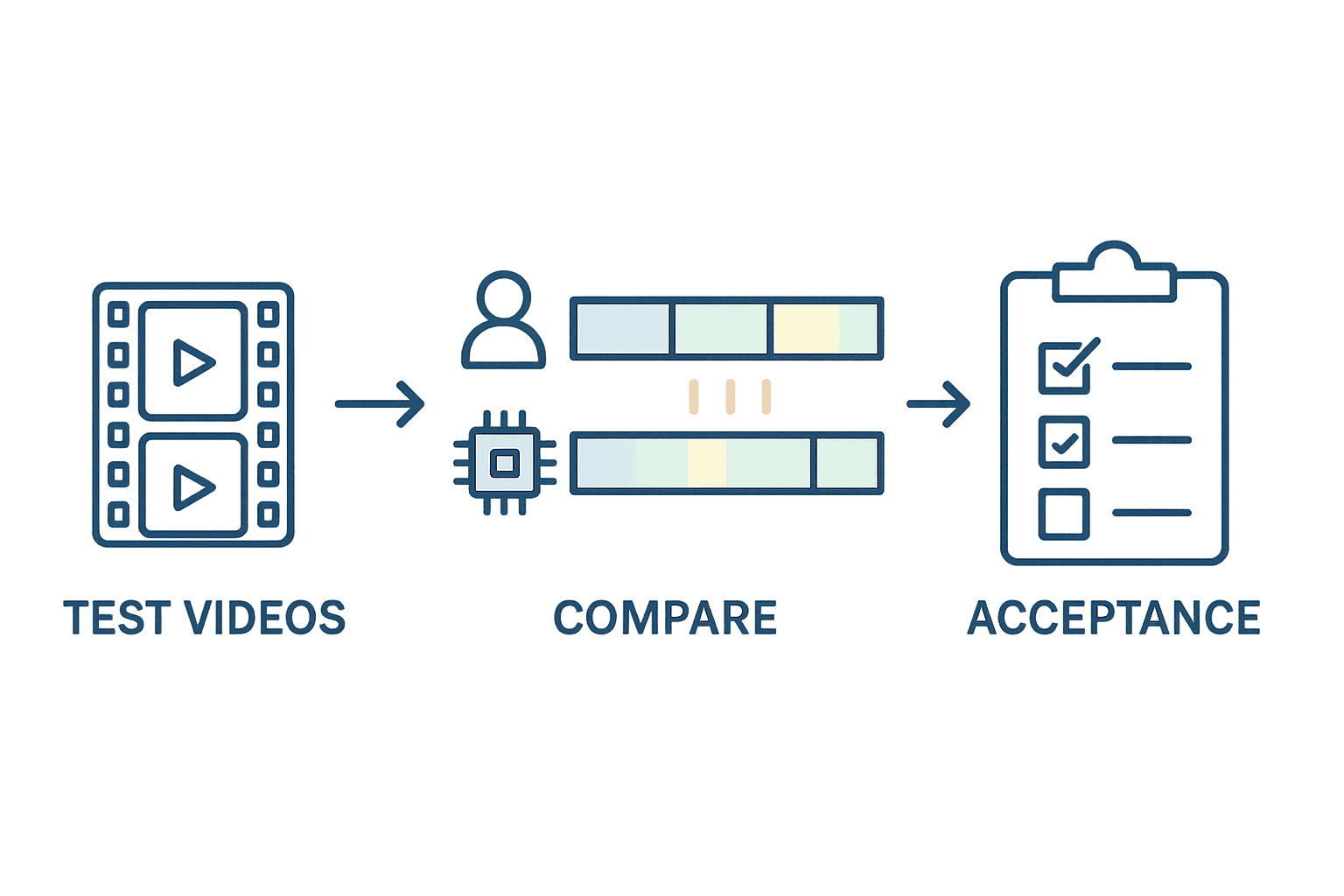
Before acceptance testing, build an evaluation set. For example, prepare videos of 2 representative processes × 3 operators (veteran, mid-level, newcomer) × 30 cycles each. IE staff analyze the same videos manually, and those results become the “correct answer.”
In FAT (testing in the vendor’s environment), you provide the evaluation set videos to the vendor and test in the vendor’s environment. In SAT (testing with actual cameras on your own line), IE staff assign correct answers in the same way to video of the same processes and same operators filmed with the actual cameras, and the same procedure is run. By running both with an evaluation set of the same composition and the same procedure, you can see in numbers any gap where it worked in the vendor’s environment but not on the shop floor.
The target values below are placeholder examples. They are not standard values. The factory decides its own pass criteria.
Indicators to look at
- Cycle time difference: Calculate the difference between human and AI for each cycle. An example target is “within ±1 second at the median.” Look not only at the median but also at what situations the cycles with large differences occurred in
- Agreement of work element breaks: Check what percentage of element breaks agree with human judgment
- Missed cycles: Count the number of cycles that could not be counted. Also check whether missed cycles are concentrated in particular operators or times of day
- Behavior under changed conditions: How results change under conditions such as occlusion, people passing each other, two-person work, lighting changes, and similar uniform colors
- Retraining burden: How many videos and how many hours retraining requires after a part number changeover or process change
- Results with video not stored: Whether the same results are obtained with a setting that keeps only skeleton and time data without retaining raw video
- Output: Whether results can be exported to MES or Excel, and whether reports can be used as-is in improvement meetings
Always include tests with changed conditions
If you test only with video taken under ideal conditions, you will not see the problems that arise when it goes onto the shop floor. Deliberately include video with poor conditions in the evaluation set. Examples are scenes where the adjacent operator enters the frame, a team leader walks behind, or outside light changes in the evening. If you know how much the results break down under such conditions, you can act in advance through camera position adjustments and operating rules.
Keep checking for degradation with the same correct-answer videos after go-live
After go-live as well, run the same correct-answer videos once a quarter and compare the results. Camera shifts, lighting replacement, added part numbers, and so on can cause accuracy to drop without anyone noticing. Keep the correct-answer videos from acceptance testing stored without modification.
Issues Specific to Thailand and ASEAN
1. PDPA: purpose of filming, legal basis, and notice
Thailand’s Personal Data Protection Act (PDPA, B.E. 2562) came into full effect on June 1, 2022. Data such as race, health, and biometric data are treated as sensitive data, and their collection, use, and disclosure in principle require explicit consent (with statutory exceptions). Administrative fines are up to THB 5,000,000, and there are criminal penalties as well. There is also an obligation to appoint a DPO (data protection officer) in cases such as large-scale regular monitoring.
What tends to become an issue with AI motion analysis is the handling of skeleton data. Whether skeleton data counts as biometric data is not expressly stated in the PDPA, and we do not make a definitive statement here. Its treatment may change depending on whether the system is designed to be used to identify individuals. Please confirm the purpose of filming, the legal basis, and the content of notices individually with the competent authorities or legal professionals.
The PDPC (Personal Data Protection Committee of Thailand) held a public hearing on draft guidelines on April 1 to 2, 2026. One of the six topics was the use of CCTV and access control systems. However, this is at the draft stage and has no legal binding force. Its examples also center on housing estates and condominiums, and it does not directly address filming of employees in factories.
On the enforcement side, the PDPC published multiple administrative fines on August 1, 2025. For example, administrative fines of THB 7,000,000 were imposed on a PC and peripherals retailer, and THB 2,500,000 on a cosmetics company. None of these are motion analysis or camera cases, but they are useful reference in that basic shortcomings such as security measures and DPO appointment were at issue. We summarize how to organize factory IoT data in general from a PDPA perspective in Factory IoT and PDPA.
2. Protecting through design
In parallel with confirming the legal treatment, risk can be reduced at the design stage. The following are recommendations and are not written as legal obligations.
- Convert to skeletons on the edge PC and delete raw video after a short period
- If video is retained, blur faces
- State clearly in the work rules and in notices to employees that results will not be used for individual evaluation or disciplinary action
- Post notices in Thai where cameras are installed, and hold briefing sessions
We could not find explicit provisions on employee monitoring in Thailand’s Labour Protection Act. In practice, it is common to address this through the PDPA, work rules, and notices to employees. For reference, in Japan the Ministry of Internal Affairs and Communications and the Ministry of Economy, Trade and Industry published the “Camera Image Utilization Guidebook ver3.0” on March 30, 2022, and the Personal Information Protection Commission states in Q&A 1-14 that, for cameras with face recognition functions, the purpose of use must be notified or published, and it recommends posting notices at installation sites. Both are Japanese documents mainly aimed at stores, crime prevention, and the like, and they do not apply directly in Thailand, but they are useful references for how to approach notices and signage.
3. Labor cost context
The minimum wage is THB 337 to 400 per day by province under the revision effective July 1, 2025, and the social security wage ceiling has been raised from January 1, 2026. The labor cost underlying the calculation changes depending on the province where the factory is located.
4. Language of work standards and results
If the work element names output by AI and the reports used in improvement meetings cannot be read in the shop-floor language, they will not be used. Check whether they can be displayed not only in Thai but also in the languages of the people working on the line, such as Burmese. Ways to communicate work standards through video are also covered in Work Instruction Video AI.
5. Vietnam sites
In Vietnam, the Personal Data Protection Law (Law No. 91/2025/QH15) took effect on January 1, 2026. For biometric data, it requires measures such as physical security for devices that store and transmit it, and access restrictions. When extending the same system as in Thailand to a Vietnam site, separate confirmation is needed.
6. Local maintenance
Camera position shifts, retraining at part number changeovers, and edge PC failures will inevitably occur after go-live. Decide before ordering who in Thailand will handle these, and within what time. Remote support from Japan alone may not keep up with the pace of line improvement.
A 90-Day Plan for AI Motion Analysis Implementation
| Period | What to do | Completion criteria |
|---|---|---|
| Days 0-30 | Decide on the 2 target processes. Create the “correct answers” for the evaluation set through manual IE analysis. Prepare the explanation to employees and the notices | Correct-answer data is complete, and the explanation content and notices are decided |
| Days 31-60 | Install cameras and run a trial. Measure the difference between human and AI. Implement one improvement idea based on the variation found | The human-AI difference is available in numbers, and one improvement idea is in motion |
| Days 61-90 | Measure the improvement size. Create the rollout plan, RFP, and FAT/SAT criteria, and decide whether to place an order | Based on the improvement size and the number of lines it can be rolled out to, the payback outlook can be produced with your own figures |
The key point is to actually put one improvement idea into motion in days 31-60. If you spend the 90 days only confirming accuracy, you stop at “the AI looks usable” and do not get the improvement-size figures needed for the investment decision. For how to proceed with improvement, see also How to Start AI Process Improvement, and for the thinking behind connecting data to shop-floor improvement, Data-Driven Shop Floor Improvement. If you find waste in movement paths, this connects to Factory Layout Improvement, and if you are considering automation as the next step after improvement, to Collaborative Robot Implementation.
Frequently Asked Questions (FAQ)
Can AI motion analysis be used to set standard work time?
What AI motion analysis outputs is the measured result of actual work time. “Setting” standard work time requires judgments such as which operator’s which time to use as the basis and how to set allowances, and those are decided by people and internal rules. Think of AI as a tool that quickly collects the measured values that serve as material for that judgment, across many cycles.
Does pose estimation AI require factory operators to wear anything?
Some products, such as Mitsubishi Electric’s WA-SW1000 (product name 骨紋), analyze using camera video alone without attaching sensors or markers to operators. However, in exchange for not requiring anything to be worn, filming conditions are required. Accuracy will not be achieved unless you arrange the field of view so the hands and joints are visible, the number of people in frame, occlusion, lighting, and so on.
What are the typical implementation cost and payback period for AI work analysis?
In this article’s model calculation, analysis labor savings alone did not pay back, and the result was about 1.8 years when line balance improvement was rolled out to all 4 lines. However, these are original placeholder values for this article, not industry market rates. Please recalculate with your own number of analyses, labor costs, improvement size, and number of lines the improvement can be rolled out to.
Can it be used on lines where multiple people work at the same time?
There are products and settings that can be used, but some tools detect only one person by default. For processes with two-person work or people passing each other, please verify performance under those conditions in acceptance testing. Deliberately including video in which multiple people appear in the evaluation set is the reliable approach.
What should we watch out for under the PDPA when filming operators in a Thai factory?
The starting point is organizing the purpose of filming, the legal basis, and notices to employees. Whether skeleton data counts as biometric data (sensitive data) cannot be stated definitively, because its treatment may change depending on whether the system is designed to be used to identify individuals. Please confirm individually with the competent authorities or legal professionals. On that basis, the realistic approach is to protect through design, such as deleting raw video after a short period and stating clearly that results will not be used for individual evaluation.
What should be checked in the RFP and acceptance tests (FAT/SAT) for AI motion analysis?
In the RFP, align these 12 items: goal and target processes, filming conditions, number of people in frame at once, output definitions, how the correct answer is created and pass criteria, retention and deletion of video and skeleton data, a design that prevents use for individual evaluation, retraining, OSS model licenses, MES and Excel integration, shop-floor languages, and local maintenance. In FAT/SAT, use an evaluation set of the same composition with IE staff’s manual analysis as the correct answer, and check cycle time differences, agreement of element breaks, missed cycles, and behavior under changed conditions.
Summary
- The value of AI motion analysis lies not in reducing analysis hours, but in increasing the number of processes that can be analyzed and turning the variation found into improvement
- The order of decisions is five: what to measure, how to film, how to create the correct answer, how to handle people and data, and the mechanism for turning findings into improvement
- Narrow the goal to one at first. Starting with automated cycle time measurement lets you compare human and AI differences in seconds
- Vendor figures come with conditions such as maximum values, shortest periods, or verification in one plant, and the same values are not necessarily achieved on your line
- In the model calculation (placeholder values), labor savings alone do not pay back; improving one line gives about 22.7 years, and rolling out to 4 lines gives about 1.8 years. With a smaller improvement, it extends to about 6.9 years
- Align assumptions with the 12-item RFP, and in FAT/SAT run an evaluation set of the same composition with IE staff’s analysis as the correct answer
- Proceed with Thailand-specific issues such as the PDPA, the handling of skeleton data, shop-floor languages, and local maintenance while confirming individually with the competent authorities and professionals
You are welcome to start with how to choose target processes, the stage of creating correct-answer data through manual IE analysis, or organizing the explanation to employees. If you are considering AI motion analysis implementation at a factory in Thailand, we can help you sort things out from the very first steps of your evaluation, so please feel free to reach out via our contact page.
References
- Mitsubishi Electric, work analysis software “WA-SW1000” (product name 骨紋) product page: https://www.mitsubishielectric.co.jp/nwcamera/software/
- Mitsubishi Electric news release (January 25, 2024): https://www.mitsubishielectric.co.jp/ja/pr/2024/0125-a/
- Fujitsu press release (February 18, 2021): https://info.archives.global.fujitsu/global/about/resources/news/press-releases/2021/0218-01.html
- BrainPad, launch of “COROKO Analytics” (July 6, 2026): https://newscast.jp/news/2562320
- MotionLogic named Propel-AIR 2026 finalist (Australian Manufacturing, July 31, 2026): https://www.australianmanufacturing.com.au/manufacturing-analytics-start-up-motionlogic-named-propel-air-2026-finalist/
- MediaPipe Pose Landmarker (Google): https://developers.google.com/edge/mediapipe/solutions/vision/pose_landmarker
- OpenPose (CMU Perceptual Computing Lab): https://github.com/CMU-Perceptual-Computing-Lab/openpose
- Ultralytics Pose Estimation: https://docs.ultralytics.com/tasks/pose/
- Ultralytics License: https://ultralytics.com/license
- ILO, *Introduction to Work Study*, 4th edition: https://www.ilo.org/publications/introduction-work-study-4th-revised-edition
- REBA (Cornell University Ergonomics Web): https://ergo.human.cornell.edu/ahREBA.html
- ISO 11226:2000 (SCC Standards Database): https://scc-ccn.ca/standardsdb/standards/8112092
- Overview of Thailand’s PDPA (DLA Piper Data Protection Laws of the World): https://www.dlapiperdataprotection.com/?c=TH&t=law
- Public hearing on draft PDPA guidelines (Tilleke & Gibbins, April 9, 2026): https://www.tilleke.com/insights/thailands-public-consultation-on-proposed-pdpa-guidelines-key-updates/
- PDPC administrative fines (Tilleke & Gibbins): https://www.tilleke.com/insights/more-than-a-warning-eight-serious-fines-imposed-in-thai-data-protection-cases/
- Labor law and electronic privacy in Thailand (Chulalongkorn University Intellectual Repository): https://cuir.car.chula.ac.th/handle/123456789/66758
- Increase in Thailand’s social security wage ceiling (KPMG Thailand Tax News Flash Issue 157): https://kpmg.com/th/en/insights/2026/01/th-tax-news-flash-issue-157.html
- Revision of Thailand’s minimum wage (Tilleke & Gibbins): https://www.tilleke.com/insights/thailand-increases-minimum-wage-across-all-provinces
- Revision of Thailand’s minimum wage (DLA Piper, July 2025): https://www.dlapiper.com/insights/publications/2025/07/thailand-increases-minimum-wage-across-all-provinces
- Vietnam Personal Data Protection Law, Law No. 91/2025/QH15 (GV Lawyers, September 15, 2025): https://gvlawyers.com.vn/legal-alert-september-2025-no-2/
- Camera Image Utilization Guidebook ver3.0 (Ministry of Internal Affairs and Communications, March 30, 2022): https://www.soumu.go.jp/menu_news/s-news/01kiban18_01000152.html
- Personal Information Protection Commission (Japan) Q&A 1-14: https://www.ppc.go.jp/all_faq_index/faq1-q1-14_


