


When selecting an AGV manufacturer, a table of list prices and maximum speeds will not tell you which system will work in your Thai factory. Real performance depends on the load, floor, intersections, wireless network and mixed traffic, as well as local service, spare parts, software rights and upstream integration. This buyer’s guide shows how to build a fair shortlist and compare vendors through one transport brief, common-condition demonstrations, an RFP, and FAT/SAT evidence.
The decision: choose an AGV delivery system, not only a vehicle brand
The best AGV manufacturer is not automatically the largest brand or the supplier with the fastest published specification. It is the delivery organization that can make your transport operation safe and sustainable by taking accountable responsibility for the vehicle, load-handling module, charging, fleet control, WMS/MES connection, site integration, training and maintenance—and can prove the result under conditions shared by every bidder.
Start with what must be moved, from where to where, by when and in what condition. Give that same baseline to every candidate. Require each bidder to identify its assumptions and deviations, then test the same payload, route, congestion and failure scenarios. Compare the whole service, not the vehicle quotation alone.
| Evaluation unit | What is included | Evidence for acceptance |
|---|---|---|
| Transport capability | Vehicle, top module, stations and fleet | Cycle-time distribution, queues and incomplete missions at peak |
| Safety | Vehicle, load, operating zone and procedures | Risk assessment, safety functions, test records and residual risks |
| Integration | WMS/MES/ERP, doors, lifts and PLCs | Interface specification, state transitions and negative-test logs |
| Operational continuity | Support, spares, battery and training | Thai support SLA, parts list, escalation and recovery drill |
| Digital assets | Maps, workflows, logs, APIs and licenses | Export, backup/restore, rights and exit arrangements |
| Commercial scope | All cash flows through decommissioning | Like-for-like quotation, exclusions and responsibility matrix |
Online “top AGV manufacturer” lists may help create a longlist, but they are not a purchase decision. Product lines, software versions, distributors and support arrangements change. Verify the current product on an official source, then obtain a fresh contractual commitment from the legal entity serving Thailand.
Build one transport brief before comparing AGV manufacturers
If you ask several vendors to “automate internal transport,” each will naturally propose its strongest product. One quotation may include only robots; another may include stations and integration; a third may exclude software subscriptions. The totals are then incomparable. The buyer should first create a version-controlled Transport Requirement Sheet and issue the same revision to all bidders.
Observe the work as transport missions
Do not convert only a worker’s walking time into robot travel time. Observe a representative period that includes product changeovers, shift changes, end-of-month peaks, delayed material and urgent calls. Waiting for a call, docking, load transfer, empty-container returns and congestion are part of the service.
| Field | Record | Why it matters |
|---|---|---|
| From / to | Source, destination, connected equipment, buffer | Routes, station count and interfaces |
| Load | Envelope, mass, center of gravity, base, overhang, variation | Platform, top module and protective field |
| Required time | Trigger, deadline and early/late tolerance | Dispatch rules, fleet size and priority |
| Volume | Missions by shift, peak clustering and seasonality | Capacity and charging plan |
| Exceptions | Defect, shortage, destination change and urgent job | Cancel, reroute and manual fallback |
| Return flow | Empty carts, pallets and returnable containers | Prevents one-way optimization |
| Business impact | Line stop, quality or safety consequence | SLA, redundancy and recovery priority |
Attach a source to each number—MES timestamps, kanban scans, observation sheets or video studies. A fleet size calculated from an average cycle is only a starting hypothesis. Validate it against peak arrivals, travel and transfer-time distributions, congestion, charging, failures and planned maintenance through simulation or a site pilot.
Separate requirements into must, should and could. “Prevent duplicate execution after a restart” may be a must. “Future connection to a multi-vendor master control” may be a should. Give every requirement an ID and require a response of Comply, Partially Comply, Not Comply or Custom Development. A partial or custom response must state the condition, price impact, lead time, constraint, test and future maintainer. “Supported” without evidence is not an answer.
Do not decide an automated guided vehicle comparison by the AGV/AMR label
AGV is often used for guided paths and AMR for autonomous navigation, but market terminology overlaps. Some platforms combine laser SLAM with floor codes; others follow virtual routes while avoiding dynamic obstacles; some use magnetic or QR guidance. Compare how the platform localizes, how far it may alter a route and how it behaves when localization or the path is lost.
A stable path with physical traffic separation and strict positioning may favor a more deterministic guidance concept. A frequently changing layout with valid alternate routes may benefit from freer navigation. Yet an AMR still needs aisle rules, refuge points, no-stop zones, intersection priority and fire-route protection.
For a technical overview, see our laser-guided AGV navigation guide. To normalize the cost scope beyond the robot chassis, use our AGV and AMR cost guide for Thailand.
The load-handling method often decides the supplier
Travel alone does not finish the job. An under-ride lift, tugger, roller conveyor, fork, shelf carrier or mobile manipulator changes capability, risk and interfaces. MiR’s current official application page, for example, shows mobile bases combined with cart, shelf and pallet modules. That is an illustration, not a recommendation. Where the base manufacturer and top-module builder differ, require one party to accept integration accountability.
Test mass, center of gravity, overhang, load stability, station tolerances, damaged pallets, load-presence sensing, jams and manual removal. A vehicle may stop safely while a tall or eccentric load remains unstable. Treat the robot, top module, load carrier and station as one test article.
Create a longlist and a defensible shortlist
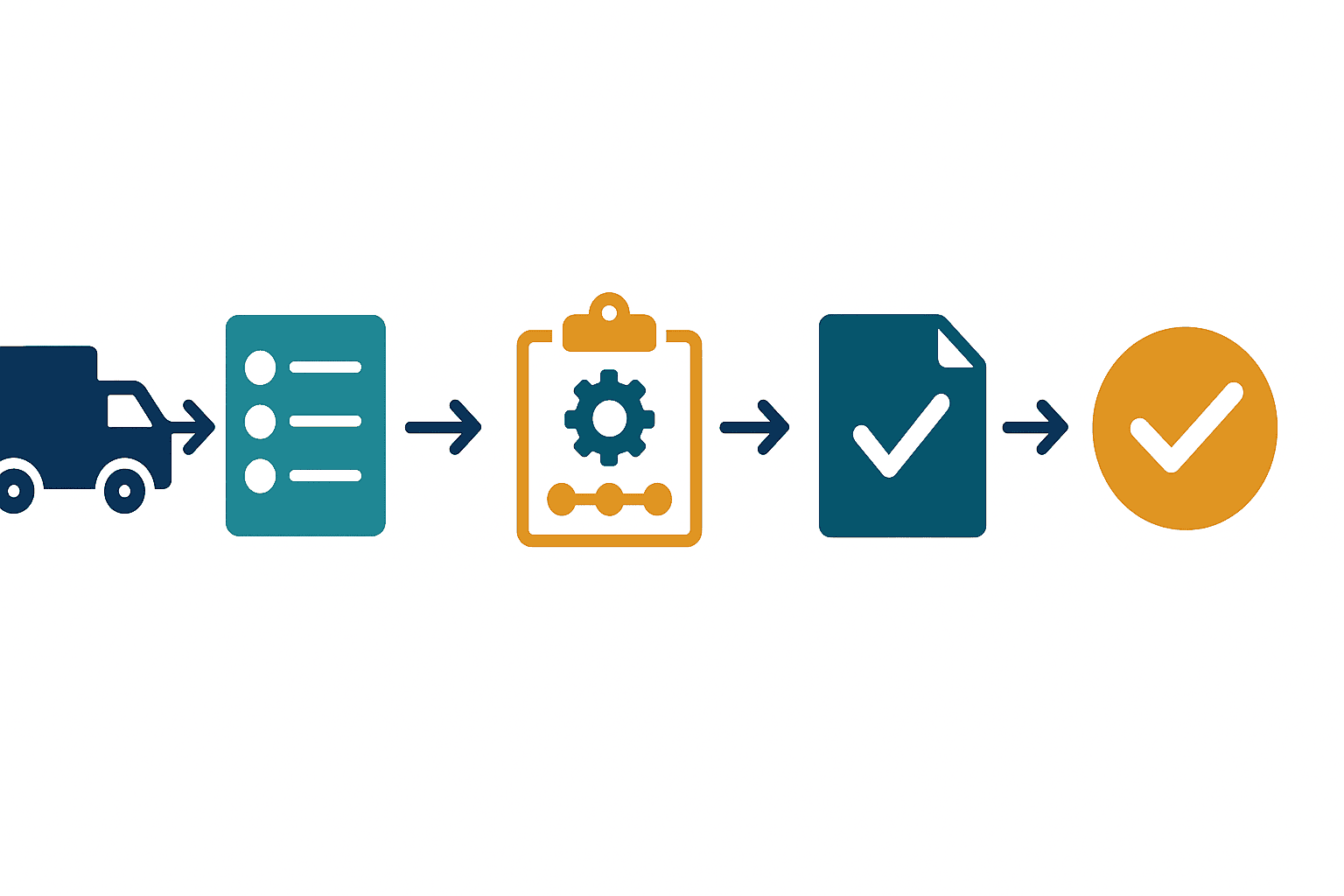
Separate roles before listing names. A robot manufacturer may supply the base, another company may build the handling module, an integrator may connect the WMS and site equipment, and a local partner may maintain the system. Decide who is the single accountable party to the factory.
Current official sources show, for example, OMRON offering its MD series and fleet management, MiR offering several payload classes and a top-module ecosystem, and KUKA offering KMP platforms, navigation, fleet software and products advertised as VDA 5050 compatible. These are examples for longlist research, not rankings or endorsements. Published payload, speed and charging figures use different conditions and should not be ranked without a common test. A global page also does not prove Thai stock or response time.
Longlist gates
- The complete vehicle/handling combination supports the real load envelope, mass and center of gravity.
- The supplier can assess the narrowest aisle, gradient, floor, temperature, humidity and contamination.
- Required station and WMS/MES interfaces are deliverable.
- Applicable safety standards, editions and deliverable evidence are explicit.
- A contracting service entity and escalation route for Thailand are identified.
- Maps, configurations and logs can be backed up and exported under defined terms.
- Spares, batteries, end-of-life notices and cybersecurity patches are addressed.
Brand size is not a pass criterion, and being a local builder is not a rejection criterion. The gate is the ability to provide the required lifecycle evidence in the same response format.
After document review, narrow the field to a manageable number that still represents different solution concepts. Require each bidder to distinguish standard functionality, configuration, custom code and third-party components. Customization is not inherently wrong, but its source control, upgrade regression, intellectual property, recovery and future maintainer must be visible.
Run a common-condition AGV comparison demonstration
A smooth empty run in a showroom does not prove production readiness. Issue one route map, real payload set, mission sequence, obstacle pack, network condition and scoring sheet. Where practical, perform the demonstration at your site or in a test area that reproduces its constraints.
| Scenario | Observe | Example failure |
|---|---|---|
| Start, stop and turn with maximum/eccentric load | Stability, stopping, movement and fields | Protective field covers chassis but not overhang |
| Narrow aisle, junction and dead end | Entry control, waiting and deadlock recovery | Mutual blocking requires undocumented action |
| People, forklifts and carts | Detection, deceleration, stop and restart | Unsafe response to entry from an occluded side |
| Wi-Fi roaming and packet loss | Mission state, safe behavior and evidence | Duplicate command or unknown state |
| Low state of charge / charger failure | Dispatch and service continuity | Fleet queues for one unavailable charger |
| Full station / missing load | Timeout, cancellation and reassignment | False completion or duplicate transport |
| E-stop / power recovery | Stop, authorized reset and order consistency | Same physical load is moved twice |
| Route closure | Reroute, escalation and no-stop compliance | Robot blocks an emergency path |
Collect distributions, not one best cycle. Record slower-tail cycles, incomplete jobs and manual interventions. If candidates use different safety settings, do not compare speed alone. Preserve load, velocity, floor, protective-field and stopping configurations in the evidence.
In Thailand, include strong daylight at loading bays, wet-season floor conditions where relevant, temperature transitions, metal-rich wireless reflections and multilingual shifts. Replace a marketing claim of “Southeast Asia support” with a site test and a written local service plan. Confirm the languages used by operators and maintenance. If remote support is English-only, define who performs first-line diagnosis on night shift.
Compare AGV safety evidence, not only a standards logo
ISO 3691-4:2023, edition 2 published in June 2023, covers safety requirements and verification for driverless industrial trucks and their systems and explicitly gives AGVs and AMRs as examples. Its scope includes relevant automatic, manual and maintenance modes, while certain applications such as public roads and potentially explosive atmospheres require different or additional treatment. ISO also emphasizes that the operating-zone condition affects safe operation. The withdrawn 2020 edition should not be cited as current.
For North American requirements, ANSI/RIA R15.08-1-2020 addresses the industrial mobile robot, while ANSI/A3 R15.08-2-2023 addresses IMR systems, integration and applications. These are not Thai statutes. Use them when the project market or corporate standard requires them.
Ask for the exact edition, scope, covered configuration, declaration, risk assessment, test report, instruction manual and exclusions. “Compliant” is too vague. A certificate for the base does not automatically cover a third-party top module, station, site layout or modified software.
Extend the risk assessment beyond normal travel
Using the principles of ISO 12100:2010, examine installation, teaching, cleaning, charging, jam clearing, manual towing, battery work, updates, failures and decommissioning. A vehicle may detect a person yet still expose someone to a transfer pinch point, unstable load, fork hazard or recovery blind spot.
Safety scanners, emergency stops, speed control and interlocks should be derived as safety functions from the site risk assessment. ISO 13849-1:2023 provides a methodology for safety-related parts of control systems, but it does not assign one required performance level to every AGV use case. Ask which safety function, boundary, architecture and validation meet the project requirement.
Manual mode and recovery must be acceptance scenarios. Specify authorization, key or credential, speed, indication, load handling, fleet isolation, relocalization and treatment of unfinished missions. Recovery is not complete when power returns; the physical load, vehicle position, station occupancy, WMS order and fleet mission must agree.
Understand VDA 5050 interoperability before scoring it
The correct name is VDA 5050, not “VDI 5050.” As of September 2026, VDA identifies Version 3.0.0, dated March 2026, as current; its release announcement was published on April 20, 2026. Version 3.0 expands support for freely navigating mobile robots with a zone concept and path sharing, supporting heterogeneous fleets connected to a central control.
However, the specification explicitly excludes safety requirements, traffic-management logic and interfaces to external systems such as WMS or infrastructure. “VDA 5050 compatible” therefore does not prove that two products use the functions your application needs.
Require bidders to provide:
- implemented version, profile and mandatory/optional features;
- messages, actions, parameters, topics and security configuration;
- factsheet, geometry and load-handling information;
- deviations, vendor extensions and omissions;
- robot/master test-harness results;
- behavior for disconnects, duplicates, reordering and restarts;
- upgrade and backward-compatibility policy.
If mixed fleets are a future requirement, test a second manufacturer or independent simulator during procurement. Verify order, state, cancel, error recovery, zones and path sharing—not only a successful connection.
Compare WMS, door and elevator integration as stateful systems
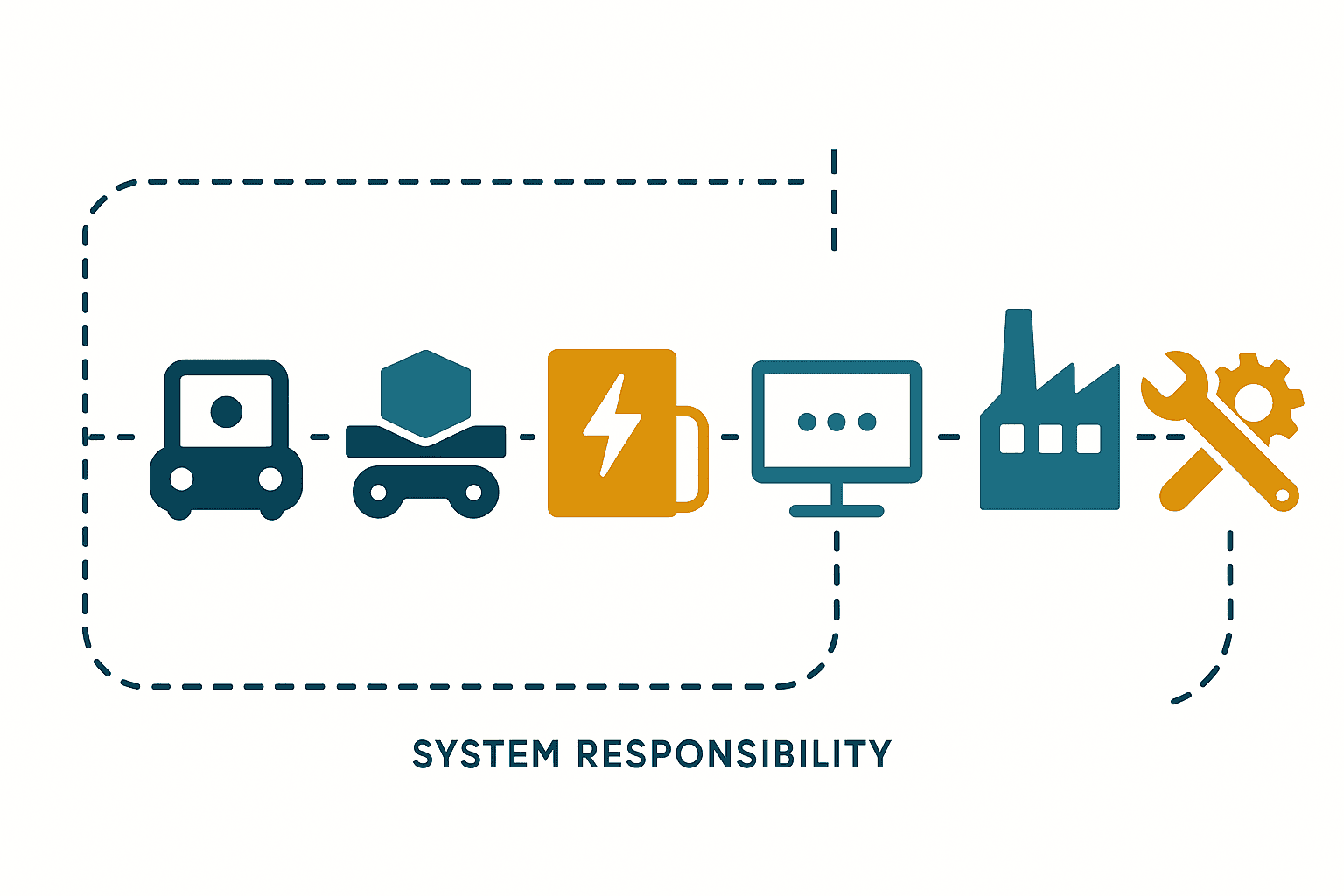
Separate the business order held by WMS/MES/ERP from the execution mission held by fleet control. Define which system is the source of truth for priority, inventory confirmation, reassignment and completion. Document idempotency keys, state transitions, timeouts, retry, cancellation, duplicates, out-of-order messages, time synchronization, master-data mismatch, manual correction and audit logs.
An available API is not an acceptance result. Deliverables should include a versioned interface specification, sample payloads, error codes, a test environment and change-notification rules. After a connection recovers, stale commands must not execute again.
For automatic doors and elevators, specify a state machine: request, grant, open confirmed, vehicle entry, occupancy, arrival, vehicle exit, completion and fault. Elevator assessment also covers car position, load, vehicle envelope, sill gap, door time, shared use, fire signal, power loss, communication loss and rescue. VDA 5050 does not define these external interfaces. Put the building-equipment supplier, AGV integrator and safety owner in one responsibility matrix.
Make Thai service, spares and software rights central criteria
The operational difference appears not in a promise that failures are rare, but in the ability to detect, isolate and recover safely. “24/7 support” may mean only telephone reception. Define acknowledgment, remote diagnosis and on-site arrival separately.
| Service subject | What the RFP must document |
|---|---|
| Desk | Hours, language, ticket and severity definitions |
| First response | Acknowledgment and remote-session target |
| On-site | Technician location, access and arrival target |
| Parts | Thai stock, consignment, lead time, substitutes and EOL notice |
| Battery | Warranty, health test, replacement, transport and disposal |
| Software | Patch, vulnerability notice, upgrade and regression testing |
| Recovery | Backup/restore, golden image and restoration drill |
| Transfer of skills | Operator, admin and maintenance training in usable languages |
Connect each recommended spare to a failure mode, lead time, storage condition, tool and qualification. A stocked controller may still be unusable without a license activation. Confirm compatibility when part numbers change.
Maps, routes, zones, workflows, station settings, roles, logs, API mappings and custom source code are operating assets. Define ownership, edit rights, export formats and verified restoration. Understand whether licenses are per robot, site, server or user, and what happens when a subscription ends. Create an exit plan for credentials, certificates, source, builds, backups and documents if the vendor or integrator changes.
Cybersecurity requirements include approved remote access, MFA, session records, segmentation, certificate renewal, vulnerability notification, patch tests and incident escalation. After an update, regress navigation, safety interfaces, WMS integration and reporting, with a defined rollback condition.
Issue one RFP structure to every candidate
A useful RFP elicits comparable evidence. Include:
- Business objective, target process, exclusions and success metrics.
- Transport register, layout, loads, peaks and exceptions.
- Vehicle, top module, stations, chargers and fleet architecture.
- Safety concept, standards, risk assessment and residual risks.
- WMS/MES/ERP, PLC, door and elevator interfaces.
- IT/OT, networks, identity, logging, backup and cybersecurity.
- Site survey, design review, training and cutover plan.
- FAT, SAT, performance run, documentation and acceptance.
- Warranty, SLA, spares, battery, EOL and upgrades.
- Commercial breakdown, assumptions, exclusions and change control.
Use columns for requirement ID, response, evidence, deviation, owner and delivery milestone. Make the responsibility matrix functional rather than company-level: localization, safety scanner, top-module PLC, station sensor, dispatch, WMS connector, Wi-Fi, door PLC and server backup. Maintain one accountable party to the buyer while verifying back-to-back obligations.
Compare lifecycle cost on the same scope
This article does not estimate market prices or generic payback because payload, navigation, handling, quantity, building work, software and support change the result. Request cash flows over one common evaluation horizon for vehicles, modules, carriers, stations, chargers, safety measures, building work, fleet servers, licenses, integrations, design, testing, freight, installation, travel, training, maintenance, spares, batteries, upgrades, revalidation and removal.
A low initial price can be offset by proprietary parts, annual licenses, vendor-only changes or night support. A high price is not automatically superior either. Link every cost to a requirement or risk reduction and disclose exclusions.
Measure benefits before and after over comparable periods: manual transport hours, line waiting, shortages, work in process, wrong deliveries, damage and interventions. Do not monetize safety benefits without a defensible method. If a supplier calculator is used, audit every input, operating assumption, maintenance cost and residual value.
Use FAT and SAT to prove production readiness
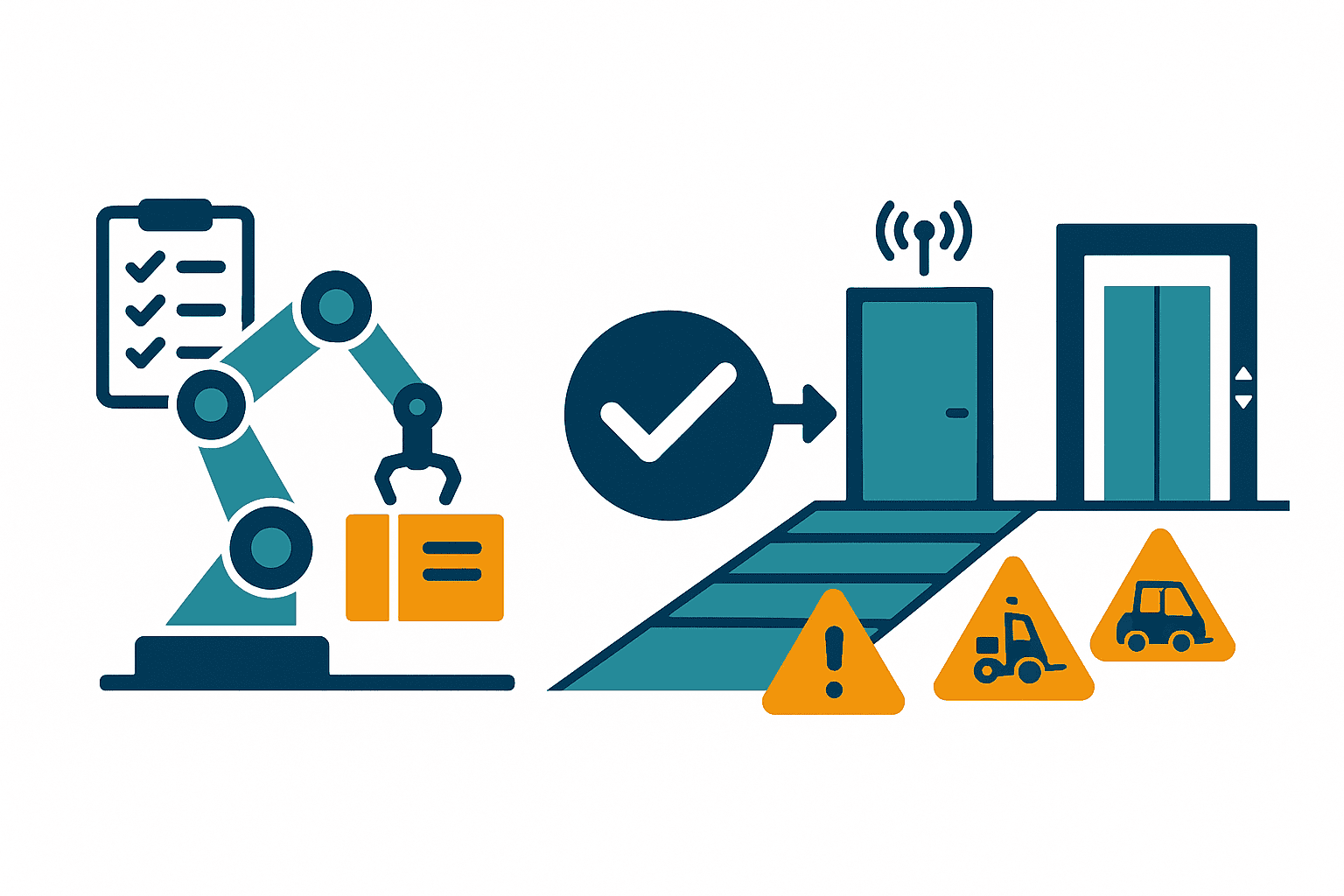
FAT verifies configuration, functions, interfaces, failures and documentation before shipment or at the supplier’s test facility. SAT proves the system at the Thai site with its floor, layout, wireless network, people, payloads and equipment. Their purposes differ.
| Gate | Representative checks | Evidence |
|---|---|---|
| Design review | Requirement trace, layout, risk, interfaces and capacity | Approved drawings, trace matrix and risk register |
| FAT | Models/versions, handling, missions, errors, backup and simulator | Test record, logs, video and open issues |
| Installation | Floor, power, network, stations, markings and as-built state | Inspection data, photographs and drawings |
| SAT | Real loads/routes, traffic, WMS, doors, recovery and operators | Scenario evidence, training record and punch list |
| Performance run | Continuous peak and shift operation | Throughput, delay, availability and intervention history |
| Handover | Manuals, export/source, spares, support and backup | Document index, restore result and sign-off |
Every case needs an ID, objective, precondition, input, procedure, expected result, tolerance, evidence, approver and retest rule. Record software, map, safety parameters, load and speed so the test can be repeated.
FAT should remove issues that do not require the site: identities, top-module I/O, dispatch, API schemas, duplicate orders, timeout, low battery, charger fault, E-stop, backup/restore and roles. Do not release a severe safety or interface issue as “site adjustment.”
SAT must use real minimum, maximum and representative loads; actual stations; shift traffic; roaming; gradients; junctions and housekeeping. Operators, maintenance, EHS and IT/OT should perform their scenarios rather than watching the vendor. Test loss of network, server restart, unavailable charger, route closure, full station, missing load, unreadable code, vehicle failure, manual recovery and fire-alarm behavior. After recovery, physical load, inventory, order and mission must agree.
Define availability before the performance run: how planned maintenance, external equipment waiting, material waiting, manual intervention and communication outages affect the numerator and denominator. Otherwise, every result can be made to look favorable.
Turn the AGV selection method into a scoring sheet
Weights vary by site, but safety gates must not be traded against price points.
| Area | Gate example | Scored example |
|---|---|---|
| Requirement fit | Load, safety and mandatory interfaces | Peak performance and changeability |
| Safety | Evidence, site risk response and failure behavior | Evidence quality and usability |
| Integration | Data integrity, recovery and required equipment | API maturity and observability |
| Lifecycle | Service entity, spares, backup and EOL | SLA and local competence |
| Commercial | Complete scope and acceptable responsibility | Lifecycle cost and transparency |
| Project | Credible team, schedule and acceptance plan | Site method and communication |
Include production, logistics, maintenance, EHS, IT/OT, procurement and finance. Tie every score to evidence. Escalate minority concerns about safety, maintenance or cybersecurity into the risk register rather than hiding them in an average.
A structured reference call should ask what was unexpected, which recovery took longest, how upgrades worked, whether spares arrived as promised, where manufacturer and integrator responsibilities conflicted, and what the user can change without vendor assistance.
Stage deployment to reduce vendor-selection risk
Do not begin with an entire factory. Choose a use case whose value can be measured, whose exceptions are visible, and whose learning transfers to later phases. It should contain enough real integration or traffic complexity to expose risk without endangering production.
Define production conversion in the pilot contract: which robots, licenses and custom code carry forward; additional fees; warranty start; support commencement; removal and data return. Repeat acceptance on the production configuration even if a free demonstration succeeded.
Reuse requirement traceability, risk assessment and FAT/SAT templates when scaling, while adding each site’s differences. Reassess laws, power, networks, languages and service entities for another country. If common machinery will be placed on the EU market, assess Regulation (EU) 2023/1230. The consolidated text current on July 27, 2026, incorporating Regulation (EU) 2026/1744, gives an Article 54 general application date of January 20, 2027, with some provisions applying earlier. The consolidated text is a documentation tool; the authentic acts are those published in the Official Journal, so verify the law current at contracting. The Regulation does not automatically govern every domestic Thai project.
Summary: choose the evidence that will protect operations after go-live
Selecting an AGV manufacturer means choosing an accountable supply system that proves transport, safety, integration, support, digital continuity and lifecycle cost against one requirement baseline. Build the transport register, separate must/should/could, shortlist through documented gates, and run every candidate through the same demonstration. Verify the edition, scope and evidence behind ISO 3691-4 and other standards. Treat VDA 5050 as a fleet-control interface—not an automatic guarantee of safety or WMS integration. Complete the decision with reproducible FAT/SAT and recovery drills at the real factory.
Even if your transport register and layout are not finished, you can begin defining shortlist gates, RFP questions, common demonstrations and acceptance evidence. TOMAS TECH can support the requirements work across equipment, IT/OT and site operations in Thailand. Contact us to discuss an early-stage assessment.
FAQ: common questions when selecting an AGV manufacturer
How many AGV manufacturers should we compare?
A broad research longlist is acceptable, but the common-condition demonstration should contain only a manageable number of candidates that passed every must requirement. Include meaningfully different solution concepts. The critical point is not a universal number; it is applying the same payloads, scenarios, evidence requirements and scoring method to every finalist.
Should we contract the AGV manufacturer or a system integrator?
It depends on the boundary. With top modules, stations, WMS, doors, safety integration and local construction, an integrator often has a major role. Define one accountable party to the buyer and verify how warranty and support obligations flow to the base manufacturer, software provider and local maintainer.
Are speed and payload enough for an automated guided vehicle comparison?
No. Published test conditions differ. Real performance changes with load geometry, center of gravity, protective fields, floors, curves, congestion and transfer time. Compare cycle distributions, incomplete jobs and interventions in a common test.
Which AGV cost is most often omitted?
It varies, but licenses, upstream integration, building work, spares, batteries, night support, upgrades, map changes and revalidation are commonly outside a chassis price. Obtain a formal lifecycle quotation using one scope template; do not use an assumed market price.
Is VDA 5050 compatibility mandatory when choosing an AGV?
It can be important for future multi-vendor control, but it is not universal. Verify the version and implementation profile. Compatibility wording alone does not prove interoperability, and the specification does not define safety, traffic logic or WMS/door/elevator interfaces.
Does an ISO 3691-4 vehicle complete the AGV safety case?
No. ISO 3691-4:2023 is highly relevant, but site operating zones, loads, stations, mixed traffic and recovery must be risk-assessed and validated. Verify the evidence scope and test normal, abnormal and recovery scenarios during SAT.
How should we compare local support in Thailand?
Compare the contracting entity, service language and hours, severity-based acknowledgment, remote and on-site targets, technician location, access constraints, Thai spares, battery handling and escalation. Walk through a night-shift failure and verify who can restore what, by when.
Do we need both FAT and SAT?
They prove different things. FAT removes configuration, function, interface and documentation defects before shipment. SAT proves the installed system with real site conditions. If a small project combines them, preserve traceability showing where each condition was verified.
Why do software and data rights matter in AGV selection?
Without usable maps, workflows, interfaces, backups and logs, the factory may depend on one supplier for every change and recovery. Contract ownership, edit rights, export formats, restore procedures, license-end behavior, custom-source delivery and credential control.
Can we compare fairly without public price data?
Yes. Issue one commercial scope and lifecycle template to the qualified bidders and obtain formal quotations. Pass technical and safety gates first, then compare lifecycle cash flow, assumptions, exclusions and contract terms on the same basis.


