


An inventory management system for SMEs should not be selected on company size alone. “Excel is enough” and “choose the cheapest cloud tool” can both be wrong. ETDA’s 2025 survey placed Thai SMEs’ digital maturity at 2.45/4.00, up 3.81% year on year, yet still within the Digital Follower category. A business may use digital tools for sales and communication while inventory and production data remain disconnected. The sound starting point is the control boundary: which transaction changes stock, in which unit, who confirms it, and when it becomes official.
This practical guide is for factory managers, administration leaders, and IT owners at Japanese and Thai SMEs that still rely on spreadsheets and paper but need to reduce shortages, excess stock, discrepancies, and duplicate entry. It compares four paths—Excel, lightweight inventory, ERP inventory, and WMS—against five decision axes: transaction events, locations, lot/expiry/serial requirements, concurrent updates, and downtime tolerance. Detailed design is kept to a short handoff after the operating model is selected.
An SME inventory system should be sized by required control, not by company size
“For SMEs” often implies fewer users and a smaller budget. Manufacturing complexity, however, does not rise neatly with headcount. A factory may have relatively few materials but still handle multiple units of measure, preserve lot genealogy, record issue and completion events, and produce history for customer investigations. That operation needs meaningful controls. Conversely, even a larger company with one location, no lot tracking, and acceptable daily updates may not need an advanced WMS.
Start with the consequence of an incorrect stock position, not the number of users. If purchasing, production planning, delivery commitment, costing, and quality investigation all depend on the same quantity, inventory is core operational data rather than a simple quantity list. Defining controls first prevents both under-specification and unnecessary functionality while creating a foundation that can survive future locations and customer integration.
A control boundary should answer questions such as:
- At which event—receipt, move, issue, completion, shipment, return, cancellation, or count adjustment—does stock change?
- Who records, approves, and may later correct each event?
- At what level must item, location, lot, serial number, and unit be identified?
- During an outage, does work stop or continue under controlled temporary records?
- Is an error corrected by overwriting history or by a reversing transaction that references the original?
If a factory chooses scanners and screens before resolving these questions, data entry may become faster while the causes of discrepancy remain. If the minimum transaction rules are clear, even an Excel-based starting point can prepare a cleaner migration later.

Comparing Excel, lightweight inventory management, ERP inventory, and WMS
The choice is not simply “spreadsheet or system.” Compare four operating models against current processes, the degree of coupling with purchasing, accounting, and production, and the volume of exceptions.
| Option | Suitable situation | Main strength | Main caution | Signal to move onward |
|---|---|---|---|---|
| Continue with Excel | One site, few editors, daily updates are acceptable | Fast to modify and useful for establishing a baseline | Weak concurrent control, permissions, history, validation, and resend handling | Duplicate files, rekeying, update queues, and unexplained differences become routine |
| Lightweight inventory management | Shop-floor transactions need immediate capture, but advanced warehouse optimization is unnecessary | Transaction history, barcode, location, lot, and basic approval can start small | Unclear boundaries with accounting, purchasing, and production can create duplicate masters | Demand grows for MRP, costing, purchase, and production-result integration |
| ERP inventory module | Purchasing, sales, production, and finance should confirm inventory from shared data | Supports consistency between documents, costs, and accounts | Heavy shop-floor interaction can lead to delayed entry or spreadsheet workarounds | Warehouse waves, task allocation, and detailed location control become important |
| WMS | Multiple warehouses, detailed bins, variable workload, and work assignment are complex | Controls checking, put-away, replenishment, picking, and warehouse tasks in depth | Scope and operating burden can exceed the needs of a smaller site | Before selection, define which system owns inventory and what happens when ERP integration fails |
Excel is not inherently wrong. It is useful for baseline measurement and for testing transaction types or reason codes. But a shared workbook is not a governed source of truth if several people update copies at different times and can overwrite history. A factory that keeps Excel should still document the recorder, closing time, change rights, correction method, backup, and reconciliation owner.
A lightweight inventory system is often a practical intermediate step. It can capture events near the work, retain history, and expose locations and lots. Yet it creates another source of truth if purchasing receipts, production issues and completions, sales shipments, and accounting valuation are not assigned clearly. A proposal should explain not only that integration is possible but which event updates which application and how failed messages are reversed or retried.
An ERP inventory module is strong where cross-process consistency matters. If its shop-floor interface is cumbersome, workers may record the physical event first and enter it later in an office, defeating real-time inventory management. Acceptance must therefore use the actual terminal, sequence, labels, and network conditions.
A WMS can provide deep warehouse task control. “We have discrepancies, so we need a WMS” is not a safe conclusion. If the root cause is inconsistent item masters, unit conversions, unrecorded issues, cancellation rules, or training, a larger system will inherit those weaknesses.
Five decision axes for an SME inventory management system
1. Transaction events: identify every moment that can change stock
Begin with events, not screens. Inventory receipt, inspection, transfer, production issue, return from production, completion receipt, shipment, customer return, supplier return, cancellation, disposal, and count adjustment should be reviewed. Remove events that truly do not exist, but do not omit real exceptions.
For each event, define the source document, recorder, approver, effective stock time, impact on cost or accounts, and cancellation method. If “saved” and “approved” sometimes have different meanings, the quantity on screen may differ from the quantity used for purchasing. Use explicit states such as pending, approved, and cancelled, and state which ones contribute to available inventory.
2. Locations: consider in-transit stock, not only the warehouse count
Even one factory may have receiving, raw-material stores, line-side stock, WIP areas, finished-goods stores, and quarantine. If they are operationally distinct, movements must be recorded. With multiple sites, decide which side owns stock after dispatch but before receipt, and how transit discrepancies are resolved.
GS1 EPCIS 2.0 offers a common language for sharing visibility events within and across enterprises; its use cases include an accurate view of product inventory and asset availability across distributed locations. This does not make EPCIS mandatory for a small plant. It demonstrates why an event model—what happened, when, where, and why—is valuable if future links to customers, logistics providers, or another factory are possible.
3. Lots, expiry dates, and serial numbers: determine whether quantity alone is enough
Where quality investigations or customer requirements apply, an item total is insufficient. Usability can vary by lot, expiry, serial, quality status, and storage condition. Decide which attributes are established at receipt, carried through production, and presented at shipment.
The GS1 Global Traceability Standard gives a warehouse example in which GTIN plus lot/batch is linked to the SSCC for a logistics unit, then made available in the inventory system after required checks. GS1 General Specifications Release 24.0 identifies products with GTIN and logistics units with SSCC, while Application Identifiers define the meaning and format of data fields. The lesson is not simply to print a barcode. It is to connect identifiers consistently to business events.
4. Concurrent updates: define where real-time inventory creates value
Real time is more than a short refresh interval. When several people allocate the same stock, the system must prevent duplicate issue, show consistent pre- and post-confirmation states, and expose integration delay.
Making every item instantly integrated can add unnecessary complexity where daily closing is adequate. Conversely, delayed entry for materials used in shortage decisions or delivery commitment drives staff back to chat messages and paper. Set tolerable delay per event—immediate, scheduled intervals, or day-end—rather than applying one slogan to all data.
5. Downtime tolerance: design work during network and application failure
Before choosing cloud or on-premises deployment, decide what happens while the system is unavailable. Can receiving, shipping, or issue to line stop? May work continue with temporary records? Who reconciles resends and duplicates after recovery?
Offline capture is not safe if synchronization creates duplicate events. It needs a unique transaction ID at the device, visible send status, resend rules, server-side deduplication, and understandable errors. Downtime tolerance is both a technical requirement and a business-continuity decision that operational management should approve.
Seven signs that Excel may no longer be the right control tool
Graduating from Excel is not a decision about file size or row count. It happens when spreadsheet flexibility creates more operating risk than value. Look for these signs across shifts and departments, not only in one user’s complaint:
- Purchasing, warehouse, production, and sales hold different quantities for the same item.
- Users create side files while waiting for the main workbook and merge them later.
- Delay between physical movement and entry affects purchasing or delivery commitment.
- A correction’s author and reason cannot be reconstructed several days later.
- Lot, expiry, serial, and quality fields keep expanding with inconsistent rules.
- Backups exist, but nobody can identify which workbook should be restored as authoritative.
- Leave or staff turnover makes macros, formulas, and closing routines difficult to explain.
One sign does not automatically justify a system. Several signs linked to shortages, emergency purchases, shipping errors, count investigation, or delayed closing justify a formal option review. If the root problem is undefined operating rules, fix those first; otherwise the same confusion will move into the new application.
When continuing with Excel is a valid decision
Keeping Excel is not always passive delay. It can fit one site, a small controlled editing group, no lot tracking, and decisions that tolerate daily updates. Attach an expiry condition to that choice. Management should define specific triggers such as a second warehouse, more simultaneous editors, or entry delay above the factory’s tolerance.
Strengthen the workbook by standardising item and unit codes, separating entry from reporting, protecting formula cells, recording daily close and discrepancy reasons, and documenting restoration. Before adding more macros, identify who maintains them and how long the operation can tolerate their failure. A highly personalised macro is sometimes technical debt rather than digital transformation.
How to make “do not implement yet” a responsible option
A selection process becomes biased when implementation is assumed. Postpone the system when item codes, units, and locations differ by department with no accountable owner; the physical and recorded flow do not agree; the objective has no scope or KPI; nobody will own masters and access after go-live; or management requests standardisation while allowing every department to retain unrestricted entry.
“Not yet” is an active preparation stage. Measure the baseline, align codes, map events, and improve spreadsheet controls. This work narrows the future scope and makes vendor quotations comparable. Start because the decision prerequisites exist, not merely because budget has become available.
Evaluate fit and non-fit conditions for all four paths
Selection materials tend to show strengths. A better workshop also states when each operating model should be rejected.
| Path | Fits when | Usually does not fit when | Management responsibility accepted |
|---|---|---|---|
| Continue Excel | One site, few editors, low concurrency, simple traceability | Multiple sources of truth, frequent late entry, lots, separated duties | Maintain file controls and explicit review triggers |
| Lightweight inventory | Capture must move to the floor while accounting and purchasing remain | Costing, MRP, accounting, and production must be unified at once | Own integration boundaries and prevent duplicate masters |
| ERP inventory | Cross-document consistency across purchase, production, sales, and finance dominates | Operators cannot use the transaction flow and late entry is assumed | Align processes with the agreed standard |
| WMS | Warehouse tasks, detailed bins, replenishment, and priority execution are complex | Discrepancies mainly come from master and basic process failures | Own ERP/WMS authority, staffing, and outage procedures |
Lightweight software is not automatically best for an SME. If the existing ERP has sufficient inventory logic and only its shop-floor capture needs improvement, using the ERP as the single source may be cleaner. If ERP change is slow and the target is one warehouse, an event-based lightweight layer may be easier to validate.
WMS is not simply a premium tier. It has a different responsibility: warehouse execution. Rich picking functions do not solve delayed production issue if that is the real problem. Treat the four paths as different control boundaries, not a price ladder.
Responsibility design matters more in a small organisation
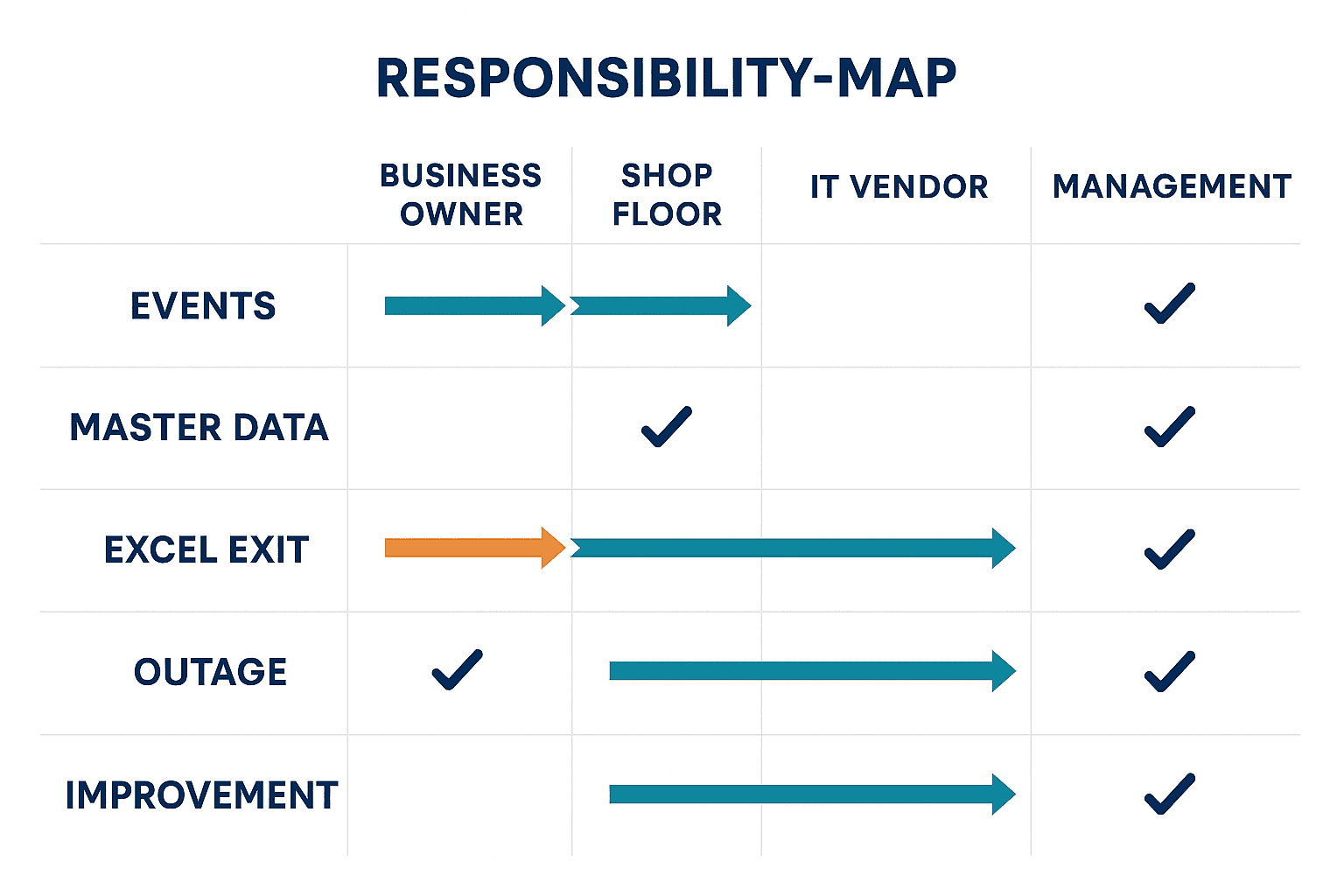
People in an SME often hold several roles, but the roles still need to be explicit. The same person may act in two capacities, provided the decision and accountability are clear.
| Decision | Business owner | Shop-floor owner | IT/vendor | Management |
|---|---|---|---|---|
| Balance-changing events | Defines and approves | Checks practical execution | Implements the rule | Resolves departmental conflict |
| Items, units, locations | Assigns data owners | Confirms physical reality | Retains change history | Supports standardisation |
| Excel graduation | Shows KPI and business impact | Shows entry burden | Explains options and limits | Decides investment or non-investment |
| Outage operation | Sets business priority | Executes fallback | Restores and restarts interfaces | Approves tolerated risk and downtime |
| Post-go-live improvement | Reviews measures | Reports exceptions | Governs configuration changes | Decides additional investment |
Avoid both “inventory belongs only to warehouse” and “the system belongs only to IT.” Warehouse owns physical execution, the business owner owns rules, IT owns reliable processing, and management owns priorities. Do not outsource business decisions to a vendor or leave retry and backup to operator effort.
Test the four paths against representative SME scenarios

Scenario A: one warehouse and a workable daily close
There are few editors, no lot tracking, and purchasing can wait until the next day. Excel remains a strong candidate. Standardise codes and fields, operate a daily close, record reasons, document backup, and set review triggers. Keeping transaction-type columns also makes a later migration more useful than a balance-only file.
Scenario B: line-side issue is entered late and shortage decisions lag
The problem is immediate event capture while purchasing and accounting already work. Lightweight barcode inventory is a candidate. Define when its issue event reaches ERP, which side is authoritative after failure, and whether operators can finish the transaction at the point of work.
Scenario C: purchasing, production, sales, and finance disagree
If cross-document consistency and costing dominate, ERP inventory is a strong candidate. Keeping every local spreadsheet alongside ERP multiplies authority, so management must support a standard process. A simplified capture front end can still be compared while ERP remains authoritative.
Scenario D: several warehouses have complex picking and replenishment
The problem includes who should pick which bin and when, not only the quantity on hand. WMS becomes relevant. Agree synchronization, ownership, and shipping during outages between WMS and ERP. If the need is simple inventory visibility, WMS is likely excessive.
Scenario E: a second site is planned before operating standards exist
Copying spreadsheet freedom into another site makes consolidation harder. First standardise codes, events, closing, and accountability at the original site. Then compare lightweight inventory and ERP without turning the new facility into the first uncontrolled experiment.
Run the selection meeting as a decision workshop, not a product demo
The workshop should put internal facts before vendor slides. Include management, warehouse, production, purchasing, finance, and IT, and limit each meeting to a clear decision.
Meeting 1: turn pain into events and measures
Replace “inventory is inaccurate” with the item, location, event, affected decision, and owner. Use only measures the factory can define—discrepancy rate, shortages, emergency purchases, entry delay, exception handling time, and count labour. If the baseline is unavailable, create a measurement period rather than inventing an industry benchmark.
Meeting 2: populate the five axes
Record current and near-future facts for events, locations, tracking, concurrency, and downtime tolerance. A possible future requirement is not mandatory without timing and evidence. A confirmed customer or site requirement should not be ignored merely because today’s operation is small.
Meeting 3: remove non-fitting paths
Evaluate non-fit before comparing prices. If two paths remain, compare source-of-truth ownership, internal responsibility, and failure behaviour. The result may be a product shortlist or a decision to improve operations first.
Meeting 4: define the end conditions for a small proof
Where a PoC is useful, restrict it to one process or warehouse route and predefine continue, correct, and stop conditions. TOMAS TECH’s recommended 90-day model separates baseline, one flow, exceptions, recovery, and scale decision; it is not an external statistic or guaranteed implementation period. Detailed data design, RFP, acceptance, and KPI methods are covered in our inventory management system implementation guide.
Minimum checks after the operating model is selected
This article is about selecting the operating model. After that decision, organise item, unit, location, lot/serial, transaction type, reason code, approver, and time. Acceptance should include returns, cancellation, count differences, offline work, resend, access violations, and backup restoration. Designing every detail before choosing the model distorts comparison; skipping it after selection turns implementation into a screen replacement.
Investigate discrepancies through missed entry, duplicate send, conversion, location, lot, cancellation, and master change rather than adjustment value alone. For count governance, see reducing inventory count time while protecting accuracy. If the main issue is WIP delay, separate it with our work-in-process inventory management guide.
Final failure-avoidance checklist
- Did a product enter the shortlist only because it says “for SMEs”?
- Are future sites and confirmed tracking requirements absent from the decision?
- Was Excel removed from the comparison, making implementation inevitable?
- Is the source of truth between lightweight software and ERP explicit?
- Is WMS being treated as a universal cure for discrepancies?
- Does Thai support cover only menus, not work decisions and errors?
- Are master ownership, first-line support, and access reviews staffed?
- Has management approved whether work stops or continues during outage?
- Does the PoC have correction and stop conditions, not only success criteria?
- Does cost scope include devices, labels, migration, interfaces, training, support, and data return?
BOI incentive considerations
Thailand BOI reported 132 applications worth approximately THB 17.2 billion under Smart and Sustainable Industry in the first half of 2026. Those are applications, not approvals or completed investments. Current BOI information states that an efficiency-improvement investment must be at least THB 1 million excluding land and working capital. Listed incentives include import-duty exemption for eligible machinery and equipment and a three-year corporate income tax exemption, normally capped at 50% of eligible investment. The cap may reach 100% where specified conditions are met, including where machinery, automation systems, or robots that link to and support Thailand’s domestic automation-machinery manufacturing industry account for at least 30% of the value of the machinery, automation systems, or robots being modified or introduced in the project.
Do not infer that a small stand-alone inventory software project automatically qualifies. The assessment can depend on the overall investment including machinery renewal, automation and digital technology, the timing, eligible costs, and relationship to existing operations. Confirm current announcements and the specific project with BOI before including an incentive in an RFP or investment decision.
Frequently asked questions
What does an inventory management system cost for an SME?
User count alone does not determine cost. Separate sites, events, lot/serial scope, terminals, labels, migration, ERP integration, Thai support, training, operations, and recovery requirements. We do not invent a universal price range not present in the research ledger. Compare setup and subscription together with master cleanup, device replacement, interface changes, operating ownership, and data return at contract end.
When has Excel reached its limit for inventory management?
The boundary is not row count. It is the need for concurrent updates, roles, change history, unique transactions, and controlled retries. When duplicate files, rekeying, late entry, update queues, and untraceable differences are routine, revisit the control boundary. Excel can remain useful for baselines and master design while balance-changing transactions move to a governed application.
Will barcode or RFID eliminate inventory discrepancies?
They accelerate identification and capture but do not guarantee accuracy. Item, unit, location, lot, event, cancellation, and approval must be sound, and read errors or retries must be controlled. RFID can read multiple tags, but the plant should test the environment, tag, read zone, and false-read prevention.
How is a lightweight inventory system different from a WMS?
Lightweight inventory software governs balances, event history, locations, lots, and barcode capture on a smaller footprint. A WMS controls warehouse execution more deeply, including work assignment, replenishment, waves, picking, and detailed bins. Decide from events, work complexity, and ownership between ERP and warehouse systems—not the product label.
How long does implementation take?
There is no responsible fixed answer. Data quality, interface count, decision speed, site tests, and scope matter. The 90 days here are TOMAS TECH’s recommended PoC structure, not a promised standard deployment. Expansion, migration, training, cutover, and stabilization still require planning after PoC acceptance.
What should Thai-language support include?
Review work instructions, reason codes, errors, search, reports, labels, and training—not only menus. Maintain a terminology mapping so Thai operators and Japanese or English managers make the same decision. Assign translation-change ownership and test with actual operators and devices.
Is an inventory system eligible for BOI promotion?
Not automatically as stand-alone software. Current information lists requirements and incentives for efficiency-improvement investment, but project scope, eligible cost, timing, and other conditions require case-by-case review. Do not treat the stated THB 1 million threshold alone as confirmation; verify current rules and the specific plan with BOI.
Conclusion: agree the control boundary before comparing feature lists
An SME inventory system should be chosen from transaction events, locations, lot/expiry/serial needs, concurrent updates, and downtime tolerance—not company size alone. Excel, lightweight inventory, ERP inventory, and WMS are not price tiers; they carry different operating responsibilities.
Include continued Excel use and non-implementation when applying non-fit rules. For the remaining paths, compare source-of-truth ownership, internal accountability, and outage operation. Only then proceed to data design, RFP, acceptance, and a PoC where useful. This sequence keeps the decision anchored in factory needs rather than product demonstrations.
You can speak with TOMAS TECH even at the early stage when the right path—continued Excel use, lightweight inventory management, ERP integration, or WMS—is still unclear. We can map shop-floor events and control boundaries with your team and help shape the RFP and 90-day PoC. Contact us with your current method and the situations that cause the most difficulty.