


An inventory management system implementation often starts with product demos and quotations. That sequence is risky. A Thai factory first needs to decide how each receipt, move, production issue, return, quality hold, count variance and correction becomes one authoritative event: who or what recorded it, when it happened, where the stock moved, which item and quantity were involved, why it happened, and how it reconciles to ERP and accounting. This guide turns that decision into an RFP, a transparent cost model, a 90-day pilot and testable FAT/SAT acceptance criteria.
The implementation decision: define authoritative events and acceptance before selecting software
Cloud versus on-premises and barcode versus RFID are secondary choices. The primary choice is which system owns the accounting ledger, which owns warehouse execution, and which owns each master. If a handheld confirms a receipt while ERP never posts it, quarantined material remains pickable, or an offline retry creates the same receipt twice, scanning technology has merely digitised the discrepancy.
Before requesting a quote, agree on five points:
- The authoritative system for financial stock, operational stock and master data.
- The events representing receipt, put-away, move, production issue/return, quality status, disposal, consignment, subcontracting, counting and correction.
- Governance for item, unit of measure, location, lot/serial, stock status and owner.
- Controlled behaviour during disconnection, duplicate scans, ERP outage, month-end closing and reversal.
- Inputs, expected outputs and evidence for FAT and SAT.
The realistic architecture patterns are an ERP inventory module, a lightweight inventory application, a WMS, or a custom integration layer. None wins universally. Select according to process complexity, floor response time, traceability, accounting integration, site rollout and maintainability.
Why Thai factories should make inventory implementation evidence-based now
Thailand BOI reported investment applications of approximately THB 1.47 trillion across 1,299 projects in the first half of 2026, up 37% year on year. This is macro context, not evidence that an inventory system creates a specific return or qualifies for incentives. It does show an active investment environment in which factories must integrate more equipment, systems and transactions without losing control.
An unofficial English translation of the BOI announcement on Industry 4.0 transformation indicates that certain digital technology, software, cloud and enterprise-management expenditure may count under stated conditions. Eligibility is project-specific. An inventory management implementation does not automatically receive an incentive; obtain written confirmation from BOI or a qualified adviser before including it in the business case.
Accounting and tax interfaces matter as well. Thailand’s Revenue Code addresses ending stock using cost or market price, whichever is lower, and consistency of the costing approach. IAS 2 measures inventories at the lower of cost and net realisable value and addresses cost assignment including specific identification, FIFO and weighted average in the appropriate circumstances. These are general statutory and accounting points, not tax advice. A WMS does not establish accounting policy by itself. The implementation must preserve quantities, units, posting evidence and reconciliation needed to execute the policy the business has adopted.
For a deeper treatment of lot consumption, see our guide to FIFO inventory management. For the boundary between product scope and budget, compare the cost of WMS for Thai factories. This article focuses on the implementation programme and acceptance evidence.
Set the scope boundary before issuing the RFP
“Inventory management” can include the financial ledger, warehouse work, production supply, quality, procurement, sales, subcontracting and consigned stock. If the boundary is vague, bidders quote different solutions and neither price nor duration is comparable.
Separate the stock ledger from warehouse execution
The ledger increments and decrements quantities by item, location, status and owner. Warehouse execution directs receiving, inspection, labelling, put-away, picking, packing, loading and human work. ERP may be strong in ledger, purchasing, production and finance but lack low-latency handheld operation. A WMS may excel at execution without being the financial book of record.
For every event, the RFP should show input, owner, approval, ERP posting point, exception queue and correction route. “Inventory function available” is not an adequate requirement.
Do not disguise production issue and return as generic movement
Line issue, unused-material return, WIP movement and finished-goods receipt relate to production order, operation, BOM, lot consumption and yield. A generic quantity move loses the production reason. If backflushing is used, define how theoretical and actual consumption, substitute material, rework and scrap are represented.
Treat quality hold as status, not only a physical location
Inspection pending, nonconforming, concessionally accepted and reinspection stock may sit on the same rack but must not have the same availability. Separate physical location from stock status and retain the authority and evidence for every status change. ISO guidance on documented information for ISO 9001:2015 discusses evidence around unique identification where traceability is required, release and nonconformity. Deploying software does not grant certification; the important question is whether the operating process retains the required evidence.
Represent ownership for consignment and subcontracting
If company-owned, supplier-consigned and customer-supplied stock share an item and lot, owner is an inventory dimension. Their valuation, use permission and replenishment responsibility differ even on the same shelf. Stock sent to a subcontract process should move to an external location tied to the subcontract order and expected return, not simply disappear.
Understand inventory discrepancy as a missing or malformed event
The physical count reveals a discrepancy, but its cause occurred earlier. Labelling every case as operator error prevents structural improvement.
| Symptom | Likely design issue | Control response |
|---|---|---|
| Physical stock exists but book stock does not | Unposted receipt, lost offline queue, unofficial staging | Formal staging locations; visible ageing for unsynchronised events |
| Book stock exists but material does not | Duplicate issue, wrong location, unrecorded disposal | Idempotency key, location scan, approved disposal event |
| Lot differs | Relabelling, mixed containers, optional lot entry | Reprint history, container identity, mandatory scan |
| Quantity drifts repeatedly | Unit conversion, rounding, packaging change | Versioned UOM conversion and boundary tests |
| WMS and ERP differ by timing | Async integration, retry or posting after close | Separate event time from posting time; reconciliation queue |
| Variance returns after a count | Movement during freeze, backdating, offline terminal | Count-scope freeze rules and terminal sync confirmation |
The objective is not merely to create an adjustment document. Link the source event, expected event, actual posting and correction so recurring causes can be measured.
Minimum data model: design movement events before balances
A balance is the accumulated result of events. Replacing it nightly destroys the ability to replay the discrepancy. The following is a practical minimum for an RFP, not a mandatory vendor schema.
| Field | Purpose | Acceptance question |
|---|---|---|
| event ID | Uniquely identifies one action | Does retry avoid double posting? |
| item / UOM | Identifies item and quantity unit | Are base unit, transaction unit, version and rounding retained? |
| from / to location | Explains the physical path | Are staging, line, vehicle and subcontractor formal locations? |
| lot / serial | Establishes traceability | Can split, merge, expiry and parent container be preserved? |
| stock status | Controls availability | Who may move available, quarantine and blocked states? |
| owner | Identifies the owning party | Can company, customer and supplier stock be reconciled separately? |
| event time | Time of the floor activity | Is it retained while offline? |
| posting time | Time accepted by the book of record | Can delayed and cross-period posting be explained? |
| business reason | Explains why it moved | Does it reference PO, production order, return, scrap or variance? |
| actor / device | Identifies the recording party | Can person, device, rule and interface be distinguished? |
| correction link | Connects reversal to source | Is the original retained rather than deleted? |
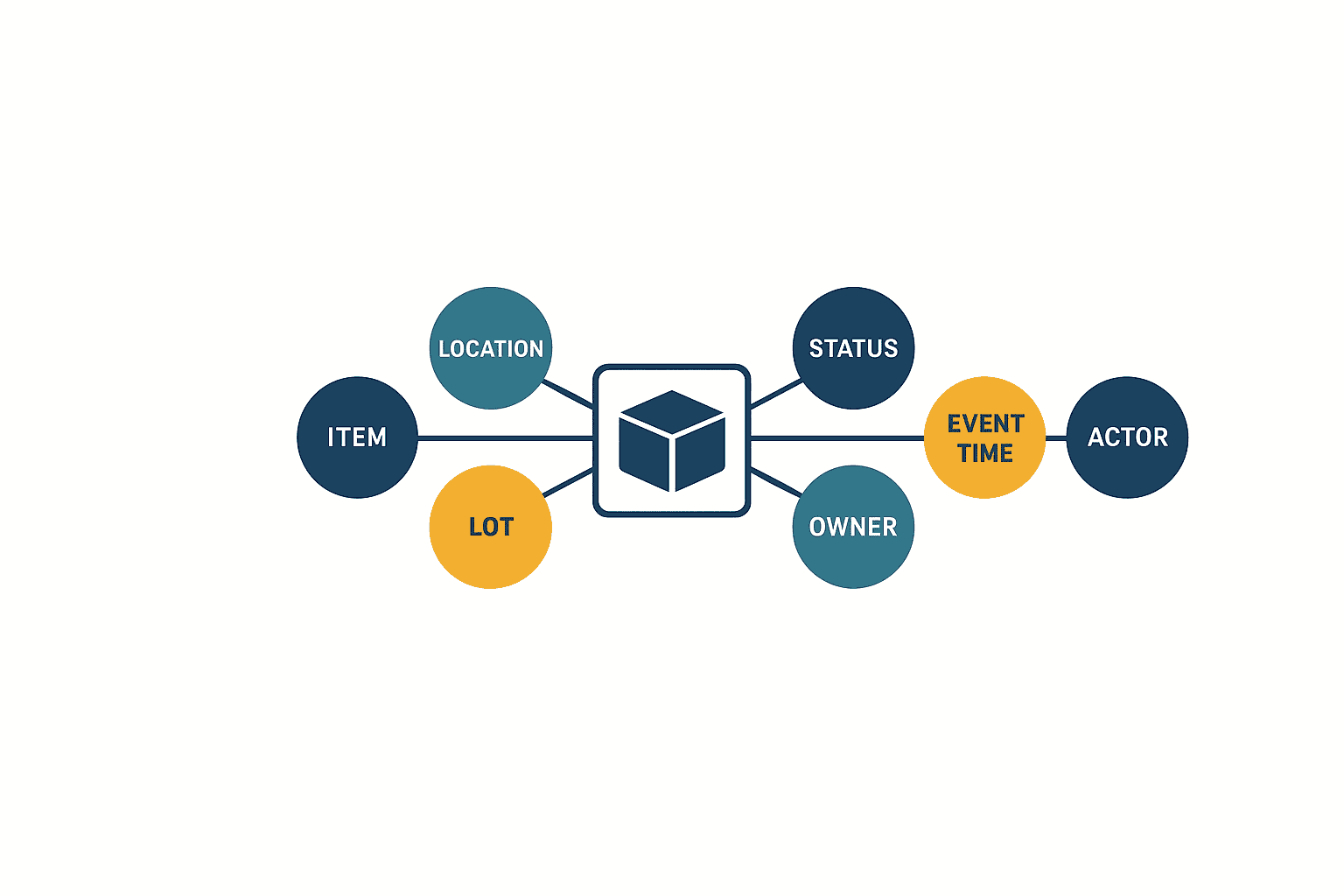
GS1 Global Traceability Standard 2.0 describes critical tracking-event data including date/time, object identity, location, business step/disposition and responsible party. GS1 EPCIS 2.0 offers a what/when/where/why event model with REST, JSON-LD and sensor support. EPCIS is optional, not a mandatory WMS feature, but it is worth evaluating for multi-site or trading-partner visibility before creating incompatible local fields.
Compare four inventory system architecture patterns
Compare where truth and execution sit, not vendor rankings.
| Pattern | Best fit | Strength | Main diligence point |
|---|---|---|---|
| ERP inventory module | Relatively simple flow, finance-led control | Close to purchasing, production, master and accounting | Handheld latency, offline handling and warehouse depth |
| Lightweight inventory app | Small warehouse, narrow scope, fast launch | Simple user experience and shorter setup | Audit depth, scale, complex lots and ERP retries |
| WMS-led execution | Many locations, high volume or complex work | Put-away, location control and task optimisation | Book-of-record boundary, customisation and support |
| Custom integration layer | Existing systems retained, unique process | Absorbs plant-specific events | Hidden master, key-person dependency and change cost |
Do not score only “yes” and “no.” Record whether a requirement is standard, configuration or development; who maintains it; what evidence exists after a failure; and whether it survives product upgrades. Use your abnormal test cases in every vendor demonstration.
Choose barcode, QR or RFID by object and environment
The GS1 General Specifications archive lists Version 26.0.0 published in January 2026. Use governed identifiers and data carriers instead of inventing local label rules that partners and future sites cannot interpret.
One-dimensional barcodes remain inexpensive and broadly compatible. Two-dimensional codes can carry more data in limited space, although encoding every master attribute creates conflicts when the master changes. RFID can read without line of sight and may read multiple tags, but metal, liquid, range, tag cost, stray reads and process design require site testing.
The RFP should specify what is identified—item, case, pallet, fixture or location—when the label is created, who may reprint it, and how identity is recovered if it is lost. Distinguish duplicating the same ID from replacing it with a new ID; retain printer, time, reason and former ID.
RFP requirements that make proposals comparable
Process and exception requirements
- Handle unscheduled receipt, shortage/overage, partial receipt, return, mixed load and damage.
- Preserve lot split/merge, expiry, serial and parent-child container relationships.
- Link production issue, return, substitute, rework and scrap to the production order.
- Retain authorised evidence for quarantine, release, concession and reinspection.
- Reconcile consignment, subcontract and customer-owned stock by owner.
Usability in a Thai factory
- Govern consistent terminology across Thai, English and Japanese where required.
- Keep event IDs and reason codes language-neutral while translating display labels.
- Test gloves, lighting, noise, Wi-Fi dead zones, shared devices and shift handovers.
- Clearly display what is permitted offline and which transactions remain unsynchronised.
- Define Thailand support hours, severity, first response, escalation and device replacement.
Integration, performance and recovery
- Document API/file/message contract, versioning, authentication and monitoring.
- Process the same event ID idempotently and quarantine conflicting payloads.
- Explain floor continuity during ERP outage and ordered recovery afterwards.
- Prove peak scan response, concurrent users, daily volume and retention with tests.
- Back up and restore configuration, labels, interfaces and roles as well as the database.
Security and audit
- Apply least privilege, segregation of duties and prompt revocation after role changes.
- Protect logs of administration, master changes, label reprints and stock adjustments.
- Retain an accountable actor even on shift-shared devices.
- Define vulnerability response, update, remote maintenance and credential rotation.
Inventory management system cost: compare three-year TCO, not licence labels
No public source in the research supports a universal implementation price or guaranteed improvement. The following is an explicit worked scenario, not a TOMAS TECH quote, market benchmark or observed result. It assumes one Thai warehouse, 20 named users and 5,000 active SKUs. Values are in THB, exclude VAT and exclude hardware replacement after year one.
| Initial cost item | Assumption (THB million) |
|---|---|
| Discovery, RFP and fit-gap | 0.20 |
| Master-data cleansing and migration | 0.25 |
| ERP interfaces and reporting | 0.45 |
| Handhelds, printers, labels and network readiness | 0.35 |
| Training, pilot and cutover | 0.15 |
| Contingency | 0.21 |
| Initial subtotal | 1.61 |
Assuming annual subscription, support and operations of THB 0.60 million, three-year TCO is 1.61 + (0.60 × 3) = THB 3.41 million. Put data migration, interfaces, consumables, spare devices, night cutover, travel, translation, training, test environment and upgrades into the same comparison frame.
Worked benefit and payback scenario
Assume annual gross benefits of THB 0.72 million from receiving/counting/picking labour avoided, THB 0.45 million from reduced write-off/obsolescence and THB 0.30 million from reduced expedite and stockout handling: THB 1.47 million in total. After THB 0.60 million annual operations, net benefit is THB 0.87 million and simple payback on the initial outlay is 1.61 ÷ 0.87 = 1.85 years. These are assumptions, not guarantees.
| Gross-benefit sensitivity | Gross benefit (THB m/year) | Net benefit (THB m/year) | Simple payback |
|---|---|---|---|
| 60% of assumption | 0.882 | 0.282 | 5.71 years |
| 100% of assumption | 1.470 | 0.870 | 1.85 years |
| 140% of assumption | 2.058 | 1.458 | 1.10 years |
This range shows why a single optimistic forecast is insufficient. During the pilot, fix definitions for baseline labour, discrepancies, expedite, write-off and stockout handling. Decide in advance whether the investment remains acceptable if only 60% of assumed gross benefit appears.
A 90-day pilot with end-to-end evidence
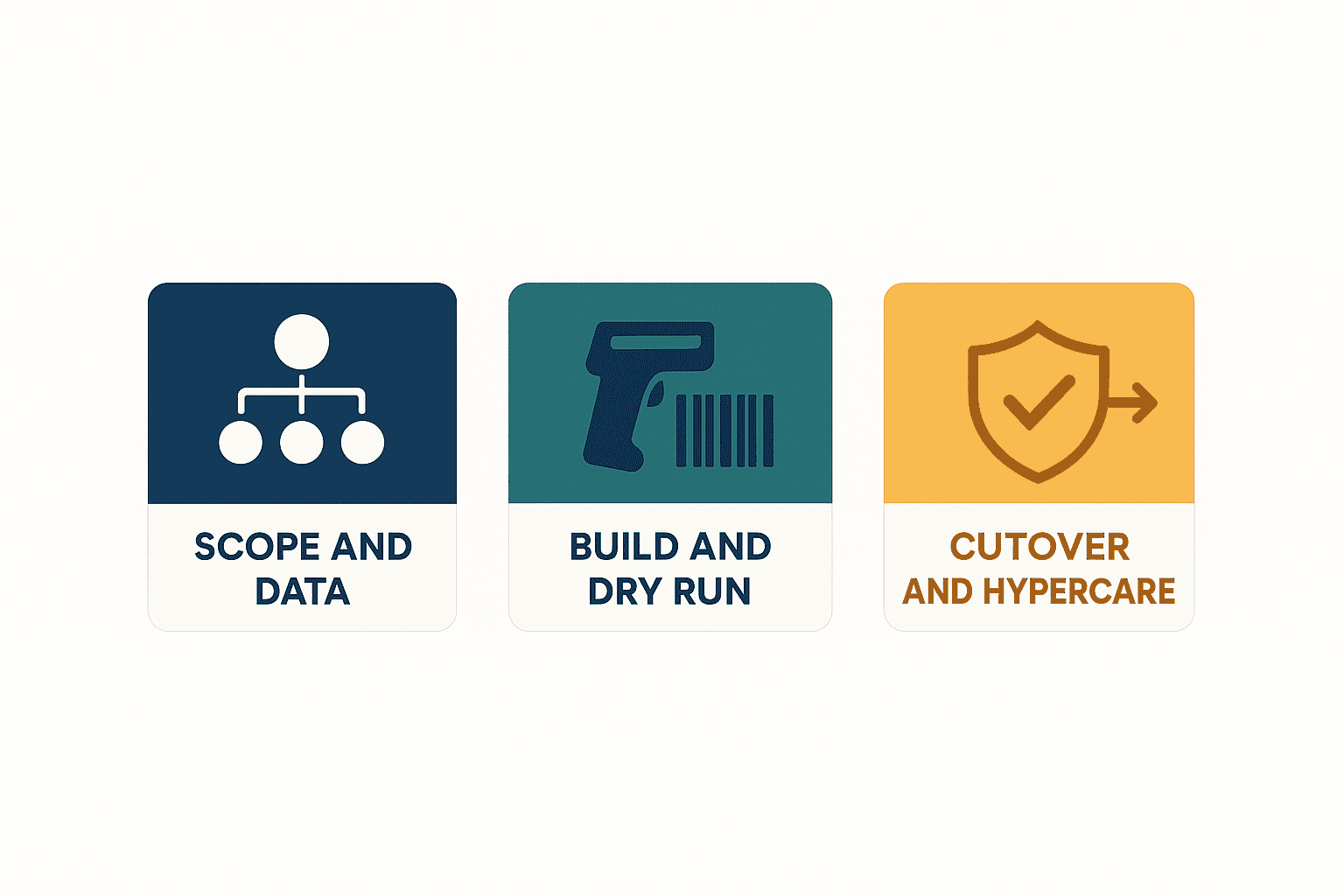
Days 0–30: freeze scope and understand data
Limit the warehouse, item family, shifts and transactions. Observe normal flow and exceptions. Profile item, UOM, location, lot, status and owner for duplicates, gaps and unused codes. Create requirement IDs and their acceptance tests together. Do not set a “99% accuracy” target without documenting the current value and measurement method.
Days 31–60: build and run dry tests
Configure migration, devices, labels, ERP integration and roles. Inject abnormal cases before polishing the happy path: duplicate scan, partial receipt, unit conversion, lot split, quality hold, disconnection and ERP outage. Compare legacy and new flows and explain every difference by event ID.
Days 61–90: controlled cutover and hypercare
Cut over a named scope. Remove shadow spreadsheets but replace them with an immediately visible exception queue. Assign a super user to every shift. Manage problem, workaround, cause, permanent action and retest in one register. Reconcile physical, WMS and ERP stock daily; monitor unsynchronised event count and age. Day 90 is an evidence gate for expansion, conditional continuation or stop—not merely a celebration of uptime.
Concrete FAT and SAT acceptance tests
FAT proves deterministic processing in the supplier-controlled environment. SAT repeats the evidence with actual terminals, Wi-Fi, printers, ERP, user roles and shifts. Retain input, expected result, actual result, software/configuration versions, actor, timestamp, evidence file, difference and retest.
| Test | Input or action | Example expected result |
|---|---|---|
| Duplicate scan | Receive the same case twice with one event ID | Stock increases once; duplicate is logged |
| Partial receipt | Receive 60 against PO quantity 100 | 60 posted, 40 remains open, no false completion |
| Unit conversion | Receive ten cases at 24 pieces; later change conversion version | Transaction remains 240 pieces under historical version |
| Lot split/merge | Split 100 into 60/40 and combine containers | Quantity conserved; lineage remains traceable |
| Quarantine | Hold a lot immediately after receipt | Balance exists but cannot be issued; unauthorised release denied |
| Negative stock prevention | Issue 12 where only 10 are available | Reject or approved exception; never silently go negative |
| Offline resync | Process three events offline and reconnect | Unsynced status visible; IDs/order retained; each posts once |
| Idempotent retry | Retry after timeout before ERP response | No double posting; caller receives the prior outcome |
| Reversal | Reverse a completed move with authority | Original retained; linked reverse event and reason created |
| Cycle-count freeze | Request movement while a bin is being counted | Hold or segregate by defined rule; variance remains explainable |
| ERP outage | Stop ERP for 30 minutes while floor continues | Queue, count, order, recovery and conflicts are visible |
| Role violation | Operator attempts quality release or adjustment | Request denied and attempt logged |
| Backup/restore | Restore from backup including configuration | Labels, interfaces and roles recover within agreed RTO/RPO |
| Month-end reconciliation | Close a period with unsent, backdated and reversed events | WMS/ERP/ledger differences listed with owners |
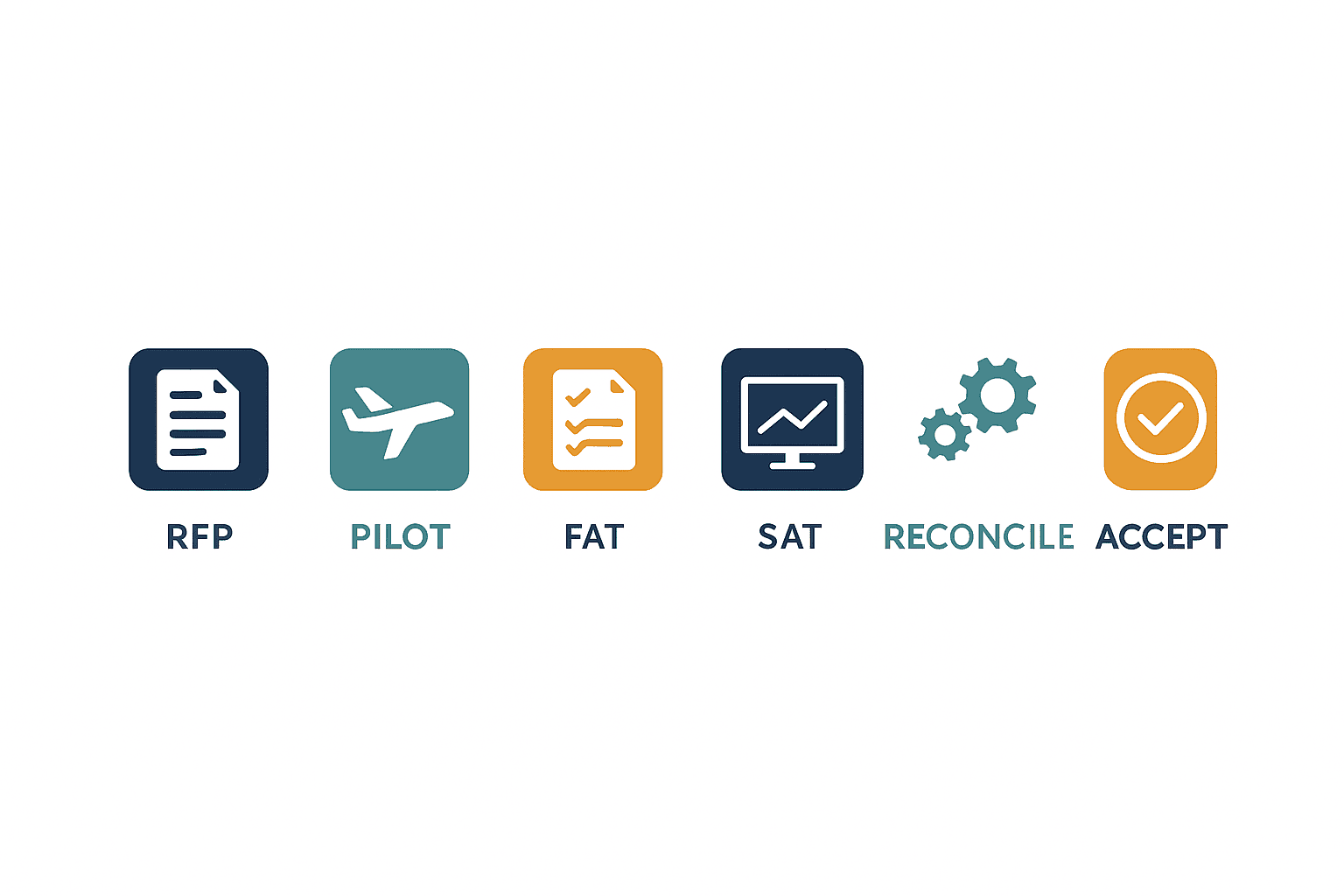
Go/no-go thresholds must be project-defined. Examples might be 100% pass for critical tests, zero duplicate postings, zero unexplained ERP differences, 95th-percentile normal scan response within two seconds, zero open severity-one defects, and one successful restore. These are examples, not standards or guarantees. Adapt them to transaction volume, network conditions, safety and closing procedures.
Do not make go/no-go a user-interface decision
The go pack should show that:
- scoped item, UOM, location, lot, status and owner masters are approved;
- critical normal and abnormal cases pass, with owners and dates for residual items;
- floor personnel have demonstrated ERP-outage, offline-device and printer-failure procedures;
- ownership exists for unsynchronised events, conflicts, reprints and adjustments;
- every shift can perform work and exception handling without the project team;
- rollback conditions, data recovery, decision authority and contacts are named; and
- day-one, first-week and month-end reconciliations are scheduled and owned.
“Fix master data after go-live,” indefinite shadow Excel, direct database corrections by administrators, and screenshots as the only evidence are reasons for no-go or tightly conditional go.
Eight common failure modes and how to prevent them
1. Master data arrives just before migration
Duplicate items, contradictory UOMs, dead locations and missing lot rules create more rework than screen development. Assign data owners and create the quality report and remediation plan by day 30.
2. Shadow Excel remains the safety valve
Users return to spreadsheets when the system lacks exception handling. Provide a visible exception queue and rapid approval route; feed spreadsheet-only cases back into requirements.
3. Location granularity is ambiguous
“Warehouse” and “line” cannot explain staging, inspection pending, loading or stock on a vehicle. Code every controlled temporary place and assign movement responsibility.
4. Backdating is unlimited
Event time can differ from posting time, but unrestricted posting into closed periods changes the book. Define permitted age, approval, accounting impact and re-reconciliation.
5. UOM conversion exists only on the screen
Case, piece, kilogram and metre conversions change with packaging, density and rounding. Retain the transaction-time conversion version and test base-unit conservation.
6. Label reprint is treated as normal printing
Two labels with one ID can be attached to two physical objects. Use a separate reprint flow with reason, approval, invalidation and physical verification.
7. Exceptions have no owner
Integration conflicts, unexplained variances and held stock accumulate without responsibility and age targets. Assign first-line owner, escalation and SLA by exception type.
8. Over-customisation reproduces every old report
It creates a bespoke product that cannot upgrade. Separate legal, customer and safety needs from competitive needs and habits. Develop only what configuration and process change cannot responsibly absorb.
Post-go-live KPIs and governance
Inventory accuracy alone can encourage more adjustments to make the number look good. Monitor discrepancy value and count together with unsynchronised events, deduplications, open conflicts, label reprints, backdated postings, ageing quarantine, master errors and manual corrections.
In monthly review, classify causes into process, master, device, network, interface, privilege and training rather than blaming individuals. Regression-test changes. Version master rules, interfaces, labels and reason codes with scope, implementer, approval and rollback.
Backup must cover more than a database copy. Test restoration of configuration, APIs, certificates, device profiles, reports, labels, roles, jobs and operating instructions. After restore, prove event continuity and the ability to resume from the last ERP reconciliation point.
Conclusion: implementation is a contract for events, including exceptions
A Thai factory should define the responsibilities of ledger, warehouse execution, ERP and accounting before comparing products. Govern item, UOM, location, lot/serial, status and owner, and connect every movement to an event ID, event/posting times, reason, actor and correction trail. An effective RFP asks for evidence under duplication, network loss, ERP outage, count freeze, privilege violation, restore and month-end reconciliation.
Compare cost as three-year TCO and benefit sensitivity, and use the 90-day pilot as an end-to-end acceptance exercise rather than a small production demo. Trace the same requirement IDs through FAT and SAT and replace all example thresholds with project-specific values. That creates a defensible go/no-go decision.
TOMAS TECH can help define process boundaries, event data, the RFP, a transparent TCO model, a 90-day pilot and FAT/SAT acceptance before a product is selected. Even if the plant is still investigating unexplained variances, the engagement can begin with current-state evidence. Contact us when you are ready to structure the decision.
FAQ: inventory system implementation, cost and comparison
What should be decided first in an inventory management system implementation?
Decide the authoritative system for financial stock, floor execution and master data. Then define events from receipt through correction, the ERP posting point, exception queues and expected FAT/SAT results. Product demonstrations come later.
How should inventory management system costs be compared?
Compare discovery, master cleansing, interfaces, devices, labels, network, training, cutover, operations and upgrades over one TCO period. THB 3.41 million in this article is a worked assumption, not a quote or market benchmark.
Should a factory choose ERP inventory or WMS?
ERP-led inventory may fit simpler processes and finance-led integration. WMS may fit many locations, complex flows and execution optimisation. In either case, test the system-of-record boundary, floor performance, failure recovery and maintenance with your own cases.
What causes inventory discrepancies and how can they be prevented?
Common causes include unposted or duplicate events, vague locations, UOM conversion, label reprints, backdating and unsynchronised devices. Link source and correction events, then monitor recurrence by cause rather than closing only the adjustment.
Is barcode or RFID better for inventory management?
Choose by object, distance, environment, throughput, partner standard and total cost. RFID can read in bulk but needs on-site tests for metal, liquid and stray reads. Barcode still needs controlled identity and reprinting.
What should be tested for offline operation?
Test visible unsynchronised status, device queue, event ID, ordering, deduplication, conflicts and recovery guidance. After reconnection, reconcile that every transaction posted exactly once through ERP.
What inventory-accuracy threshold should be accepted?
There is no universal threshold in this guide. Define criticality, volume, baseline and measurement method, then agree project-specific targets. Measure unexplained differences, not only the adjusted final balance.
Can a factory go live within 90 days?
A limited warehouse, item family and transaction scope may reach a pilot and scale decision in 90 days. This is not a promise for enterprise rollout. Use the three 30-day gates for data, abnormal testing and operational readiness.
Primary and official sources
- Thailand BOI, 1H 2026 Investment Applications — https://www.boi.go.th/index.php?_module=news&from_page=press_releases2&language=en&page=press_releases_detail&topic_id=139075
- Thailand BOI, Industry 4.0 Transformation Announcement (unofficial English translation) — https://www.boi.go.th/upload/content/15_2565EN.pdf
- Thailand Revenue Department, Revenue Code Sections 65–76 — https://www.rd.go.th/english/37764.html
- IFRS Foundation, IAS 2 Inventories — https://www.ifrs.org/issued-standards/list-of-standards/ias-2-inventories/
- GS1 General Specifications archive — https://ref.gs1.org/standards/genspecs/archive/1000
- GS1 EPCIS overview — https://www.gs1.org/standards/epcis
- GS1 Global Traceability Standard 2.0 — https://ref.gs1.org/standards/global-traceability/2.0.0/
- ISO, Guidance on Documented Information for ISO 9001:2015 — https://www.iso.org/files/live/sites/isoorg/files/standards/docs/en/iso_9001_2015_guidance_documented_information.pdf


